
🐎 The Scottish Kelpie
Along the banks of Scottish lochs and swollen rivers, where mist clings low and the current runs cold and black, something watches from beneath the surface, patient, ancient, and hungry.
They call it the kelpie. To a weary traveler on a moonless night, it appears as a magnificent horse: sleek, dark-coated, standing calm and inviting where no horse should be.
Its mane drips with water that never seems to dry. Its eyes hold something too knowing, too old, for an ordinary beast.
But this is no lost farm animal waiting to be led home, it is a shapeshifting malevolent water spirit wearing the shape of trust itself.
Legend warns that the moment a curious soul climbs onto the kelpie’s back, the trap is sprung.
The creature’s skin turns adhesive, fusing rider to hide, and no strength of will or muscle can tear them free.
Then the kelpie runs, not toward the road home, but straight into the loch, dragging its captive down into the black water to be devoured, leaving nothing behind but scraps washed ashore by morning.
For centuries, Scottish parents invoked the kelpie to keep children from wandering too close to dangerous water, and travelers swapped hushed accounts of dripping hoofprints leading down to the shoreline and never back out again.
Whether born of genuine folklore fear, a cultural warning against the Highlands’ treacherous waters, or something else entirely watching from beneath the surface, the kelpie endures as one of Scotland’s most haunting legends, a reminder that not everything offering you a ride home means to get you there.
📍 Location & Country
Primary Location: The Helix, Falkirk
Region: Falkirk / Central Scotland
Country: Scotland, United Kingdom
Specific Area: The Kelpies, The Helix, near the Forth & Clyde Canal, Falkirk
Coordinates (Approx.): 56.000° N, 3.815° W
🐎 Location Details:
The Kelpie is traditionally associated with Scotland’s waterways, rather than a single geographical location.
Stories describe supernatural water horses haunting lochs, rivers, pools and other bodies of water throughout the country.
For this profile, Falkirk’s The Helix provides the ideal modern focal point. The site is home to the enormous Kelpies, two 30-metre-high steel horse-head sculptures created by artist Andy Scott.
They stand beside the Forth & Clyde Canal and have become one of Scotland’s most recognisable modern landmarks.
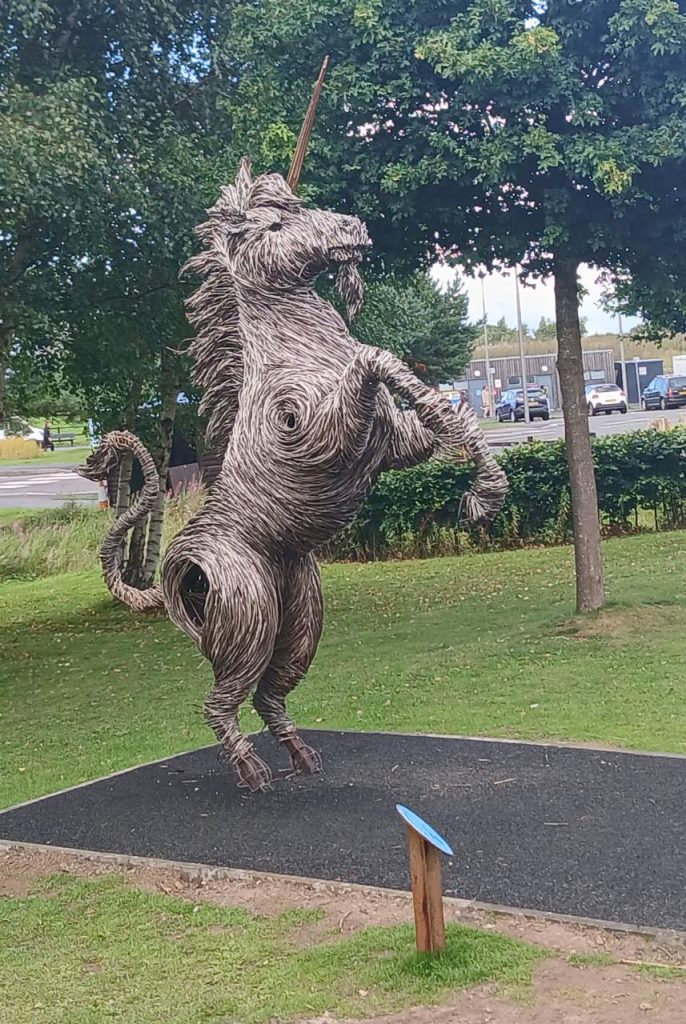
The sculptures are not representations of documented supernatural animals, but a monumental artistic interpretation of the Kelpie tradition and the historic importance of the heavy horse to Scotland’s canals and industries.
🌊 Background & Legend

The Kelpie is one of Scotland’s best-known supernatural water spirits: a shapeshifting being traditionally associated with rivers, streams, fords and other dangerous waterways, most famously appearing in the form of a horse.
Unlike a conventional monster, the Kelpie’s greatest weapon was traditionally deception.
Its horse form could appear perfectly ordinary, sometimes even unusually beautiful and inviting, allowing it to approach people who would otherwise have kept away from a strange creature beside the water.
The name itself belongs to the Scots language. The Dictionary of the Older Scottish Tongue records kelpie in a 1674 Kirkcudbrightshire place-name, Kelpie Hoall, providing the earliest known surviving written occurrence of the word.
The later Scottish National Dictionary defines the Kelpie as a water demon haunting rivers and fords, generally in the form of a black or white horse, capable of luring people to their deaths by drowning.
The precise etymology of kelpie remains uncertain. The Dictionaries of the Scots Language suggest a possible connection with Gaelic cailpeach / colpach, words associated with a bullock or colt, while also comparing it with the Gaelic each uisge, meaning “water horse.”
The exact linguistic origin should therefore be treated as probable rather than settled.
🐴 The Scottish Water-Horse Tradition
The Kelpie belongs to a much wider family of water-horse traditions found throughout Scotland and the wider Celtic world.
Scottish folklore contains several related beings whose appearance and behaviour overlap with the Kelpie.
In Gaelic tradition, the each-uisge, literally the water horse, is particularly associated with deep lochs and can assume the form of a horse or an attractive human figure.
Historic Environment Scotland distinguishes the traditions geographically: Kelpies are especially associated with rivers and streams, while each-uisge stories are more strongly connected with large lochs.
Other regions preserved their own versions of supernatural water horses. Shetland folklore, for example, contains the nuggle or shoepultie, while Orkney had related traditions including the tangie.
These creatures are not simply different names for one universal monster; they represent regional variations within a much broader supernatural water-spirit tradition.
🌊 Why Was the Kelpie Associated With Dangerous Water?
Water was both essential to traditional Scottish life and potentially lethal.
Rivers provided routes through the landscape, mills depended upon them, livestock drank from them, and children played beside them. Yet cold currents, deep pools, sudden floods and difficult crossings could turn familiar waterways into deadly places.
The Kelpie gave those dangers a supernatural identity.
A mysterious horse standing beside a river could represent temptation itself: the traveller sees an apparently useful animal and approaches, only to discover that the creature belongs to the water rather than the human world.
The traditional story therefore carries an obvious warning:
Do not approach an unfamiliar animal beside deep or dangerous water.
This becomes especially significant in tales involving children. The Kelpie could function as a frightening folkloric boundary marker, a supernatural explanation for why certain pools, rivers and lochs were places where children should never wander alone.
But the tradition should not simply be reduced to a children’s safety story. The Kelpie became a genuine supernatural figure within Scottish storytelling, developing its own mythology, characteristics and regional variations.
👻 The Deceptive Nature of the Legend
The Kelpie’s horse form is particularly effective because the creature does not necessarily look monstrous.
That is what separates it from many later monster traditions.
The danger is concealed beneath something familiar.
A traveller sees: A horse.
Folklore says: A water spirit.
This recurring contrast between appearance and reality became one of the defining themes of Kelpie stories. The creature could supposedly reveal its supernatural nature only after someone had approached, touched or mounted it.
The famous adhesive-hide motif, in which a rider becomes magically attached to the Kelpie’s back — turns an apparently harmless encounter into a trap.
🔥 How the Stories Survived
Much of the Kelpie tradition was transmitted through oral storytelling, rather than through a single ancient text describing the creature.
Stories could therefore change from one community to another. Details of appearance, behaviour, location and even the creature’s name could vary, while the central idea remained remarkably stable:
A supernatural being associated with water takes the form of a horse and poses a deadly danger to humans.
Over generations, these stories became attached to particular lochs, rivers, pools, fords and landmarks, allowing folklore to become part of the landscape itself.
This helps explain why Scotland contains so many different water-horse traditions rather than one universally standardised Kelpie story.
The Kelpie was not simply a monster that lived somewhere in Scotland.
It belonged to the water beside which people lived.
And that may be one reason the legend has endured for so long: every dark loch, rushing river and mist-covered pool provided a setting in which the old story could be told again.
🐴 Traditional Encounters, Powers & Kelpie Tales

The Kelpie’s legend is preserved not through a single definitive story, but through generations of traditional tales attached to Scotland’s waterways.
The details change from one story to another, yet the same unsettling pattern repeatedly appears: an apparently ordinary horse offers itself to a person, the victim discovers the animal is supernatural, and the encounter ends at the water.
These stories also established the Kelpie’s characteristic supernatural abilities.
🌑 The Kelpie as a Shapeshifter
The ability to change form is central to the Kelpie tradition.
Although the horse is its most famous appearance, folklore sometimes describes the creature taking the form of a human being, allowing it to approach its victims without immediately revealing its identity.
The human form could be particularly deceptive. A Kelpie might appear as an attractive stranger beside the water, only revealing its supernatural nature through some small but disturbing detail.
The horse and human forms therefore serve the same purpose:
To make the supernatural appear familiar.
🐎 The Strange Horse by the Water
One of the most common traditional encounters begins with something deceptively ordinary.
A lone horse is discovered beside a loch, river or pool.
It may appear unusually beautiful, powerful and calm. A traveller, child or rider assumes that it is simply a wandering animal and approaches.
In some versions, the horse seems almost eager to be ridden.
This is where the story changes.
Once the victim climbs onto its back, the Kelpie’s supernatural nature becomes apparent.
✋ The Enchanted Skin
The most famous explanation is that the Kelpie possesses magically adhesive skin.
The rider’s hands may become fixed to its body, or their entire body may become attached to the creature.
The Kelpie then carries them towards the water.
Attempts to escape are useless.
The creature plunges into the loch or river, taking its victim beneath the surface.
This particular motif is one of the most enduring elements of Kelpie folklore and helps distinguish the creature from an ordinary dangerous horse.
🌊 Beneath the Water
The Kelpie is not simply a horse that happens to live near water.
The water is its domain.
Traditional stories give the creature extraordinary ability in the water, allowing it to disappear beneath the surface and emerge elsewhere.
Its victims are therefore placed at an enormous disadvantage.
A person who encounters a Kelpie on land may believe they have found an animal.
Once the creature enters the water, the balance of power changes completely.
The Kelpie knows the environment.
The victim does not.
💪 Supernatural Strength
Folklore frequently gives Kelpies strength far beyond that of an ordinary horse.
A Kelpie can supposedly carry several people, overpower a rider or drag a person into deep water with almost no effort.
This extraordinary strength is another clue that the apparently normal horse is something else entirely.
In some stories, the creature can also resist attempts to restrain or capture it.
🪢 Magical Bridles & Captured Kelpies
Not every Kelpie story ends with the creature winning.
Scottish folklore also preserves traditions concerning people attempting to capture or control supernatural horses.
The most important object in these stories is often the bridle.
A magical bridle, enchanted halter or other supernatural object could supposedly give a person power over the Kelpie, temporarily forcing the creature to obey.
Such stories transform the Kelpie from an unstoppable monster into something that can potentially be outwitted or controlled through supernatural knowledge.
This introduces an important recurring theme within Scottish folklore:
The creature may possess greater physical power, but knowledge of its supernatural nature provides a way to defeat it.
✝️ Crosses, Iron & Protection
Later Scottish storytelling sometimes incorporates familiar protective elements such as Christian crosses, iron and other objects believed to possess supernatural protective qualities.
However, these motifs vary considerably between traditions and should not be treated as universal rules governing every Kelpie.
The important point is that folklore frequently provides its human characters with some form of ritual knowledge or protective object that allows them to survive an encounter.
👁️ Recognising the Kelpie
Traditional stories sometimes contain small clues that reveal the creature before it is too late.
The horse may behave unnaturally.
It may appear:
- Completely alone beside dangerous water.
- Impossibly clean or beautiful.
- Unusually powerful.
- Resistant to ordinary restraint.
- Covered in water despite being away from the loch.
- Possessed of an unnatural temperament.
- Impossible to control once mounted.
In some versions, wet hair, unusual hoofprints or other supernatural characteristics allow an experienced person to recognise what they are dealing with.
The implication is chilling:
The Kelpie can be defeated if you recognise it before you touch it.
👦 The Child and the Kelpie
Children feature prominently in many water-spirit traditions because they were particularly vulnerable around dangerous waterways.
A strange horse appearing beside a river would naturally attract curiosity.
The Kelpie transformed that curiosity into a supernatural threat.
Stories could therefore teach children that the beautiful animal standing beside the water was not necessarily something to approach.
The lesson was simple:
Keep away from the water. Keep away from the strange horse.
But as the stories became established folklore, the practical warning became something much darker — a tale about a creature actively waiting for human curiosity.
🩸 The Predatory Kelpie
Not every Kelpie tradition portrays the creature in exactly the same way, but its reputation is overwhelmingly dangerous and predatory.
The creature may lure people deliberately, carry them into the water and, in darker versions, devour them.
This distinguishes the Kelpie from supernatural beings that merely frighten or mislead humans.
The Kelpie is often presented as an active predator.
Its intelligence makes it particularly disturbing.
It does not simply attack.
It waits.
🐴 What Makes a Kelpie Different?
Taken together, the traditional stories give the Kelpie a distinctive combination of abilities:
| Trait | Traditional role |
|---|---|
| 🐎 Horse transformation | Lures humans close |
| 👤 Human transformation | Allows greater deception |
| ✋ Adhesive skin | Prevents victims escaping |
| 🌊 Aquatic ability | Allows the creature to dominate its environment |
| 💪 Supernatural strength | Overpowers riders and captives |
| 🪢 Magical bridles | In some tales, allows humans to control it |
| ✝️ Protective objects | Occasionally provide humans with defence |
| 🧠 Deception | Makes the creature more dangerous than a simple monster |
| 🩸 Predatory behaviour | Turns the encounter into a potentially fatal one |
🌫️ The Kelpie’s Greatest Power
Perhaps the most important supernatural ability is not its strength, shapeshifting or ability to swim.
It is its ability to disguise danger as something desirable.
A monster with horns and fangs warns you to run.
A beautiful horse standing quietly beside a Scottish loch invites you closer.
That is what makes the Kelpie such an effective piece of folklore.
It does not need to chase you.
It only needs you to take the first step.
🏗️ The Kelpies — Falkirk
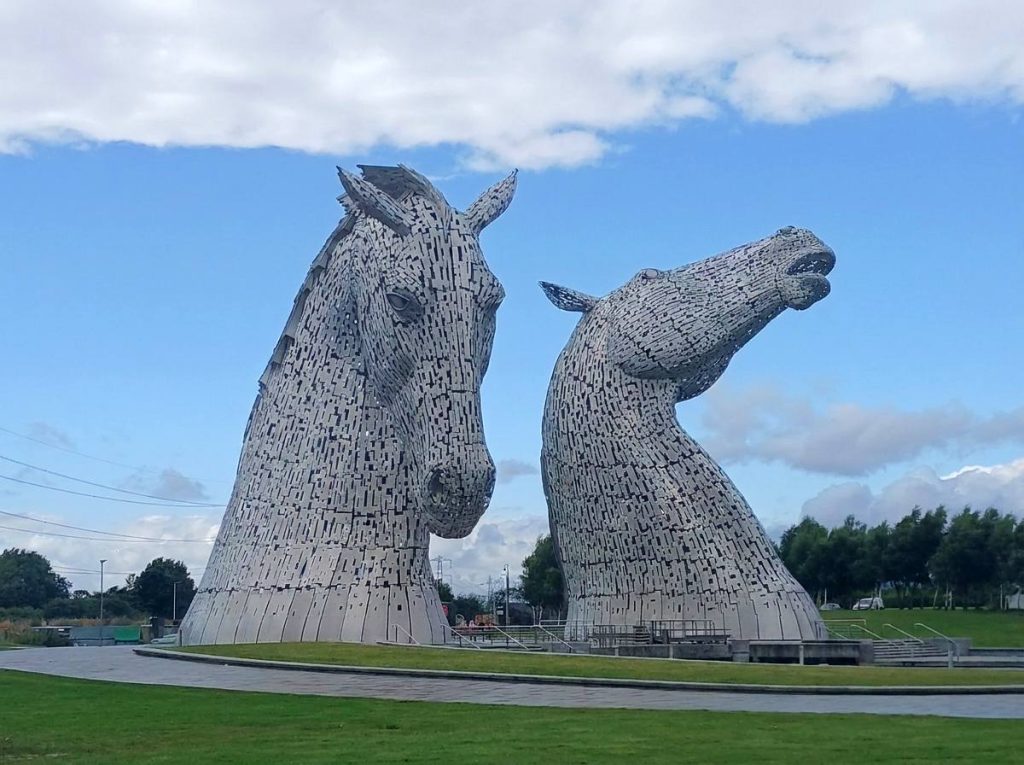
Rising from the landscape beside the Forth & Clyde Canal at The Helix in Falkirk, two enormous horse heads stand against the Scottish sky.
They are not ancient monuments.
They are not archaeological evidence of the creatures described in Scottish folklore.
But they have become perhaps the most recognisable modern representation of the Kelpie anywhere in Scotland.
Standing approximately 30 metres (100 feet) tall, the two steel sculptures dominate the surrounding landscape.
Created by Glasgow-born sculptor Andy Scott, they were commissioned as the centrepieces of The Helix project and officially opened to the public in April 2014.
Scott’s sculptures take their inspiration not simply from the supernatural horse of Scottish folklore, but from the real working horses that once powered Scotland’s canals and industries.
Heavy horses, particularly Clydesdales, were used to pull barges and cargo along the towpaths of the Forth & Clyde and Union Canals during Scotland’s industrial past.
The result is a fascinating meeting of mythology, industrial history, engineering and modern sculpture.
🐴 Duke & Baron
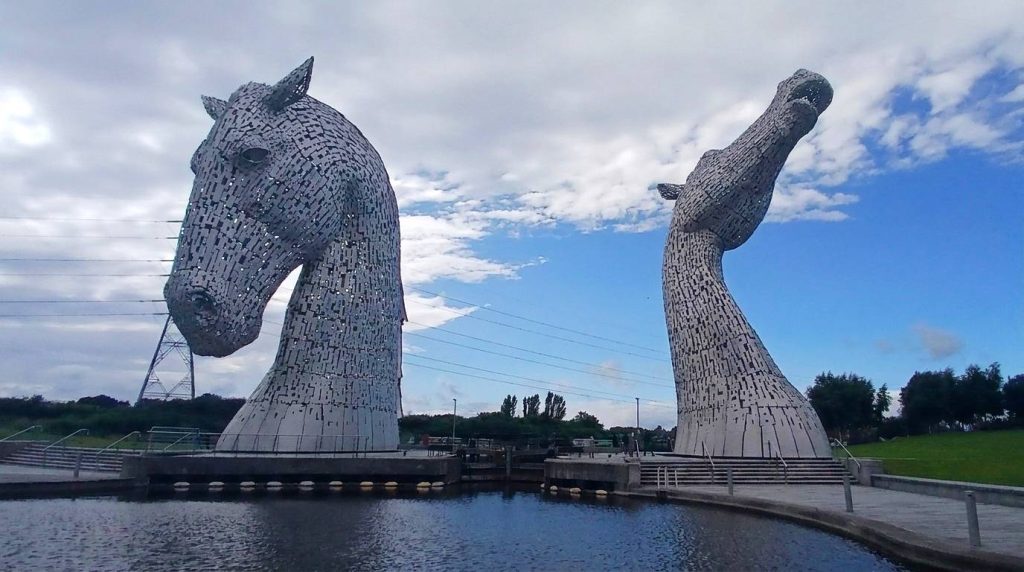
The two monumental horses are commonly known as Duke and Baron.
Rather than being identical copies, Scott gave each sculpture its own character and posture.
Their enormous heads rise from the landscape like two supernatural guardians, creating an effect that is particularly striking when viewed from the canal or from beneath the sculptures themselves.
The scale is difficult to appreciate from photographs alone.
Each sculpture weighs more than 300 tonnes, while their enormous steel forms are clad in approximately 990 individual shimmering steel panels.
The engineering required to construct them was extraordinary. The project involved specialist engineers and fabricators across Britain, including steel production and fabrication in locations such as Yorkshire, Hartlepool, Corby, Tipton and Sheffield.
⚙️ From Folklore to Steel

There is an interesting contrast at the heart of The Kelpies.
The traditional Kelpie was a creature of water, darkness and deception.
Scott’s interpretation transforms that supernatural horse into something monumental and permanent.
Instead of emerging from a loch at night, the modern Kelpies stand openly beside the canal.
Instead of hunting travellers, they commemorate the horses that once hauled boats and goods through Scotland’s industrial landscape.
The mythology therefore becomes intertwined with a very real part of Scottish history.
The official Scottish Canals interpretation describes the sculptures as a tribute to the working horses that pulled barges along Scotland’s canals and worked the surrounding fields.
🌊 The Canal Connection
Their location is particularly appropriate.
The Kelpies stand beside a new section of the Forth & Clyde Canal, linking the historic canal system with the River Carron and forming part of the wider Helix regeneration project.
The Helix itself transformed approximately 350 hectares of previously underused land into a major parkland, visitor attraction and marine hub.
The sculptures became its visual centrepiece.
Today, the enormous horses stand above the waterway much like the supernatural guardians of the landscape that inspired their name.
🌌 A Modern Scottish Landmark

Within little more than a decade, The Kelpies have become far more than an art installation.
They have become a symbol of Falkirk and a modern Scottish landmark, attracting millions of visitors.
The Helix reported in 2024 that more than seven million people had visited the sculptures since their opening.
They have also helped introduce the Kelpie legend to people who might never have encountered the original folklore.
For many visitors, these enormous steel horses are their first introduction to the word Kelpie.
That makes them an important part of the creature’s modern cultural history.
The ancient water spirit has effectively been given a new physical form, one that now stands permanently on the Scottish landscape.
📚 The Kelpie in Literature & Popular Culture
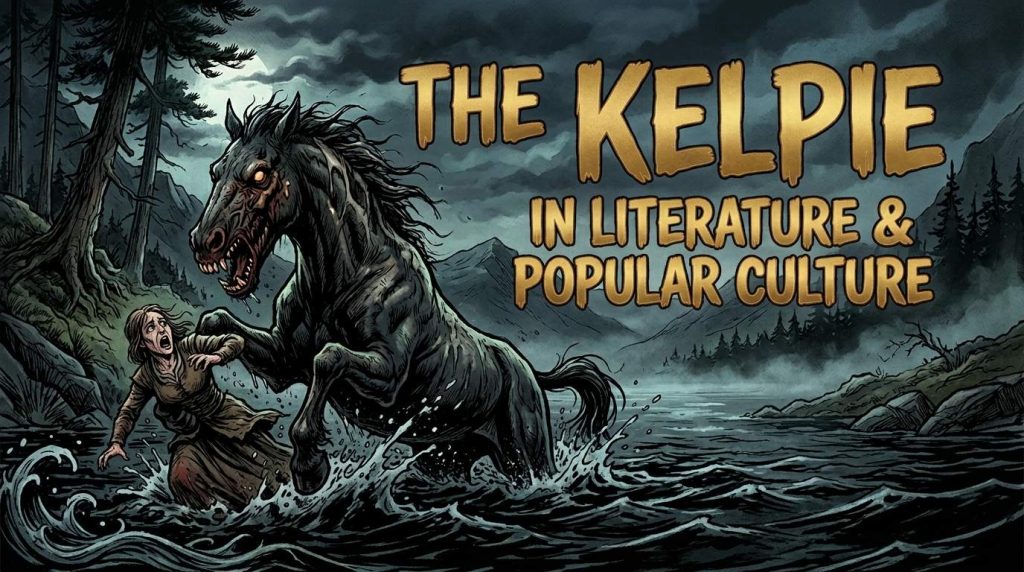
Few creatures from Scottish folklore have travelled as successfully from oral tradition into modern popular culture as the Kelpie.
The creature’s combination of a beautiful horse, supernatural shapeshifting and a deadly relationship with water has made it particularly adaptable to children’s stories, fantasy, horror, animation, artwork and modern Scottish tourism.
Unlike many modern cryptids, however, the Kelpie did not first become famous through television or cinema.
Its cultural life began in the stories themselves.
📖 Scottish Literature & Folklore Collections
Kelpies have appeared repeatedly in collections of Scottish folklore and fairy tales, helping preserve stories that were originally passed down through oral tradition.
Modern illustrated collections continue to introduce the creature to new generations.
The National Museums Scotland Shop, for example, features Theresa Breslin’s An Illustrated Treasury of Scottish Folk and Fairy Tales, which includes traditional Scottish creatures such as kelpies, selkies, brownies and stoorworms.
These retellings are important because they preserve the Kelpie not simply as a monster, but as part of Scotland’s wider folkloric landscape.
📚 Children’s Books & Education
The Kelpie has become particularly prominent in Scottish children’s literature.
There is an interesting connection here with Floris Books’ Kelpies imprint, one of Scotland’s major children’s publishing programmes.
The imprint began with Scottish children’s literature and has expanded into age ranges from toddlers through teenagers. Its catalogue deliberately incorporates Scottish authors, settings, characters, folklore and cultural themes.
The publisher also specifically provides Scottish folklore-themed booklists and classroom resources, allowing folklore to become part of children’s literacy and cultural education.
This means the Kelpie occupies an unusual position in modern Scotland:
it can be both a terrifying supernatural predator and a character through which children encounter Scottish culture and storytelling.
🎬 Film & Animation
The Kelpie has also appeared in Scottish film and animation.
One particularly notable example is The Loch Ness Kelpie, a 2006 animated short directed by Iain Gardner.
The story follows a young Highland boy who decides to confront the creature, turning the traditional water-horse legend into a children’s supernatural adventure. The British Council’s film database categorises the production as Scottish children’s fiction animation.
This is an excellent example of how the traditional story can be adapted without losing its central theme: a child confronting a supernatural creature associated with the water.
🎨 Art & Modern Storytelling
The Kelpie has become a particularly popular subject for Scottish artists and illustrators.
The traditional image of the dark horse emerging from mist or water lends itself naturally to visual storytelling, while modern artists frequently exaggerate the creature’s:
- 🌑 Dark or spectral appearance
- 🌊 Connection with water
- 🐴 Equine anatomy
- 🌿 Seaweed and wet vegetation
- 👁️ Supernatural eyes
- 🌫️ Mist-covered surroundings
Modern artwork therefore ranges from relatively faithful folkloric horses to much darker interpretations resembling aquatic demons or fantasy monsters.
This visual flexibility has helped keep the Kelpie recognisable while allowing artists to continually reinvent it.
🏴 Scottish Identity & Tourism
The Kelpie has become much more than a supernatural character.
It is now part of the visual identity of modern Scotland, appearing in tourism, artwork, souvenirs, educational material and cultural branding.
The creature works particularly well as a Scottish symbol because its mythology is inseparable from the country’s lochs, rivers, misty landscapes and historic relationship with horses and waterways.
That has made the Kelpie particularly useful to Scotland’s tourism industry: visitors can encounter the legend not merely in a book, but as part of the landscape they are exploring.
🥃 Whisky, Food & Commercial Culture
The Kelpie name has also found its way into commercial Scottish culture, particularly through whisky and spirits branding.
One notable example outside Scotland’s own folklore tradition is Ardbeg’s Kelpie whisky, released as a limited-edition expression in 2017. The name and presentation drew directly upon the dark, sea-associated character of the legendary creature.
This illustrates how the Kelpie’s image has become shorthand for something dark, wild, mysterious and distinctly Celtic/Scottish, even when used in a commercial context rather than a literal folklore product.
🛍️ Merchandise & Popular Imagery
The creature’s instantly recognisable horse form has made it particularly suitable for:
- T-shirts
- Posters
- Artwork
- Children’s toys
- Books
- Jewellery
- Souvenirs
- Fantasy illustrations
- Scottish-themed gifts
The modern Kelpie is consequently found in both serious folklore interpretation and commercial fantasy imagery.
This has created an interesting divide between the traditional creature, a dangerous water spirit, and the friendlier modern image often presented to tourists and children.
🎭 Festivals, Events & Living Folklore
The Kelpie also survives through live storytelling, Scottish folklore events, cultural programmes and educational activities.
Rather than existing solely as a historical curiosity, the creature continues to be retold and reinterpreted.
Storytellers can adapt the old tales for modern audiences while retaining the essential ingredients:
the water, the horse, the deception and the danger.
That continuing retelling is arguably more important to folklore than any single modern film or book.
🌊 From Water Spirit to Cultural Icon
The Kelpie’s journey through popular culture is unusual.
It began as a frightening supernatural explanation for encounters with dangerous Scottish waterways.
It became a recurring figure in folklore collections and literature.
It entered children’s stories and education. Artists transformed it into a visual symbol.
Film and animation turned its traditional tales into new stories. Tourism transformed its image into one of Scotland’s most recognisable cultural symbols.
And modern commercial culture continues to borrow its name and imagery.
Yet beneath all those modern interpretations, the original idea remains remarkably intact:
a horse beside the water may not be what it appears to be.
The Kelpie has survived not because Scotland stopped believing in its old monsters, but because each generation has found a new way to tell the story.
And perhaps that is the most fitting fate for a shapeshifter.
The Kelpie itself keeps changing, but the legend never truly disappears.