Sierra Sounds: The Strange Bigfoot Audio That Remains Unexplained
Sierra Sounds: The Voices of the High Sierra
High in California’s Sierra Nevada, the mountains become a world of their own.
The air is thin, the nights are profoundly dark, and beyond the small circle of a campfire, there is little to distinguish one ridge from another.
At elevations approaching 9,000 feet, the wilderness stretches away in every direction, broken only by pine, rock and the distant silhouettes of the surrounding peaks.
It was into this remote country that a group of hunters travelled in the early 1970s, establishing a camp far removed from the roads and settlements below.
They had come for deer, but the mountains had already given them another reason to pay attention.
There were reports of enormous footprints around the area, along with strange sounds coming from the surrounding forest and ridges.
At first, there was nothing particularly unusual about hearing something in the wilderness after dark.
The Sierra is alive with sound. Wind moves through the trees, animals call from unseen places and echoes can carry remarkable distances through the mountains. But these sounds seemed different.
They came from somewhere out in the darkness, sometimes distant and sometimes apparently much closer to camp.
There were howls and whistles, strange knocks and rapping sounds, and vocalisations that seemed startlingly unlike the calls of familiar wildlife. Morehead became convinced that something unusual was moving through the country around them.
Among those who became involved was Al Berry, a reporter and experienced outdoorsman who approached the story from a considerably more sceptical position.
Berry was not simply looking for a monster in the mountains. He wanted to know what was actually happening, and if there was a straightforward explanation, he intended to find it.
So the men began taking the sounds seriously enough to record them.
What happened next would become one of the most enduring audio mysteries in the history of the Bigfoot phenomenon.
On one of those nights, as darkness settled over the camp, sounds began coming from the ridge above.
There were movements and knocks against wood or rock, followed by vocalisations that seemed to come from more than one direction. Berry and the others listened, watched and attempted to determine where the sounds were coming from.
Then came the whistles.
Berry answered.
A whistle came back.
What followed was not simply a distant animal call disappearing into the night. For those present, it seemed as though something in the darkness was paying attention to them.
The encounter continued for a prolonged period, with the sounds moving around the camp and the men attempting to communicate back. By the time the night was over, Berry had recorded what he could, while physical impressions discovered around the camp provided another remarkable piece of the story.
He would eventually return home without having obtained the one thing that might have ended the mystery immediately: a clear sighting of whatever had been making the sounds.
Instead, he had something far more difficult to explain.
He had the recordings.
Those tapes would remain with Ron Morehead and eventually become known as the Sierra Sounds, a collection of vocalisations that, more than five decades later, continue to attract attention from Bigfoot researchers, acousticians, linguists and anyone intrigued by the possibility that something unknown may have been moving through those mountains.
The recordings themselves are perhaps the most remarkable part of the story.
They preserve fragments of those nights in the High Sierra: distant calls, whistles, knocks and vocal exchanges, including the rapid, unusual vocalisation that would later become famous among Bigfoot researchers as the “samurai chatter.”
And unlike a written account passed down through the years, the Sierra Sounds allow us to return to the evidence itself.
The voices of the mountains were recorded.
Now, more than half a century later, we can listen to them.
Ron Morehead & Al Berry — The Men Behind the Recordings
Before the Sierra Sounds became recordings, albums, books and one of the most recognisable audio cases in Bigfoot research, they were simply a strange series of experiences shared by a small group of men in the California wilderness.
At the centre of that story was Ron Morehead, an outdoorsman, adventurer and lifelong explorer whose experience in remote environments would eventually lead him into a very different kind of exploration.
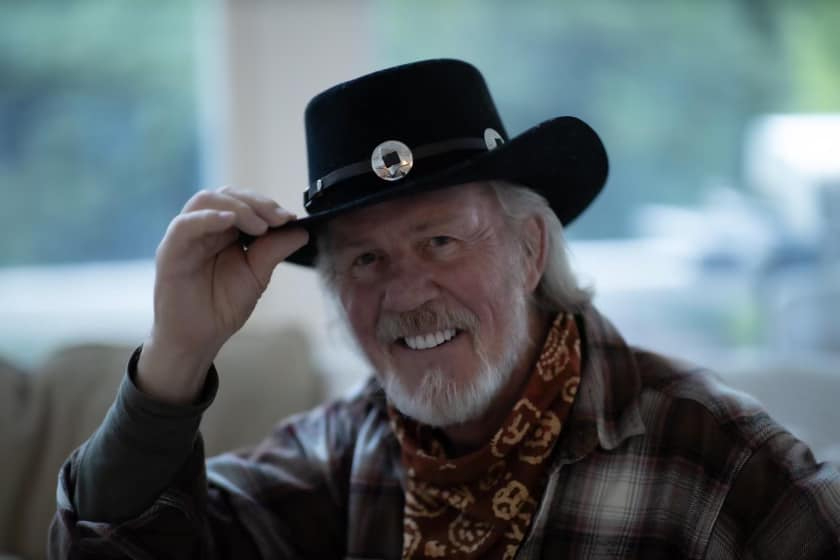
Ron Morehead
Photo: Courtesy of Sierra Sounds Media. With thanks to Royce Morehead for providing the image.
Long before the Sierra Sounds became part of his life’s work, Morehead had already developed a deep familiarity with the outdoors and with places far removed from ordinary civilisation.
He became a private pilot, travelling from the Alaskan bush to the jungles of Costa Rica and beyond, and explored remote regions of Mexico, Nepal, Siberia and South America.
He also worked as a SCUBA diver, experiences that included swimming with hammerhead sharks and riding on the backs of giant manta rays in the Pacific.
His life was not defined by adventure alone. Ron is also an author, speaker, musician and entrepreneur, as well as a U.S. Air Force veteran. But it was his experiences in the Sierra Nevada that would eventually become the foundation of a much longer journey of recording, research and writing about the unexplained.
The camp itself was deep in the Sierra Nevada, at an elevation of roughly 9,000 feet and accessible only by horse or on foot.
There was no convenient road leading directly to the shelter where the hunters stayed, and the surrounding wilderness placed the men a considerable distance from the ordinary sounds and activity of civilisation.
Morehead was part of a group of hunters who had initially gone into the mountains to hunt, rather than to conduct a dedicated search for Bigfoot. Among them were the Johnson brothers, Warren and Louis, along with Bill McDowell and others who would become familiar with the strange activity around the camp.
According to the accounts preserved by Morehead and Berry, unusual events began occurring repeatedly around the camp, including reports of very large footprints and unexplained sounds.
During the winter of 1971, Warren Johnson wrote a detailed account of what had been happening and sent it to Ivan T. Sanderson, the well-known investigator of unexplained phenomena.
Sanderson passed the information to Peter Byrne, who was then conducting his own investigations into Bigfoot reports in the Pacific Northwest. Both men initially suspected that the story might be a hoax.
That suspicion would help bring another important figure into the story.
Al Berry Arrives
Al Berry was an investigative reporter and freelance journalist whose background made him an especially interesting person to bring into the Sierra investigation.
He was a former Army officer who had served in Vietnam and held a Master of Science degree.
By the time he entered the Sierra story, he had experience both in journalism and in approaching evidence with a trained, analytical eye.
Berry was not being sent into the Sierra simply to confirm that Bigfoot existed.
He went looking for the trick.
When Berry was allowed to trek into the remote camp in 1971, his purpose was to investigate the strange reports surrounding the hunters and determine whether someone was playing a joke on them.
He arrived with the intention of finding an explanation, rather than accepting the stories at face value.
Instead, he found himself confronted with something that proved considerably harder to explain.
Berry spent time at the remote camp observing the hunters, listening to the sounds around them and examining the circumstances for himself.
He also brought recording equipment, giving the investigation something that earlier encounters with mysterious creatures had often lacked: a chance to preserve the sounds themselves.
The equipment was relatively simple by modern standards, but Berry’s own description gives us a remarkably clear picture of how the original recording was made.
A single-point stereo microphone was positioned approximately two feet above the ground in a young pine tree, around 40 feet from the camp shelter, while the cassette recorder remained at the shelter.
The microphone was oriented toward the area from which the strange voices appeared to be coming. Berry noted that the creatures’ voices seemed to originate to the left of centre and uphill from the microphone, carrying through the crisp, windless mountain air.
Although the sounds could seem surprisingly close, he believed their source was actually 50 feet or more uphill, in the direction of large trees and a prominent boulder outcrop where tracks were discovered the following morning.
Berry’s account also tells us something about the recording itself. A standard 120-minute cassette was used, and the tape captured approximately 80 minutes of sporadic vocal activity and other sounds, with the recording continuing apart from the change from Side A to Side B.
The recorder’s automatic audio-input system controlled the recording level, a detail that becomes particularly interesting later in the story when the sound of high-altitude aircraft can be heard passing overhead alongside the distant vocalisations.
Even the difference between the human voices and the mysterious sounds was noted. Berry described the men’s own voices as comparatively diminutive, generally originating around the shelter and downhill from the microphone, while the strange voices and whistles were powerful and appeared to carry across the mountain landscape.
What happened during Berry’s time in the Sierra would eventually become the foundation of the original Bigfoot Recordings, later known more widely as the Sierra Sounds.
The importance of Berry’s role extends beyond simply operating a tape recorder.
He became the investigator who attempted to approach the story from outside the belief system of the hunters, documenting what he encountered while simultaneously looking for evidence that somebody was responsible for the mystery.
And Berry did not simply walk away from the experience and dismiss it as an elaborate prank.
In his own account of the investigation, he described searching for evidence of a joke, including looking through the belongings of the other men while they were away hunting.
Yet he ultimately returned from the Sierra without discovering how the events could have been staged, while carrying audio recordings and physical impressions that would remain associated with the case for decades.
The relationship between Morehead and Berry therefore became an important part of the Sierra Sounds legacy.
Morehead had experienced the phenomenon first and remained convinced that something unusual was visiting the camp. Berry arrived determined to investigate that belief rather than simply accept it.
Between them, they brought two very different perspectives to the same remote mountain mystery.
And that difference may be one of the most interesting aspects of the story. One man believed something extraordinary was happening in the mountains. The other went there looking for an ordinary explanation.
Instead, Berry came away with a tape.
And one evening in the High Sierra, with the recorder running in the darkness beyond the camp, the sounds began again.
The Original Sierra Sounds Encounter

By the time Al Berry made his way into the Sierra camp, he already knew that the hunters believed something unusual had been happening there.
Reports from the previous season had described strange sounds around the camp and unusually large, bare-foot impressions in the surrounding ground. Berry therefore arrived with a very specific purpose: to find out what was really happening.
He brought with him a portable Sony tape recorder, plaster of Paris for making casts, and his experience as an investigative reporter.
He expected that the mystery might ultimately have a simple explanation, perhaps involving one of the hunters themselves.
On his first visit to the camp, however, nothing happened. He did find some remarkably large old impressions in a sandy area, showing the characteristic toe, ball and heel pattern of a human-like foot, but there was nothing fresh enough to tell him what had made them.
Berry returned to the camp again.
The second visit was very different.
As daylight disappeared and dusk gave way to darkness, something appeared to approach the camp from a ridge above.
According to Berry’s account, the movement was accompanied by sounds of rapping or knocking on wood or rocks as it came down from the ridge.
Then the vocalisations began.
Berry reported that he could distinguish what sounded like two voices. The sounds carried through the trees with a quality he had never experienced from human voices before, and among the calls was a clear whistle. At one point, Berry and the others responded with a whistle of their own, and a whistle came back.
For the men sitting in the darkness, the important detail was not simply that something was making an unfamiliar sound. There appeared to be an exchange taking place between the camp and whatever was positioned beyond it.
The encounter continued for approximately an hour and a half. The sounds were not confined to a single brief call before disappearing into the forest.
There was further activity around the camp, and another encounter followed on the second night. Berry also reported additional encounters later that season.
Throughout this period, the men were unable to obtain the sighting they wanted. Whatever was making the sounds remained concealed in the surrounding wilderness. Yet the absence of a visual encounter did not mean there was nothing left to investigate.
Berry had been recording.
The tapes captured the sounds and interactions taking place around the camp, preserving an unusual series of vocalisations from those nights in the Sierra.
The physical evidence was also investigated. Several of the large foot impressions found around the camp were cast in plaster, including impressions found in both the pine mat and snow.
For Berry, this was becoming increasingly difficult to reconcile with the simple hoax he had expected to uncover. He searched for evidence that someone was playing a joke on him, even examining the belongings of the other men while they were away hunting. He found no explanation that satisfied him.
He eventually left the Sierra without seeing the source of the voices.
But he did not leave empty-handed.
He had the recordings.
More than half a century later, those original recordings remain at the heart of the Sierra Sounds story.
They preserve the sounds that Berry heard in the darkness of the High Sierra and provide something rare in a case built largely around eyewitness testimony: an opportunity for the listener to hear the unexplained vocalisations for themselves.
🎙️ Listen to the Original Sierra Sounds
The following recording is part of the original Sierra Sounds material captured by Al Berry during the 1972 investigation.
Ron Morehead has preserved and presented these recordings for decades, allowing the sounds recorded at that remote mountain camp to be heard long after the men who experienced them first returned home.
Listen carefully to the vocalisations, whistles and surrounding sounds of the recording, and then consider the extraordinary circumstances in which it was made.
The Evidence That Came Out Of The Sierra Nevada Mountains
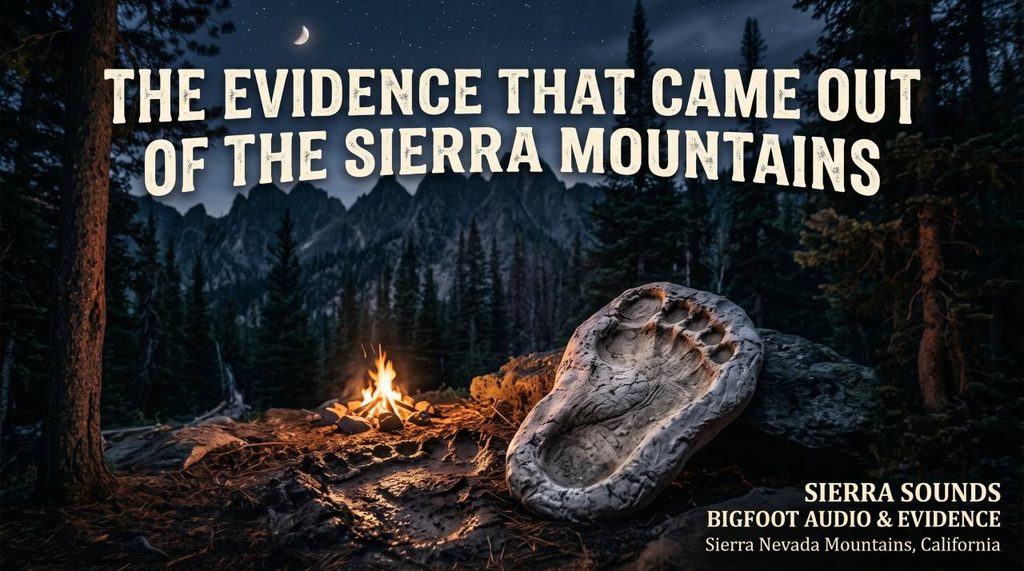
The recordings were only part of what came out of the Sierra camp.
Alongside the sounds were physical impressions in the ground, large, human-like footprints that the men regarded as another part of the strange activity surrounding the camp.
Berry had already encountered some large, older impressions during his first visit, including what he described as unusually large toe, ball and heel impressions in a sandy area. At the time, he remained suspicious that the explanation might lie much closer to home.
The situation changed when fresh impressions began appearing around the camp.
The ground around the shelter consisted of pine mat, patches of soil and, later in the season, snow and ice. It was across these different surfaces that Berry and the hunters found a number of large footprints.
Some of the impressions were sufficiently clear for their dimensions and form to be examined, photographed and preserved.
Berry recorded two particularly notable examples measuring approximately 13 inches (33 centimetres) and 18 inches (46 centimetres) in length.
The smaller impression was found in softer ground around the camp, while the larger print appeared in a thin patch of snow. Other impressions were also reported in the pine mat beneath the trees.
The footprints became especially significant because they were not simply an isolated discovery made before the recordings. They were associated with the period of unusual activity at the camp itself.
Berry described finding impressions in the same general area where the men had been experiencing the unexplained sounds, including tracks discovered after following the activity on one of the nights.
Rather than simply photographing what they found, the men attempted to preserve the clearest impressions.
Using plaster of Paris, Berry and the hunters made casts from several of the footprints. These casts provided a three-dimensional record of impressions that would otherwise have disappeared with changing weather, melting snow and the movement of people around the camp.
The resulting casts became part of the physical record carried forward from the Sierra encounters.
Today, some of that history can still be seen in the surviving photographs and material associated with the Sierra Sounds story.
One of the photographs supplied to Cryptid Legends by Royce Morehead / Sierra Sounds Media shows Ron Morehead himself at the Sierra camp, holding one of the large footprint casts inside the camp kitchen area.

It is a remarkable image for a story that has survived for more than five decades.
Rather than showing the footprint as an abstract measurement on a page, the photograph puts the physical evidence back into the setting where the Sierra story unfolded.
Ron is standing inside the old camp surrounded by the same mountain environment in which the original reports were made, holding a tangible object produced from one of the impressions found there.
Another surviving photograph associated with the case shows Bill McDowell making a cast of a 13-inch impression, with another cast visible in the foreground. A separate photograph records an approximately 18-inch footprint in snow.
For Berry, the physical impressions presented the same problem as the sounds.
He had gone into the mountains expecting to uncover a human explanation. If somebody was attempting to deceive the hunters, then the evidence should, in principle, lead back to the people at the camp.
Instead, he found himself documenting both unexplained vocalisations and physical impressions that appeared to have been made by something considerably larger than an ordinary human foot.
The casts therefore left the Sierra alongside the recordings as another part of the story, physical objects produced from impressions that had been present at the camp during the encounters.
And while the footprints could not identify their maker, they gave the men something tangible to preserve.
The voices had been captured on magnetic tape.
The footprints had been preserved in plaster.
The mystery now existed in two very different forms.
The Sierra Sounds Continue
The first recordings did not mark the end of the strange encounters in the Sierra. The hunters continued returning to the remote camp, and the sounds that had first disturbed them began to take on another character.
At first, the activity could be intimidating. The men would hear calls, howls, whoops and other vocalisations coming from the darkness around the camp, sometimes accompanied by the unmistakable sound of something striking or rapping against wood.
Yet as the encounters continued, Morehead began to notice something else.
There appeared to be a responsiveness to what the men were doing.
Rather than simply listening to sounds coming from somewhere beyond the camp, the men began experimenting with the interaction itself. They would call into the darkness, imitate sounds they had heard, and wait to see whether anything would answer.
According to Morehead’s account, this became part of the developing relationship between the men and the mysterious visitors. The creatures would vocalise from the surrounding forest, the men would answer, and at times the exchange would continue back and forth.
That distinction is important to the story.
The recordings were no longer simply capturing unidentified sounds in the wilderness. They appeared, at least to the people present, to contain moments in which the men themselves were participating in the encounter.
The later material preserved by Morehead contains some of these interactions, including rhythmic rapping and pounding, whooping sounds and vocalisations that he has described as resembling phrases.
Ron’s own description of the Volume 2 recordings identifies them as coming from the same remote Sierra location and says they represent the only recordings in the collection featuring vocalising interaction between the creatures and humans.
And then there is the sound that would become perhaps the most recognisable part of the entire collection.
🎙️ A Conversation in the Darkness?
In the later recording supplied to Cryptid Legends by Ron Morehead and Sierra Sounds Media, the atmosphere is very different from simply hearing an isolated call echoing across the mountains.
The recording captures an apparent exchange.
The men make sounds toward the darkness, attempting to reproduce or answer the vocalisations they have been hearing. From beyond them comes a response, followed by further vocalisations.
The exchange gives the impression of two sides testing one another, with the men trying different sounds and listening for what comes back.
There is something strangely intimate about hearing it.
The men are not standing face-to-face with whatever they believe is out there. They cannot clearly see their correspondent in the darkness.
Instead, the interaction is taking place entirely through sound, with the surrounding Sierra acting almost like a vast natural chamber.
Then, toward the latter part of the recording, the vocalisation changes.
The sounds become faster.
More rhythmic.
A rapid succession of short, emphatic vocal bursts emerges from the darkness, unlike the slower howls and calls heard elsewhere in the recordings.
To listeners unfamiliar with the Sierra Sounds, it can sound almost startlingly human in its apparent rhythm, while still seeming completely unlike ordinary conversation.
This is the sequence that became known as “Samurai Chatter.”
🎙️ Listen to the Sierra Sounds: Vocal Interaction
In this later recording from the Sierra Sounds collection, the men attempt to interact with the vocalising figures in the surrounding forest, responding to the sounds they hear and, at times, imitating them.
What follows is an unusual exchange of calls and responses, culminating in the rapid vocal sequence that has become known as the “Samurai Chatter.”
The “Samurai Chatter”

The nickname is not a scientific designation, nor was it originally presented as the name of a recognised language.
It is simply the memorable description that became attached to the rapid vocalisations because of the way they sound to human listeners.
The sequence has become one of the defining features of the Sierra Sounds collection.
Ron Morehead’s own site describes the recordings as containing interaction vocalisations also known as “Samurai Chatter,” while also noting that cryptologic linguist R. Scott Nelson has interpreted the material as evidence of Sasquatch language.
What makes the recording particularly fascinating is the speed and apparent structure of the vocalisation.
Instead of one sustained cry, the listener hears a succession of rapidly delivered sounds, with changes in rhythm and pitch occurring over a very short period.
For Morehead, this was not simply an unusual animal call. After years of hearing the sounds and recording the encounters, he came to believe that the men were witnessing something far more significant: a form of communication taking place between the beings around the camp and the people inside it.
That interpretation would eventually attract the attention of researchers who approached the recordings from very different disciplines.
The first major technical examination came through the work of R. Lynn Kirlin and Lasse Hertel, whose acoustic study examined recorded vocalisations attributed to Bigfoot.
Their work was subsequently published in Manlike Monsters on Trial by the University of British Columbia Press in 1980.
Decades later, the rapid vocalisations would attract another kind of scrutiny.
Retired U.S. Navy cryptologic linguist R. Scott Nelson approached the recordings not primarily as an acoustic engineering problem, but as a possible linguistic one.
His work would lead him to argue that the apparently chaotic sounds contained recurring phonetic structures and characteristics that he believed were consistent with language.
For Morehead, therefore, the importance of the recordings lies not simply in how strange they sound.
It is the possibility that something was answering back.
And that brings us to the question that has followed the Sierra Sounds for decades:
What exactly are we hearing?
The University of Wyoming Analysis (Kirlin & Hertel (1980))

By the late 1970s, the Sierra recordings had travelled far beyond the mountain camp where they had been captured.
They were no longer simply recordings held by the men who had been there. They had become material that could be subjected to technical examination.
One of the most significant examinations came from the University of Wyoming, where electrical engineer R. Lynn Kirlin and graduate student Lasse Hertel applied techniques from speech and signal processing to the recordings.
Their work would become one of the most frequently cited technical studies associated with the Sierra Sounds.
The study was not a casual listening exercise. Kirlin and Hertel examined measurable characteristics of the recorded vocalisations, particularly pitch and the resonances known as formants.
Formants are important because they are influenced by the physical dimensions of the vocal tract, allowing researchers to estimate its length from acoustic information.
The researchers applied four different vocal-tract-length estimation methods to the recordings and compared the results with known human speech data.
Their approach was designed to determine whether the acoustic characteristics of the voices could be accounted for by ordinary human speakers, including the possibility of unusually low-pitched human voices or changes to the speed of the recording.
What they found was unusual.
The resulting data produced an average estimated vocal-tract length of approximately 20.2 centimetres, substantially longer than the average they used for a human male.
When the measurements were extrapolated according to human proportions, the researchers produced estimated body heights ranging from approximately 6 feet 4 inches to 8 feet 2 inches, depending upon the data and estimator being considered.
The paper also examined the particularly deep “grr” or growl portions of the recording separately.
Those sounds produced still larger proportional estimates, reaching approximately 7 feet 4 inches by vocal-tract length and 8 feet 2 inches by pitch.
Using the complete data set, their corresponding estimates were approximately 6 feet 4 inches by tract length and 7 feet 3 inches by pitch. – [1]
These numbers need to be understood for what they actually represent. Kirlin and Hertel were not measuring the height of a creature standing in front of them.
They were extrapolating a possible physical size from acoustic measurements of the recorded voice, using human proportions as the reference model.
Nevertheless, the results were striking enough for the authors to conclude that the vocal features corresponded to a physical size larger than that of an average human adult male.
Their statistical analysis also suggested that the recording could contain more than one speaker, with the possibility of as many as three speakers represented in the data.
The researchers then turned to one of the obvious questions surrounding any old audio recording: could the apparent low frequencies and unusually long vocal tracts have been created by altering the tape speed?
They considered this possibility in detail.
Slowing a recording lowers the apparent frequencies while proportionally increasing the estimated pitch period and vocal-tract length. Kirlin and Hertel therefore examined whether changing the playback speed could bring the Sierra data into the normal human range.
Their conclusion was that the patterns did not sit comfortably with a straightforward tape-speed explanation.
They noted that a time-varying tape speed could theoretically produce some of the observed distributions, but argued that both the articulation rate and the characteristics of the recordings did not support that explanation.
They specifically considered the consistency of the vocalisations and the relationship between pitch and estimated tract length.
They also considered the possibility that ordinary human speech had been recorded beforehand and subsequently manipulated.
When they played the tape backwards, they found no clearly identifiable speech, and they noted that the characteristics of the “huu-u” and “gob” sequences were not easily explained by simple speed alteration.
There was another intriguing aspect to the investigation.
The recordings contained whistle exchanges between the humans and the apparent vocalisers. Kirlin and Hertel did not include these whistles within the main pitch and vocal-tract data set because they considered them separately.
They identified both ordinary human-type whistles and a second group with unusual formant characteristics.
The researchers suggested that these latter whistles might have been produced using only part of a vocal tract, while also acknowledging that some could potentially have been produced by a musical instrument.
The possibility of multiple vocalisers was also considered alongside the field evidence. Kirlin and Hertel observed separate clusters within their data and noted that the listener could interpret some of the sounds as two creatures “conversing.”
They further recorded that three distinct sets of foot tracks had reportedly been found the morning following the recording session. The researchers were careful, however, to say that the acoustic data did not conclusively establish two speakers.
Perhaps the most important point about the study is how the authors themselves framed their conclusion.
Kirlin and Hertel did not claim that they had proved Bigfoot existed. Their work was concerned with what could be learned from the acoustic properties of the recording.
Their conclusion was that the results indicated more than one speaker and that one or more of those speakers had characteristics corresponding to a larger physical size than an average human adult male.
They also concluded that the recorded formant distributions did not indicate that they were simply the product of human vocalisations combined with tape-speed alteration.
And when considering the possibility that the recordings had been prerecorded, they acknowledged that many forms of manipulation were theoretically possible, but stated that there was no clear reason to believe such manipulation was likely.
For the Sierra Sounds story, this represented an important transition.
The men in the mountains had recorded something they believed was unusual.
Kirlin and Hertel then took those recordings and asked what the acoustics themselves could reveal.
Their measurements did not identify the creature responsible. They could not establish that the voices belonged to an unknown species, and their height estimates were dependent upon assumptions based on human anatomy.
But the analysis did something that the original recordings alone could not do: it gave the strange voices a measurable acoustic profile.
And that profile, particularly the unusually long estimated vocal tracts, the very low-pitched vocalisations, the apparent variation between speakers and the researchers’ examination of possible recording-speed manipulation, would become an enduring part of the Sierra Sounds story.
The voices had begun as an unexplained experience in a remote mountain camp.
Now they had become data.
R. Scott Nelson & The Language Hypothesis

The Sierra Sounds had already attracted attention for the unusual character of their vocalisations, but years after Ron Morehead and Al Berry first captured them in the High Sierra, the recordings would be approached from an entirely different direction.
That came through R. Scott Nelson, a retired U.S. Navy cryptologic linguist whose background included work with foreign languages, military transcription standards and the analysis of communications.
His interest in the Sierra Sounds eventually led him to undertake an extended examination of the Berry/Morehead recordings, concentrating particularly on the vocal material that listeners had long regarded as resembling speech.
Nelson approached the recordings not simply as strange noises, but as material that could be documented and compared.
One of the difficulties he encountered was that listeners attempting to describe unusual vocalisations often tried to spell them using ordinary English.
Nelson considered this inadequate for studying an unknown form of speech, because English spelling does not consistently represent the sounds of spoken language.
His solution was to develop a dedicated phonetic and transcription system based upon the Berry/Morehead tapes.
This eventually led to the development of what became known as the Sasquatch Phonetic Alphabet (SPA), also formally designated by Nelson as the Unclassified Hominid Phonetic Alphabet (UHPA).
The distinction is important. Nelson’s alphabet was not intended to be a simple dictionary or an English-to-Sasquatch translation key.
It was designed as a way of representing and standardising the sounds themselves, allowing vocalisations from different recordings to be transcribed and compared using the same system.
His standard incorporates variations of phonetic symbols alongside additional notation for characteristics such as whistles, clicks, growls, screams, whispered sounds and other vocal elements.
Nelson also established conventions for recording things such as inaudible sections, inflection and the distinction between human and suspected Sasquatch vocalisations.
At the heart of the work were the Berry/Morehead tapes themselves.
Nelson spent considerable time listening to and working through the recordings, including slowing portions of the audio in order to examine the rapid vocalisations more carefully.
In his transcription standard, he describes suspected Sasquatch speech as occurring at an exceptionally rapid rate and establishes slowed playback as part of the transcription process.
That brings us back to one of the most distinctive portions of the Sierra Sounds: the rapid vocal sequence that has become popularly known as the “samurai chatter.”
To an ordinary listener, the sequence can be difficult to break apart. Sounds arrive in quick succession, with changes in pitch and articulation that can give the impression of something approaching speech, yet without corresponding neatly to familiar human words.
For Nelson, however, the important question was not whether the sounds merely resembled human speech.
It was whether there were repeatable and organised elements within them.
His analysis led him to transcribe what he regarded as individual phonetic components and to look for recurring patterns in the vocalisations.
The resulting transcriptions were intended to give researchers a means of comparing suspected Sasquatch vocal material rather than relying solely upon a listener’s impression of what a sound might resemble.
Nelson’s interpretation went considerably further than simply identifying unusual phonetics.
He came to believe that the vocalisations represented structured communication, and ultimately argued that the Sierra Sounds contain characteristics consistent with language.
Contemporary accounts of his work describe his examination of the Berry/Morehead recordings as lasting many months, while his own transcription standard explains that its purpose was to facilitate the comparison of suspected Sasquatch language.
This is where the Sierra Sounds move from an acoustic mystery into a linguistic one.
If the vocalisations are simply unusual animal calls, then their complexity would need to be understood as part of an animal communication system.
But if they represent deliberate, structured communication between intelligent beings, then the recordings potentially preserve something considerably more remarkable: an example of communication from a being that has never been scientifically classified.
Nelson’s work does not claim to have produced a definitive translation of the recordings into English.
Instead, his approach begins with the sounds themselves, documenting them, separating their apparent components and attempting to establish whether consistent linguistic characteristics can be identified.
That distinction matters when describing his conclusions.
The SPA/UHPA is a transcription standard, while the interpretation that the transcribed material represents a genuine Sasquatch language is Nelson’s hypothesis and conclusion drawn from his analysis.
The existence of such a language has not been independently established simply by creating the transcription system. Indeed, Nelson’s own standard separates the transcription process from arguments concerning the existence of Sasquatch or its language.
Nevertheless, his work represents one of the most detailed attempts to examine the Sierra Sounds from a linguistic perspective.
The story had begun with men sitting in an isolated mountain camp, listening to voices coming through the darkness and trying to work out where they were coming from.
Decades later, Nelson was listening to those same voices through headphones, slowing them down and attempting to document their individual sounds.
The mountains were gone.
The campfire was gone.
The men who first heard the voices were now separated from the recordings by decades of time.
But the voices remained on tape.
And for Nelson, they presented a question that could not be answered simply by deciding whether they sounded strange:
Was there a structure behind them?
Whether the vocalisations ultimately prove to be a previously unknown language, an unusual animal communication system, or something else entirely remains unresolved.
What makes Nelson’s contribution significant to the Sierra Sounds story is that he attempted to move the discussion beyond simply asking whether the sounds were unusual.
He asked a more specific question:
Do they contain the characteristics of structured communication?
That question remains one of the most intriguing aspects of the Sierra Sounds, and one that continues to give the recordings a place in the history of Bigfoot research
What Can Actually Be Established?
After more than five decades, the Sierra Sounds remain an unusual case precisely because there are several different pieces to the story, rather than a single recording standing alone.
There is the testimony of the men who were there, the recordings made during their time in the Sierra, the reports of large footprint impressions around the camp, and the physical casts produced from some of those impressions.
There is also a later technical examination of the recordings by researchers with an academic background in acoustics, followed many years later by Scott Nelson’s linguistic investigation.
None of these elements, taken by itself, can tell us exactly what produced the sounds or who made the footprints.
But the recordings themselves are real historical artefacts of the investigation, and they have been available for examination for decades.
What makes the Sierra Sounds particularly interesting is the variety of people who have subsequently examined or interpreted the material.
R. Lynn Kirlin and Lasse Hertel, working from an acoustic engineering perspective at the University of Wyoming, subjected the recordings to technical analysis in 1980.
Their work produced unusual measurements concerning the vocalisations, including estimated vocal-tract lengths and corresponding physical-size estimates, while finding no clear indication of tape manipulation.
Decades later, R. Scott Nelson, a retired U.S. Navy cryptologic linguist, approached the recordings from an entirely different direction, concentrating on the structure of the vocalisations and whether repeated sounds could be represented phonetically and interpreted as communication.
The significance of these investigations is not that they have produced a definitive identification of whatever was responsible for the recordings. They have not.
Rather, they demonstrate that the Sierra Sounds have continued to attract serious examination from people approaching the material from very different areas of expertise.
And that leaves the case in an unusual position.
The recordings can be heard.
The physical impressions were documented and casts were made.
The men who experienced the events left their accounts.
The sounds have subsequently been subjected to acoustic and linguistic analysis.
Yet the identity of the voices remains unresolved.
That distinction is important. The Sierra Sounds can be presented as a fascinating body of historical evidence without claiming that they prove the existence of Sasquatch.
The question is still open, and the recordings remain what they have always been: a preserved record of something heard in the darkness of the High Sierra that the men who recorded it could not satisfactorily explain.
And perhaps that is why, more than half a century later, the recordings still have the power to stop a listener in their tracks.
What were those voices?
That question brings us back to the man who has spent much of his life preserving them.
Ron Morehead’s Continuing Legacy

The story of the Sierra Sounds has continued far beyond the original recordings made in the remote Sierra Nevada.
Ron Morehead has spent decades documenting, researching and sharing his experiences, helping to preserve the recordings and the wider story for future generations.
His official website brings this work together in one place, including information on the Sierra Sounds, his research, books, events, news and other material relating to his ongoing work.
Ron Morehead’s Official Website
Books & Publications
Ron Morehead has also explored the Sierra Sounds and the wider Bigfoot phenomenon through a range of books, with titles available in both paperback and Kindle formats.
His publications include Voices In The Wilderness (2nd Edition), which contains additional chapters and new information relating to his experiences in the Sierra Nevada.
The Sierra Sounds Mystery – Book One: Voices in the High Country; The Quantum Bigfoot; and Bigfoot Unveiled. Together, these works provide readers with different perspectives on Ron’s experiences, research and ideas surrounding the Sierra Sounds and the possibility of an unknown North American hominoid.
Among the available publications is also Bigfoot Recordings Vol. 1 & 2 & Voices in the Wilderness, bringing together the famous recordings with Voices in the Wilderness for readers and listeners who want to explore the original material in greater depth.
For anyone wanting to go beyond secondary accounts of the Sierra Sounds, Ron’s official website is the best starting point.
It provides access to the recordings themselves alongside information about their history, Ron’s research and his continuing work.
A Special Thank You
We would like to extend a huge thank you to Ron Morehead for allowing Cryptid Legends to cover the famous Sierra Sounds recordings and discuss their history, investigation and significance.
The opportunity to examine such an unusual and historically important piece of cryptozoological material directly is something we greatly appreciate.
We would also like to extend our sincere thanks to Sierra Sounds Media, and particularly Royce J. Morehead, for providing photographs and additional information that helped bring this story to life.
The Sierra Sounds remain one of the most intriguing audio cases in cryptozoology, and whatever conclusions individual researchers ultimately draw from them, preserving the original recordings and the story behind them is enormously valuable.
We are grateful to Ron for helping keep that story alive.
REFERENCES:
[1] Estimates of Pitch and Vocal Tract Length from Recorded Vocalizations of Purported Bigfoot*