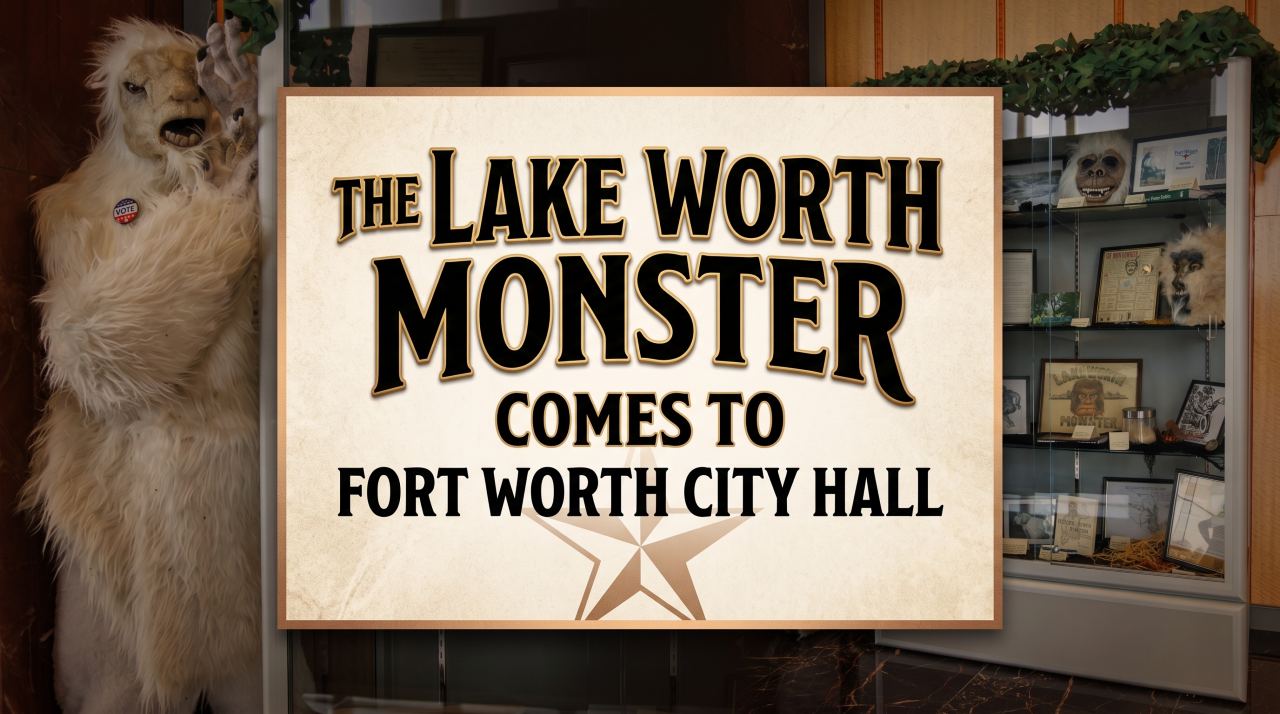
The Lake Worth Monster Comes To Fort Worth City Hall
For more than half a century, the Lake Worth Monster has existed somewhere between local folklore, eyewitness testimony and one of Texas’ strangest mysteries.
Now, the legendary creature has stepped out of the shadows and into the heart of Fort Worth.
This September, visitors entering Fort Worth City Hall can come face-to-face with the Goatman of Greer Island, better known as the Lake Worth Monster, in a special exhibit celebrating one of the city’s most enduring legends.

Curated by Paige Frantz, Public Education Program Coordinator with the Fort Worth Parks & Recreation Department, the display brings together an extraordinary collection of material connected with the legend, including artwork, books on the legend, footprint cast representations, replica masks, specimen-style displays and a striking life-sized recreation of the creature itself.
For a legend born on the shores of Lake Worth in 1969, its arrival at City Hall represents something rather remarkable: the Lake Worth Monster has become more than a mysterious creature from an old story. It has become part of Fort Worth’s cultural folklore.
👹 Inside the Exhibit
The centrepiece of the display is hard to miss.
Standing alongside the cabinet is a striking life-sized representation of the Lake Worth Monster, giving visitors an imposing three-dimensional interpretation of the creature that has occupied Fort Worth folklore for more than half a century.

But the life-sized figure is only part of the story.
Inside the accompanying display cabinet is a fascinating collection of material exploring the legend, bringing together artwork depicting the Lake Worth Monster by various artists, books about the case, photographs of locations associated with the sightings, and a selection of physical pieces connected with the creature’s mythology.
Among the most recognisable pieces is the white Lake Worth Monster mask identified by the exhibit as having been used in the 2007 documentary Southern Fried Bigfoot.

The mask has also appeared at Monster Bash, giving the display a direct connection to the documentary history and the modern celebration of the legend.
The literature surrounding the Lake Worth Monster is represented too.

The cabinet includes Lyle Blackburn’s The Lake Worth Monster: The True Story of the Greer Island Goatman, alongside the work of Sallie Ann Clarke, whose The Lake Worth Monster of Greer Island, Ft. Worth, Texas was published during the original 1969 monster flap.
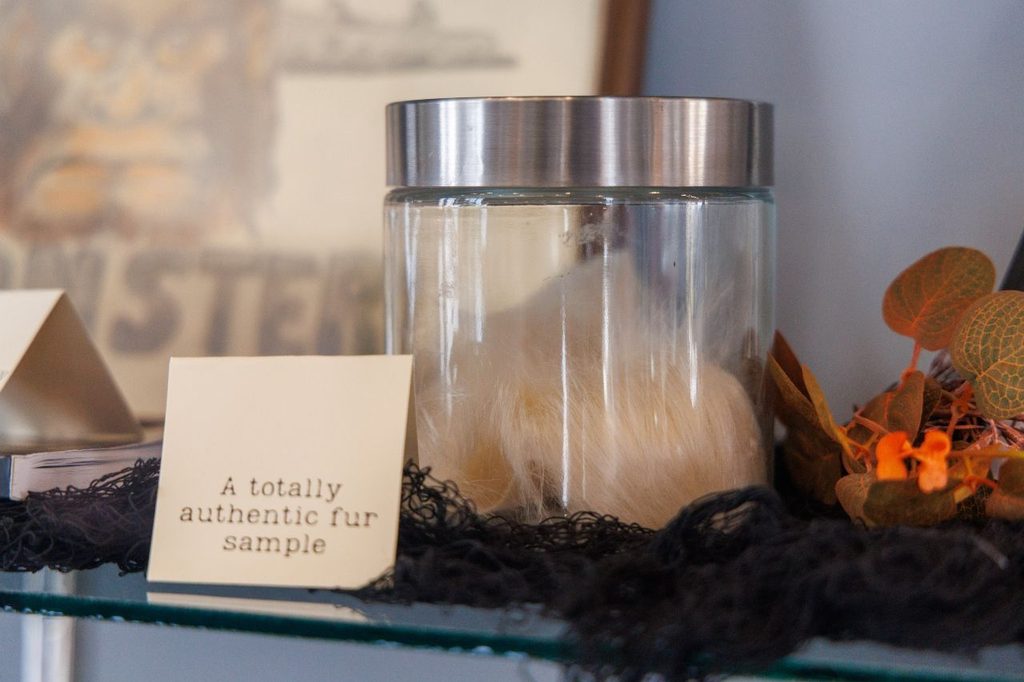
For those fascinated by the physical evidence reported in connection with the case, there’s also a replica footprint track cast, while another small exhibit piece is presented with a wonderfully playful touch as a “totally authentic fur sample.”
The photographs extend beyond the creature itself, taking visitors back to the landscape where the legend unfolded.
Images of Lake Worth, Greer Island and other reported sighting locations help connect the modern display with the places at the centre of the original stories, while photographs associated with the sightings give visitors a glimpse of the imagery that helped propel the Lake Worth Monster into local folklore.
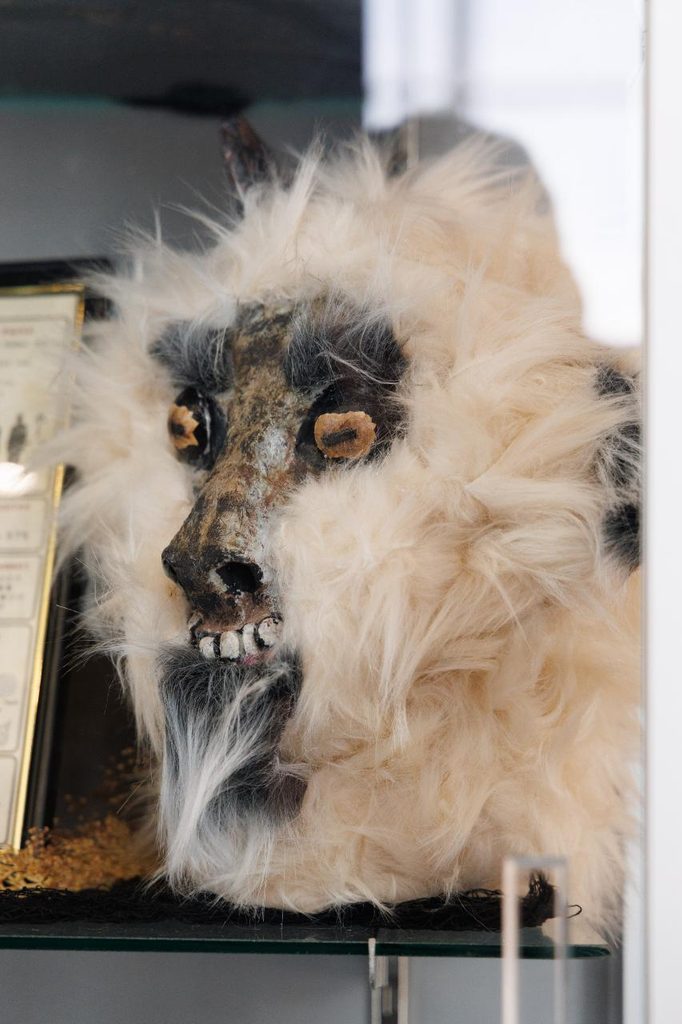
Alongside these historical and documentary elements, the artwork on display shows how differently artists have imagined the creature over the years, another reminder that the Lake Worth Monster exists not only as a collection of reported encounters, but as a visual character within Fort Worth’s folklore.
👹 The Legend of the Lake Worth Monster

To understand why a life-sized Lake Worth Monster now stands inside Fort Worth City Hall, we have to go back to the summer of 1969, when reports of a strange creature around Lake Worth and Greer Island captured the attention of local residents and newspapers.
What began as a series of unusual encounters quickly developed into one of the most famous monster stories in Texas.
The first major reports reached Fort Worth police during the night of July 9, 1969.
Three couples who had been parked near Greer Island told police that something had attacked them.
Their description was extraordinary: a creature said to be part-man and part-goat, covered in fur and scales.
According to the account published in the Fort Worth Star-Telegram the following day, the creature had apparently leapt from a nearby tree and landed on their automobile. John Reichert, one of those involved, reported that it subsequently reached towards his wife before they managed to escape.
The incident was taken seriously enough for four Fort Worth police units to search the area with the witnesses.
Nothing was found, although Reichert reportedly showed officers an approximately 18-inch scratch on the side of his car, which he believed had been left by the creature’s claws.
Police had already heard earlier reports of something strange around Lake Worth, but had generally dismissed them as pranks. This time, however, the people making the report appeared genuinely frightened.
The Star-Telegram gave the story a memorable headline: “Fishy Man-Goat Terrifies Couples Parked at Lake Worth.”
The newspaper also immediately introduced the competing explanations that would follow the legend for decades.
Police suspected a prankster, potentially someone wearing an ape costume or using an animal hide, while a naturalist suggested that an unusually large bobcat could explain at least some of what had been seen.
But the story was only beginning.
🦶 The Monster Strikes Again
The following night, July 10, reports came in again. One of the witnesses was Jack E. Harris, who told the Star-Telegram that he and others had gone looking for the creature after hearing reports of its appearance.
Harris said they heard the creature before they saw it, describing its cries as a squall or howl. He attempted to photograph it, but his camera’s flash failed.
He took another hurried photograph, although he wasn’t sure whether he had captured anything because he was more concerned with getting the window of his car closed.
According to Harris, the creature then moved around a bluff while an increasing number of vehicles arrived at the scene. Soon, 30 or 40 people were watching. What had begun as a strange sighting was rapidly becoming a public spectacle.
Then came the incident that would help define the Lake Worth Monster legend.
Harris reported that the creature seized a spare automobile tire with its rim still attached and threw it towards the vehicles. He estimated that it travelled more than 500 feet, sending the spectators scrambling back into their cars.

The incident was extraordinary enough that the following day’s Star-Telegram carried the headline “Police, Residents Observe, But Can’t Identify Monster.”
Police were becoming increasingly concerned, but not necessarily because they feared the creature itself. Sgt. A. J. Hudson expressed a rather more immediate concern: the growing number of people travelling to the area armed with guns.
And that is when the Lake Worth Monster stopped being merely a strange local report and became a phenomenon.
🌙 “Goatmania”
News and radio reports drew curious spectators towards Lake Worth, and increasingly large numbers of people began travelling to Greer Island in the hope of seeing the creature for themselves.
The Star-Telegram reported that Fort Worth police eventually had to station an officer near Greer Island to help deal with the traffic.
The situation was becoming sufficiently chaotic that authorities were concerned someone might be injured, particularly with armed members of the public searching for whatever they believed was lurking around the lake.
The monster had acquired several names. It was called the Lake Worth Monster, the Goat-Man, a “manny-goat” and even a satyr.
Descriptions varied, but recurring elements included a large, hairy humanoid body, goat-like or dog-like features, scales and, in some accounts, a horn.
Later accounts commonly placed the creature at around seven feet tall and several hundred pounds, although these measurements were witness estimates rather than scientific measurements.
The phenomenon attracted considerable attention beyond Fort Worth. Reporters from outside the area came to investigate, and the story was carried by newspapers well beyond Texas. More than 70 people would eventually claim to have seen the creature, according to later Star-Telegram retrospectives.
Yet there was another important element developing alongside the sightings: the Lake Worth Monster was becoming folklore almost in real time.
One of those fascinated by the events was Sallie Ann Clarke, a Fort Worth-area writer who began collecting material about the creature. In 1969 she published The Lake Worth Monster of Greer Island, Ft. Worth, Texas, one of the earliest books devoted specifically to the case.
Clarke’s book would become an important part of the monster’s literary history, although its contents need to be treated with some care.
Later researchers have noted that Clarke herself characterised parts of the work as semi-fictional, meaning that it cannot simply be treated as a contemporary catalogue of verified eyewitness testimony.
Nevertheless, the book remains an important historical artefact of the 1969 phenomenon, something produced while the monster was still making headlines.
📸 The Photograph
Perhaps the most famous physical object associated with the Lake Worth Monster would come several months after the initial July frenzy.
On November 19, 1969, Fort Worth resident Allen Plaster, then 22 years old, was driving along Shoreline Road with two friends from Weatherford. At approximately 1:35 a.m., they reportedly saw a large, pale or white, furry figure standing up in tall grass near the lakeshore.
Plaster had a Polaroid camera with him and took a photograph.
The resulting image is one of the enduring pieces of the Lake Worth Monster mystery.
It is undeniably intriguing, but undeniably difficult to interpret. The photograph is extremely grainy and poorly defined, with the creature appearing largely as a pale, indistinct shape against the darkness.
It has consequently been interpreted in very different ways, as a genuine unknown animal, a human in costume, an optical or photographic artefact, or simply somebody playing a prank.
The photograph’s most interesting characteristic may actually be its provenance.
It wasn’t a modern internet image with an unknown origin; it was a contemporary Polaroid taken in Fort Worth in 1969 and subsequently preserved in the literature surrounding the case.
Plaster himself later expressed the view that the thing he photographed was probably a prank, saying that whatever it was, it seemed to want to be seen.
That makes the photograph an important part of the history of the mystery, even if it cannot establish what stood in that field that night.
🍗 The Strange Encounters Continue
The Lake Worth Monster did not completely disappear after the extraordinary events of July.
Later in 1969, another bizarre report came from Charles Buchanan, who said he encountered a large, gorilla-like creature while near the lake.
In the account preserved by later researchers, Buchanan claimed that the creature approached him while he was sleeping in the back of his pickup truck.
He reportedly responded by throwing a bag of chicken towards it, after which the creature departed towards the lake.
It is one of the more colourful stories attached to the case, but it also demonstrates how difficult the Lake Worth Monster legend becomes to untangle as the months pass.
Some accounts describe a goat-like animal, others a hairy humanoid or gorilla-like creature, and others something altogether different.
The further the story travelled from the original July reports, the more the legend and the individual encounters became intertwined.
🕵️ What Was Really Happening Around Lake Worth?
From the beginning, sceptical explanations accompanied the monster reports.
The possibility of a large bobcat was raised by a local naturalist, with its ability to climb and move through trees potentially explaining some sightings.
Others suggested that the creature was a person wearing an animal or ape costume, while rumours circulated about local teenagers staging elaborate pranks.
One particularly persistent theory eventually centred on Foots Fowler, a resident of the nearby New Liberty Mission Rehabilitation Center, which became known locally as the “Goat Farm.”
Fort Worth police investigator Dale Hinz later suggested that Fowler, described as a very tall man with unusually long arms and large feet, may have been responsible for some of the encounters, allegedly sneaking away at night wearing goat skins to frighten people parked around the lake.
Another explanation involved a macaque monkey reportedly escaping from a nearby kennel around the same period, while other versions of the story have suggested everything from an unusually large animal to coordinated high-school pranks.
These theories are interesting, but they do not necessarily explain every reported encounter, and some belong to later recollections rather than the original contemporary reports.
There is also an important historical detail that predates the famous 1969 monster flap.
A 1947 Lake Worth prank had already produced a “monster” story in the area.
According to a later Star-Telegram retrospective, workers at the boat works had rigged an inner tube with a pulley and trotline so that it moved up and down in the water, creating the impression of something mysterious in the lake.
The prank generated excitement for days before its true nature was revealed. In December 1968, just seven months before the famous 1969 sightings, columnist George Dolan revisited that earlier incident in the Star-Telegram and joked that some people might still believe there was a monster in Lake Worth.
Whether that earlier story influenced the events of 1969 is difficult to establish, but it provides fascinating context: Lake Worth already had a monster story in its local folklore before the Goatman appeared.
👹 A Mystery Becomes a Legend
By September, the extraordinary concentration of reports had begun to fade. The summer’s monster hunt had generated huge public interest, but sightings declined sharply, around the time school returned.
That timing became one of the reasons the hoax theory gained strength. If teenagers had been responsible for dressing up as the creature and frightening motorists, the disappearance of the sightings at the end of the summer would make obvious sense.
But even if some encounters were hoaxes, that doesn’t necessarily explain every report made during the 1969 flap.
The original police reports documented frightened witnesses. The Star-Telegram documented the investigation and the extraordinary claims being made. Photographs were taken. Tracks were reportedly found and examined. And hundreds of curious people descended upon the area looking for something that, at the time, nobody could satisfactorily identify.
There is no confirmed zoological specimen, body or other conclusive physical evidence demonstrating that an unknown creature inhabited Lake Worth.
But neither can the entire story simply be reduced to a single photograph or a single prankster.
The most defensible conclusion is therefore also the most interesting one: the Lake Worth Monster became a genuine social phenomenon in Fort Worth during the summer of 1969, regardless of what was ultimately responsible for the individual encounters.
More than half a century later, the original question remains unresolved in popular culture: what, exactly, were people seeing around Lake Worth and Greer Island?
A misidentified animal? A series of elaborate hoaxes? Multiple unrelated encounters that became joined together by an increasingly famous story? Or something genuinely unidentified?
The evidence does not provide a definitive answer.
What it does provide is something perhaps equally fascinating for students of folklore, the story of how a handful of strange encounters became one of Texas’ enduring monster legends.
And now, in 2026, that legend has a home inside Fort Worth City Hall.
A Legend Brought Into City Hall

The idea for the exhibit began with Paige Frantz’s own interest in the Goatman of Greer Island and the Lake Worth Monster legend, combined with a desire to bring a little of Fort Worth’s local folklore into an unexpected setting.
Rather than simply presenting the creature as a mysterious figure from the past, Paige wanted to create something fun, unusual and engaging for people visiting City Hall, while also shining a light on the Fort Worth Nature Center & Refuge and its upcoming Monster Bash.
The result is a beautiful display that deliberately embraces the lighter side of monster folklore.
Alongside material relating to the Lake Worth Monster are the kinds of imaginative and unusual pieces that make cryptid culture so much fun: artwork, books, replica masks, footprint cast representations and a life-sized recreation of the creature itself.
For visitors who know the Lake Worth Monster story, the exhibit offers a chance to see the legend represented in a completely different way. For those encountering the Goatman for the first time, it provides an unusual introduction to one of Fort Worth’s most enduring pieces of local folklore.
And importantly, the exhibit isn’t asking visitors to decide whether the Lake Worth Monster was real. It is inviting them to discover the story, explore the legend and have a little fun with a strange and fascinating part of Fort Worth’s history.
📍 Visit the Exhibit
The Lake Worth Monster / Goatman of Greer Island exhibit is located on the north side of the lobby at Fort Worth City Hall.
It will remain on display through September 9, 2026, and visitors can view it during normal Fort Worth City Hall business hours.
For a monster that first made headlines around Lake Worth in 1969, finding itself inside the city’s municipal headquarters more than five decades later is quite a journey.
And the story doesn’t end when the City Hall exhibition comes down.
The Lake Worth Monster is heading back to the Nature Center.
Monster Bash & The Legacy Continues
The Lake Worth Monster may have first captured Fort Worth’s imagination in 1969, but the legend has never entirely disappeared.
More than five decades later, the creature is still being celebrated in the very landscape where the original reports unfolded, this time through the Fort Worth Nature Center & Refuge’s Lake Worth Monster Bash.
The fall festival commemorates the anniversary of the famous Lake Worth Monster sightings and gives the public an opportunity to experience the legend in a completely different way.
Rather than simply reading about the Goatman of Greer Island, visitors can spend a day exploring the Nature Center, taking part in activities, meeting other monster enthusiasts and hearing stories about one of Fort Worth’s most unusual pieces of folklore.
The Nature Center describes Monster Bash as a family-friendly event that combines the area’s natural environment with the enduring legend of the Lake Worth Monster.
The 2026 Monster Bash takes place on Saturday, October 24, at the Fort Worth Nature Center & Refuge.
The flyer lists the event hours as 10:00 a.m. to 3:00 p.m., and lists it as a family-friendly outdoor event.
The Lake Worth Monster Bash is held at the Fort Worth Nature Center & Refuge.
The official physical address is: 9601 Fossil Ridge Rd, Fort Worth, TX 76135, United States
And there is plenty to do.
The 2026 event features vendors and exhibits, hayrides, guided hikes and cryptozoology presentations, while the Nature Center’s Monster Bash information also highlights paddling opportunities, games and a tire-tossing contest.
That last activity is particularly appropriate.
Few details from the original 1969 monster flap are as wonderfully strange as the story of the creature allegedly picking up and throwing a vehicle tyre towards a gathering of onlookers.
More than half a century later, that bizarre episode has effectively become part of the fun of the legend itself, transformed from a frightening account in the original monster hunt into an activity visitors can enjoy at Monster Bash.
The event also provides an opportunity to hear from cryptozoology speakers, bringing modern discussion of mysterious creatures into a setting where visitors can explore the actual natural environment associated with the Lake Worth Monster.
The Nature Center describes the speakers as part of what makes the event unique, alongside its outdoor activities and family-oriented entertainment.
And the setting could hardly be more appropriate.
The Fort Worth Nature Center & Refuge protects thousands of acres of natural habitat on the western edge of Fort Worth, providing forests, prairies, wetlands, trails and access to the Lake Worth area.
It is a place primarily devoted to nature, conservation, education and outdoor recreation, which makes the Lake Worth Monster an unusually fitting piece of folklore to celebrate there.
The Nature Center’s stated mission is centred on educating the community about the preservation and protection of natural areas in North Central Texas.
Monster Bash has also become part of the Nature Center’s broader programme of special events. The Nature Center notes that the event occurs every other year, making the 2026 celebration something of a special occasion rather than simply another annual festival.
That makes Paige Frantz’s City Hall exhibition particularly fitting.
For a short period in September, the Lake Worth Monster is being brought into Fort Worth City Hall, allowing visitors to encounter the creature through photographs, artwork, books, masks, footprint representations and other pieces of the legend.
Then, in October, the story moves back outdoors.
From a glass display cabinet in the centre of Fort Worth to the trails and landscape of the Nature Center, the Lake Worth Monster continues to occupy a strange but increasingly comfortable place within the city’s cultural identity.
It is a creature that was once the subject of frightened telephone calls to police, newspaper headlines and crowds of curious spectators descending on Lake Worth.
Today, families can come together to hike, explore, play games, take a hayride, enjoy the exhibits, hear cryptozoology presentations and even try their hand at throwing a tyre, all while celebrating the same mysterious creature that caused such a sensation in 1969.
That evolution perhaps says more about the staying power of the Lake Worth Monster than any individual photograph or footprint ever could.
The question of what people actually encountered around Lake Worth in 1969 remains open to interpretation. But the question of whether the story has become part of Fort Worth folklore is considerably easier to answer.
It has.
And thanks to people like Paige Frantz and the Fort Worth Parks & Recreation Department, that folklore isn’t being forgotten or hidden away. It is being brought into public spaces, shared with new audiences and celebrated alongside the natural environment that has always formed the backdrop to the story.
The Lake Worth Monster has travelled a long way since that strange summer in 1969.
From the shores of Lake Worth, to newspaper headlines, to books and documentaries, to a display inside Fort Worth City Hall, and now back to the Nature Center for another Monster Bash.
The mystery may remain unsolved.
The legend is still very much alive.