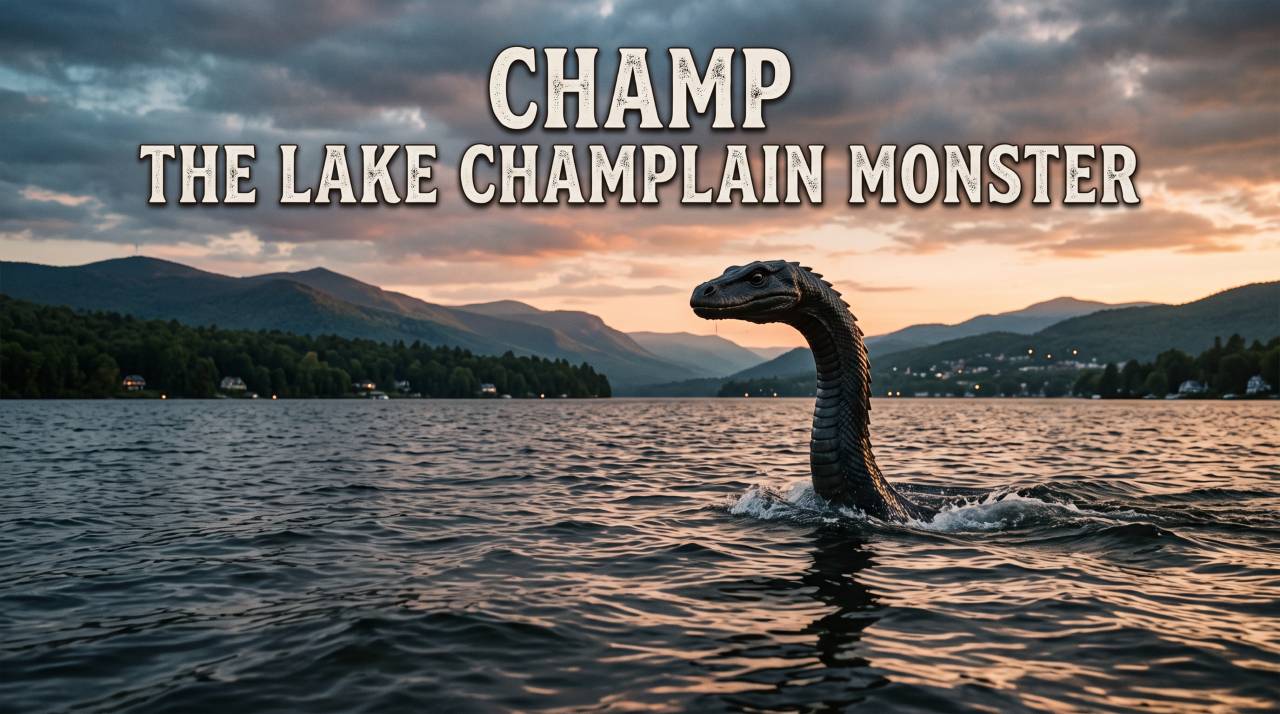
For centuries, the dark waters of Lake Champlain have carried more than boats, storms and stories.
Stretching for more than 100 miles between New York and Vermont, with its northern reaches extending into Québec, the lake has become home to one of North America’s most enduring aquatic mysteries, Champ, or affectionately, Champy.
The legend describes a creature large enough to challenge the imagination: something glimpsed rising from the water with a long neck, a serpentine body, powerful humps or coils moving beneath the surface, and sometimes a head compared to that of a horse or prehistoric reptile.
But unlike many lake-monster traditions, Champ’s modern legend is unusually well documented.
Its recorded history reaches back to the 19th century, with newspaper accounts describing witnesses who claimed to have encountered enormous serpentine creatures in Lake Champlain.
The most famous early report came in 1819, when Captain William Crum was said to have encountered a gigantic black creature in Bulwagga Bay, a remarkable account that helped establish Lake Champlain as a setting for monster folklore.
More than half a century later, reports again exploded into the American press. During the 1870s, railroad workers, local officials and passengers aboard vessels on the lake claimed encounters with enormous water serpents.
The stories became sufficiently famous that legendary showman P. T. Barnum reportedly offered a substantial financial reward for convincing evidence of the creature.
Yet Champ’s story did not disappear with the Victorian era.
Through the 20th century, reports continued, culminating in one of the most famous pieces of alleged lake-monster evidence ever produced: the 1977 photograph taken by Sandra Mansi near St. Albans, Vermont.
The image appears to show a dark, elongated form rising from the surface, complete with what resembles a long neck and several humps.
The photograph remains controversial.
It has never been conclusively established as an image of an unknown animal, but neither has it provided a simple answer that satisfies everyone who has examined it.
Alongside later eyewitness reports, amateur video, sonar claims and organised investigations, the Mansi photograph has ensured that Champ remains one of America’s best-known lake monsters.
And yet, beneath the mystery lies an important scientific question.
Lake Champlain contains an abundance of real wildlife capable of producing surprising observations. Large fish, especially lake sturgeon, can reach impressive sizes, while gar, waterfowl, floating debris, waves and atmospheric conditions can all create deceptive shapes on the water.
Investigations have also demonstrated how easily ordinary objects can resemble the traditional image of a lake monster when viewed from a distance.
No confirmed specimen of Champ has ever been recovered.
No authenticated skeleton, tissue sample or photograph has established the existence of an unknown large animal living within the lake.
For mainstream zoology, Champ therefore remains unverified.
But that does not make the story uninteresting.
Champ is something larger than a disputed creature in the water. The legend has become woven into the cultural identity of the communities surrounding Lake Champlain, inspiring books, television programmes, documentaries, children’s stories, artwork, souvenirs, museums, festivals and even an official sporting mascot.
From an extraordinary newspaper report in 1819, through Victorian monster fever, the remarkable Mansi photograph and modern sonar and drone investigations, Champ has survived for more than two centuries at the boundary between folklore and natural history.
Whether the dark shapes reported beneath Lake Champlain represent an unknown animal, misidentified wildlife, optical illusion, floating debris, or simply the power of a great regional legend, the mystery remains.
Something has been reported in these waters for generations.
The question is whether it has ever truly been a monster.
🐉 Physical Appearance
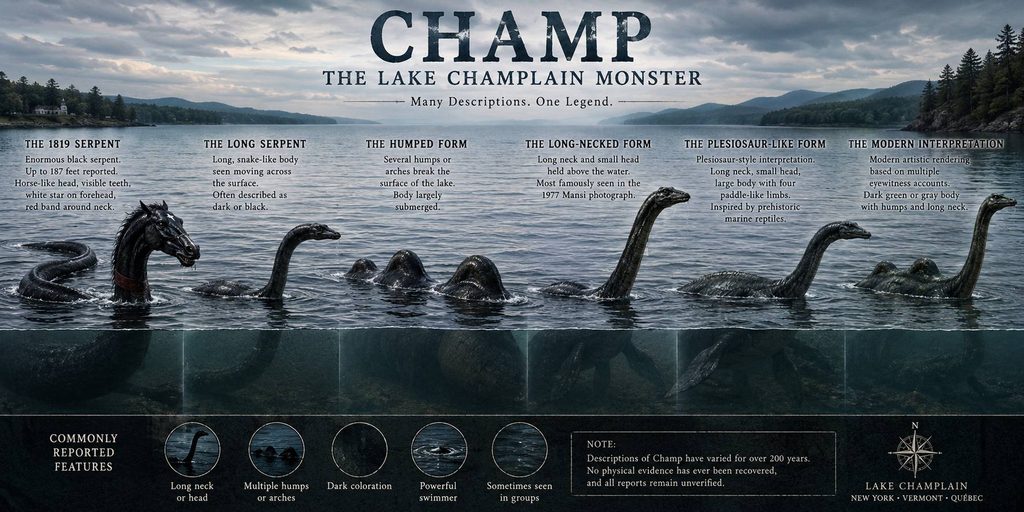
There is no single established physical description of Champ.
Accounts spanning more than two centuries describe a remarkably varied creature, ranging from an enormous serpent-like animal to a long-necked, humped creature resembling a prehistoric marine reptile.
The differences are important. Some of the earliest reports describe an animal that would have been extraordinarily large by any biological standard, while later witnesses generally describe something considerably smaller and more consistent with the proportions traditionally associated with a lake monster.
Because no specimen has ever been recovered, all descriptions remain eyewitness reports rather than zoologically confirmed characteristics.
🌊 The Serpentine Form
The earliest published accounts portray Champ primarily as a large water serpent.
The famous 1819 William Crum report from Bulwagga Bay described a gigantic dark creature rising from Lake Champlain.
The account attributed to Crum gave an extraordinary length of approximately 187 feet, with around 15 feet reportedly visible above the water.
The creature was described with several highly unusual details, including a dark or black body, a horse-like head, prominent teeth, striking eyes, and distinctive colour markings. A white marking was reportedly visible on the forehead, accompanied by a reddish band around the neck.
The reported dimensions are so extreme that they should be treated as part of the historical folklore rather than evidence for the actual size of a biological animal.
Nevertheless, the account established several motifs that would continue appearing in Champ lore:
- A long, serpentine body
- A creature capable of raising part of its body above the lake
- A conspicuous head or neck
- Dark coloration
- An aquatic animal of exceptional apparent size
These early descriptions are particularly significant because they demonstrate that the Champ legend did not originally depend upon the modern image of a plesiosaur-like monster.
🐍 The Long, Snake-Like Body
Throughout the 19th century, Champ was repeatedly described using language associated with serpents, water snakes and enormous aquatic reptiles.
Witnesses reported elongated forms moving through the water, sometimes apparently travelling in a series of bends or undulations.
Rather than presenting a conventional fish-shaped body, these accounts often suggested something longer and more flexible, with only portions of the animal visible at any one time.
This creates an important problem when interpreting historical reports: a long object moving through water can produce the visual impression of a much larger animal than actually exists.
Waves, floating vegetation, logs, swimming animals and the repeated appearance of several sections of a moving body can all produce the impression of multiple connected humps.
Nevertheless, the elongated serpentine body remains one of the most persistent elements of Champ’s reported appearance.
🦕 The Long-Necked Form
The modern image of Champ is dominated by a different configuration: a long neck emerging from the water above a series of humps.
This is particularly associated with the famous Sandra Mansi photograph of 1977.
The image appears to show a dark object protruding above the lake surface, with what looks like an elongated raised section at one end and several lower elevations behind it.
To believers, this has often been interpreted as a long-necked aquatic animal, with the visible portion representing a head and neck while the remainder of the body remains submerged.
The photograph therefore helped establish the visual template now strongly associated with Champ:
A raised neck or head + a long submerged body + several visible humps.
It is important, however, to distinguish the appearance of the photograph from what it proves. The image has never established that the object is an unknown animal, and its precise identity remains disputed.
🐲 The Humped Back
Another recurring feature in modern Champ reports is a series of humps breaking the surface.
Witnesses have described anything from one or two elevations to several separate humps apparently travelling together across the lake.
The humps are generally portrayed as:
- Rounded or arched
- Dark in colour
- Separated by sections of water
- Moving in sequence
- Sometimes disappearing and reappearing as the creature travels
In traditional Champ artwork, these humps are frequently exaggerated into a series of large, almost dinosaur-like coils.
Eyewitness reports, however, do not provide a consistent number of humps or establish that they belonged to a single continuous body.
This is particularly relevant when examining reports involving small groups of humps. Several unrelated objects or animals moving together can potentially create the same visual effect from a distance.
🦎 The Plesiosaur-Like Interpretation
As lake-monster imagery developed during the 20th century, Champ increasingly became associated with plesiosaurs and other prehistoric aquatic reptiles.
This interpretation generally depicts Champ with:
- A long, narrow neck
- A relatively small head
- A large submerged body
- Four powerful flippers
- A broad or streamlined torso
- Several humps visible above the water
This is now probably the best-known artistic representation of Champ, particularly in modern cryptozoological literature and popular culture.
However, there is no historical evidence demonstrating that Champ was originally described as a plesiosaur.
The comparison developed largely because the traditional lake-monster silhouette resembles popular reconstructions of long-necked prehistoric reptiles.
There is also an important anatomical issue. A true plesiosaur would have possessed four substantial paddle-like limbs, yet no reliable Champ observation has established the presence of flippers.
Consequently, the plesiosaur interpretation should be regarded as a modern hypothesis or artistic reconstruction, not an established characteristic of the creature.
🐴 The Head
Champ’s head is one of the least consistent aspects of the legend.
Historical descriptions have compared the creature’s head to that of a horse, while later depictions generally show a small reptilian or serpentine head attached to a long neck.
Reported characteristics across the broader tradition include:
- A relatively small head compared with the apparent body
- A horse-like profile in some early accounts
- A dark or black appearance
- Visible eyes
- Teeth in some historical descriptions
- A long neck or raised front section
There is no consistent evidence for a particular skull shape.
The famous 1819 account is especially unusual because of its detailed description of the eyes, teeth and facial markings.
These details are valuable historically because they show how elaborate some early monster reports could be, but they cannot be treated as a confirmed anatomical description.
👁️ Eyes
Some Champ traditions describe conspicuous or unusually noticeable eyes, particularly when the creature’s head was supposedly visible above the water.
The 1819 Crum account famously described the eyes in an unusual comparison to the colour of a peeled onion.
Later popular artwork frequently gives Champ large, dark or glowing eyes, although glowing eyes are not a consistent feature of the historical reports.
The dramatic eyes seen in modern illustrations therefore owe more to cryptid artwork and horror imagery than to a reliable body of eyewitness testimony.
🦷 Teeth
Teeth are another feature appearing in some early descriptions but largely absent from the modern Champ image.
The 1819 account attributed to Crum described three teeth.
Later representations generally depict Champ as a relatively harmless-looking lake serpent or prehistoric reptile rather than a heavily toothed predator.
There is consequently no reliable basis for determining whether Champ supposedly possessed a mouth resembling a snake, fish, crocodilian, marine reptile or mammal.
🎨 Colouration
Champ is most commonly represented as dark green, dark grey, brown or black, but historical accounts contain considerable variation.
The 1819 description is particularly distinctive because it reportedly included a black body with contrasting white and red markings.
Modern illustrations often use dark green or blue-green colouring because these colours visually connect the animal with deep freshwater environments.
The apparent colour of a creature observed on Lake Champlain would also be heavily affected by:
- Distance
- Sunlight
- Cloud cover
- Water conditions
- Reflection
- Atmospheric haze
- The portion of the animal visible above the surface
For this reason, colour descriptions are among the less reliable characteristics when attempting to reconstruct Champ’s appearance.
📏 Reported Size
Reported size varies enormously.
The extraordinary 187-foot estimate from the 1819 account is an extreme outlier and should not be regarded as representative of later Champ reports.
Most modern descriptions portray Champ as a substantially smaller animal, generally something large enough to produce conspicuous humps or a visible neck, but nowhere near the dimensions claimed in the earliest account.
This variation may reflect the difficulty of estimating the size of an unfamiliar object on open water.
Without a known reference point, a partially submerged animal can appear considerably larger than it actually is, particularly when only its neck, head or several humps are visible.
No reliable measurement of a living Champ has ever been obtained.
🏊 Movement Through the Water
Champ is generally described as a powerful swimmer capable of travelling across the surface or immediately beneath it.
Witnesses have variously reported:
- A long body travelling in a serpentine motion
- Several humps moving sequentially
- A head or neck remaining above the surface
- A large dark shape travelling beneath the water
- A visible wake following the object
- Sudden disappearance beneath the surface
Some accounts suggest surprisingly rapid movement, although exact speeds have never been measured.
The supposed swimming style also varies according to the form witnesses believed they saw. A serpentine creature would presumably move through lateral undulation, whereas a plesiosaur-like animal would theoretically use four paddle-like limbs.
No observation has provided sufficient detail to establish Champ’s actual method of propulsion.
🐟 What Champ Does Not Consistently Have
Despite the highly recognisable modern image, several supposed characteristics are not consistently supported by historical reports.
There is no established evidence that Champ possesses:
- Four flippers
- A plesiosaur-like skeleton
- A specific number of humps
- A fixed body length
- Horns or antlers
- Scales
- Hair or fur
- A forked snake-like tongue
- Glowing eyes
- A particular head shape
- A confirmed method of propulsion
Many of these characteristics come from later artwork, comparisons with prehistoric animals, fictional representations and modern cryptozoological interpretation rather than a consistent historical description.
🔎 The Champ Silhouette
Taken together, the most recognisable modern Champ description is that of a large, dark aquatic animal with an elongated body, a raised neck or head and several humps moving across the surface of Lake Champlain.
But the historical record is more complicated.
The creature described in the earliest famous reports was closer to an enormous water serpent, while the long-necked, humped silhouette became increasingly dominant in the modern era.
The result is a cryptid whose appearance has effectively evolved alongside the legend itself.
The serpent, horse-headed monster of the 19th century, the humped creature of modern eyewitness accounts, and the plesiosaur-like Champ of popular culture are not necessarily identical interpretations.
With no verified specimen, photograph or biological remains to settle the question, Champ’s physical appearance remains part of the mystery rather than an established zoological description.
📍 Location & Country
- 🇺🇸 Primary Location: Bulwagga Bay, Lake Champlain, near Port Henry
- 🌎 Region: Champlain Valley / Adirondack region
- 🏞️ Lake: Lake Champlain
- 🏛️ State: New York
- 🗺️ Wider Range: Lake Champlain, extending between New York and Vermont and northward toward Québec, Canada
- 🇺🇸 Country: United States
- 🐉 Legendary Epicentre: Bulwagga Bay, Port Henry
- 👁️ Primary Sighting Area: The waters surrounding Port Henry and Bulwagga Bay
- 📜 Historical Association: The area traditionally associated with the famous 1819 report by Captain William Crum
- 🏠 Local Nickname: Often described as “Champ’s home base” or the “Home of Champ”
- 📍 Coordinates (Approx.): 44.036111° N, 73.456659° W
Lake Champlain stretches for more than 100 miles between the American states of New York and Vermont, before extending north toward Québec.
Its long, narrow waters pass through the Champlain Valley, bordered by the Adirondack Mountains to the west and Vermont’s Green Mountains to the east.
While Champ sightings have been reported from numerous locations across the lake, Bulwagga Bay near Port Henry, New York, occupies a particularly important place in the history of the legend.
The sheltered bay is closely associated with the famous 1819 sighting attributed to Captain William Crum, whose extraordinary account of a gigantic serpent-like creature helped establish Champ as one of North America’s most enduring lake-monster legends.
The area subsequently became a focal point for later reports, and Port Henry developed a particularly strong cultural association with the creature.
Today, Bulwagga Bay remains one of the locations most closely identified with Champ.
Historical markers in and around Port Henry commemorate both the legend and reported sightings, while the surrounding community has embraced its connection to the Lake Champlain Monster.
The William G. Pomeroy Foundation notes that stories of Champ have been especially strong in Bulwagga Bay and describes Port Henry as being widely associated with the creature’s legendary home territory.
The bay itself forms part of the wider Lake Champlain system, meaning that it should not be interpreted as the creature’s only reported location.
Champ reports have emerged from across the lake, on both the New York and Vermont sides. Bulwagga Bay is instead best understood as one of the legend’s principal historical focal points, a location where the story of Champ, local folklore and alleged sightings have become closely intertwined.
For the Cryptid Legends encyclopedia, Bulwagga Bay provides a strong map location because it represents a specific, historically associated place within the enormous geographical range of Lake Champlain, rather than reducing the legend to a generic pin placed somewhere in the centre of the lake.
The wider Lake Champlain region itself remains the true geographical setting of the Champ phenomenon.
🌊 Habitat

Champ is said to inhabit the full length and breadth of Lake Champlain, a vast freshwater lake stretching approximately 120 miles between New York and Vermont and extending north into Québec.
The lake covers a remarkably varied underwater environment, with shallow bays, vegetated shorelines, open pelagic water, deep basins and a dark benthic zone along the lake floor.
These different habitats support a complex freshwater food web of aquatic plants, plankton, invertebrates and more than 90 species of fish.
For the purposes of the legend, this variety has always made Lake Champlain an ideal setting for an elusive aquatic creature.
The shallower littoral zone around the shoreline receives enough sunlight for submerged vegetation to grow, while rocks, fallen wood and aquatic plants provide shelter and structure for fish and other wildlife.
Farther from shore, the limnetic or pelagic zone consists of open water supporting plankton and fish, while deeper regions become darker and increasingly unsuitable for plant growth.
The deepest parts of the lake form a cold, dark environment where benthic organisms and bottom-dwelling fish occupy the sediments and surrounding water.
The shoreline itself is equally diverse. Lake Champlain contains beaches, low plains, bluffs, wetlands and marshes, with natural shore vegetation creating important habitat for fish, birds, amphibians and terrestrial wildlife.
Wetlands are particularly productive ecological areas, providing spawning and nursery habitat while also filtering sediment and nutrients entering the lake.
🐟 A Lake Rich Enough to Support a Large Predator?
Lake Champlain contains an extensive freshwater food web that includes northern pike, lake trout, walleye, bass, catfish, sturgeon, perch, salmon and numerous other fish species.
Bulwagga Bay alone is recorded as supporting species including muskie, northern pike, channel catfish, trout, walleye, sturgeon, gar and white perch.
This abundance of aquatic life is important to the Champ legend because many traditional descriptions portray the creature as a large aquatic animal that would presumably require a substantial food source.
The ecological reality is more complicated, however: while Lake Champlain unquestionably contains a rich and varied food web, there is no scientific evidence that it supports an undiscovered animal of the size traditionally attributed to Champ.
📍 Bulwagga Bay
Bulwagga Bay near Port Henry, New York, is one of the most important areas in the Champ tradition.
The bay has become closely associated with the creature because of the large number of reported sightings and the long-standing local identity of Port Henry as the “Home of Champ.”
Its combination of open water, sheltered shoreline and access to the wider lake makes it a natural setting for reports of something large moving near the surface.
The bay is also surrounded by recreational activity, including boating and fishing, meaning that the area receives regular human observation. Local tourism material specifically identifies Bulwagga Bay as a place associated with Champ sightings.
🌊 A Habitat of Depth, Darkness and Changing Conditions
Lake Champlain’s deeper waters undergo seasonal temperature stratification, producing distinct layers within the water column.
During summer, warmer surface water can sit above colder deep water, while seasonal turnover in spring and autumn mixes oxygen and nutrients through the lake. These changing conditions create different ecological environments throughout the year.
For Champ folklore, this provides a compelling natural backdrop: an enormous lake containing areas where visibility is limited, where the water column changes with depth and temperature, and where a large object seen briefly at the surface could disappear into open water within moments.
It is one reason Lake Champlain’s physical environment has remained so effective at sustaining the mystery.
Scientifically, however, the lake’s depth and complexity should not be mistaken for evidence of a hidden monster.
Lake Champlain provides a plausible environment for an unidentified aquatic sighting, but no confirmed biological evidence demonstrates that an unknown large animal lives there.
The habitat is real, Champ remains a matter of folklore, eyewitness testimony and continuing speculation.
👁️ Historical Sightings & Famous Events
The history of Champ is unusually extensive for a North American lake monster.
Reports associated with Lake Champlain span more than two centuries, although the quality of the historical record varies considerably.
Some accounts survive in contemporary newspapers or through named witnesses, while others are preserved only through later books, local folklore or modern retellings.
The number of reported encounters also depends heavily on the source.
By 1992, the Lake Champlain Region tourism authority reported approximately 180 sightings involving around 600 claimed witnesses, while other Champ researchers have subsequently compiled several hundred reports.
These figures should be understood as counts of reported encounters rather than independently verified observations.
📜 1609 — The Samuel de Champlain Misattribution
The story traditionally begins in 1609 with Samuel de Champlain, the French explorer after whom Lake Champlain was named.
For generations, books and television programmes claimed that Champlain himself saw a huge serpent-like animal in the lake and recorded it in his journal.
This has become one of the most repeated pieces of Champ lore, but it is not a genuine Champ sighting.
Champlain’s surviving writings describe an unusual fish reported by Indigenous people, with a long snout and prominent teeth.
Modern researchers have identified the description as consistent with gar, a group of large predatory fish that occurs in the Lake Champlain region.
The famous story of Champlain personally seeing a twenty-foot serpent in Lake Champlain was created through later misinterpretation and repetition.
Historian Robert E. Bartholomew, whose 2012 book The Untold Story of Champ examined the historical record in detail, specifically identifies the supposed 1609 monster encounter as fictitious.
The William G. Pomeroy Foundation’s historical marker for Champ likewise explains that Champlain’s account concerned a fish rather than the legendary monster.
For the historical record, therefore, 1819 is the important starting point for the modern documented Champ tradition, not 1609.
🐍 1819 — Captain William Crum and the Bulwagga Bay Monster
The first major published account came in July 1819, when Captain William Crum reportedly encountered an enormous creature in Bulwagga Bay near Port Henry, New York.
According to the account published in the Plattsburgh Republican on July 24, Crum was travelling aboard a scow when he and others noticed what he described as a gigantic black creature in the water.
The description was extraordinary.
Crum reportedly estimated the animal at approximately 187 feet long and said that more than fifteen feet of it rose above the surface.
Its head was described as resembling a sea horse, while the witness reported three teeth, unusually coloured eyes, a white star-like marking on the forehead and a red band around the neck.
The account is remarkable not only because of the alleged size, but because of the unusual amount of detail supposedly observed from a considerable distance.
The report therefore became both the foundation of the modern Champ legend and one of its most controversial historical accounts.
There is no physical evidence from the encounter, and the enormous 187-foot estimate cannot be independently verified.
Nevertheless, the 1819 report is historically important because it appeared in a contemporary newspaper and firmly established the idea of an enormous serpent-like creature in Lake Champlain.
The location is particularly significant. Bulwagga Bay would later become one of the most strongly associated areas in the entire Champ tradition, linking the earliest major published account directly with the modern “Home of Champ” identity of Port Henry.
🚢 1870–1873 — The Sea-Serpent Craze Reaches Lake Champlain
More than half a century later, reports of enormous serpentine animals became particularly prominent during the 1870s.
Historical compilations record several reports from the period, including sightings from steamboats and people working around the lake.
One account from 1871 describes passengers aboard the steamer Curlew reportedly seeing a head and long neck moving through the water and creating a considerable wake.
Other accounts place sightings around Charlotte, Vermont, and Dresden, New York.
The most famous cluster came in 1873.
A New York Times report described a railroad crew working near Dresden, New York, who reportedly saw the head of an enormous serpent approaching through the lake.
The creature was said to have bright, silvery scales that reflected the sunlight.
Soon afterwards, Clinton County Sheriff Nathan H. Mooney reportedly encountered what he described as an “enormous snake or water serpent,” which he estimated at approximately 25–35 feet long.
The same year also produced the famous story of the steamship W. B. Eddy, whose passengers reportedly believed the vessel had collided with an enormous creature. According to the later account, the impact was sufficient to make the ship appear to nearly turn over.
These reports helped transform Champ from a local curiosity into a regional sea-serpent phenomenon.
💰 1873 — P. T. Barnum’s $50,000 Challenge
The 1873 reports attracted the attention of the famous American showman P. T. Barnum, who saw the possibility of exhibiting the creature.
Barnum publicly offered $50,000 for the hide of the “great Champlain Serpent” so that he could add it to his mammoth World’s Fair exhibition.
The reward was never collected, and no authenticated body or hide was ever produced.
Barnum later renewed his interest in 1887, reportedly offering another $20,000 bounty for the Champlain sea serpent, dead or alive. The William G. Pomeroy Foundation records both rewards and notes that neither was ever claimed.
Barnum’s involvement is important historically because it demonstrates that Champ was no longer simply a local campfire story.
By the late nineteenth century, the creature had entered America’s wider fascination with sea serpents, giant animals and unexplained creatures, and the possibility of monetary reward encouraged people to actively search for it.
🐉 1878–1879 — Further Lake Reports
Reports continued after the famous 1873 wave.
In 1878, six people aboard the yacht Rob Roy reportedly saw a “large monster” swimming rapidly past them near Button Bay Island.
In 1879, three Burlington University students reportedly observed a large object gliding through the water near Appletree Point and Rock Dunder.
These cases are preserved primarily through later historical compilations rather than the same level of contemporary documentation available for the 1819 and 1873 reports, so they should be treated as historical claims rather than independently established events.
⚓ 1887 — Barnum Renews the Hunt
Barnum’s renewed $20,000 reward in 1887 revived public interest in the Champlain sea serpent.
Historical reports describe Barnum suggesting an unusually aggressive approach to the search, involving boats and even Gatling guns.
The proposal illustrates how dramatically attitudes toward mysterious animals differed during the nineteenth century: the objective was not simply to document the creature but to capture or kill it and place the remains on public display.
No specimen resulted from the renewed hunt.
🌊 Early 20th Century — Reports Continue
The Champ tradition did not disappear with the nineteenth-century sea-serpent craze.
Later compilations record further reports during the early twentieth century, including a 1915 account of a roughly 40-foot creature reportedly seen thrashing in or near the entrance to Bulwagga Bay.
The documentation for many of these early twentieth-century reports is considerably weaker than that for the famous newspaper cases, and some details have clearly accumulated through later retellings.
They nevertheless demonstrate that reports of unusual large animals continued to circulate around Lake Champlain before the modern cryptozoological movement emerged.
🚢 1945 — The S.S. Ticonderoga Encounter
One of the best-known mid-century reports occurred in 1945, when passengers aboard the S.S. Ticonderoga reportedly saw a large creature while travelling across Lake Champlain.
The account is remembered as a multiple-witness sighting from a passenger vessel rather than a solitary observation from shore.
Details of the original event are surprisingly limited in surviving popular documentation, and later sources differ in exactly how the encounter unfolded.
Nevertheless, the incident became an important part of Champ’s twentieth-century history because multiple passengers were said to have witnessed the same unusual object.
The event helped preserve the idea that Champ was not simply a nineteenth-century sea-serpent story that had disappeared with the age of steamships.
🔎 1960s–1970s — The Beginning of Organised Champ Investigation
A significant change occurred during the 1970s, when Champ began attracting dedicated investigators rather than merely newspaper reporters and curious locals.
One of the most important figures was Joseph Zarzynski, a teacher and researcher who became deeply involved in documenting Champ reports.
He eventually established the Lake Champlain Phenomena Investigation, collecting witness accounts, mapping reported sightings and attempting to apply photographic and sonar technology to the mystery.
Zarzynski’s work helped transform Champ from folklore into a subject of organised cryptozoological investigation.
Rather than simply waiting for a sighting, investigators began attempting to locate the animal systematically using boats, cameras, binoculars, sonar and underwater searches.
📡 1979 — The First Major Sonar Searches
In June 1979, Zarzynski joined engineer and remote-sensing specialist Jim Kennard in using towed side-scan sonar to search Lake Champlain.
One sonar survey produced an unusual moving target in the region of Whallon Bay, reportedly at approximately 175 feet depth.
The reading attracted attention because it represented an object beneath the surface that was large enough to interest the investigators. However, the researchers themselves did not identify it as Champ. A school of fish remained one possible explanation.
The wider 1979 sonar work also illustrates an important feature of Champ research: sonar could detect unexplained objects, but an unexplained sonar return was not equivalent to identifying a new animal.
Kennard subsequently became heavily involved in underwater archaeological work on Lake Champlain, and side-scan sonar surveys demonstrated how easily apparently mysterious underwater targets could ultimately prove to be shipwrecks or other submerged structures.
One 1979 survey, for example, helped locate the wreck of the Phoenix.
📸 1977 — Sandra Mansi’s Famous Photograph
Although the photograph was taken before the 1979 sonar searches, its significance became apparent only later.
On July 5, 1977, Connecticut resident Sandra Mansi reportedly encountered a strange object while vacationing with her family near the Vermont side of Lake Champlain.
Mansi said she saw the lake surface begin to churn and initially wondered whether she was looking at divers or a large concentration of fish. She then reported seeing a head and neck emerge above the water, followed by part of the creature’s back.
She managed to take a single colour photograph with a Kodak Instamatic camera.
The photograph remained largely private for several years before entering the Champ investigation. It eventually became the most famous image associated with the creature.
In 1981, the photograph received national attention after publication in The New York Times and Time magazine.
The University of Arizona Optical Sciences Center examined the image, and professor B. Roy Frieden reported that there was no evidence that the photograph was a photographic montage or obvious composite.
That finding was frequently simplified in later media coverage into claims that scientists had “authenticated” Champ.
That is not what the examination established.
The analysis could indicate that the photograph contained a genuine object photographed in the scene, but it could not establish that the object was a living unknown animal.
Time itself noted several unresolved problems, including the missing negative and uncertainty over the exact location of the photograph.
The photograph subsequently became the centrepiece of decades of Champ investigation.
🏛️ 1980–1983 — Champ Receives Legal Protection
The Mansi photograph dramatically increased public interest in Champ, and investigator Joseph Zarzynski began campaigning for legal protection for the alleged creature.
In 1980/1981, Port Henry took the unusual step of establishing protection for Champ in its local waters.
In 1982, the Vermont House of Representatives passed a resolution protecting Champ.
In 1983, both houses of the New York State Legislature passed resolutions protecting the creature.
These measures were not scientific declarations that Champ existed. They were largely symbolic protections reflecting the creature’s growing status as regional folklore and the desire to prevent people from deliberately harming a creature that might, theoretically, exist.
The Lake Champlain Region records the sequence as:
- 1981 — Port Henry establishes a Champ safe haven
- 1982 — Vermont House resolution
- 1983 — New York Assembly and Senate resolutions
The legislation represents one of the strangest milestones in Champ’s history: an alleged cryptid became the subject of government protection despite never having been scientifically confirmed.
🚢 1984 — The Spirit of Ethan Allen Mass Sighting
On July 28, 1984, Champ produced perhaps the most famous twentieth-century multiple-witness event.
Approximately 60–70 passengers, crew members and others aboard the Spirit of Ethan Allen reportedly saw a large object moving through Lake Champlain near Appletree Point, Burlington, Vermont.
According to contemporary UPI reporting, the object travelled parallel to the boat for more than 1,000 yards and appeared to have three to five fins or humps projecting above the surface.
The band aboard the vessel reportedly stopped playing as passengers crowded to one side of the boat to watch the object.
Michael Shea, owner of the vessel, estimated the creature at roughly 30 feet long. Witness Bette Morris described it as several dark bumps on the surface.
The creature reportedly disappeared and then appeared again approximately fifteen minutes later.
The event became important because of the number of witnesses and because the observation occurred from a commercial passenger vessel, where many people were simultaneously looking at the same area.
It remains one of the most frequently cited mass sightings in Champ history.
🎥 1988 — The Tappan Family Video
On July 7, 1988, Walter Tappan, his wife Sandi and their daughter Heidi went onto Lake Champlain with a camcorder specifically hoping to see Champ.
The family had reportedly already seen an unusual object the previous day.
During the second outing, Sandi reportedly noticed a series of dark humps moving near the surface. The family managed to capture approximately 20–30 seconds of footage.
Sandi later described seeing what she believed was a neck and head rise from the water before the object disappeared.
The footage became one of the best-known pieces of moving-image evidence associated with Champ.
The Tappan case became nationally famous when it appeared on NBC’s Unsolved Mysteries on September 23, 1992.
The programme presented the family, their testimony and the video while also presenting competing interpretations.
One expert believed the footage showed a school of fish feeding near the surface rather than a single giant animal.
Skeptical investigator Joe Nickell later cited the case as an example of how multiple fish can create the appearance of a single long, segmented creature.
The case nevertheless became an important turning point because Champ was no longer represented solely through still photographs and eyewitness testimony. Viewers could now see the alleged creature moving on video.
🧭 1990s — Champ Quest and the Search Becomes Systematic
The 1990s saw the emergence of another major Champ investigator, Dennis Jay Hall, who founded Champ Quest and devoted years to documenting the creature.
Hall claimed numerous personal sightings and compiled witness reports, photographs and video material.
He published Champ Quest 1999: The Ultimate Search and later Champ Quest 2000, field guides and almanacs documenting reported encounters and identifying periods and locations he considered favourable for searching.
Hall’s work represented another stage in Champ research: rather than concentrating exclusively on one famous photograph or isolated historical account, the effort attempted to build a long-term database of sightings.
By the late 1990s, however, disagreements between different Champ investigators had become increasingly pronounced. Researchers differed over the reliability of witness testimony, the interpretation of photographs and videos, and the significance of sonar and acoustic recordings.
Champ investigation had effectively developed its own internal history and rivalries.
🎬 1992 and Beyond — Champ Becomes a Television Cryptid
The Unsolved Mysteries broadcast dramatically expanded Champ’s audience.
The programme’s use of the Mansi photograph and Tappan video introduced the creature to millions of viewers and helped establish the now-familiar comparison between Champ and Scotland’s Loch Ness Monster.
Television coverage subsequently became a recurring part of Champ’s history, with programmes including Sightings, MonsterQuest, Discovery Channel specials and later cryptid-investigation programmes returning to the lake.
The Lake Champlain Region notes that by the early twenty-first century the creature had attracted attention from Japanese television, NBC’s Unsolved Mysteries, Fox’s Sightings and other national media.
🎥 2003 — Discovery Channel and the Search for Champ
In 2003, the Discovery Channel produced America’s Loch Ness Monster, bringing together eyewitness testimony, historical reports and technological investigation.
The programme’s research included underwater acoustic work led by Elizabeth von Muggenthaler and the Fauna Communications Research Institute.
Hydrophones were deployed at several locations in Lake Champlain and produced unusual clicking and pulsing sounds. The recordings were interpreted by the researchers as resembling biological sonar or echolocation.
The acoustic work subsequently became more than television material.
A paper titled “Echolocation in a Fresh Water Lake” was published in the Journal of the Acoustical Society of America in 2010, describing acoustic signals recorded during Lake Champlain investigations in 2003, 2005 and 2009.
The paper reported signals whose characteristics were considered interesting in comparison with known echolocation sounds.
The significance of this research remains disputed, and it does not identify the source as Champ.
The acoustic investigation is therefore best understood historically as an attempt to investigate the legend with scientific instrumentation, rather than as a confirmed discovery of an unknown species.
🔬 2003 — Joe Nickell and Benjamin Radford Investigate Champ
The same period also saw one of the most detailed sceptical investigations.
Skeptical investigator Joe Nickell and writer Benjamin Radford conducted field research on Lake Champlain, later publishing their findings in Skeptical Inquirer.
Their investigation examined the Mansi photograph, eyewitness reports, sonar claims and possible natural explanations for observations.
They also attempted to understand the scale of the object in the famous photograph rather than simply accepting witness estimates. Their work demonstrated how perspective, distance, waves, submerged objects and ordinary animals could produce apparently extraordinary observations.
The investigation was published in two Skeptical Inquirer articles under the broader “Chasing Champ” project.
The investigation became particularly influential because it showed that the Champ mystery could be approached from both sides: researchers actively searching for an unknown animal and investigators testing whether known phenomena could reproduce the reported observations.
🎥 2005 — The Affolter–Bodette Video
In the summer of 2005, fishermen Dick Affolter and his stepson Pete Bodette reportedly filmed something unusual in Lake Champlain.
The resulting footage showed a dark object or disturbance moving close to the surface. Bodette later said that parts of what they observed appeared to rise above the water, describing what he believed could have been the back, nose or head of a large animal.
The footage attracted major national attention when ABC News obtained and broadcast it in 2006.
Bodette was unusually cautious in his testimony, saying that he was certain about what he had seen but not certain what the object actually was.
Two retired FBI image analysts reportedly examined the video and found no obvious evidence of manipulation.
However, the authenticity of the recording and the identity of whatever was filmed are separate questions. The footage can be genuine without demonstrating that the object was a previously unknown animal.
Possible interpretations have included a large fish, an otter, an eel-like animal or an unusual surface effect.
📺 2006 — Champ Returns to National Television
ABC News’ Good Morning America coverage in February 2006 brought the Affolter–Bodette footage to a national audience under the headline “Is There a Monster in Lake Champlain?”
The report presented the fishermen’s testimony alongside the wider Champ legend and the continuing debate over the creature’s identity.
The broadcast was significant because it demonstrated that Champ remained a mainstream media story more than a century after the nineteenth-century sea-serpent reports.
📺 2007 — MonsterQuest: America’s Loch Ness Monster
On October 31, 2007, History Channel’s MonsterQuest opened its first season with “America’s Loch Ness Monster.”
The programme investigated whether a large prehistoric animal could inhabit Lake Champlain.
Special cameras and other equipment were used to search for Champ, while the existing photographic evidence, particularly the Mansi photograph, was subjected to further examination.
The episode helped cement Champ’s position within the modern television cryptid genre, presenting the mystery through the increasingly familiar combination of eyewitness testimony, historical research, field investigation and scientific analysis.
📚 2012 — Robert Bartholomew’s The Untold Story of Champ
A major milestone in the historical study of Champ came with sociologist and historian Robert E. Bartholomew’s 2012 book, The Untold Story of Champ: A Social History of America’s Loch Ness Monster.
Rather than simply asking whether Champ was real, Bartholomew investigated how the legend itself developed.
He examined historical newspapers, witness reports, investigators and the changing public image of the creature.
His research argued that much of the popular Champ story had been distorted over time, particularly the supposed 1609 Champlain encounter.
The book also examined the famous Mansi photograph and raised questions about the missing negative, uncertainty surrounding the exact location and inconsistencies in later versions of the story.
Whatever one’s position on Champ, Bartholomew’s work is important because it treats the creature as a historical and cultural phenomenon as well as a cryptozoological mystery.
🔊 2014–2021 — Renewed Acoustic and Technological Searches
Champ research continued to move increasingly toward technology.
Researchers including Katy Elizabeth and Dennis Hall explored the possibility that an unknown animal might be detected acoustically rather than visually.
In 2014, hydrophone equipment was used to record distinctive clicking sounds that Elizabeth interpreted as possible echolocation.
Later searches incorporated increasingly sophisticated equipment, including sonar, underwater cameras, drones and remotely operated vehicles.
By 2021, WPTZ reported on Elizabeth’s ongoing search programme, including claimed sonar images and acoustic recordings, as well as the deployment of an ROV capable of reaching more than 300 feet.
The reports presented these findings as intriguing but did not establish the existence of an unknown animal.
These investigations are historically important because they demonstrate how the Champ search has evolved from nineteenth-century attempts to capture the creature into twenty-first-century attempts to detect it indirectly.
🎬 2022–2024 — Lucy and the Lake Monster
A new chapter began with the production of Lucy and the Lake Monster, a family film centred directly on the Champ legend.
Filmmakers Richard Rossi and Kelly Tabor filmed around Port Henry and Bulwagga Bay.
Tabor had a personal connection to the legend, having grown up visiting Lake Champlain and searching for Champ since childhood.
During production, drone footage was captured over the lake. The footage was not immediately recognised as containing anything unusual.
During post-production, the filmmakers reportedly noticed what appeared to be a large submerged object moving behind a small boat carrying the film’s actors.
The boat was approximately 11.8 feet long and 4.3 feet wide, providing a potential scale reference that the famous Mansi photograph lacks.
The filmmakers dated the footage to August 2, 2024, and identified the location as Bulwagga Bay.
Unlike many earlier Champ images, the footage was captured from above using a modern drone, allowing the alleged object to be viewed in relation to a nearby boat.
The filmmakers released a short excerpt publicly while retaining a longer approximately five-minute sequence.
They argued that the footage showed a large, long-necked aquatic creature and shared the material for further assessment.
📰 2024 — The Drone Footage Enters the Media
The alleged drone encounter received regional and national attention.
The State newspaper reported in August 2024 that Tabor and Rossi believed the footage showed Champ and had submitted it to scientists for assessment. The report noted that the object appeared to be larger than the small boat visible in the footage.
The film itself subsequently received a wider release, and the footage became one of the most heavily promoted new pieces of visual material associated with Champ in decades.
Importantly, the footage is not an independently confirmed observation of an unknown animal.
Its significance lies in the fact that it provides a new piece of visual material with a nearby object for scale, while its interpretation remains disputed.
📺 2025 — The UnXplained with William Shatner
The Tabor–Rossi footage received another major media boost when it appeared on History Channel’s The UnXplained with William Shatner.
The footage was presented in the episode “Terrors of the Deep,” which aired on October 3, 2025.
The programme brought in experts to examine the footage and framed it as potentially significant evidence for Champ.
The filmmakers subsequently described the footage as a major development in the search for the creature.
The television exposure substantially increased public interest in the footage, but television analysis should still be distinguished from independent scientific confirmation.
📰 2026 — The Champ Drone Footage Goes Viral
In June 2026, the Tabor–Rossi footage experienced another major surge of attention when national media revisited the case.
The New York Post reported on June 7 that the filmmakers believed they had captured America’s equivalent of the Loch Ness Monster.
The report described the apparent creature as moving beneath the surface behind their boat and highlighted the fact that the object could be compared visually with the boat’s known dimensions.
The story subsequently spread through other media outlets, bringing Champ back into international news coverage.
The filmmakers maintain that the footage represents a genuine large aquatic animal and have described it as potentially the strongest visual evidence for Champ since the Mansi photograph.
Those are the filmmakers’ conclusions, however, rather than an established zoological finding.
🔎 The Evolution of the Champ Search
The history of Champ investigation is almost as interesting as the sightings themselves.
The search has passed through several distinct phases:
The nineteenth century was dominated by attempts to capture the creature, culminating in P. T. Barnum’s monetary rewards.
The 1970s and 1980s saw the rise of organised cryptozoological investigation under Joseph Zarzynski, with researchers using photography, sonar, boats and systematic witness interviews.
The 1990s brought increasingly organised databases and field searches through investigators such as Dennis Jay Hall and Champ Quest.
The early 2000s introduced modern scientific instrumentation, including hydrophones, digital recording equipment, sonar and specialist photographic analysis.
The 2000s and 2010s saw television programmes turn Champ into a recurring subject of documentary-style investigation, including Unsolved Mysteries, Discovery Channel productions and MonsterQuest.
The 2020s have increasingly focused on drones, high-resolution video, underwater cameras, remotely operated vehicles and digital image analysis.
Despite this progression from nineteenth-century hunting parties to modern remote sensing, no search has produced a body, skeleton, tissue sample, independently verified DNA sequence, or other biological specimen demonstrating the existence of an unknown large animal in Lake Champlain.
That absence does not erase the historical record of reported encounters.
It simply means that the history of Champ remains a history of claims, observations, searches, photographs, recordings and competing interpretations, rather than a confirmed zoological discovery.
🌊 Why the Legend Has Survived
Champ has survived for more than two centuries because the reports have never completely disappeared.
There have been solitary eyewitnesses, groups of passengers, fishermen, families, investigators, sonar operators, photographers and filmmakers who all claimed to have encountered something unusual in or around Lake Champlain.
The descriptions have also changed dramatically. Early reports favoured enormous serpents; later witnesses described humps; the Mansi photograph encouraged a long-necked interpretation; modern filmmakers have interpreted their drone footage as showing a plesiosaur-like animal.
The result is a remarkably flexible legend.
What remains historically consistent is not a single physical description, but the recurring claim that something large and unusual has occasionally been seen moving through the waters of Lake Champlain.
Whether those observations represent one unknown animal, several ordinary animals and natural phenomena, misidentifications, deliberate hoaxes, or some combination of these possibilities remains unresolved.
For more than 200 years, however, the search has continued, and Champ has become inseparable from the history and identity of Lake Champlain itself.
🔬 Scientific Evidence & Explanations
Champ occupies an unusual position among lake monsters.
The legend has generated an unusually large body of eyewitness testimony, photographs, video recordings, sonar reports and organized searches, yet none has produced the kind of physical evidence required to establish the existence of a previously unknown large aquatic animal.
There is currently no scientifically verified Champ specimen, skeleton, tissue sample or DNA sequence, and no photograph or video has been independently demonstrated to show an unknown animal.
The evidence therefore has to be assessed individually rather than treated as one cumulative body of proof.
📸 The Sandra Mansi Photograph
The most famous piece of Champ evidence remains the photograph taken by Sandra Mansi in 1977.
The image appears to show a dark object projecting above the surface of Lake Champlain, with what looks like a long neck or head at one end.
It became famous after being published publicly in 1981 and has subsequently been described by some cryptozoologists as one of the strongest lake-monster photographs ever taken.
An important distinction must be made between authenticity of the photograph and identification of the object.
There has been no convincing demonstration that the image is a conventional photographic composite.
Optical analysis conducted after the photograph became public found no obvious evidence of manipulation.
That does not, however, establish that the object photographed was an unknown animal.
The photograph has several significant limitations. The original negative is no longer available, the precise location where Mansi took the photograph has never been conclusively established, and there is no reliable independent scale reference immediately beside the object.
These missing pieces of information are extremely important because estimating the size of an unfamiliar object floating on open water is notoriously difficult.
Without a known distance and nearby object of known dimensions, an object only a few feet long can potentially be interpreted as something vastly larger.
Benjamin Radford and Joe Nickell therefore attempted to recreate the circumstances of the photograph during their “Chasing Champ” investigation.
Using the same model of camera as Mansi’s Kodak Instamatic and constructing scale models, they tested whether an ordinary object could reproduce the apparent proportions and perspective.
Their experiments suggested that the photographed object could be considerably smaller than the enormous creature traditionally claimed.
Their estimates placed the apparent object at roughly seven feet in length, with the portion interpreted as a neck rising approximately three feet above the water.
A floating log or tree stump could therefore produce an appearance resembling the photograph.
The result does not prove that the Mansi photograph depicts a log.
It demonstrates something more important scientifically: the photograph cannot establish the identity or size of the object without the missing geographical and photographic information.
Later research also uncovered inconsistencies and previously unpublished information concerning the circumstances surrounding the photograph, further weakening its value as definitive zoological evidence.
🌲 The Floating Log Explanation
One of the strongest proposed explanations for the Mansi image is therefore a floating log, tree stump or partially submerged piece of vegetation.
This may sound mundane, but floating objects on water can produce surprisingly convincing animal-like silhouettes.
Waves can make an object appear to rise and fall, while perspective can make a relatively small object appear much larger when there is nothing nearby providing scale.
A submerged log can also create the impression of a long body below the surface, with only a portion visible above the water.
Radford and Nickell’s field experiments were particularly significant because they did not merely argue that a log could look like Champ, they attempted to reproduce the photographic geometry under comparable conditions. Their work produced a plausible natural model for the famous photograph.
The log hypothesis remains an interpretation rather than a demonstrated identification, because the exact original location of the photograph is still uncertain.
🐟 Fish and Groups of Fish
Fish are another important potential explanation for Champ sightings.
Lake Champlain contains large predatory and sport fish, including lake trout, northern pike, muskellunge, sturgeon and other species capable of producing substantial surface disturbances.
Several fish swimming close together can create a particularly deceptive effect. Individual backs or fins may briefly appear and disappear as the animals move, creating the impression of a much longer creature travelling through the water.
This interpretation became particularly relevant to the Tappan family video, where a sequence of apparent humps was interpreted by some observers as a single animal.
Sceptical investigators have demonstrated that schools of fish can create apparently segmented forms when filmed from a distance.
This is especially problematic for lake-monster observations because only a small fraction of a submerged animal is normally visible from the surface.
🦦 Otters and Other Aquatic Animals
Other known animals can also produce surprisingly large-looking surface disturbances.
Groups of North American river otters can travel in lines or groups, producing repeated ripples and dark shapes.
Waterfowl, beavers and other animals can also create wakes that appear disproportionately large when viewed from a distance.
An observer expecting a large animal may consequently interpret an unfamiliar wake as the movement of a single enormous creature.
This does not explain every Champ report, but it provides plausible alternatives for some of the brief, distant observations in which witnesses saw only movement rather than clearly identifying an animal.
🌊 Waves, Wakes and Water Disturbances
Not every reported Champ observation necessarily involves an animal.
Lake Champlain is large enough for wind-generated waves, boat wakes, currents, floating debris and interacting wave patterns to create unusual shapes on the surface.
A particularly deceptive phenomenon occurs when several wave crests line up in perspective. From shore, they can resemble the repeated humps of a long creature.
Boat wakes can produce a similar illusion, particularly when viewed from an angle.
The difficulty is compounded when the observer has no fixed reference point for judging distance. An object or disturbance far across the lake can appear much closer and larger than it really is.
This problem is especially relevant to historical Champ accounts, many of which were made before modern range-finding equipment or photography capable of recording fine detail.
👁️ Eyewitness Testimony
Champ’s enormous number of reported witnesses is frequently presented as evidence in itself.
Eyewitness testimony is certainly important when reconstructing the history of the legend, but it is considerably weaker as biological evidence.
Witnesses can honestly report what they believe they saw while still being mistaken about the object’s identity, size or distance.
Lake-monster observations are particularly difficult because:
- the object is usually partially submerged;
- the observer is often some distance away;
- there may be no nearby object providing scale;
- waves constantly alter the apparent shape;
- observations may last only seconds or minutes;
- lighting conditions can change rapidly;
- memory becomes less reliable as time passes;
- and witnesses already familiar with the Champ legend may interpret ambiguous objects within that framework.
Radford and Nickell specifically emphasized the problem of estimating the size of unfamiliar objects on open water.
Their work concluded that eyewitness estimates of enormous lengths should therefore be treated with considerable caution.
📈 The “Sightings Boom” Problem
One of the most interesting findings in Champ research concerns the relationship between publicity and subsequent sightings.
Robert Bartholomew examined historical reports and found that Champ sightings increased dramatically following the public exposure of the Mansi photograph.
When Benjamin Radford examined a Champ sighting board in Port Henry in 2004, nearly half of the 132 recorded sightings were dated to 1981 or 1982, immediately following the photograph’s emergence in the media.
This does not demonstrate that the sightings were fabricated.
Instead, it provides evidence for a well-known phenomenon in folklore and psychology sometimes called a social contagion or bandwagon effect.
Once a mysterious object receives enormous publicity, people become more attentive to similar observations and may be more likely to interpret ambiguous events according to the newly popular explanation.
In other words, the Mansi photograph may have influenced not only how people thought about Champ, but also how subsequent unexplained things on the lake were interpreted.
This is particularly significant because the modern image of Champ became much more standardized after the photograph, especially the concept of a long-necked, serpent-like creature.
📡 Sonar Evidence
Sonar has played an important role in Champ investigations since the twentieth century.
Unlike eyewitness testimony, sonar has the advantage of detecting objects that cannot be seen at the surface. Investigators have consequently hoped that sonar could provide objective evidence of a large unknown animal beneath Lake Champlain.
Several searches have produced unusual sonar returns.
The problem is that sonar detects objects, not species.
A sonar target may represent a fish, group of fish, submerged log, rock formation, boat, wreck, debris or another structure.
Without obtaining the target visually or physically, it is impossible to determine simply from a sonar trace that the object is a previously unknown animal.
Lake Champlain is also a complicated underwater environment containing numerous natural and artificial structures, making unexplained sonar returns inevitable during sufficiently extensive searching.
The most interesting sonar findings therefore remain unidentified targets, rather than evidence demonstrating Champ.
🔊 The Echolocation Recordings
One of the more unusual scientific investigations involved underwater acoustic recordings.
Researchers associated with the Fauna Communications Research Institute, including Elizabeth von Muggenthaler, recorded unusual clicking and pulsing sounds in Lake Champlain during investigations beginning in 2003.
The researchers proposed that some of the sounds could represent echolocation, raising the possibility that an unknown aquatic animal might be producing them.
A paper titled Echolocation in a Fresh Water Lake was subsequently published in the Journal of the Acoustical Society of America and discussed acoustic recordings from Lake Champlain investigations.
This is certainly more substantial than an anecdotal claim because the recordings were subjected to formal acoustic analysis.
However, the existence of unusual underwater sounds does not automatically establish an unknown animal.
The crucial missing link is identification of the source. Without simultaneously observing or capturing the organism responsible, the sounds cannot be confidently assigned to Champ.
The acoustic evidence is therefore best regarded as interesting unexplained biological-sounding data, rather than proof of an undiscovered species.
🔬 The Joe Nickell & Benjamin Radford Investigation
The most important modern sceptical field investigation was conducted by Joe Nickell and Benjamin Radford.
Their research examined the Mansi photograph, eyewitness testimony, reported sightings and physical conditions around Lake Champlain.
Their approach was particularly significant because they did not assume that witnesses were lying. Instead, they investigated whether sincere witnesses could have observed ordinary objects that appeared extraordinary.
Their recreation of the Mansi photograph was one of the central experiments.
The investigation ultimately concluded that several prominent Champ cases could be explained through ordinary phenomena, particularly floating debris and perspective effects.
Their research was subsequently incorporated into the broader book Lake Monster Mysteries.
🎥 The Tappan Video
The Tappan family’s late-1980s video remains one of Champ’s most frequently discussed pieces of moving-image evidence.
Unlike a single still photograph, the footage records movement. That makes it interesting, but it does not remove the identification problem.
The footage shows a series of shapes and disturbances on the lake, but there is insufficient visual information to demonstrate that they belong to one enormous animal.
A school of fish remains one plausible interpretation.
The video therefore provides evidence that the Tappan family genuinely recorded something moving on Lake Champlain, but it does not establish what that something was.
🎞️ The Affolter–Bodette Footage
The 2005 footage recorded by Dick Affolter and Pete Bodette similarly became important because it appeared to show something large moving beneath the surface.
The footage received national attention through ABC News.
There was no requirement for the recording itself to be fraudulent for the Champ interpretation to be wrong. A genuine video of an unidentified surface disturbance remains unidentified until the object can be reliably determined.
Consequently, the footage remains an interesting historical recording but cannot currently be classified as evidence of a new species.
🚁 The 2024 Bulwagga Bay Drone Footage
The newest major addition to the Champ evidence record is the 2024 drone footage filmed in Bulwagga Bay during production of Lucy and the Lake Monster.
Filmmakers Richard Rossi and Kelly Tabor reported noticing an unusual submerged object in the footage during post-production. They interpreted it as a large aquatic animal and highlighted the nearby boat as a potential scale reference.
This is arguably one of the more interesting modern Champ cases because the overhead perspective potentially makes it easier to compare the apparent object with a known object of approximately known dimensions.
However, the footage remains unverified.
The important scientific questions include the object’s actual distance from the drone, the water depth, camera perspective, image resolution, the full unedited sequence, underwater visibility and whether the apparent form represents one continuous animal.
Until those questions are independently resolved, the footage remains an intriguing modern Champ claim rather than confirmed zoological evidence.
🧬 DNA and Environmental DNA
Despite the enormous amount of interest in Champ, there is currently no publicly verified DNA result demonstrating an unknown large animal living in Lake Champlain.
This is significant because modern environmental DNA (eDNA) technology provides a potential way of testing whether organisms are present without physically capturing them.
Water samples can contain microscopic traces of DNA shed by fish, amphibians, mammals and other organisms.
In principle, repeated sampling throughout Lake Champlain could establish whether an unexpected vertebrate genetic signature occurs consistently.
However, a convincing Champ eDNA study would need extremely careful controls.
A single unidentified DNA sequence would not automatically mean “Champ.” It would need to be replicated, independently sequenced, compared against contamination controls and shown to represent a genuinely unknown organism rather than an incompletely represented known species.
As of the current evidence record, no such publicly verified Champ DNA discovery has been established.
🦕 Could Champ Be a Surviving Plesiosaur?
The most famous proposed identity for Champ is a plesiosaur-like reptile.
This interpretation is largely based on modern artistic reconstructions and some reports describing a long neck, small head and multiple humps.
There is, however, a major biological problem.
Plesiosaurs were marine reptiles that disappeared at the end of the Cretaceous Period approximately 66 million years ago. There is no accepted evidence that any lineage survived into the modern world.
A surviving plesiosaur population in Lake Champlain would therefore require not simply the discovery of an unknown species, but the survival of an entire lineage through tens of millions of years without leaving an accepted fossil, skeletal or genetic record.
The lake’s freshwater environment would also require a plausible evolutionary history explaining how such an animal could become established and maintain a viable breeding population.
The plesiosaur hypothesis is therefore a popular interpretation of Champ’s appearance rather than a scientifically supported identification.
🐍 Could Champ Be a Giant Unknown Fish?
A giant fish is biologically more plausible than a surviving plesiosaur.
Lake Champlain already supports large fish, including lake sturgeon and muskellunge. An undiscovered fish species would not require the same extraordinary evolutionary survival scenario as a Mesozoic reptile.
However, a truly enormous fish should still leave evidence.
Large fish require substantial food resources and breeding populations. They also produce remains, scales, bones and DNA.
A population large enough to survive for generations should be expected to leave detectable biological traces.
No confirmed evidence of such a giant unknown fish has yet been produced.
🐟 Lake Sturgeon as a Possible Source of Misidentification
Lake sturgeon deserves particular attention because it is one of the largest native fish in the Lake Champlain ecosystem.
Sturgeon have long bodies, dark colouring and unusual body shapes. When seen briefly from the surface, particularly when only the back or part of the body is visible, a large sturgeon can look remarkably unfamiliar.
Sturgeon also occur in habitats that overlap with areas where Champ reports have been made.
This does not mean that Champ reports are simply sturgeon sightings.
It does, however, demonstrate that Lake Champlain already contains animals capable of appearing surprisingly large and unfamiliar to observers.
🦈 The “Unknown Animal” Problem
There is a major difference between saying:
“Something unidentified was seen.”
and:
“An unknown species was discovered.”
Many Champ reports genuinely fall into the first category.
Witnesses may have seen something they could not identify. A photograph may contain an object whose identity remains uncertain. A sonar screen may record a target whose source is unknown.
But scientific zoology requires considerably more.
A new large vertebrate species would ideally produce multiple independent lines of evidence:
- repeatable observations;
- clear photographs or video;
- identifiable anatomical features;
- physical remains;
- DNA;
- consistent ecological behaviour;
- evidence of a breeding population;
- and eventually a specimen or sufficiently detailed biological material allowing formal description.
Champ has not yet produced this chain of evidence.
⚖️ Overall Evidence Assessment
Champ’s evidence can therefore be divided into several categories.
🟢 Strong evidence for a genuine folklore phenomenon
There is an extensive historical record of people reporting unusual things in Lake Champlain. The legend is unquestionably real and has been documented for more than two centuries.
🟡 Interesting but inconclusive evidence
The Sandra Mansi photograph, Tappan video, Affolter–Bodette footage, sonar targets, acoustic recordings and 2024 drone footage are all historically interesting. Some remain genuinely difficult to identify with complete certainty.
🟠 Evidence with credible conventional explanations
Several major cases can plausibly be explained by floating logs, waves, wakes, fish, groups of animals, perspective and other ordinary phenomena. The Mansi photograph is particularly vulnerable to this category because its exact location and original negative are unavailable.
🔴 No confirmed zoological evidence
There is no verified specimen, skeleton, tissue sample or DNA result establishing a previously unknown large animal in Lake Champlain.
🧭 The Scientific Verdict
The most defensible scientific position is therefore not that every Champ sighting was a hoax, nor that every witness was mistaken.
Some witnesses almost certainly saw something unusual.
The problem is that an unusual observation is not necessarily evidence of an unusual species.
The strongest historical cases remain interesting because their precise causes cannot always be established decades after the event.
At the same time, the best-known photographic and video evidence has substantial limitations, while organized searches have failed to produce physical biological evidence.
The Mansi photograph remains an unexplained image, but not an authenticated photograph of a monster.
The sonar and acoustic investigations demonstrate that unusual signals and targets can occur in a large and complex lake, but they have not identified an unknown animal.
The 2024 drone footage is potentially interesting because of its modern overhead perspective and apparent scale reference, but it too remains unverified.
For now, the evidence supports a fascinating conclusion:
Lake Champlain unquestionably contains a rich and complex ecosystem, and people have repeatedly reported seeing unusual things within it.
What those observations represent remains uncertain, but there is currently no scientifically verified evidence that a giant unknown creature known as Champ inhabits the lake.
That leaves Champ exactly where the historical record has placed the creature for generations: somewhere between folklore, eyewitness mystery, natural phenomena and the possibility, however unproven, of something yet to be discovered.
🎬 Champ In Pop Culture & Literature

Champ has developed into far more than a cryptozoological mystery.
Around Lake Champlain, the creature has become a genuine regional cultural icon, appearing in children’s literature, novels, television documentaries, feature films, sporting identities, public art, tourist attractions, merchandise and annual celebrations.
Unlike some lake monsters whose cultural presence is largely confined to books and television, Champ has become particularly embedded in the communities surrounding Lake Champlain.
Port Henry openly embraces the creature as its unofficial resident, while Burlington has incorporated Champ into public art and sporting culture.
📚 Literature
Champ’s earliest major literary appearances came through books examining the creature as a genuine mystery rather than simply using it as a fictional monster.
One of the most notable works is Joseph A. Citro’s Dark Twilight, first published in 1991 by Warner Books.
The supernatural horror novel follows Harrison Allen, who moves to an island in Lake Champlain and becomes interested in stories of the lake monster said to inhabit the surrounding waters and marshes.
Champ functions as an important part of the novel’s atmosphere and mystery. The book was later republished as Lake Monsters: A Novel by the University Press of New England in 2001.
Citro’s novel is particularly significant because it treats the Lake Champlain monster as part of the landscape and folklore of Vermont rather than simply transplanting a generic Loch Ness-style creature into an American setting.
🧒 The Search for Champ
Champ also became the subject of children’s interactive fiction.
Author Shannon Gilligan wrote The Search for Champ, published by Yearling in 1983 as Choose Your Own Adventure: Young Readers #14.
The story places young readers on Lake Champlain searching for the legendary creature while following different narrative paths depending upon the choices they make.
The book was subsequently republished in revised form as The Lake Monster Mystery by Chooseco/Choose Your Own Adventure Jr.
The later edition was published in 2009 and contains 80 pages, with readers following two children investigating mysterious clues while searching for Champ.
This makes Gilligan’s work one of the earliest significant pieces of children’s fiction to place Champ directly at the centre of an adventure.
Le Monstre du lac Champlain
Champ has also appeared in French-language children’s literature.
Jean-Pierre Guillet and illustrator Christiane Gaudette produced Le Monstre du lac Champlain, published by Éditions Pierre Tisseyre in 2000.
The 72-page children’s novel follows Charles, Jasmine and their classmates during an adventurous school trip involving the strange monster said to haunt Lake Champlain.
The book demonstrates the geographical reach of Champ’s cultural identity into Québec and the French-speaking northern part of the Lake Champlain watershed.
🧒 Lucy & the Lake Monster
The most substantial modern literary treatment of Champ is Richard Rossi and Kelly Tabor’s Lucy & the Lake Monster.
Published in 2022, the children’s novel follows nine-year-old Lucy and her grandfather, Papa Jerry, as they search for Champ in Lake Champlain.
The story draws heavily on Tabor’s childhood experiences around the lake and transforms the Champ legend into a story about family, faith, courage, grief, bullying and childhood imagination.
The authors deliberately made Champ more than a frightening monster. In their story, the creature represents mystery, hope and the things people cannot necessarily see but nevertheless believe to be important.
The book subsequently became the foundation for a feature film of the same name.
🎥 Lucy & the Lake Monster — 2024
Champ received his most substantial cinematic treatment to date with Lucy & the Lake Monster, a 2024 American family film directed by Richard Rossi and co-written by Rossi and Kelly Tabor.
The film follows Lucy and her grandfather as they search Lake Champlain for Champ while dealing with sceptics, bullies and people attempting to exploit the legend.
The production has an unusually strong connection to the real Champ tradition because it was filmed around Port Henry and Bulwagga Bay, rather than simply using Champ as a fictional creature in an unrelated setting.
The film premiered in September 2024 and subsequently received attention on the film-festival circuit.
The movie subsequently became available through streaming platforms including Amazon and Plex, bringing Champ to a new generation of viewers.
The production also generated its own chapter in Champ history when the filmmakers discovered what they believed to be footage of a large aquatic creature in drone material filmed over Bulwagga Bay.
The footage subsequently became part of television coverage of Champ and was discussed in the earlier evidence history of the legend.
The film and its associated book therefore occupy an unusual position: a fictional children’s story about Champ directly contributed new real-world material to the modern Champ legend.
📺 Unsolved Mysteries
Champ became nationally famous in the United States through NBC’s Unsolved Mysteries.
The programme featured the Lake Champlain monster in connection with the famous Tappan family video, helping bring the creature’s photographic and video evidence to a huge television audience.
The broadcast was particularly influential because viewers could see the alleged creature moving through the water rather than simply being shown a still photograph.
Champ consequently became part of the wider American television fascination with unexplained creatures during the 1990s.
The Lake Champlain Region identifies Unsolved Mysteries alongside Sightings and other national programmes as important sources of Champ’s modern media exposure.
📺 Sightings
The syndicated television series Sightings also covered Champ during the creature’s rise to national prominence.
The programme’s mixture of eyewitness testimony, unexplained phenomena and investigation made Champ an ideal subject for the series.
Together, Unsolved Mysteries and Sightings helped establish the creature as America’s own equivalent of the Loch Ness Monster in the public imagination.
📺 CBS News — 2002
Champ was also the subject of a substantial CBS News report in 2002, titled Champ: A Monster in the Lake?
The report examined the legend through the work of investigator Dennis Jay Hall, who had devoted decades to searching for the creature.
CBS presented Champ as a continuing mystery, discussing reported sightings and video evidence while introducing the debate over whether a large unknown animal could actually inhabit Lake Champlain.
The report is significant because it demonstrates that Champ had moved beyond specialist cryptozoological publications and into mainstream national news coverage.
📺 Discovery Channel — America’s Loch Ness Monster
In 2003, Discovery Channel produced America’s Loch Ness Monster, a documentary-style investigation into Champ.
The programme examined the historical legend, eyewitness accounts and attempts to locate the creature using modern technology.
It was particularly significant because it connected Champ directly with the much more internationally famous Loch Ness Monster, effectively presenting the Lake Champlain creature as America’s equivalent.
The Discovery production also coincided with renewed interest in acoustic and underwater investigation of Lake Champlain.
The Lake Champlain Region notes that Discovery became involved following several new reported sightings early in 2003.
📺 MonsterQuest — “America’s Loch Ness Monster”
Champ became the subject of the first episode of History Channel’s MonsterQuest.
“America’s Loch Ness Monster” aired on October 31, 2007, and investigated whether a large prehistoric creature could be living beneath Lake Champlain.
The programme used specialist equipment, including underwater cameras and other detection technology, while revisiting the famous photographic evidence.
The episode specifically explored the possibility of a plesiosaur-like animal, reflecting the increasingly common modern interpretation of Champ as a long-necked prehistoric survivor.
The episode helped establish Champ as one of the flagship American lake monsters of the modern television cryptid genre.
📺 The UnXplained with William Shatner
The modern Champ legend received another major television boost through History’s The UnXplained with William Shatner.
The programme featured the 2024 Tabor–Rossi drone footage in the episode “Terrors of the Deep,” broadcast in 2025.
The episode examined the footage and presented the possibility that it could represent Champ.
The programme brought the modern drone claim to a much larger audience and ensured that the Lake Champlain monster remained part of mainstream television’s unexplained-phenomena landscape.
Importantly, the programme’s treatment should be regarded as television investigation and entertainment rather than scientific confirmation of the creature.
📺 Children’s and Educational Media
Champ has also become an educational and children’s subject.
Scholastic’s Storyworks included a 2025–26 feature titled “Monster Mystery,” using Captain William Crum, Sandra Mansi and the Champ legend to encourage children to consider what eyewitnesses might actually have seen and whether the creature is real.
The article presents both the legendary interpretation and possible ordinary explanations such as sturgeon or floating objects.
This is an interesting development because Champ is no longer presented solely as a monster story.
The legend has also become a vehicle for teaching children about evidence, eyewitness testimony, uncertainty and scientific thinking.
🎮 Video Games
Champ has made at least one particularly unusual appearance in video-game culture.
In Rapala Pro Bass Fishing, the Lake Champlain fishing location includes a fictional “monster fish” named Champ.
Rather than depicting Champ as a gigantic unknown reptile, the game treats Champ as an American eel, weighing approximately 14 pounds.
This is a playful adaptation rather than a serious representation of the cryptid, but it is notable because the game effectively turned Champ into a catchable legendary fish within a conventional fishing-game environment.
⚾ The Vermont Lake Monsters
Perhaps the most successful transformation of Champ into popular culture occurred in professional and collegiate baseball.
The Vermont Expos, a minor-league baseball team based in Burlington, had used Champ as its mascot from its first season in 1994.
In 2005, the team abandoned the Expos identity and became the Vermont Lake Monsters, explicitly embracing the Lake Champlain legend.
The club’s new identity was built around Champ, with the creature appearing in logos, uniforms, merchandise, promotional material and at games.
The team’s own history describes Champ as its mascot and notes that the creature has been part of the organisation since 1994.
When the team moved from Minor League Baseball into the Futures Collegiate Baseball League in 2021, Champ remained the mascot.
Today, the creature continues to appear at Delta Dental Diamond at Centennial Field and at community events around Vermont.
The Lake Monsters organisation even operates a “Champ Sightings” programme in which the costumed mascot makes appearances for community and nonprofit events.
Champ has consequently become something considerably larger than a cryptozoological mascot: he is effectively a sports celebrity in Vermont.
🗿 The Port Henry Champ Statue
Port Henry has embraced Champ particularly strongly.
A large, playful Champ statue stands beside the waterfront near the beach, providing visitors with one of the most recognisable physical representations of the creature.
The statue is specifically promoted by the Lake Champlain Region as a popular Champ selfie location.
Its friendly appearance is very different from the frightening sea-serpent descriptions found in nineteenth-century newspaper accounts.
Like the Vermont Lake Monsters mascot, the statue represents the modern transformation of Champ from mysterious monster into a beloved local character.
🗿 The Burlington Champ Monument
Burlington contains another, much older public tribute.
At Perkins Pier, a granite monument was erected in 1984 in honour of Champ.
The monument is considerably more understated than Port Henry’s giant statue: it consists of a squat granite marker with an inscription dedicated to “Champ, Beula Aquatica Champlainiensis” and to Vermont residents who have claimed to see the creature.
The monument is a fascinating piece of cryptid history because it was created at the height of Champ’s modern popularity, only a few years after the famous Mansi photograph became nationally known.
It also reflects the unusual status Champ achieved during the 1980s, when Vermont and New York had already adopted symbolic legal protections for the alleged creature.
🪧 Champ Sightings Display — Port Henry
Port Henry also has a dedicated Champ Sightings display, sometimes referred to locally as the “Big Board.”
The display records reported Champ encounters and allows visitors to explore the history of the creature while visiting the area most strongly associated with the legend.
The Lake Champlain Region currently identifies the display as being located near the entrance to the Bulwagga Bay campground and beach, making it effectively an outdoor public-history exhibit devoted to the monster.
🗿 Origin of Champ Historic Marker
Near Bulwagga Bay is another important historical installation: the Origin of Champ historic marker and associated sculpture.
The installation commemorates the history of the legend and the famous association between Champ and Port Henry.
The Lake Champlain Region specifically encourages visitors to see the Origin of Champ historic marker and sculpture at the Bulwagga Bay Campground, alongside the Champ Sightings display.
🏖️ Champ Beach and Waterfront Culture
Champ’s influence extends beyond dedicated monuments.
Port Henry’s waterfront contains Champ Beach, and Champ-themed imagery appears throughout the local tourist landscape. The creature features on souvenirs, clothing, signs, children’s material and local businesses.
The Lake Champlain Region itself actively promotes Champ as part of the area’s visitor experience, describing Port Henry as the creature’s “home” and Bulwagga Bay as one of the principal places for visitors to look for him.
🏛️ ECHO — Champ: America’s Lake Monster
One of the most impressive dedicated Champ attractions is found at the ECHO Leahy Center for Lake Champlain in Burlington.
Its Champ: America’s Lake Monster exhibition combines the history and folklore of the creature with actual scientific investigation.
Visitors can explore a “Champ Through the Ages” timeline, investigate the evidence, consider competing explanations and examine how a creature such as Champ might theoretically survive in Lake Champlain.
The centrepiece is an enormous life-sized Champ sculpture more than 30 feet long, designed using historical reports and real-world animals rather than simply reproducing the familiar cartoon mascot.
The exhibition deliberately presents both sides of the mystery, asking visitors to consider the evidence and decide whether they believe Champ could exist.
For a cryptid encyclopedia, this is particularly significant because ECHO does not simply promote Champ as fact. It places the creature within a museum-style framework of history, folklore and scientific inquiry.
🎉 Champ Day
The most important annual celebration of the creature is Champ Day, held in Port Henry.
The event has become an established summer festival organised by the Moriah Chamber of Commerce, celebrating the town’s association with its legendary lake monster.
The festival includes activities such as live music, vendors, food, children’s entertainment, games and the famous cardboard boat race.
The 2026 Champ Day was held on August 1, 2026, at Bridgeview Harbour Marina in Port Henry, with the event explicitly promoted as “Champ Day, The Lake Champlain Monster Festival.”
The programme also included a book signing connected with Lucy and the Lake Monster.
Champ Day has therefore evolved into something similar to the monster festivals associated with Loch Ness and other famous cryptid locations: part local festival, part tourism event and part celebration of regional folklore.
The tradition has been running for many years. Earlier Champ Days included boat displays, vendors, music and other waterfront activities, demonstrating that the celebration has become a recurring part of Port Henry’s summer calendar.
🛍️ Home of Champ
Port Henry’s relationship with Champ is also reflected commercially through Home of Champ, a local business devoted to Champ-themed merchandise and memorabilia.
Visitors can find Champ clothing, souvenirs, gifts and other items celebrating the legendary creature.
The Lake Champlain Region currently lists Home of Champ among Port Henry’s attractions and describes it as offering merchandise connected with the town’s resident lake monster.
☕ Champ Café
Champ has also inspired dedicated local businesses outside Port Henry.
Champ Café in Ticonderoga, New York, combines food and drink with Champ-themed souvenirs, books, toys, stickers and other merchandise.
The Lake Champlain Region specifically promotes the café as a place where visitors can encounter Champ culture away from the immediate Port Henry area.
🎨 Champ as a Local Character
The modern Champ has undergone a striking transformation from the creature described in nineteenth-century newspapers.
Early accounts portrayed an enormous, frightening sea serpent. Modern tourism and children’s culture have transformed him into a much friendlier figure: usually green, smiling, cartoon-like and approachable.
This version of Champ appears on signs, merchandise, children’s books, colouring materials, sports logos and public art.
The Lake Champlain Region even provides a Champ colouring page for children and presents the creature as a friendly local resident rather than a dangerous monster.
This cultural transformation is important. It demonstrates how Champ has evolved from a nineteenth-century sea-serpent mystery into a twenty-first-century regional mascot and folk character.
🃏 Trading Cards & TCG
Unlike some cryptids, Champ does not currently appear to have a major, well-documented official trading-card presence in a leading cryptid TCG such as MetaZoo.
There are numerous unofficial Champ cards, novelty collectibles and fantasy representations circulating online, but no sufficiently authoritative source was found establishing Champ as an official major TCG character comparable with cryptids that have received dedicated licensed card releases.
For that reason, Champ is best represented in the encyclopedia through his much stronger connections with books, television, film, sport, tourism and public art, rather than claiming a TCG history that cannot currently be substantiated.
🌎 A Regional Cryptid Icon
Champ’s cultural importance ultimately comes from the fact that the legend has become inseparable from the place where it is supposed to live.
Visitors can encounter Champ in books and films, watch investigations on television, see him on baseball uniforms, pose beside his Port Henry statue, visit the Burlington monument, explore the ECHO museum exhibition, browse Champ merchandise, examine the historical displays around Bulwagga Bay and attend the annual Champ Day Festival.
Few cryptids have become so thoroughly integrated into the everyday identity of their supposed habitat.
Whether Champ is eventually demonstrated to be an unknown animal or ultimately explained through a combination of natural phenomena, misidentification and folklore, his cultural legacy is already secure.
Champ is no longer merely a creature said to live beneath Lake Champlain.
He has become one of the defining symbols of the lake itself, America’s own lake monster, transformed from mysterious sea serpent into mascot, children’s character, tourist attraction, cinematic subject and beloved piece of regional folklore.