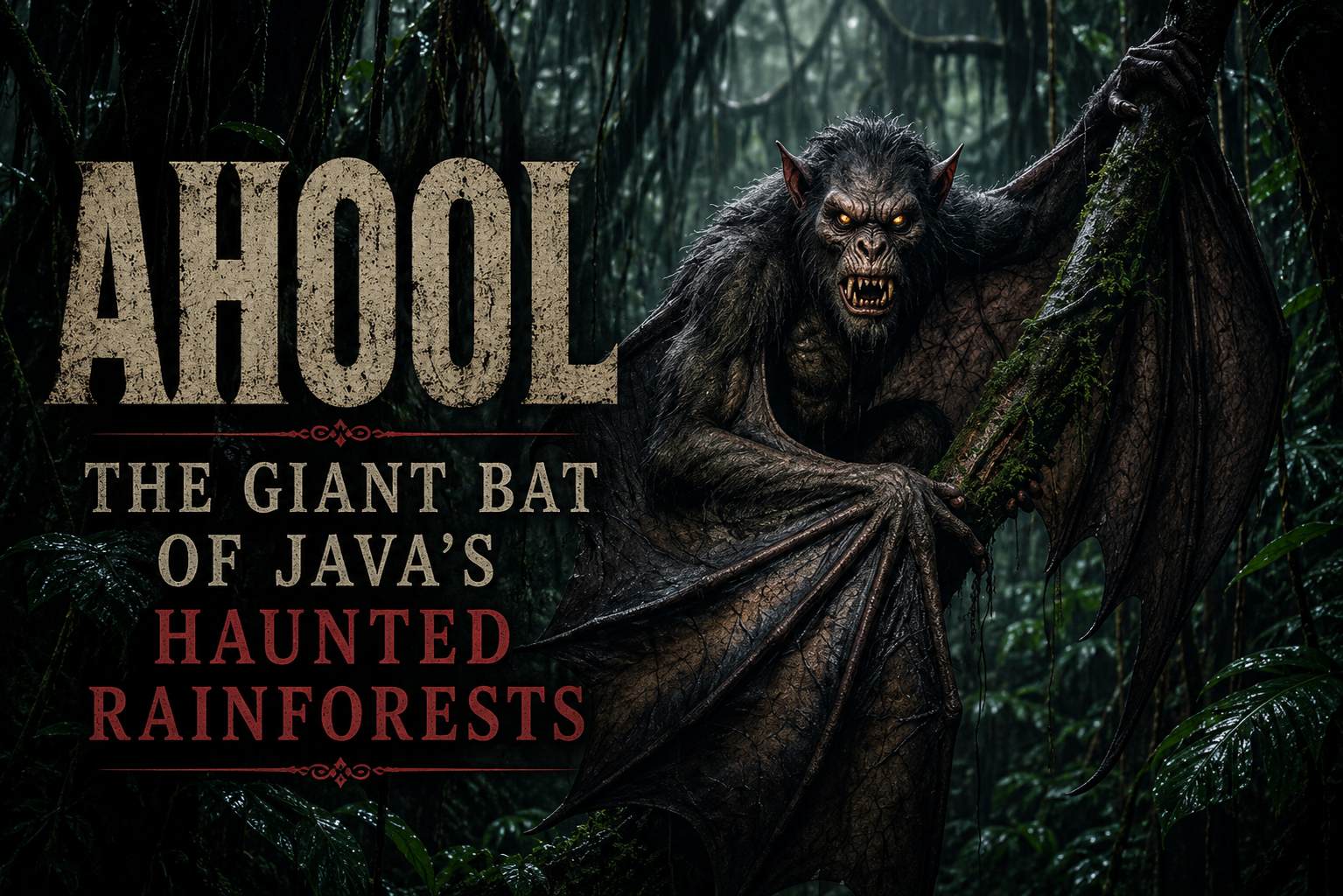
The Giant Bat of Java’s Haunted Rainforests
Far beyond the crowded cities of Indonesia, where ancient volcanic mountains disappear beneath blankets of mist and the rainforest swallows the daylight whole, stories persist of a creature unlike anything recognised by modern science.
Hidden within the dense jungles surrounding Gunung Salak, local whispers speak of an enormous winged beast that glides silently above rivers and waterfalls after sunset.
Witnesses describe a monstrous bat with leathery wings stretching wider than a small aircraft, burning crimson eyes, a flattened primate-like face, and a chilling cry that echoes through the darkness:
“A-HOOOOL…”
Unlike many legendary cryptids born solely from centuries of folklore, the Ahool occupies a curious place between myth and recorded history.
Its legend is largely rooted in the experiences of Dutch naturalist Dr. Ernest Bartels, whose encounters in the 1920s transformed an obscure local mystery into one of Southeast Asia’s most enduring cryptozoological legends.
For nearly a century, the Ahool has remained one of the most enigmatic flying cryptids ever reported. No confirmed photographs exist. No specimen has ever been recovered. Modern DNA studies have produced no evidence of an unknown giant bat lurking within the Indonesian wilderness.
Yet the legend refuses to disappear.
Towering volcanic forests, unexplored valleys and remote river gorges continue to fuel speculation that something extraordinary may still haunt the mountains of West Java.
Whether misunderstood wildlife, exaggerated folklore, or an undiscovered species hidden within one of Earth’s richest ecosystems, the Ahool remains one of cryptozoology’s greatest aerial mysteries.
Today, the creature stands as one of Indonesia’s most famous cryptids, joining the ranks of the Yeti, Mothman and Bigfoot as a symbol of humanity’s enduring fascination with the unknown.
It is a legend carried not by footprints in snow, but by an eerie cry drifting through the rainforest canopy, a sound that, according to those who claim to have heard it, can still silence an entire jungle.
Could the Ahool simply be a case of mistaken identity, born from encounters with giant owls or fruit bats? Or does something truly unknown still glide through the ancient forests beneath the shadow of Gunung Salak?
Whatever the truth may be, the legend of the Ahool continues to haunt the mist-covered jungles of Java, where every unexplained shadow overhead keeps one of Southeast Asia’s greatest cryptid mysteries alive.
👤 Physical Appearance
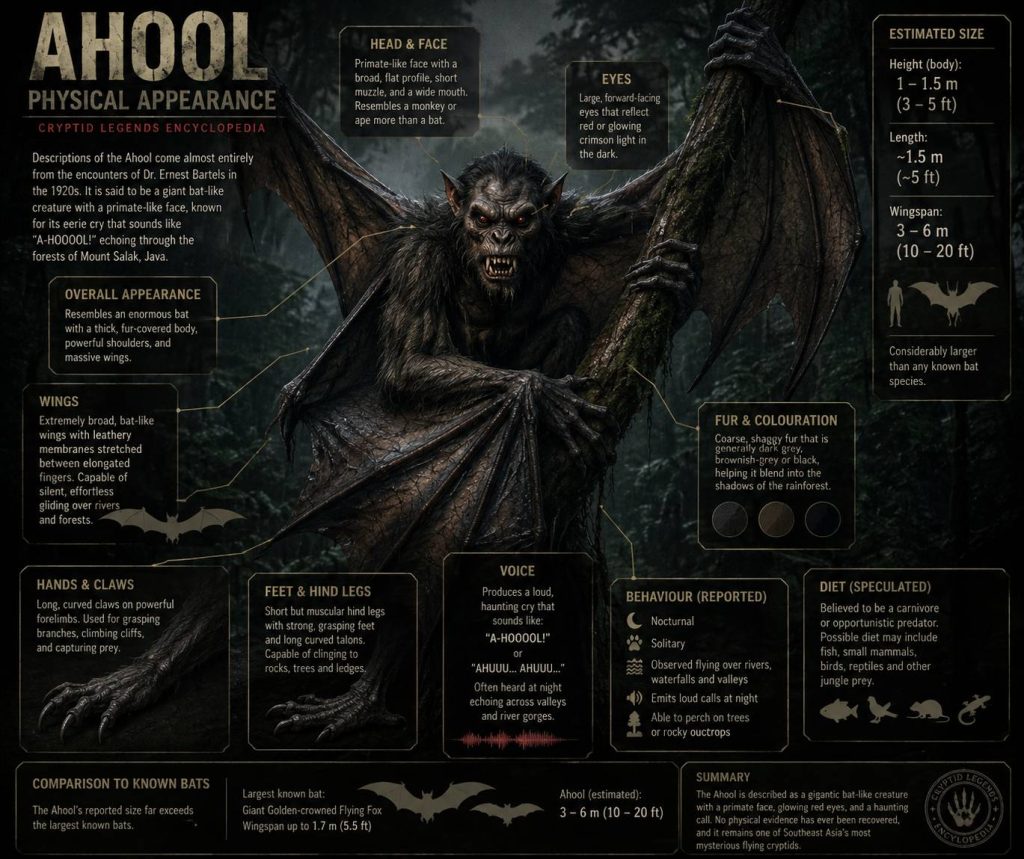
Unlike many legendary creatures whose appearance has evolved through generations of folklore, descriptions of the Ahool remain surprisingly consistent.
Almost every account traces back to the observations of Dr. Ernest Bartels and later retellings within Indonesian cryptozoology, describing an enormous flying animal that combined the features of a giant bat with those of a primate.
Although no confirmed photographs or physical remains have ever been recovered, eyewitness descriptions have established a remarkably distinctive image that separates the Ahool from both known bats and birds.
📏 Estimated Size
The Ahool is consistently described as being far larger than any living bat.
Reported measurements include:
- Height (body): Approximately 1–1.5 metres (3–5 feet)
- Estimated Length: Around 1.5 metres (5 feet)
- Wingspan: Approximately 3–6 metres (10–20 feet) depending on the account
- Estimated Weight: Unknown
Even the smallest reported wingspan would make the Ahool significantly larger than the world’s largest known bats, whose maximum wingspans rarely exceed 1.7 metres (5.5 feet).
🦇 Overall Appearance
Witnesses generally describe the Ahool as resembling an enormous bat rather than a bird.
Common descriptions include:
- Massive leathery wings
- Thick body covered in grey or dark brown fur
- Broad chest
- Powerful shoulders supporting immense wings
- Large clawed forelimbs
- Short but muscular hind legs
- Strong grasping feet capable of perching on rocks or branches
Its silhouette has often been compared to a gigantic flying fox or megabat, although vastly exceeding any known species in size.
🐵 Head and Face
Perhaps the Ahool’s most unusual feature is its distinctly primate-like head.
Descriptions frequently mention:
- Flat, almost human-like facial profile
- Broad forehead
- Short muzzle
- Rounded ears
- Large mouth
- Monkey or ape-like appearance rather than the elongated snout seen in most bats
This unusual facial structure is one of the reasons the Ahool has remained difficult to explain through simple misidentification.
👁️ Eyes
The creature’s eyes are commonly described as:
- Large and forward facing
- Bright red or glowing crimson in darkness
- Highly reflective when illuminated
- Intense and intimidating in appearance
Whether this “glow” represents genuine bioluminescence or simply eyeshine reflecting torchlight remains unknown.
🦅 Wings
The Ahool’s wings are its defining characteristic.
Witnesses describe them as:
- Extremely broad
- Bat-like rather than feathered
- Leathery membranes stretched between elongated fingers
- Capable of silent gliding
- Powerful enough for sustained flight through mountainous rainforest
Some reports suggest the creature was able to soar effortlessly above rivers and waterfalls with very little wing movement, much like modern vultures or large raptors riding thermal currents.
🦶 Hands, Feet and Claws
The Ahool is frequently described as possessing formidable claws.
Reported features include:
- Long curved claws on both forelimbs and hind feet
- Strong grasping ability
- Capable of clinging to cliffs, trees and rocky ledges
- Powerful enough to seize fish or other prey
Some cryptozoological accounts even suggest the creature occasionally rested on the ground with its feet turned backwards, although this detail is not consistently reported and may represent folklore rather than eyewitness observation.
🎨 Colouration
Descriptions generally remain consistent regarding the Ahool’s colouring:
- Grey
- Dark grey
- Brownish-grey
- Black in low light
Its fur is often described as shaggy or coarse, helping it blend into the shadowy rainforest canopy.
🔊 Distinctive Call
Unlike many cryptids that are primarily identified by appearance, the Ahool is equally famous for its unmistakable vocalisation.
Witnesses describe a loud, haunting cry sounding remarkably like:
“A-HOOOOL!”
or
“AHUUU… AHUUU…”
This eerie call is said to echo across valleys and river gorges during the night and ultimately gave the creature its modern name.
⚖️ Comparison with Known Wildlife
One of the greatest challenges facing the Ahool legend is that no known animal perfectly matches its reported appearance.
While sceptics have proposed that eyewitnesses may have mistaken:
- Large flying foxes (fruit bats)
- Javan wood-owls
- Other nocturnal birds
none of these species possess the combination of an enormous wingspan, primate-like face and distinctive “Ahool” call consistently reported throughout the legend.
As a result, the Ahool remains one of cryptozoology’s most visually distinctive flying creatures—an alleged giant bat unlike anything formally recognised by modern zoology.
📍 Location & Country
📌 Primary Location: Gunung Salak National Park
🏞️ Region: West Java Province
🌍 Country: Indonesia
📍 Specific Area: Mount Salak (Gunung Salak), Mount Halimun–Salak National Park, Tjidjenkol River, Tjemoro River, surrounding waterfalls, volcanic rainforest, and the dense mountain valleys of West Java.
🗺️ Coordinates (Approx.): 6.7170° S, 106.7330° E
🌋 The Volcanic Rainforests of Gunung Salak
The Ahool is almost exclusively associated with the remote volcanic forests surrounding Gunung Salak, one of the most mysterious mountains in Indonesia.
Rising to approximately 2,211 metres (7,254 feet) above sea level, the dormant stratovolcano dominates the landscape of West Java, where steep ridges, deep river gorges and dense tropical rainforest create one of the island’s most inaccessible wilderness areas.
Unlike cryptids linked to vast geographic ranges, the Ahool’s legend remains remarkably localised.
Nearly every historical account, including those attributed to Dutch naturalist Dr. Ernest Bartels during the 1920s, originates from the forests, rivers and waterfalls surrounding Mount Salak.
It was here that Bartels reported seeing an enormous bat-like creature soaring above a jungle waterfall before later hearing its distinctive “A-HOOOOL!” call echo through the night sky above his riverside camp.
Today, much of this landscape forms part of Gunung Halimun–Salak National Park, a protected expanse of ancient rainforest covering more than 870 square kilometres (336 square miles).
The park is recognised as one of Indonesia’s richest biodiversity hotspots, home to critically endangered species including the Javan leopard, Javan gibbon, silvery gibbon, and numerous endemic birds, bats and reptiles.
Its thick canopy, frequent fog, heavy rainfall and rugged volcanic terrain have helped preserve an atmosphere of mystery for centuries. Even in the modern era, large sections of the forest remain difficult to access, with hidden waterfalls, narrow ravines and dense jungle providing the perfect backdrop for one of Southeast Asia’s most enduring cryptid legends.
Whether viewed as an undiscovered flying predator or simply a product of folklore, Gunung Salak remains inseparable from the legend of the Ahool, standing as the creature’s spiritual home in both Indonesian mythology and modern cryptozoology.
🌿 Habitat
Unlike many legendary creatures associated with snowy mountains or remote wilderness, the Ahool is almost exclusively linked to one of the oldest and most biologically diverse rainforest ecosystems in Southeast Asia.
Its reported habitat consists of dense tropical jungle, steep volcanic valleys, fast-flowing rivers, deep ravines and towering waterfalls surrounding Mount Salak (Gunung Salak) in West Java, Indonesia.
This landscape is renowned for its near-constant mist, heavy rainfall and thick forest canopy, conditions that create an environment where visibility is often limited to only a few metres. Even during daylight hours, much of the rainforest floor remains cloaked in deep shadow beneath towering emergent trees.
Many alleged encounters place the creature close to rivers or waterfalls, particularly during the evening or at night. Ernest Bartels’ famous 1925 sighting reportedly occurred near a secluded waterfall, while his later 1927 encounter took place beside the Tjidjenkol River, reinforcing the idea that the creature may favour humid waterways and inaccessible ravines.
Dense Tropical Rainforest
The forests surrounding Mount Salak are among the last remaining examples of primary montane rainforest on the island of Java.
This habitat contains:
- Towering dipterocarp and evergreen forests.
- Dense bamboo thickets.
- Moss-covered volcanic cliffs.
- Hidden caves and rocky overhangs.
- Numerous rivers, streams and waterfalls.
- Thick cloud forest at higher elevations.
The near-continuous vegetation would provide exceptional concealment for any large nocturnal animal capable of gliding or flying between the forest canopy.
Nocturnal Environment
Nearly every reported Ahool encounter has occurred after sunset or during periods of low light.
Witnesses frequently describe:
- Flying silhouettes against the moonlight.
- Loud cries echoing through valleys.
- Glowing red eyes reflecting torchlight.
- Sudden appearances above rivers before disappearing into darkness.
If such a creature existed, a nocturnal lifestyle would greatly reduce the chances of human encounters while taking advantage of cooler nighttime temperatures and reduced competition from many daytime predators.
Elevation Range
Unlike fruit bats, which commonly inhabit lower tropical forests, the Ahool is traditionally associated with higher mountain elevations.
Most reports originate between approximately 500–2,000 metres (1,600–6,500 ft) above sea level, within the rugged volcanic terrain surrounding Mount Salak and neighbouring sections of Gunung Halimun–Salak National Park.
These elevations support dense cloud forests where persistent fog, frequent rain and rugged terrain make wildlife surveys particularly challenging.
Abundant Wildlife
West Java’s rainforests support an extraordinary diversity of wildlife, including many endemic species found nowhere else on Earth.
Known inhabitants include:
- 🦇 Large fruit bats (Flying Foxes)
- 🦉 Javan Wood Owl (Strix leptogrammica bartelsi)
- 🐒 Javan Gibbon
- 🐆 Javan Leopard
- 🐗 Wild Boar
- 🦎 Monitor Lizards
- 🐍 Reticulated Pythons
- 🦅 Eagles, hornbills and numerous nocturnal birds
This rich biodiversity is significant because several of these species, particularly large fruit bats and the Javan Wood Owl, have been proposed by researchers as possible explanations for reported Ahool encounters.
An Ideal Setting for Legend
Whether the Ahool represents an undiscovered animal or simply a product of folklore, its legendary home provides the perfect backdrop for mystery.
Heavy fog, dense jungle, powerful waterfalls and the eerie echoes of nocturnal wildlife combine to create an environment where unusual sounds and fleeting glimpses can easily become the foundation of enduring local legends.
For nearly a century, these forests have remained inseparable from the Ahool story, ensuring that the shadowy valleys of Mount Salak continue to occupy a unique place in cryptozoological history.
📜 Background & Legend
Unlike many legendary creatures whose origins stretch back hundreds or even thousands of years, the Ahool occupies a unique place within cryptozoology.
Rather than emerging from ancient mythology, the creature appears to represent a fascinating blend of local folklore and twentieth-century exploration.
Stories of strange flying creatures certainly existed among communities living around Mount Salak, but it was the reports attributed to Dutch naturalist Dr. Ernest Bartels during the 1920s that transformed the Ahool into one of Indonesia’s most enduring cryptid legends.
Over time, the mysterious flying creature became woven into regional folklore, with tales describing a gigantic bat-like animal haunting remote waterfalls, volcanic valleys and dense rainforest.
Its distinctive cry — “A-hool!” — became both its calling card and ultimately its name.
As the story spread beyond Indonesia through cryptozoological books, magazines and documentaries, the Ahool gained international recognition as Southeast Asia’s answer to creatures such as the Mothman, Jersey Devil and Owlman.
Despite remaining one of the lesser-known cryptids outside specialist circles, it has become a permanent fixture within modern cryptozoological literature.
Today, the Ahool exists at the crossroads between folklore, eyewitness testimony and mystery.
Whether interpreted as an undiscovered species, a misidentified nocturnal animal or simply a compelling modern legend, it continues to intrigue researchers and enthusiasts alike, with its entire reputation resting upon just a handful of extraordinary reports from the forests of West Java.
👣 Sightings History
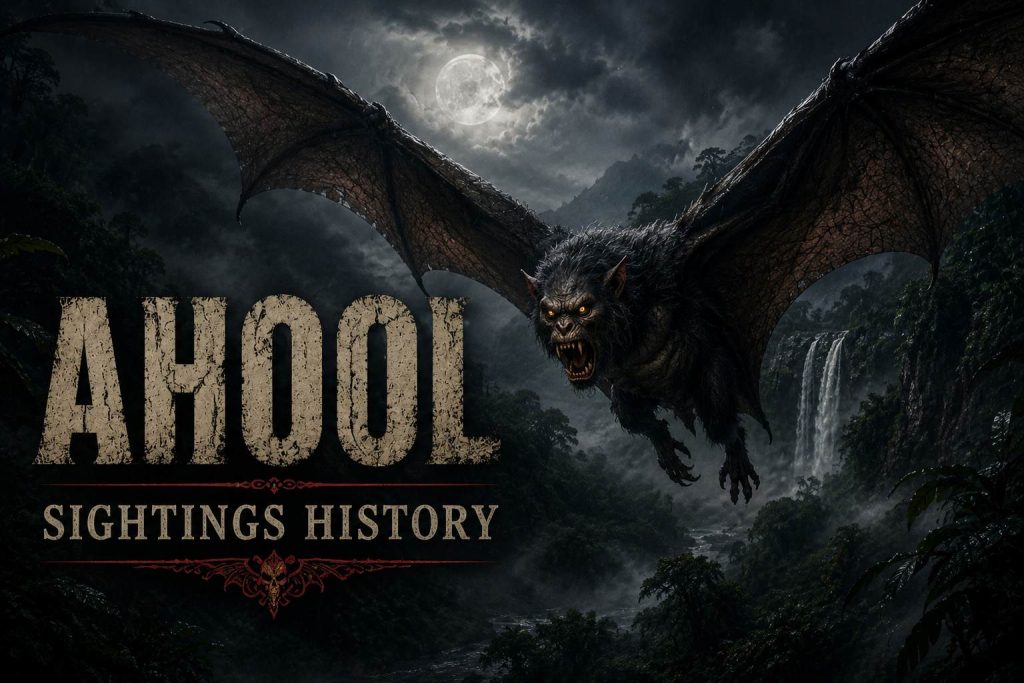
Unlike famous cryptids such as Bigfoot, the Yeti or the Loch Ness Monster, whose histories span hundreds or even thousands of reported encounters, the Ahool is unusual in that almost the entire legend originates from one respected naturalist and two closely linked experiences.
No long catalogue of eyewitnesses exists.
No newspaper flaps followed.
No organised searches uncovered additional reports.
Instead, the Ahool remains one of cryptozoology’s most mysterious creatures precisely because its reputation rests almost entirely upon a handful of remarkable observations made deep within the rainforests of West Java during the 1920s.
Whether those observations represented an undiscovered species, a misidentified animal or simply an unforgettable encounter under difficult conditions remains one of cryptozoology’s enduring mysteries.
1925 — The Waterfall Encounter
The first recorded Ahool sighting is attributed to Dr Ernest (Ernst) Bartels, a Dutch physician and naturalist living and conducting wildlife research in Java.
While exploring the dense forests surrounding Mount Salak, Bartels reached a secluded jungle waterfall during daylight.
As he approached the rocky gorge, his attention was drawn to what initially appeared to be a large figure sitting motionless upon a rock ledge above the water.
For a brief moment he reportedly believed he was looking at another human explorer.
Then the creature moved.
According to later accounts, the figure suddenly unfolded an enormous pair of leathery wings before launching itself silently into the air.
Bartels described the animal as possessing:
- A broad wingspan estimated at 3–4 metres (10–13 feet).
- A dark grey body.
- A flattened, ape-like face.
- Large forward-facing eyes.
- Powerful wings unlike any known bat.
As it flew overhead it allegedly emitted a loud cry that sounded like:
“A-HOOOOL!”
The strange vocalisation would eventually provide the creature with its modern name.
The encounter lasted only a few seconds before the animal disappeared into the surrounding rainforest canopy.
Bartels reportedly never identified it as any known species.
1927 — The Midnight Visitor
Two years later Bartels experienced the incident that cemented the Ahool legend.
While staying in a small thatched research hut beside the Tjidjenkol River near Mount Salak, he was awakened shortly before midnight by an unusually loud cry outside.
He later described hearing the distinctive call three separate times.
“A-Hool!… A-Hool!… A-Hool!”
Recognising the sound immediately from his earlier encounter, Bartels hurried outside carrying a lantern.
Looking upward into the moonlit sky, he reportedly observed a massive dark silhouette gliding silently above the treetops.
Although the creature remained too high to make out fine details, Bartels believed it matched the same enormous flying animal he had witnessed two years earlier.
Within moments it disappeared downstream into the darkness.
No physical evidence was recovered.
No footprints were found.
The encounter ended as suddenly as it had begun.
Local Folklore
Although Bartels’ reports became the foundation of modern Ahool lore, stories of strange flying creatures were already said to exist among some communities living around Mount Salak.
Local accounts describe enormous nocturnal animals inhabiting remote valleys, rivers and waterfalls where dense rainforest remains largely untouched.
Common descriptions include:
- Giant bat-like creatures.
- Red glowing eyes.
- Loud screaming vocalisations.
- Solitary nocturnal behaviour.
- Rare appearances during misty or rainy weather.
Whether these traditions genuinely pre-date Bartels’ experiences or became influenced by later publications remains uncertain.
No historical Indonesian folklore has yet been discovered that clearly documents the Ahool before the twentieth century.
No Modern Sighting Flap
Unlike many famous cryptids, the Ahool has never experienced a major wave of sightings.
There are:
- No verified modern eyewitness clusters.
- No police investigations.
- No newspaper reporting flaps.
- No photographs.
- No recovered biological evidence.
- No expedition discovering fresh evidence after Bartels.
Instead, nearly every modern account can ultimately be traced back to Bartels’ original observations, making the Ahool one of cryptozoology’s most singular and elusive legends.
Legacy of the Sightings
Although consisting of only two documented encounters, Bartels’ reports proved remarkably influential.
They inspired decades of speculation among cryptozoologists, who debated whether the Ahool might represent:
- An undiscovered giant species of bat.
- A gigantic nocturnal owl.
- A surviving prehistoric flying reptile.
- An entirely unknown flying mammal.
To date, however, no additional evidence has emerged to support any of these hypotheses.
The Ahool therefore occupies a unique place within cryptozoology, a creature whose entire legend rests upon two brief encounters recorded nearly a century ago, leaving behind one of the field’s smallest, yet most enduring, sighting histories.
🎬 Ahool in Popular Culture
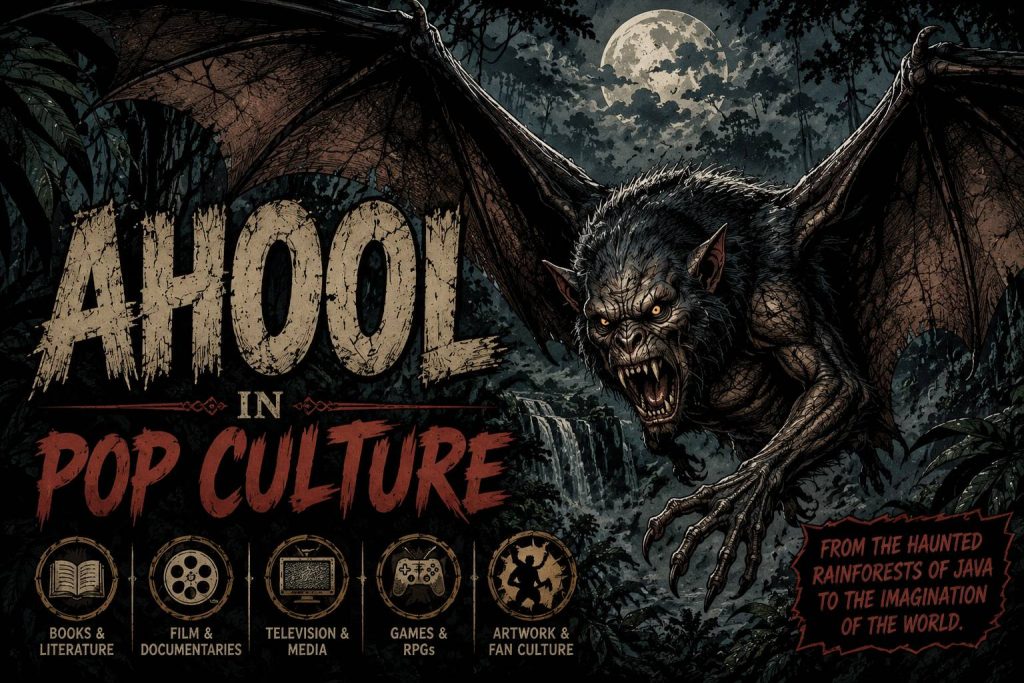
Although the Ahool has never achieved the worldwide fame of the Yeti or Bigfoot, its eerie appearance and mysterious origins have earned it a dedicated following within cryptozoology.
Over the past century, the creature has gradually evolved from an obscure expedition anecdote into one of Southeast Asia’s most recognisable cryptids, appearing in books, documentaries, artwork, games and modern internet folklore.
Unlike many famous monsters, however, the Ahool remains something of a hidden gem.
Its limited number of reported encounters has meant that most appearances focus on mystery rather than horror, preserving the creature’s reputation as one of cryptozoology’s most elusive flying enigmas.
📚 Books & Cryptozoology Literature
The Ahool first entered Western cryptozoological literature through the writings of researchers who collected unusual animal reports from around the world.
Among the most influential works are:
- Ivan T. Sanderson – one of the earliest cryptozoologists to popularise Dr. Ernest Bartels’ account for English-speaking audiences.
- Bernard Heuvelmans – often referred to as the “Father of Cryptozoology,” whose collections of unexplained animal reports helped preserve the Ahool story.
- Karl Shuker – has written extensively about the Ahool in several cryptozoological books, analysing Bartels’ reports alongside possible zoological explanations.
- Loren Coleman & Jerome Clark – included the Ahool in numerous encyclopaedias covering mysterious animals and unexplained creatures.
- A to Z Cryptozoology – one of the best-known modern reference books documenting the Ahool alongside hundreds of other legendary creatures.
Today, virtually every major cryptid encyclopaedia includes an entry for the Ahool, ensuring the legend continues reaching new generations of researchers.
📺 Television & Documentaries
Although never receiving its own major television series, the Ahool has appeared in numerous documentaries exploring mysterious creatures from around the world.
Featured in productions including:
- Cryptozoology documentary series
- Television specials covering unexplained animals
- YouTube documentaries focusing on Southeast Asian folklore
- Independent films exploring Indonesia’s mysterious wildlife
- Numerous paranormal and mystery channels examining Bartels’ sightings
Most documentaries present the Ahool alongside creatures such as:
- Orang Pendek
- Kongamato
- Thunderbird
- Ropen
- Flying humanoid legends
Its unusual combination of giant bat, primate and possible pterosaur characteristics has made it a favourite subject among speculative cryptid researchers.
🎨 Artwork & Internet Culture
The internet has dramatically expanded the Ahool’s popularity.
Artists frequently depict it as:
- A monstrous bat with glowing red eyes
- A terrifying primate-headed flying predator
- A surviving prehistoric pterosaur
- A supernatural guardian of Java’s volcanic forests
Digital illustrations often portray the creature emerging from mist-filled rainforest canopies, gliding silently above waterfalls, or perched high within ancient jungle trees watching unsuspecting explorers below.
These dramatic interpretations have helped transform one of cryptozoology’s lesser-known creatures into an increasingly recognisable internet cryptid.
🎲 Tabletop Games & Roleplaying
While the Ahool has not yet enjoyed widespread representation in mainstream trading card games or board games, it has appeared in:
- Independent tabletop RPG bestiaries
- Homebrew Dungeons & Dragons campaigns
- Pathfinder fan supplements
- Cryptid-themed roleplaying adventures
- Online monster databases used by game designers
Its combination of flight, stealth and jungle habitat makes it an ideal encounter for fantasy and horror roleplaying settings.
🌍 A Growing International Cryptid
For much of the twentieth century, the Ahool remained largely unknown outside specialist cryptozoology circles.
Today, thanks to documentaries, podcasts, YouTube creators and online encyclopaedias, it has become one of the best-known flying cryptids from Southeast Asia.
Its mysterious origins, striking appearance and extremely limited number of eyewitness accounts have given it a unique place within modern cryptid culture.
Unlike creatures whose legends have been diluted through countless fictional adaptations, the Ahool retains an air of authenticity rooted almost entirely in two reported encounters deep within the rainforests of Java, a rarity that continues to fascinate researchers and enthusiasts around the world.