
Unlike the ancient legends of Bigfoot or the Mothman, the story of Batsquatch is surprisingly modern.
Said to haunt the mist-covered forests surrounding Mount St. Helens, this enormous winged cryptid first emerged into public consciousness only years after one of America’s most devastating volcanic disasters.
Witnesses describe a towering blue-furred creature with enormous bat-like wings, glowing eyes, and an intimidating presence capable of stopping even the bravest observer in their tracks.
Whether born from folklore, misidentification, or something that still remains unexplained, Batsquatch has become one of the Pacific Northwest’s most mysterious modern cryptids, its legend forever intertwined with the shadow of the volcano that transformed the landscape forever.
👁️ Physical Appearance & Description
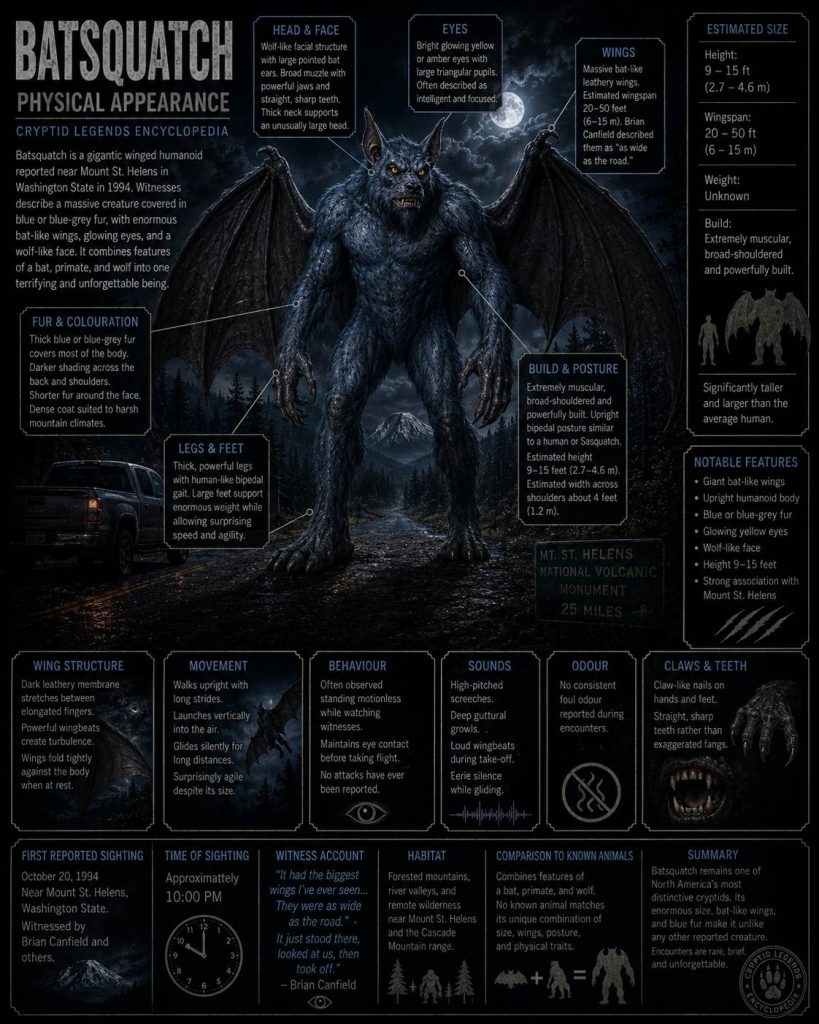
Although no physical evidence has ever been recovered, eyewitness descriptions of Batsquatch have remained surprisingly consistent since the original 1994 encounter.
Witnesses describe a gigantic winged humanoid unlike any known animal, combining features of a bat, primate and wolf into a single terrifying creature.
Its appearance has often been compared to a monstrous fusion of Bigfoot and a giant bat, making it one of North America’s most distinctive modern cryptids.
General Description
- Height: Approximately 9–15 feet (2.7–4.6 m) tall.
- Build: Extremely muscular, broad-shouldered and powerfully built.
- Posture: Upright, bipedal stance similar to a human or Sasquatch.
- Estimated Wingspan: Witnesses estimate 20–50 feet (6–15 m), with Brian Canfield describing the wings as “as wide as the road.”
- Weight: Unknown, though likely several hundred kilograms if descriptions are accurate.
Head & Face
The creature’s head is often described as one of its most unsettling features.
- Wolf-like or canine facial structure.
- Large pointed ears resembling those of a bat.
- Bright glowing yellow or amber eyes.
- Large triangular pupils.
- Broad muzzle with powerful jaws.
- Straight, sharp teeth rather than exaggerated fangs.
- Thick neck supporting an unusually large head.
Unlike many flying cryptids, witnesses generally describe Batsquatch as displaying distinctly mammalian rather than bird-like facial features.
Fur & Colouration
The original eyewitness account consistently describes:
- Thick blue or blue-grey fur covering most of the body.
- Darker shading across the back and shoulders.
- Shorter fur around the face.
- Dense coat capable of surviving the harsh mountain climate surrounding Mount St. Helens.
The unusual blue colouring remains one of the creature’s most distinctive characteristics and sets it apart from other North American cryptids.
Wings
Perhaps the defining characteristic of Batsquatch is its enormous bat-like wings.
Witnesses describe:
- Massive leathery membrane wings similar to those of a giant bat.
- Dark wing membranes contrasting against the lighter fur.
- Powerful wingbeats capable of creating noticeable turbulence.
- Wings folding tightly against the body while standing.
- Silent gliding interspersed with slow, heavy flapping during take-off.
Brian Canfield reported the creature’s wings generated enough force to rock his pickup truck as it launched back into the air.
Arms & Hands
Descriptions indicate unusually long upper limbs.
- Long muscular arms reaching below the waist.
- Large hands equipped with elongated fingers.
- Dark claw-like nails capable of gripping branches or rocky surfaces.
- Dexterous movement rather than simple animalistic behaviour.
Legs & Feet
Eyewitnesses consistently describe powerful lower limbs.
- Thick muscular legs.
- Human-like bipedal gait.
- Large feet capable of supporting the creature’s enormous size.
- Surprisingly agile movement despite its bulk.
Behaviour & Movement
Witnesses report that Batsquatch moves with remarkable confidence.
Observed behaviour includes:
- Standing motionless while observing witnesses.
- Maintaining prolonged eye contact.
- Walking upright with long deliberate strides.
- Launching vertically into flight.
- Soaring effortlessly above forests and mountains.
- Flying silently before disappearing into darkness or cloud.
Unlike many cryptids associated with aggression, Batsquatch has never been reported physically attacking a witness. Instead, encounters typically involve brief observation before the creature departs.
Odour & Vocalisations
Unlike creatures such as Bigfoot or the Skunk Ape, no consistent foul odour has been associated with Batsquatch.
Reported sounds include:
- High-pitched screeches.
- Deep guttural growls.
- Loud wingbeats during take-off.
- An eerie silence during gliding flight.
Most witnesses focus far more on the creature’s immense wings and intimidating appearance than on any distinctive vocalisations.
Distinguishing Features
Batsquatch is most commonly identified by the following characteristics:
- 🦇 Giant bat-like leathery wings.
- 👣 Upright humanoid body.
- 🟦 Blue or blue-grey fur.
- 👁️ Glowing yellow eyes.
- 🐺 Wolf-like facial features.
- 📏 Estimated height of 9–15 feet.
- 🌋 Strong association with Mount St. Helens and the Cascade Mountains.
Taken together, these features make Batsquatch one of the most visually unique cryptids in North American folklore, blending characteristics of mammals and bats into a creature unlike any recognised species.
📍 Location & Country
- 📌 Primary Location: Mount St. Helens National Volcanic Monument
- 🏞️ Region: Cascade Range, Southwestern Washington
- 🌍 Country: United States
- 📍 Specific Area: Mount St. Helens, Gifford Pinchot National Forest, Camp One Road, Lake Kapowsin, Mount Rainier foothills, and the surrounding forests of the Cascade Mountains.
- 🗺️ Coordinates (Approx.): 46.1912° N, 122.1944° W
🌋 Location Overview
Batsquatch is most commonly associated with the dense conifer forests surrounding Mount St. Helens in Washington State.
Although the creature’s first widely reported encounter occurred on Camp One Road near Lake Kapowsin in 1994, the legend quickly became intertwined with the aftermath of the catastrophic 1980 eruption.
Today, sightings and folklore centre around the volcanic wilderness of the Cascade Range, particularly the forests surrounding Mount St. Helens, where vast tracts of remote woodland, rugged mountains, lava fields and frequent mist provide an ideal setting for one of North America’s most mysterious winged cryptids.
🌲 Habitat
Unlike many cryptids that are associated with a single forest or stretch of wilderness, Batsquatch is believed to inhabit the vast volcanic landscapes of the Pacific Northwest.
Witnesses most often describe encounters occurring in remote mountain forests, where towering evergreen trees, steep valleys and volcanic terrain provide both isolation and natural cover.
The legend is closely linked to environments shaped by the 1980 eruption of Mount St. Helens. Dense conifer forests, ash-covered ridges, lava fields, abandoned logging roads and deep river valleys create an eerie landscape where visibility is often limited by fog, rain and low cloud.
These conditions have long fuelled stories of strange creatures disappearing into the wilderness.
Unlike Bigfoot, which is commonly described as remaining on the ground, Batsquatch is said to move both through the forest canopy and across open mountain skies.
Reports frequently place the creature soaring above tree lines before descending into secluded woodland, suggesting it favours rugged, elevated terrain where human activity is minimal.
Many cryptozoologists also note that the Cascade Range supports an abundance of wildlife, including deer, elk, mountain goats, black bears and countless smaller mammals and birds.
If a large unknown predator or omnivore were ever to exist, these forests would theoretically provide plentiful food, freshwater sources and extensive areas capable of concealing an elusive species.
Despite these claims, there is no scientific evidence that any undiscovered winged primate inhabits the Cascade Mountains.
Wildlife experts instead point to the region’s dramatic weather, dense forests and large birds of prey as factors that can contribute to misidentifications, particularly during dawn, dusk or periods of poor visibility.
📖 Background & Legend
Unlike many North American cryptids whose legends stretch back centuries, Batsquatch is a remarkably modern addition to American folklore.
The creature did not emerge from ancient Native American legends or pioneer tales, but instead entered popular culture during the 1990s, becoming one of the newest cryptids to capture the imagination of the Pacific Northwest.
The legend is almost inseparable from Mount St. Helens, whose catastrophic eruption on 18 May 1980 dramatically transformed the surrounding landscape.
The explosion destroyed vast forests, reshaped entire mountainsides and left behind an eerie volcanic wilderness that quickly became fertile ground for stories of unexplained creatures.
Although no contemporary reports from 1980 describe a giant winged humanoid emerging from the eruption itself, later retellings frequently linked Batsquatch to the disaster, suggesting the creature either fled from the devastated forests or somehow appeared in its aftermath.
As the legend spread, Batsquatch evolved into something distinctly different from traditional Bigfoot folklore.
Rather than a reclusive forest-dwelling primate, witnesses described an enormous winged humanoid capable of soaring above the Cascade Mountains before vanishing into dense woodland.
This combination of mammalian and bat-like characteristics gave the cryptid an identity unlike any other creature in American folklore, drawing comparisons to everything from giant bats and prehistoric pterosaurs to supernatural entities.
The creature’s association with volcanic landscapes also helped distinguish it from other cryptids. Mist-covered forests, lava fields, abandoned logging roads and remote mountain valleys created a dramatic backdrop that naturally encouraged speculation, particularly in a region already famous for Bigfoot sightings, unexplained lights and wilderness legends.
Today, Batsquatch occupies a unique place in Pacific Northwest folklore. While its documented history is relatively short, the creature has become one of Washington State’s best-known modern cryptids, frequently appearing alongside Bigfoot and other regional legends.
Despite the absence of physical evidence, the mystery surrounding the winged beast continues to inspire investigators, hikers and cryptozoology enthusiasts, ensuring that the legend remains firmly rooted in the shadow of Mount St. Helens.
👣 Sighting History
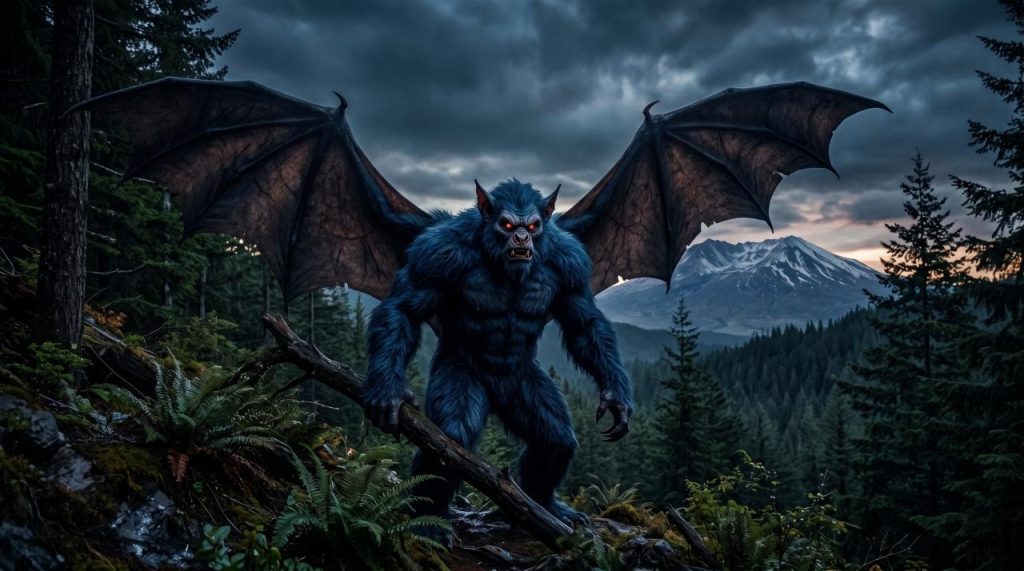
Although Batsquatch is now one of the Pacific Northwest’s most recognisable modern cryptids, its documented history is surprisingly short.
Unlike Bigfoot or other long-established North American legends, Batsquatch first entered the public record during the spring of 1994, before gradually evolving into a regional mystery associated with Mount St. Helens and the Cascade Mountains.
Many internet articles claim the creature first appeared immediately after the catastrophic 1980 eruption of Mount St. Helens, with rumours suggesting eyewitnesses saw a giant winged humanoid emerging from the volcanic ash cloud.
However, no contemporary newspaper articles, police reports or official records from 1980 have ever confirmed these claims.
Modern researchers generally regard these eruption stories as folklore that developed years later rather than documented eyewitness evidence.
🦇 April 1994 – Brian Canfield Encounter (First Documented Sighting)
The earliest widely documented Batsquatch sighting occurred during the evening of 16 April 1994, when 18-year-old Brian Canfield was driving along Camp One Road, near Lake Kapowsin, Washington.
According to Canfield, his pickup truck suddenly lost power without warning while travelling through the remote forest. Moments later he noticed an enormous blue-grey creature descending from above before landing directly on the hood of his vehicle.
Canfield later described the creature as:
- Standing approximately 9 feet (2.7 metres) tall.
- Covered in blue-tinted fur.
- Possessing enormous bat-like wings spanning almost the width of the road.
- Large glowing yellow eyes.
- Pointed ears.
- A wolf-like face with sharp, straight teeth.
- Powerful clawed hands.
Rather than immediately attacking, the creature reportedly stared directly at Canfield through the windscreen before spreading its immense wings and launching back into the night sky.
Canfield stated the force of the wingbeats caused his truck to rock violently before the creature disappeared towards the forests surrounding Mount Rainier.
Perhaps the strangest aspect of the encounter was what happened next.
Canfield claimed that the truck, which moments earlier had completely stalled, suddenly restarted without any mechanical intervention once the creature had departed.
Shaken by the experience, he immediately returned home and informed his parents of what had happened.
📰 Tacoma News Tribune Investigation
Unlike many cryptid stories that first surfaced decades later, Brian Canfield’s account received immediate newspaper coverage.
On 24 April 1994, veteran journalist C.R. Roberts published Canfield’s story in the Tacoma News Tribune, making it the first documented public report of Batsquatch.
Rather than dismissing the teenager outright, Roberts personally interviewed Canfield, his family and several neighbours.
After conducting his investigation, Roberts wrote that Canfield appeared to be a sincere young man with no obvious motive to fabricate the story.
In one of the most frequently quoted passages surrounding the case, Roberts concluded:
“I believe Brian Canfield… it did happen, I’m willing to put my life on it.”
While this statement represented Roberts’ personal opinion rather than scientific evidence, it remains one of the reasons the encounter continues to attract attention within cryptozoology today.
A follow-up article published shortly afterwards reinforced the newspaper’s coverage and featured artist Dave Kiele’s now-famous illustration based directly upon Canfield’s description.
✈️ 1994 – Pilot Encounter
Not long after Canfield’s experience entered the public domain, another witness reportedly came forward.
Local private pilot Butch Whitaker claimed he encountered a large winged humanoid while flying a light aircraft near Mount Rainier.
According to later interviews, Whitaker described watching the creature pace his aircraft for several minutes before abruptly turning away and disappearing into the surrounding mountains.
Although considerably less documented than Canfield’s encounter, the report helped establish the idea that Batsquatch was capable of sustained flight across the Cascade Range rather than remaining confined to the forest floor.
🌲 Late 1990s–2010s – Scattered Reports
Following the publicity generated during 1994, occasional reports continued to emerge throughout Washington and neighbouring states.
Witnesses described:
- Large winged humanoids flying above dense forests.
- Glowing eyes observed at dusk.
- Enormous bat-like silhouettes crossing mountain ridges.
- Deep wingbeats accompanied by sudden silence within surrounding woodland.
Most of these accounts, however, originated from internet forums, paranormal websites or second-hand retellings many years after the alleged events occurred.
Unlike the original Canfield case, few included named witnesses or contemporary newspaper documentation, making independent verification impossible.
🪵 The Oregon Logging Truck Story
One frequently repeated account concerns an anonymous logging truck driver in Oregon who allegedly struck an enormous winged creature while travelling along a remote forest road.
Descriptions of the animal differ considerably depending upon the source.
Some versions describe:
- A creature over 15 feet tall.
- Purple glowing eyes.
- Tiny wings.
- A stockier, almost gargoyle-like appearance.
Because these descriptions differ dramatically from Brian Canfield’s original account, many cryptozoologists believe this story either refers to an entirely different creature or represents folklore that later became attached to the Batsquatch legend.
🏔️ Mount Shasta Reports
Several later stories place similar winged humanoids around Mount Shasta in northern California.
One widely circulated report from 2009 described hikers observing a gigantic winged figure emerging from the mountains before disappearing into cloud cover.
Although often linked with Batsquatch, these reports occur hundreds of miles from Mount St. Helens and involve substantially different descriptions, leading many researchers to treat them as separate regional cryptid traditions rather than confirmed Batsquatch encounters.
🔍 Modern Assessment
Today, the Brian Canfield encounter remains the only extensively documented Batsquatch sighting supported by contemporary newspaper reporting and named witnesses.
While numerous additional stories have appeared over the past three decades, most rely entirely upon anecdotal testimony without supporting photographs, physical evidence or official investigations.
Researchers continue to debate whether Canfield witnessed an unidentified animal, a remarkable misidentification or an experience that has since evolved into modern folklore.
Despite the absence of verifiable physical evidence, the 1994 Tacoma News Tribune investigation ensured that Batsquatch secured a permanent place within Pacific Northwest cryptid history, transforming a single extraordinary encounter into one of America’s best-known modern monster legends.
🎭 Batsquatch in Popular Culture
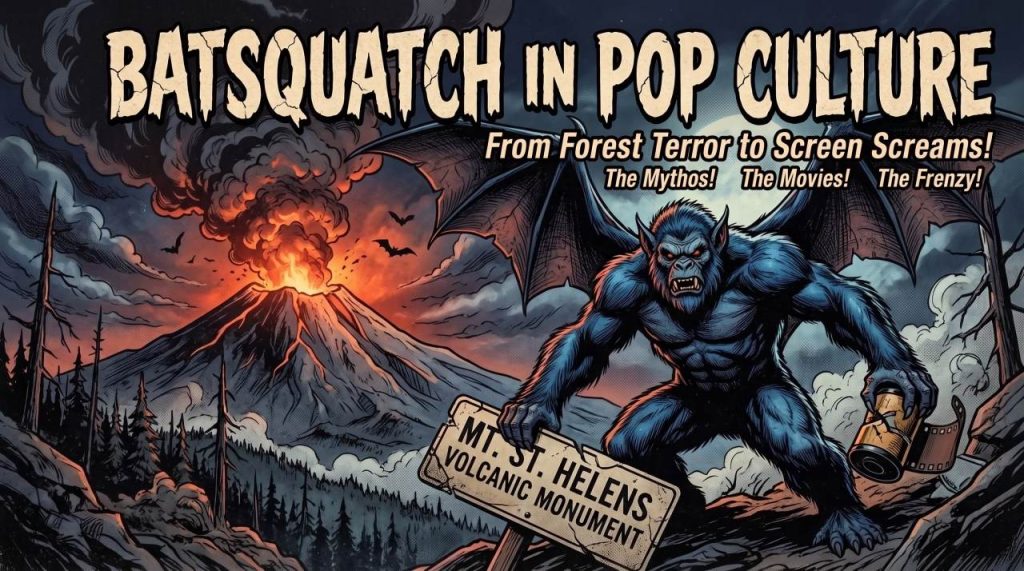
Although Batsquatch first entered public consciousness during the 1990s, the mysterious winged cryptid has rapidly become one of the Pacific Northwest’s most recognisable modern monsters.
Its striking appearance and association with Mount St. Helens have made it a popular subject for documentaries, podcasts, books, video games, craft brewing, trading cards and cryptid merchandise.
📚 Books
Batsquatch has appeared in numerous cryptozoology books covering North American monsters and unexplained creatures, including:
- United States of Cryptids (J.W. Ocker, 2023)
- Mysterious Creatures: A Guide to Cryptozoology by George M. Eberhart
- Various Pacific Northwest cryptid guides and regional folklore collections
- Independent cryptozoology publications exploring modern American cryptids and volcanic folklore
Most publications trace the legend back to Brian Canfield’s 1994 encounter while examining possible links between Mount St. Helens and later sightings.
📺 Television
Batsquatch has appeared in numerous paranormal and cryptozoology television programmes, including:
- Monsters and Mysteries in America (Travel Channel)
- Monsters of America
- Various History Channel and Travel Channel cryptid specials
- Numerous independent documentary productions exploring Pacific Northwest legends
Although often featured alongside Bigfoot and Mothman, Batsquatch remains one of the few cryptids strongly associated with volcanic landscapes.
🎙️ Podcasts
The creature has become a favourite subject within paranormal podcasts, including:
- Camp Monsters
- One Strange Thing
- Numerous independent Bigfoot and cryptozoology podcasts
- Pacific Northwest folklore series
Most discussions revisit the original Brian Canfield encounter while debating possible explanations for the winged humanoid.
🍺 Rogue Ales – Batsquatch IPA
Perhaps the cryptid’s most famous commercial appearance comes from Rogue Ales, whose Batsquatch Hazy IPA has become one of the brewery’s best-known beers.
Released in 2018, the beer embraces the legend with the playful slogan:
“All stories of Batsquatch are a little hazy…”
The colourful artwork depicts the legendary winged creature soaring above Mount St. Helens and has introduced the cryptid to countless people outside the cryptozoology community.
Today, Batsquatch IPA remains one of the most recognisable pieces of merchandise inspired by the creature.
🎮 Video Games
While Batsquatch has yet to achieve the same level of fame as Bigfoot or Mothman in gaming, it has appeared in:
- Independent cryptid-themed games
- Tabletop role-playing game bestiaries
- Fan-created horror games inspired by Pacific Northwest folklore
Its dramatic appearance makes it a popular choice for creature artists and indie horror developers.
🃏 MetaZoo Trading Card Game
Batsquatch became part of the hugely popular MetaZoo Cryptid Nation trading card game, introducing the legendary creature to a new generation of collectors.

🃏 MetaZoo Card Details
- Card Name: Batsquatch
- Set: Cryptid Nation – 2nd Edition
- Card Number: 42/159
- Rarity: Rare
- Aura Type: Lightning
- Beastie Type: Cryptid
- Region: Washington State
The artwork portrays Batsquatch as a towering blue-furred winged humanoid emerging from the forests surrounding Mount St. Helens beneath storm-filled skies, closely reflecting the creature’s traditional folklore.
Since MetaZoo’s release, Batsquatch has become one of the better-known Pacific Northwest cryptids among trading card collectors.
🎨 Merchandise
The creature regularly appears on:
- T-shirts
- Hoodies
- Stickers
- Posters
- Art prints
- Enamel pins
- Cryptid-themed apparel
- Handmade collectibles
- Independent artist merchandise
Its imposing silhouette and enormous wings make it one of the most visually distinctive modern cryptids.
🏔️ Tourism & Local Folklore
Although Batsquatch does not yet have an annual festival comparable to Mothman or the Flatwoods Monster, the creature has become firmly woven into Pacific Northwest folklore.
Visitors exploring Mount St. Helens, the Cascade Mountains and surrounding hiking trails frequently encounter references to Batsquatch in:
- Cryptid trail guides
- Local folklore books
- Gift shops
- Tourism blogs
- Hiking websites
- Regional paranormal events
The Washington Trails Association has even featured Batsquatch in guides celebrating the state’s legendary creatures, cementing its place alongside Bigfoot as one of Washington’s most recognisable cryptids.
🌎 Lasting Legacy
Despite its relatively recent origins, Batsquatch has quickly established itself as one of America’s most distinctive modern cryptids.
From newspaper headlines and eyewitness testimony to trading cards, craft beer and paranormal documentaries, the mysterious winged guardian of Mount St. Helens continues to capture imaginations around the world.
Unlike many legendary creatures whose origins have faded into folklore, Batsquatch’s documented beginnings in the 1990s allow researchers to trace the evolution of its legend almost from the very beginning, making it one of the most fascinating examples of a modern cryptid entering contemporary popular culture.