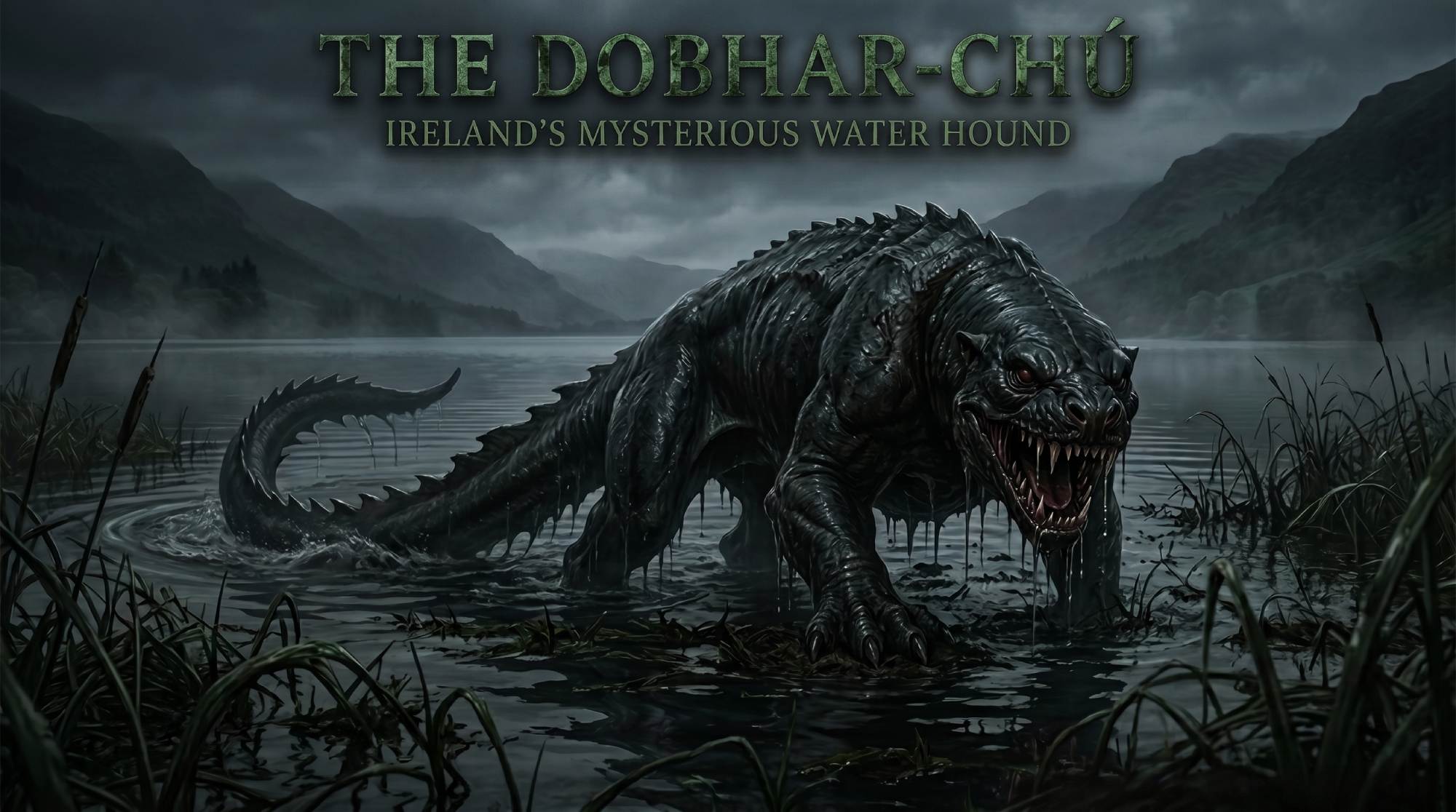
The Dobhar-chú — Ireland’s Mysterious Water Hound
The water of Lough Glenade in County Leitrim lies dark and still beneath the surrounding hills.
For generations, people living around these remote waters have told of something that is not quite an otter, not quite a dog, and not quite anything known to natural history.
The Irish name itself is unsettling.
Dobhar-chú.
Literally associated with the idea of a water hound, the name belongs to one of Ireland’s oldest and strangest traditions of mysterious creatures associated with lakes, rivers and remote waterways.
Long before the modern language of cryptids existed, stories were being told of enormous aquatic animals capable of attacking people, creatures that could move through water with extraordinary speed and emerge onto land with a ferocity more like a hunting beast than an ordinary otter.
In 1684, Irish writer Roderick O’Flaherty recorded a remarkable account of an animal he called the “Irish crocodile”, describing a dangerous aquatic creature associated with the waters of Connacht. His account used the name Doyarchu, connecting the animal with the idea of a water hound.
But the most famous chapter in the legend would unfold almost forty years later.
In 1722, according to local tradition, a woman named Grace Connolly went to the waters of Glenade Lough, County Leitrim, to wash clothes.
She never returned.
Her husband, Terence McGloighlin, is said to have discovered her body beside the lake and encountered the creature responsible.
The story that followed became one of Ireland’s most extraordinary pieces of folklore.
McGloighlin reportedly attacked and killed the animal, only for its dying cries to summon another from the lake.
What followed was a terrifying pursuit across the countryside.
The legend eventually became permanently connected to a remarkable stone grave monument at Conwall Cemetery near Glenade, where an unusual carving depicts an elongated animal being pierced by a weapon.
The monument is real.
The carving is real.
Its connection with the Dobhar-chú tradition was documented by Irish antiquarian Patrick Tohall, who studied the tombstone during the twentieth century and published his findings in the Journal of the Royal Society of Antiquaries of Ireland in 1948.
Yet the mystery does not end with an eighteenth-century gravestone.
Irish folklore collections preserve multiple versions of the Glenade story, while later reports have continued to associate enormous, otter-like creatures with Irish waters. In 2003, a modern sighting on Omey Island, County Galway, would once again bring the Dobhar-chú into the public imagination.
Was the Dobhar-chú an enormous unknown otter?
Could some reports have originated with seals, ordinary otters or other animals glimpsed under unusual circumstances?
Could ancient memories of Ireland’s vanished wildlife have contributed to the legend?
Or was the creature never intended to represent a biological animal at all, but rather a powerful water-being embedded within the folklore of the Irish landscape?
There is no scientifically verified species hiding beneath Ireland’s lakes.
There is no recovered Dobhar-chú corpse.
And the 1722 tragedy survives through folklore and later recorded tradition rather than a contemporary newspaper account.
But unlike many modern cryptid stories, the Dobhar-chú possesses something extraordinary:
A centuries-old written tradition.
An actual historic monument.
An unusual carved creature upon its stone.
Folklore preserved in Ireland’s national collections.
And stories that have survived generations around the very waters where they were said to have happened.
At Glenade, the old grave still stands.
The stone still bears its mysterious creature.
And beneath the dark Irish water, the legend of the Dobhar-chú, Ireland’s legendary water hound, continues to endure.
🐾 Physical Appearance
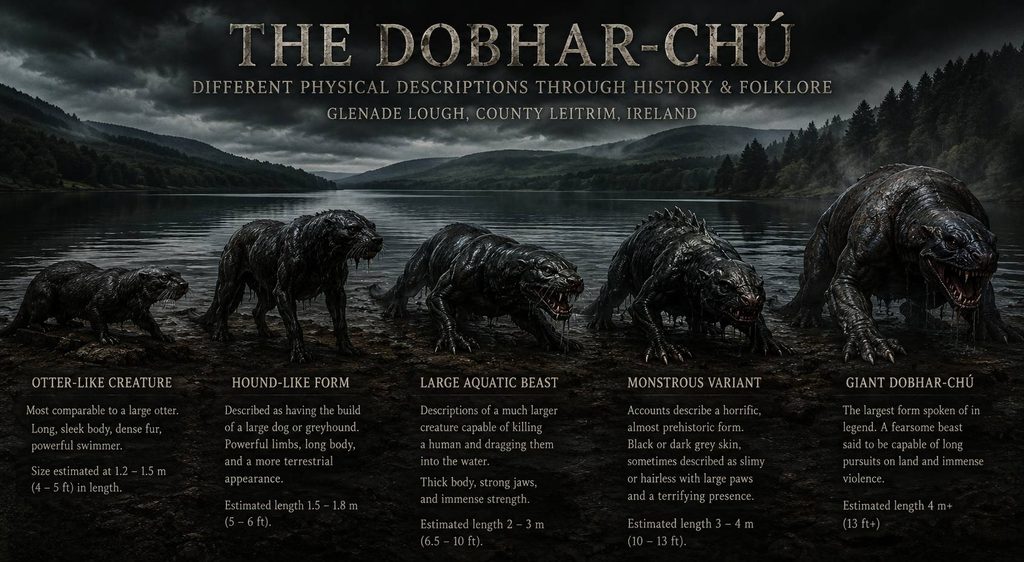
There is no single universally agreed description of the Dobhar-chú, and that uncertainty is one of the most intriguing features of the creature’s folklore.
The descriptions preserved across Irish tradition range from something recognisably otter-like to a much larger, more dangerous animal resembling a cross between an otter, dog and aquatic predator.
The name itself provides an important clue. Dobhar-chú is an established Irish term associated with an otter, literally carrying the sense of a water hound.
Consequently, many traditional descriptions and artistic interpretations give the creature a long, powerful, streamlined body similar to a giant otter, combined with the head, aggression and proportions of a large dog.
The creature’s most famous physical representation comes not from a modern artist, but from the stone monument at Conwall Cemetery near Glenade, County Leitrim, traditionally associated with the 1722 death of Grace Connolly.
The carving depicts an elongated animal with a long body, prominent paws, a long curved tail and a relatively small head, while the animal appears to be pierced around the neck by a weapon held by a human figure. Antiquarian Patrick Tohall, who examined the monument and published his findings in 1948, considered aspects of the carving particularly reminiscent of an otter.
This is significant because the carving predates modern cryptozoological artwork and provides an actual historical representation of the creature associated with the Glenade tradition.
🌊 The “Irish Crocodile”
An even older description comes from Roderick O’Flaherty’s 1684 A Chorographical Description of West or H-Iar Connaught. O’Flaherty recorded an animal he called the “Irish crocodile”, associated with Irish waters and identified using the name Doyarchu.
The account describes an aggressive aquatic animal which was initially mistaken for an ordinary otter before attacking a man.
While O’Flaherty’s description does not provide the precise measurements or detailed anatomy found in later cryptid accounts, it establishes an early tradition of an unusually dangerous, otter-like aquatic creature in Irish folklore.
🦦 The Great Water Hound
Later folklore surrounding the Dobhar-chú tends to exaggerate its size and ferocity beyond that of any ordinary European otter.
The creature is commonly imagined as having a dark or greyish coat, a powerful body adapted for swimming, strong limbs and large paws, a long tail and formidable teeth.
Some modern artistic depictions make it considerably larger than a normal otter, sometimes approaching the size of a large dog or even substantially exceeding it.
However, these larger dimensions should be treated as later representations rather than established measurements from historical eyewitness testimony.
What remains remarkably consistent is the creature’s association with the water. It is portrayed as an animal capable of moving rapidly beneath the surface and emerging onto land to attack or pursue people.
The traditional creature therefore occupies an unusual position between familiar animals:
🦦 The body of an otter.
🐕 The aggression of a hound.
🌊 The habits of an aquatic predator.
And in some versions of the legend, something considerably larger and more dangerous than any animal known to inhabit modern Ireland.
🪦 The Creature on the Glenade Stone
Perhaps the most compelling visual clue remains the Glenade/Conwall carving.
Rather than depicting a recognisable ordinary otter, the elongated animal carved into the stone has exaggerated proportions and is shown in direct association with a human attacker.
The long body and tail have traditionally been interpreted as otter-like, while its large paws and overall form contribute to the impression of a formidable beast.
It is impossible to determine from the carving alone exactly what animal the sculptor intended to represent, or precisely when the carving was produced. Its interpretation as a depiction of the Dobhar-chú therefore belongs to the documented local tradition surrounding the monument, rather than constituting zoological evidence.
Nevertheless, it remains an extraordinary piece of Irish folklore heritage.
Unlike a modern eyewitness sketch produced decades after an alleged encounter, the Glenade monument provides a physical historical representation of the creature that became attached to the story.
And perhaps that is what makes the Dobhar-chú’s appearance so fascinating.
It was never simply described as a monster.
It was imagined as something that looked almost familiar.
An otter.
A hound.
A creature of the lake.
But made larger, stronger and far more dangerous.
Something that belonged beneath the water, until it came ashore.
📍 Location & Country
- 🇮🇪 Primary Location: Conwal Cemetery, Drummans, Glenade, County Leitrim
- 🌊 Associated Water: Glenade Lough
- 🗺️ Region: North Leitrim, northwest Ireland
- 🇮🇪 Country: Ireland
- 🪦 Specific Landmark: Conwal Cemetery and the traditional Dobhar-chú grave slab
- 🌊 Legendary Encounter Area: Shoreline and surrounding countryside of Glenade Lough
- 📍 Grave Slab Coordinates: 54.40836° N, 8.31319° W
- 📍 Conwal Cemetery Approx. Coordinates: 54.4085° N, 8.3135° W
- 🏘️ Nearest Locality: Glenade
- 🛣️ Road: R280, near Drummans
The geographical heart of the Dobhar-chú legend lies around Glenade Lough in County Leitrim, in the rugged landscape of northwest Ireland.
Surrounded by hills and remote countryside, the lake forms the setting for the traditional 1722 encounter involving Grace Connolly, whose death is said to have been caused by the mysterious water creature.
Nearby Conwal Cemetery, in the Glenade valley, preserves the remarkable stone monument traditionally associated with the story.
The carved slab depicts an elongated, otter-like animal alongside a human figure holding a weapon, and its association with the Dobhar-chú legend has been documented by Irish antiquarian Patrick Tohall, who examined the monument during the twentieth century and published his findings in 1948.
The two locations therefore form the centre of the surviving tradition: Glenade Lough as the legendary encounter site, and Conwal Cemetery as the location of the extraordinary monument associated with the creature.
Today, the surrounding landscape remains a remote and atmospheric part of County Leitrim, where the combination of lake, mountains, old burial grounds and centuries-old folklore gives the Dobhar-chú legend a particularly tangible connection to the Irish landscape.
🌊 Habitat
The traditional habitat of the Dobhar-chú is the freshwater landscape of Ireland, particularly the remote lakes, rivers and marshy waterways associated with its oldest stories.
The creature’s name itself — Dobhar-chú, meaning water hound and associated with the Irish word for otter, reflects this close relationship with aquatic environments.
The most important location in the surviving tradition is Glenade Lough in County Leitrim, where the legendary 1722 encounter involving Grace Connolly is said to have taken place.
The lake lies within the rugged Glenade Valley, surrounded by hills, wooded areas, farmland and remote stretches of shoreline. Such an environment provides an appropriately secluded setting for a creature traditionally imagined as living beneath or beside the water.
The Dobhar-chú was not generally portrayed as a creature restricted to one particular lake. O’Flaherty’s 1684 account described an aggressive aquatic animal associated with Irish waters and indicated that similar creatures were known from other lakes. Later Irish folklore likewise preserved traditions of mysterious water animals in different parts of the country.
Its traditional environment would therefore have consisted of deep freshwater lakes, secluded shorelines, reed beds, marshes, rivers and other quiet waterways, particularly places where dense vegetation and darkness could conceal a large animal.
The creature’s legendary behaviour also suggests that its habitat extended beyond the water itself. In the Glenade tradition, the Dobhar-chú is said to have emerged from the lake, attacked on land and pursued its victim through the surrounding countryside. The boundary between water and land is therefore an important part of the legend: the Dobhar-chú is a creature of the water, but not necessarily one that remains there.
From a natural-history perspective, modern Ireland has no known animal matching the legendary Dobhar-chú. European otters remain widespread in suitable Irish waterways and are the obvious zoological comparison, but their size and behaviour do not correspond to the more extraordinary descriptions associated with the folklore creature.
The landscape around Glenade nevertheless retains many of the characteristics that may have helped such stories endure: dark water, secluded shorelines, mountainous terrain and long stretches of countryside where an unfamiliar animal could easily remain unseen.
And at Glenade, the habitat and the legend remain unusually close together.
🌊 The lake is still there.
🪦 The old monument is still there.
🏔️ And the lan
📜 The Dobhar-chú Origins & Irish Folklore
The Dobhar-chú belongs to a much older layer of Irish water folklore than the modern idea of a “cryptid.” Its name is traditionally understood as meaning “water hound”, and dobhar-chú is also the Irish word for an otter.
The term therefore sits at an unusual intersection between the natural animal and the supernatural creature: an animal known from Irish waterways, transformed in folklore into something larger, fiercer and considerably more dangerous.
The tradition was never necessarily confined to one particular lake. Historical and folkloric records associate the Dobhar-chú, or related names such as Doyarchu, Dobarcu and Anchu, with mysterious aquatic animals in different parts of Ireland.
The surviving folklore is particularly rich around Glenade Lough in County Leitrim, where stories of a dangerous water creature became attached to the tragic tale of Grace Connolly and the remarkable carved stone at Conwall Cemetery.
Importantly, the surviving evidence does not establish a single biological species. Instead, it shows a long-lived tradition surrounding strange aquatic animals, preserved through written accounts, local storytelling, manuscripts and folklore collections.
The National Folklore Collection contains multiple Dobhar-chú traditions from Leitrim, Donegal and elsewhere in Ireland, demonstrating that the name and creature belonged to a wider folklore tradition rather than being an invention of modern cryptozoology.
📖 The 1684 “Irish Crocodile” Account
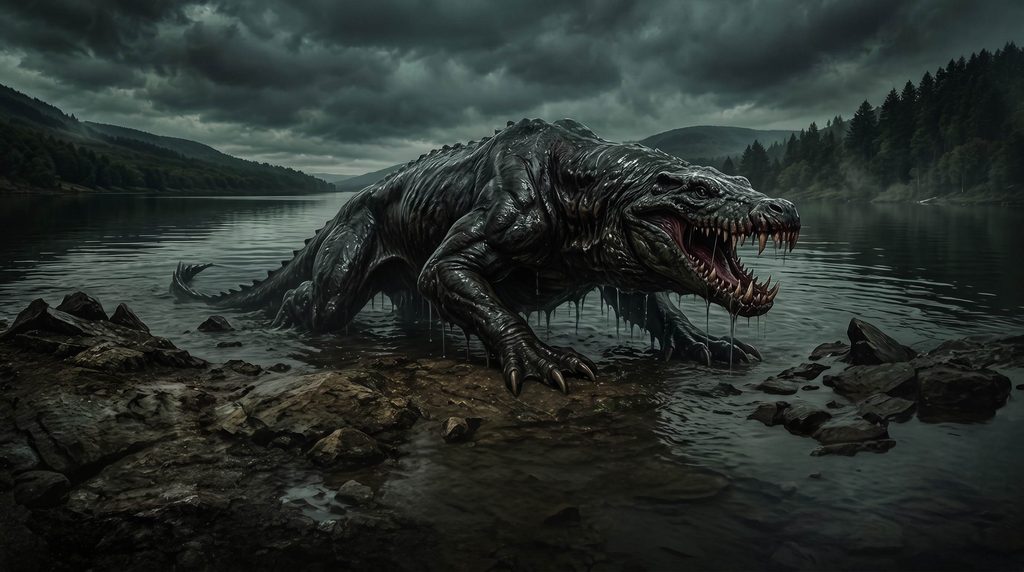
One of the most important early written references appears in Roderick O’Flaherty’s A Chorographical Description of West or H-Iar Connaught, written in 1684.
O’Flaherty described what he called the “Irish crocodile”, recounting an incident associated with the waters of Lough Mask. A man travelling beside the lake saw the head of an animal swimming in the water and initially took it for an ordinary otter.
The animal then reportedly submerged, approached beneath the water and emerged suddenly, attacking the man and dragging him towards the lake. The man managed to fight it off with a stone and a knife.
O’Flaherty described the animal as approximately the colour of an ordinary greyhound, with black, slimy, hairless skin according to the injured man’s impression. He also recorded that older people familiar with the lake claimed that similar animals existed there and that comparable creatures had been seen in other Irish lakes.
Most importantly, O’Flaherty preserved the name:
“Doyarchu” — described as a water-dog — or “anchu.”
This account is particularly valuable because it demonstrates that reports of unusual, aggressive aquatic animals carrying the Dobhar-chú name or related terminology existed in written Irish literature centuries before the modern cryptid movement.
The account should nevertheless be treated as a historical report of folklore and testimony, rather than scientific evidence that an unknown animal species inhabited Lough Mask.
🪦 The 1722 Glenade Lough Tragedy
The most famous Dobhar-chú tradition concerns Glenade Lough in County Leitrim and the death of a woman traditionally identified as Grace Connolly, also remembered in some versions as Grace or Gráinne McLoughlin/MacLoghlin.
According to the surviving tradition, Grace lived with her husband near the northwestern part of Glenade Lough. She went to the lake to wash clothes but failed to return home.
Her husband eventually went looking for her.
At the lakeshore he discovered her dead body and a strange animal nearby. The creature was identified in the tradition as the Dobhar-chú.
The story has survived in numerous versions, and the details vary. In some accounts the animal is lying upon Grace’s body; in others it is simply beside her. Some versions say her husband killed the creature with a dagger, while others describe a gun or another weapon.
The date 1722 is particularly important because the surviving Conwall monument bears a date of 24 September 1722 and is traditionally identified with Grace’s grave.
However, there is an important distinction between the date preserved on the monument and the historical documentation of the event itself.
There is no known contemporary written record from 1722 independently documenting Grace’s death as a Dobhar-chú attack. The narrative survives principally through local oral tradition and later folklore collection. The Leitrim Observer likewise notes that no written record of the story dates directly to the early eighteenth century, although the oral tradition remained strong in the area.
The story therefore occupies an unusual position: the monument is historical, the folklore is well documented, but the alleged monster attack remains a traditional account rather than a verified historical event.
⚔️ The Second Dobhar-chú & The Great Pursuit
The most dramatic part of the Glenade tradition begins after Grace’s husband kills the first Dobhar-chú.
According to several versions, the dying creature produced an extraordinary whistle or shriek.
That call summoned another Dobhar-chú from the lake.
The second animal then pursued the man.
The details become increasingly dramatic as the story progresses. In versions preserved in the Schools’ Collection, the fleeing man obtains a horse and attempts to escape while the creature follows him through the countryside.
Some versions describe a second man joining the flight, with the men eventually using their horses to block the creature’s path. The animal is said to have charged beneath or between the horses, allowing the men to attack it.
One Largy version records the pursuit continuing for approximately 20 miles, eventually reaching a place called Castle-Garden in County Sligo, where the creature catches up with the fugitives and kills one of their horses before being killed itself.
Another version from Árd Fearna in County Donegal preserves the same basic structure: the husband discovers his wife dead, kills the first creature, a second emerges from the lake, and the men flee on horseback across roads, glens and mountains before turning upon their pursuer.
The repeated appearance of the whistle, paired creatures and prolonged pursuit across separate collected versions is one of the most distinctive features of the Glenade tradition.
🪦 The Dobhar-chú Grave at Conwall Cemetery
The most remarkable physical feature associated with the legend is found at Conwall (Congbháil) Cemetery near Glenade.
The sandstone grave slab is traditionally identified as the resting place of Grace Connolly, and its surface contains an unusual carved depiction of an elongated animal.
The figure has an otter-like head and small ears, a powerful elongated body and unusually large paws. A human hand holds a weapon which appears to penetrate the creature around the neck.
The surviving inscription has deteriorated considerably, but earlier examination preserved important details.
Antiquarian Patrick Tohall visited the monument on multiple occasions between 1935 and 1948 and published “The Dobhar-Chú Tombstones of Glenade, Co. Leitrim” in the Journal of the Royal Society of Antiquaries of Ireland in 1948.
Tohall considered the monument likely to belong to the period when the death it commemorated remained within living local memory. The Leitrim Observer records his observation that similar raised-letter tombstones in the cemetery were characteristic of approximately 1722–1760.
The monument therefore provides an extraordinary physical connection between the Glenade folklore tradition and a specific eighteenth-century burial site.
It does not, however, scientifically establish that a Dobhar-chú killed Grace.
What it demonstrates is that a remarkable animal carving and a named burial became firmly associated with the story, and that this association was already established in local tradition by the time Tohall investigated it.
A second Dobhar-chú-associated stone, traditionally linked with Grace’s husband Terence, was reportedly known at Cill Rúisc/Kilroosk Cemetery. By the twentieth century it had reportedly broken into pieces and subsequently disappeared. Tohall nevertheless recorded local memories of the stone and its supposed animal carving.
📚 The Folklore Archive — Dúchas & The Schools’ Collection
The National Folklore Collection’s Schools’ Collection, preserved through Dúchas.ie, provides some of the strongest evidence for the survival of the Dobhar-chú tradition into the twentieth century.
Rather than one modern retelling, the archive contains multiple independently collected versions from communities around Leitrim and neighbouring counties.
At Cloonty, County Leitrim, a collected account specifically states that a Dobhar-chú was carved on a tombstone in Conwall graveyard and that the story of the strange animal had been handed down to the present day.
At Largy, another version records the Glenade story, including the killing of the first animal, the second creature’s pursuit and the journey towards Castle-Garden in County Sligo.
At Carrigeengeare, another collected account tells of a woman taking washing to Glenade Lough and failing to return, with her husband subsequently discovering what had happened.
The “Whistling Dobharchú” collected at Killanummery preserves another version in which the creature is described as a fierce monster living in a lonely lake surrounded by woods and mountains.
There are also traditions from Donegal, including an account of a large Dobhar-chú in Loch Conaill which reportedly seized a swimmer by the leg.
The archive is particularly valuable because these records preserve local oral tradition rather than modern cryptozoological interpretation.
They also demonstrate that the story was not static. Names, weapons, victims, locations and details of the pursuit sometimes change between versions.
That variation is precisely what would be expected from a story transmitted orally across generations.
📰 Historical & Modern Reports
The documentary history of the Dobhar-chú differs significantly from cases such as the Fouke Monster or Hopkinsville Goblins, where contemporary newspapers provide detailed accounts of alleged encounters.
For the Glenade tragedy, there is no known surviving contemporary newspaper report from 1722 confirming a monster attack. The earliest substantial documentary material available today comes through later folklore, antiquarian investigation and the physical monument itself.
The story was nevertheless preserved strongly enough within the local community for folklorists to collect numerous versions during the twentieth century.
Patrick Tohall’s 1948 antiquarian study then provided an important scholarly record of the Glenade tombstones. His paper is catalogued by the National Library of Ireland as appearing in the Journal of the Royal Society of Antiquaries of Ireland, Series 7, Volume XVIII, pages 127–129.
Modern Irish journalism has subsequently brought the story to a wider audience. The Leitrim Observer published a detailed examination of the Glenade tradition in 2018, discussing the oral history, Grace’s monument and Tohall’s investigation.
The result is an unusual documentary chain:
Oral tradition → eighteenth-century monument → twentieth-century folklore collection → antiquarian investigation → modern journalism and cryptozoological research.
🎨 The 2003 Omey Island Encounter
One of the most unusual modern claims associated with the Dobhar-chú came from Omey Island in County Galway.
Irish artist Seán Corcoran and his wife reported encountering a strange aquatic animal while camping near Fahy Lough, one of Omey’s freshwater lakes.
According to Corcoran’s later account, the incident occurred during the early hours of the morning. They were alerted by an unusual sound and investigated the shoreline, where they reportedly encountered a dark animal larger than a Labrador-sized dog.
The creature allegedly entered the water and crossed the lake with considerable speed, producing a substantial wake.
Corcoran later said that it climbed onto a rock and reared up, appearing approximately five feet tall, before producing what he described as a haunting screech. He also described unusual orange-red, flipper-like feet.
Corcoran and his wife subsequently maintained that what they had seen was neither an otter nor another familiar animal.
The account eventually attracted Irish media and cryptozoological interest, and Corcoran later incorporated the experience into his work concerning Omey Island.
The encounter remains an unverified eyewitness report. No biological specimen, photograph conclusively establishing an unknown animal, or independent physical evidence has established the presence of a Dobhar-chú on Omey Island.
Nevertheless, the report is significant within the modern history of the legend because it represents a rare twentieth-/twenty-first-century claim associated directly with the Dobhar-chú name.
🔬 What Could the Dobhar-chú Have Been?
The simplest natural explanation is the European otter, and the connection is reinforced by the creature’s name. Irish otters inhabit lakes, rivers and coastal environments, are excellent swimmers and can occasionally appear surprisingly large when seen partially submerged.
But ordinary otters do not fit every traditional description.
The folklore Dobhar-chú is sometimes portrayed as considerably larger, unusually aggressive, capable of prolonged pursuit on land and possessing characteristics that ordinary otters do not possess.
Several possibilities have therefore been proposed.
🦦 A Misidentified Otter
An unusually large otter viewed in poor light or at a distance could potentially account for some reports, particularly those involving an elongated aquatic animal.
🐕 A Large Terrestrial Animal
Some descriptions blur the distinction between an aquatic creature and a dog-like animal. A large dog or other mammal encountered near a lake could potentially contribute to stories in which the animal appears to move between land and water.
🦭 Seals or Other Aquatic Animals
Ireland’s coastal waters contain seals, and unfamiliar aquatic animals can produce dramatically distorted impressions when seen briefly. This explanation is more relevant to coastal traditions and modern reports than to the inland Glenade story.
🦴 Memories of Extinct Animals
Cryptozoologists have occasionally proposed that Irish folklore could preserve distant memories of extinct large mammals or prehistoric otters.
Such proposals are hypotheses rather than established explanations. There is currently no demonstrated fossil or genetic evidence showing that an extinct giant otter survived into the historical period represented by the Dobhar-chú stories.
👻 Folkloric or Supernatural Creature
The traditional Dobhar-chú may never have been intended as a zoological species.
Irish folklore contains numerous supernatural animals and water beings, and the creature’s extraordinary behaviour, particularly the dying whistle that summons a mate, fits naturally within a legendary rather than biological framework.
🎭 Story Development and Retelling
The variations preserved in the Schools’ Collection demonstrate how the story changed between communities and generations. Details such as the victim, weapon, method of killing, number of animals and precise route of the pursuit vary between accounts.
That does not prove the entire tradition was invented. It demonstrates that the story evolved through oral transmission, as folklore commonly does.
👻 Folklore vs Cryptozoology
The Dobhar-chú occupies an unusual position because its history can be examined without assuming that the creature was either real or imaginary from the outset.
The folklore evidence is genuine.
The 1684 O’Flaherty account is a genuine historical text. The 1722 Conwall monument is a genuine physical object. Patrick Tohall’s 1948 antiquarian investigation is a genuine scholarly publication. And the twentieth-century Dúchas Schools’ Collection contains multiple genuine records of people preserving the Dobhar-chú tradition.
What remains unproven is the biological interpretation.
There is no verified Dobhar-chú specimen, no scientifically confirmed population and no evidence demonstrating that an unknown giant otter-like animal survives in Ireland’s lakes.
The most responsible interpretation is therefore to recognise two different histories existing alongside one another.
The first is the history of the Dobhar-chú as Irish folklore , a remarkably persistent water-hound tradition preserved in language, oral storytelling, manuscripts, monuments and local memory.
The second is the modern cryptozoological question: whether some of the historical descriptions could have originated from encounters with an unusual but real animal.
At present, the evidence can establish the first far more securely than the second.
And that distinction is precisely what makes the Dobhar-chú such a fascinating entry in the Cryptid Legends Encyclopedia.
The folklore is real.
The monument is real.
The stories are real historical traditions.
But the creature itself remains where it has lived for centuries:
Beneath the dark waters of Irish folklore, somewhere between the otter and the monster.
🎬 The Dobhar-chú in Irish Pop Culture
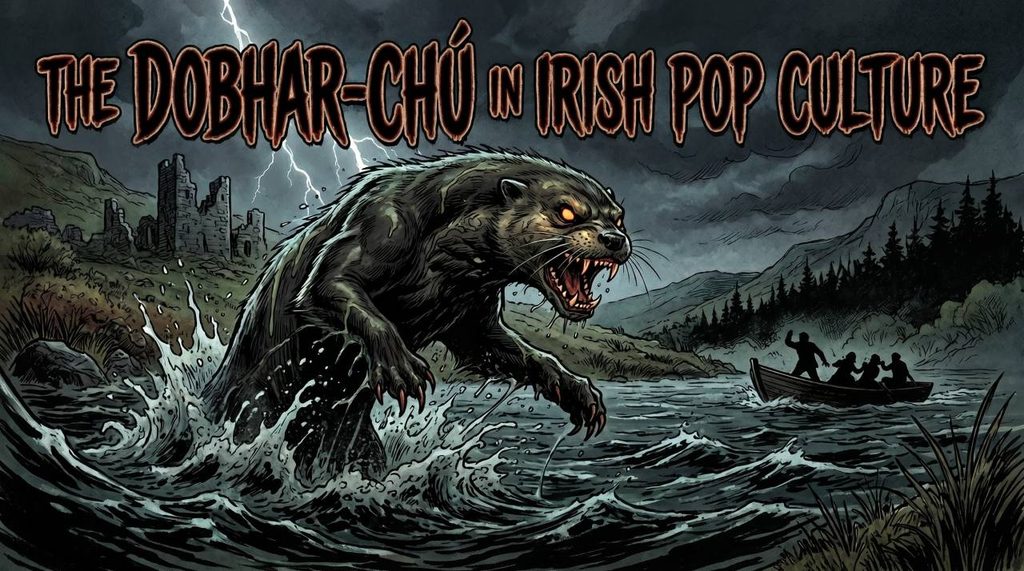
The Dobhar-chú has a considerably smaller modern pop-culture footprint than creatures such as the Banshee, Púca or Irish merrows, but its appearances are particularly interesting because the creature has remained closely tied to its Leitrim folklore, Conwall Cemetery monument and Glenade Lough tradition rather than being transformed into a large commercial franchise.
📚 Literature & Books
The Dobhar-chú has appeared in a number of works dealing with Irish folklore, supernatural traditions and cryptozoology, although relatively few books are devoted exclusively to the creature.
One important modern cryptozoological source is Karl P. Shuker’s The Beasts That Hide from Man: Seeking the World’s Last Undiscovered Animals.
Shuker discusses the Dobhar-chú in the context of alleged surviving unknown animals and gives particular attention to the Glenade tradition, the 1722 story, the pursuit to Castlegarden and the two Dobhar-chú-associated tombstones documented by Patrick Tohall.
The Dobhar-chú has also appeared in Irish folklore writing and regional treatments of the Glenade legend, particularly material concerning the Conwall Cemetery monument.
The Leitrim Observer’s 2018 feature, for example, examined the story as part of North Leitrim’s folklore heritage, drawing upon local traditions and recollections preserved by earlier storytellers.
A particularly valuable body of literature exists outside commercial publishing altogether: the National Folklore Collection’s Schools’ Collection, now accessible through Dúchas.ie.
These are not modern monster books but genuine archival folklore records, including several versions of the Dobhar-chú story from Leitrim and Donegal.
The Ahanlish collection describes the Dobhar-chú as a creature known throughout the Glenade community and records the remarkable Conwall gravestone.
The Largy collection preserves another version of the Glenade story, including the famous 20-mile pursuit towards Castle-Garden in County Sligo.
Other collections preserve traditions under Irish titles including “An Dobharchú agus an Chú Dhubh”, “Scéal fán Dobharchú”, “An Dobharchú” and “The Whistling Dobharchú.”
For the Cryptid Legends Encyclopedia, these archival records are arguably more important than many modern books because they demonstrate that the Dobhar-chú remained a living piece of regional folklore during the twentieth century, rather than being reconstructed entirely by modern cryptozoologists.
📺 Television & Documentary
The Dobhar-chú has appeared in the documentary series Boogeymen: Monsters Among Us.
The episode “Dobhar Chu”, released in 2013 as part of Series 1, examines the creature as an alleged Irish aquatic monster and discusses its traditional description as a combination of a giant otter and hound.
The programme also covers the 2003 Omey Island encounter involving artist Seán Corcoran and his wife Miranda.
The programme is particularly notable because it connects the traditional Glenade folklore with a modern alleged sighting rather than presenting the Dobhar-chú purely as an ancient myth.
The creature has also featured in various Irish folklore, paranormal and cryptozoological media treatments, generally in documentaries or online factual features rather than fictional television drama.
🎥 Film & Cinema
Unlike the Banshee, Leprechaun or Púca, the Dobhar-chú does not currently have a major feature film franchise directly based on it.
There is no established Irish equivalent of The Legend of Boggy Creek or The Mothman Prophecies built specifically around the Dobhar-chú.
Its cinematic presence has instead largely remained within documentary and folklore programming, with the Glenade story and Conwall monument providing the visual centrepiece.
This relative absence is notable considering how cinematic the legend actually is: a woman murdered beside a remote lake, an enormous aquatic predator, a husband pursuing it across the countryside, a second creature, horses, weapons and finally a mysterious grave carving depicting the monster itself.
🪦 Conwall Cemetery — The Living Landmark
Perhaps the most important “pop-culture” representation of the Dobhar-chú is not a book, film or television programme at all.
It is the actual Conwall Cemetery monument in Glenade, County Leitrim.
The sandstone grave slab traditionally associated with Grace Connolly/McLoughlin carries the unusual carving of the creature. The monument was examined by antiquarian Patrick Tohall, whose 1948 study, The Dobhar-Chú Tombstones of Glenade, Co. Leitrim, remains one of the most important scholarly treatments of the physical monument.
The carving has subsequently appeared in Irish newspaper features, folklore articles, cryptozoological publications, websites, documentaries and tourism material.
It has effectively become the visual symbol of the Dobhar-chú.
The surrounding landscape has likewise become part of the creature’s identity, with Glenade Lough functioning as the legendary habitat and Conwall Cemetery as the physical landmark connecting the folklore to a real place.
🌊 Glenade Lough & Local Heritage
The Dobhar-chú remains particularly important to North Leitrim’s local folklore identity.
Unlike many cryptids whose supposed locations have become commercial attractions long after the original reports, the Dobhar-chú remains strongly connected to the community and landscape from which its story emerged.
Modern accounts frequently refer to Glenade Lough as “Leitrim’s Loch Ness”, while local publications continue to revisit the story of Grace Connolly, the Dobhar-chú and the Conwall monument.
The story has consequently become part of the broader cultural identity of the Glenade Valley, alongside its archaeological landscape, traditional storytelling and historic sites.
📖 Modern Folklore Retellings
The Dobhar-chú continues to be retold through Irish folklore websites, regional publications and storytelling projects.
One modern example is Stories from the Waterside, which presents The Day of the Dobharchu as a literary retelling of the Glenade tradition. It incorporates the traditional murder of Grace, the pursuit of the creature and the Conwall gravestone into a contemporary folklore narrative.
These modern retellings should be distinguished from historical sources: they are creative or popular presentations of the tradition, rather than newly discovered contemporary evidence.
That distinction is important because the Dobhar-chú has accumulated many variations as the story has travelled between oral tradition, folklore collections, journalism and modern cryptozoology.
🧭 The Dobhar-chú as a Modern Irish Cryptid
The creature’s modern identity has increasingly moved beyond its original regional folklore.
Today the Dobhar-chú appears across three overlapping cultural worlds:
📜 Irish folklore — through the oral traditions and archival material preserved by Dúchas and the National Folklore Collection.
🪦 Irish heritage — through the Conwall Cemetery monument and the landscape of Glenade Lough.
🔬 Cryptozoology — through books, documentaries, modern alleged encounters and investigations into whether the stories could have originated from an unknown or misidentified animal.
That combination has allowed the Dobhar-chú to survive into the modern era without requiring a large fictional franchise.
It remains something much more unusual:
A monster whose greatest piece of “merchandise” is an actual historic stone.
A creature whose most famous setting is still a real Irish lake.
And a legend that can still be followed physically across the landscape, from Glenade Lough, to Conwall Cemetery, and onward towards the old Castlegarden pursuit in County Sligo.