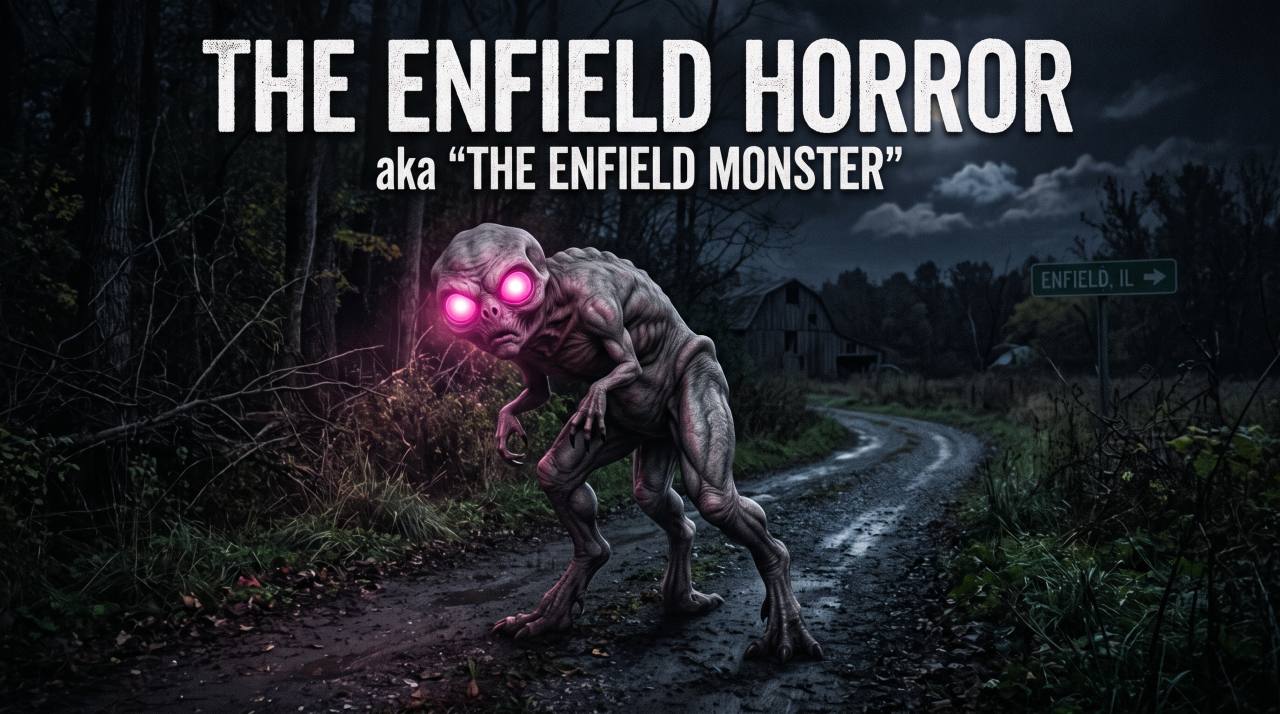
Nestled among the quiet farmland, wooded hills, and winding backroads of southern Illinois lies the small village of Enfield, a place forever linked to one of America’s most puzzling cryptid encounters.
In the spring of 1973, an extraordinary series of reports transformed this otherwise peaceful rural community into the centre of an international mystery.
Frightened residents, police officers, journalists, and curious investigators all descended upon White County after multiple witnesses described encountering a bizarre creature unlike anything documented in modern zoology.
Known today as the Enfield Horror or Enfield Monster, the creature has become one of the most distinctive cryptids in North American folklore.
Unlike many legendary monsters rooted in centuries of mythology, the Enfield case unfolded in real time through newspaper headlines, police investigations, eyewitness interviews, and national media attention.
Its strange appearance, unusual tracks, and the sheer speed with which the story spread have secured its place as one of the most fascinating cryptid incidents of the twentieth century.
More than fifty years later, debate continues over what was truly seen during those tense nights in April and May 1973. Was the Enfield Horror an undiscovered animal, an escaped exotic species, a remarkable case of mistaken identity, or the product of fear amplified by intense media coverage?
While definitive answers remain elusive, the case endures as one of Illinois’ most enduring unsolved mysteries, standing alongside famous American cryptids such as the Mothman, Flatwoods Monster, and Beast of Bray Road as a cornerstone of modern cryptozoological history.
Today, the Enfield Horror occupies a unique place where documented eyewitness testimony, local folklore, and cryptid legend intersect, an enduring reminder that even the quietest rural communities can become the setting for stories that continue to captivate believers, sceptics, historians, and monster hunters alike.
👁️ Physical Appearance
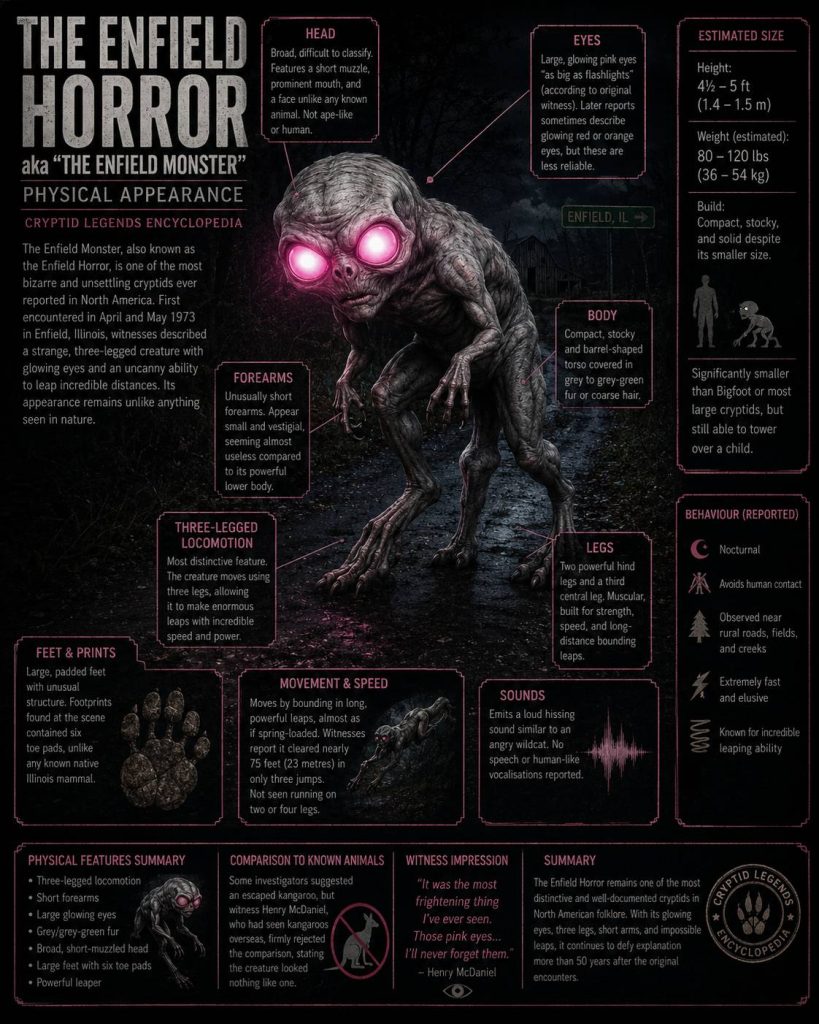
The Enfield Monster, also known as the Enfield Horror, is unlike almost any other creature in American cryptid folklore.
Witnesses consistently described a bizarre, almost surreal being that combined mammalian, reptilian and seemingly impossible anatomical features.
According to the original reports from April and May 1973, the creature stood approximately 4½–5 feet (1.4–1.5 metres) tall, making it significantly smaller than creatures such as Bigfoot but large enough to tower over a child.
Its body was described as compact and stocky, with a barrel-shaped torso covered in grey to grey-green fur or coarse hair.
Its most distinctive characteristic was its three-legged locomotion. Henry McDaniel insisted the creature possessed three legs, allowing it to move with astonishing speed by making enormous bounding leaps.
He estimated it cleared nearly 75 feet (23 metres) in only three jumps, a feat far beyond any known terrestrial animal.
The creature’s forearms were unusually short, giving the impression of small vestigial limbs that appeared almost useless compared to its powerful lower body. Witnesses never reported seeing claws or hands clearly enough to determine their exact structure.
Perhaps the most unsettling feature was its eyes.
McDaniel described them as large, glowing pink eyes “as big as flashlights,” which reflected brightly in his torchlight and dominated the creature’s face. Other later witnesses described glowing red or orange eyes, although these accounts are generally considered less reliable than McDaniel’s original testimony.
Its head has been described as difficult to classify. Rather than resembling an ape or human, witnesses reported a broad face with a short muzzle and prominent mouth.
McDaniel stated the creature emitted a loud hissing sound similar to an angry wildcat, suggesting an animal-like vocalisation rather than anything resembling speech.
The creature’s movement remains one of the greatest mysteries surrounding the case. Rather than running on two or four limbs, witnesses described it bounding in long, powerful leaps, almost as though it were spring-loaded.
This unusual gait led some investigators to speculate about an escaped kangaroo, although McDaniel, who had seen kangaroos while serving overseas, firmly rejected the comparison, insisting the creature looked nothing like one.
Adding further intrigue, investigators discovered unusual footprints containing six toe pads, unlike those of any recognised native Illinois mammal. While the prints were never conclusively identified, they became one of the most discussed physical pieces of evidence associated with the case.
Unlike many legendary monsters whose appearance changes dramatically over time, the earliest reports of the Enfield Monster remained remarkably consistent.
Most descriptions centred around the same unusual combination of grey fur, glowing eyes, short forearms, three legs, and extraordinary leaping ability, making it one of the most distinctive and instantly recognisable cryptids in North American folklore.
📍 Location & Country
📌 Primary Location: Enfield, White County, Illinois
🏞️ Region: Southern Illinois
🌍 Country: United States
📍 Specific Area: Rural farmland surrounding Enfield, including the outskirts of the village, Henry McDaniel’s farmhouse, nearby railroad tracks, woodland, drainage ditches, and agricultural fields in White County.
🗺️ Coordinates (Approx.): 38.1000° N, 88.3400° W
🌾 Where the Legend Began
Unlike many famous American cryptids associated with vast forests or remote mountains, the Enfield Monster emerged from one of the quietest farming communities in southern Illinois.
The legend centres on the small village of Enfield, where local resident Henry McDaniel reported encountering the mysterious creature outside his farmhouse on the night of 25 April 1973.
The surrounding landscape consisted of isolated farmhouses, crop fields, patches of woodland, drainage creeks and abandoned railroad corridors—terrain capable of concealing wildlife and fuelling local mystery.
Following McDaniel’s encounter, additional reports came from the immediate area surrounding Enfield, including nearby farmland and railroad tracks where McDaniel claimed to see the creature for a second time.
Unlike many cryptid legends that spread across entire regions, the Enfield Monster remained remarkably localised, with virtually all credible reports occurring within only a few miles of the original sighting.
Today, Enfield remains forever linked with one of America’s strangest monster mysteries, attracting cryptozoologists and folklore enthusiasts interested in one of the most unusual creature encounters ever documented in the Midwest.
🌿 Habitat
The reported habitat of the Enfield Monster differs significantly from that of many legendary North American cryptids.
Rather than inhabiting vast mountain forests or remote wilderness, the creature was encountered within the quiet agricultural landscape of southern Illinois, where farmland, woodland and rural homesteads exist side by side.
The region surrounding Enfield, White County, is characterised by gently rolling farmland broken by patches of mature deciduous woodland, creek systems, drainage ditches, overgrown hedgerows and abandoned railroad corridors.
These natural features provide numerous areas of cover where wildlife can move largely unseen, particularly after dark.
Henry McDaniel’s original encounters occurred on the edge of cultivated farmland, where isolated homes bordered woodland and open fields.
The creature’s reported movements between gardens, brush and nearby railroad tracks suggest that, if it existed, it was comfortable navigating both developed rural properties and the surrounding natural landscape.
Southern Illinois also supports an abundance of wildlife, including white-tailed deer, coyotes, bobcats, raccoons, foxes, wild turkeys and numerous small mammals.
This rich ecosystem has led some researchers to speculate that the original witnesses may have encountered an unusually behaving or poorly observed animal, although none of the native species match the creature’s reported appearance.
Unlike cryptids such as Bigfoot or the Skunk Ape, the Enfield Monster has never been associated with deep forests or extensive migration routes. Instead, the legend remains firmly rooted within a relatively small rural area, where farmland and woodland meet, a setting that helped fuel both mystery and speculation during the remarkable events of spring 1973.
Although no verified evidence has ever demonstrated the existence of a permanent breeding population, the isolated fields, wooded ravines and quiet backroads surrounding Enfield continue to provide the atmospheric backdrop for one of America’s most unusual and enduring monster legends.
📖 Background & Legend
Unlike many legendary American cryptids whose origins stretch back centuries through Indigenous traditions or pioneer folklore, the Enfield Monster is a surprisingly modern mystery.
Its legend can be traced to a single extraordinary period during the spring of 1973, when a handful of unexplained encounters transformed an otherwise quiet farming community into the focus of national attention.
Before those events, there was no established folklore describing a three-legged creature haunting the countryside around Enfield.
The monster appears to have emerged almost overnight, making it one of the few American cryptids whose entire legend can be followed from its first reported appearance through its rapid rise into popular culture.
As newspapers across the United States carried the story, Enfield quickly became synonymous with one of the strangest creature reports of the twentieth century.
Curiosity seekers, amateur monster hunters, journalists and sceptics descended upon the small Illinois village, each hoping to solve, or witness the mystery for themselves.
Within days, what had begun as a local incident had become part of a wider wave of monster stories sweeping across the American Midwest during the early 1970s.
The Enfield Monster also occupies an unusual position within cryptozoology. Unlike creatures such as Bigfoot or the Loch Ness Monster, which are often interpreted as unknown species with centuries of reported history, the Enfield case has become equally important as a study in folklore, media influence and public psychology.
Historians, sociologists and folklorists frequently cite it as an example of how extraordinary eyewitness accounts, intense newspaper coverage and community speculation can rapidly create a lasting modern legend.
Despite these differing interpretations, the Enfield Monster has never completely disappeared from public consciousness.
The case continues to be discussed in cryptozoological research, paranormal investigations and American folklore collections, where it remains one of the Midwest’s most distinctive and puzzling creature mysteries.
More than fifty years after the events of 1973, the Enfield Monster endures not because its existence has been proven, but because its story represents one of the clearest examples of how a single unexplained incident can evolve into a permanent chapter of cryptid history, occupying the fascinating space between eyewitness testimony, local legend and modern mythology.
👣 Sightings & History
Unlike many cryptid legends built upon decades of folklore, the Enfield Horror can be traced back to a very specific series of events during the spring of 1973.
Over just a few weeks, a quiet farming community in southern Illinois became the focus of national media attention after multiple residents reported encounters with an unknown creature unlike anything they had ever seen.
While later embellishments and copycat reports would inevitably appear, the original Enfield case remains unusually well documented through eyewitness interviews, police investigations, newspaper archives, photographs, and contemporary radio broadcasts.
🌑 April 25, 1973 — The First Encounter
The legend began on the evening of 25 April 1973, when Henry McDaniel, a respected Enfield resident, returned to his home after hearing strange scratching noises outside.
Believing that an animal was disturbing the property, McDaniel armed himself with a flashlight and a .22 calibre pistol before stepping outside.
What he claimed to see would become one of America’s most famous cryptid reports.
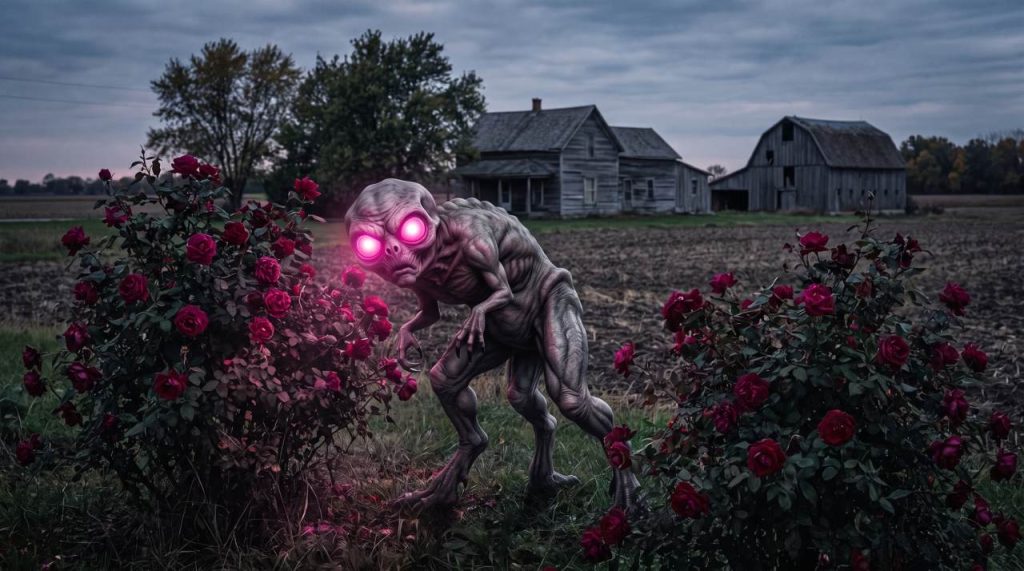
Standing near two rose bushes was a bizarre creature approximately 4½ to 5 feet tall.
According to McDaniel, it possessed:
- three legs
- a compact grey body
- two short forearms
- enormous glowing pink eyes “as big as flashlights”
As the creature stared directly at him, McDaniel fired several shots.
Instead of collapsing, the animal reportedly emitted a loud hissing sound before fleeing with astonishing speed.
McDaniel later estimated it covered around 75 feet in only three enormous leaps, disappearing into the darkness almost instantly.
👣 Strange Tracks
When police arrived shortly afterwards, they discovered unusual impressions in the soft ground outside the house.
Witnesses described them as resembling canine footprints—but with six distinct toe pads instead of four.
Although plaster casts were never publicly released, officers acknowledged the prints did not immediately resemble those of any common local wildlife.
These footprints quickly became one of the most discussed pieces of physical evidence connected to the case.
👮 Police Investigation
Illinois State Police officers interviewed McDaniel immediately after the incident.
Rather than dismissing the report outright, investigators noted that McDaniel appeared calm, coherent and genuinely shaken.
Several officers later commented that they believed he sincerely reported what he thought he had witnessed.
Although no creature was found, the official investigation lent credibility to the incident, separating it from many cryptid stories that rely solely upon second-hand folklore.
👟 Greg Garrett Incident
Earlier the same evening, local ten-year-old Greg Garrett claimed that a strange creature had stepped on his feet while he was outside playing, shredding his tennis shoes before disappearing into the darkness.
For years this story was repeated alongside McDaniel’s encounter.
However, Garrett later admitted that his account had been a childhood prank, intended partly to frighten neighbours and partly to entertain visiting reporters.
Today, researchers generally exclude the Garrett incident when evaluating the strongest evidence surrounding the Enfield Horror.
🌅 May 6, 1973 — Second Sighting
Just over a week later, Henry McDaniel reported seeing the creature once again.
Awakened by barking dogs during the early morning hours, he observed the same grey figure near nearby railroad tracks.
Unlike the first encounter, the creature showed no aggression.
McDaniel watched as it calmly walked away before disappearing into the darkness.
He deliberately chose not to fire his weapon during this encounter.
📻 Journalists Arrive
As newspaper coverage spread across Illinois and neighbouring states, journalists travelled to Enfield hoping to investigate the mystery themselves.
Among them was Rick Rainbow, News Director of WWKI Radio.
Rainbow and several companions spent nights searching the surrounding woods.
Although they never obtained photographs, Rainbow later claimed his team briefly observed a grey, stooped figure moving through the darkness before hearing what he described as an unearthly piercing scream unlike any known animal.
🔫 The Monster Hunters
By early May the Enfield Horror had become national news.
On 8 May 1973, five young men travelled to Enfield carrying rifles and shotguns, intending to hunt the creature themselves.
That evening they reported seeing a large grey figure moving through nearby woods.
Several opened fire.
Police quickly arrested the group for firearms offences and publicly warned others against attempting similar expeditions.
The White County Sheriff’s Office famously remarked:
“Nothing I know of is in season now… especially monsters.”
The arrests effectively marked the end of the public frenzy.
📰 National Headlines
Within days, newspapers across America were reporting on the Enfield mystery.
Publications including:
- The Mount Vernon Register-News
- Evansville Courier & Press
- Reading Eagle
- numerous Associated Press syndications
carried detailed accounts of McDaniel’s testimony.
Photographs of Henry McDaniel standing beside his damaged screen door, along with images of armed “monster hunters” being escorted by police, became some of the most iconic visuals associated with the case.
Unlike many cryptid stories, the Enfield flap unfolded in real time before newspaper reporters rather than decades later through oral tradition.
🦘 The Kangaroo Theory
As national attention grew, numerous explanations were suggested.
One of the strangest came from Ohio, where a man contacted authorities claiming the creature was actually his escaped pet kangaroo.
Although kangaroos can briefly balance on their tails, creating the illusion of three points of contact, McDaniel rejected the idea outright.
Having previously encountered kangaroos while overseas, he insisted the animal he saw looked nothing like one.
No escaped kangaroo was ever recovered.
📚 Later Investigation
Years later, researchers revisited the Enfield case in greater detail.
A sociological study conducted by Western Illinois University concluded that only a handful of genuine eyewitness reports could be considered independent.
The researchers argued that intense media attention, local excitement and rumour rapidly transformed a small number of unusual encounters into a widespread monster panic.
Even so, they did not accuse Henry McDaniel of fabrication.
Instead, they concluded that McDaniel most likely witnessed something real, even if the identity of that animal remains unknown.
🕵️ Cryptid Legends Assessment
More than fifty years later, the Enfield Horror remains one of America’s most fascinating cryptid cases.
Several aspects distinguish it from typical monster folklore:
- documented police involvement
- contemporary newspaper coverage
- multiple independent investigations
- physical footprints reported by officers
- consistent testimony from Henry McDaniel throughout his life
At the same time, the case also includes admitted hoaxes, sensational media coverage and the classic effects of collective excitement that often accompany famous cryptid flaps.
Whether the Enfield Horror was an unknown animal, an extraordinary misidentification or something stranger altogether remains unresolved.
Its brief but explosive appearance during the spring of 1973 has secured its place as one of the most enduring mysteries in American cryptozoology.
🎬 Enfield Monster in Popular Culture
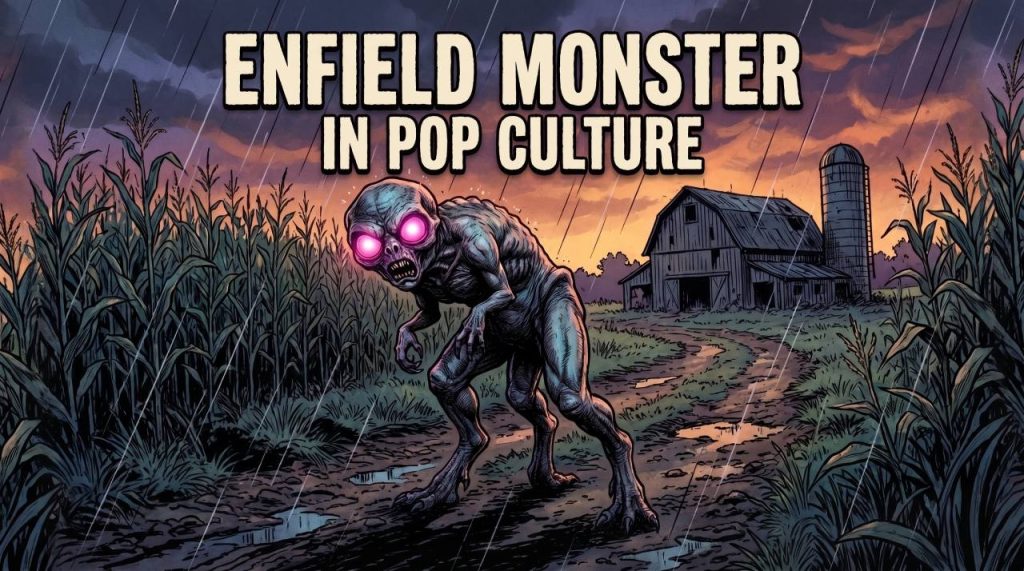
Although the Enfield Monster was only reported during a brief period in the spring of 1973, the bizarre creature has remained a fascinating part of American cryptid folklore.
Over the decades, it has appeared in documentaries, books, podcasts, trading card games and countless collections exploring unexplained mysteries.
Its unusual appearance, particularly the reported three legs, glowing eyes and incredible leaping ability, has made it one of the most visually distinctive cryptids in North America.
📚 Books
The Enfield Monster has featured in numerous books covering cryptozoology, paranormal history and American folklore, including:
- Mysterious America — Mysterious America
- One of the most influential cryptozoology books ever published, documenting unusual creature reports throughout the United States, including the Enfield case.
- Monsters of Illinois — Monsters of Illinois
- Examines the Enfield Monster alongside many of Illinois’ strangest legends and unexplained creatures.
- Haunted Illinois — Haunted Illinois
- Includes the Enfield Monster as one of the state’s best-known unexplained mysteries.
- The United States of Cryptids — The United States of Cryptids
- Features the Enfield Monster as Illinois’ representative cryptid, placing it alongside creatures such as Mothman and the Jersey Devil.
- Bigfoot!: The True Story of Apes in America — Bigfoot!: The True Story of Apes in America
- Discusses the Enfield encounters within the wider context of mysterious humanoid reports across North America.
📺 Television & Documentaries
The Enfield Monster has appeared in numerous paranormal and cryptid television programmes, including:
- MonsterQuest
- Lost Tapes
- Monsters and Mysteries in America
- Small Town Monsters productions discussing Midwestern cryptid legends
- Various episodes of Travel Channel, History Channel, Destination America, and independent documentary productions exploring famous American monster cases.
Although rarely the sole focus of a feature-length documentary, the Enfield case is frequently included among America’s classic cryptid encounters due to its strong contemporary documentation.
🎙️ Podcasts & Online Media
The story has become a favourite among paranormal podcasts, including:
- Astonishing Legends
- Cryptonaut Podcast
- MonsterTalk
- Expanded Perspectives
- The Cryptid Factor
- numerous YouTube channels dedicated to cryptozoology and unexplained phenomena
Its combination of police reports, newspaper coverage and eyewitness testimony makes it one of the most frequently revisited American monster cases.
🎮 Trading Card Games
🃏 MetaZoo TCG
The Enfield Monster appears as an official cryptid within the MetaZoo Trading Card Game, introducing the Illinois legend to a new generation of cryptid enthusiasts.
Card Details
🃏 Card Name: Enfield Monster
🎴 Set: Cryptid Nation – Base Set (1st Edition / Unlimited)
🔢 Card Number: 10/159
⭐ Rarity: Common
The MetaZoo artwork portrays the creature as a muscular grey humanoid with glowing red eyes, staying faithful to many of the original eyewitness descriptions while giving it the game’s signature horror-inspired artistic style.
As with many MetaZoo Beasties, the card draws directly from real American folklore rather than inventing an entirely fictional monster, helping preserve awareness of one of Illinois’ most famous cryptid legends.
🎨 Comics & Artwork
While the Enfield Monster has never achieved the mainstream popularity of creatures such as Bigfoot or Mothman, it regularly appears in:
- independent cryptid art collections
- horror illustration books
- comic anthologies
- cryptozoology calendars
- monster-themed posters
- fan artwork across online communities
Its unique silhouette makes it instantly recognisable among North American cryptids.
🌎 Legacy
Today, the Enfield Monster remains one of the defining cryptids of the American Midwest.
Although the sightings lasted only a matter of weeks, the extraordinary newspaper coverage, police involvement and eyewitness interviews transformed a small Illinois farming community into a permanent chapter of cryptozoological history.
More than fifty years later, the Enfield Monster continues to inspire researchers, artists, writers and collectors alike, proving that even one brief wave of unexplained encounters can leave a lasting mark on popular culture.
Within the Cryptid Legends universe, it stands as one of the most thoroughly documented and enduring monster cases ever recorded.