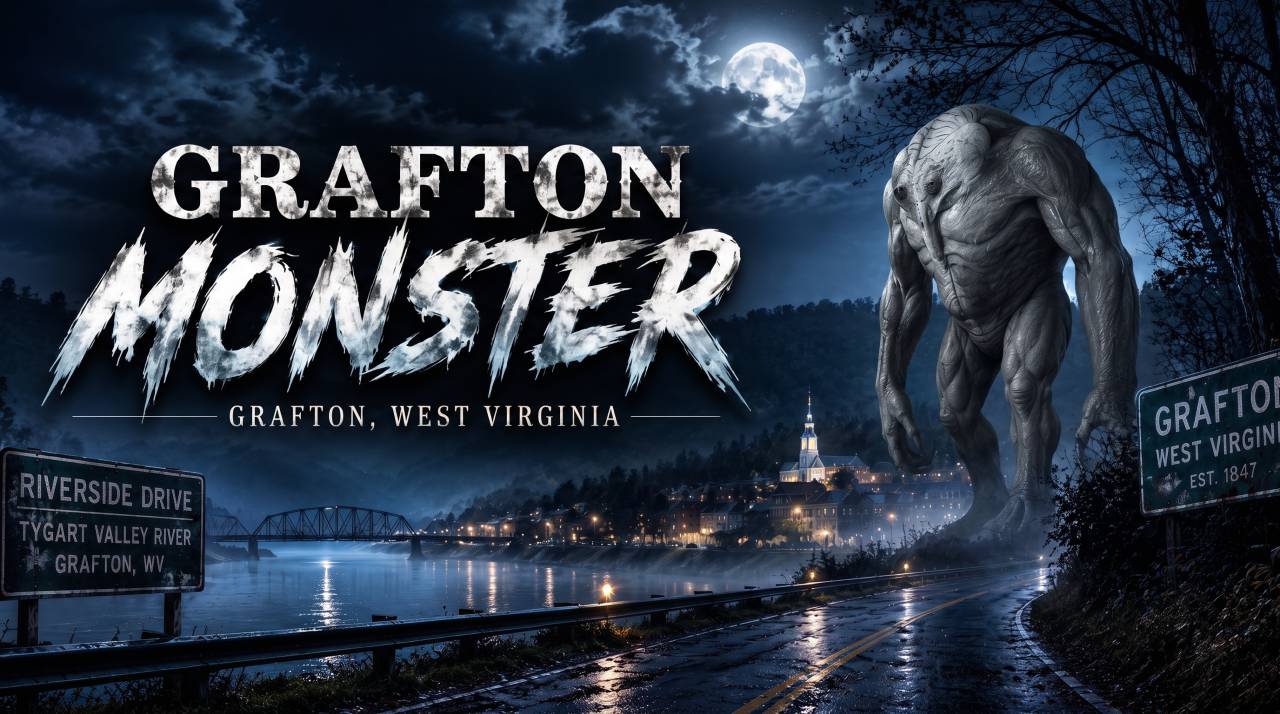
Beneath the mist-covered hills of Taylor County, West Virginia, where the Tygart Valley River winds through dense woodland and abandoned industrial landscapes, one of Appalachia’s strangest cryptid legends first emerged during the summer of 1964.
Unlike many legendary monsters rooted in centuries of folklore, the Grafton Monster appeared suddenly, described as an enormous, pale, headless creature standing silently beside the riverbank before disappearing into the darkness.
Within days, reports spread throughout the town, drawing armed search parties, curious residents, and newspaper headlines as rumours of the mysterious beast swept across Grafton.
More than sixty years later, the Grafton Monster remains one of West Virginia’s most unusual cryptid cases.
Built upon eyewitness testimony, newspaper archives, local legend, and decades of debate, it occupies a unique place in American cryptozoology, balanced somewhere between genuine mystery, mass misidentification, and one of Appalachia’s most enduring modern legends.
👣 Physical Appearance
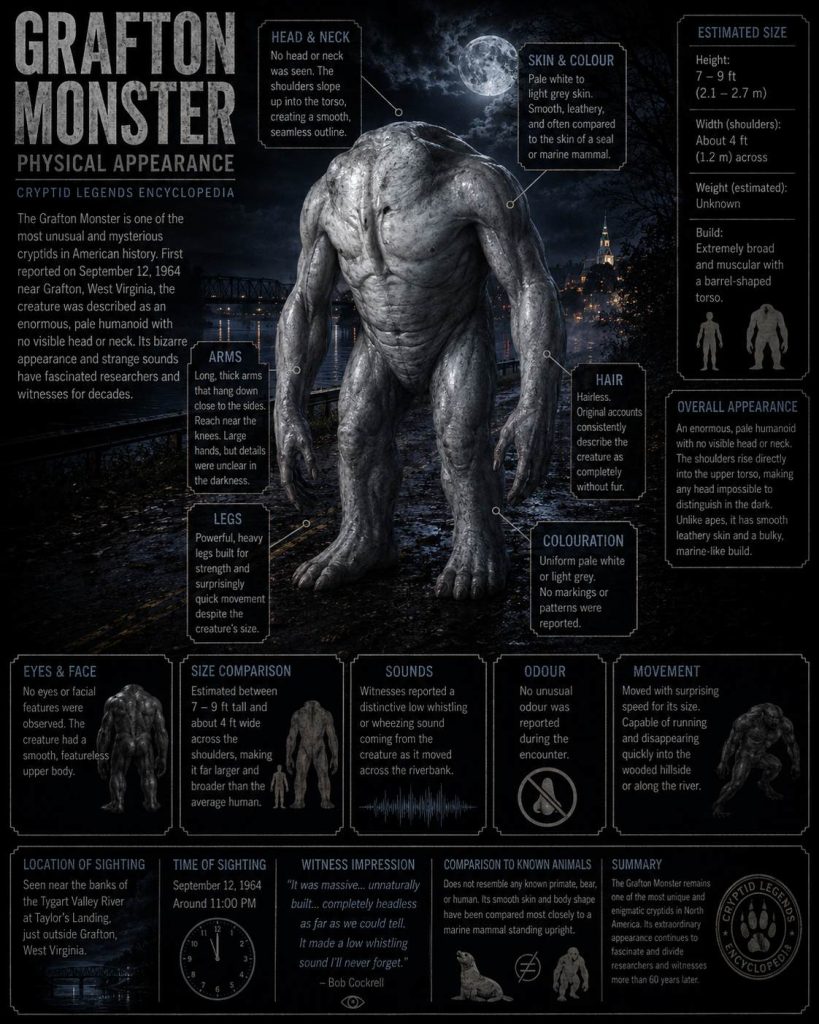
Unlike many cryptids that have been reported hundreds of times, the Grafton Monster’s physical appearance is based almost entirely on the original 1964 eyewitness descriptions.
As a result, its appearance remains one of the most unusual, and most debated in American cryptozoology.
Witnesses consistently described an enormous, pale humanoid unlike any known animal.
Rather than resembling a giant ape like Bigfoot or the Skunk Ape, the Grafton Monster was said to possess a broad, almost barrel-shaped body with little visible neck or facial detail, giving the unsettling impression that it was completely headless.
📏 Reported Characteristics
- Height: Approximately 7–9 feet (2.1–2.7 metres).
- Build: Extremely broad and muscular, estimated at around 4 feet (1.2 metres) wide across the shoulders and torso.
- Colouration: Pale white to light grey.
- Skin: Smooth, leathery, and often compared to the skin of a seal or marine mammal rather than fur.
- Head: Witnesses reported no visible head or neck, although some researchers believe the head may simply have been tucked low into the shoulders.
- Eyes: No eyes or facial features were clearly observed.
- Hair: Most original accounts describe the creature as hairless, although some later retellings incorrectly added shaggy fur.
- Arms: Long, thick arms hanging close to the sides of the body.
- Legs: Powerful, heavy legs capable of moving surprisingly quickly.
- Odour: No unusual smell was reported during the original encounter.
- Sound: Several witnesses described hearing a distinctive low whistling or wheezing sound, often considered one of the creature’s defining characteristics.
👹 Overall Appearance
The Grafton Monster is often portrayed today as a giant white humanoid with no head, but this image largely stems from later artwork and popular culture.
The earliest descriptions suggest something even stranger, a massive, pale figure whose shoulders rose directly into its upper torso, making any head or neck impossible to distinguish in the darkness.
This unusual body shape has led to decades of speculation. Some researchers have suggested witnesses simply observed an awkward posture or optical illusion in poor lighting, while others believe the bizarre silhouette is precisely what makes the Grafton Monster unlike any other cryptid reported in North America.
Whatever Bob Cockrell witnessed beside the Tygart Valley River in 1964, his description remains one of the most distinctive physical accounts in American cryptid history.
📍 Location & Country
- 📌 Primary Location: Riverside Drive, Grafton, Taylor County
- 🏞️ Region: Appalachian Mountains (North-Central West Virginia)
- 🌍 Country: United States
- 📍 Specific Area: Riverside Drive along the Tygart Valley River, near Grafton, with later reports centred around the nearby stone quarry and surrounding woodland
- 🗺️ Coordinates (Approx.):39.340° N, 80.018° W
The Grafton Monster is uniquely tied to the small Appalachian town of Grafton, where the legendary encounter reportedly occurred during the evening of 16 June 1964.
Unlike many American cryptids that are associated with vast wilderness areas, nearly every historical account centres on a short stretch of Riverside Drive, overlooking the Tygart Valley River on the edge of town.
Surrounded by wooded hills, riverbanks, abandoned railway corridors, and dense Appalachian forest, the area provided an eerie backdrop for one of West Virginia’s most unusual cryptid encounters.
Today, Grafton embraces the legend through the annual Grafton Monster Festival, public artwork, and the Grafton Monster Museum, making the town one of the state’s best-known cryptid destinations.
🌲 Habitat
Unlike many North American cryptids said to inhabit vast wilderness areas, the Grafton Monster is most closely associated with the wooded riverbanks, steep hillsides, and abandoned industrial landscapes surrounding Grafton, West Virginia.
The creature’s reported habitat centres on the Tygart Valley River corridor, where dense vegetation, rocky embankments, and patches of mature Appalachian forest provide natural cover.
The region forms part of the rugged Appalachian Mountains, characterised by mixed hardwood forests, secluded hollows, limestone outcrops, and winding waterways.
During the 1960s, much of the area surrounding Riverside Drive was quieter and less developed than today, creating an ideal backdrop for strange encounters after dark.
Witness accounts consistently place the creature close to water, particularly along the banks of the Tygart Valley River, leading some researchers to speculate that, if such a creature existed, it may have preferred secluded riparian habitats where thick vegetation, mist, and the constant sound of flowing water offered concealment.
Others note that the nearby abandoned quarries, wooded slopes, and railway corridors would have provided additional shelter and hidden travel routes through the landscape.
Unlike creatures such as Bigfoot or the Skunk Ape, no long-term migration routes, feeding grounds, nests, or physical traces have ever been documented for the Grafton Monster.
As a result, its supposed habitat remains based entirely on the limited locations connected to the original 1964 reports rather than decades of recurring evidence.
Habitat Overview
🌲 Environment: Appalachian hardwood forests, riverbanks, wooded hillsides, and rocky outcrops
🌊 Primary Habitat: Tygart Valley River corridor near Grafton, West Virginia
🏞️ Terrain: Dense woodland, steep valleys, abandoned quarries, riverside vegetation, and rural backroads
🌙 Activity: Reportedly nocturnal, with all known sightings occurring after dark
📍 Evidence: No verified den sites, tracks, nests, or biological remains have ever been discovered
📖 Background & Legend
Unlike many legendary creatures rooted in centuries of Native American folklore or pioneer traditions, the Grafton Monster is one of the few American cryptids whose origins can be traced to a specific place, date, and newspaper report.
The legend emerged during the summer of 1964 in the small Appalachian town of Grafton, West Virginia, after reports began circulating of a bizarre white creature seen near the banks of the Tygart Valley River.
What started as a local mystery quickly spread through word of mouth, attracting curious residents, armed search parties, and widespread newspaper coverage throughout the region.
The story gained further momentum because it unfolded during one of America’s greatest waves of paranormal fascination.
The early-to-mid 1960s saw growing public interest in UFO sightings, mysterious creatures, and unexplained phenomena.
Just days before the Grafton reports appeared, newspapers across the United States had been covering another alleged monster sighting in Michigan, helping fuel public imagination and making communities more receptive to tales of unknown creatures.
Unlike Bigfoot, the Mothman, or the Flatwoods Monster, however, the Grafton Monster never developed into a creature supported by decades of recurring encounters.
Instead, its reputation was built almost entirely upon the extraordinary events reported during the summer of 1964.
As stories spread from resident to resident, descriptions became increasingly exaggerated, transforming what may have begun as a single unexplained sighting into one of West Virginia’s most enduring modern legends.
Almost immediately, sceptics suggested far more ordinary explanations, ranging from misidentified wildlife to a person transporting boxes or equipment along Riverside Drive in poor lighting.
Local newspapers themselves later published articles questioning the monster’s existence, illustrating how belief and scepticism existed side by side almost from the very beginning.
Despite the controversy, the legend refused to disappear. Over the following decades the Grafton Monster became firmly woven into West Virginia folklore, appearing in books, documentaries, cryptozoology research, festivals, museums, and modern popular culture.
Today it stands as one of the state’s most recognisable cryptids, not because of overwhelming evidence, but because of the remarkable way a single unexplained incident grew into a lasting piece of Appalachian legend.
Unlike many cryptid stories that evolved gradually over generations, the Grafton Monster offers a rare opportunity to trace the birth of a modern legend almost step by step, from its original newspaper headlines to its place in contemporary folklore.
👣 Sighting History
Unlike many legendary creatures whose origins are lost to history, the Grafton Monster can be traced almost entirely to a remarkable series of events during June 1964.
Contemporary newspaper reports, later correspondence from eyewitness Robert Cockrell, and modern historical research allow investigators to reconstruct the birth of one of West Virginia’s most famous cryptid legends with unusual accuracy.
🌙 June 16, 1964 — Robert Cockrell’s Encounter

The story began shortly after 11:00 p.m. on the night of June 16, 1964, when Robert “Bob” Cockrell, a reporter for the Grafton Sentinel, was driving home along Riverside Drive (Route 119/Yates Avenue) beside the Tygart Valley River.
As he rounded a bend, his headlights illuminated what he initially believed was a large white obstruction standing between the roadside and the riverbank. As he slowed, Cockrell realised the object was standing upright.
He later described the creature as:
- Standing approximately 7–9 feet (2.1–2.7 metres) tall.
- Nearly 4 feet (1.2 metres) across the shoulders.
- Covered in smooth, pale, “seal-like” skin that reflected his headlights.
- Possessing no visible head or neck.
- Broad, muscular, and unnervingly silent.
Startled, Cockrell accelerated away from the scene before returning later that night with friends Jerry Morse and Jim Mouser to investigate.
The creature had disappeared, but the group reportedly found flattened vegetation near the riverbank and heard a strange low whistling sound that appeared to follow them as they searched the area. No tracks or physical evidence were recovered.
📰 June 18, 1964 — The Story Becomes Public
Initially reluctant to publish such an extraordinary claim, the Grafton Sentinel only ran Cockrell’s account after rumours began spreading throughout town.
On June 18, 1964, the newspaper published its now-famous article:
“Teen-Age Monster Hunting Parties Latest Activity on Grafton Scene.”
According to the report, groups of local teenagers armed with flashlights, clubs, crowbars, and improvised weapons spent the evening searching the riverbanks and surrounding woodland for the mysterious creature.
Descriptions given to the newspaper were remarkably similar:
- A huge white creature.
- Roughly nine feet tall.
- Approximately four feet wide.
- No visible head.
- Occasionally producing a strange whistling noise.
Some locals even speculated it might be an escaped circus animal or polar bear, although no evidence supported these suggestions. Local police acknowledged the reports but conducted only a brief investigation and found nothing unusual.
🌲 Additional Reports
Following publication of Cockrell’s story, reports multiplied rapidly.
According to Cockrell’s later correspondence, more than twenty local residents claimed to have seen an unusual white figure during the following days, particularly along:
- Riverside Drive
- The banks of the Tygart Valley River
- Nearby wooded hillsides
- A local stone quarry north of town
Unfortunately, very few of these reports were formally documented. Most consisted of brief verbal accounts passed between neighbours or reported to the newspaper, making independent verification impossible today.
🗞️ June 19, 1964 — The Newspaper Changes Course
Remarkably, only one day later, the Grafton Sentinel published a second article with a dramatically different tone.
Under the headline:
“‘Monster’ Result of Spring Fever, Wild Imagination”
the newspaper suggested the entire episode had been exaggerated through excitement, rumours, and local curiosity.
Its reporters proposed a far more mundane explanation: that residents had mistaken a man pushing a handcart stacked with white boxes along Riverside Drive during the evening darkness.
The article concluded humorously that:
“It’s fairly certain that monsters don’t go around pushing handcarts loaded with boxes.”
By this point, however, the legend had already spread beyond Grafton, and monster hunters continued searching despite the newspaper’s scepticism.
✉️ Cockrell’s Later Reflections
In a private letter written during July 1964 to paranormal researcher Gray Barker, Cockrell maintained that he genuinely believed he had seen a living creature.
He insisted the object he encountered was not a handcart or stationary object and noted that the supposed handcart sighting actually occurred after his own experience.
Decades later, however, Cockrell softened his position.
In 2014, he published a letter entitled “Requiem for a Monster”, acknowledging that the legend had grown far beyond the original event.
He suggested the most likely explanation was a local man known for riding his bicycle at night while carrying stacks of large white boxes, which, under poor lighting, may have created the illusion of a massive headless figure.
Cockrell concluded:
“There is no Grafton Monster and there never was one.”
Despite this personal reassessment, he never denied experiencing something unusual that night in June 1964.
🔍 Modern Assessment
Today, historians generally agree that the Grafton Monster represents one of America’s best-documented examples of a modern cryptid legend forming in real time.
Researchers point to several contributing factors:
- A genuine unexplained sighting experienced by Robert Cockrell.
- Rapid spread of rumours throughout a small Appalachian community.
- Newspaper publicity that encouraged further reports.
- Armed search parties attracting additional attention.
- Public fascination with monsters and unexplained phenomena during the 1960s.
Unlike Bigfoot or the Mothman, no verified sightings, photographs, footprints, hair samples, or biological evidence have ever been recovered.
As a result, most modern investigators consider the Grafton Monster an enduring piece of West Virginia folklore rather than evidence of an undiscovered species.
Nevertheless, the original 1964 reports remain among the most fascinating and well-preserved cryptid case files in Appalachian history.
🎬 Grafton Monster In Popular Culture
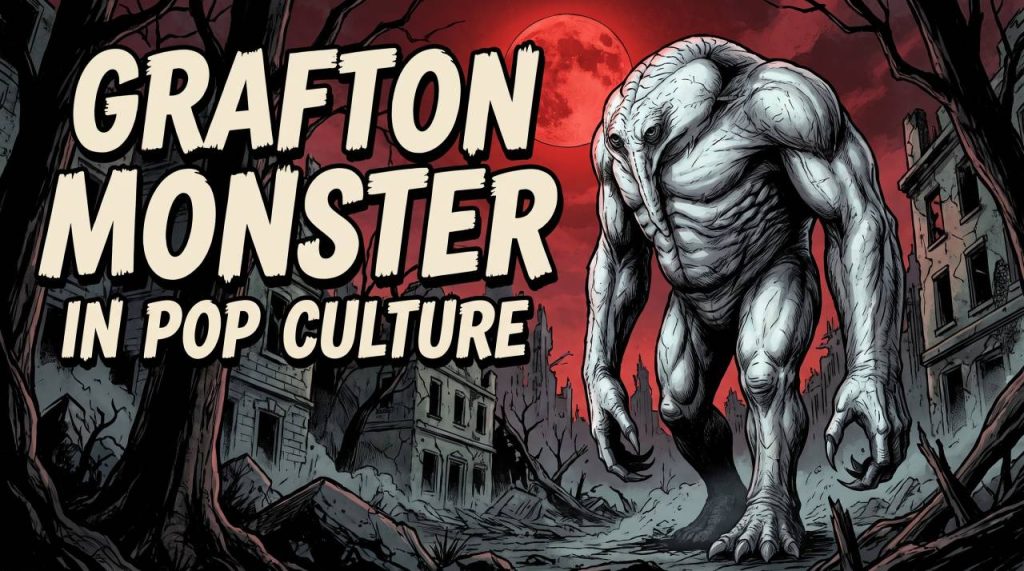
Although the Grafton Monster has never achieved the worldwide fame of creatures such as Bigfoot, the Mothman, or the Jersey Devil, it has steadily grown into one of West Virginia’s best-known cryptids.
Since its original 1964 sighting, the creature has appeared in books, documentaries, video games, festivals, museums, and collectibles, becoming an enduring symbol of Appalachian folklore.
🎮 Fallout 76
Without question, the Grafton Monster’s most famous modern appearance is in Fallout 76 (Bethesda Softworks, 2018).
Set in a post-apocalyptic version of West Virginia, the game reimagines the legendary cryptid as one of Appalachia’s most powerful mutant creatures.
While inspired by the real legend, Bethesda created an entirely fictional origin story involving West Tek experiments and the Forced Evolutionary Virus (FEV).
Players encounter several variants including:
- 🩶 Grafton Monster
- 💀 Enraged Grafton Monster
- ☣️ Parasitic Grafton Monster
- ⚡ Alpha Grafton Monster
- 🔥 Scorched Grafton Monster
The creature also features in:
- Grafton Day public event
- Heart of the Swamp
- Project Paradise
- Primal Cuts
- Spin the Wheel
The game’s loading screens even describe it as:
“The source of endless fireside horror stories, the Grafton Monster is said to be a lumbering, pale, headless horror that wanders the woodlands of Grafton, West Virginia.”
🃏 Fallout Cryptid Trading Cards
Bethesda later expanded its cryptid lore through the Once in a Blue Moon update for Fallout 76, introducing collectible in-game Cryptid Trading Cards.
The Grafton Monster Card is one of the collectible cryptid cards available alongside creatures such as the Flatwoods Monster, Mothman, and Ogua, further cementing its place within Fallout’s growing cryptid universe.
📚 Books & Cryptozoology
The Grafton Monster has become a regular feature in books covering American cryptids and Appalachian folklore.
Notable publications include:
- 📖 Monsters of West Virginia: Mysterious Creatures in the Mountain State – Rosemary Ellen Guiley (2012)
- 📖 The Grafton Monster – George Dudding (2019)
- 📖 Numerous regional cryptozoology guides and West Virginia folklore collections
Most modern authors revisit the original 1964 newspaper reports, Cockrell’s correspondence, and later investigations while examining how the story evolved into modern folklore.
📺 Television & Documentaries
Although it has never received a dedicated feature film, the Grafton Monster has appeared in numerous television programmes exploring American cryptids.
Notable appearances include:
- 📺 Mountain Monsters (Travel Channel)
- 📺 Regional paranormal documentaries
- 📺 West Virginia cryptid specials
- 📺 Various YouTube documentaries and folklore channels examining the original 1964 case
Unlike fictional portrayals, these programmes generally focus on the historical newspaper reports and competing explanations behind the original sightings.
🎭 Festivals & Tourism
Today, the Grafton Monster has become an important part of West Virginia tourism.
Highlights include:
- 👹 Grafton Monster Festival (first held in 2024)
- 🏛️ Grafton Monster Museum
- 📸 Official roadside signs and photo opportunities
- 👕 Festival-exclusive merchandise
- 🎨 Local artwork celebrating the famous cryptid
The annual festival celebrates both the original legend and West Virginia’s rich cryptid heritage through guest speakers, vendors, live entertainment, cosplay, and folklore exhibits.
🎲 Tabletop Gaming & Miniatures
Following the success of Fallout 76, the creature was adapted into the official Fallout: Miniatures Game by Modiphius Entertainment.
The detailed resin miniature recreates Bethesda’s interpretation of the monster and forms part of The Wilds of Appalachia expansion, allowing players to field the Grafton Monster during tabletop battles.
🃏 MetaZoo Trading Card Game
The Grafton Monster became an official cryptid in the MetaZoo Trading Card Game, appearing as one of the flagship Beasties in the Nightfall expansion.
Its artwork closely reflects the original 1964 descriptions, depicting a towering pale humanoid with an enormous muscular frame, broad shoulders, and virtually no visible head or neck.
Card Details
- 🃏 Card Name: Grafton Monster
- 📦 Set: Nightfall
- 🔢 Card Number: 10/163
- 🌎 Region: West Virginia
- 🌿 Aura Type: Earth
- ⭐ Rarity: Gold Rare
- 👣 Card Inspiration: Based on the original 1964 Grafton Monster sightings reported by Grafton Sentinel journalist Robert “Bob” Cockrell.
Like many of MetaZoo’s cryptids, the Grafton Monster helped introduce a new generation of collectors to one of West Virginia’s lesser-known legends, sitting alongside iconic creatures such as Mothman, Flatwoods Monster, Wendigo, and the Headless Horseman within the Nightfall set.