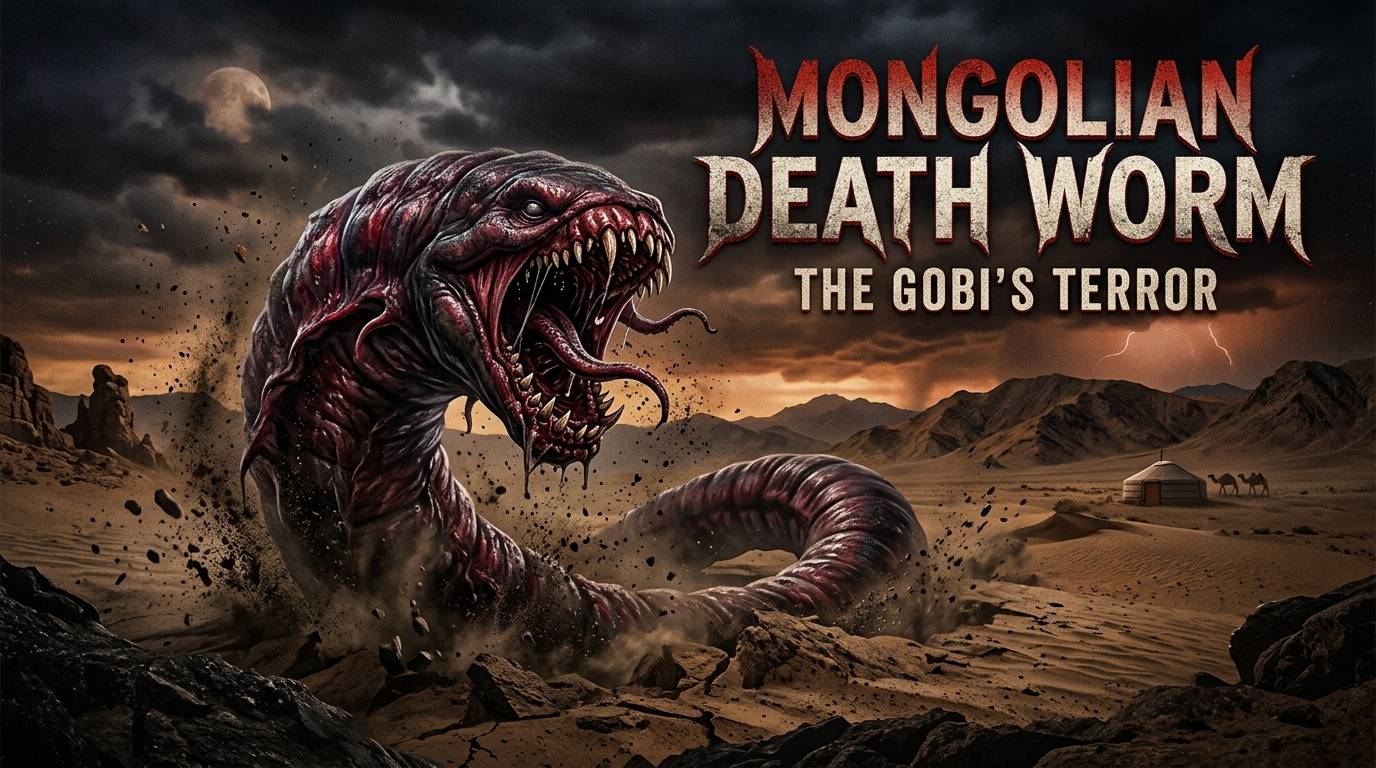
The Buried Horror of the Gobi Desert
Beneath the endless sands of Mongolia’s vast Gobi Desert, where ancient landscapes stretch beyond the horizon and the silence of the wilderness feels almost otherworldly, there exists a legend of a creature said to move beneath the earth.
Known to Mongolian folklore as the Olgoi-Khorkhoi, meaning “intestine worm”, this terrifying desert creature has been described for generations as a monstrous, blood-red worm-like beast that emerges from the barren ground to attack those who venture too close.
Said to hide beneath the shifting sands of one of Earth’s harshest environments, the Mongolian Death Worm has become one of the world’s most infamous cryptid legends — a creature surrounded by fear, mystery, and unanswered questions.
Ancient tales speak of a strange underground predator with deadly abilities, capable of bringing sudden death to anyone unfortunate enough to encounter it.
But does the Gobi Desert truly hide an unknown creature lost to science?
Or is the Olgoi-Khorkhoi a powerful piece of folklore born from one of the planet’s most remote and unforgiving landscapes?
📍 Location & Country
📌 Primary Location: Gobi Desert, Southern Mongolia
🏜️ Region: Ömnögovi Province and remote southern Gobi wilderness
🌍 Country: Mongolia
📍 Specific Area: Remote desert plains, sandy basins, and isolated regions of the Gobi Desert traditionally associated with Olgoi-Khorkhoi legends and expeditions
🗺️ Coordinates (Approx.): 43.5° N, 104.0° E
The legendary Mongolian Death Worm (Olgoi-Khorkhoi) is said to inhabit the vast and remote landscapes of the Gobi Desert, one of the most extreme environments on Earth.
Unlike many cryptid legends tied to a single location, the Death Worm is associated with the enormous wilderness of southern Mongolia, a land of endless desert plains, ancient fossil beds, rocky valleys, and isolated regions where folklore has described strange creatures hidden beneath the sands.
Many modern investigations and expeditions have focused on the remote areas of the South Gobi region, where the harsh terrain and immense isolation continue to fuel one of the world’s most famous cryptid mysteries.
🏜️ Habitat
The legendary Mongolian Death Worm (Olgoi-Khorkhoi) is said to inhabit the harsh and unforgiving environment of the Gobi Desert, one of the largest and most extreme desert regions on Earth.
Unlike traditional desert creatures that move openly across the landscape, folklore describes the Olgoi-Khorkhoi as a creature that spends much of its life hidden beneath the ground, emerging from the sand and rocky terrain when threatened or disturbed.
The Gobi provides a mysterious setting for the legend, with its:
🏜️ Vast sand plains and desert basins
⛰️ Rocky valleys and mountain ranges
🌡️ Extreme temperature changes between day and night
🦴 Ancient fossil-rich landscapes
🌌 Remote areas far from human civilisation
According to legend, the Death Worm prefers isolated areas away from settlements, using the desert surface and underground environment as protection from the harsh conditions.
The combination of the Gobi’s immense size, ancient geology, and unexplored wilderness has helped transform the Olgoi-Khorkhoi into one of the world’s most enduring desert cryptid mysteries.
📖 Background & Legend
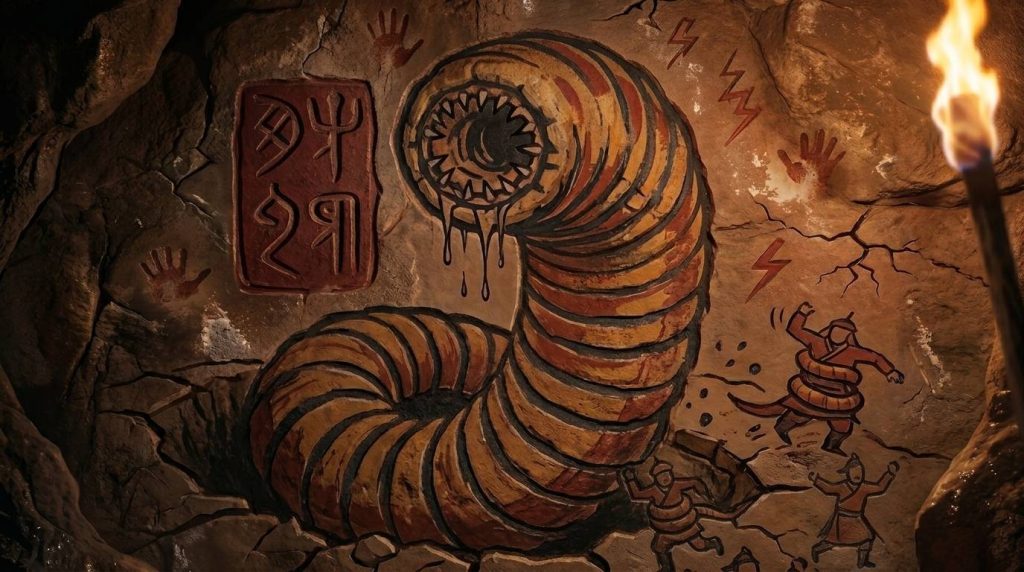
The legend of the Mongolian Death Worm, known in Mongolian folklore as the Olgoi-Khorkhoi, has been passed down through generations as one of Central Asia’s most mysterious creature stories.
The name Olgoi-Khorkhoi translates roughly as “intestine worm”, referring to the creature’s reported appearance — a thick, red, worm-like animal resembling the internal organs of livestock.
Unlike ordinary desert animals, folklore describes the Death Worm as a highly dangerous creature with unusual and almost supernatural abilities.
According to traditional accounts, the Olgoi-Khorkhoi is said to attack in several terrifying ways:
☠️ Deadly Poison
The creature is believed to possess a powerful venom capable of killing a person or animal almost instantly, with some stories claiming even touching the creature could be fatal.
⚡ Electric Shock Attack
Some modern retellings describe the Death Worm as being able to release a powerful electrical discharge, allowing it to kill victims without physical contact.
🔥 Corrosive Spray
Other legends claim the creature can release a deadly yellow substance or corrosive liquid that burns or destroys whatever it touches.
🪱 Ambush From Beneath the Ground
Perhaps the most famous aspect of the legend is the idea that the creature hides beneath the desert surface, waiting unseen before suddenly emerging to attack.
These abilities have made the Olgoi-Khorkhoi unlike almost any other cryptid legend, combining the appearance of a giant worm with the characteristics of a venomous predator.
🏜️ A Creature Between Folklore and Mystery
The Mongolian Death Worm occupies a unique place in cryptid history because its legend comes from a culture with a long relationship with the harsh landscapes of Central Asia.
For generations, stories of dangerous creatures have served as warnings about the dangers of travelling through remote wilderness. The Olgoi-Khorkhoi became a symbol of the unknown dangers that could exist beyond the safety of human settlements.
When the legend reached the outside world during the 20th century, explorers and cryptid researchers became fascinated by the possibility that the story could represent an undiscovered animal.
The Mongolian Death Worm remains one of the world’s most unusual cryptid mysteries — a creature that exists somewhere between ancient folklore, exploration history, and the search for the unknown.
👣 Sightings & Expeditions

Unlike many famous cryptid legends, the Mongolian Death Worm (Olgoi-Khorkhoi) has very few confirmed first-hand sightings recorded in modern history.
Much of what is known about the creature comes from Mongolian folklore, reports collected from local people, and expeditions searching for evidence of the legendary desert beast.
Despite numerous investigations, no specimen, remains, photograph, or scientific evidence has ever confirmed the existence of the Olgoi-Khorkhoi.
📜 Roy Chapman Andrews — The First Western Account (1920s)
The Mongolian Death Worm first gained international attention through American explorer and paleontologist Roy Chapman Andrews, who travelled through Mongolia during scientific expeditions in the 1920s.
In his 1926 book On the Trail of Ancient Man, Andrews documented stories he heard from Mongolian officials about a strange desert creature known locally as the Olgoi-Khorkhoi.
The accounts described a creature resembling a thick, sausage-like worm, said to inhabit the most remote regions of the Gobi Desert.
However, Andrews himself never encountered the creature and remained sceptical, recording the legend as a fascinating local belief rather than confirmed zoological evidence.
🏜️ Local Mongolian Accounts
Many stories surrounding the Death Worm come from nomadic communities who traditionally lived alongside the Gobi landscape.
These accounts describe a creature that:
🪱 Burrows beneath the desert surface
🏜️ Appears only rarely
☠️ Is feared because of its deadly abilities
🌧️ May become more active after rainfall
Some stories describe the creature moving beneath the sand, leaving waves or disturbances on the surface as it travels underground.
However, many of these reports were collected indirectly, meaning researchers often recorded stories about the creature rather than direct encounters.
🔎 Major Expeditions Searching for the Olgoi-Khorkhoi
Ivan Mackerle Expeditions (1990 & 1992)
One of the most famous modern searches was led by Czech explorer and cryptozoologist Ivan Mackerle.
Inspired by the legend, Mackerle travelled into the Gobi Desert with the goal of finding evidence of the Death Worm.
His team interviewed locals and searched remote areas, even experimenting with methods designed to draw the creature from underground, inspired partly by the fictional sandworms of Dune.
Despite extensive searching, no physical evidence was found.
🦎 Scientific Investigations & Possible Explanations
One of the more interesting developments came in 1983, when researchers showed a Tartar sand boa (Eryx tataricus) to people who claimed familiarity with the Olgoi-Khorkhoi legend.
Some identified the snake as resembling the creature they had described, suggesting that a real desert animal may have helped inspire parts of the legend.
🌵 Modern Searches
Further expeditions have continued into the 21st century, including searches by cryptozoologists, television crews, and researchers.
Notable investigations include:
🔍 Richard Freeman’s 2005 expedition
📺 Destination Truth investigations
🎥 Various documentary searches
However, all expeditions have returned without finding evidence of an unknown giant worm-like animal.
🎬 Mongolian Death Worm (Olgoi-Khorkhoi) in Popular Culture
The Mongolian Death Worm (Olgoi-Khorkhoi) has become one of the world’s most unusual cryptid legends, inspiring filmmakers, explorers, writers, and monster enthusiasts fascinated by the idea of a hidden creature beneath the sands of the Gobi Desert.
Although it has never reached the mainstream popularity of creatures like Bigfoot or the Loch Ness Monster, the Death Worm has gained a dedicated following within cryptozoology and monster fiction due to its strange appearance, mysterious origins, and legendary abilities.
🎥 Movies & Television
🪱 Mongolian Death Worm (2010)
The most famous fictional adaptation of the legend is the 2010 Syfy original television film Mongolian Death Worm.
The movie reimagines the Olgoi-Khorkhoi as a giant subterranean monster awakened after an American oil company begins drilling operations in the Mongolian desert. The disturbance awakens a nest of deadly creatures hidden beneath the earth, turning the ancient legend into a modern creature-feature horror adventure.
The film combines:
🏜️ Desert survival horror
🪱 Giant underground creatures
🏭 Environmental disaster themes
☠️ Monster movie action
While the movie takes many fictional liberties with traditional Mongolian folklore, it introduced the Death Worm legend to a wider international horror audience.
📺 Destination Truth (2007–2012)
The Mongolian Death Worm was investigated in the Syfy adventure series Destination Truth, where explorer Josh Gates and his team travelled to Mongolia to investigate reports surrounding the legendary creature.
The episode explored:
🏜️ The Gobi Desert environment
🗣️ Local stories and accounts
🔍 The search for physical evidence
Like many cryptid investigations, the expedition did not produce confirmed evidence of the creature, but it helped increase international interest in the Olgoi-Khorkhoi legend.
📚 Books & Literature
📖 On the Trail of Ancient Man — Roy Chapman Andrews (1926)
One of the earliest major Western references to the Olgoi-Khorkhoi came through explorer and paleontologist Roy Chapman Andrews.
During his expeditions through Mongolia in the 1920s, Andrews recorded stories of the mysterious creature from local sources.
Although he never encountered the Death Worm himself, his writings helped introduce the legend to Western readers and explorers.
🌍 Cultural Legacy
The Mongolian Death Worm remains one of the most fascinating cryptid legends because it represents a very specific human fear:
What might exist beneath the surface of places we still do not fully understand?
From Mongolian folklore, to Roy Chapman Andrews’ writings, to modern creature films and investigations, the Olgoi-Khorkhoi continues to capture the imagination as one of the world’s strangest legendary creatures.