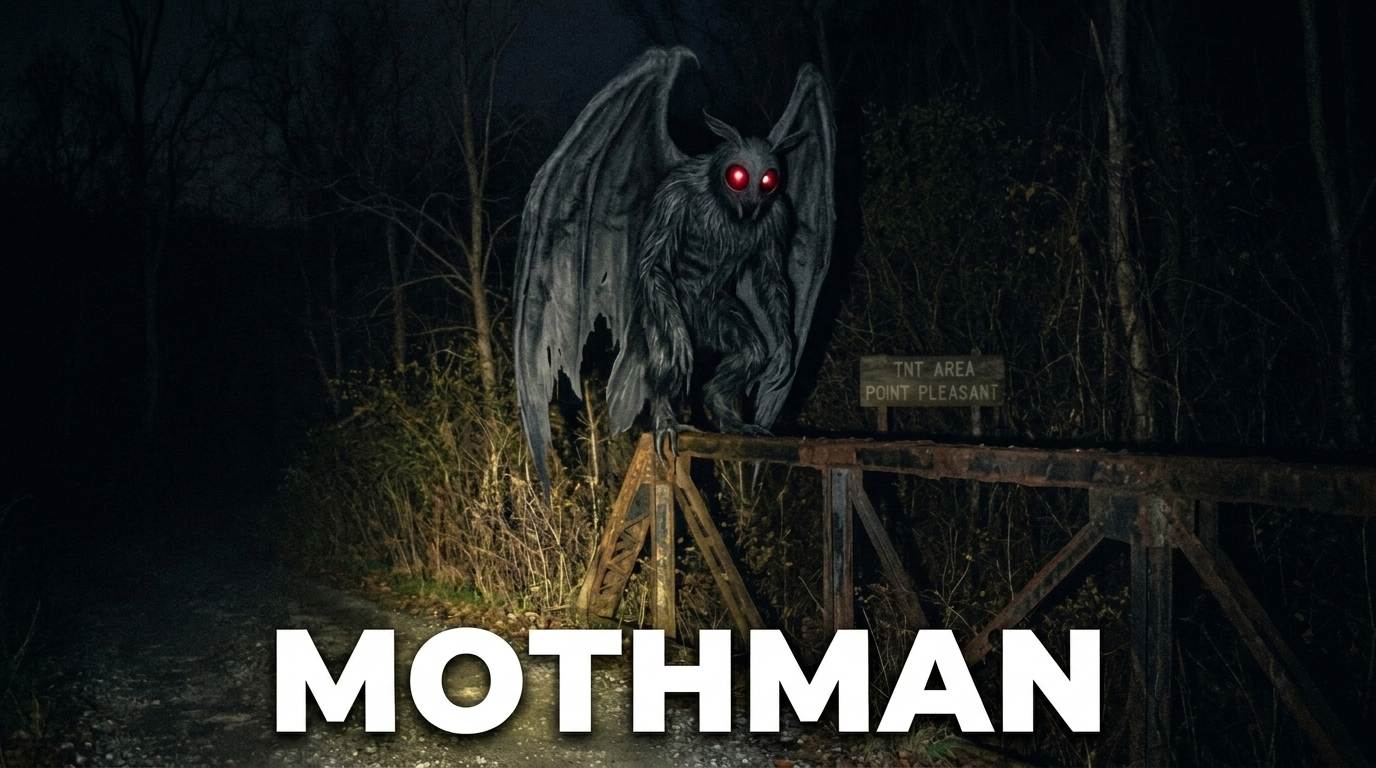
There are places where the darkness feels deeper than it should.
In the autumn of 1966, something was said to have emerged from that darkness, something witnesses struggled to describe as either man, animal, or bird.
It was enormous.
A dark, winged figure standing upright in the night, its body black against the trees and its eyes burning an impossible, vivid red.
Those who encountered it claimed that it could move without warning, appearing beside roads, rising from the darkness, or spreading immense wings before vanishing into the night sky. Some said they heard strange buzzing or humming. Others remembered only the eyes.
Always the eyes.
Within weeks, reports of the creature had spread through Point Pleasant, transforming an obscure encounter into one of America’s most enduring cryptid legends.
The name Mothman soon became inseparable from the town, its abandoned TNT-area forests, and the growing sense that something was watching from the darkness.
Then came the warnings.
Then came the Silver Bridge.
And after the bridge collapsed on December 15, 1967, killing 46 people, the Mothman legend changed forever.
What had begun as a handful of bizarre encounters became something darker, a story of a mysterious creature supposedly appearing before disaster, leaving behind questions that have endured for generations.
Was Mothman an unknown animal?
A misidentified bird?
A product of fear, folklore and coincidence?
Or was something truly watching Point Pleasant from the shadows?
More than half a century later, the red eyes still stare back from the legend.
🦇Physical Description / Appearance
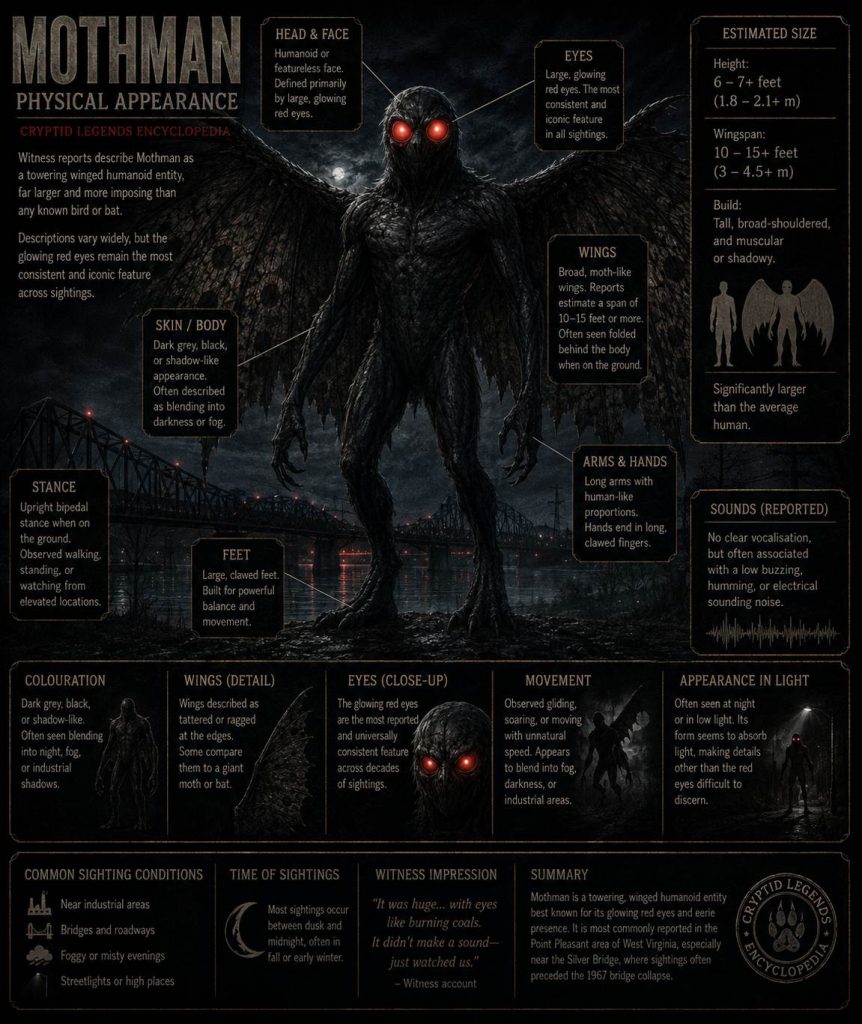
Witness reports describe Mothman as a towering winged humanoid entity, far larger and more imposing than any known bird or bat.
Reported Characteristics:
- 🦇 Height: 6–7+ feet (some reports suggest even larger)
- 👁️ Large, glowing red eyes set in a humanoid or featureless face
- 🪽 Broad wings spanning 10–15 feet or more
- ⚫ Dark grey, black, or shadow-like body
- 🚶 Upright bipedal stance when on the ground
- 🔊 No clear vocalisation, but often associated with buzzing or humming sounds
- 🌫️ Appears to blend into fog, darkness, or industrial shadows
Descriptions vary widely, but the glowing red eyes remain the most consistent and iconic feature across sightings.
📍 Location & Country
- 📌 Primary Location: Point Pleasant, West Virginia
- 🏞️ Region: Mason County
- 🌍 Country: United States
- 📍 Specific Area: Old National Guard Armory, Silver Bridge area, Ohio River Valley
- 🗺️ Coordinates (Approx.): 38.844° N, 82.137° W
The Mothman legend is closely associated with Point Pleasant, West Virginia, where a series of mysterious sightings between 1966 and 1967 brought the creature to international attention.
Reports were concentrated around the Ohio River Valley, including rural highways, the former Silver Bridge area, and the abandoned World War II munitions complex now known as the TNT Area.
Many of the most famous encounters occurred within what is now the McClintic Wildlife Management Area. Once used to store explosives during World War II, the site contains a network of abandoned bunkers, access roads, and wetlands that provided an eerie backdrop to numerous eyewitness reports.
Today, the area remains one of the locations most closely linked to the Mothman legend and continues to attract folklore enthusiasts, paranormal investigators, and curious visitors from around the world.
🗺️ Habitat
Mothman is typically associated with industrial decay zones, wetlands, river valleys, and abandoned infrastructure.
Rather than a natural ecosystem, its “habitat” appears tied to areas of human abandonment and environmental transition, particularly where fog, water, and artificial structures intersect.
📜 Background & Legend

The Mothman legend is rooted in mid-20th century American folklore, emerging from a series of reported sightings in and around Point Pleasant.
Unlike many cryptids tied to centuries of myth, Mothman is considered a modern cryptid phenomenon, closely linked to contemporary reports, media coverage, and urban legend formation.
Over time, the creature evolved beyond a simple “unknown animal” narrative into something far more symbolic, often interpreted as a harbinger of disaster, particularly in relation to the tragic collapse of the Silver Bridge in 1967.
Skeptical interpretations range from misidentified birds (such as sandhill cranes or owls) to psychological suggestion and mass hysteria, while believers point to the consistency of glowing red eyes and large winged silhouettes across multiple independent accounts.
Today, Mothman stands as one of the most iconic figures in global cryptozoology.
👣 First Original Sightings (1966–1967)
The earliest Mothman reports emerged in West Virginia during late 1966, forming a short but intense period of sightings that would later define the legend.
🦇 November 12, 1966 — Clendenin Sighting
The earliest recorded encounter linked to the Mothman phenomenon is often traced to Clendenin, West Virginia, where a group of gravediggers reported seeing a large, winged humanoid figure moving above the treeline while they worked at night.
The witnesses described:
- 🦇 A large human-shaped figure with wings
- 🌫️ Rapid, silent movement between trees
- ⚫ A dark silhouette blending into the night sky
- 👁️ Brief visibility before disappearing
This sighting remained largely local at the time, but is now frequently cited as the first known encounter in the Mothman timeline.
🌫️ November 15, 1966 — Point Pleasant Armory Encounter
Just three days later, the most famous early sighting occurred near the Old National Guard Armory outside Point Pleasant.
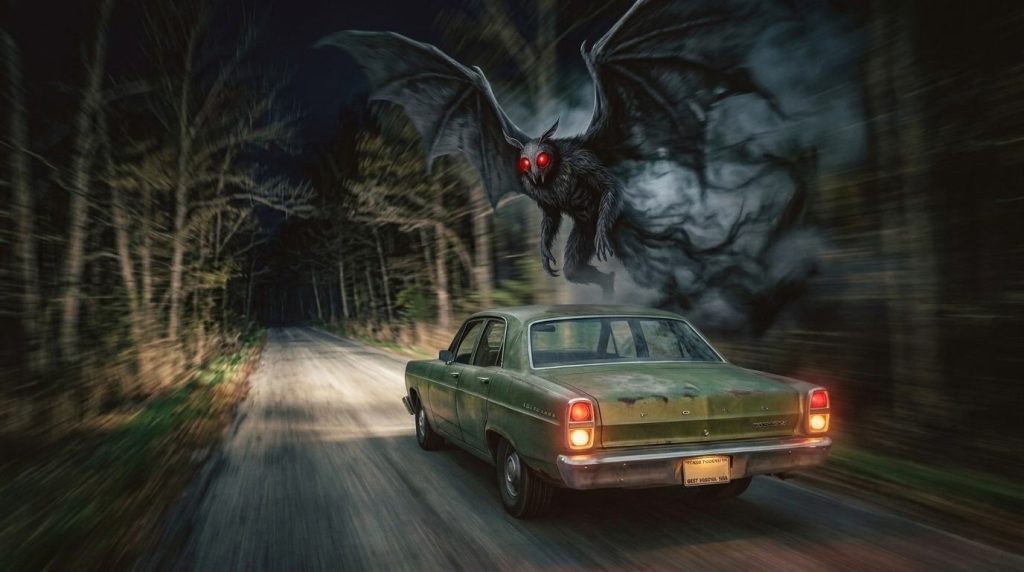
Two young couples reported seeing a tall, winged humanoid figure rise from the trees near a former industrial site known as the “TNT Area”.
According to their account, the creature:
- 🦇 Had a large wingspan and humanoid body
- 👁️ Possessed glowing red eyes that reflected headlights
- 🚗 Appeared to follow their vehicle as they fled at high speed
- 🌫️ Moved without visible sound or flapping motion
The encounter was quickly reported to local authorities and local press, marking the beginning of widespread public awareness of the phenomenon.
🌉 Late 1966–1967 — Escalating Reports
Following the initial sightings, multiple residents of Point Pleasant and surrounding areas reported similar encounters near:
- 🏭 The TNT munitions site
- 🌉 Bridges crossing the Ohio River
- 🌲 Rural roads and wooded areas
Descriptions remained consistent: a large winged humanoid with glowing red eyes appearing at night, often near vehicles or isolated infrastructure.
These reports continued intermittently until December 1967, when the collapse of the Silver Bridge brought national attention to the region and permanently linked the creature to the tragedy in popular folklore.
🎬 Mothman In Pop Culture
The Mothman has become one of the most recognisable figures in modern cryptozoology, evolving from a regional West Virginia legend into a global icon of paranormal culture, featured across film, literature, gaming, and tourism.
📖 Literature & Investigations
The most influential work in Mothman mythology is The Mothman Prophecies, written by paranormal investigator John Keel.
The book documents alleged sightings in Point Pleasant between 1966–1967 and introduces broader theories linking the Mothman phenomenon to UFO activity, Men in Black encounters, and precognitive warnings of disaster.
Earlier research by journalist Gray Barker helped bring attention to the case, but Keel’s work cemented Mothman as a central figure in modern Fortean and paranormal literature.
🎥 Film & Television
The legend was brought to mainstream audiences through the 2002 supernatural thriller The Mothman Prophecies, starring Richard Gere.
The film is loosely based on Keel’s investigations and popularised the idea of Mothman as a harbinger of catastrophe.
Since then, Mothman has appeared in numerous:
- 📺 Paranormal documentary series
- 🎬 Independent horror films
- 🎥 YouTube investigative documentaries
- 🧠 “High strangeness” media explorations
Documentaries such as The Mothman of Point Pleasant and The Mothman Legacy have further expanded public interest in the case.
🏛️ The Mothman Museum & Tourism
A major cultural hub for the legend is the Mothman Museum, located in Point Pleasant near the famous Mothman statue.
The museum contains:
- 📰 Original newspaper clippings from 1966–67 sightings
- 📸 Photographs and archives of the Silver Bridge disaster
- 👮 Eyewitness accounts and police documentation
- 🎬 Props and memorabilia from The Mothman Prophecies film
- 🛍️ Cryptid merchandise and collectibles
Adjacent to the museum stands the iconic Mothman Statue, which has become a pilgrimage site for cryptid enthusiasts and is central to the annual Mothman Festival, drawing thousands of visitors each year.
🎮 Video Games
Mothman has been widely adopted in gaming culture, particularly in titles drawing from folklore and American myth.
Notable appearances include:
🎮 Fallout 76 — features Mothman as a mutated cryptid tied to Appalachian folklore, appearing in both hostile and neutral forms depending on encounter type
The game significantly expanded Mothman’s modern identity, introducing variants such as the “Wise Mothman” and integrating the creature into faction-based lore.
🃏 Trading Card Games & Collectibles
Mothman also appears in modern collectible gaming culture, most notably in the cryptid-themed trading card game MetaZoo, where it is one of the most iconic and frequently reprinted creatures in the entire set.
The card features:
- 🦇 Flying humanoid design with glowing red eyes
- 🌙 Night-based abilities and fear-based traits
- 📊 High popularity among collectors due to rarity variants and artwork editions
This helped introduce Mothman to a younger audience and reinforced its status as a mainstream cryptid symbol.
🎨 Comics, Art & Internet Culture
Mothman is a recurring figure in:
- 🖼️ Horror illustration and digital cryptid art communities
- 📚 Independent comics and anthology horror publications
- 👕 Streetwear and alternative fashion designs
- 📱 Social media memes and paranormal storytelling pages
Its striking silhouette and glowing eyes make it one of the most visually reproduced cryptids online.
🌍 Legacy in Modern Culture
Today, Mothman exists far beyond its original sightings, functioning as both a folklore entity and a pop culture archetype. It is frequently used as a symbol of:
- ⚠️ Omens and disaster folklore
- 🌫️ Urban mystery and unexplained phenomena
- 👁️ “High strangeness” paranormal storytelling
From rural West Virginia to global media franchises, Mothman has become one of the defining cryptids of modern mythology.