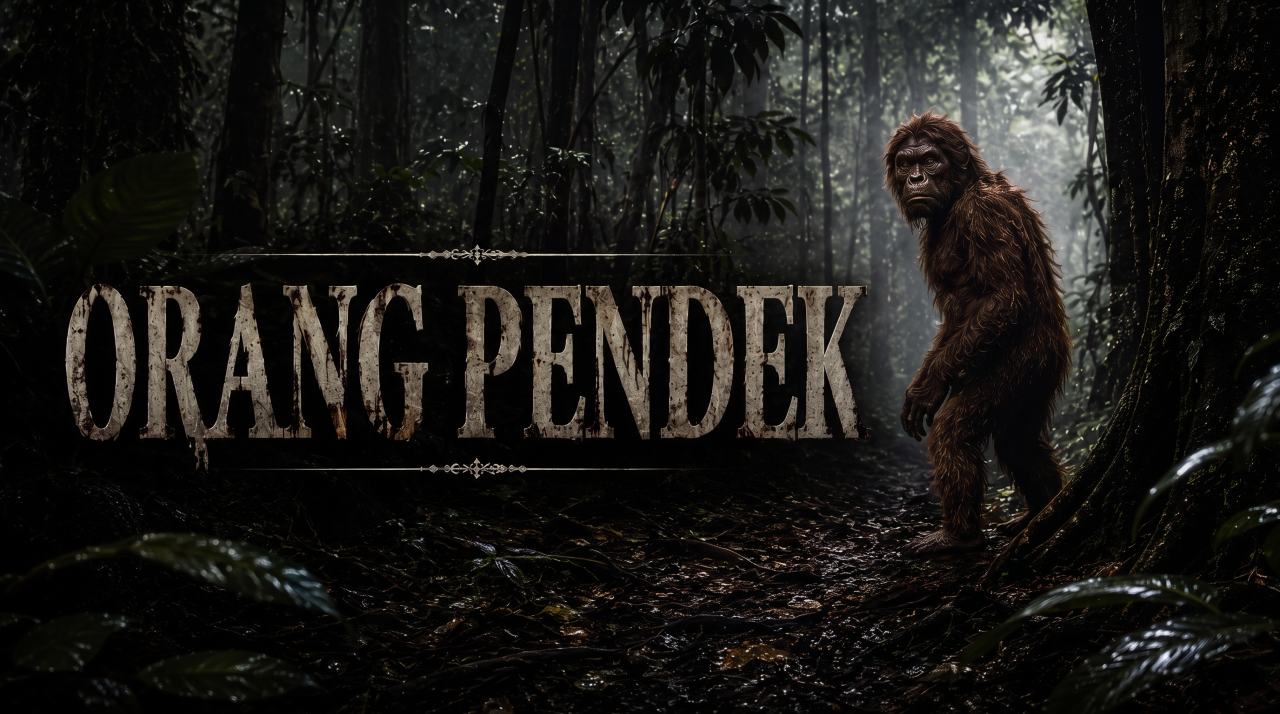
Orang Pendek — The Little People of Sumatra
Deep within the rainforests of Sumatra, where mountains disappear beneath walls of vegetation and the forest floor can remain almost permanently hidden beneath shadow, there persists a strange and remarkably enduring story.
The people of the forest speak of something that walks there.
Not a spirit that floats through the trees.
Not a giant like the legendary wildmen of other lands.
But something small, powerful and disturbingly human-like.
It is known by the name Orang Pendek — literally, “short person.”
For generations, villagers, hunters, plantation workers and forest peoples have described encounters with a creature standing somewhere between a large child and a small adult human.
It is said to walk upright on two legs, possess unusually powerful arms and shoulders, and be covered in short, dark hair. Some accounts describe a creature with a human-like face; others give it a distinctly ape-like appearance.
And yet it is not simply the creature’s appearance that has made the Orang Pendek one of cryptozoology’s most enduring mysteries.
It is the footprints.
Across the forests of Sumatra, investigators have collected casts of tracks which some researchers have argued do not correspond neatly with any recognised local primate. Hair samples have been collected.
Witnesses have been interviewed by the hundreds. Expeditions have entered the rainforest carrying cameras, traps and scientific equipment.
But the forest has never surrendered its secret.
No body has been recovered.
No skeleton has been identified.
No unquestionably authentic photograph has emerged.
And no zoological expedition has yet returned with an animal that could give the Orang Pendek a place in the scientific record.
The mystery becomes even more fascinating when the modern cryptid is placed against Sumatra’s older traditions.
Stories of small forest beings existed within indigenous cultures long before Orang Pendek became a familiar name in Western cryptozoology.
Among the Orang Rimba, traditions concerning a hantu pendek — a “short ghost” or short forest being — have been recorded by researchers.
Such traditions do not necessarily describe the same entity imagined by modern cryptozoologists, but they demonstrate that stories of mysterious small inhabitants of the forest have a deeper cultural history than the twentieth-century cryptid literature alone suggests.
Then, during the colonial era, European visitors began recording their own encounters with strange, human-like figures in the Sumatran wilderness.
Reports accumulated.
A short hairy figure glimpsed in the jungle.
A dark creature moving upright through vegetation.
A mysterious being observed at surprisingly close range before vanishing into the forest.
By the twentieth century, the name Orang Pendek had become attached to this growing body of testimony.
And eventually, the mystery attracted investigators willing to spend years searching for it.
Among them was Debbie Martyr, whose extensive fieldwork in Sumatra helped transform Orang Pendek from a collection of scattered jungle stories into one of the world’s most extensively investigated alleged mystery primates.
British trackers and researchers followed the trail. Footprints were cast. Hair was collected. Scientists were asked to examine the evidence.
Later came increasingly sophisticated camera-trapping projects, including major efforts in Kerinci Seblat National Park, one of the most biologically important protected forests in Southeast Asia.
Still, the Orang Pendek remained unseen.
Or perhaps, more accurately, unproven.
Because that distinction lies at the heart of the mystery.
The Orang Pendek is not recognised by modern zoology as a species. There is currently no confirmed biological evidence establishing an unknown primate living in Sumatra’s forests.
Many alleged encounters can potentially be explained by known animals, including sun bears, gibbons, orangutans and other wildlife, while questions have also been raised about the authenticity or interpretation of some footprint casts and hair samples.
Yet the story refuses to disappear.
For those who believe something remains undiscovered in the mountains of Sumatra, the Orang Pendek represents the possibility of a surviving, unknown primate, perhaps a remarkable relic of Southeast Asia’s ancient evolutionary past.
For sceptics, it represents something equally fascinating: the way folklore, wildlife, human perception and the enormous complexity of tropical forests can combine to create a mystery that survives for generations.
Somewhere beneath the canopy, the footprints disappear into the mud.
The witnesses disappear into the villages.
The photographs remain blurred.
And the forest remains silent.
Perhaps the Orang Pendek is an unknown animal.
Perhaps it has always been something else.
Or perhaps, deep within the last great forests of Sumatra, there really is a small, dark figure watching from between the trees, waiting for the moment when the jungle hides it again.
🐾 Physical Appearance
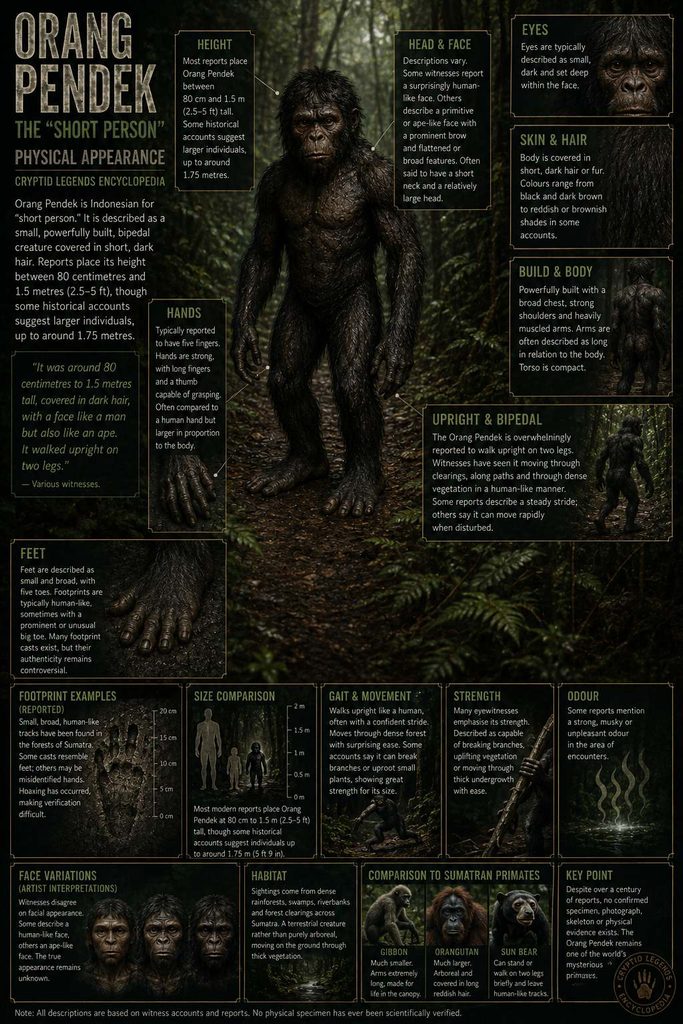
Perhaps the most intriguing aspect of the Orang Pendek legend is that, despite the enormous amount of uncertainty surrounding the creature, its reported appearance has remained surprisingly consistent across many accounts.
The name itself offers the simplest description. Orang Pendek is Indonesian for “short person”, and witnesses have generally described something considerably smaller than an adult human but distinctly human-like in its posture and movements.
Reported estimates vary, but descriptions commonly place the creature somewhere around 80 centimetres to 1.5 metres (approximately 2.5–5 feet) in height.
It is usually described as a powerfully built, bipedal animal, with a broad chest, strong shoulders and unusually muscular arms.
Rather than possessing the proportions of a small human, some witnesses describe it as having a distinctly ape-like physique. The arms are often said to appear long in relation to the body, while the torso is compact and heavily built.
Its body is generally covered in short, dark hair or fur, ranging from black and dark brown to reddish or brownish shades in some accounts.
This feature is particularly significant because it separates the traditional Orang Pendek description from one of Sumatra’s most familiar great apes: the orangutan. Orangutans possess their characteristic long reddish-orange hair, whereas the mysterious forest figure is generally described as dark-haired.
The head is where descriptions begin to diverge.
Some witnesses have reported a face that appeared surprisingly human-like, with recognisable eyes, nose and mouth.
Others describe a distinctly primitive or ape-like face, sometimes with a pronounced brow and flattened or broad features.
The creature has occasionally been characterised as having a short neck and a relatively large head in proportion to its body.
There is no established anatomical description, however, and no verified specimen exists from which such characteristics could be measured.
🚶 Upright and Bipedal
Perhaps the most important physical characteristic is the Orang Pendek’s reported method of locomotion.
The creature is overwhelmingly portrayed as walking upright on two legs.
Witnesses have described it moving through forest clearings, along paths and through dense vegetation in a manner resembling a human walking through the jungle. Some reports describe a steady, confident stride, while others suggest that it can move rapidly when disturbed.
This apparent combination of human-like bipedalism and ape-like anatomy is central to the mystery.
Sumatra already possesses several remarkable primates, but none corresponds neatly to the classic Orang Pendek description.
Gibbons, for example, can occasionally travel terrestrially on two legs, particularly across open ground, but they are considerably smaller and possess extremely long arms adapted primarily for life in the canopy.
Orangutans are much larger and predominantly arboreal, while the Malayan sun bear can sometimes produce remarkably human-like tracks and may briefly stand or move upright.
Consequently, a fleeting upright figure in dense rainforest can be extraordinarily difficult to identify with certainty.
💪 A Small but Powerful Creature
The Orang Pendek is rarely portrayed as frail.
Quite the opposite.
Many accounts emphasise its strength. Witnesses have described an animal with powerful arms and shoulders capable of moving through dense vegetation with ease. Some stories claim that it could break branches or even uproot small plants and saplings.
Such claims belong firmly to the realm of eyewitness testimony and folklore, rather than established zoology, but the recurring description of an unusually muscular little primate is noteworthy.
The traditional image is therefore not simply that of a miniature human.
It is more often something resembling a compact, heavily built ape capable of standing and travelling comfortably on two legs.
👣 Feet and Hands
The creature’s alleged feet have become one of the most controversial parts of its physical description because they form the basis of much of the physical evidence collected by Orang Pendek investigators.
Reported footprints are generally described as small, broad and surprisingly human-like, sometimes with an apparently prominent or unusual big toe.
Some casts have been interpreted by investigators as resembling the feet of an unknown ape, while other specialists have questioned whether particular impressions were actually hands rather than feet.
The controversy is important because footprints can potentially provide information that eyewitnesses cannot.
A witness may misjudge an animal’s height, colour or facial characteristics. A footprint, by contrast, can preserve evidence of anatomy, gait and weight distribution.
But only if the print itself is genuine.
A number of Orang Pendek footprint casts have subsequently been questioned, and some investigators have acknowledged that hoaxing has occurred in areas where tourists and cryptozoologists search for the creature. This makes it impossible to treat every cast as evidence of an unknown primate.
👁️ Face and Eyes
Descriptions of the Orang Pendek’s face vary considerably more than descriptions of its body.
Some witnesses have reported small, dark eyes set within an ape-like face, while others have described a surprisingly human expression. In certain accounts the creature appears almost like a primitive human covered in hair; in others it is unmistakably described as an ape.
This variation may reflect the conditions under which many encounters supposedly occur.
The forests of Sumatra are extraordinarily dense. A witness may see the animal for only a few seconds, sometimes through vegetation, in poor light or while the creature is moving rapidly away. Under such circumstances, the human brain attempts to interpret an unfamiliar silhouette using familiar categories.
The result can be an animal that is simultaneously described as human, ape and something entirely unfamiliar.
📏 How Tall Is an Orang Pendek?
There is no agreed size.
Reported estimates range broadly, with many modern accounts clustering around 1–1.5 metres, while some historical descriptions suggest somewhat greater heights.
One particularly notable early twentieth-century account associated with A.H.W. Cramer described an orang pendek at approximately 1.75 metres, demonstrating that the reported size has never been completely uniform.
This creates an important distinction between the classic modern image and the entire historical record.
The familiar cryptozoological Orang Pendek is generally a small, compact primate, but historical reports sometimes describe an individual closer to the size of a short adult human.
🌿 A Creature Built for the Forest
Taken together, the recurring descriptions create a remarkably distinctive image.
A small, dark-haired, powerfully built creature, standing upright on two legs and possessing strong arms, a compact torso and a mixture of human-like and ape-like facial characteristics.
It is generally imagined as a terrestrial rather than purely arboreal animal, moving through the dense undergrowth of Sumatra rather than swinging continuously through the canopy. This is particularly interesting because the island’s existing primates occupy highly specialised ecological niches.
The Orang Pendek, if it existed as described, would therefore represent something unusual: a relatively small, ground-dwelling bipedal primate inhabiting one of the world’s most biologically diverse tropical forests.
But there is a final complication.
For all the descriptions, sketches, footprint casts and alleged encounters accumulated over more than a century, there is still no confirmed Orang Pendek specimen from which its physical appearance can be established scientifically.
No skull.
No skeleton.
No preserved hide.
No verified photograph.
No living animal.
The Orang Pendek therefore remains a creature whose body exists almost entirely through description, reconstructed from footprints in rainforest mud, fleeting silhouettes between trees and the memories of those who claim to have encountered something they could not identify.
And perhaps that is what makes its appearance so compelling.
It is not the image of one perfectly defined monster.
It is the recurring outline of something small, dark and unmistakably upright, disappearing into the Sumatran forest before anyone can get close enough to prove what it was.
📍 Location & Country

- 🇮🇩 Primary Location: Lake Gunung Tujuh, Kerinci Regency, Jambi, Sumatra
- 🌏 Region: Central Sumatra
- 🏛️ Province: Jambi
- 🇮🇩 Country: Indonesia
- 🌳 Historical Setting: The montane rainforest of the Kerinci highlands and surrounding forests of Kerinci Seblat National Park
- 🏞️ Associated Location: Mount Tujuh and Lake Gunung Tujuh, including the surrounding forest and approaches from the village of Pelompek
- 🌲 Protected Area: Kerinci Seblat National Park
- 👁️ Primary Report Area: The forests around Gunung Tujuh and the Kerinci highlands, where numerous local accounts and modern investigations have been concentrated
- 🔎 Major Investigation Area: Kerinci Seblat National Park, particularly the Gunung Tujuh region
- 📅 Modern Investigation Period: 1980s–present
- 📍 Coordinates (Approx.): 1.7064° S, 101.4117° E


Lake Gunung Tujuh lies deep within the Kerinci Seblat National Park in Jambi, Sumatra, surrounded by steep, forest-covered volcanic mountains and extensive areas of remote rainforest.
The lake sits within the caldera of Mount Tujuh at approximately 2,000 metres above sea level, with dense vegetation, streams and frequently mist-covered slopes creating a secluded highland environment.
The area is closely associated with the modern Orang Pendek investigation tradition.
Forests around Gunung Tujuh and the nearby village of Pelompek (Polompek) have been repeatedly identified by local residents and visiting researchers as an important area for reports of the creature.
Expeditions investigating Orang Pendek have followed local accounts into the surrounding forests, documenting alleged footprints, collecting hair samples and recording eyewitness descriptions of a small, powerfully built, bipedal figure moving through the vegetation.
Reports from the wider Gunung Tujuh–Kerinci region describe Orang Pendek as approximately 1–1.5 metres tall, covered in dark hair and capable of travelling upright through dense forest.
The Gunung Tujuh area subsequently became one of the locations associated with the field investigations of researchers including Debbie Martyr, Jeremy Holden, Adam Davies and Richard Freeman, alongside Indonesian researchers and local guides.
No confirmed Orang Pendek specimen has ever been recovered from Gunung Tujuh, and no photograph or DNA sample has established the existence of an unknown primate.
Nevertheless, the combination of longstanding local reports, alleged tracks and repeated expeditions makes the Gunung Tujuh forests one of the most significant locations in the modern Orang Pendek legend.
🌳 Habitat
Orang Pendek is traditionally associated with the dense rainforests of central Sumatra, particularly the remote forests surrounding Kerinci and Kerinci Seblat National Park in Jambi and neighbouring provinces.
The reported habitat is one of steep volcanic mountains, deep valleys, fast-flowing streams, swamps, bamboo, thick undergrowth and largely undisturbed tropical forest.
The Kerinci Seblat landscape is particularly significant because it provides an enormous area of continuous forest in which a large ground-dwelling animal could theoretically remain difficult to observe.
The national park covers roughly 1.4 million hectares, extending across Jambi, West Sumatra, Bengkulu and South Sumatra, and contains some of Sumatra’s most important remaining montane and lowland rainforest.
🌿 Montane Forests
Many Orang Pendek reports originate from the higher forests around the Kerinci highlands, including the forests surrounding Mount Kerinci and Gunung Tujuh. These areas contain cooler montane environments where vegetation becomes increasingly dense and distinctive with altitude.
Gunung Tujuh is particularly interesting within the Orang Pendek tradition. The forest around Lake Gunung Tujuh and Pelompek has repeatedly featured in modern investigations, with local witnesses describing a small, powerful, upright-walking animal moving through the forest.
Such terrain would provide numerous opportunities for an elusive terrestrial animal to remain concealed. Dense vegetation limits visibility, while steep slopes, ravines and streams create a highly fragmented landscape that can be difficult for researchers to survey systematically.
🌴 Lowland & Transitional Forest
Reports are not restricted to high elevations. Orang Pendek accounts from the wider Kerinci region also place the creature in lower-elevation rainforest and transitional forest, suggesting that the reported animal is not tied exclusively to alpine or montane conditions.
These forests contain an extraordinary diversity of potential food sources, including fruit, seeds, shoots, insects and small vertebrates.
The wider ecosystem supports Sumatran orangutans, siamangs, gibbons, sun bears, wild pigs, deer, elephants and Sumatran tigers, demonstrating that the region is capable of supporting a diverse community of large and medium-sized terrestrial and arboreal mammals.
🍃 Forest Floor
Unlike orangutans and most gibbons, Orang Pendek is consistently described in eyewitness accounts as a ground-dwelling creature. Witnesses commonly report seeing it walking upright along forest paths, through undergrowth or across clearings.
Descriptions of powerful arms, broad shoulders and a compact body have led some investigators to suggest an animal adapted to moving through difficult vegetation rather than an exclusively arboreal primate.
Alleged footprints have also been reported along muddy trails, stream margins and other soft ground where tracks would be more likely to survive.
However, no confirmed trackway has demonstrated the presence of an unknown primate.
Known Sumatran animals, including sun bears, humans and other mammals, can leave tracks that may appear unusual when encountered in isolation, while some purported Orang Pendek casts have also been acknowledged as possible hoaxes.
🌧️ A Difficult Environment to Survey
Kerinci’s rainforest is an exceptionally challenging environment for wildlife research. Heavy rainfall, thick vegetation, steep terrain and limited visibility can make direct observation extremely difficult. An animal spending most of its time within dense forest could potentially encounter very few people, even in a relatively well-studied landscape.
This environmental difficulty has become an important part of the Orang Pendek mystery. Numerous expeditions have deployed camera traps and conducted searches throughout the region, yet no verified photograph, body, skeleton or uncontaminated biological sample has established the existence of an unknown primate.
The habitat therefore presents a fascinating contradiction: Sumatra possesses extensive, biologically rich rainforest capable of supporting elusive mammals, but the available evidence has never demonstrated that Orang Pendek is among them.
Today, the forests associated with the legend are valuable regardless of the cryptid question. Kerinci Seblat protects some of the last major areas of Sumatran rainforest and provides habitat for genuinely threatened species, making conservation of this landscape important both for its extraordinary biodiversity and for the cultural traditions that have grown around its unexplored wilderness.
🌿 Background & Legend

The name Orang Pendek is Indonesian for “short person” or “short human,” a simple description that reflects one of the most distinctive features attributed to the creature.
Unlike many cryptids whose identities are tied to a single dramatic encounter, Orang Pendek belongs to a much older and more complicated landscape of Sumatran forest traditions, local terminology and oral accounts.
The legend is particularly associated with the Kerinci highlands of western central Sumatra, where stories of small, human-like forest beings have circulated among communities living around the mountains and rainforest.
Different names have been recorded in different areas, including Uhang Pandak, Sedapa, Orang Gugu and Atoe Pandak.
These variations are important because they suggest that the modern idea of a single creature called “Orang Pendek” may have developed from several overlapping local traditions rather than representing one universally defined being.
Among the Orang Rimba, an Indigenous forest people of Sumatra, accounts of a being known as hantu pendek, meaning approximately “short ghost”, provide an important cultural parallel.
Ethnographic accounts describe the hantu pendek as a dangerous or troublesome forest being associated with the wilderness.
Some traditions describe people leaving tobacco offerings for such beings, reflecting a relationship based on respect, caution and avoidance rather than a straightforward belief in an undiscovered animal.
The distinction between hantu pendek and Orang Pendek is nevertheless important. They should not automatically be treated as two names for exactly the same entity.
The hantu pendek belongs to an Indigenous spiritual and folkloric context, while Orang Pendek as a cryptozoological concept has largely been constructed around reports interpreted as encounters with a physical, unknown primate.
Modern investigators have sometimes connected the traditions, but there is no evidence that every community describing a short forest being was referring to the same creature.
The legend also occupies an unusual position between human folklore and zoological possibility. The creature is generally portrayed as neither a giant nor a supernatural monster.
Instead, it is imagined as something remarkably close to humanity: short, muscular, hairy and capable of walking upright, yet sufficiently different from known people and primates to remain mysterious.
This ambiguity has helped the legend survive. A person glimpsed briefly through dense vegetation, a strangely shaped footprint in mud, movement between trees or an unfamiliar animal seen at a distance can all become incorporated into an existing tradition.
Once stories are repeated between generations and communities, individual observations can acquire characteristics belonging to the wider legend.
Sumatra itself has also played an important role in shaping the mystery. Its forests contain an extraordinary mixture of humans, great apes, lesser apes, bears, deer and other mammals, while much of the interior has historically been difficult for outsiders to explore.
For people living close to the forest, encounters with unusual animals are part of a very different experience of the landscape from that of visitors arriving with cameras and scientific equipment.
Orang Pendek consequently became more than simply a proposed unknown primate. During the twentieth and early twenty-first centuries, it evolved into a symbol of the unexplored Sumatran forest, a creature positioned somewhere between folklore, Indigenous tradition, anthropology and cryptozoology.
That ambiguity remains at the heart of the legend. To some, Orang Pendek represents the possibility that an unknown primate could still exist in one of Asia’s great remaining wildernesses.
To others, the story illustrates how genuine encounters with wildlife can become transformed through oral tradition, cultural interpretation and modern expectations of mysterious animals.
What makes the legend particularly enduring is that neither interpretation has completely erased the other.
The forests remain real, the traditional stories remain culturally significant, and reports of an unidentified small biped continue to circulate. Yet the biological identity of the supposed creature remains unresolved.
📜 Historical Sightings & Famous Expeditions
The modern history of Orang Pendek is unusual even by cryptozoological standards.
Rather than emerging from a single celebrated encounter, the legend developed through local testimony, Dutch colonial reports, travelling naturalists and, eventually, organised expeditions involving zoologists, anthropologists, trackers and cryptozoologists.
Over more than a century, investigators have accumulated eyewitness accounts, footprint casts and hair samples, but no expedition has yet produced the decisive evidence that would establish Orang Pendek as a previously unknown primate.
The Early Sumatran Accounts
Reports of small, human-like forest beings in Sumatra long pre-date modern cryptozoological investigations.
Local traditions contain several names and descriptions, and these were later encountered by Dutch colonial officials and European travellers attempting to understand the forests of the island.
One of the most frequently cited early accounts came from the Dutch surveyor J. van Herwaarden, whose encounter was originally published in Dutch in De Tropische Natuur in 1924 under the title Een Ontmoeting met een Aapmensch — “An Encounter with an Ape-Man.”
A later scholarly translation preserved the account and identified the animal as a sedapa, one of the regional names subsequently associated with Orang Pendek.
Van Herwaarden described encountering a dark, hairy creature while surveying and hunting. Its hair was darker on the back and longer around the head and shoulders, while its arms appeared exceptionally long in relation to its legs.
Significantly, he did not describe a monstrous or grotesque creature. Instead, he remarked that its face did not appear particularly apelike and that there was nothing ugly or repulsive about it.
Other Dutch-era reports are frequently included in Orang Pendek histories, including accounts attributed to plantation owners and colonial officials during the early twentieth century.
These reports helped establish a recurring pattern: a relatively small, dark-haired, upright animal encountered briefly within the Sumatran forest.
The surviving documentation is uneven, however. Some accounts survive only through later retellings, while others are better documented in contemporary publications. They therefore need to be treated as historical reports rather than zoological records.
🧭 Debbie Martyr & Jeremy Holden
The most important transition in Orang Pendek history came much later, when British researcher Debbie Martyr began investigating the creature in the late 1980s.
Martyr spent years working in and around the Kerinci region, interviewing local people, hunters, forest workers and members of Indigenous communities. Photographer and field researcher Jeremy Holden subsequently became closely associated with the work.
Their approach differed from earlier cryptozoological expeditions. Rather than simply searching for a mysterious animal, they attempted to build a substantial ethnographic and geographical record of sightings, asking witnesses where encounters occurred, what the animal looked like, how it behaved and how it reacted to humans.
Martyr has also reported a personal sighting, describing an unidentified bipedal animal in the forest. Holden likewise reported an encounter. Their experiences became influential within the modern Orang Pendek investigation community, although neither produced independently verifiable photographic or biological evidence.
The work attracted support from Fauna & Flora International, linking the Orang Pendek investigation with genuine conservation work in Sumatra.
Much of the information accumulated during this period remained unpublished or circulated primarily within cryptozoological and expedition literature, leaving an unusual situation in which a substantial body of field testimony exists without a corresponding peer-reviewed zoological discovery.
🐾 Adam Davies, Andrew Sanderson & Keith Townley
One of the most important physical-evidence episodes occurred during expeditions involving British researchers Adam Davies, Andrew Sanderson and Keith Townley around the turn of the millennium.
Their work produced alleged Orang Pendek footprints in the Kerinci area, including a particularly interesting cast that became one of the most reproduced pieces of physical evidence associated with the creature.
The cast was examined by Dr David Chivers, a primate biologist at the University of Cambridge. Chivers compared the print with known primate and local animal tracks and considered it an ape-like print with an unusual combination of characteristics. His interpretation was that it did not correspond neatly to a known primate.
The interpretation was not universally accepted. Anthropologist and footprint specialist Dr Jeffrey Meldrum considered the print potentially primate in origin but raised the possibility that it could actually represent a hand rather than a foot.
That distinction is crucial because a handprint can produce an apparently unusual “footprint” when viewed without the surrounding trackway.
The cast consequently became an intriguing but disputed object rather than proof of an unknown species.
🧬 The Orang Pendek Hair Samples
The Davies expedition also produced hair samples, which became another major episode in the investigation.
Mammal-hair specialist Dr Hans Brunner examined the samples and reported that their structure appeared unusual when compared with known local mammals and primates. In accounts published by expedition researchers, Brunner considered the material consistent with an undocumented primate.
The subsequent genetic investigation was much less conclusive.
Samples were divided between laboratories. Richard Freeman later reported that analysis at Copenhagen found structural similarities to orangutan hair but differences significant enough to raise questions about the material’s identity.
A DNA result reported by Dr Tom Gilbert appeared to contain human DNA, while Todd Disotell of New York University was unable to obtain usable DNA from his portion of the material. Freeman and colleagues suggested contamination as a possible explanation for the human result.
The hair therefore cannot be treated as confirmed Orang Pendek DNA. At most, it represents an unresolved sample whose original collection and subsequent genetic condition prevented a definitive identification.
📷 The Search for Photographic Evidence
The absence of a clear photograph became increasingly important as technology improved.
Beginning in the 1990s and continuing into the 2000s, researchers deployed camera traps throughout areas associated with Orang Pendek reports.
The expectation was straightforward: if a breeding population of unknown primates existed, automatic cameras placed along forest trails, feeding areas and suspected travel routes might eventually record one.
Instead, the cameras photographed the known wildlife of Sumatra.
This included exactly the kind of animals that could potentially complicate Orang Pendek reports, bears, primates, pigs and other forest mammals. Despite substantial effort, no verified camera-trap photograph of Orang Pendek emerged.
🌎 The National Geographic Expedition, 2005–2009
The growing international interest eventually attracted major media and scientific resources.
A National Geographic-supported investigation led by Peter Tse used extensive camera trapping in the Kerinci Seblat region.
The project was particularly significant because it represented an attempt to approach the Orang Pendek question using modern wildlife-survey techniques rather than relying principally on eyewitness testimony.
The expedition accumulated large quantities of wildlife imagery but did not obtain a confirmed Orang Pendek photograph.
The failure did not prove that no unknown primate existed. Camera trapping has obvious limitations, particularly in an enormous tropical forest.
But it did remove one of the simplest potential routes to confirmation: an identifiable animal repeatedly appearing before automatically triggered cameras.
🌳 Richard Freeman’s Expeditions
British zoologist and cryptozoological researcher Richard Freeman subsequently became one of the most prominent investigators of Orang Pendek.
Freeman conducted several expeditions to Sumatra and published detailed accounts of his investigations, including extensive interviews with local witnesses. His 2011 Guardian reports provide unusually detailed contemporary documentation of the expedition process.
During a 2003 expedition around Lake Gunung Tujuh, Freeman’s team encountered a number of local reports.
One particularly detailed testimony came from men near the village of Polompek, who described seeing a roughly 1.5-metre-tall, blackish-brown, powerfully built biped lifting and throwing cut logs.
Other witnesses described smaller animals around one metre tall with black hair, long arms and upright movement.
The expedition also encountered alleged tracks, although some were too damaged by rainfall to cast.
One particularly striking story concerned a local man who claimed that he had caught an Orang Pendek in a deer snare.
According to his account, the animal resisted violently, broke his spear and eventually freed itself. As with other eyewitness cases, there was no independent physical evidence establishing what the man had actually encountered.
🏞️ The 2009 Expedition
Freeman returned to Sumatra in 2009, continuing interviews, tracking work and camera-trapping.
The investigation produced another alleged eyewitness encounter by a member of the expedition team.
Freeman reported that the observer saw a small ape-like animal attempting to conceal itself against a tree before disappearing into the vegetation.
Once again, however, there was no photograph, specimen or biological material capable of independently confirming the observation.
This expedition nevertheless reinforced a recurring pattern in the Orang Pendek literature: witnesses consistently described an animal that appeared more ape-like than human, with long arms, powerful shoulders, relatively short legs and a distinctly upright gait.
🔎 The Major 2011 Investigation
Freeman’s 2011 expedition was one of the most extensively documented modern Orang Pendek searches.
Two teams operated in different environments. One concentrated on the highland forests surrounding Lake Gunung Tujuh, while another investigated the more open agricultural “garden” areas bordering the forest, where local reports sometimes described Orang Pendek entering crops.
Before entering the forest, the team interviewed Pak Entis, who claimed to have seen an approximately three-foot-tall creature with enormous shoulders and chest, tan-coloured hair and an ape-like face.
According to his account, the animal became alarmed when discovered, raised its hands and produced a “hoo-hoo” vocalisation before disappearing.
In the forest around the lake, researchers found vegetation that appeared to have been eaten or disturbed, including ginger and rattan shoots. They also found a suspicious print beside a rotten log that had apparently been pulled apart.
The resulting cast became another important piece of the Orang Pendek story, but with an unexpected conclusion.
After cleaning the cast, Freeman determined that it appeared to be a handprint rather than a footprint. He described a rounded palm, short triangular thumb and thick fingers. He considered it unlike the hand of a Sumatran orangutan and compared it qualitatively with a small gorilla hand.
This is an important example of why the physical evidence surrounding Orang Pendek remains controversial.
A supposedly unknown footprint became an alleged handprint, making the biological interpretation considerably more complicated.
The camera traps also failed to produce the hoped-for result. Freeman reported that the cameras recorded insects, rainfall and a bird, but no Orang Pendek.
🐾 Cliff Barackman & The Orang Pendek Project, 2012–2016
American researcher Cliff Barackman, known internationally through Finding Bigfoot, subsequently established the Orang Pendek Project.
Running from 2012 to 2016, the project was an international collaborative effort involving researchers across several countries. Its aim was to collect, document and analyse evidence associated with Orang Pendek reports.
The project accumulated dozens of footprint casts and other field information from reported encounter locations. However, Barackman himself acknowledges that the collection is mixed: some casts were probably hoaxed, while others appeared sufficiently interesting to warrant further examination.
That admission is particularly valuable historically because it demonstrates that even investigators sympathetic to the Orang Pendek hypothesis do not regard every physical trace as genuine.
Barackman also investigated the possibility that Orang Pendek might represent a surviving population related to Homo floresiensis, the diminutive hominin discovered on the Indonesian island of Flores.
His subsequent analysis rejected the idea that the alleged Orang Pendek footprint morphology corresponded to Homo floresiensis, particularly because of differences in the reported orientation of the big toe.
The project ended without a specimen or confirmed photograph.
Dally Sandradiputra & Indonesian Research
Orang Pendek investigations have not been exclusively foreign.
Indonesian researcher and writer Dally Sandradiputra has conducted repeated self-funded expeditions since the late 2000s, particularly around Kerinci and western Sumatra.
His work has focused heavily on local testimony, alleged tracks and the geographical distribution of reports.
Sandradiputra has helped maintain interest in the subject within Indonesia itself, including through interviews and Indonesian-language media coverage.
His work illustrates an important aspect of the Orang Pendek mystery: much of the surviving testimony exists within communities that have lived alongside the Sumatran forest for generations.
Yet, like the better-known Western expeditions, his investigations have not produced an independently verified specimen.
🎥 The 2020s — A Continuing Mystery
The investigation did not end with the major expeditions of the 1990s and 2000s.
Interest was renewed by documentaries and independent researchers, including Expedition Sumatra: In Search of the Orang Pendek, which brought the mystery to a modern streaming audience.
The documentary renewed public interest but did not produce scientific confirmation of the creature.
More recently, researchers have continued experimenting with camera traps, acoustic lures, footprint documentation and environmental DNA.
One independent 2022 expedition around Gunung Tujuh reported finding a track consistent with descriptions of Orang Pendek, including a divergent big toe, although the print could not be cast.
In May 2026, researcher Adam Thorn of the Primate Discovery Unit conducted another five-day expedition in West Sumatra.
His team reported obtaining what appeared to be a large ape-like arm on camera and collected hair and environmental DNA samples for testing.
The material remains unconfirmed and pending analysis, meaning it cannot presently be regarded as evidence of a new species.
This latest work is particularly interesting because it demonstrates how the investigation is moving toward modern biological techniques rather than relying exclusively on eyewitness testimony.
🧭 What More Than a Century of Investigation Has Established
After more than a hundred years of reports, the Orang Pendek investigation has produced a surprisingly substantial historical record but a remarkably small amount of verifiable biological evidence.
There are repeated eyewitness descriptions, numerous alleged tracks, several physical casts and disputed hair samples. Researchers have spent years interviewing witnesses and placing cameras in areas where reports have concentrated. Some investigators have personally claimed to see the animal.
Yet the essential pieces of zoological evidence remain absent.
There is no confirmed body, skeleton, skull, tissue sample, uncontaminated DNA sequence, authenticated photograph or independently verified video demonstrating that Orang Pendek represents an unknown primate.
The footprint evidence remains the most interesting physical aspect of the case, particularly the casts examined by Chivers and the later handprint discovered during Freeman’s 2011 expedition. But the existence of disputed or unusual prints is not equivalent to demonstrating an unknown species.
Likewise, the hair evidence remains unresolved rather than positive. Brunner’s morphological observations were intriguing, but subsequent genetic work failed to provide a clean, reproducible Orang Pendek DNA identification.
The historical record therefore leaves Orang Pendek in an unusual position. The legend is unquestionably real; the reports are historically documented; the investigations genuinely occurred; and some of the evidence remains difficult to explain.
What has never been demonstrated is that the source of those reports is a previously unknown primate.
That distinction is central to the Orang Pendek mystery, and it is precisely why, after generations of stories and decades of organised searching, the creature remains one of Sumatra’s most enduring cryptozoological enigmas.
📚 Orang Pendek in Pop Culture & Literature

Orang Pendek has never reached the global cultural status of Bigfoot or the Yeti, but it has developed a distinctive place within cryptozoology, expedition literature, television, documentaries and popular science media.
Unlike many cryptids that exist primarily through fictional portrayals, Orang Pendek’s cultural footprint has largely grown from the continuing search for the creature itself.
📖 Orang-Pendek: Sumatra’s Forgotten Ape — Richard Freeman
The most substantial book devoted specifically to the mystery is Richard Freeman’s Orang-Pendek: Sumatra’s Forgotten Ape, published by the Centre for Fortean Zoology in 2011.
At more than 300 pages, the book examines the creature’s reported history, eyewitness accounts, footprint evidence, possible evolutionary origins and the author’s own investigations in Sumatra.
Freeman presents Orang Pendek as one of the more compelling unresolved mystery animals, while also discussing the difficulties involved in investigating a potentially unknown primate in dense rainforest.
The book became an important reference point for later English-language coverage of Orang Pendek and helped move the creature beyond the relatively small world of Fortean literature.
📖 A Little Bigfoot: On the Hunt in Sumatra — Pat Spain
Another important work is Pat Spain’s A Little Bigfoot: On the Hunt in Sumatra, published by 6th Books.
Spain, who had experience working on wildlife-adventure television, travelled to Sumatra with a National Geographic film crew while investigating the Orang Pendek mystery.
The book recounts the expedition through a mixture of wildlife adventure, field investigation and encounters with local guides and witnesses.
It provides a different perspective from Freeman’s dedicated cryptozoological investigation, documenting the practical realities of attempting to search for an elusive animal in the Sumatran rainforest.
📚 Orang Pendek in Cryptozoological Literature
The creature has also appeared extensively in broader cryptozoological books, encyclopedias and Fortean publications.
Its unusual combination of a relatively small body size, upright locomotion, ape-like appearance and Sumatran rainforest habitat has made it particularly interesting to writers exploring undiscovered primates.
Richard Freeman’s later books, including Adventures in Cryptozoology: Hunting for Yetis, Mongolian Deathworms and Other Not-So-Mythical Monsters and In Search of Real Monsters, continued to reference Orang Pendek alongside other mystery animals.
The creature has also featured regularly in publications such as Fortean Times, where it occupies the intersection between cryptozoology, folklore, anthropology and unexplained animal reports.
📺 Finding Bigfoot — “Indonesia’s Little Bigfoot”
Perhaps the biggest exposure Orang Pendek has received outside specialist literature came through Animal Planet’s Finding Bigfoot.
The programme travelled to the Kerinci region of Sumatra for the episode “Indonesia’s Little Bigfoot,” which aired in February 2013.
The team, including Cliff Barackman, James “Bobo” Fay, Matt Moneymaker and Ranae Holland, investigated reports of Orang Pendek and searched the surrounding rainforest for evidence.
The episode deliberately framed Orang Pendek as a kind of “little Bigfoot”, introducing the Sumatran mystery to a much larger international audience.
Its significance to Orang Pendek’s cultural history is considerable: the creature went from being a relatively obscure cryptozoological subject to appearing on a mainstream American television series watched by a worldwide audience.
The episode also helped establish the familiar modern visual association between Orang Pendek and Bigfoot-style field investigation, night searches, eyewitness interviews, footprint analysis, thermal equipment and attempts to obtain photographic evidence.
🌏 National Geographic & Sumatran Expedition Media
National Geographic also played an important role in bringing Orang Pendek to a wider audience through its coverage of the large-scale camera-trapping investigations in Kerinci Seblat.
The National Geographic-associated work attempted to approach the mystery more like a wildlife survey than a conventional monster hunt, using extensive camera trapping to document the rainforest’s animal population.
Although no confirmed Orang Pendek was photographed, the expedition itself became an important part of the creature’s modern cultural identity: the mystery became associated with genuine rainforest exploration and modern wildlife-survey techniques rather than folklore alone.
Pat Spain’s A Little Bigfoot provides an especially useful literary record of this period and the National Geographic filming expedition.
📰 The Guardian — Orang Pendek Expedition Reports
Orang Pendek also received unusual mainstream scientific-media attention through The Guardian, which published Richard Freeman’s first-person expedition accounts in 2011.
The article “On the trail of the orang pendek, Sumatra’s mystery ape” discussed the creature’s possible appearance, evolutionary significance and the expedition Freeman was preparing to undertake in Sumatra.
This coverage was significant because it presented Orang Pendek not simply as a monster story but as a question touching on primate evolution, rainforest biodiversity and the possibility of undiscovered species.
📺 Indonesian Media & Local Culture
Within Indonesia, Orang Pendek has appeared regularly in regional news stories, television features and online documentaries, particularly around Jambi, Kerinci and West Sumatra.
Indonesian coverage tends to place greater emphasis on the creature’s status as a local forest legend and cultural mystery, rather than automatically comparing it with Bigfoot.
Stories about Orang Pendek frequently revisit:
- traditional accounts from forest communities;
- alleged sightings around Kerinci;
- mysterious footprints;
- expeditions by foreign researchers;
- local trackers and guides;
- the relationship between the legend and the Sumatran rainforest.
This gives Orang Pendek a somewhat different cultural character from Bigfoot: in Sumatra, it remains connected to the landscape and local traditions from which the reports originated, rather than being solely an imported cryptozoological phenomenon.
🎨 Art, Illustration & Cryptid Merchandise
Orang Pendek has also developed a recognizable visual identity within modern cryptid art.
Artists commonly portray it as:
- a small, heavily built ape-man;
- covered in dark brown, black or reddish-brown hair;
- standing upright;
- with long, powerful arms;
- a broad chest and shoulders;
- an ape-like face;
- and proportions somewhere between a human and a great ape.
These artistic interpretations have appeared in cryptid books, posters, illustrations, calendars, T-shirts and online artwork.
Because no verified photograph exists, virtually every modern depiction is ultimately an artistic interpretation of eyewitness descriptions rather than a reconstruction from a confirmed specimen.
🏛️ Museums & Cryptozoological Exhibitions
Orang Pendek has also entered the museum culture surrounding cryptozoology.
The International Cryptozoology Museum and other specialist collections have displayed material associated with the creature, including purported hair and footprint evidence.
Such exhibits are culturally significant because they demonstrate how Orang Pendek has transitioned from a collection of local reports into a recognized subject within the broader history of cryptozoological investigation.
Importantly, exhibition of alleged evidence should not be confused with scientific confirmation: no museum possesses a verified Orang Pendek specimen.
🧭 Orang Pendek’s Place in Cryptid Culture
Unlike some cryptids that have become almost entirely fictional characters, Orang Pendek remains closely associated with the search for a real animal.
Its cultural story has therefore developed around a fascinating contradiction:
The more researchers search for Orang Pendek, the more famous the mystery becomes — yet no search has produced the specimen that would finally resolve it.
That unresolved status is precisely what has kept the creature alive in cryptozoological literature and popular culture.
From Dutch colonial reports and local Sumatran traditions to Richard Freeman’s investigations, National Geographic expeditions, Pat Spain’s expedition memoir and Finding Bigfoot, Orang Pendek has accumulated a substantial cultural history without ever crossing the final boundary between legend and zoological discovery.
For now, it remains one of the world’s best-known “littlefoot” mysteries, a creature whose greatest cultural legacy may ultimately be the extraordinary rainforest landscape and unanswered questions surrounding it.