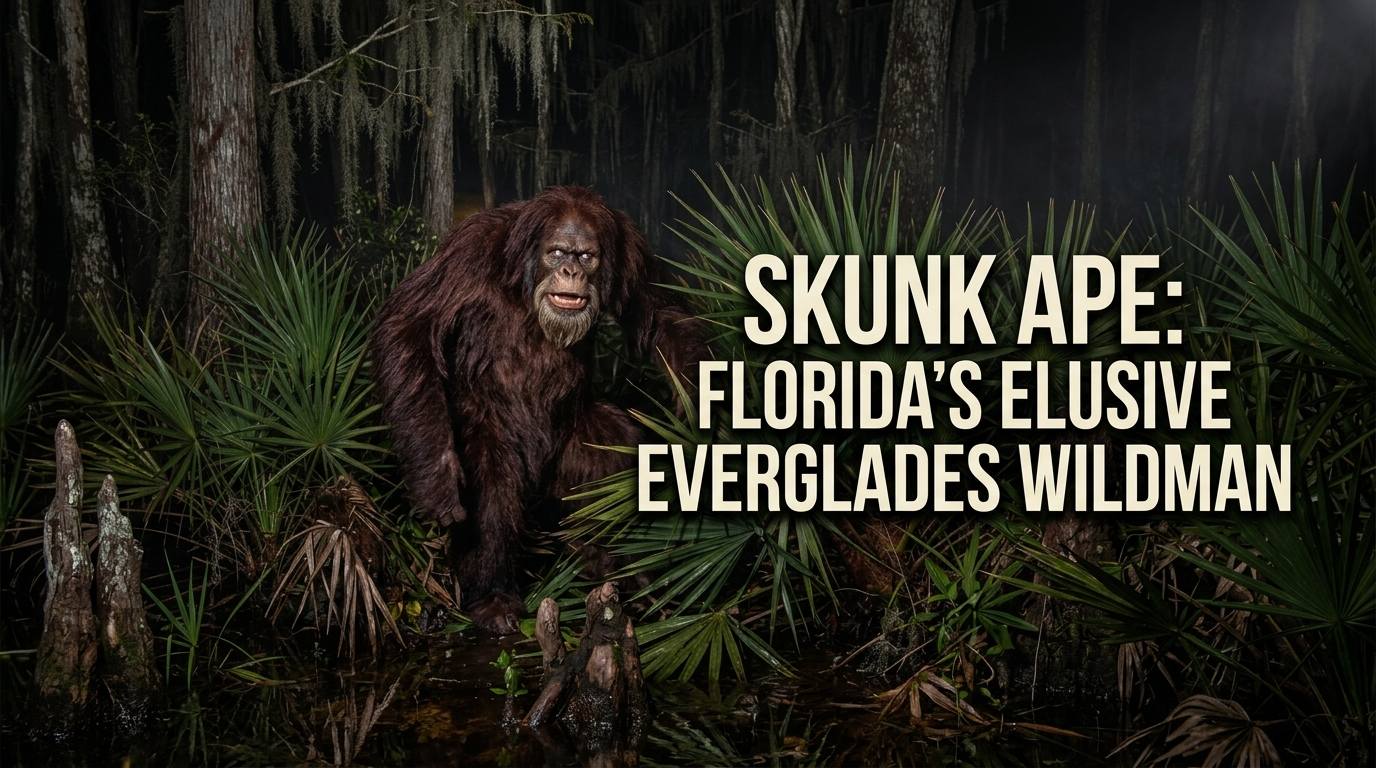
🌴 Florida’s Elusive Swamp Dweller
Deep within the vast subtropical wetlands of Florida, where ancient cypress forests, mangrove swamps, and endless marshes stretch beneath a humid canopy, stories have persisted for generations of a mysterious ape-like creature roaming the wilderness.
Known simply as the Skunk Ape, this legendary cryptid is often described as a large, bipedal, hair-covered humanoid possessing an overpowering foul odour that has become its defining characteristic.
Reported throughout the Everglades, Big Cypress National Preserve, and the remote forests of the southeastern United States, the creature has earned a reputation as one of North America’s most enduring Bigfoot relatives.
Whether an undiscovered primate, a case of mistaken identity, or simply one of Florida’s greatest folklore mysteries, the Skunk Ape continues to fascinate cryptozoologists, wildlife enthusiasts, and curious explorers drawn to the state’s mysterious swamplands.
🦍 Physical Appearance & Description
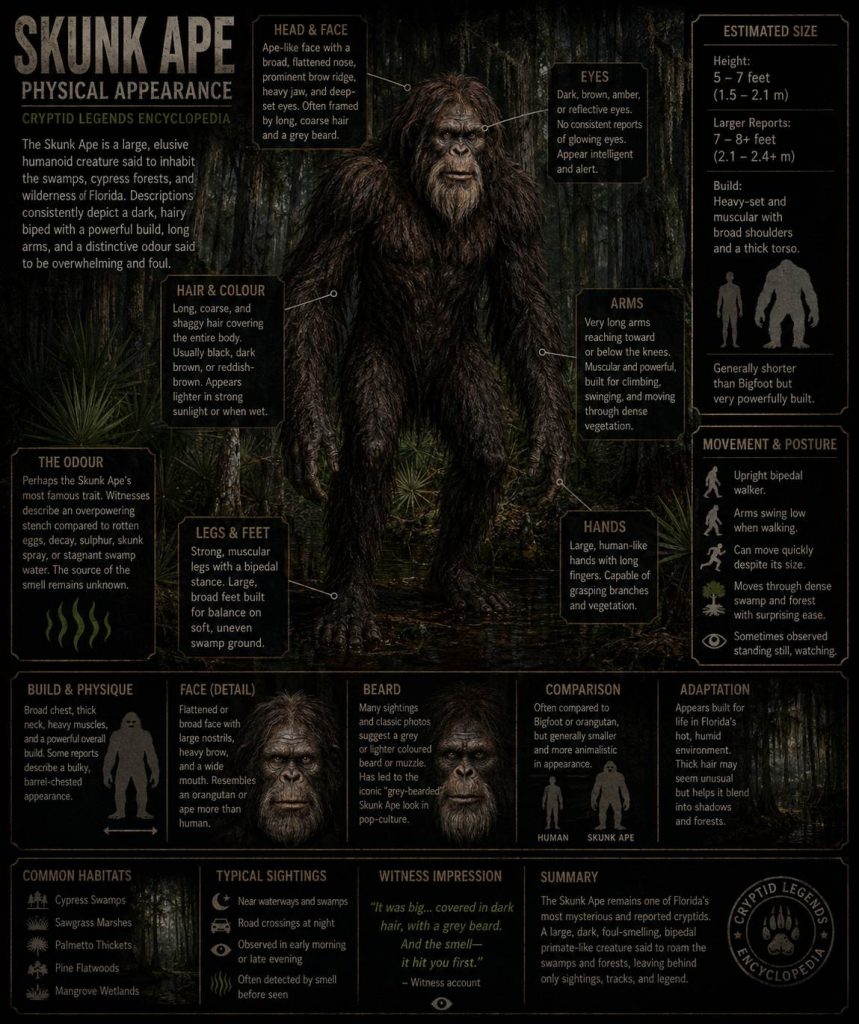
Descriptions of the Skunk Ape vary considerably between Florida sightings, but a surprisingly consistent physical image has emerged across decades of reports: a large, upright, ape-like creature covered in dark hair and possessing a distinctly human-shaped body.
Unlike the enormous, almost mythical proportions sometimes attributed to Bigfoot, the Skunk Ape is generally described as shorter, heavier-set and more animalistic, seemingly adapted to the hot, humid environment of the Florida swamps.
📏 Height & Build
Most reports place the Skunk Ape somewhere around 5–7 feet (1.5–2.1 metres) tall, although some witnesses have claimed individuals considerably larger.
Witnesses commonly describe a creature with:
- A broad, powerful torso.
- Heavy shoulders and muscular arms.
- A thick neck that appears to merge into the upper body.
- Long arms reaching toward or below the knees.
- A robust, somewhat hunched posture.
- Thick legs capable of supporting its considerable weight.
- A distinctly bipedal stance and gait.
Some reports portray it as relatively slender, while others describe an extremely bulky animal with a barrel-like chest.
The variation may reflect differences between individual encounters, viewing conditions, or simple differences in witness perception.
🖤 Hair & Colouration
The creature is overwhelmingly associated with dark body hair.
Descriptions include:
- Black.
- Dark brown.
- Reddish-brown.
- Occasionally greyish or faded hair.
The hair is generally described as long, coarse and shaggy, rather than the short fur of most Florida mammals.
Some witnesses have reported particularly thick hair around the shoulders, chest and arms, giving the creature a heavily furred, almost gorilla-like silhouette.
In Florida’s intense sunlight, however, dark hair can appear considerably lighter, particularly when wet or illuminated from behind.
👤 Head & Face
The Skunk Ape’s face is usually described as distinctly ape-like rather than human.
Reported characteristics include:
- A broad or flattened face.
- A pronounced brow ridge.
- Deep-set eyes.
- A wide, heavy mouth.
- A broad, flattened or animal-like nose.
- Large nostrils.
- A heavy jaw.
- A rounded or somewhat conical head.
- Little or no visible neck beneath the surrounding hair.
Some witnesses have described the facial expression as intelligent but intimidating, while others recall something much more animalistic.
Unlike the Mothman, the Skunk Ape is not consistently associated with glowing eyes. Reports instead tend to describe ordinary dark, brown, amber or reflective eyes.
👃 The Face — and the Famous Odour
Perhaps the Skunk Ape’s most distinctive characteristic isn’t visual at all.
It is the smell.
Witnesses have repeatedly described an overwhelming odour accompanying encounters, variously compared with:
- Rotten eggs.
- Decaying vegetation.
- Wet animal fur.
- Sulphur.
- Skunk spray.
- Decomposition.
- Stagnant swamp water.
This reputed smell is responsible for the creature’s famous nickname, “Skunk Ape.”
It is important to distinguish the folklore from established biology, however: no verified animal has been demonstrated to produce the extraordinary odour described in Skunk Ape reports.
🧔 The Grey-Bearded Appearance
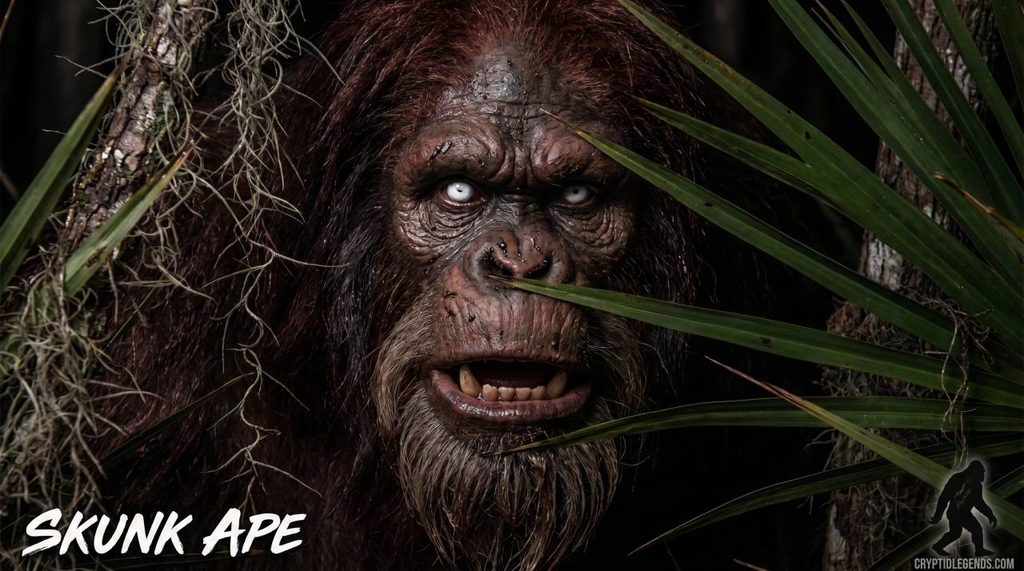
One of the most recognisable visual traits associated with the classic Skunk Ape photographs is the suggestion of a lighter, greyish beard or muzzle around the face.
This has helped shape the creature’s modern appearance considerably. Early descriptions of the Skunk Ape were often relatively generic, simply a large, dark-haired, orangutan- or ape-like animal, but later artistic interpretations increasingly emphasised a heavy, shaggy face with a pronounced grey beard, giving the creature the appearance of an ageing orangutan or a wild, weather-beaten Sasquatch.
The grey facial hair is particularly important to the pop-culture version of the Skunk Ape, where it has become almost as recognisable as the creature’s dark body hair and pungent odour.
It should nevertheless be treated as an interpretive feature rather than a firmly established anatomical characteristic, since the original photographs are disputed and do not provide enough detail to establish the creature’s actual facial hair with certainty.
🦶 Hands & Feet
Descriptions of the hands are relatively uncommon, but witnesses generally portray them as large, dark and human-like, with long fingers capable of grasping vegetation.
The feet are similarly described as unusually large, broad and somewhat human in appearance.
Some reports claim footprints measuring well over a foot in length, although alleged Skunk Ape tracks have never produced a scientifically verified anatomical specimen.
The combination of large feet, long arms and an upright gait contributes strongly to the creature’s resemblance to a large unknown primate.
🦍 Movement & Posture
One of the most frequently emphasised characteristics is the creature’s ability to walk upright on two legs.
Witnesses have described it:
- Walking slowly through swamp vegetation.
- Moving rapidly across roads or trails.
- Crossing open ground with a pronounced swinging arm motion.
- Occasionally appearing hunched forward.
- Moving through dense vegetation with surprising ease.
- Disappearing into palmettos and cypress forest despite its apparent size.
Some accounts describe an almost human-like stride, while others report a distinctly animalistic, heavy gait.
This variation has helped create two broad interpretations of the Skunk Ape’s appearance: a large, shaggy humanoid in some accounts and a massive ape-like animal in others.
📐 Reported Size Range
| Feature | Commonly Reported Description |
|---|---|
| Height | ~5–7 ft (1.5–2.1 m) |
| Larger reports | 7–8+ ft |
| Build | Muscular, broad and heavy |
| Body covering | Long, coarse hair |
| Colour | Black, dark brown or reddish-brown |
| Face | Ape-like, broad and heavy |
| Eyes | Dark, brown, amber or reflective |
| Arms | Long and powerful |
| Hands | Large, human/ape-like |
| Feet | Large, broad and human-like |
| Posture | Upright, sometimes hunched |
| Distinctive feature | Extremely foul odour |
👁️ The Classic Skunk Ape
Taken together, the most recognisable Skunk Ape description is of a 5–7-foot-tall, heavily built, dark-haired biped, with long arms, large feet, a broad ape-like face and an unmistakable animalistic presence.
It is less a supernatural monster than an imagined Florida wildman — something that could theoretically move through the cypress swamps unseen, leaving only footprints, a fleeting silhouette and, according to witnesses, an unbearable smell behind.
No physical specimen has ever established that such an animal exists. The description remains entirely dependent upon eyewitness testimony, photographs of disputed provenance, alleged tracks and the folklore that has grown around Florida’s wilderness.
📍 Location & Country
📌 Primary Location: Big Cypress National Preserve
🏞️ Region: South Florida (Everglades Ecosystem)
🌍 Country: United States
📍 Specific Area: Big Cypress National Preserve, Everglades National Park, Myakka River State Park, Fakahatchee Strand Preserve State Park, and the surrounding wetlands of South Florida
🗺️ Coordinates (Approx.): 25.86° N, 81.08° W
🌴 Where is the Skunk Ape Said to Live?
The Skunk Ape is most closely associated with the vast subtropical wilderness of South Florida, where thousands of square miles of swamps, marshes, cypress forests, mangrove wetlands, and remote waterways create one of the largest undeveloped ecosystems in the eastern United States.
While sightings have been reported across much of Florida, the highest concentration of reports has traditionally emerged from Big Cypress National Preserve, the Florida Everglades, and Myakka River State Park.
The Myakka region gained worldwide attention following the famous anonymous “Myakka Skunk Ape” photographs released in 2000, while Big Cypress remains the primary focus of modern Skunk Ape investigations.
Together, these remote wilderness areas form the legendary heartland of Florida’s Skunk Ape, providing an environment where dense vegetation, abundant wildlife, and difficult terrain continue to fuel one of North America’s most enduring cryptid mysteries.
🌿 Habitat
The Skunk Ape is said to inhabit some of the most remote and challenging wilderness in the southeastern United States.
Unlike the mountainous forests associated with the Pacific Northwest Bigfoot, the Skunk Ape is traditionally linked to subtropical swamps, flooded forests, and dense wetlands, where thick vegetation and year-round humidity create an environment capable of concealing large wildlife.
Its reported habitat includes expansive cypress swamps, sawgrass marshes, mangrove forests, pine flatwoods, and the countless waterways that weave through the Everglades and Big Cypress National Preserve.
These isolated landscapes are home to alligators, black bears, Florida panthers, wild boar, deer, and a rich variety of birdlife, providing both abundant natural resources and vast areas where a large animal could remain largely unseen.
Witnesses frequently describe encounters occurring near water sources, remote trails, hunting areas, and swamp edges where visibility is limited by dense vegetation. The creature’s alleged ability to move quietly through flooded terrain has become one of the defining characteristics of Skunk Ape reports.
Supporters of the legend argue that the immense size and inaccessibility of Florida’s wetland ecosystems could allow an undiscovered species to evade detection, while sceptics point to the region’s difficult terrain, abundant wildlife, and frequent opportunities for misidentification as more likely explanations for reported sightings.
📖 Background & Legend

Unlike many modern cryptids whose legends can be traced to a single famous encounter, the Skunk Ape appears to have developed gradually through a combination of regional folklore, eyewitness reports, and local storytelling across the wetlands of the southeastern United States.
Long before the creature became widely known by its modern name, Native American tribes living throughout Florida including the Seminole and Miccosukee, shared traditions describing mysterious wild beings inhabiting the remote swamps and forests.
While these stories vary considerably and should not automatically be interpreted as direct references to the modern Skunk Ape legend, they demonstrate that beliefs surrounding elusive humanoid creatures have existed in the region for centuries.
The earliest newspaper reports resembling modern Skunk Ape sightings began appearing during the 1940s and 1950s, with hunters, fishermen, and outdoorsmen occasionally describing encounters with large, upright, ape-like creatures in the Florida wilderness.
Reports increased throughout the 1960s and 1970s, as Bigfoot gained national attention following the famous Patterson–Gimlin film and growing public interest in North American wildman legends.
It was during this period that the creature became widely known as the “Skunk Ape”, a nickname inspired by the overpowering odour consistently reported by witnesses.
Many described the smell as resembling a mixture of rotten eggs, sulphur, wet animal fur, sewage, or decaying vegetation, so distinctive that it became one of the creature’s defining characteristics.
By the late twentieth century, the Skunk Ape had established itself as Florida’s own regional counterpart to Bigfoot.
While often compared to its Pacific Northwest relative, witnesses frequently described notable differences, including a generally smaller build, darker hair, and its apparent adaptation to Florida’s hot, swampy environment rather than mountainous forests.
One of the most influential events in the creature’s modern history occurred in 2000, when an anonymous woman mailed two photographs to the Sarasota County Sheriff’s Office claiming she had photographed a strange ape-like creature behind her home near Myakka River State Park.
These images, now widely known as the Myakka Skunk Ape photographs remain among the most recognisable and debated pieces of alleged Skunk Ape evidence ever recorded.
Today, the Skunk Ape occupies a unique place in American cryptozoology. It has become deeply woven into Florida folklore, inspiring documentaries, books, museum exhibits, festivals, and decades of field investigations.
Whether regarded as an undiscovered primate, a case of mistaken identity, or simply one of the Sunshine State’s most enduring legends, the Skunk Ape continues to capture the imagination of researchers and visitors exploring Florida’s vast and mysterious wetlands.
👣 Sightings & Encounters
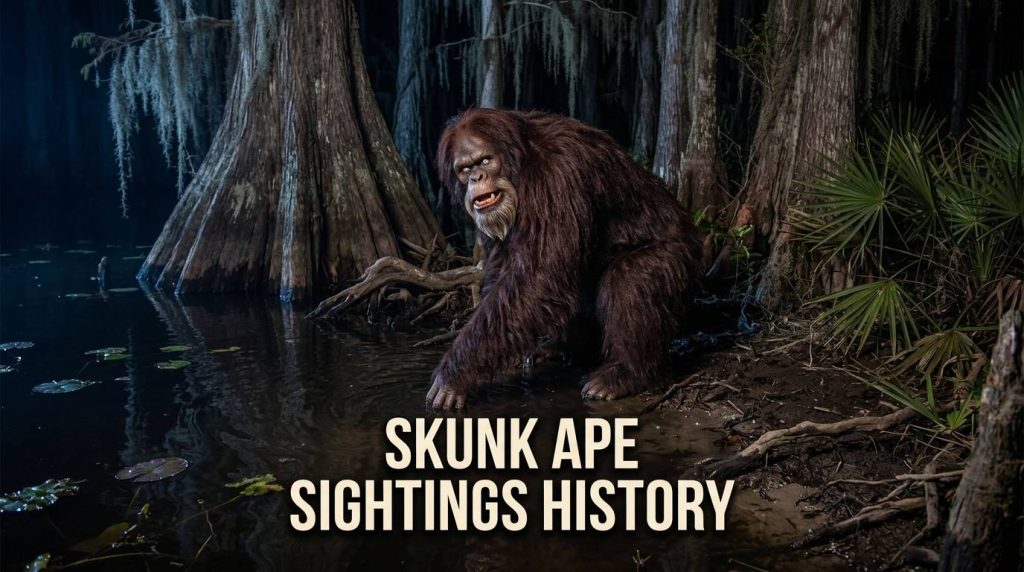
The Skunk Ape has been reported throughout Florida for more than two centuries, making it one of North America’s longest-running wildman traditions.
Although no encounter has produced conclusive scientific evidence, the remarkable consistency of many witness descriptions has helped establish the creature as one of the Sunshine State’s most enduring cryptid legends.
📰 Early Historical Reports (1818–1960s)
One of the earliest known newspaper references resembling the modern Skunk Ape legend dates to 1818, when an Apalachicola newspaper reportedly described a mysterious “man-sized monkey” frightening local fishermen and stealing supplies.
While it is impossible to determine what was actually observed, the account demonstrates that stories of large ape-like creatures in Florida existed more than a century before the name Skunk Ape entered popular folklore.
Throughout the late nineteenth and early twentieth centuries, scattered reports continued to emerge from Florida’s rural communities.
Hunters, trappers, fishermen, and swamp residents occasionally described encounters with large, hairy humanoid figures inhabiting the state’s remote wetlands and forests. Many of these stories were passed down locally rather than formally documented, gradually becoming woven into Florida folklore.
By the 1940s and 1950s, newspaper reports and eyewitness accounts became increasingly common, particularly from isolated communities bordering Florida’s vast swamps. Witnesses frequently described remarkably similar characteristics:
- 🦍 A large, muscular, hair-covered humanoid.
- 🚶 Walking upright on two legs.
- 👃 A powerful, unpleasant odour resembling rotten eggs, sulphur, wet animal fur, or decaying vegetation.
- 👀 Reflective eyes observed during nighttime encounters.
- 🌿 The ability to disappear quickly into dense vegetation and flooded forest.
It was during the 1960s that the creature became widely known as the “Skunk Ape,” a nickname inspired by the distinctive foul smell so consistently reported by witnesses.
🌴 The 1970s Sighting Wave
Following the widespread publicity surrounding the 1967 Patterson–Gimlin Bigfoot film, reports of Florida’s mysterious swamp-dwelling ape increased dramatically.
Throughout the 1970s, dozens of sightings were reported across southern and central Florida, particularly within:
- 🌴 Big Cypress National Preserve
- 🐊 Everglades National Park
- 🌿 Fakahatchee Strand Preserve
- 🌳 Ocala National Forest
- 🌾 Green Swamp and surrounding wilderness
Newspaper reports from the period describe motorists, hunters, fishermen, park visitors, and even law enforcement officers claiming encounters with large ape-like creatures crossing roads, standing along woodland edges, or disappearing silently into dense swamp vegetation.
Several reports also involved unusual livestock deaths, mysterious vocalisations, and strong lingering odours. Although some incidents prompted searches by local authorities, none produced verifiable physical evidence, leaving the reports open to interpretation.
🌿 The Key Largo Encounter (1977)
Among Florida’s best-known Skunk Ape reports is the 1977 Key Largo encounter, when the Stoeckman family claimed they observed a massive, foul-smelling, hair-covered creature near their home.
The witnesses described an upright figure standing approximately 8–9 feet tall, covered in dark hair and emitting an overpowering odour often compared to that of a wet dog or decaying animal.
The family reported hearing strange vocalisations before local law enforcement officers and members of the Florida Marine Patrol conducted searches of the surrounding area.
Despite extensive efforts, no physical evidence was recovered, although the case remains one of Florida’s most widely discussed Skunk Ape reports.
📸 The Big Cypress Sightings (1997)
Modern interest in the Skunk Ape was revitalised during July 1997, when several notable reports emerged from Big Cypress National Preserve.
One widely discussed encounter involved Steve Goodbread, a tour guide who claimed that he and approximately thirty tourists observed a large, brown-haired, upright creature for several minutes before it disappeared into dense vegetation.
Only days later, Jan Brook reported seeing a shaggy, ape-like figure crossing a remote road within Big Cypress. Approximately fifteen minutes after her sighting, local Fire Chief Vince Doerr photographed a dark, upright figure standing within nearby swamp vegetation.
Although the photograph remains blurry and inconclusive, it continues to be debated by both believers and sceptics as one of the better-known modern Skunk Ape images.
📷 The Myakka Skunk Ape Photographs (2000)
Perhaps the most famous evidence associated with the Skunk Ape emerged in December 2000, when the Sarasota County Sheriff’s Office received an anonymous letter accompanied by two colour photographs.
The woman claimed that a large ape-like creature had repeatedly entered her property at night to steal apples left outside her home near Myakka River State Park. She described the visitor as:
🦍 Approximately 6–7 feet tall.
🟤 Covered in reddish-brown hair.
👃 Producing an overwhelming foul odour.
👀 Possessing unusually large reflective eyes.
The resulting photographs, now known worldwide as the Myakka Skunk Ape photographs, remain among the most recognisable pieces of alleged Skunk Ape evidence ever published.
Because the photographer chose to remain anonymous, investigators were unable to independently verify the circumstances surrounding the encounter.
Over the years, interpretations have ranged from an undiscovered primate to an escaped orangutan or another misidentified animal, and the photographs continue to divide opinion within the cryptozoological community.
🌴 Modern Sightings
Reports continue to emerge from across Florida each year, particularly from:
- 🐊 Big Cypress National Preserve
- 🌿 Everglades National Park
- 🌳 Myakka River State Park
- 🌲 Ocala National Forest
- 🌾 Green Swamp
- 🏕️ Remote areas of Collier, Marion, Lake, and Polk counties
Modern witnesses continue to describe remarkably consistent characteristics:
👣 A large upright ape-like figure.
👃 A powerful, lingering foul smell.
🌿 Rapid movement through dense vegetation.
👀 Brief encounters lasting only a few seconds before the creature disappears into the surrounding wilderness.
While hundreds of reports have been documented over the decades, none have produced conclusive scientific evidence.
No verified specimen, DNA, or physical remains have ever been recovered, leaving the Skunk Ape as one of North America’s most enduring, and most hotly debated cryptid mysteries.
🎬 Skunk Ape in Popular Culture
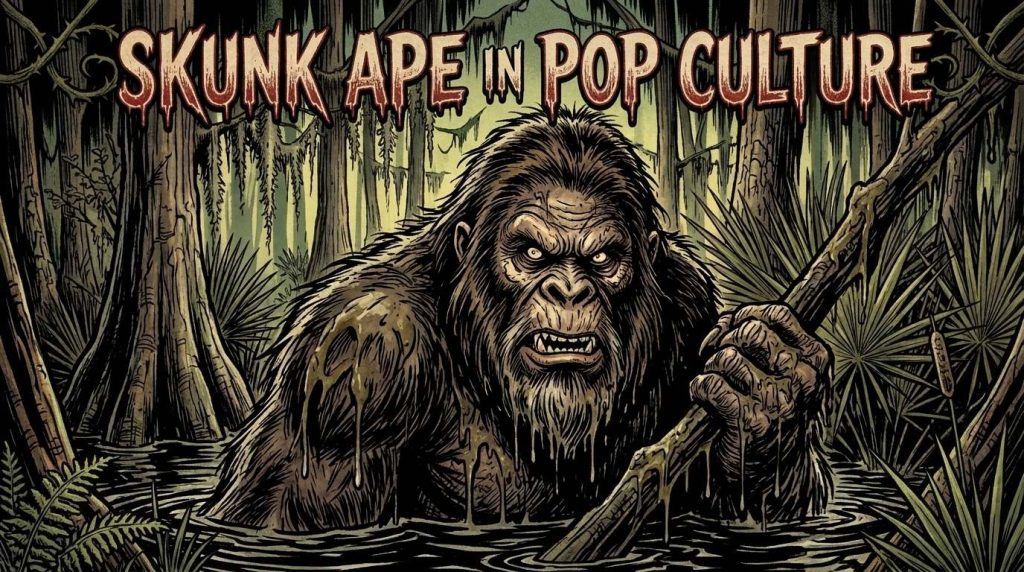
Although the Skunk Ape has never achieved the same worldwide fame as Bigfoot, it has become one of Florida’s most recognisable cryptids.
Over the past several decades, the mysterious swamp-dweller has inspired books, documentaries, television programmes, museums, trading cards, tourism, and countless appearances throughout Florida’s popular culture.
🌴 Dave Shealy & The Skunk Ape Research Headquarters
No individual has done more to preserve the modern Skunk Ape legend than Dave Shealy, one of Florida’s best-known cryptozoologists and founder of the Skunk Ape Research Headquarters in Ochopee, Florida.
Shealy has spent more than four decades investigating Skunk Ape reports throughout the Everglades and Big Cypress National Preserve. His research headquarters has become one of Florida’s best-known cryptid attractions, featuring:
🦍 Footprint casts
📸 Photographs and reported evidence
📚 Educational displays and field guides
🎁 Skunk Ape memorabilia and collectibles
🌴 Guided Everglades experiences
Shealy has undoubtedly played a major role in preserving and promoting the Skunk Ape legend for future generations.
📚 Learn More: Visitors can explore Dave Shealy’s official website, where you’ll find books, field guides, research information, and a wide range of Skunk Ape-themed merchandise, alongside details about visiting the Skunk Ape Research Headquarters.
📚 Books & Literature
The Skunk Ape has appeared in numerous books exploring Florida folklore, Bigfoot research, and American cryptozoology.
Notable examples include:
📖 Everglades Skunk Ape Research Field Guide — Dave Shealy
📖 The Florida Skunk Ape: A Complete History — Jacob Desjarlais
📖 On The Tracks Of The Skunk Ape: Florida Skunk Ape — Ron Milione & Dave Shealy
📖 Numerous Bigfoot encyclopedias and North American cryptid reference books frequently include the Skunk Ape as Florida’s regional wildman.
📺 Television & Documentaries
The Skunk Ape has featured in numerous documentaries and television programmes investigating unexplained creatures, including:
📺 Finding Bigfoot (Animal Planet)
📺 MonsterQuest
📺 In Search Of…
📺 Expedition X
📺 Various specials on the Travel Channel, History Channel, Discovery Channel, and local Florida television.
Dave Shealy himself has appeared in numerous documentaries discussing his decades of field investigations and the continuing search for Florida’s legendary swamp ape.
🎮 Popular Culture
The Skunk Ape has become an unofficial symbol of Florida folklore and regularly appears throughout the state’s tourism industry.
Examples include:
🌴 Roadside attractions throughout South Florida.
🦍 Florida cryptid festivals and conferences.
🎡 Souvenir shops and Everglades attractions.
📢 Promotional campaigns, including Gatorland’s humorous social-distancing campaign during the COVID-19 pandemic, which joked that the Skunk Ape’s legendary smell would naturally keep visitors apart.
🃏 MetaZoo Trading Card
The Skunk Ape is also featured in the popular MetaZoo Cryptid Nation Trading Card Game.
🃏 Card Name: Skunk Ape
📦 Set: Cryptid Nation – Base Set (1st Edition / 2nd Edition)
🔢 Card Number: 68/165
⭐ Aura Type: Beast
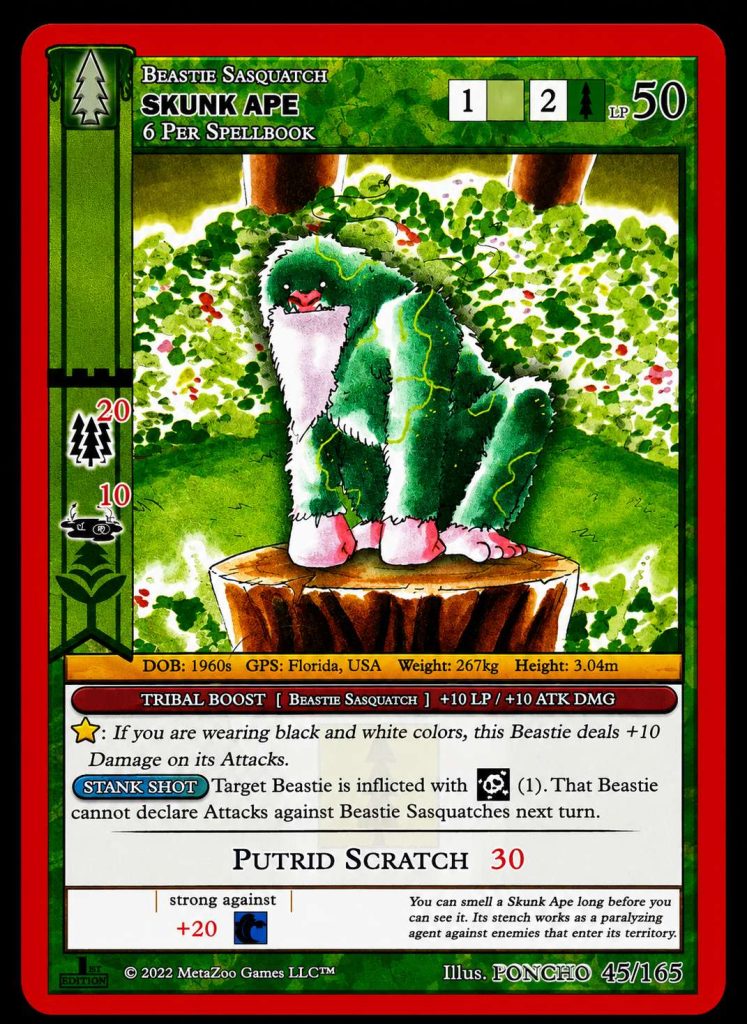
🌴 The artwork portrays the Skunk Ape emerging from Florida’s dense swamp vegetation, perfectly capturing the creature’s reputation as the mysterious “Bigfoot of the Everglades.”
As one of MetaZoo’s best-known North American cryptids, the card remains a favourite among collectors building regional cryptid-themed collections.
🌎 Enduring Legacy
Today, the Skunk Ape remains one of the world’s best-known regional Bigfoot legends.
While no verified scientific evidence has confirmed its existence, the creature continues to inspire new eyewitness reports, documentaries, books, artwork, museum exhibits, and ongoing field investigations throughout Florida.
Whether regarded as an undiscovered primate, a misunderstood native legend, or simply one of America’s greatest pieces of modern folklore, the Skunk Ape has secured its place as one of the defining icons of Florida’s mysterious wilderness.