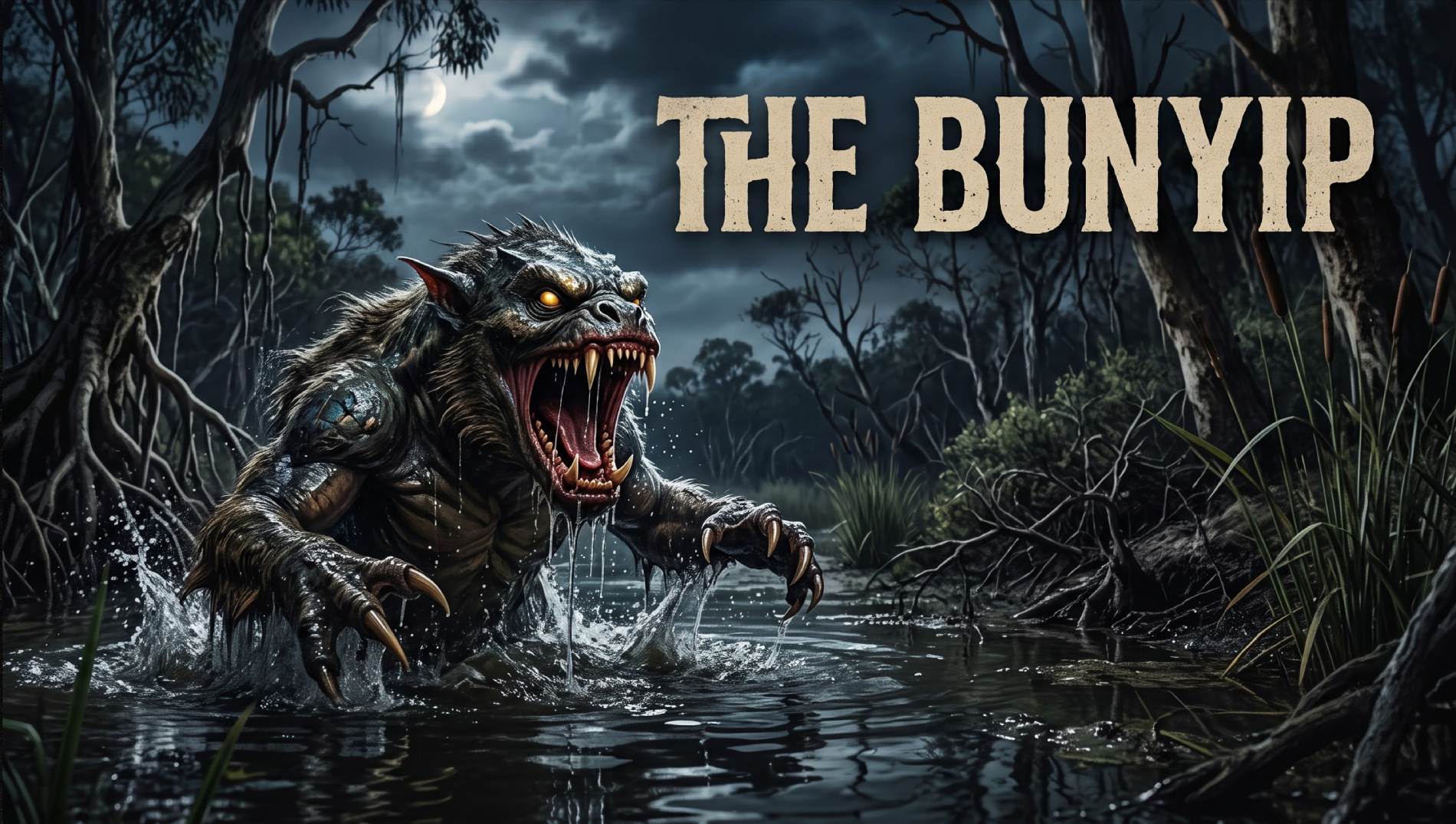
Across the dark waterways of southeastern Australia, where reeds whisper in the night and black water lies motionless beneath the moon, Aboriginal traditions have long spoken of something that does not belong to the ordinary world.
They call it the Bunyip.
A creature of swamps, billabongs, rivers and deep waterholes, the Bunyip has never possessed one fixed form. In different accounts it has been imagined as enormous and hairy, seal-like, reptilian, bird-like or something altogether stranger — a reflection of the many regional traditions that became gathered beneath the name.
Its reputation is equally varied.
Sometimes it is a terrifying predator lurking beneath the surface. Sometimes it is a mysterious inhabitant of a particular waterhole. In some Aboriginal traditions, beings later identified by Europeans as “bunyips” are connected with powerful water spirits and places that should be approached with respect.
The Australian Museum, for example, records contemporary First Nations testimony describing Ngatyi water beings whose habitats are deliberately avoided.
Then, during the nineteenth century, something remarkable happened.
European settlers began recording Bunyip stories in newspapers and wondering whether the creature might be a real unknown animal.
Bones discovered near Geelong were reportedly identified as belonging to a Bunyip. Newspapers described witnesses, attacks and strange animals emerging from Australian waterways.
A spectacular 1845 account even described a creature combining the characteristics of an emu and an alligator, supposedly capable of reaching twelve or thirteen feet when standing upright.
Soon the Bunyip had crossed a strange boundary.
It was no longer simply a being of Aboriginal storytelling.
It had become, in the eyes of colonial Australia, a possible undiscovered monster.
Reports multiplied. Strange skulls were exhibited. Newspapers published alleged encounters. Naturalists debated whether some unknown Australian animal might still survive in the country’s remote waterways, while others searched for mundane explanations behind the stories.
And yet, beneath all the speculation, the older mystery remained.
Was the Bunyip an animal?
A supernatural water spirit?
A collection of different creatures and traditions reshaped by colonial storytelling?
Or had nineteenth-century Australia mistaken ancient stories about the waterways for evidence of a creature waiting to be discovered?
More than two centuries after the first surviving written references, the Bunyip remains one of Australia’s most enduring legends, a creature whose footprints are difficult to separate from folklore, history, landscape and memory.
Something is still said to live beneath the Australian water.
The question is whether the Bunyip was ever meant to be an animal at all.
🐾 Physical Appearance
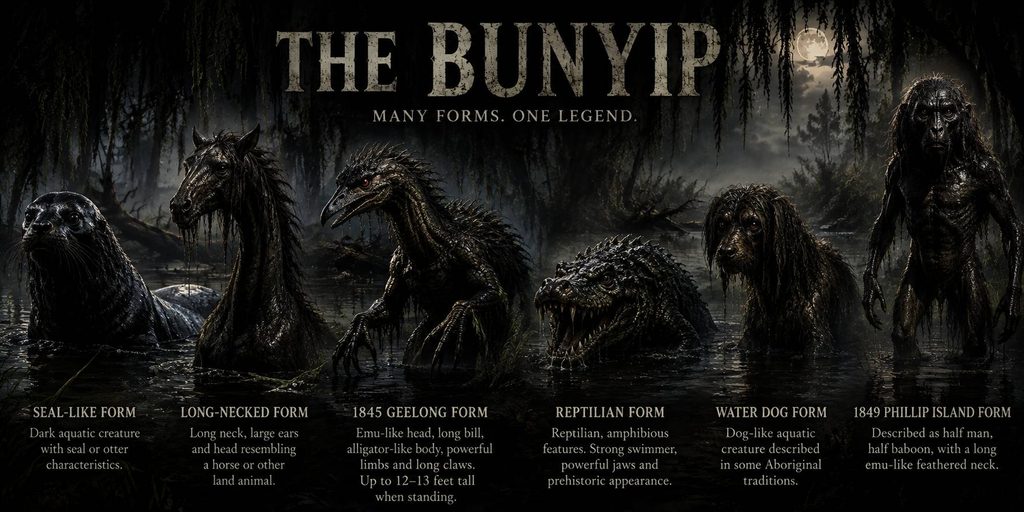
One of the most unusual aspects of the Bunyip tradition is that there is no single universally accepted appearance.
Unlike creatures such as Bigfoot or the Loch Ness Monster, whose modern images have become relatively standardised, the Bunyip has been described in dramatically different forms across Australian traditions and later European accounts.
Some descriptions portray something resembling a large aquatic mammal; others describe a bizarre amphibious creature combining characteristics of birds and reptiles.
This variation is important because the word “Bunyip” came to encompass a range of different Aboriginal traditions and supernatural beings, rather than necessarily referring to one biological species.
🌊 A Creature of the Water
Descriptions generally place the Bunyip in or around water.
It is traditionally associated with rivers, lagoons, swamps, billabongs and deep waterholes, with some accounts portraying it as an amphibious creature capable of moving between water and land.
The Australian Museum records Aboriginal testimony describing Ngatyi, powerful water beings associated with particular places along the Darling River, which could change form into something resembling the “water dog” that Europeans called a Bunyip.
This is an important reminder that Aboriginal traditions cannot simply be reduced to the later European image of a single monster.
🦭 The Dark, Seal-Like Bunyip
One recurring family of descriptions portrays the Bunyip as a dark aquatic mammal.
Later accounts have compared it to a seal, otter, dog or other large water-dwelling animal.
A particularly interesting description published in the Beaudesert Times in 1920 described an exceptionally black animal approximately six feet tall, with a head resembling a large kangaroo dog, long drooping spaniel-like ears and a seal-like head and shoulders when seen in the water.
These descriptions helped produce one of the more familiar cryptozoological interpretations of the Bunyip: a large, dark, shaggy aquatic animal emerging briefly from the water before disappearing beneath the surface.
🐴 The Long-Necked or Horse-Like Form
Other traditions and later reports describe something considerably stranger.
Some accounts portray a creature with a long neck, large ears and a head resembling an emu, horse or other land animal, sometimes combined with dark fur or a mane.
The long-necked form is particularly interesting because it demonstrates how dramatically Bunyip descriptions could differ from the later popular image of a generic swamp monster.
Rather than a single creature design, the Bunyip appears to have accumulated characteristics from the animals familiar to the people describing it, while retaining its fundamental association with mysterious waterways.
🦅 The Extraordinary 1845 Geelong Description
Perhaps the most famous historical description appeared in the Geelong Advertiser on 2 July 1845, in an article titled “Wonderful Discovery of a New Animal.”
The report claimed that a First Nations man who was shown a large fossil bone recognised it as belonging to a Bunyip and subsequently produced a drawing of the creature.
The newspaper described the Bunyip as combining the characteristics of a bird and an alligator.
According to the report, it possessed:
- 🦅 An emu-like head
- 🦆 A long bill
- 🦴 Strange transverse projections at the end of the bill with serrated edges
- 🐊 A body and legs resembling those of an alligator
- 💪 Extremely powerful hind legs
- 🦵 Longer but still powerful forelegs
- 🐾 Long claws
- 🪶 A breast covered with different-coloured feathers
- 🐸 The ability to swim like a frog
- 🧍 The ability to walk upright on its hind legs
- 📏 A claimed height of approximately 12–13 feet when standing erect
The same account claimed that the creature killed prey by hugging it, rather than relying solely on its claws.
It is an extraordinary description, and one of the reasons the Bunyip subsequently became so fascinating to nineteenth-century naturalists and cryptozoologists.
Importantly, however, this is a colonial newspaper’s recording of Aboriginal testimony, not a modern zoological description. It should not automatically be treated as evidence that all Aboriginal communities described the Bunyip in this way.
🦎 Reptilian, Amphibious Characteristics
The 1845 account also gave the Bunyip characteristics that would later fuel comparisons with prehistoric animals.
Its combination of:
Bird-like head + reptilian body + powerful limbs + claws + amphibious behaviour
created an image unlike any known Australian animal.
Later writers have consequently compared the description with everything from crocodilians to extinct megafauna and even dinosaurs.
Those comparisons are interpretations rather than established explanations, and there is no scientific evidence demonstrating that Bunyip traditions preserve memories of a surviving prehistoric animal.
🐕 The Bunyip as a “Water Dog”
Another recurring description is surprisingly mundane compared with the enormous monster of later popular culture.
Some Aboriginal traditions recorded by Europeans used comparisons with a dog-like aquatic animal, while contemporary Aboriginal testimony recorded by the Australian Museum describes Ngatyi changing into a form resembling what Europeans called a “Water Dog” or Bunyip.
This is significant because it shows how the later popular conception of the Bunyip as a gigantic swamp monster may obscure much older and more diverse traditions.
🌑 Colour, Eyes & Behaviour
Across later descriptions, Bunyips are frequently portrayed as:
- Black, dark brown or otherwise very dark
- Difficult to see clearly
- Associated with night or twilight
- Extremely elusive
- Strong swimmers
- Capable of remaining concealed beneath the surface
- Associated with strange sounds or cries
- More likely to be glimpsed briefly than observed clearly
However, these characteristics should be regarded as recurring motifs rather than universal rules.
There is no definitive historical “Bunyip specification” comparable to a zoological species description.
🐾 A Changing Monster
Perhaps the most fascinating thing about the Bunyip’s appearance is how much it changed over time.
The nineteenth-century record contains descriptions of everything from seal-like aquatic animals and dark, dog-like creatures to emu-headed amphibious monsters and strange reptilian beasts.
Other accounts went even further, describing enormous creatures supposedly capable of standing more than twelve feet tall.
The famous 1849 Phillip Island report, for example, described a supposed Bunyip approximately six to seven feet long, with an appearance described as “half man and half baboon” and a long, emu-like, feathered neck.
According to the account, the creature reportedly sprang into the air after being fired upon five times before disappearing into the lake.
Rather than weakening the legend, these contradictions reveal something fundamental about the Bunyip.
It was never simply a monster with one face.
Its appearance was shaped by place, culture, oral tradition, individual interpretation and later retelling, with different communities and witnesses describing something that could look remarkably different from one account to another.
That makes the Bunyip’s physical form one of the most mysterious aspects of the legend.
Beneath all those wildly different descriptions, however, one recurring image remains: something inhabits the water, something watches from beneath its surface, and when it finally rises, nobody seems to agree on exactly what they saw.
📍 Location & Country
- 🇦🇺 Primary Location: Bunyip State Park, Victoria
- 🌏 Region: Gippsland / Yarra Valley & Dandenong Ranges, southeastern Victoria
- 🇦🇺 Country: Australia
- 🌿 Specific Area: Bunyip State Park and the Bunyip River, including the surrounding wetlands, swamps, forest and waterways
- 🏞️ Traditional Landscape: Country associated with the Bunurong and Wurundjeri peoples
- 🌊 Associated Waterway: Bunyip River
- 📍 Coordinates (Approx.): 37.984° S, 145.688° E
- 🗺️ Nearest Locality: Gembrook, Victoria
- 📏 Distance from Melbourne: Approximately 65 km southeast
🌿 The Bunyip’s Landscape
The Bunyip is not associated with a single lake or isolated body of water. Its traditional geography is much broader, encompassing rivers, swamps, lagoons, waterholes and deep pools across southeastern Australia.
Bunyip State Park nevertheless provides one of the most evocative locations for the encyclopedia because the connection is built directly into the landscape’s history.
Parks Victoria records that the park was named after the Bunyip, which was believed to live along the Bunyip River flowing through the area.
The park contains a striking mixture of heathland swamps, river plains, dense forest and fern-filled gullies, creating an unusually fitting real-world setting for the legend.
The wider Bunyip River also has a fascinating cultural history. Historical accounts recorded a water-being tradition in the Western Port region, where a particular deep basin was said to be inhabited by a Bunyip known as Toor-roo-dun.
The water was reportedly regarded as dangerous and was avoided because of the supernatural being believed to inhabit its depths.
This makes southeastern Victoria particularly valuable when documenting the Bunyip: the name, landscape and folklore remain connected rather than existing solely as a modern cryptid attraction.
🌿 Habitat
The Bunyip is traditionally associated with water, but unlike many modern lake monsters, its supposed habitat is not restricted to one particular lake or river.
Across Australian Aboriginal traditions and later European accounts, the creature is connected with a wide variety of inland and coastal waterways, particularly places where deep, dark or concealed water could provide a natural setting for a mysterious being.
🌊 Swamps, Billabongs & Lagoons
Swamps, lagoons, billabongs and secluded waterholes form some of the most characteristic Bunyip environments.
These habitats can contain dense reeds, overhanging vegetation, muddy banks and deep pools, making them places where an animal could remain largely hidden beneath the surface.
Such environments also have a strong cultural significance within Aboriginal Australia, and the Bunyip tradition is closely connected with particular waterways and places that were regarded as dangerous or spiritually significant.
The creature’s association with deep water is therefore more than simply a convenient setting for a monster story.
In many traditions, particular bodies of water were understood to be inhabited or controlled by powerful beings, and people were warned against approaching certain locations.
🏞️ Rivers & Deep Waterholes
Rivers provide another major habitat within Bunyip traditions.
Historical accounts frequently place mysterious water beings around deep river pools, bends, banks and isolated stretches of waterways, where the depth and murkiness of the water could conceal something large.
The Bunyip River in Victoria is particularly interesting for Cryptid Legends because the name itself preserves the connection.
The modern Bunyip State Park was named after the Bunyip traditionally believed to inhabit the river flowing through the area.
The landscape surrounding the river contains forest, wetlands, heathland swamps, fern gullies and waterways, providing an excellent real-world illustration of the type of environment traditionally associated with the creature.
🌑 Deep & Concealed Water
A recurring feature of the Bunyip’s supposed habitat is concealment.
The creature is rarely imagined as living in open, shallow water where it could easily be observed. Instead, descriptions tend to favour:
Dark pools, reed-filled waterways, flooded margins, submerged vegetation and deep holes.
This fits the traditional character of the Bunyip remarkably well. It is a creature whose presence is often suggested rather than clearly witnessed, a cry from the darkness, movement beneath the surface or a fleeting glimpse before something disappears into the water.
🌾 Wetlands & River Country
The Bunyip’s habitat can extend beyond the water itself.
Accounts and traditions associate the creature with wetland margins, riverbanks, marshes and surrounding vegetation, creating a transitional environment between land and water.
This is important because some descriptions portray Bunyips as capable of leaving the water and moving on land.
The combination of dense vegetation and waterways would also have provided countless opportunities for unfamiliar animals, floating vegetation, birds, shadows and other natural phenomena to be interpreted as something supernatural, particularly at night.
🐾 A Habitat Rather Than a Single Location
There is therefore no single “Bunyip habitat” in the modern zoological sense.
The creature’s range is better understood as a landscape tradition spread across numerous Australian waterways, with different Aboriginal communities possessing their own names, stories and traditions concerning powerful beings associated with particular places.
This is one of the most important distinctions when examining the Bunyip historically.
The Bunyip should not be treated as though every Aboriginal tradition describes the same biological animal.
Instead, the name has become a broad umbrella within Australian popular culture for a collection of older water-being traditions, later European interpretations and modern cryptozoological reports.
🌿 The Perfect Bunyip Environment
For the modern cryptid image, however, the classic Bunyip habitat has become unmistakable:
A still billabong beneath an Australian night sky.
Reeds moving in the darkness.
Black water disappearing beneath tangled vegetation.
A deep pool whose bottom cannot be seen.
And somewhere beneath that surface, according to the legend, something is waiting.
That enduring relationship between the Bunyip and Australia’s waterways is perhaps more important than any particular description of its body.
Whatever the creature was supposed to look like, its story almost always brings us back to the same place:
The water.
🌊 Background & Aboriginal Traditions
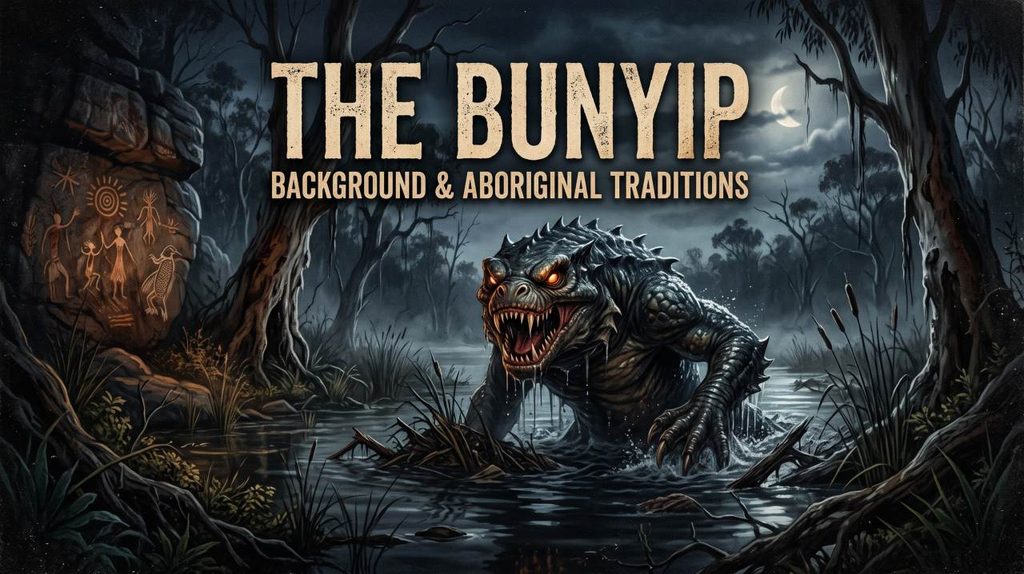
The history of the Bunyip reaches deep into Australia’s Aboriginal cultural traditions, long before the creature became a subject of European newspapers, museums and natural-history speculation.
Australia contains hundreds of distinct Aboriginal peoples, language groups and cultural traditions, and there was never a single uniform Aboriginal conception of one creature called the Bunyip.
Different communities had their own names, stories and traditions concerning beings associated with rivers, lakes, waterholes, swamps and other significant places.
European observers recorded forms including Bunyip or Bunyup, Katenpaiy, Kayan-prati, Tunatbah and other regional names, with descriptions that varied considerably between communities.
These beings were not necessarily understood simply as undiscovered animals. In many traditions, supernatural beings associated with water were connected to Country, cultural law, danger, respect and particular places.
One particularly valuable surviving tradition concerns the Ngatyi, recorded among the Barkandji people of the Barka/Darling River. Barkandji elder Uncle Harry describes Ngatyi as powerful beings associated with particular sections of the river.
They may change form, including taking forms resembling what Europeans later called a Water Dog or Bunyip.
Certain locations associated with Ngatyi were traditionally treated with caution, and people were taught not to enter particular waters. The story therefore describes not merely a monster but a being embedded within the cultural relationship between people, river and Country.
This broader context is essential to understanding the Bunyip. The surviving European descriptions represent only fragments of much older oral traditions, filtered through colonial observers who frequently attempted to interpret unfamiliar Aboriginal beliefs through European ideas about monsters, animals and natural history.
📜 Early European Records & The Birth of the Bunyip in Print
One of the earliest surviving European references commonly associated with the Bunyip dates to 1812, when the form “bahnyip” was recorded in connection with James Ives.
The creature was described as a large, dark, seal-like animal associated with water and possessing a frightening voice.
The early nineteenth-century record would eventually become part of the chain of references through which the Bunyip entered written Australian history. The surviving evidence, however, differs substantially from the detailed newspaper accounts that appeared several decades later.
By 1818, another important strand of the mystery had emerged.
Explorer Hamilton Hume reportedly discovered large unidentified bones around Lake Bathurst in New South Wales. The discovery attracted interest because European naturalists were increasingly aware that Australia’s interior contained unfamiliar and extinct forms of animal life.
By 1821, the possibility of investigating the remains further had become sufficiently interesting to members of the geographical community that discussion took place about obtaining additional evidence, including a hide or teeth, from the mysterious animal.
The idea that Aboriginal stories of mysterious water creatures might correspond to unknown animals therefore began developing alongside Australia’s rapidly expanding fossil and natural-history discoveries.
The Bunyip was beginning to occupy an unusual position between Indigenous tradition, folklore and zoology.
🦴 1845 — “Wonderful Discovery of a New Animal”
The Bunyip entered the Australian colonial press in spectacular fashion in 1845.
On 2 July 1845, the Geelong Advertiser and Squatters’ Advocate published an extraordinary article under the headline:
“Wonderful Discovery of a New Animal.”
The report concerned fossil remains discovered near Geelong. A bone was reportedly shown to a Wathaurong man, who identified it as belonging to a Bunyip and reportedly produced a drawing of the creature from memory.
According to the newspaper, the bone and drawing were subsequently shown separately to other Aboriginal people who had supposedly not communicated with one another. The newspaper claimed that they likewise recognised the remains as belonging to the Bunyip.
The creature described in the report was extraordinary.
It was portrayed as a huge amphibious animal combining characteristics of several familiar species. Its head was compared with that of an emu, while its body was described as resembling an alligator. It was said to possess powerful hind limbs, long claws and an ability to move both through water and on land.
The newspaper claimed that the animal could reach approximately 12 to 13 feet in height and that it attacked prey by embracing and crushing it.
The account also contained a supposed human encounter involving an Aboriginal woman who was said to have been killed by a Bunyip and a man named Mumbowran, who was reportedly left with wounds attributed to the creature’s claws.
The report was subsequently circulated more widely, helping transform the Bunyip from a collection of regional traditions into a subject of national fascination.
🐾 Different Names, Different Creatures
As reports accumulated, it became increasingly apparent that descriptions of the supposed creature differed dramatically between regions.
In 1847, William Hovell recorded information concerning mysterious animals associated with waterways in inland New South Wales.
Names including Katenaipai, Kyenprate, Tunatbah and Dongus appeared in connection with different regional traditions, while a similar creature associated with the Great Carangamite Lake in the Portland district was reportedly called the Bunyip.
Descriptions varied accordingly.
One account from the Murrumbidgee described an animal said to be approximately the size of a bullock, with an emu-like head and long neck, a mane extending from the head towards the shoulders, four webbed feet and a horse-like tail.
Other accounts described creatures that were smaller, seal-like, dog-like or otherwise unlike the enormous animal described in the 1845 Geelong newspaper.
The nineteenth-century record therefore preserves not one consistent physical description but a collection of regional water-being traditions that European writers increasingly grouped under the word Bunyip.
🦴 The Bunyip Skull Controversy
The most famous attempt to produce physical evidence of the Bunyip began in January 1846.
Settler Athol Fletcher reportedly discovered an unusual skull on the banks of the Murrumbidgee near Balranald. The specimen was incomplete, lacking substantial portions of the cranium, snout and lower jaw.
Aboriginal people shown the remains reportedly identified them as belonging to a Bunyip or one of the regional water beings.
The skull attracted serious attention from European naturalists. It was examined by figures including Dr James Grant and William Sharp Macleay, while explorer William Hovell became involved in correspondence concerning the specimen.
The remains were eventually associated with names including Katenpai and Kine Pratie, again demonstrating that the word Bunyip was being applied alongside several regional names.
The specimen was later exhibited at the Australian Museum in Sydney, where it attracted considerable public interest.
For a time, the possibility remained that the skull represented an unknown Australian animal.
Closer examination produced a far less spectacular conclusion.
The remains were eventually regarded as belonging to a young or malformed domestic animal, with comparisons suggesting a deformed foal or calf rather than an unknown monster.
The supposed Bunyip skull consequently failed to establish the existence of an unknown species.
Nevertheless, the controversy dramatically increased public fascination with the creature.
📰 The Great Bunyip Excitement
The skull controversy coincided with a remarkable increase in Bunyip reports during the 1840s and 1850s.
Newspapers began publishing accounts of mysterious animals observed around Australia’s rivers, lakes and swamps. Strange sounds, dark shapes in water and unfamiliar animals were increasingly interpreted through the growing Bunyip tradition.
One 1847 report from Lake Paika described two servants of settler George Hobler who reportedly saw what initially appeared to be two horses across the lake.
When they rode around the water to investigate, however, they reportedly found no tracks or trace of animals.
The contemporary account considered several possible explanations, illustrating the uncertainty surrounding many early Bunyip reports.
Another Melbourne report described a supposed Bunyip or “immense Platibus” seen sunning itself in the Yarra opposite the Custom House. Several people reportedly attempted to approach the animal by boat before it disappeared beneath the water.
The episode is particularly revealing because the suspected creature was potentially a platypus, one of Australia’s strangest genuine animals.
🐾 The 1849 Phillip Island Encounter
One of the most extraordinary nineteenth-century Bunyip stories appeared in 1849, when The Melbourne Morning Herald reported an encounter on Phillip Island.
According to the report, John Edwards and his companions encountered an animal beside a lake.
The creature was reportedly approximately six or seven feet long, with an appearance described as “half man and half baboon.” It supposedly possessed a long neck covered in feathers resembling those of an emu.
The witnesses reportedly fired five shots at the animal.
After the final shot, the creature allegedly sprang into the air, threw out its hind legs and disappeared into the lake.
The story subsequently became part of Bunyip folklore, although later historical accounts questioned the reliability of the story and the reputation of those associated with it.
📰 The Bunyip Becomes a National Mystery
By the 1850s, the Bunyip had become firmly established within Australian colonial culture.
Explorer Edwin Roper Loftus Stocqueler was reported in 1857 as having produced sketches of a Bunyip supposedly encountered during his travels along the Murray and Goulburn Rivers.
The reports were treated with sufficient interest that newspapers continued debating whether the creature represented an unknown species or a misunderstanding of known Australian wildlife.
At the same time, the word Bunyip began taking on wider meanings.
It entered Australian political and popular language as a term for an impostor, humbug or pretender, eventually producing the famous expression “bunyip aristocracy.”
The word was also applied to the Australasian bittern, whose extraordinarily deep booming call had already become associated with mysterious noises coming from Australian wetlands.
The bird became popularly known as the “Bunyip Bird.”
The Bunyip was no longer merely a mysterious creature.
It had become part of Australian identity.
🌊 Historical Bunyip Reports Continue
Bunyip reports continued into the later nineteenth century.
In 1873, the Wagga Express published an account concerning Lake Cowal in New South Wales. A party of surveyors reportedly observed a dark, hairy or human-like figure emerging from the water. The creature was said to rise sufficiently for its shoulders to become visible before disappearing beneath the surface.
The story subsequently became associated with the growing body of historical Bunyip reports from inland waterways.
Another famous tradition emerged from Hexham Swamp in New South Wales.
In 1879, three miners reportedly heard an extraordinary roaring sound coming from the swamp. The noise was described as resembling the roar of a lion.
The story eventually became associated with the Hexham Bunyip.
Modern ornithological knowledge provides a striking natural explanation for this particular mystery. The Australasian bittern is a secretive wetland bird capable of producing an extraordinarily deep booming call that can travel considerable distances through reeds and swamp vegetation.
Its association with Bunyip stories eventually earned it the popular name “Bunyip Bird.”
🌧️ The Bunyip in the Twentieth Century
Reports continued long after the great Bunyip excitement of the nineteenth century.
In 1920, the Beaudesert Times published descriptions of a mysterious dark creature estimated at approximately six feet tall.
One account described a black animal with a head resembling that of a large kangaroo dog and long ears, while another described a dark, seal-like creature whose head and shoulders appeared above the surface of a deep waterhole before disappearing beneath the water.
A particularly interesting series of reports occurred at Dynevor Lakes near Thargomindah, Queensland, in 1941, following heavy rainfall.
Postal inspector J. G. Utz reported seeing a dark head projecting approximately 30–45 centimetres above the water.
Utz himself suggested that the animal might have been a seal.
Other possibilities proposed at the time included a wombat, platypus, musk duck, swimming dingo, drowned bullock, turtle, floating vegetation and wild pig.
The Dynevor Lakes reports demonstrate how Bunyip investigations frequently occupied a space between cryptozoology and ordinary natural-history observation.
The witnesses could describe something unusual without necessarily claiming that they had seen a supernatural monster.
🔬 What Could the Bunyip Have Been?
No confirmed biological species corresponding to the Bunyip has ever been scientifically established.
One of the oldest natural explanations is the Australian fur seal.
Seals are capable of entering freshwater environments and can travel considerable distances through river systems.
Their dark bodies, aquatic behaviour, unusual vocalisations and unfamiliar appearance could potentially account for some historical reports, particularly descriptions of smooth, dark creatures appearing briefly in rivers or waterholes.
Another possible explanation is the Australasian bittern.
The bird is large, secretive and strongly associated with wetlands. Its booming call can sound remarkably deep and powerful for an animal of its size. The long-standing nickname “Bunyip Bird” preserves the historical association between the species and mysterious wetland sounds.
Other reports may have resulted from platypuses, water rats, turtles, waterbirds, livestock, floating vegetation or other unfamiliar animals viewed under poor conditions.
The Bunyip’s changing physical descriptions also make simple identification difficult. A seal-like creature, a tall dark figure, an animal with an emu-like neck and a huge amphibious beast represent radically different possibilities.
🦴 The Extinct Megafauna Theory
One of the most enduring cryptozoological theories proposes that some Bunyip traditions may preserve memories of Australia’s extinct megafauna.
Australia once possessed enormous mammals including Diprotodon, Zygomaturus, Nototherium, Palorchestes and other animals that disappeared thousands of years before European settlement.
Their fossils were unknown to European Australians during the earliest period of Bunyip speculation, making the discovery of enormous prehistoric bones particularly dramatic.
Some later writers proposed that stories of huge water-dwelling creatures might preserve memories of extinct animals.
The theory remains speculative.
There is currently no established scientific evidence demonstrating that a surviving population of Australian megafauna lies behind the Bunyip tradition. Nor can the existence of oral traditions concerning ancient animals automatically be interpreted as evidence of eyewitness survival into recent historical times.
The fossil record establishes that extraordinary animals once lived in Australia.
It does not establish that they survived into the period of recorded Bunyip sightings.
👻 Folklore, Spiritual Beings & The Supernatural Bunyip
A further possibility is that the Bunyip should not be interpreted primarily as a zoological mystery at all.
For many Aboriginal traditions, beings associated with waterways belong to a cultural and spiritual framework involving Country, law, danger, ancestral power and relationships between people and place.
The surviving Ngatyi tradition along the Barka/Darling River demonstrates how a water-being can remain culturally meaningful without being reduced to the question of whether a biological animal exists.
European settlers subsequently encountered these traditions and frequently translated them into the language of monsters, animals and natural history.
The resulting nineteenth-century Bunyip therefore became a hybrid figure: part Indigenous tradition, part colonial folklore, part newspaper sensation and part zoological mystery.
🎭 Hoaxes, Exaggeration & Misidentification
Not every historical Bunyip story needs an extraordinary explanation.
Nineteenth-century newspapers regularly published sensational material concerning mysterious creatures, unexplored Australia and supposed discoveries.
Some reports were based upon genuine observations, while others were second-hand stories, folklore, exaggeration or deliberate tall tales.
The 1849 Phillip Island account, for example, acquired a long afterlife despite later doubts about its reliability.
Other stories may have begun with an ordinary animal and accumulated increasingly dramatic details through retelling.
This process was especially likely in an era when Australia’s landscape still contained enormous areas that European settlers had barely explored and when unfamiliar native wildlife could appear genuinely extraordinary.
🌊 The Bunyip Mystery
After more than two centuries of written references, newspaper stories, eyewitness accounts, Indigenous traditions, fossil discoveries and natural-history investigations, the Bunyip remains one of Australia’s most enduring mysteries.
There is no verified evidence for a surviving unknown aquatic monster species.
There are, however, genuine historical records of people reporting strange animals, unexplained sounds and unusual figures around Australian waterways.
Some cases have plausible natural explanations. Others remain uncertain. Some became embellished through newspapers and later retelling, while others belong to cultural traditions whose meaning extends far beyond the question of zoological identification.
The Bunyip skull was ultimately attributed to a malformed domestic animal.
The mysterious Hexham roar has a compelling connection to the Australasian bittern.
The Dynevor Lakes witnesses themselves considered the possibility of a seal.
The nineteenth-century newspapers preserved descriptions ranging from seal-like creatures to enormous amphibious monsters, while Aboriginal traditions preserved a much older and far more diverse world of beings associated with water and Country.
The Bunyip therefore refuses to settle into a single form.
It can be a monster beneath a billabong.
A voice rising from the reeds.
A dark shape disappearing beneath a river.
A fossil bone mistaken for evidence of a living beast.
Or a powerful cultural being whose meaning was never dependent upon being captured by science.
Perhaps that is why the Bunyip has survived.
Because for generations, Australians have stood beside dark water at dusk and wondered what might be moving beneath the surface.
And somewhere in the reeds, the oldest Australian monster still waits.
🎬 The Bunyip in Pop Culture

The Bunyip has become one of Australia’s most recognisable folkloric creatures, appearing in children’s literature, Australian cinema and television, comics, video games, tabletop games and modern horror.
Unlike many cryptids whose popular image was largely created by one famous encounter, the Bunyip has developed multiple cultural identities, from a friendly Australian children’s character to a genuinely frightening swamp monster.
📚 Literature & Children’s Books
The Bunyip has appeared in Australian literature since the nineteenth and early twentieth centuries.
One early literary appearance is associated with Andrew Lang’s The Brown Fairy Book (1904), which included a Bunyip story adapted from material published in the Journal of the Anthropological Institute in 1899.
One of the most important Australian children’s Bunyip books is Colin Thiele’s Gloop the Gloomy Bunyip, published in 1962. The story helped establish the Bunyip as a character within Australian children’s literature rather than simply a frightening folkloric being.
Another major work is Jenny Wagner and Ron Brooks’ The Bunyip of Berkeley’s Creek, first published in 1973/1975 depending on edition.
The story follows a strange creature emerging from Berkeley’s Creek who asks other animals what he is. Each has a different opinion, creating a children’s story around the very uncertainty that surrounds the Bunyip itself.
Graham Jenkin’s The Ballad of the Blue Lake Bunyip appeared in 1982, while later Australian children’s literature continued to use the creature extensively.
Meredith Costain’s Rosie and the Bunyip, published by Puffin Australia in 2008, follows Rosie as she investigates mysterious sounds around Ghost Gum Creek that she believes could be made by a Bunyip.
The Bunyip has consequently become an unusually persistent figure in Australian children’s publishing, often occupying the space between monster, mystery and misunderstood creature.
🐊 Alexander Bunyip
One of Australia’s most distinctive Bunyip characters is Alexander Bunyip, created by Australian author and illustrator Michael Salmon.
Alexander first appeared in The Monster That Ate Canberra in 1972, followed by Son of the Monster (1973), Travels with the Monster (1974) and The Monster in Space (1975).
Salmon subsequently developed the character into the Alexander Bunyip books, including Alexander Bunyip and Alexander Bunyip and the Swagman in 1980.
Alexander Bunyip became particularly important because the character crossed from books into Australian television.
📺 Alexander Bunyip’s Billabong
Alexander Bunyip’s Billabong was an Australian children’s television series associated with the ABC and Alexander Bunyip character.
The character appeared on Australian television in several programmes and formats, including ARVO (Alexander’s Recycled Visual Offerings), The Alexander Bunyip Show, Alexander’s Afternoon and eventually Alexander Bunyip’s Billabong.
The television incarnation helped establish the Bunyip as something that could be friendly, humorous and distinctly Australian, rather than simply a monster hiding in a swamp.
🎞️ Dot and the Smugglers
The Bunyip also appeared in the Australian Dot film series.
The 1977 animated film Dot and the Kangaroo included the song “The Bunyip (Bunyip Moon)”.
The creature subsequently became central to Dot and the Smugglers, in which Dot and her animal companions encounter a Bunyip that a circus ringmaster intends to capture.
Unlike the traditional horror interpretation, the Bunyip is ultimately portrayed as a gentle and shy creature.
🎬 Long Weekend — 1978
The Bunyip took a much darker turn in the Australian 1978 Ozploitation eco-horror film Long Weekend.
The film follows a couple whose destructive and disrespectful behaviour towards the Australian wilderness leads to increasingly disturbing supernatural consequences. A Bunyip appears as part of the film’s menacing supernatural imagery.
Rather than treating the creature as a cute folklore character, Long Weekend uses the Bunyip within its broader theme of nature turning against people who abuse it.
The film has subsequently become a cult classic of Australian horror and is one of the notable early cinematic uses of the Bunyip as a genuinely threatening supernatural creature.
🐸 Frog Dreaming — 1986
The Bunyip was central to the Australian adventure film Frog Dreaming, released in 1986.
The story revolves around children investigating the mystery of an alleged Bunyip known as Donkegin.
Unlike a straightforward monster movie, the film combines childhood adventure, Aboriginal folklore, mystery and an investigation into what may actually be happening around the water.
The Bunyip is therefore the central mystery of the story, rather than simply a creature appearing in the background.
📺 Hector’s Bunyip — 1985/1986
Another unusually direct Australian television production was Hector’s Bunyip.
Produced as an Australian telemovie and completed in 1985, the film follows six-year-old Hector Bailey, whose imaginary friend is a giant creature he calls his Bunyip.
When authorities decide that Hector should be removed from his foster family, a bizarre situation develops in which Hector apparently disappears and the Bunyip becomes the centre of attention.
Screen Australia describes the story as one in which Hector’s Bunyip spirits him away to safety, while the town, family and supposed creature become the focus of media and tourist attention.
The National Film and Sound Archive records the production as a 1986 Australian telemovie, categorised as comedy and fantasy.
🎬 Red Billabong — 2016
The Bunyip returned to Australian horror cinema with Red Billabong, released in 2016.
The film follows two estranged brothers who return to the Australian wilderness and become caught up in a mystery involving an apparently monstrous creature.
Unlike the gentle children’s versions, Red Billabong presents the Bunyip as a dangerous predatory entity and places it firmly within the modern Australian creature-feature tradition.
🎬 Bunyip — 2022
The creature received an even more direct horror treatment with the Australian horror film Bunyip.
Directed by Luke Sparke, the film was produced in 2022 and stars Dan Ewing, Tim Pocock, Sophie Don and Jessica Green.
The BBFC describes the film as an Australian action/adventure horror in which an ancient mythical creature is unleashed and begins attacking people, with the monster stalking victims through the Australian wilderness.
This represents perhaps the clearest modern transition of the Bunyip from folklore into the Australian creature-horror genre.
📺 Other Television Appearances
The Bunyip has appeared repeatedly in Australian and international children’s television.
The creature appeared in The Silver Brumby as a friendly, mischievous Bunyip, while the British animated series Noah’s Island also used Bunyips as part of its folklore and comedy.
The Bunyip was also the subject of an Australian Prank Patrol episode in 2011, titled around the idea of Bunyip Hunters.
In The Secret Saturdays, Bunyips appeared as cryptid creatures in a 2009 episode, although the programme reinterpreted them as small troublemaking creatures rather than faithfully reproducing the traditional Australian monster.
🦔 Comics
The Bunyip has also appeared in comic books.
One notable example is Archie Comics’ Sonic the Hedgehog #104 (2001), which features a Bunyip attacking and subsequently befriending the Downunda Freedom Fighters.
The appearance is particularly interesting because it takes an Australian folkloric creature and places it directly into the established Sonic comic universe.
🎮 Video Games
The Bunyip has had a significant presence in video games.
The Australian-developed Ty the Tasmanian Tiger series uses Bunyips as mystical beings associated with the world of The Dreaming.
In Ty the Tasmanian Tiger 2: Bush Rescue and Ty the Tasmanian Tiger 3: Night of the Quinkan, several robotic suits are named after Bunyips, including the Shadow Gunyip, Battle Gunyip and Missile Gunyip.
The creature has also appeared in RuneScape, where a Bunyip functions as a summonable familiar.
Other appearances include Tower of Saviors, Reverse: 1999 and various fantasy games that use the Bunyip as a named creature rather than merely borrowing a generic Australian-monster concept.
🃏 MetaZoo TCG — Bunyip
The Bunyip has received an official MetaZoo TCG card.
Bunyip Card Details
Set: Fan Art Contest 2022
Card Number: 1/30
Rarity: Gold
Type: Water Beastie
Printings: Full Holo, Reverse Holo and Non-Holo
Artist: Adam Keido
Life Points: 30
Aura Cost: 2 Water
Trait: Fleet
Terra Bonuses: River / Lake
Origin: 1845
Location: Victoria, Australia
Height: 2.6 m
Weight: 1,400 kg
MetaZoo’s card specifically identifies the Bunyip as an entity from Aboriginal mythology of southeastern Australia, associated with swamps, billabongs, creeks, riverbeds and waterholes.
There is also a Bunyip Alternate Art associated with the same Fan Art Contest 2022 release, making it a particularly useful addition to a Cryptid Legends TCG catalogue.
🗿 Statues, Attractions & Australian Folklore Icons
The Bunyip has also escaped the pages and screens to become a physical Australian folklore icon.
Perhaps the strangest example is the mechanical Bunyip attraction at Murray Bridge, South Australia, created by Dennis Newell in 1972 and installed at Sturt Reserve on the riverfront.
The attraction became one of Australia’s more unusual pieces of roadside/riverfront folklore entertainment.
The Bunyip has subsequently appeared in statues, playground installations, tourist attractions, artwork and local festivals across Australia.
These physical representations vary enormously, some depict a friendly furry creature, others a reptilian monster, and others a huge amphibious humanoid, mirroring the extraordinary variation found in the historical descriptions themselves.
🌏 The Bunyip’s Cultural Legacy
Few Australian legendary creatures have achieved the same breadth of cultural life as the Bunyip.
It has been portrayed as:
👹 A terrifying swamp monster
🌊 A mysterious creature beneath the water
🧸 A children’s character
📺 A television personality
🎬 A horror-film monster
📚 A recurring literary figure
🎮 A video-game creature
🃏 A collectible TCG Beastie
🗿 A physical Australian tourist attraction
That diversity is particularly appropriate for the Bunyip because there has never been one universally agreed physical form.
The creature that terrified colonial-era settlers beside a dark waterhole could become a gentle children’s character decades later; the same folklore could then be transformed again into an ancient predator stalking the Australian wilderness in modern horror cinema.
From Aboriginal water-being traditions, through nineteenth-century newspaper sensationalism, into Australian children’s literature and finally modern horror and gaming, the Bunyip has become something considerably larger than a single cryptid.
It has become one of Australia’s defining monsters.