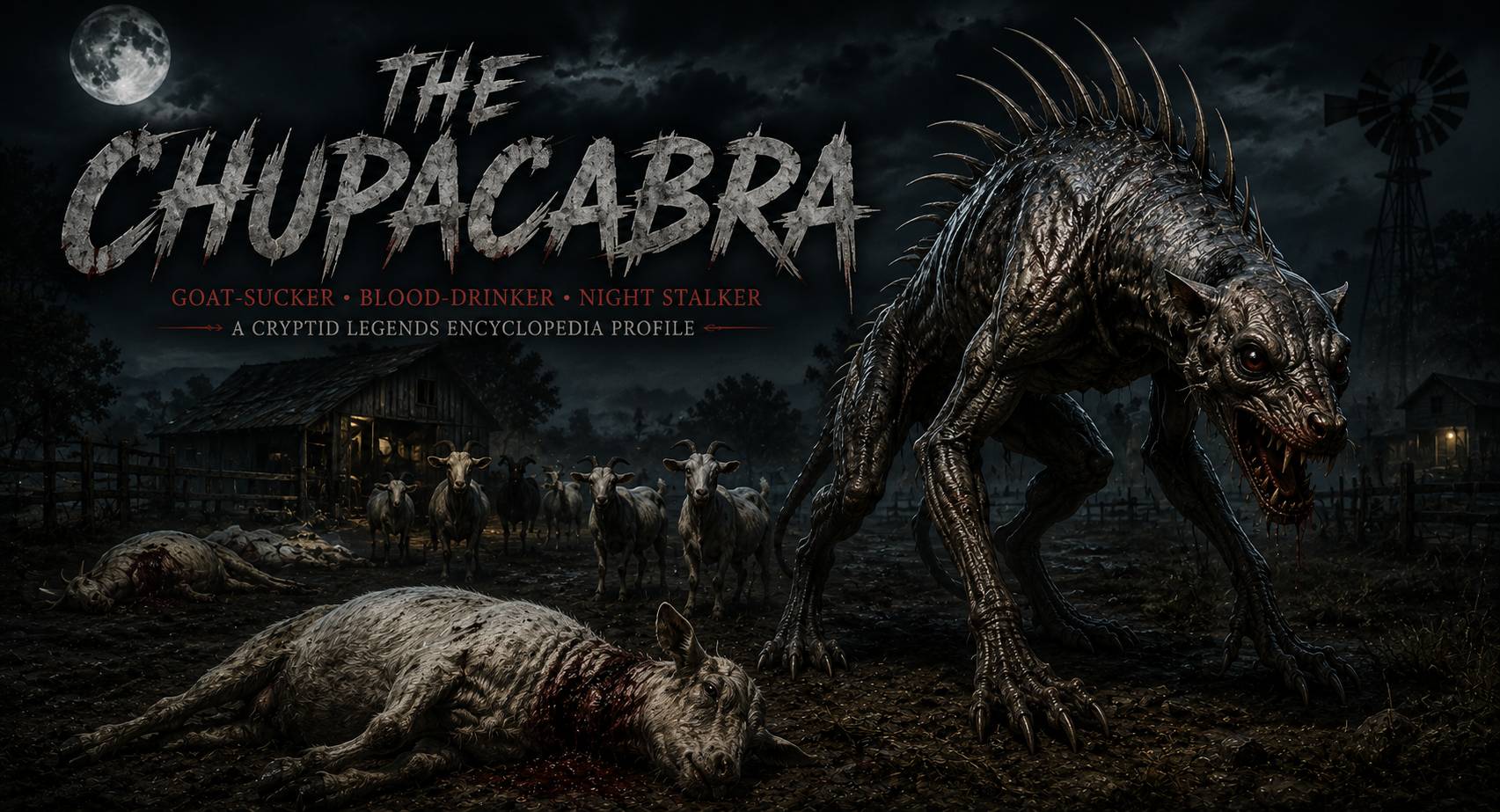
🐐 The Chupacabra – The Goat-Sucker of the Americas
Few modern cryptids have spread across the world as rapidly as the Chupacabra.
Its name is unmistakably Spanish: chupa, “to suck,” and cabras, “goats” — the “goat-sucker.” Unlike many legendary creatures whose origins disappear into centuries of oral tradition, the Chupacabra is remarkably modern.
Its emergence can be traced to Puerto Rico in 1995, when reports of mysterious livestock deaths were followed by increasingly bizarre descriptions of a creature said to stalk the countryside.
What began as a series of unexplained animal deaths soon became something far larger.
Farmers reported sheep, goats, chickens and other animals apparently killed by strange wounds. Some carcasses were said to have been completely drained of blood. Rumours spread rapidly through Puerto Rico, while newspapers, television programmes and radio transformed scattered reports into a national mystery.
Then came the creature itself.
In the summer of 1995, Madelyne Tolentino, a resident of Canóvanas, reported seeing a bizarre humanoid creature near her home. Her description became one of the defining accounts of the original Chupacabra: a creature roughly four to five feet tall, with a strange body, enormous eyes and prominent spines running along its back.
Unlike the later American version of the legend, this was not simply a hairless dog.
The original Puerto Rican Chupacabra was something distinctly monstrous — something that seemed to belong equally to the worlds of extraterrestrial horror, vampire folklore and science fiction.
Its arrival also occurred at a fascinating cultural moment. The 1995 science-fiction horror film Species had recently introduced audiences to the alien creature Sil, whose appearance and characteristics bore striking similarities to elements later incorporated into descriptions of the Chupacabra.
Skeptical investigator Benjamin Radford subsequently argued that this connection was important in understanding how the creature’s visual image developed.
Whether coincidence, unconscious influence or deliberate embellishment, the resemblance became part of the Chupacabra’s story.
And then the legend escaped Puerto Rico.
Reports began appearing throughout Mexico, Central America, South America and eventually the United States. With each new region came new descriptions. The original spiny, upright creature gradually gave way to something considerably more familiar.
By the 2000s, particularly in Texas, alleged Chupacabras were increasingly being described as hairless, blue-grey, canine-like animals with strange proportions and enormous teeth.
This transformation produced one of the most remarkable chapters in modern cryptid history.
When supposed Chupacabra carcasses were finally subjected to DNA testing, the mystery repeatedly collapsed into biology.
Coyote.
Dog.
Coyote-dog hybrid.
And, in many cases, an animal suffering from severe sarcoptic mange.
Mange can strip an animal of its hair, thicken and darken its skin, alter its body shape and leave it emaciated and sick-looking. A diseased coyote discovered at night can look extraordinarily unlike the healthy animal people expect to see.
The scientific evidence therefore presents a striking contrast with the legend.
The monster has never been genetically confirmed.
Yet the Chupacabra itself has never disappeared.
Its story has become embedded in the folklore of the Americas, fuelled by unexplained livestock deaths, frightened witnesses, sensational journalism, television investigations, alleged carcasses, conspiracy theories and the enduring human tendency to give a face to things we cannot immediately explain.
Behind the modern legend also lies an older cultural memory.
Long before the word chupacabra existed, Puerto Rico had experienced its own mysterious livestock-killing panic.
The 1975 “Vampiro de Moca” reports described animals found dead with mysterious puncture wounds and gave rise to stories of a gigantic vampire stalking the countryside. The episode would later become an important part of the cultural background against which the 1995 Chupacabra phenomenon emerged.
But the Chupacabra was something new.
It was a creature born in the age of television.
A cryptid whose mythology could evolve almost in real time as witnesses, journalists, artists, investigators and audiences exchanged stories.
The original creature had spines.
The later creature had fur missing from its body.
The first was a mysterious humanoid predator.
The later incarnation was often nothing more than a dying coyote.
And yet both became the Chupacabra.
Today, the evidence overwhelmingly supports misidentified and diseased animals rather than an undiscovered species. But the historical record remains fascinating precisely because it documents the birth, transformation and worldwide spread of a modern monster.
From the dark hills of Puerto Rico to the ranches of Texas, from mysterious livestock deaths to DNA laboratories, the Chupacabra occupies a unique place in cryptozoology.
It may not be an unknown animal.
But the story of how the Goat-Sucker became one of the world’s most famous cryptids is very real.
And it began with something dead in the Puerto Rican countryside.
Something that nobody could immediately explain.
👹 Physical Appearance
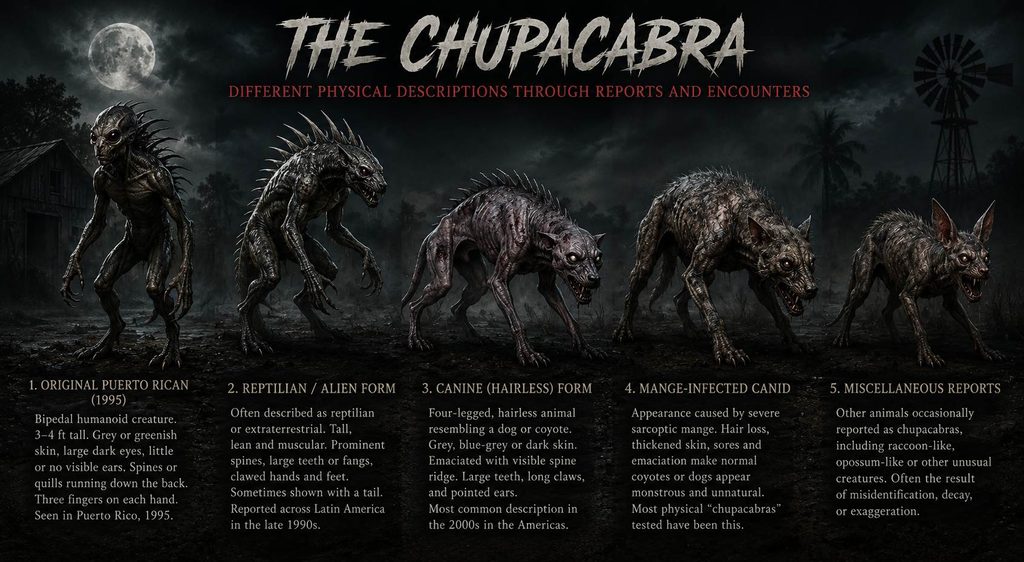
Perhaps the most fascinating feature of the Chupacabra is that it does not have one consistent physical form.
Unlike many older legendary creatures with relatively stable descriptions, the Chupacabra has undergone a remarkable transformation during its short history.
The creature described in Puerto Rico in 1995 looked almost nothing like the hairless animals later labelled Chupacabras in Mexico, Texas and the wider United States.
Benjamin Radford has described the phenomenon as having at least three broad forms: the original humanoid or alien-like creature, the later canine form, and a miscellaneous category of other animals occasionally identified as Chupacabras.
👽 The Original Puerto Rican Chupacabra
The earliest and most iconic form emerged during the 1995 Puerto Rican reports.
Contemporary descriptions generally portrayed the creature as a relatively small, upright, humanoid animal.
It was commonly reported as approximately 3–4 feet tall, although individual accounts varied. It was said to walk on two legs, sometimes with an unusual hopping or kangaroo-like gait.
The creature was described as having a strange, almost reptilian or extraterrestrial appearance, with greyish or greenish skin, large dark eyes and an elongated or unusual head.
One of the most influential descriptions came from Madelyne Tolentino of Canóvanas, who reported seeing a creature standing outside her home in August 1995.
Her later account described an approximately four-foot-tall biped with large dark eyes, thin arms, three fingers, no obvious ears, small openings where a conventional nose might be expected, and unusual spines or feather-like structures running along its back.
The creature’s back was perhaps its most distinctive feature.
Witness descriptions referred to spines, quills or feather-like projections extending down the body. Some later popular illustrations transformed these into a dramatic row of large triangular spikes.
Other accounts attributed large teeth or fangs, clawed hands and feet, unusual limbs and a strange mouth to the creature.
Some reports also described glowing or reddish eyes, although the exact colour and appearance varied between accounts.
The result was an animal that looked less like a conventional predator and more like a creature from science-fiction or extraterrestrial horror.
The famous Puerto Rican appearance is particularly significant because it became the visual template for the Chupacabra reproduced in newspapers, television, books, artwork and later popular culture.
There is, however, an important historical complication.
Skeptical investigator Benjamin Radford, after interviewing Tolentino and examining the circumstances of her sighting, argued that her description bore an extraordinary resemblance to Sil, the alien creature from the 1995 science-fiction horror film Species.
The film had been released in Puerto Rico only weeks before her reported encounter. Radford identified numerous similarities, including the bipedal posture, large eyes, unusual head, thin limbs, clawed hands and the prominent structures running down the spine.
That does not establish what Tolentino actually saw, but it is an important part of the documented history of how the Chupacabra acquired its famous appearance.
🦎 The Reptilian or Alien Form
As the legend spread through Puerto Rico and into other parts of Latin America, the creature was increasingly represented as a reptilian or alien-like monster.
This interpretation generally retained the upright body and spinal projections but exaggerated its more monstrous characteristics.
Descriptions and illustrations variously gave the creature:
🦎 Grey, greenish or leathery skin
👁️ Large dark, red or glowing eyes
🦷 Prominent teeth or fangs
🖐️ Long fingers ending in claws
🦵 Powerful hind limbs
🦔 Spines or quills extending along the back
🦘 An unusual hopping or springing gait
Some versions gave it a tail, while others specifically lacked one. Some depictions included wings, while others did not. Ears, noses and other ordinary mammalian features likewise varied considerably.
This inconsistency is important: there was never a universally accepted anatomical description even during the original Puerto Rican wave. Modern reviews of the legend note that descriptions ranged from winged creatures to tailless beings and from prominent ears to no obvious ears at all.
The result was less a single zoological description than a developing monster image.
🐕 The Hairless Canine Chupacabra
By the late 1990s and particularly during the 2000s, the Chupacabra underwent one of the most dramatic transformations in cryptid history.
The upright, spiny creature increasingly disappeared from reports and was replaced by a four-legged, hairless animal resembling a dog or coyote.
This form became particularly prominent in Mexico and the southwestern United States, eventually becoming the version most familiar to the modern public.
National Geographic notes that the original 1995 Puerto Rican reports described a distinctly non-canine creature, while by around 2000 the spiny biped had largely been replaced by the canine version.
These supposed Chupacabras were generally described as:
🐕 Four-legged
🦴 Extremely thin or emaciated
🩶 Grey, blue-grey or dark-skinned
🦲 Almost completely hairless
👁️ Large or unusually prominent eyes
🦷 Large teeth or exposed-looking fangs
🐾 Long-looking claws
🦴 A pronounced ridge along the spine
The skin could appear wrinkled, thickened, crusted or leathery, giving the animals a particularly unnatural appearance.
Unlike the original Puerto Rican creature, these animals were generally encountered on all fours, frequently moving like sick or injured dogs or coyotes.
And this is where the Chupacabra story intersects directly with veterinary science.
🧬 The “Mange Chupacabra”
Many of the hairless American animals subsequently identified as Chupacabras have been examined by wildlife biologists and veterinary specialists.
The most important explanation is sarcoptic mange, a severe parasitic skin disease caused by the mite Sarcoptes scabiei.
In badly affected wild canids, mange can cause extensive hair loss, thickened skin, inflammation and secondary infections. Severe disease can leave an animal emaciated and profoundly altered in appearance.
University of Michigan biologist Barry O’Connor explained how the condition can produce the naked, leathery and foul-smelling appearance that helped turn sick coyotes into apparent monsters.
This creates a remarkable visual paradox.
A healthy coyote is unmistakably a coyote.
A severely diseased coyote can look almost unrecognisable.
When such an animal is encountered at night, photographed from a distance or found dead beside a road, its unusual appearance can easily become the foundation for a Chupacabra report.
The later American “Chupacabra” therefore became almost the opposite of the original Puerto Rican monster.
1995 Puerto Rico:
Upright, humanoid, spiny and apparently alien.
2000s Texas and the American Southwest:
Four-legged, hairless, emaciated and biologically identifiable.
🦝 The “Other” Chupacabras
A third category developed as the legend continued to spread.
Almost any unusual, hairless or badly decomposed animal could potentially acquire the Chupacabra label.
Raccoons, dogs, coyotes and other mammals have all been suggested or reported as Chupacabras when their appearance was sufficiently unusual.
This explains why modern Chupacabra photographs can look dramatically different from one another.
One image may show a reptilian humanoid.
Another may show a hairless canine.
Another may appear to show a small, elongated mammal with strange proportions.
They are not necessarily different descriptions of the same hypothetical species. They represent the evolution of the legend and the identification of different real-world animals as Chupacabras.
Radford specifically notes that the phenomenon has included humanoid, canid and miscellaneous animal forms.
👹 One Monster — Several Faces
The Chupacabra therefore has an unusual place in cryptozoology because its appearance changed as the legend travelled.
The original Puerto Rican creature was an upright, mysterious, spiny-backed humanoid.
The Latin American versions retained much of the reptilian or extraterrestrial imagery.
The later North American creature became a hairless quadruped resembling a diseased coyote or dog.
And eventually the name Chupacabra became a general label applied to almost any mysterious-looking animal found under unusual circumstances.
This means that when discussing the Chupacabra’s physical appearance, it is misleading to present a single “official” anatomy.
There isn’t one.
Instead, the creature has accumulated a series of visual identities over three decades, each reflecting the witnesses, media, geography and circumstances surrounding the reports.
And perhaps that is the most revealing feature of the Chupacabra of all:
The monster itself keeps changing.
The spines disappear.
The fur disappears.
The creature changes from two legs to four.
Yet the name remains.
The Chupacabra.
📌 Location Details
📍 Primary Location: Barrio Campo Rico, Canóvanas
🇵🇷 Country: Puerto Rico, United States
🗺️ Municipality: Canóvanas
📌 Approximate Coordinates: 18.3789° N, 65.9014° W
🌿 Region: Northeastern Puerto Rico
🌴 Nearby Landmark: El Yunque National Forest
👹 Significance: Associated with the 1995 Chupacabra outbreak and Madelyne Tolentino’s famous encounter
📅 Historical Period: 1995
🔎 Location Type: Historic cryptid-report location / folklore site
🌎 Chupacabra — Canóvanas, Puerto Rico
The Chupacabra’s most important geographical location is Canóvanas, Puerto Rico, particularly the semi-rural Barrio Campo Rico area northeast of San Juan.
In 1995, this semi-rural Puerto Rican municipality became the centre of a strange livestock-killing panic that would ultimately produce one of the world’s most recognisable modern cryptids.
Reports of apparently mutilated and supposedly blood-drained animals were followed by eyewitness accounts of an unfamiliar creature, culminating in the famous encounter reported by Madelyne Tolentino in Barrio Campo Rico.
Most importantly, Madelyne Tolentino’s famous 1995 encounter occurred in Barrio Campo Rico, Canóvanas. Later investigation by Benjamin Radford placed the original sighting near Calle 1 and Calle 2, close to an Iglesia de Dios church. Radford returned to the location with Tolentino during his investigation of the case.
The broader Canóvanas area is also significant because it sits close to the El Yunque rainforest, which subsequently became strongly associated with the Chupacabra in popular accounts.
El Yunque is sometimes described as the creature’s supposed wilderness refuge, although this is a folkloric association rather than an established biological habitat.
From these streets and surrounding agricultural areas, the story spread outward through Puerto Rico’s newspapers and television programmes before crossing national borders and becoming the international Chupacabra legend.
🌿 Habitat
The Chupacabra has no scientifically established habitat, because no unknown species has been confirmed.
Its supposed environment has nevertheless changed considerably alongside the creature’s evolving appearance and the geography of reported encounters.
The earliest Chupacabra reports of 1995 Puerto Rico were strongly associated with semi-rural agricultural communities, particularly around Canóvanas and the northeastern countryside.
Livestock such as goats, sheep and chickens were reportedly attacked or found dead, placing the creature firmly within the landscape of farms, smallholdings, fields and wooded margins.
These environments provided the perfect setting for a nocturnal predator in the folklore: isolated enough for unexplained animal deaths to occur, yet close enough to homes for strange sightings to spread rapidly through local communities.
The nearby El Yunque rainforest subsequently became one of the locations most strongly associated with the Chupacabra in popular culture.
Dense tropical vegetation, steep mountains, caves, streams and enormous areas of difficult terrain provided an obvious imagined refuge for a creature that supposedly appeared at night and disappeared before it could be captured.
However, the connection between El Yunque and the Chupacabra is largely a later folkloric and cryptozoological association, rather than evidence that sightings originated deep inside the rainforest.
As the legend spread beyond Puerto Rico, its supposed habitat changed with it. Reports appeared across Mexico, Central America, South America and eventually the United States, particularly in rural farming and ranching areas.
In Texas, where the later “Chupacabra” became increasingly associated with strange hairless canine-like animals, reports frequently came from ranches, pastureland, roadsides and areas bordering woodland.
This geographical shift is important because it mirrors the transformation of the creature itself.
The 1995 Puerto Rican Chupacabra was imagined as a strange upright, almost extraterrestrial or reptilian predator hiding around tropical countryside.
The later North American Chupacabra was generally described as a hairless, emaciated quadruped moving through ranches and farmland, an appearance that scientific investigations repeatedly connected with coyotes, dogs and other canids suffering severe sarcoptic mange.
🌴 The Chupacabra’s Supposed Environment
Across the folklore, the creature is therefore most commonly imagined around:
🌾 Rural farmland and agricultural fields — particularly areas containing goats, sheep, chickens and other livestock.
🌳 Woodland and forest margins — providing cover between isolated farms and settlements.
🌴 Tropical rainforest — particularly in Puerto Rican versions of the legend associated with the El Yunque region.
⛰️ Mountainous and remote terrain — imagined as suitable territory for an elusive creature avoiding human contact.
🏚️ Rural settlements and farmsteads — where many of the reported livestock attacks supposedly occurred.
🌙 Roadsides and open countryside — especially in later North American reports involving alleged hairless canids.
Rather than occupying one consistent ecological niche, the Chupacabra’s habitat follows the legend.
In Puerto Rico it belongs to the humid tropical landscape of isolated farms, forests and mountains. In Mexico and Latin America it can appear around ranches and agricultural communities.
In the United States, particularly Texas, the creature became increasingly associated with dry ranch country and the woodland edges where coyotes and feral dogs actually live.
From a biological perspective, this presents a major problem for the idea of a single undiscovered species. A genuine animal population would be expected to show a consistent geographical range, ecological requirements and physical characteristics.
Instead, reported Chupacabras have appeared across vastly different environments while changing dramatically in appearance.
The habitat of the Chupacabra is therefore best understood as a landscape of folklore rather than a confirmed ecological range.
It is the dark field beyond the farmhouse.
The woodland at the edge of the pasture.
The tropical forest disappearing into the mountains.
And the silent livestock pen where something supposedly came in during the night, leaving behind only the bodies, the rumours and the question of what was really there.
📜 Background & Legend

The Chupacabra occupies an unusual position in the history of cryptozoology because its legend can be observed forming almost in real time.
There is no ancient manuscript describing a creature called the Chupacabra, nor is there a clear centuries-old tradition documenting one consistent animal under that name.
Instead, the modern legend developed through the interaction of livestock deaths, eyewitness testimony, existing supernatural beliefs, journalism, television and popular imagination during the 1990s.
The word itself became the defining feature of the legend. Chupacabra literally means “goat-sucker”, from the Spanish chupar (“to suck”) and cabra (“goat”).
The name captured the central claim surrounding the creature: that an unknown predator was attacking domestic animals and somehow removing their blood.
According to Puerto Rican entertainer Silverio Pérez, he coined or popularised the term el chupacabras during the 1995 media frenzy surrounding the mysterious animal deaths.
What began partly as a humorous description rapidly became the name by which the phenomenon was known throughout Puerto Rico and, eventually, internationally.
The concept nevertheless had a cultural predecessor.
In 1975, the Puerto Rican municipality of Moca experienced an earlier livestock-killing panic remembered as the “Vampiro de Moca”, the Vampire of Moca.
Animals were reportedly discovered with unusual wounds, producing stories of a mysterious vampire-like predator.
Contemporary coverage and later recollections associated the deaths with rumours of an enormous vampire, while other explanations circulated locally.
The Moca episode did not produce the word Chupacabra, and it should not be treated as evidence of a continuous Chupacabra tradition stretching back to 1975.
Its importance is cultural: it demonstrates that the idea of a mysterious blood-drinking predator attacking farm animals already existed within Puerto Rican popular memory before the 1995 phenomenon emerged.
The Chupacabra subsequently inherited many of these older motifs.
It became a creature associated with night, blood, livestock, unexplained death and rural isolation.
Some accounts incorporated ideas about vampires or supernatural predators, while others introduced entirely different possibilities, including extraterrestrial creatures, secret government experiments, escaped laboratory organisms and genetically engineered animals.
The latter theories became particularly prominent because the original descriptions were so unusual.
Rather than resembling a conventional predator, the earliest popular image presented something that appeared almost outside normal zoology.
The creature was represented as strange, humanoid and sometimes reptilian, allowing the legend to absorb contemporary fears surrounding aliens, genetic experimentation and unexplained biological phenomena.
This is one reason the Chupacabra differs from older folkloric monsters.
Traditional folklore generally passes through generations, gradually changing through oral storytelling. The Chupacabra instead developed through mass communication. Newspaper stories could circulate throughout Puerto Rico within hours.
Television programmes could broadcast eyewitness descriptions and sketches to enormous audiences. Viewers could then interpret their own unexplained animal encounters through the new Chupacabra framework.
A reported dead animal therefore no longer had to remain simply an unexplained dead animal.
It could become evidence of the Chupacabra.
A strange noise in the darkness could become a sighting.
A hairless animal could become a creature.
And another livestock death could appear to confirm the growing story.
This created a powerful feedback loop between event and legend.
As the phenomenon crossed national borders, local communities adapted the creature to their own surroundings. The name remained largely unchanged, but the imagined animal could become reptilian, humanoid, canine or something altogether stranger.
The Chupacabra consequently became less like a single traditional monster and more like a folkloric category, a name applied to unexplained animal deaths and unusual creatures that seemed to fit the emerging legend.
Its mythology also developed around a particularly compelling narrative:
Something is killing livestock.
The bodies appear strangely wounded.
Nobody knows what did it.
Someone eventually sees the creature responsible.
That basic sequence has allowed the legend to regenerate repeatedly, even after individual cases have been explained.
The later discovery that many alleged Chupacabra carcasses were actually mangy coyotes, dogs or other known animals did not destroy the legend. Instead, it created a second Chupacabra mythology: the idea that the hairless canine represented merely one manifestation of a much stranger creature.
Thus two very different traditions became intertwined.
The original Chupacabra became the bizarre, spiny, almost extraterrestrial predator of Puerto Rican folklore.
The modern North American Chupacabra became the mysterious hairless animal found around farms and roadsides.
They share a name, but their origins and physical descriptions are remarkably different.
This constant transformation is arguably the defining characteristic of the Chupacabra legend.
It has never required its monster to remain unchanged.
The creature adapts to whatever the surrounding culture fears, whatever unexplained event requires an explanation and whatever image happens to capture the public imagination.
And that makes the Chupacabra one of the clearest examples of a modern legend in evolution, a cryptid whose mythology developed not in some distant prehistoric past, but within living memory, leaving behind a trail of newspaper stories, eyewitness testimony, television coverage, investigations and increasingly elaborate folklore.
📜 Historical Sightings & Famous Cases

The documented history of the Chupacabra is unusual because the phenomenon did not develop from one famous encounter alone.
Instead, animal deaths, witness reports, newspaper coverage and later alleged physical specimens gradually became woven into a single legend.
For the Cryptid Legends encyclopedia, it is important to distinguish between what was reported at the time, what was remembered later, and what subsequent investigation actually established.
🩸 1975 — The “Vampiro de Moca” Precursor
The story most often mentioned as a predecessor to the Chupacabra concerns a series of mysterious livestock deaths around Moca, Puerto Rico, in 1975.
Farm animals were reportedly found dead with unusual wounds, and rumours developed that something was removing their blood. Contemporary El Vocero newspaper clippings from the period survive in Puerto Rican archives and have since been reproduced by the Biblioteca Virtual de Puerto Rico.
The phenomenon became known as the Vampiro de Moca — the Vampire of Moca.
It is tempting to describe this as the first Chupacabra outbreak, but the historical evidence does not support treating the two as the same phenomenon. Researcher Benjamin Radford found no printed reference to a vampiric “Chupacabra” before 1995, and the 1975 creature already had its own name and considerably different descriptions.
The Moca episode is therefore best understood as an important cultural precursor, demonstrating that mysterious livestock deaths and vampire-like explanations were already part of Puerto Rican folklore before the modern Chupacabra appeared.
🐐 March 1995 — The First Livestock Reports
The modern phenomenon began with reports of livestock deaths in Puerto Rico during March 1995.
Reports emerged from rural communities including Orocovis and Morovis, where farmers discovered goats, sheep and cattle dead with small puncture wounds. Later accounts described the animals as apparently drained of blood.
The precise chronology of these earliest reports is difficult to reconstruct because much of the surviving material consists of later retellings of the original newspaper coverage. Modern sources consequently differ over which individual carcass should be regarded as the “first” Chupacabra attack.
What is considerably clearer is that mysterious livestock deaths preceded the famous creature sighting later that year. The deaths created the unexplained event around which the legend would eventually form.
At this stage, there was still no universally established appearance for the supposed predator.
There were simply dead animals and rumours of something responsible.
👽 August 1995 — Madelyne Tolentino’s Famous Encounter
The event that transformed the livestock mystery into a genuine cryptid legend occurred in August 1995, when Madelyne Tolentino reported seeing an extraordinary creature in Canóvanas.
The exact date has never been firmly established. During later interviews, Tolentino placed the encounter somewhere during the second week of August, with Radford narrowing the likely period to August 7–11, 1995. She recalled seeing the creature for several minutes during the afternoon.
Her description became the foundation of the original Chupacabra image.
She reported a roughly four-foot-tall biped, walking on two legs, with unusually large dark eyes, thin arms, three-fingered hands, unusual facial features and spine-like or feather-like projections running down its back.
The account was subsequently reported through Puerto Rican media and circulated among UFO researchers.
This was the moment when the mysterious livestock killer acquired a body and a face.
Radford’s later investigation uncovered an important complication: Tolentino had seen the science-fiction film Species shortly before her encounter, and he argued that similarities between the film’s creature Sil and her description were significant.
His conclusion was not that Tolentino deliberately fabricated the encounter, but that memory and recent imagery may have influenced what she believed she had seen.
That interpretation remains Radford’s investigative conclusion, rather than an independently provable fact.
🚔 October–December 1995 — The Canóvanas Panic
By autumn, the phenomenon had become a major Puerto Rican news story.
The El Vocero newspaper devoted extensive coverage to the alleged creature, with stories about livestock deaths, eyewitnesses and searches becoming increasingly dramatic. Later analysis of the newspaper archive has shown just how heavily the paper covered the story.
The mayor of Canóvanas, José “Chemo” Soto, became one of the most prominent public figures associated with the investigation.
Search parties were organised to look for the creature. Some participants were armed, creating concern among police authorities.
The Los Angeles Times reported that Soto had already led two searches and planned another, while Puerto Rico Police Chief Pedro Toledo warned untrained civilians against arming themselves and searching for the animal, fearing someone would be injured.
The episode had become much more than a series of unexplained livestock deaths.
It was now a public investigation, media spectacle and local political phenomenon.
A contemporary December 1995 report by El Tiempo, based partly on Puerto Rican reporting, described the search effort involving approximately 200 local guides, with NBC sending a camera and reporting team to cover the developing story.
The same report noted that a police officer had shot a rhesus macaque after mistaking it for the Chupacabra, a revealing example of how the panic could turn ordinary animals into suspected monsters.
📰 December 1995 — The Story Goes International
By December, the Chupacabra was no longer merely a Puerto Rican local story.
International newspapers were reporting the phenomenon.
The Washington Post published a detailed report from Canóvanas on December 25, 1995, describing residents who claimed close encounters with a three- to four-foot creature and recording contemporary descriptions of red eyes, dinosaur-like skin and coloured spikes.
The article also documented the involvement of veterinarians, politicians, journalists and local residents.
The Los Angeles Times similarly reported the growing panic and the formation of armed search parties. It also recorded that more than 40 animals were claimed to have been killed in Canóvanas at that point.
These reports are particularly valuable to the historical record because they demonstrate that the Chupacabra phenomenon was already being treated as a major news story while it was happening, rather than becoming famous only through later retellings.
At the same time, the contemporary reporting also shows considerable uncertainty.
Different residents described the creature differently.
Some thought it was an extraterrestrial.
Others imagined a devilish or mutated animal.
Some believed it might have escaped from a wildlife facility.
And newspapers increasingly supplied increasingly elaborate descriptions of something that nobody had actually captured.
📺 1995–1996 — Television Spreads the Legend
Television proved even more influential than newspapers.
Tolentino’s story was eventually broadcast beyond Puerto Rico, including on the Spanish-language programme El Show de Cristina.
The programme’s enormous audience helped transform a local Puerto Rican story into an international Hispanic phenomenon. Radford later argued that the timing of subsequent reports demonstrated how strongly television contributed to the spread of the legend.
The phenomenon consequently began behaving like a modern media-driven folklore outbreak.
A person heard about the Chupacabra.
Another unusual animal was discovered.
The new event was interpreted through the existing story.
The newspaper reported it.
Television amplified it.
And the legend acquired another “sighting.”
By the following years, reports were appearing well beyond Puerto Rico.
🌎 1996–1999 — The Chupacabra Leaves Puerto Rico
During the second half of the 1990s, alleged Chupacabra attacks spread throughout Latin America and the Caribbean, with reports appearing in countries including Mexico, Chile, Argentina, the Dominican Republic, Nicaragua and others.
This was the period when the Chupacabra ceased being exclusively a Puerto Rican legend.
The reports were highly variable. Some continued to involve mysterious livestock deaths, while others involved strange animals or alleged sightings.
There was no consistent physical specimen.
No authenticated photograph established the existence of a new species.
No confirmed population was located.
Instead, the name itself travelled from community to community, attaching itself to local stories of unexplained animal deaths.
This geographical expansion is one of the most important developments in the history of the cryptid because it demonstrates how rapidly a modern legend could cross cultural and national boundaries.
🐕 2000 — The Chupacabra Changes Form
Around 2000, a major transformation occurred.
The Chupacabra increasingly stopped being described as the upright, spiny creature of the 1995 Puerto Rican reports.
Instead, alleged Chupacabras began appearing as hairless, four-legged animals resembling dogs, coyotes or foxes.
Radford identifies a dead canid found on a ranch outside Managua, Nicaragua, in 2000 as an important early example of this second major Chupacabra form.
This change would eventually dominate the American version of the legend.
It also created an important distinction within Chupacabra history:
The original Puerto Rican Chupacabra was humanoid.
The later American Chupacabra was canine.
The two forms were subsequently merged by popular culture even though their descriptions were dramatically different.
2000–2002 — The Calama, Chile Reports
A particularly large outbreak of alleged Chupacabra attacks occurred around Calama in northern Chile beginning in approximately 2000.
Reports claimed that roughly one hundred farm animals had been killed or mutilated in unusual circumstances. The story generated considerable media attention and increasingly elaborate speculation.
The Chilean phenomenon produced several alleged “Chupacabra” animals, including a güiña, a small native wild cat, that attracted international attention after being killed.
Other biological remains were also misidentified.
Investigations eventually pointed toward ordinary domestic dogs as the source of the livestock attacks, with tracks and hairs reportedly consistent with dogs rather than an unknown predator.
The Calama episode became another example of a recurring pattern:
Unusual livestock deaths → Chupacabra interpretation → media attention → alleged creature → natural explanation.
2004 — The Elmendorf Beast
The Chupacabra’s next major transformation took place in Texas.
In 2004, an extraordinarily strange-looking animal was encountered near Elmendorf, south of San Antonio.
The animal was almost hairless, thin and bluish-grey, with unusually prominent ears and a distinctly canine appearance.
A local rancher shot the creature after discovering it on his property.
Photographs circulated through the media and the animal became known as the Elmendorf Beast.
The appearance was so bizarre that many people immediately connected it to the Chupacabra.
Later genetic testing, however, identified the animal as a domestic dog, while severe disease, particularly mange, was recognised as an important explanation for its bizarre appearance.
The Elmendorf case was enormously important for Chupacabra folklore because it effectively established the hairless Texas canid as the new visual archetype.
🐺 2004–2006 — The Texas “Chupa” Phenomenon
Following Elmendorf, other strange-looking animals began attracting the Chupacabra label throughout Texas.
Reports from places including Pollok described hairless or badly diseased canids that looked sufficiently unusual to generate photographs and news coverage.
In October 2004, Earthfiles documented the Pollok animal and recorded correspondence from people who believed the creature might be connected to the Chupacabra phenomenon. Others, including veterinarians and experienced observers, suggested a coyote suffering from severe mange.
The pattern became increasingly clear:
The Chupacabra had moved from a mysterious blood-drinking humanoid to a mysterious hairless canid.
And Texas provided the perfect environment for that second version of the legend to flourish.
🧊 2006 — The Maine “Mystery Beast”
The phenomenon was no longer restricted to the Southwest.
In Maine in 2006, a strange animal killed or found dead near the roadside was photographed and widely discussed as a possible Chupacabra.
The case became part of a growing pattern in which decomposed, diseased or unusual-looking mammals were interpreted through the Chupacabra legend.
The incident received Associated Press coverage under the headline “Maine Mystery Beast Possibly Killed By Car”, illustrating how the term had begun to function as a general label for unidentified-looking animals rather than a description of one specific species.
🐕 2007 — The Cuero Chupacabra
Perhaps the most famous alleged Chupacabra specimen in American history emerged near Cuero, Texas, in 2007.
Rancher Phyllis Canion discovered a bizarre, almost completely hairless animal near her property and preserved its head after the body was disposed of.
Photographs of the strange blue-grey creature spread through newspapers and television.
Unlike many earlier cases, however, the Cuero animal provided researchers with something genuinely useful:
DNA.
Texas State University researchers examined tissue from the specimen and reported their findings in November 2007.
The animal was identified as a coyote, with the unusual appearance attributed to disease and other biological factors. Contemporary Texas reporting described the result as solving the mystery of the famous “Cuero Chupacabra.”
The result did not end the legend.
Instead, it created one of its most enduring debates.
For believers, the specimen demonstrated that something unusual had been found.
For biologists, it demonstrated that a spectacular-looking “Chupacabra” could ultimately be traced to a known species.
📹 2008 — The Texas Video
The following year, another strange canine-like animal attracted national attention.
A video of a hairless, dog-like creature filmed in Texas circulated through television and internet media.
CNN and Fox News both covered the phenomenon, with the creature again being presented as a possible Chupacabra.
Contemporary reporting shows how strongly the Texas cases had become associated with the wider legend by this point.
But once again, there was no confirmed evidence of an unknown species.
The imagery was compelling. The zoological evidence was not.
🐕 2010 — The Hood County Chupacabra
One of the best documented later cases occurred in Hood County, Texas, in July 2010.
Animal control officer Frank Hackett shot a bizarre hairless animal after it entered a barn near Cresson.
The creature was described by witness David Hewitt as resembling a large, hairless Chihuahua, with unusual claws, a pointed tail and almost no hair. The story was quickly reported by local television and national media.
The animal was submitted for examination.
This time, the answer was particularly clear.
According to Hood County animal control and reports of the Texas A&M examination, the corpse was identified as a coyote–canine hybrid suffering from mange and internal parasites.
A second alleged Chupacabra was reportedly shot nearby, but vultures consumed the body before it could be properly examined.
The Hood County incident became one of the strongest examples of the recurring phenomenon:
A real and extremely unusual-looking animal → Chupacabra identification → scientific examination → known canid with disease.
🛣️ 2010 — The Kentucky Roadkill
Later that year, another bizarre-looking animal found in Kentucky was described as a possible Chupacabra.
The creature was small and hairless, with an unusual appearance that generated considerable discussion in American media.
As with other cases, however, the lack of a confirmed unknown species meant that the incident remained a reported Chupacabra case rather than evidence of a new animal.
Contemporary coverage included Fox News and local reporting.
🔬 2011 — Radford’s Investigation
By 2011, the Chupacabra had accumulated enough material for a detailed historical investigation.
Researcher Benjamin Radford published Tracking the Chupacabra: The Vampire Beast in Fact, Fiction, and Folklore after approximately five years of research.
Radford interviewed Madelyne Tolentino, investigated the original Puerto Rican locations, examined the history of the livestock reports and investigated the later Texas specimens.
His conclusion was that the Chupacabra was best understood as a modern legend rather than a newly discovered biological species.
He also proposed that the original 1995 appearance was heavily influenced by Species, while later “Chupacabras” were largely known animals suffering disease.
His work remains one of the most substantial attempts to reconstruct the Chupacabra’s history from the original reports rather than relying on later internet summaries.
🧭 2010s — The Chupacabra Becomes a Catch-All
During the 2010s, reports continued throughout the Americas.
However, the nature of the reports increasingly changed.
Instead of large outbreaks of livestock deaths accompanied by multiple witnesses, many modern cases involved photographs or carcasses of unusual-looking animals.
Hairless coyotes.
Mangy dogs.
Decomposed raccoons.
Other unidentified mammals.
The word Chupacabra increasingly became a convenient description for an animal that looked strange enough to be unfamiliar.
Radford later described the creature as having evolved into at least three broad forms: humanoid, canid and miscellaneous animals including raccoons.
📺 2020 — The Legend Revisited
Twenty-five years after the original phenomenon, Radford revisited the Chupacabra for Skeptical Inquirer.
His retrospective emphasised just how dramatically the creature had changed.
The original Puerto Rican monster had been an upright, spiny humanoid.
The later international creature became a hairless canid.
And eventually the name could be attached to almost any sufficiently strange animal.
He also noted that the original Puerto Rican panic had largely faded, while the Chupacabra had been absorbed into international popular culture through television, films, books and the internet.
📍 The Historical Pattern
Taken together, the historical record reveals two very different Chupacabra traditions.
The first is the 1995 Puerto Rican phenomenon: mysterious livestock deaths, a rapidly developing vampire narrative, newspaper sensationalism, armed searches, eyewitness reports and the extraordinary humanoid creature described by Madelyne Tolentino.
The second emerged around 2000 and became particularly prominent in the United States during the 2000s: strange, hairless, four-legged animals that were interpreted as Chupacabras and subsequently investigated as biological specimens.
The scientific evidence from the second tradition is considerably stronger than the evidence for the first.
Repeated DNA examinations have identified known canids and other mammals, while mange provides a compelling explanation for the bizarre appearance of many alleged specimens.
The famous Cuero and Hood County cases are particularly important because they demonstrate how an apparently extraordinary creature can ultimately prove to be a severely diseased ordinary animal.
But this does not erase the historical importance of the original reports.
The 1995 Chupacabra panic genuinely happened.
The newspapers genuinely covered it.
Residents genuinely formed search parties.
Police genuinely became concerned about armed civilians hunting the supposed creature.
Witnesses genuinely reported seeing something they believed was extraordinary.
And the story genuinely spread from Puerto Rico into an international cryptid phenomenon.
What remains unresolved is not whether the Chupacabra legend existed.
That part of the historical record is beyond question.
The unresolved question is what, exactly, people were seeing, and whether the different creatures reported under the same name ever represented one biological animal at all.
For the evidence currently available, the historical record supports a much more complicated story:
A real livestock-killing phenomenon,
A genuine wave of eyewitness reports,
A powerful media-driven legend,
And a succession of known animals mistaken for something unknown.
That combination is precisely what transformed the Chupacabra from a local Puerto Rican mystery into one of the most famous cryptids of the modern world.
🔬 Scientific Evidence & Explanations
The Chupacabra occupies an unusual position in cryptozoology. Unlike many famous cryptids, the legend has repeatedly produced physical animals that were claimed to represent the creature.
Some were preserved, photographed, or subjected to veterinary and genetic examination. Yet the scientific investigations conducted on these specimens have so far failed to reveal an unknown species.
Instead, a remarkably consistent pattern has emerged.
🐺 The Mange Hypothesis
The strongest scientific explanation for the modern, hairless form of the Chupacabra is sarcoptic mange, a disease caused by the parasitic mite Sarcoptes scabiei.
Mange can produce dramatic changes in a mammal’s appearance. Severe infections cause intense itching, extensive hair loss, thickened and crusted skin, inflammation, weight loss and secondary infections.
A severely affected coyote can lose so much of its normal coat that its exposed grey skin, enlarged ears, prominent teeth and emaciated body can make it appear almost completely unlike a healthy coyote.
Texas Parks and Wildlife has specifically documented this phenomenon in relation to Chupacabra reports, noting that sarcoptic mange commonly affects coyotes and red foxes and can cause extensive hair loss and crusting of the skin.
Texas A&M researchers have likewise explained that several features traditionally interpreted as monstrous anatomy can have mundane anatomical explanations.
The apparent raised ridge along the back, for example, can represent remaining guard hairs, while the apparently scaly skin can result from the effects of the mite infestation and exposed skin.
The result can be an animal that looks extraordinarily strange, particularly to someone encountering a severely diseased wild canid at night.
🧬 DNA Evidence
The most significant evidence comes from specimens that were genetically tested.
The famous Cuero, Texas, Chupacabra specimen discovered by rancher Phyllis Canion in 2007 became one of the most widely publicised examples. Tissue from the animal was examined by researchers at Texas State University.
The result was not an unknown creature: the specimen was identified as a coyote (Canis latrans), with its bizarre appearance attributed to severe mange. Texas State’s own account of the investigation described the genetic identification and explained why the animal had looked so unlike a normal coyote.
The pattern has continued across other alleged Chupacabra specimens. Investigations of carcasses reported in Texas during the 2000s and 2010s repeatedly identified coyotes, dogs or canid hybrids, frequently suffering from mange.
A later journalistic review of the Texas cases found that the tested animals consistently fell into these familiar categories rather than representing an unidentified species.
This is particularly important because DNA is capable of distinguishing an unfamiliar-looking individual from an unfamiliar species. A diseased animal can look extraordinary while still possessing entirely ordinary genetics.
🩸 The “Blood-Sucking” Question
The most famous feature of the Chupacabra legend is its alleged habit of draining livestock of blood.
Scientifically, however, this claim has never been demonstrated to require a blood-drinking predator.
Animals killed by predators can have puncture wounds and significant external bleeding, while blood remaining inside the body may settle after death. Consequently, a carcass discovered some time after an attack can appear remarkably bloodless without having been literally drained by a vampire-like animal.
The veterinary evidence is particularly significant here. Benjamin Radford’s investigation of the Chupacabra phenomenon documented the absence of confirmed necropsy evidence demonstrating that the livestock victims had actually been completely exsanguinated.
His research also separated the original Puerto Rican livestock reports from the later North American “hairless canine” phenomenon.
That distinction is crucial because the 1990s Puerto Rican Chupacabra legend and the later American hairless-canine phenomenon are not necessarily the same evidential phenomenon.
🐕 Why Would a Mangy Coyote Attack Livestock?
There is also a plausible ecological explanation for why diseased canids could become associated with livestock attacks.
Severe mange can leave coyotes physically debilitated. An infected animal may lose condition, become less effective at hunting normal prey and suffer from substantial physiological stress. Livestock such as sheep and goats can consequently represent easier prey.
University of Michigan biologist Barry O’Connor, whose research focuses on parasitic mites, has argued that this could help explain why mangy coyotes became associated with livestock attacks.
The University of Michigan identifies O’Connor as a specialist in systematics, parasitology and acarology, including research into parasitic mites and their vertebrate hosts.
The University of Michigan’s own 2010 explanation of the Chupacabra phenomenon likewise argued that severely weakened animals may turn toward easier prey such as sheep and goats.
👁️ Why Do the Animals Look So Different?
One of the most interesting aspects of the evidence is that mange does not create one standard appearance.
A healthy coyote has a thick coat, recognizable body proportions and a familiar silhouette. A severely diseased individual can lose most of that visual information.
What remains may be:
- exposed grey skin
- exaggerated-looking ears
- prominent teeth
- a narrow, skeletal body
- crusted or thickened skin
- an unusually hunched posture
- patches of remaining hair
- a foul odour associated with infection and secondary disease
To someone unfamiliar with severe mange, such an animal can appear almost completely unfamiliar.
A 2008 animal photographed in Ypsilanti Township, Michigan, provides a particularly good example.
The photographs prompted Chupacabra speculation, but experts at the University of Michigan examined the case.
Barry O’Connor described the condition as classic sarcoptic mange, while a zoologist who examined the photographs concluded that the animal was most likely a severely sick domestic dog.
🧪 Other Possible Misidentifications
Mange is the strongest explanation for many of the later North American reports, but it is not necessarily the explanation for every Chupacabra story.
Other possibilities include healthy or partially diseased coyotes, feral dogs, dog–coyote hybrids, raccoons and other unfamiliar wildlife.
Decomposition can also dramatically alter the appearance of a carcass, while poor photographs, darkness and unusual viewing angles can make identification considerably more difficult.
Texas A&M specifically notes that severe mange can affect not only coyotes but other mammals, including raccoons, while Texas wildlife authorities have documented mange in several wild and domestic species.
🎬 The Possible Pop-Culture Influence
There is another scientific and cultural question surrounding the original 1995 Puerto Rican appearance.
The early Chupacabra was described quite differently from the later hairless canine. Madelyne Tolentino’s famous description included a bipedal creature with unusual anatomical features and spines along its back.
Benjamin Radford’s investigation subsequently argued that the description bore striking similarities to Sil, the alien creature from the 1995 science-fiction film Species. Radford’s research examined Tolentino’s own recollections and the chronology surrounding the film and her sighting.
If this interpretation is correct, it would provide a fascinating example of folklore being shaped by contemporary popular culture, with a cinematic monster potentially becoming incorporated into a developing real-world legend.
It also helps explain why the Chupacabra’s appearance changed so dramatically over subsequent years.
⚖️ What Does the Evidence Actually Show?
Taken together, the scientific evidence currently supports a fairly straightforward conclusion.
No genetically confirmed Chupacabra species has been discovered.
The physical specimens that have been examined have instead been identified as known mammals, particularly coyotes, dogs and related canids, often suffering from severe mange.
Veterinary science provides a credible explanation for the hairless, leathery and emaciated appearance of many later “Chupacabra” specimens, while normal predator behaviour provides a plausible explanation for at least some livestock attacks.
That does not, however, mean that every historical Chupacabra report has been individually solved. The original Puerto Rican livestock deaths, eyewitness testimony and early media reports belong to a different evidential category from the later DNA-tested Texas carcasses.
The distinction is important.
The evidence does not establish a previously unknown blood-drinking animal.
But it does establish something almost as interesting from a folklore perspective: a modern legend can evolve from unexplained animal deaths, eyewitness testimony, diseased wildlife, sensational journalism and popular culture, eventually producing a creature whose appearance changes almost completely while the name remains the same.
And that may be the most scientifically interesting thing about the Chupacabra of all.
🎬 The Chupacabra in Pop Culture & Literature
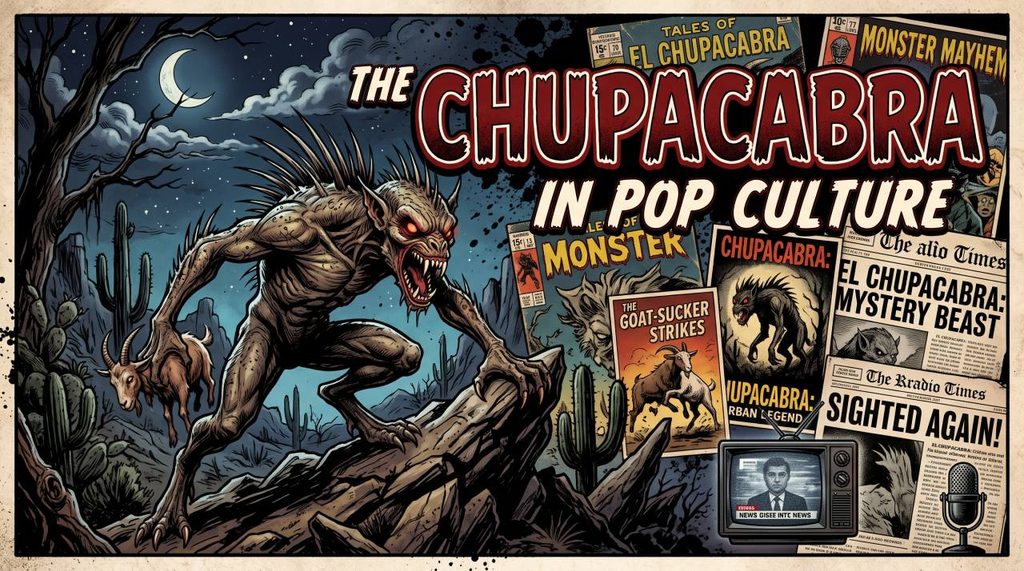
Few cryptids have undergone such a rapid transformation from a regional legend into an international pop-culture icon as the Chupacabra.
Within only a few years of the 1995 Puerto Rican reports, the name had moved beyond newspapers and television into books, documentary programmes, horror cinema, children’s entertainment, music, trading cards and collectible figures.
Importantly, the Chupacabra’s representation in popular culture has often followed the same transformation seen in reported sightings.
Early portrayals favoured the bipedal, reptilian or extraterrestrial-looking creature with dorsal spines, while later American representations increasingly adopted the hairless canine appearance associated with the Texas carcass cases.
📖 Tracking the Chupacabra
The most substantial dedicated non-fiction work on the creature is Benjamin Radford’s 2011 book, Tracking the Chupacabra: The Vampire Beast in Fact, Fiction, and Folklore, published by the University of New Mexico Press.
Radford’s book is particularly important because it is not simply a collection of Chupacabra stories. It combines eyewitness interviews, field investigation, forensic research and an examination of the creature’s folklore and cultural development.
The 216-page work investigates the transformation of the Chupacabra from the original Puerto Rican monster into the hairless canine reported throughout the United States.
📺 The X-Files — “El Mundo Gira”
The Chupacabra entered one of television’s most famous supernatural franchises with “El Mundo Gira,” Season 4, Episode 11 of The X-Files, originally broadcast in 1997.
The episode is set within a Mexican immigrant community and incorporates the Chupacabra into a murder mystery involving the Buente brothers.
The creature is treated partly as folklore and partly as a possible explanation for mysterious deaths, while Mulder and Scully ultimately uncover a much more human story behind the apparent supernatural events.
The episode is particularly notable because it appeared only around two years after the Puerto Rican Chupacabra phenomenon began, making it an early major American television appearance of the newly emerging cryptid.
🧪 MonsterQuest — “Chupacabra”
The Chupacabra received one of its most substantial television investigations in History Channel’s MonsterQuest.
The episode “Chupacabra” aired on 23 July 2008 and concentrated heavily on the Texas version of the creature.
The programme examined the contrast between the original Puerto Rican description of a bipedal, reptilian monster and the later Texas reports of a hairless, deformed dog-like animal.
Particularly significant was the programme’s use of physical specimens, photographs, bones, hair and DNA testing, alongside interviews with eyewitnesses, wildlife specialists, veterinary experts and researcher Benjamin Radford.
The episode therefore occupies an unusual position in Chupacabra pop culture: it presented the legend as a genuine cryptozoological mystery while simultaneously giving television audiences some of the strongest scientific evidence against an unknown species.
🎥 Chupacabra: Dark Seas / Chupacabra Terror — 2005
The creature became a full-blown horror-film monster with Chupacabra: Dark Seas , also known as Chupacabra Terror, released in 2005.
The film places a captured Chupacabra aboard a cruise ship, turning the Latin American livestock legend into a conventional creature-feature.
Rather than reproducing the later mangy-coyote interpretation, the film embraces the Chupacabra as a genuine monstrous predator.
Its importance lies less in its realism than in demonstrating how quickly the 1990s cryptid had become established within the direct-to-video and television horror market.
🎥 Chupacabra vs. the Alamo — 2013
The Chupacabra returned to television horror with Chupacabra vs. the Alamo, a 2013 Syfy film directed by Terry Ingram and starring Erik Estrada.
The film turns the creature into a more traditional monster threat, with Chupacabras emerging from tunnels in Texas and attacking the population.
It represents another stage in the cultural evolution of the legend: the Chupacabra had by then become sufficiently recognisable that filmmakers no longer needed to explain what the name meant.
The cryptid itself had become the monster.
🐾 Chupa — 2023
One of the most striking transformations came with Netflix’s Chupa, directed by Jonás Cuarón and released in 2023.
Rather than presenting the Chupacabra as a blood-drinking predator, the film follows a young boy who discovers a baby Chupacabra and develops a friendship with it. The creature becomes the centre of a family adventure story rather than a horror monster.
This marked a remarkable reversal of the traditional image. A creature whose name literally means “goat-sucker” and whose legend was built around livestock deaths was transformed into a sympathetic fantasy animal for a family audience.
📚 The Chupacabra in Cryptid Reference Literature
The creature also became a staple of cryptid encyclopedias, unexplained-phenomena books and children’s monster-reference books during the late 1990s and 2000s.
Unlike older cryptids such as the Loch Ness Monster or Yeti, the Chupacabra was new enough that books published before the mid-1990s could not contain it as an established cryptid.
Its rapid appearance in later reference books therefore provides another useful measure of how quickly the legend entered mainstream popular culture.
Among these publications, Radford’s Tracking the Chupacabra remains the major dedicated investigation rather than simply an encyclopedic entry.
🃏 MetaZoo TCG
The Chupacabra has also received a significant collectible treatment in the MetaZoo Trading Card Game, where it appears as an actual playable cryptid rather than merely background artwork.
The original Chupacabra is part of MetaZoo: Cryptid Nation, numbered 001/159 and classified as a Gold rarity card. It is a Dark Aura Beastie belonging to the Bloodsucker tribe, with 50 Life Points and a Spellbook Limit of 5. Its abilities revolve around recovering Life Points, while its attack is named “Clot Drain.”
The card has appeared in the Cryptid Nation Kickstarter, Cryptid Nation 1st Edition and Cryptid Nation 2nd Edition printings, with the latter listed as 001/159.
MetaZoo’s treatment is particularly appropriate to the Chupacabra because the game’s entire concept is built around folklore, cryptids and legendary creatures.
The Chupacabra therefore isn’t simply an incidental monster in the game, it is one of the creatures represented at the heart of the franchise. PSA has also specifically noted Chupacabra among the real-world cryptids represented in MetaZoo’s inaugural Cryptid Nation release.
There is also a Chupacabra Genesis NFT Promo, featuring new artwork while retaining the creature’s Bloodsucker identity and core gameplay concept.
More recently, MetaZoo’s 2026 Prize Pack programme included a “Chupacabra (The Vengeful)” 1/1, illustrated by Cu Hung. The card was described as a Fire creature costing 5 Aura with 4 Influence, making it a particularly notable modern Chupacabra collectible within MetaZoo’s continuing mythology.
🧸 LooseCollector — The Crypt: Chupacabras
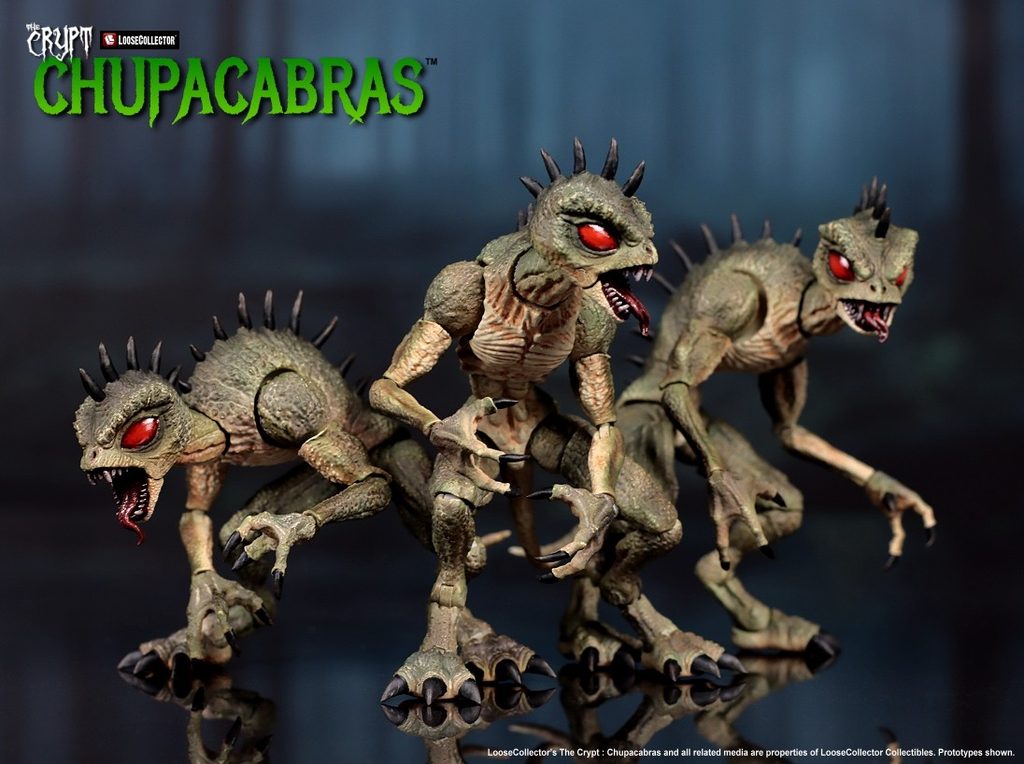
One of the newest dedicated Chupacabra collectibles is the LooseCollector The Crypt: Chupacabras 1/12 Scale Action Figure Three-Pack.
Announced for pre-order in 2026, the set contains three Chupacabra figures, each approximately 5–5.5 inches tall, in 1/12 scale, with approximately 35 points of articulation.
The figures are an original horror interpretation of the classic bipedal, reptilian/spined Chupacabra, rather than an attempt to reproduce the modern mange-afflicted canine explanation.
As of the current listing, the UK retailer Kapow Toys gives an estimated release of January 2027, subject to delays, while other retailers list the release as Q1 2027.
LooseCollector’s own product archive lists CHUPACABRAS — 2026 within its The Crypt range, confirming that the creature has become part of the company’s dedicated cryptid collectible line alongside figures such as Bigfoot, the Yeti and DogMan.
LooseCollector — Official Manufacturer Site
🎵 Music & Wider Popular Culture
The Chupacabra has also entered music and wider entertainment culture. One of the earliest notable examples is musician Imani Coppola’s 1997 album Chupacabra, released only two years after the creature’s emergence as an international legend.
The use of the name in music demonstrates how quickly Chupacabra stopped functioning solely as the name of a supposed animal and became a recognisable cultural symbol, shorthand for something strange, dangerous, supernatural or distinctly Latin American.
🌎 From Regional Legend to International Icon
The Chupacabra’s cultural journey is unusually rapid.
Unlike older folklore creatures whose traditions developed over centuries, the modern Chupacabra can be followed almost in real time.
Puerto Rican newspaper reports and television coverage in 1995 created the initial monster; books investigated it; television transformed it into a cryptozoological mystery; horror films turned it into a creature-feature villain; children’s entertainment eventually softened it into a fantasy animal; and collectibles and trading cards transformed it into a commercial character.
Perhaps most remarkably, both major Chupacabra forms have survived in popular culture simultaneously.
The original spined, reptilian, bipedal monster remains the dominant horror image, while the hairless canine remains strongly associated with the later Texas reports and scientific investigations.
The Chupacabra therefore has no single universally accepted pop-culture appearance.
It has become something much more flexible:
A modern monster whose shape changes with the culture telling its story.