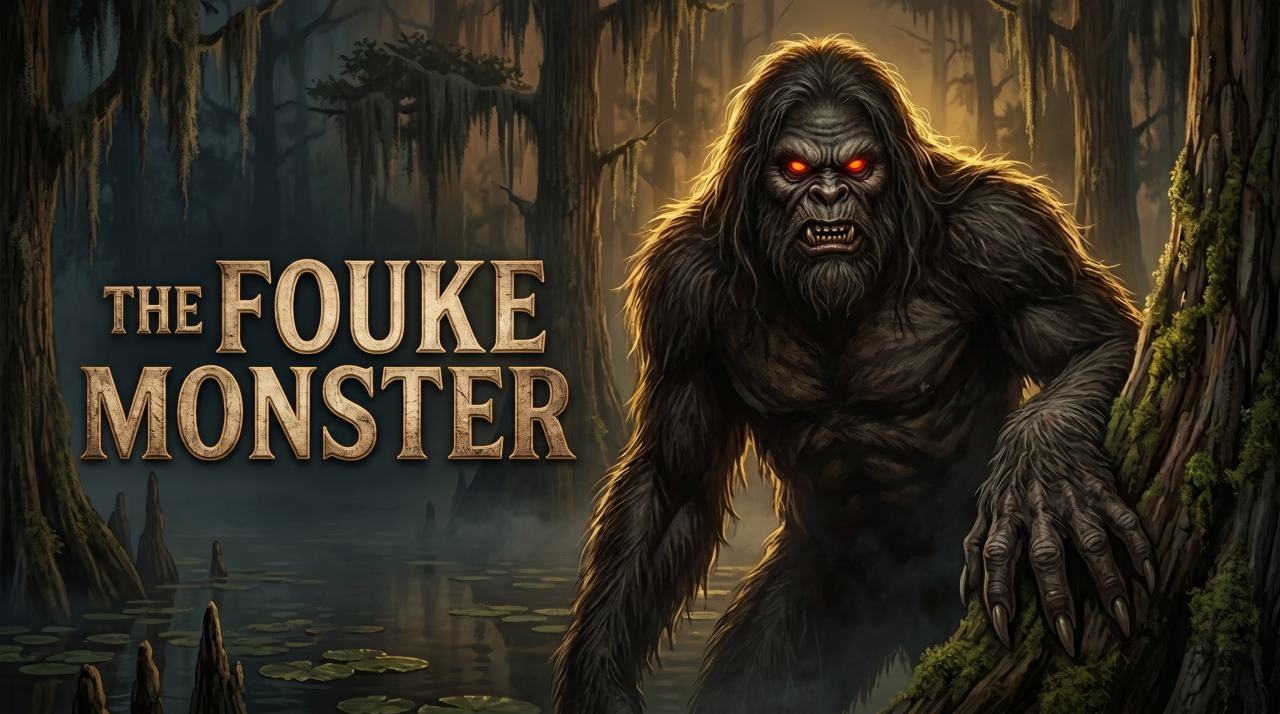
Deep in the wooded bottomlands of southwestern Arkansas, where the Sulphur River winds through tangled forest and the darkness seems to gather beneath the trees, an old Southern legend took on a terrifying new form.
They called it the Fouke Monster.
Later, after the legend spread beyond the small Arkansas community of Fouke, it would acquire another name:
The Boggy Creek Monster.
And eventually, to an entire generation of cryptid enthusiasts, it became known simply as the Southern Sasquatch.
The creature described by witnesses was no delicate forest spirit.
It was said to be enormous, powerfully built and covered from head to foot in dark, shaggy hair. Some witnesses claimed it stood around seven feet tall, possessed reddish or glowing eyes and moved through the woods with startling speed.
Then came the smell.
A powerful, foul odour was repeatedly associated with the creature in later accounts — another detail that would become inseparable from the Fouke Monster legend.
For years, stories circulated quietly around the Fouke area.
Then, in May 1971, the legend exploded into public view.
Local resident Bobby Ford reported being attacked by a hairy, man-like creature at his home. Ford told authorities that the creature had been around the property for several days before the encounter.
He described a being approximately seven feet tall with a massive chest, red eyes and heavy breathing.
During the confrontation, Ford said the creature grabbed him before he managed to break free. He was subsequently treated at hospital for scratches and shock.
The story reached the Texarkana Gazette.
The following day, newspapers carried the account, and the story was subsequently transmitted nationally by the Associated Press and United Press International.
That was the moment the local monster acquired a name that would become famous:
The Fouke Monster.
But the story was only beginning.
Other residents came forward with their own accounts.
There were reports of strange tracks, unexplained noises, encounters in the woods and livestock supposedly disturbed or attacked by something large moving through the darkness.
Some accounts predated the famous 1971 incident by decades. The Encyclopedia of Arkansas records a reported encounter as far back as 1946, while later local traditions have pushed the history of the creature even further into the past.
Then, in 1972, filmmaker Charles B. Pierce arrived.
Using local residents, real locations and a pseudo-documentary style, Pierce transformed the Fouke stories into The Legend of Boggy Creek.
The independently produced film became a sensation.
It took the creature out of the Arkansas swamps and placed it before audiences across America, helping transform the Fouke Monster from a regional legend into one of the defining creatures of American cryptozoology and Southern horror folklore.
The film’s success would eventually inspire sequels, books, investigations, merchandise, festivals and decades of renewed interest in the creature.
Yet beneath the mythology lies a much more complicated question.
Were the original witnesses describing a genuine unknown animal?
Were bears, people, wildlife and shadows being transformed into something more frightening by the darkness of the Arkansas bottomlands?
Were some of the later tracks and stories exaggerated?
Or did something genuinely unexplained move through the woods around Fouke?
There is no scientifically verified creature. No confirmed body. No authenticated biological specimen.
And no physical evidence that has established the existence of an unknown primate.
But there are historical newspaper reports, named witnesses, contemporary investigations and a documented cultural explosion surrounding the case.
And that makes the Fouke Monster particularly fascinating.
Because unlike many cryptids that existed primarily as stories passed from generation to generation, the Fouke Monster crossed a remarkable boundary:
It went from local folklore… to newspaper headline… to national sensation… to cult horror cinema… and finally to cryptid legend.
This is the story of the Fouke Monster, the beast of Boggy Creek, the Southern Sasquatch, and one of the most enduring mysteries ever to emerge from the American South.
👤 Physical Appearance & Description
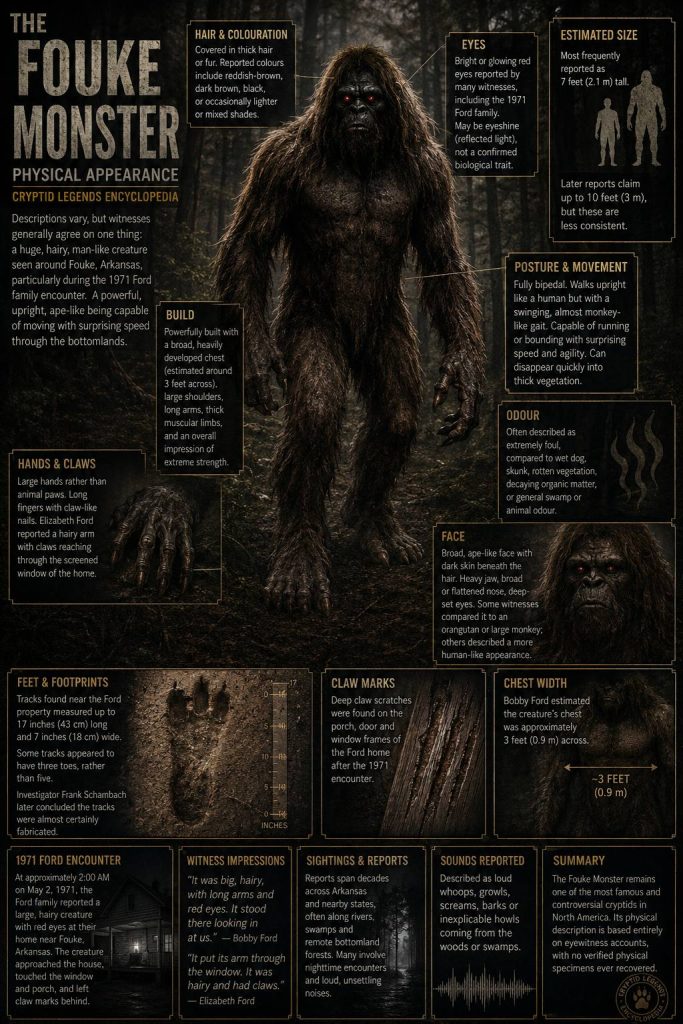
Although descriptions of the Fouke Monster vary between encounters and across later retellings, the creature is generally portrayed as a large, upright, ape-like humanoid resembling the broader American Bigfoot tradition.
The earliest and most influential modern descriptions came from witnesses around Fouke, Arkansas, particularly during the cluster of reports surrounding the 1971 Ford family incident.
Unlike the highly stylised creature that would later appear on movie posters and souvenir artwork, the original descriptions were comparatively simple:
A huge, hairy, man-like creature moving upright through the Arkansas bottomlands.
📏 Estimated Height
The most frequently reported height is approximately:
7 feet (2.1 metres)
During the 1971 Ford encounter, Bobby Ford described the creature as around seven feet tall and approximately three feet across the chest.
Later reports have produced considerably larger estimates, including claims of creatures approaching 10 feet tall, but these later measurements are less consistent and should be treated as individual eyewitness estimates rather than an established size.
💪 Build
The Fouke Monster is generally described as powerfully built and substantially larger than an ordinary human.
Recurring characteristics include:
- Broad, heavily developed chest.
- Large shoulders.
- Long, powerful arms.
- Thick, muscular limbs.
- A substantial torso.
- An imposing upright posture.
- An overall impression of considerable physical strength.
The 1971 description of a chest approximately three feet wide is particularly striking and helps explain why the creature was perceived as much larger and more powerful than a normal person.
🦍 Body & Posture
The classic Fouke Monster is described as fully or predominantly bipedal, walking upright like a human.
Some reports describe an unusual, almost monkey-like gait, with the creature swinging its long arms while moving rapidly through the woods.
Other accounts describe it running with a distinctive galloping or bounding movement, allowing it to cover ground surprisingly quickly despite its apparent size.
Its ability to disappear rapidly into dense vegetation became one of the recurring features of the legend.
🖤 Hair & Colouration
One of the most consistent characteristics is the creature’s heavy covering of hair or fur.
Reported colours include:
- Reddish-brown
- Dark brown
- Black
- Occasionally lighter or mixed shades
An earlier Arkansas account described a large upright creature covered in reddish-brown hair, while later Fouke reports frequently favoured much darker hair.
The 1971 Ford witnesses likewise described the creature as hairy, with Elizabeth Ford reporting a hairy arm reaching through the window.
The variation in colour is unsurprising given that many encounters reportedly occurred at night, often under flashlights, headlights or other poor lighting conditions.
👁️ Eyes
The eyes are among the most memorable features associated with the Fouke Monster.
Several reports describe:
Bright or glowing red eyes.
During the 1971 incident, both Bobby Ford and Elizabeth Ford were reported to have noticed red eyes.
Later descriptions sometimes compared the eyes to silver-dollar-sized red lights or described them as intensely luminous.
However, the Encyclopedia should distinguish the reported phenomenon from an established biological characteristic.
What witnesses interpreted as glowing eyes could potentially have resulted from eyeshine, reflected light from an animal’s eyes — particularly during nighttime encounters.
Therefore:
🔴 Red or luminous eyes are a frequently reported characteristic, but not a scientifically established feature of an unknown creature.
👃 Odour
An unusually strong smell has become another recurring part of the Fouke Monster legend.
Later reports have described an overpowering odour compared with combinations of:
- Wet dog
- Skunk
- Rotten vegetation
- Decaying organic matter
- General swamp or animal odour
The foul smell is particularly prominent in the later development of the Boggy Creek legend, although it should not be presented as though every original 1971 witness independently reported the same smell.
It has nevertheless become one of the defining characteristics of the modern Fouke Monster archetype.
🖐️ Hands & Claws
The creature is generally described as possessing large, powerful hands rather than animal paws.
Elizabeth Ford’s account is particularly important.
She reported seeing a hairy arm with claws reaching through the screened window of the Ford home.
This contributed to the later depiction of the Fouke Monster as possessing long fingers and claw-like nails.
The exact structure of the hands, however, was never documented scientifically.
🦶 Feet & Footprints
Perhaps the strangest physical evidence associated with the Fouke Monster concerns its alleged footprints.
Investigators searching around the Ford property following the 1971 encounter reportedly discovered strange tracks, while claw scratches were also found on the porch.
Some later tracks attributed to the creature were reported to be approximately:
17 inches (43 cm) long and 7 inches (18 cm) wide.
Other alleged tracks appeared to show three toes, rather than the five expected of a human or known great ape.
That detail eventually became one of the major problems for the idea that the tracks represented an unknown primate.
A later investigation by archaeologist Frank Schambach concluded that there was a very high probability the tracks were fabricated, pointing among other things to their three-toed appearance.
No footprint attributed to the Fouke Monster has ever been scientifically authenticated as belonging to an unknown primate.
🧍 Facial Appearance
Facial descriptions are considerably less consistent than descriptions of the creature’s size and hair.
The Fouke Monster is generally portrayed as possessing:
- A broad, ape-like face.
- Dark skin beneath the hair.
- A heavy jaw.
- A broad or flattened nose.
- Deep-set eyes.
- A distinctly simian appearance.
Some later witnesses and artists have compared its face to an orangutan or large monkey, while other accounts describe a more human-looking head.
These descriptions should be treated cautiously because most encounters occurred at night or at considerable distance.
🐾 Overall Appearance
Bringing together the strongest recurring witness descriptions, the classic Fouke Monster would appear as:
A towering, heavily built, upright humanoid approximately seven feet tall, with a broad chest, exceptionally long arms, powerful limbs and a body covered in shaggy reddish-brown to black hair. Its face was described as ape-like, while some witnesses reported intensely red or reflective eyes and claw-like hands.
The resulting image sits somewhere between human and great ape, familiar enough to appear recognisably man-like, yet sufficiently animalistic to become one of the most enduring monster figures of the American South.
And importantly, this description is the reported folklore profile, not a confirmed biological description. No specimen, DNA evidence or scientifically verified physical remains have established the existence of the Fouke Monster.
📍 Location & Country
- 🗺️ Primary Location: Fouke, Miller County, Arkansas
- 🌎 Region: Southwestern Arkansas / Arkansas–Texas borderlands
- 🇺🇸 Country: United States
- 🌲 Specific Area: The rural woodland and bottomlands surrounding Fouke, particularly the Boggy Creek and Sulphur River bottomlands
- 🏚️ Historic Encounter Site: The rural Ford family property associated with the famous May 1971 encounter
- 🌊 Associated Waterway: Boggy Creek and the surrounding Sulphur River bottomlands
- 📌 Approximate Fouke Coordinates: 33.260° N, 93.890° W
- 🏪 Modern Cryptid Landmark: Fouke Monster Mart, 104 US-71, Fouke, AR 71837
🌲 Location Blurb
The Fouke Monster belongs to the dense bottomland country surrounding the small Arkansas town of Fouke, where thick woodland, waterways, farmland and isolated rural properties create the atmospheric setting at the heart of the legend.
The most famous modern encounter occurred in May 1971, when Bobby and Elizabeth Ford reported an encounter with a large hairy creature at their rural home. Investigators subsequently searched the property and surrounding area, finding unusual tracks and claw marks but no creature.
The wider Boggy Creek/Sulphur River bottomlands subsequently became the creature’s legendary territory.
The 1972 film The Legend of Boggy Creek reinforced this association by filming extensively around Fouke and turning the surrounding landscape itself into part of the monster’s mythology.
Today, Fouke remains the geographical heart of the legend, with the community’s Monster Mart serving as one of the most recognisable modern landmarks associated with the creature
🌲 Habitat
The legendary habitat of the Fouke Monster is the dense, low-lying country surrounding Fouke, Arkansas, particularly the network of wooded creeks, wetlands and bottomlands associated with Boggy Creek and the Sulphur River drainage.
Unlike a cryptid traditionally imagined in remote mountain wilderness, the Fouke Monster’s reported territory is largely flat, humid and heavily vegetated, a landscape of forests, waterways, fields and isolated rural properties where visibility can rapidly disappear beyond the tree line.
This environment became inseparable from the creature’s identity.
The name “Boggy Creek Monster” itself reflects the importance of this landscape to the legend.
🌊 The Boggy Creek & Sulphur River Bottomlands
The area around Fouke forms part of the wider Sulphur River drainage, with numerous smaller creeks and streams feeding the river.
The Sulphur River passes through a relatively sparsely populated part of southern Miller County, where the surrounding land is used extensively for timber and agriculture.
The river’s Arkansas watershed includes much of southern Miller County, while the nearest significant settlement is Fouke.
This combination of:
- 🌲 Dense woodland
- 🌊 Creeks and waterways
- 🌾 Agricultural fields
- 🌿 Wet bottomland
- 🐾 Thick undergrowth
- 🏚️ Isolated rural properties
- 🌙 Limited visibility at night
provides the classic environmental setting associated with Fouke Monster reports.
🌳 Bottomland Hardwood Forest
One of the most important habitat characteristics attributed to the Fouke Monster is bottomland hardwood forest.
These low-lying forests can contain dense vegetation, fallen timber, tangled undergrowth and areas of standing or seasonally wet ground.
For a reported large animal, such terrain would provide numerous opportunities to remain concealed.
This is particularly relevant to the Fouke reports because witnesses repeatedly described something appearing briefly at the edge of properties, roads, fields and woodland, before disappearing into vegetation.
The creature’s legendary ability to vanish into the surrounding countryside therefore became as important to the story as its physical appearance.
🌾 Forest, Farm & Field
The Fouke Monster does not have a habitat restricted exclusively to deep wilderness.
Some of the most famous reports occurred around human habitation.
The 1971 Ford encounter, for example, took place at a rural home rather than deep inside an inaccessible forest. The creature was reportedly active around the property for several nights before the famous confrontation.
Other reports involved people travelling along roads or encountering the alleged creature around fields and woodland margins.
This produces an unusual habitat profile:
The Fouke Monster is traditionally associated with the boundary between civilisation and wilderness.
It is the creature glimpsed between the house and the woods, across the field, beside the road or disappearing into the bottomland.
🌊 Water & Creek Corridors
Waterways are particularly important to the Fouke Monster legend.
Boggy Creek and the surrounding drainage system provide natural corridors through the landscape, while dense vegetation along waterways can make observation difficult.
The wider Sulphur River system contains numerous smaller streams and creeks, while the surrounding Arkansas landscape includes extensive timber and sparsely populated agricultural country.
The association with waterways is therefore not simply a product of the creature’s name.
The landscape genuinely contains the kind of wet, wooded environment that became central to the legend.
🌙 A Nocturnal Environment
Many Fouke Monster reports occurred after dark, when the landscape becomes dramatically more difficult to interpret.
At night:
- Tree lines become solid walls of darkness.
- Animals can appear much larger than they are.
- Eye-shine can create apparently glowing eyes.
- Dense vegetation obscures movement.
- Sounds can travel unpredictably through woodland.
- A person or animal crossing a field can briefly appear as a large silhouette.
This is particularly significant when assessing the legend critically.
The same environment that makes an excellent hiding place for a hypothetical large animal also creates ideal conditions for misidentification.
🐾 Why This Habitat Became Part of the Legend
The Fouke Monster’s reputation cannot really be separated from its environment.
The creature was not simply reported as an enormous hairy humanoid.
It became the Beast of Boggy Creek.
The surrounding landscape supplied the atmosphere, mystery and sense of isolation that transformed scattered reports into a regional legend.
When Charles B. Pierce filmed The Legend of Boggy Creek in 1972, he deliberately incorporated local wetlands, rivers and creeks, effectively turning the real Arkansas landscape into another character in the story.
The result was an unusually powerful connection between place and monster.
Fouke became the community.
Boggy Creek became the wilderness.
And the bottomlands became the creature’s legendary territory.
🔬 Habitat — Folklore vs Reality
There is, of course, no scientifically established Fouke Monster population, and no biological evidence demonstrating that an unknown primate inhabits the region.
The habitat described here therefore represents the geographical environment associated with reported encounters, rather than a confirmed ecological range.
If an unknown large primate actually existed in the area, questions about food availability, breeding population, seasonal movement, shelter and genetic evidence would become critical.
No such population has been scientifically demonstrated.
Nevertheless, the real landscape remains fascinating in its own right:
A vast network of wooded bottomlands, waterways, fields and isolated rural country surrounding one of America’s most famous monster legends.
And that is ultimately what makes the Fouke Monster’s habitat so effective as folklore — the wilderness is real, even if the beast remains unproven.
👣 Historical Sightings & Encounters
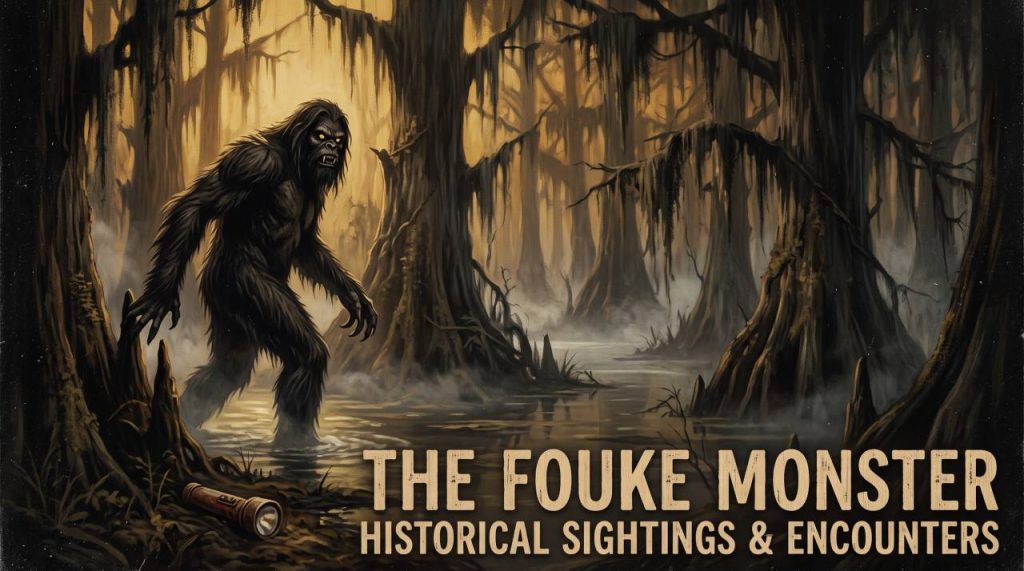
The Fouke Monster legend did not begin with the famous Ford family encounter of 1971.
Later researchers and local historians have traced stories of large, hairy, human-like creatures in Arkansas back considerably further, while the modern Fouke legend itself developed through a remarkable concentration of reports around Fouke, Boggy Creek and the Sulphur River bottomlands during the early 1970s.
What makes the Fouke case particularly interesting is that the 1971 wave was not based upon a single witness.
Multiple people reported seeing something unusual, local newspapers followed the reports over several weeks, law enforcement investigated physical evidence, and the story was eventually distributed nationally by the wire services.
🕰️ Before Fouke — The Older Arkansas “Wild Man” Tradition
Claims of a much older tradition surrounding hairy wild men have subsequently been connected with the Fouke Monster.
Two nineteenth-century newspaper reports are particularly interesting.
🗞️ 1851 — The Greene County “Wild Man”
A report published in the Memphis Enquirer in 1851 described hunters encountering an enormous hairy creature in Greene County, Arkansas.
The animal was described as being of gigantic stature, with hair covering its body and long hair around its head and shoulders.
The hunters reportedly encountered it while hunting and saw it moving around cattle before it disappeared into the wilderness. Later researchers have connected this report with the wider Arkansas wild-man tradition.
However, there is an important geographical qualification:
Greene County is hundreds of kilometres from Fouke.
There is therefore no historical evidence proving that the 1851 creature was the Fouke Monster. It is better understood as an early Arkansas hairy-wild-man report that later researchers have included in the wider Fouke/Boggy Creek tradition.
🗞️ 1856 — The Caddo Gazette “Wild Man”
An even more dramatic nineteenth-century story appeared in the Caddo Gazette in 1856.
The report described an exceptionally strong, heavily hairy man-like figure approximately 6 feet 4 inches tall, covered in brown hair.
According to the story, men attempted to pursue and capture the creature.
The encounter reportedly became violent, with the wild man attacking one of the hunters before escaping with the man’s horse.
The story has subsequently been cited in discussions of the historical Arkansas wild-man tradition.
Again, however, this should not be presented as a confirmed Fouke Monster sighting.
The geographical and historical connection was made retrospectively.
👤 1946 — The Earliest Fouke-Area Tradition
The Encyclopedia of Arkansas records reports of a strange creature in the Fouke area dating back as far as 1946.
According to the account, a local resident reported seeing a strange creature near her home and contacted Miller County Sheriff Leslie Greer.
This is important because it places the local tradition decades before the 1971 media explosion.
However, the surviving historical documentation is much thinner than that surrounding the 1971 events.
For that reason, the 1946 report should be presented as an early documented/recorded Fouke-area tradition, rather than as evidence of a continuous, independently verified creature population.
🦍 1955 — The Teenage Encounter
A later account describes a 14-year-old boy encountering a reddish-brown, hairy creature in the Fouke area during the 1950s.
The creature was reportedly approximately 7–8 feet tall, and the boy claimed to have fired birdshot at it without apparently affecting it.
The account later became associated with James “Lynn” Crabtree, whose story was incorporated into the developing Fouke Monster mythology and later literature.
Skeptical investigator Joe Nickell subsequently examined the description and argued that a black bear could potentially account for the reported animal.
This is a good example of why our Encyclopedia should distinguish between:
reported encounter → later recollection → later interpretation
rather than treating every element as equally well documented.
🌲 1960s — The “Jonesville Monster”
Local tradition claims that sightings occurred around the Jonesville area during the 1960s, including reports from around 1964.
During this period the creature was sometimes referred to as the “Jonesville Monster” rather than the Fouke Monster.
The important caveat is that these claims were largely retrospectively reported after the 1971 publicity, rather than appearing in contemporary newspaper reports at the time.
This means they are valuable to the history of the folklore, but considerably weaker as contemporary evidence.
🏹 1965 — The Lynn Crabtree Encounter
One of the most frequently repeated pre-1971 stories concerns young Lynn Crabtree, who reportedly encountered a large reddish-haired creature while hunting near Fouke.
According to the later account, Crabtree fired at the creature several times but believed it remained unaffected.
The story eventually became part of the wider Fouke Monster literature and was later included in accounts associated with The Legend of Boggy Creek.
There is an important historical distinction here:
The encounter is part of the Fouke tradition, but its surviving documentation is largely retrospective rather than equivalent to the contemporary 1971 newspaper record.
🔥 1971 — The Fouke Monster Explosion
Everything changed in May 1971.
This is where the Fouke Monster moves from regional folklore into a genuinely documented modern media case.
🏚️ May 1971 — The Ford Family Encounter
The most famous encounter occurred at the rural home of Bobby and Elizabeth Ford.
According to the family’s account, strange activity had occurred around the property for several nights.
The creature was described as approximately seven feet tall, heavily hairy, broad across the chest and possessing long arms, red eyes and an extremely powerful appearance.
Elizabeth Ford reportedly saw a hairy arm with claws reaching through a screened window.
Bobby Ford subsequently encountered the creature outside and reported that it attacked him.
He was treated at a Texarkana hospital for minor scratches and shock.
The men fired at the creature and believed they had struck it.
But no blood or body was found.
When authorities searched the property they reportedly discovered:
- 👣 Strange tracks
- 🐾 Scratches on the porch
- 🪟 Damage around the house
- 🔫 Evidence that firearms had been discharged
The creature itself had disappeared.
This was the encounter that ultimately gave the legend its modern identity.
🗞️ 3 May 1971 — “Hairy ‘Monster’ Hunted in Fouke Sector”
The story quickly reached the local press.
Reporter Jim Powell, working for the Texarkana Gazette and Texarkana Daily News, produced the initial newspaper coverage.
The May 3 report was headlined:
“Hairy ‘monster’ hunted in Fouke sector.”
This is an extremely important piece of the Fouke Monster’s history because it represents the beginning of the modern newspaper record surrounding the creature.
Powell later recalled that the original story was not intended as a sensational monster feature.
It was essentially a local news story.
The legend grew afterwards.
🚗 23 May 1971 — The Woods Highway Encounter
One of the most important independent reports followed later that month.
D. C. Woods Jr., Wilma Woods and Mrs. R. H. Sedgass reportedly encountered an ape-like creature crossing U.S. Highway 71 near Fouke.
Woods described something large moving extremely quickly across the highway.
The creature was described as:
- Dark-haired
- Long-armed
- Ape-like
- Upright
- Moving faster than a human
Woods reportedly compared its appearance to a giant monkey.
The report was published in the Texarkana Daily News on 24 May 1971, under Powell’s byline.
This is particularly valuable because it involved people outside the Ford household, providing an independent report during the same period.
👁️ June 1971 — The Red-Eyed Creature
The reports continued.
A June account described three people seeing a tall, hairy creature with red eyes.
It was reportedly seen squatting on an embankment near the edge of woodland, across from a residence.
Another child reportedly described seeing a “monster in the woods” in the same general area.
Again, these reports appeared during the period when the local newspapers were actively following the Fouke Monster story.
🌾 June 1971 — The Willie Smith Soybean Field Tracks
Another important episode involved alleged tracks found in a soybean field belonging to local resident Willie E. Smith.
The trackway reportedly consisted of unusual three-toed footprints.
The tracks attracted considerable attention and were examined by Carl Galyon, a local game warden.
Their authenticity could not be established.
The Arkansas Gazette published a report on 16 June 1971 under the headline:
“Tracks of the incredible three-toed Fouke Monster.”
The three-toed appearance eventually became one of the most controversial aspects of the case.
If the tracks were genuine, they would have represented an extraordinary anatomical feature.
If fabricated, they represented something very different.
📰 16 June 1971 — “Monster — A Monkey’s Uncle”
The same month saw another revealing newspaper report.
Barry Powell of the Texarkana Gazette published:
“He’s been sighted again: Monster — a monkey’s uncle.”
The title itself demonstrates how quickly the newspaper coverage had begun shifting between genuine local reports and speculation about what the creature might actually be.
The ape/monkey interpretation was already part of the discussion in 1971.
⚠️ 17 June 1971 — The “Fouke Hoax?”
Perhaps one of the most important pieces of contemporary media history is that the newspapers did not simply accept the monster story.
The Texarkana Gazette published a story titled:
“The Fouke Hoax?”
on 17 June 1971.
This demonstrates that skepticism and the possibility of fabrication were already being discussed within weeks of the original reports, rather than being inventions of much later skeptics.
That is an important detail for our Encyclopedia.
The Fouke Monster was controversial from the beginning.
👮 Law Enforcement & Searches
The growing number of reports prompted searches of the area.
Authorities investigated the Ford property and surrounding terrain, but no creature was captured.
The most significant physical claims were the alleged tracks and damage to the Ford property.
The investigation ultimately failed to establish what had produced them.
Later accounts state that Frank Schambach, an archaeologist at Southern State College, examined the tracks and concluded there was a 99 percent probability that they were a hoax.
His reasoning included the fact that the tracks appeared to show three toes, whereas known primates have five.
This became one of the strongest skeptical arguments against the physical evidence.
🔦 The $1,090 Bounty
The story became sufficiently famous that the Little Rock radio station KAAY reportedly offered a $1,090 bounty for the capture of the creature.
Hunters and enthusiasts began searching the area.
Dogs were reportedly used in attempts to track the creature but failed to establish a reliable trail.
The growing presence of armed hunters eventually became a safety problem, and Miller County Sheriff Leslie Greer reportedly imposed a temporary “no guns” policy in connection with monster hunting.
This is a fascinating moment in the history because the alleged creature had effectively transformed from a local mystery into a real-world public search.
🐾 1971 — The Sightings Multiply
During the months following the Ford encounter, the Fouke area produced a remarkable cluster of reports.
Accounts collected by later researchers include reports of:
- A hairy biped crossing roads.
- A creature seen near Boggy Creek.
- A large figure seen near fields.
- A dark-haired creature crossing Highway 71.
- A six-foot hairy figure moving through woodland.
- A creature observed from a vehicle.
- Strange tracks discovered in fields.
- A creature reported near the Mercer Bayou area.
The crucial point is that not every one of these reports has the same evidential status.
Some appeared in contemporary newspapers.
Others were recorded decades later by researchers interviewing witnesses.
For the Encyclopedia, they should therefore not all be presented as equally documented sightings.
🌊 1971 — Mercer Bayou Encounter
One later-compiled report describes a family at the Mercer Bayou boat ramp preparing to go boating when they heard strange howls and saw a sasquatch-like creature emerge from the woods.
Nearby campers reportedly came outside carrying shotguns, but did not fire.
The creature reportedly remained visible only briefly before retreating into the woods.
This account is interesting because it fits the environmental pattern of the Fouke legend, water, woodland and nighttime activity, but its surviving documentation is weaker than the Ford and Highway 71 newspaper reports.
👣 1973 — The Post-Film Sightings
Reports continued after The Legend of Boggy Creek dramatically increased the creature’s fame.
Later accounts include:
🚲 A Young Girl on a County Road
A young girl reportedly saw a black, ape-like creature walking upright from a pipeline clearing.
It was described as having:
- Long arms
- A broad chest
- Dark coloration
🚙 Two Girls in a Pickup
Two girls reportedly observed a huge hairy creature walk into a road behind their vehicle.
The creature reportedly stepped into the centre of the road before continuing into the woods.
🌅 Early Morning Field Encounter
A local skeptic reportedly saw a four-foot hairy biped moving across his field.
These reports were compiled by later researchers, but they are not all supported by the same level of contemporary newspaper documentation as the 1971 cluster.
🌲 1974 — The Legend Refuses to Die
Reports continued into 1974.
Two hunters reportedly encountered a large hairy creature thrashing through trees and howling.
Another report described two brothers driving a truck near Doddridge when an ape-like creature reportedly jumped into their trailer before fleeing into the woods.
These accounts are part of the later Fouke Monster report tradition rather than the original 1971 newspaper record.
By this point, however, the creature had already become firmly established as a regional legend.
🎬 1972–1974 — From Sightings to “The Legend of Boggy Creek”
The most consequential development was not another sighting.
It was the movie.
Charles B. Pierce transformed the reports into The Legend of Boggy Creek, a faux-documentary-style film released in 1972.
It combined interviews with Fouke residents and dramatic recreations of alleged encounters.
The production used the actual Fouke/Boggy Creek landscape, including local wetlands, rivers and creeks.
The movie dramatically expanded the creature’s audience.
What had been a series of Arkansas newspaper stories became an international monster legend.
📉 After the 1970s
The intense publicity surrounding Fouke eventually faded.
However, the reports did not necessarily end.
Later researchers have documented additional alleged encounters extending through the following decades, including reports in the 1980s, 1990s, 2000s and 2010s, with some modern researchers continuing to catalogue reports in the Fouke area.
These later reports are much more difficult to assess historically because they generally lack the unusually strong combination of contemporary newspaper coverage, named witnesses and official investigation that makes the 1971 cluster so important.
📰 1986 — The “Hoax” Debate Returns
Fifteen years after the original tracks appeared, the Associated Press revisited the story in an article titled:
“15 Summers After Tracks Found, Fouke Monster Called Hoax.”
The report demonstrates that the controversy surrounding the creature’s authenticity had never completely disappeared.
The debate had effectively become part of the Fouke Monster itself:
Was there ever a creature, or had the legend become larger than the evidence?
📚 2001 — The Journalists Look Back
One of the most useful retrospective sources is a 24 June 2001 Texarkana Gazette article by Sunni Thibodeau, in which former journalists discussed the original 1971 reporting.
This is valuable because it allows us to separate the original newspaper story from the mythology that accumulated afterwards.
The later journalists recalled that Powell’s initial article was comparatively straightforward local reporting and that the subsequent wave of stories, rumours, witnesses and speculation helped create something much larger.
👣 The Fouke Monster Today
The Fouke Monster remains one of the most heavily reported regional Bigfoot-type legends in the American South.
Modern researchers continue to catalogue alleged encounters, with some recent report databases listing sightings in the 2020s, including reports from 2023 and 2024.
These should be treated as modern eyewitness claims rather than historically verified sightings.
There remains no scientifically verified specimen, DNA sample, body or photograph demonstrating the existence of an unknown primate at Fouke.
🔎 What Makes the Fouke Case Historically Significant?
The Fouke Monster is unusual because the legend contains several overlapping layers of evidence and storytelling:
🗞️ Contemporary journalism
The 1971 reports were documented by the Texarkana Gazette, Texarkana Daily News and Arkansas Gazette, with the story eventually distributed nationally by Associated Press and United Press International.
👥 Multiple witnesses
The famous episode was followed by reports from unrelated residents and motorists.
👮 Official involvement
Sheriffs, game wardens and other authorities investigated elements of the case.
👣 Physical claims
Tracks, scratches and property damage were reported — although none has been scientifically authenticated as evidence of an unknown animal.
🎬 Extraordinary cultural impact
The Legend of Boggy Creek transformed a local Arkansas story into an internationally recognised monster legend.
❓ Persistent uncertainty
The central question remains unresolved: what, exactly, were the witnesses seeing?
🎬 The Fouke Monster in Literature & Popular Culture
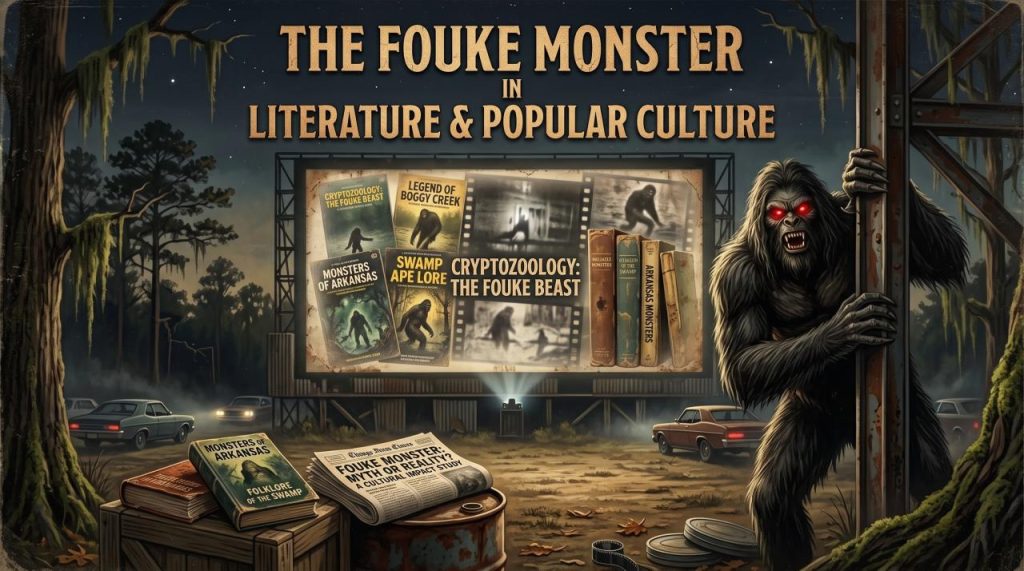
Few American cryptids have been so completely transformed by popular culture as the Fouke Monster.
What began as a cluster of reports around a small Arkansas community became a regional legend, a successful theatrical film, a series of follow-up movies, dedicated books and documentaries, and eventually an important part of Fouke’s identity.
The creature is now more widely known as the Boggy Creek Monster than many of the original witnesses could ever have imagined.
🎥 The Legend of Boggy Creek — 1972
The defining moment in the Fouke Monster’s cultural history came with Charles B. Pierce’s The Legend of Boggy Creek.
Released theatrically in 1972, the film presented itself in a pseudo-documentary/docudrama style, combining interviews, narration and dramatizations of alleged encounters.
Rather than relocating the story to a generic horror-movie setting, Pierce filmed extensively around Fouke, Arkansas, using the real wetlands, rivers, creeks and surrounding countryside. Local residents and some people connected with the original stories also appeared in the production.
That decision was enormously important.
The landscape itself became part of the monster.
The dark waterways, isolated houses, woodland and bottomlands shown in the film gave audiences the impression that the creature was not simply a fictional movie monster — it belonged to a real place.
The film was independently produced on a reported budget of around $160,000 and went on to become a major success, eventually earning an estimated $25 million according to the film’s official site, although some historical box-office figures remain disputed.
It became a cult classic of regional horror and cryptid cinema, and is arguably the single most important piece of media ever produced about an American cryptid.
🎞️ The Film’s Lasting Influence
The Legend of Boggy Creek helped establish a style of horror that blurred the boundary between:
Documentary → folklore → eyewitness testimony → fictional horror.
That approach would become hugely influential.
Director Daniel Myrick, co-director of The Blair Witch Project, later cited The Legend of Boggy Creek as an influence on the 1999 film’s approach to folklore and supposedly real encounters.
The influence is particularly interesting because both films use real landscapes, local legends and supposedly authentic testimony to make fictional horror feel like something that could have happened just beyond the viewer’s front door.
📽️ Return to Boggy Creek — 1977
The first follow-up arrived only five years later.
Return to Boggy Creek was released in 1977, but it is important not to treat it as a straightforward continuation of Pierce’s original film.
Charles B. Pierce was not involved, and the movie abandoned much of the original’s pseudo-documentary approach.
Instead, it became a fictional creature adventure involving a mother and children lost in the Louisiana swamps. It starred Dawn Wells and Dana Plato.
Although often grouped with the Boggy Creek films, it is best described as an unofficial spin-off/sequel rather than a continuation of the original Fouke story.
🎬 Boggy Creek II: And the Legend Continues — 1985
Charles B. Pierce eventually returned to the creature with Boggy Creek II: And the Legend Continues.
Despite its title, this is actually the third film associated with the Boggy Creek series, following Return to Boggy Creek.
This time Pierce returned as writer/director and also appeared as Professor Brian Lockart, who leads university students into the Fouke area to investigate the creature.
Importantly for the Encyclopedia, the film was actually shot in Fouke, reconnecting the movie with the real Arkansas landscape.
The movie later gained an entirely different kind of cult following when it was featured on Mystery Science Theater 3000 in 1999.
Today, it occupies a curious place in Fouke Monster history:
part sequel, part cryptid adventure, part 1980s B-movie cult object.
📼 Boggy Creek / Boggy Creek: The Legend Is True — 2010/2011
Another film arrived decades later under the title Boggy Creek, also marketed as Boggy Creek: The Legend Is True.
Despite the title, it is not a direct continuation of Pierce’s Fouke films.
The story is set in a fictional Boggy Creek, Texas, where a Bigfoot-like creature attacks a group of young people.
It was therefore inspired by the Boggy Creek/Fouke concept rather than being a documentary-style retelling of the Arkansas case.
🎥 The Legacy of Boggy Creek — 2011
The Legacy of Boggy Creek followed in 2011.
This low-budget independent production was originally released under the title The Skunkape Story before being re-edited and released as The Legacy of Boggy Creek.
It belongs more to the wider Southern Bigfoot/monster-film tradition than to the strict historical Fouke record, but its title demonstrates just how powerful the Boggy Creek name had become.
👹 Boggy Creek Monster — 2016
One of the most important modern productions is Boggy Creek Monster, a documentary from Small Town Monsters, directed by Seth Breedlove and co-produced/narrated by Lyle Blackburn.
Unlike the fictional sequels, this production returned to the actual Fouke legend, examining the history, eyewitness reports and continuing mystery surrounding the creature.
The documentary was filmed in Fouke and features interviews with people connected to the legend.
Its importance is that it helped introduce the Fouke Monster to a new generation of cryptid enthusiasts, at a time when interest in Bigfoot, regional monsters and documentary-style cryptozoology was experiencing another major resurgence.
📚 Literature & Books
The Fouke Monster has inspired a surprisingly substantial body of literature.
📖 Smokey and the Fouke Monster — Smokey Crabtree, 1974
One of the earliest important books connected to the legend was Smokey and the Fouke Monster: A True Story, written by Smokey Crabtree and published in 1974.
Crabtree was a Fouke resident and an important figure in the making of The Legend of Boggy Creek.
His book is particularly valuable because it is not simply another monster-sighting catalogue.
It discusses what happened in Fouke during the monster hysteria of the early 1970s and the making of Pierce’s film, including Crabtree’s own perspective on the production and its effects on local residents.
The book has subsequently become an important part of the behind-the-scenes history of the Fouke Monster phenomenon.
📕 The Beast of Boggy Creek: The True Story of the Fouke Monster — Lyle Blackburn, 2012
For modern Fouke Monster research, one of the most important books is Lyle Blackburn’s The Beast of Boggy Creek: The True Story of the Fouke Monster.
Published by Anomalist Books in 2012, the book runs to 258 pages and contains photographs and illustrations.
Blackburn reconstructs the history of the Fouke Monster from scattered material including:
- 🗞️ Newspaper reports
- 👁️ Eyewitness accounts
- 👣 Sightings
- 🚔 Investigative material
- 🎬 The making of The Legend of Boggy Creek
- 🌲 The history of the surrounding landscape
- 📸 Photographic material
- 🧾 Earlier reports predating the famous 1971 encounter
The official Legend of Boggy Creek site describes it as a comprehensive history containing a chronicle of more than 70 visual encounters near Fouke, alongside a breakdown connecting scenes in Pierce’s film with the reported encounters that inspired them.
For anyone researching the Fouke Monster seriously, this is one of the key modern reference works.
📗 Beyond Boggy Creek: In Search of the Southern Sasquatch — Lyle Blackburn, 2017
Blackburn returned to the subject in Beyond Boggy Creek: In Search of the Southern Sasquatch in 2017.
Rather than concentrating exclusively on Fouke, the book expands outward across the Southern United States, examining similar reports from more than ten states.
Importantly, Blackburn begins with newer reports around the Boggy Creek/Fouke area before following the broader Southern Sasquatch tradition through other waterways, forests and rural regions.
This makes it particularly useful for understanding the Fouke Monster as part of a much larger Southern wild-man tradition rather than an isolated Arkansas story.
📺 Television & Cryptid Documentaries
The Fouke Monster has also appeared within the wider modern cryptid-documentary industry.
Lyle Blackburn himself has appeared on programs including Monsters and Mysteries in America and Finding Bigfoot while discussing Southern Sasquatch reports.
The creature has consequently become part of the broader television mythology surrounding:
Bigfoot → Southern Sasquatch → Skunk Ape → Swamp Monsters → Fouke Monster.
This has helped establish the creature as one of the most recognisable regional Bigfoot variants.
🏪 Fouke Monster Mart
Perhaps nowhere is the transformation from local legend to modern folklore more obvious than at Fouke Monster Mart.
The business was established in 1983 and has become a dedicated local attraction and museum celebrating the Boggy Creek Monster. Its current official site describes the museum as preserving the history of the legend and displaying memorabilia connected with The Legend of Boggy Creek.
Its current published hours are:
- 🗓️ Monday–Friday: 5:00 AM–9:30 PM
- 🗓️ Saturday: 6:00 AM–9:30 PM
- 🗓️ Sunday: 10:00 AM–9:30 PM
The business is located at 104 U.S. Highway 71, Fouke, Arkansas.
The attraction includes:
- 🦍 Fouke Monster displays
- 🎬 Legend of Boggy Creek memorabilia
- 👕 T-shirts and merchandise
- 📚 Books
- 🎁 Souvenirs
- 📰 Historical material
- 🏛️ A dedicated museum area
The current owners describe it as a place visited by people from all 50 U.S. states and 36 foreign countries, showing just how far the once-local legend has travelled.
🎪 Fouke & the Living Legend
The Fouke Monster has also become part of the identity and tourism culture of the community.
The town that once found itself overwhelmed by newspaper reporters, monster hunters and curiosity seekers has gradually incorporated the creature into its identity.
The legend now exists simultaneously as:
👣 Cryptid mystery
🎬 Cult cinema
📚 Regional folklore
🏪 Tourism attraction
🦍 Southern Bigfoot tradition
🎨 Horror culture
That transformation is one of the most fascinating parts of the Fouke story.
🌎 The Fouke Monster’s Wider Cultural Legacy
The influence of The Legend of Boggy Creek extends beyond films explicitly using the Boggy Creek name.
The film helped establish a particular form of Southern cryptid horror in which a mysterious humanoid creature inhabits a recognisable rural landscape.
Its influence can be seen alongside the wider wave of 1970s Bigfoot cinema, including films such as Creature from Black Lake and other regional Sasquatch productions.
The original film’s mixture of eyewitness testimony, documentary presentation, folklore and horror also helped establish a template that later filmmakers could adapt.
The Fouke Monster therefore became more than another Bigfoot.
It became a cinematic archetype.
🦍 The Fouke Monster Today
More than fifty years after the 1971 reports, the Fouke Monster remains unusually alive in popular culture.
The original film continues to circulate. New documentaries continue to investigate the legend.
Books continue to catalogue its history. Modern researchers continue to collect alleged encounters.
And in Fouke itself, the Monster Mart continues to preserve the story for visitors.
The remarkable thing is that the creature’s cultural life has now become almost independent of the question of whether the creature itself exists.
The Fouke Monster is real as folklore.
It is real as a piece of Arkansas history. It is real as a cult horror icon. It is real as a tourism legend.
Whether there was ever a seven-foot hairy creature moving through the Boggy Creek bottomlands remains the mystery at the centre of it all.
And perhaps that is exactly why the legend has survived.
The monster disappeared into the Arkansas woods.
The legend never did.