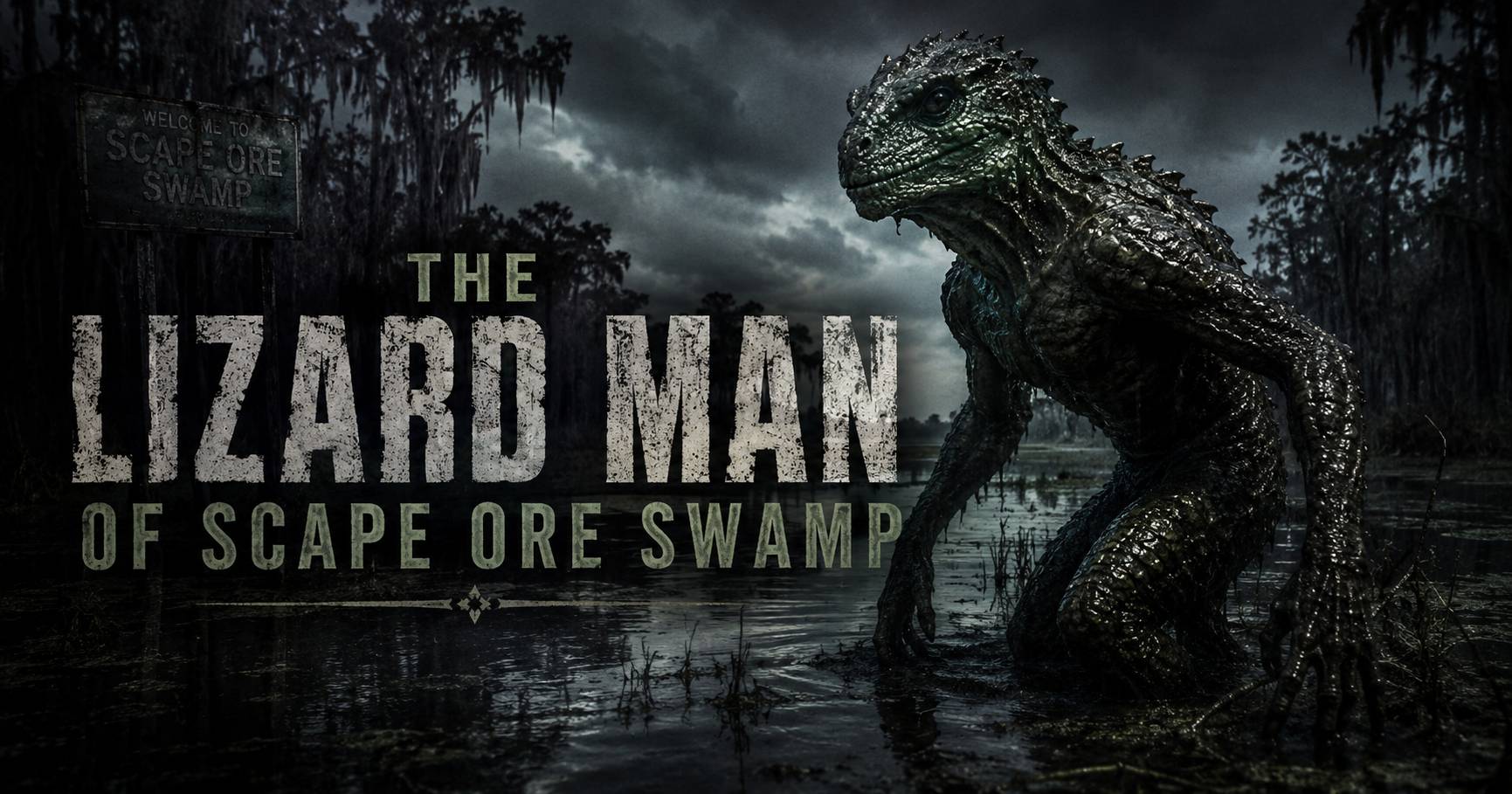
Deep in the humid lowlands of Lee County, South Carolina, where blackwater channels wind through cypress and tupelo and the swamp can swallow a road in darkness, an old Southern nightmare was given a name.
In the summer of 1988, something was said to be moving through the darkness around Scape Ore Swamp, south of Bishopville.
It was not described as a bear.
Not a man.
Not anything that local residents recognised.
Witnesses spoke of a creature standing roughly seven feet tall, covered in green, reptile-like skin, with glowing red eyes, clawed hands and an unnerving ability to move through the darkness with startling speed.
Then came the cars.
A teenager returning home from work stopped beside the road to change a flat tyre.
And according to his account, something came out of the darkness.
The creature ran toward him.
He reached his car.
And then, he said, it climbed onto the roof.
What followed turned a quiet South Carolina community into the centre of an extraordinary media frenzy.
Newspapers carried the story. Radio stations offered rewards. Hunters entered the swamp. Tourists arrived hoping to glimpse the creature.
And before long, Scape Ore Swamp had become synonymous with one of America’s most famous reptilian cryptids.
They called it the Lizard Man.
More than three decades later, nobody has captured the creature.
No biological specimen has ever been produced.
And some of the most dramatic claims surrounding the legend were later exposed as hoaxes.
Yet the original reports, the damaged vehicles, the alleged footprints, the contemporary newspaper coverage and the sheer scale of the 1988 panic remain part of the historical record.
Whether something genuinely strange emerged from the swamp, or whether a frightened community watched an urban legend grow in real time, the Lizard Man remains one of South Carolina’s most enduring monsters.
Somewhere beneath the cypress, the legend is still waiting.
🦎 Physical Appearance & Description
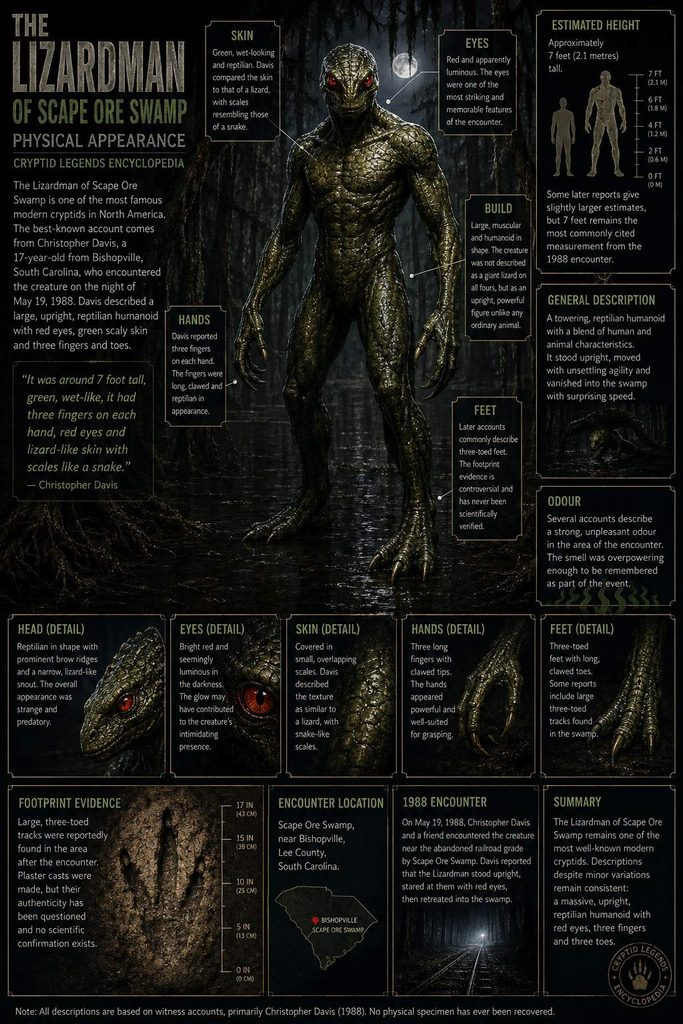
The modern image of the Lizard Man is remarkably distinctive, although the original 1988 descriptions were not quite as standardised as later artwork suggests.
The best-known account came from Christopher Davis, a 17-year-old from the Bishopville area.
Davis described the creature as approximately:
📏 Height
Around 7 feet tall
🦎 Skin
Green, wet-looking and reptilian, with skin Davis compared to that of a lizard and scales resembling those of a snake.
👁️ Eyes
Red and apparently luminous, producing one of the most enduring features of the later Lizard Man image.
🖐️ Hands
Davis reported three fingers on each hand.
🦶 Feet
Later accounts commonly describe the creature as having unusual three-toed feet, although the footprint evidence is considerably more complicated than the popular image suggests.
💪 Build
The creature was generally portrayed as large, muscular and humanoid, rather than resembling an ordinary giant lizard walking on four legs.
The result was something occupying an unsettling space between:
Human + reptile + swamp predator.
Contemporary UPI reporting preserved Davis’s description almost word-for-word: a creature that was “green, wet-like,” around seven feet tall, with three fingers, red eyes, lizard-like skin and snake-like scales.
This is particularly important because later popular artwork sometimes gives the Lizard Man far more elaborate dinosaur-like characteristics than the original witness description actually contained.
📍 Location & Country
- 🇺🇸 Primary Location: Scape Ore Swamp
- 📍 Nearest Town: Bishopville
- 🗺️ County: Lee County, South Carolina
- 🌎 Country: United States
- 🌳 Region: South Carolina Lowcountry / Sandhills transition
- 🐊 Specific Area: Scape Ore Swamp and the rural roads around Browntown
- 📏 Approximate Location: Around four miles south of Bishopville
- 🧭 Approx. Coordinates: 34.17° N, 80.55° W
The Lizard Man is inseparable from Scape Ore Swamp.
Contemporary reporting repeatedly placed the creature’s alleged territory approximately four miles south of Bishopville, with the surrounding Browntown community and roads near the swamp becoming the centre of the 1988 investigation.
The location is important because this isn’t simply a cryptid assigned to an entire state.
The legend grew from a very specific landscape, dark roads, swamp margins, humid summer nights and dense vegetation capable of concealing almost anything moving through it.
The City of Bishopville itself still presents the Lizard Man as Lee County’s homegrown monster, directly connecting the creature with Scape Ore Swamp and the 1988 encounter.
🌿 Habitat
Scape Ore Swamp provides almost perfect scenery for the creature’s mythology.
The environment is dominated by wetland habitat, wooded swamp and waterways, with dense vegetation creating poor visibility and numerous places for an animal, or a person, to remain concealed.
The Lizard Man legend particularly emphasises:
- 🌳 Dense woodland
- 🌿 Thick swamp vegetation
- 💧 Blackwater wetlands
- 🌙 Extremely dark nighttime conditions
- 🛣️ Rural roads bordering the swamp
- 🐊 Native reptiles and amphibians
- 🦌 Abundant wildlife
- 🌫️ Humid summer conditions
The environment also provides an important skeptical consideration.
A large animal moving through dense vegetation at night could be extremely difficult to identify accurately, particularly during a frightening encounter.
That doesn’t explain the entire legend, but it is an important part of understanding why Scape Ore became such an effective setting for the story.
👣 Historical Sightings & Reports
The Lizard Man legend did not emerge from a single isolated story. During the summer of 1988, a rapidly developing sequence of reports around Scape Ore Swamp and the Browntown community near Bishopville, South Carolina, brought local law enforcement, newspapers, television crews, hunters and eventually national media into the investigation.
The events began with the account that would become the foundation of the legend: that of 17-year-old Christopher Davis, who reported encountering a large reptilian humanoid while changing a flat tyre near the swamp.
Within weeks, however, the story had expanded into a much larger collection of alleged sightings, damaged vehicles, strange tracks and competing explanations, some apparently sincere, some never independently verified, and at least one conclusively admitted hoax.
🌙 Christopher Davis — The Foundational Encounter
The central account dates to the early hours of June 29, 1988, when Christopher Davis was reportedly driving home after working a late shift at a fast-food restaurant.
Near the edge of Scape Ore Swamp, Davis suffered a flat tyre and stopped to change it.
According to his account, he heard something approaching through the darkness before seeing a large humanoid figure emerging from the surrounding area.
He described the creature as approximately seven feet tall, green and wet-looking, with red eyes, three fingers and skin resembling a lizard or covered in snake-like scales.
Davis managed to get back inside his vehicle and escape. He later reported that the creature pursued the car and climbed onto it, with the incident leaving damage to the vehicle. His description became the template for virtually every subsequent representation of the Lizard Man.
The account was sufficiently unusual that Davis reported it to Lee County Sheriff Liston Truesdale. Truesdale subsequently became one of the principal law-enforcement figures associated with the case.
Importantly, Davis’s story was not initially presented as part of an established monster legend. The wider Lizard Man phenomenon developed after his report, as other incidents began to be connected with it and the media descended upon Bishopville.
🚗 The Waye Vehicle Incident
One of the earliest incidents to become associated with Davis’s encounter involved Tom and Mary Waye, whose vehicle was reportedly damaged near the swamp.
Contemporary reporting described damage to the vehicle including battered chrome, torn moulding, pulled wires and a damaged hood ornament. The Wayes suspected that the mysterious creature was responsible.
The incident became particularly important because it appeared to provide something beyond eyewitness testimony: physical damage to a vehicle.
However, investigators did not establish that a humanoid reptile had caused it.
State wildlife biologist Matt Knox examined evidence associated with the vehicle and reportedly believed that the damage and hairs were consistent with a red fox, while other explanations were also discussed at the time. The contemporary press therefore recorded both the Lizard Man interpretation and the mundane alternative.
This distinction is important when assessing the historical record: the vehicle damage was real enough to attract investigation, but its attribution to the Lizard Man remained unproven.
🌿 Reports From the Swamp
As the story spread through the Browntown area, Deputy Chester Lighty, who patrolled the community surrounding Scape Ore Swamp, reported hearing additional claims.
Two men reportedly told Lighty that they had encountered a creature which chased them away from a spring while they were attempting to collect water. These reports were already circulating before the story became a national sensation.
The reports helped establish an important feature of the developing legend: the creature was increasingly being associated with the swamp itself, rather than existing solely as the result of Davis’s roadside encounter.
Later accounts would attach additional stories to the same landscape, creating the impression of a creature repeatedly moving between the swamp, roads and surrounding rural properties.
👣 The Three-Toed Tracks
Perhaps the most intriguing physical development occurred when Lee County deputies reported finding large three-toed tracks in the area.
Deputies Jim Tallon and Phil Stokes reportedly encountered large footprints while patrolling near the Browntown community. Plaster casts were subsequently made of tracks believed by some investigators to have been produced by the creature.
The State newspaper’s photographic archive preserves an August 1988 photograph showing Tallon and Stokes holding casts of purported Lizard Man footprints.
Contemporary wire reporting went further.
A later report described deputies Wayne Atkinson and state Trooper Mike Hodge discovering fresh three-toed prints along a dirt road after responding to another reported sighting.
The tracks were described as approximately 14 inches long and 7 inches wide, extending into woodland. Officers also reported disturbed vegetation, damaged or dragged rubbish containers and a broken branch several feet above the ground.
The officers reportedly attempted to determine whether the tracks could have been artificially produced. Atkinson stated that when he stamped his own foot into the hard dirt, he could not reproduce a comparable impression.
South Carolina Law Enforcement Division bloodhounds were subsequently brought in but reportedly failed to establish a clear trail to a culprit.
These reports are among the most frequently cited physical elements of the 1988 case.
But they should still be treated cautiously.
The tracks were never scientifically established as belonging to an unknown reptilian humanoid, and the contemporary sheriff remained skeptical about at least some of the evidence.
UPI reported that Sheriff Truesdale believed some of the large tracks could have been produced by a prankster attempting to prolong the Lizard Man hysteria.
🚓 The Sheriff’s Investigation
Sheriff Liston Truesdale became an unusual figure in the story because he neither simply dismissed the reports nor publicly confirmed the creature.
Instead, his department investigated numerous complaints while repeatedly warning people against fabricating reports.
By late July, the sheriff was dealing with an extraordinary amount of attention. UPI reported that media organisations from across the United States and Canada were contacting him, while hunters and curious visitors were gathering around the swamp.
At one point, approximately 75 armed hunters were reported waiting near the area in hopes of seeing the creature.
The Washington Post similarly reported the extraordinary atmosphere surrounding Browntown, describing hunters camping near the swamp while the sheriff dealt with the growing media frenzy.
The case had therefore evolved beyond a simple alleged sighting.
The investigation itself had become part of the legend.
📺 The 1988 Media Explosion
By the third week of July, the story had escaped South Carolina.
The Kentucky? No, this was very much a South Carolina story, but newspapers across the United States began carrying Associated Press and United Press International reports.
Among the contemporary coverage were:
- 📰 The State — extensive local reporting by journalist Jan Tuten
- 📰 The Evening Post — Associated Press coverage
- 📰 The Washington Post
- 📰 Los Angeles Times
- 📰 TIME
- 📰 Charlotte Observer
- 📺 CBS Evening News
- 📻 South Carolina radio coverage, including the famous WCOS reward
The South Carolina Encyclopedia notes that by August 14 the Lizard Man had become a national celebrity, with reports of more than 200 calls per day coming from locations as distant as New Zealand and Germany.
Contemporary TIME coverage described hunters entering the swamp and a local radio station offering a $1 million reward for the creature’s capture. It also reported the appearance of large footprints and plans to send plaster casts to the FBI.
🔫 The Kenneth Orr Incident — A Confirmed Hoax
One of the most important episodes in the entire historical record occurred in August 1988, when Kenneth Orr, a 26-year-old airman stationed at Shaw Air Force Base, claimed that he had encountered and shot the Lizard Man.
Orr initially reported that he had fired several shots at the creature along U.S. 15, claiming that he had wounded it.
He presented what he said were blood and scales as evidence.
The story initially appeared to provide the case with exactly the sort of physical evidence investigators and journalists had been seeking.
It collapsed almost immediately.
According to contemporary UPI and Associated Press reporting, authorities determined that the supposed biological material was actually from a fish. Orr subsequently admitted that he had fabricated the encounter because he wanted to keep the Lizard Man legend alive. He was also charged in connection with unlawfully carrying a pistol and the false report.
This is one of the rare parts of the Lizard Man story that can be classified with considerable confidence:
The Kenneth Orr encounter was a hoax.
It should therefore never be presented alongside the Davis encounter as though both have equal evidential status.
👁️ Other 1988 Reports
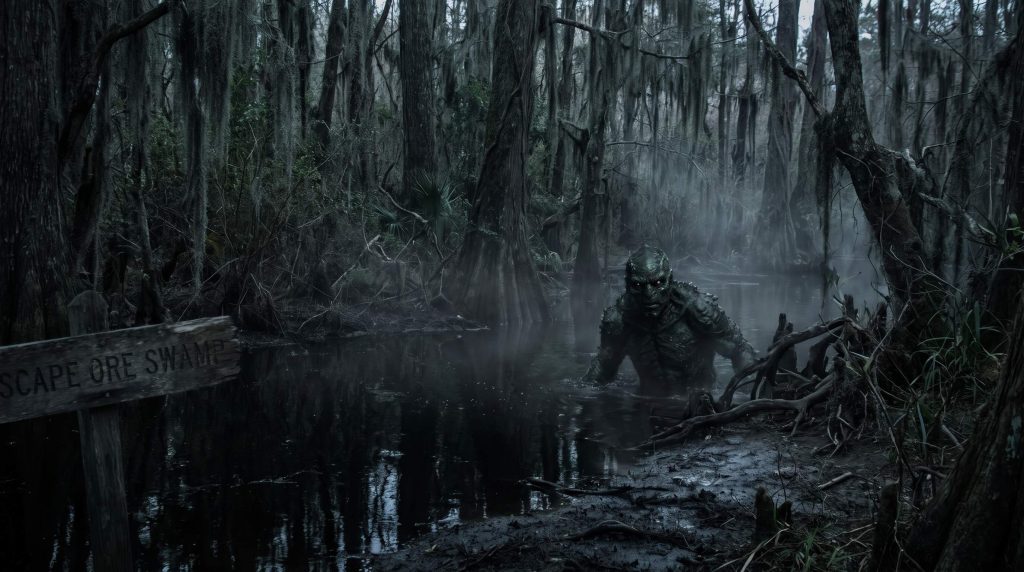
As the summer continued, additional people claimed to have seen the creature.
Some reports involved direct encounters, while others involved damaged vehicles, tracks or unexplained disturbances that residents attributed to the Lizard Man.
This distinction matters because modern summaries can give the impression that dozens of people independently saw the same seven-foot reptilian humanoid.
Skeptical investigator Benjamin Radford, reviewing the historical record in Skeptical Inquirer, notes that relatively few of the later cases were actually direct eyewitness encounters. Many involved damage to vehicles or other evidence that was attributed to the creature after the fact.
By the end of the summer, the wave of reports had largely subsided.
🌙 The 1990 Bertha Blythers Report
The legend did not completely disappear.
On 30 July 1990, Bertha Blythers and her five children reportedly encountered a large humanoid figure while travelling near the Scape Ore Swamp area after leaving a restaurant in Bishopville.
According to a statement attributed to Blythers, the family was travelling near the intersection of Hickory Hill Road when a large figure appeared near their vehicle and lunged toward the passenger side.
Blythers reportedly described the figure as large and broad, with two human-like arms, and said that its body appeared to be covered in brown hair. She told investigators that she did not believe it was a deer, bear or person.
The account is interesting because the reported creature differed substantially from the green, red-eyed, reptilian figure of the 1988 legend.
Rather than strengthening a consistent biological description, such differences demonstrate how the Lizard Man tradition subsequently absorbed encounters with a variety of large or unidentified figures.
📹 Later Reports
Reports continued sporadically in later decades.
In 2008, a Bishopville-area couple reported damage to their vehicle, including apparent blood traces. The material was subsequently identified as belonging to a domestic dog, rather than an unknown creature.
In 2015, photographs and video purporting to show the Lizard Man were presented by local television coverage, including material attributed to Jim Wilson and others. These images generated renewed interest but did not establish the creature’s existence.
The legend also received renewed public attention during the 2017 solar eclipse, when South Carolina Emergency Management used the Lizard Man in a humorous social-media reference to possible paranormal activity in the region.
📰 What the Historical Record Actually Shows
The 1988 Lizard Man wave is unusual because the original story can be followed through contemporary newspaper and wire-service reporting rather than relying solely on decades-later folklore books.
The surviving record establishes that:
- 👤 Christopher Davis genuinely reported an encounter to the Lee County Sheriff’s Office.
- 🚗 Vehicle damage was genuinely reported and investigated, although its cause was disputed.
- 👣 Large three-toed tracks were reported and plaster casts were produced.
- 🚓 Lee County deputies and state law-enforcement personnel investigated multiple incidents.
- 📰 The story received extensive contemporary newspaper coverage in July and August 1988.
- 📺 National television and international media attention followed.
- 🔫 Kenneth Orr’s supposed shooting was subsequently admitted to be fabricated.
- 🌿 The majority of later reports were considerably less well documented than the original Davis case.
- ❓ No physical specimen, body, DNA sample or other scientifically verified evidence of a seven-foot reptilian humanoid has ever emerged.
Modern scholarship consequently treats the Christopher Davis encounter as the foundational historical event, while regarding many later reports as part of the folklore expansion that followed the enormous media attention of 1988.
That doesn’t make the story uninteresting, quite the opposite.
The remarkable thing about the Lizard Man case is that we can watch a modern cryptid legend being created in real time: one frightening roadside encounter, followed by vehicle damage, police reports, footprints, newspaper headlines, television coverage, hunters, hoaxes and competing explanations, all within a matter of weeks.
And that makes the summer of 1988 the true birthplace of the Lizard Man of Scape Ore Swamp as we know him today.
📚 The Lizard Man of Scape Ore Swamp in Literature & Popular Culture
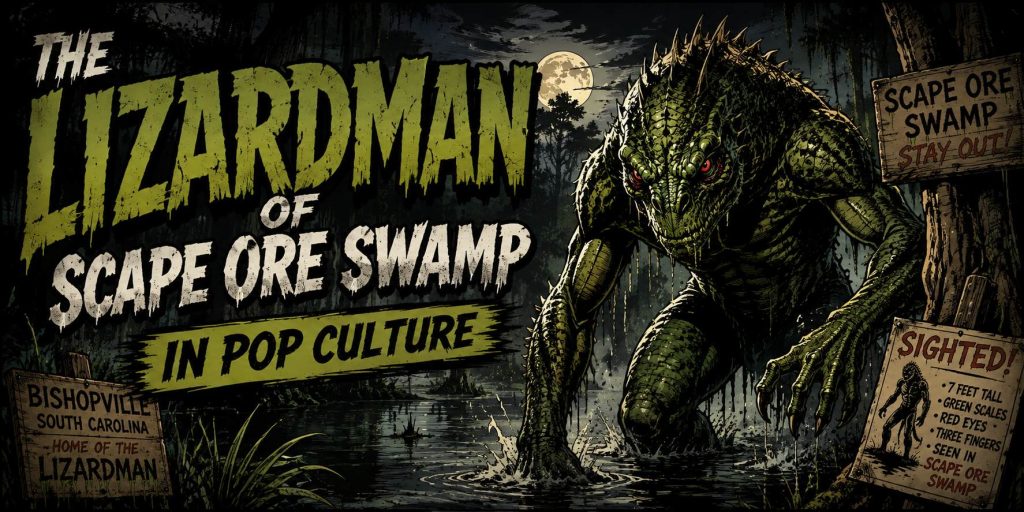
The Lizard Man of Scape Ore Swamp may have originated from a handful of bizarre reports in rural Lee County, South Carolina, but the creature quickly escaped the swamp and entered American popular culture.
Within weeks of the 1988 encounters, the story had become a national media sensation. Newspapers across the United States were carrying reports from Bishopville, television crews were arriving in South Carolina, hunters were entering Scape Ore Swamp and local businesses were selling Lizard Man merchandise.
The phenomenon subsequently evolved from a contemporary mystery into a recognisable piece of American cryptid folklore.
📖 Lizard Man: The True Story of the Bishopville Monster
The most important dedicated book on the subject is Lyle Blackburn’s Lizard Man: The True Story of the Bishopville Monster, published by Anomalist Books in 2013.
Blackburn’s investigation is particularly significant because it goes beyond simply repeating the famous 1988 newspaper story.
He travelled to Bishopville and Scape Ore Swamp, interviewed witnesses and local law-enforcement figures, revisited the alleged sighting locations and examined surviving documentation.
The book includes a chronological sighting log, photographs of eyewitness statements and police documents, making it one of the principal modern sources for anyone attempting to reconstruct the historical case.
Blackburn’s research also examines competing explanations rather than presenting the creature simply as an established animal.
📚 American Monsters
The Lizard Man also receives dedicated treatment in Linda S. Godfrey’s American Monsters: A History of Monster Lore, Legends, and Sightings in America, published in 2014.
Godfrey’s book places the Bishopville creature within the wider history of American monster traditions, rather than treating the case in isolation.
This is particularly useful because the Lizard Man occupies an unusual position within American cryptozoology: unlike some much older folklore creatures, its modern legend can be traced to a clearly defined period in the late twentieth century, complete with contemporary newspaper coverage, police involvement and a rapidly developing media mythology.
📚 Maniacal Monsters and Bizarre Beasts
The Lizard Man has also entered children’s cryptid literature.
The creature appears in the illustrated children’s bestiary Maniacal Monsters and Bizarre Beasts, published by Rosen Publishing in 2013.
Its inclusion alongside other legendary creatures demonstrates how the Bishopville case had moved beyond specialist cryptozoology and into general monster education and children’s folklore collections.
📚 Swamp Cryptids
The Lizard Man has also appeared in broader collections dealing with swamp and Southern cryptids, including Clayton Hooke’s Swamp Cryptids: Moss Man, Skunk Ape and Lizard Man of Scape Ore Swamp.
Rather than being a dedicated historical investigation like Blackburn’s book, this type of publication places the Bishopville creature alongside other American swamp legends and highlights the common themes of remote wetlands, nocturnal encounters and elusive humanoid creatures.
📺 Television
Television played a major role in turning the Lizard Man into a modern cryptid celebrity.
👁️ Destination Truth
The creature received one of its most prominent television investigations on Destination Truth.
The episode “Ghost of Petra/The Lizard Man” aired on 14 April 2010 as Season 3, Episode 14. Josh Gates and the investigation team travelled to Bishopville, South Carolina, specifically to investigate the Lizard Man of Scape Ore Swamp.
The episode helped introduce the Bishopville legend to a large international paranormal television audience and cemented the Lizard Man alongside creatures such as the Jersey Devil, Yeren and Mothman within the modern television cryptid canon.
🔬 Fact or Faked: Paranormal Files
The Lizard Man subsequently appeared on Syfy’s Fact or Faked: Paranormal Files.
The episode “Reptile Rampage/Gasoline Ghoul” aired on 22 May 2012. The investigation team travelled to the Bishopville area to investigate reported Lizard Man sightings and alleged property damage.
The programme is particularly interesting from a historical perspective because its premise was not simply to celebrate the legend, but to test evidence and investigate competing explanations.
👹 Lost Tapes
The Lizard Man was also adapted into the Discovery Channel’s fictional found-footage series Lost Tapes.
The episode simply titled “Lizard Man” aired on 29 September 2009.
Unlike documentary investigations such as Destination Truth, Lost Tapes presented the creature as a fictionalised horror scenario. Its version of the Lizard Man was depicted as a highly aggressive reptilian humanoid stalking underground and sewer environments.
This should therefore be regarded as a fictional adaptation of the legend, rather than evidence for any historical encounter.
🧬 The Secret Saturdays
The Bishopville Lizard Man also appeared in the animated children’s series The Secret Saturdays.
In the Season 1 episode “Ghost in the Machine,” which originally aired on 15 May 2009, the Bishopville Lizard Man appears among a collection of cryptids encountered by the Saturday family.
The series is notable because the creature was treated as part of a fictional universe containing numerous real-world cryptozoological legends.
The Lizard Man therefore crossed from real-world cryptid folklore into children’s adventure fiction.
🎙️ Podcasts & Modern Cryptid Media
The creature has continued to receive attention from modern paranormal and cryptozoological media.
In 2018, the popular MonsterTalk podcast devoted an episode to the case titled “The Tail of the Lizard Man.”
The programme featured cryptozoologist Lyle Blackburn, discussing the Bishopville case and the research behind his book. The episode provides another example of the Lizard Man’s transition from newspaper curiosity into an enduring subject of modern cryptid investigation.
The case has also subsequently been discussed by podcasts including Astonishing Legends, which devoted a 2024 episode to the Bishopville Lizard Man with Blackburn as a guest.
🎪 The Bishopville Lizard Man Festival
Perhaps the clearest sign that the creature has become part of local culture is the Lizard Man Festival also known as the Lizard Man Stomp Festival in Bishopville.
The modern festival culture was inspired partly by the success of the Mothman Festival in Point Pleasant, West Virginia.
Researcher Joseph P. Laycock, writing for Smithsonian Magazine in 2018, documented Bishopville’s first Lizard Man festival and described how the creature had evolved from a frightening local legend into a source of tourism, merchandise and community identity.
The festival has featured cryptozoology speakers, monster-themed merchandise, tours, art and Lizard Man-related activities, turning the alleged creature’s territory into a destination for enthusiasts.
The transformation is striking:
In 1988, Bishopville wanted to know what was attacking its cars.
Decades later, people travel to Bishopville specifically to look for the monster.
That transition mirrors what happened with other famous American cryptids such as Mothman and the Beast of Boggy Creek.
🛍️ Merchandise & Local Identity
The Lizard Man became commercialised almost immediately following the 1988 media frenzy.
Contemporary and later accounts document Lizard Man T-shirts, souvenirs, artwork and other merchandise appearing in Bishopville. Local businesses recognised that the bizarre story could attract visitors, while the town’s association with the creature gradually became part of its identity.
The phenomenon eventually extended beyond simple souvenirs.
The Lizard Man became a local symbol of Bishopville itself, appearing in tourism material, monster festivals, artwork and roadside attractions.
The result is an unusual form of folklore in which the alleged creature’s home territory has become part of the creature’s mythology.
🃏 MetaZoo — Lizard Man of Scape Ore Swamp
The Lizard Man has also received a major place in modern cryptid collecting through MetaZoo.
The creature appears as Lizard Man of Scape Ore Swamp in the original MetaZoo: Cryptid Nation trading-card set.
🦎 Card Details
- 🎴 Card: Lizard Man of Scape Ore Swamp
- 📦 Set: Cryptid Nation
- 🔢 Card Number: 6/159
- 🏆 Rarity: Gold
- 🌲 Type: Forest Beastie
- ❤️ Life Points: 50
- ⚡ Aura Cost: 1 Neutral + 1 Forest
- 🧬 Traits: Regen, Stone Skin
- 🎨 Illustrator: PONCHO
- 🗺️ Origin: Lee County, South Carolina
- 📏 Card Height: 2.8 m
- ⚖️ Card Weight: 124 kg
- 🃏 Printings: Holo and Reverse Holo
The card was released in 1st Edition, 2nd Edition and Kickstarter Edition versions of Cryptid Nation.
Its principal attack is “Descale”, dealing 50 damage, while its card abilities include Regen and Stone Skin.
MetaZoo’s portrayal is particularly fitting for the legend because it retains the creature’s association with Scape Ore Swamp and Lee County, rather than simply using a generic “Lizard Man” character.
🃏 Topps × MetaZoo Cryptid Nation Series 0
The creature also appeared in the 2021 Topps × MetaZoo Cryptid Nation Series 0 trading-card release.
The Lizard Man is:
- 🔢 Card #37
- 🏆 Gold rarity
- 👹 Beastie
- ⭐ First Sighting insert: 37-G
- 💎 First Sighting print run: /99
The First Sighting insert series specifically commemorated the origins of various cryptids, placing the Bishopville Lizard Man alongside creatures including Bigfoot, Flatwoods Monster, Jersey Devil and Mothman.
🃏 2022 Topps Chrome MetaZoo
The creature was subsequently included in 2022 Topps Chrome MetaZoo.
The checklist contains Lizard Man of Scape Ore Swamp #37 in the Base portion of the set, with another Lizard Man entry at #110 in the later portion of the checklist.
This further demonstrates how the Bishopville creature had become one of the recognisable names within MetaZoo’s wider cryptid universe.
🌎 A Modern American Cryptid Icon
The cultural history of the Lizard Man is unusual because it happened so quickly.
There is no ancient medieval tradition behind the Bishopville creature comparable to the Jersey Devil or European lake monsters.
Instead, its transformation can be followed almost step-by-step:
1988 — alleged encounter
↓
Newspaper headlines
↓
National television coverage
↓
Monster hunters descend on Bishopville
↓
Merchandise appears
↓
Books investigate the case
↓
Television paranormal programmes revisit it
↓
Children’s fiction adopts the creature
↓
Bishopville establishes a monster festival
↓
MetaZoo turns the legend into a collectible cryptid
The Lizard Man therefore represents something particularly fascinating in American folklore: a cryptid whose entire modern mythology can be watched developing within living memory.
What began beside a dark South Carolina swamp became a newspaper sensation, a television monster, a children’s-fiction creature, a festival mascot, a subject of dedicated books and finally a trading-card icon.
And somewhere beneath all of that modern mythology remains the original question from the summer of 1988:
What, if anything, was actually moving through Scape Ore Swamp?