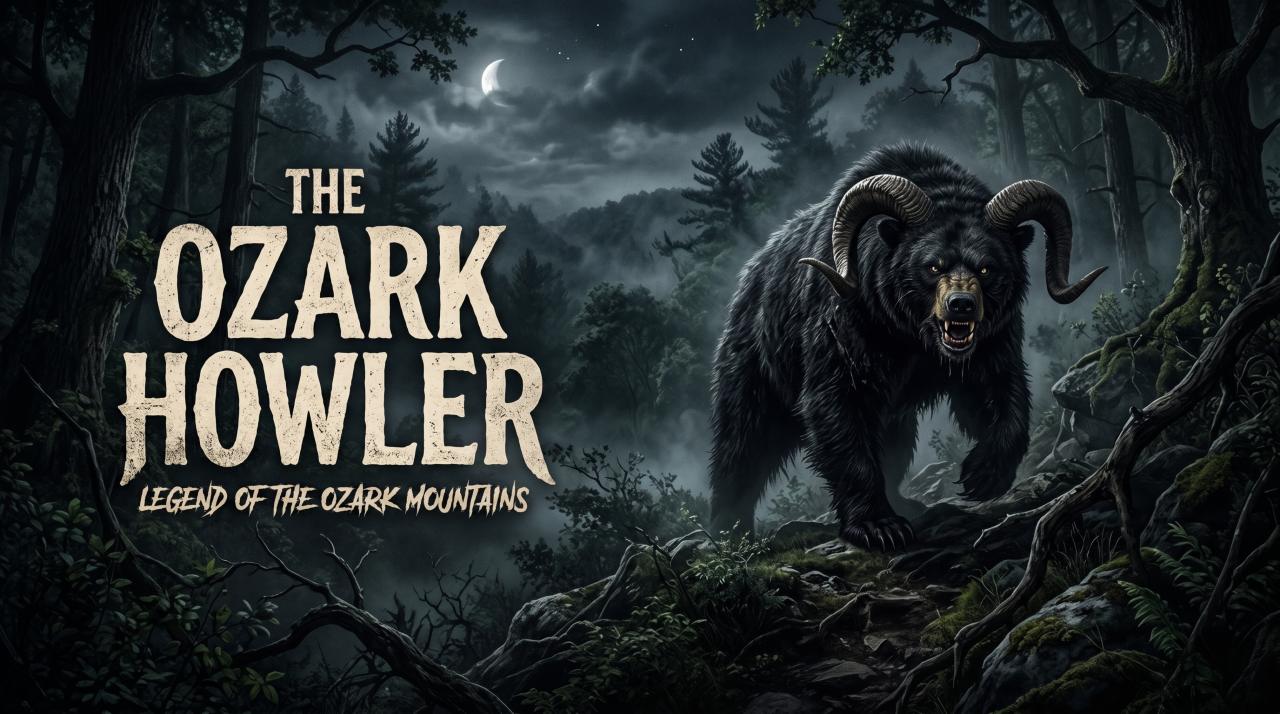
Deep within the forested hills of the American Ozarks, where ridgelines disappear beneath dense woodland and darkness settles quickly between the trees, there persists a legend of something that is not quite wolf, not quite bear, and not quite any animal known to science.
It is known as the Ozark Howler.
For generations, people across the remote country of northern Arkansas and southern Missouri have spoken of a strange creature said to haunt the wooded hills, isolated roads and wilderness surrounding the Ozark Mountains.
Its appearance varies between accounts, but the most enduring image is that of a large, dark and powerfully built animal, sometimes described as shaggy or cat-like, with glowing red eyes and prominent horns or antlers.
Yet it is the creature’s voice that gives the legend its name.
Witnesses describe an unnerving, far-carrying howl unlike the familiar calls of wolves, coyotes or dogs, a deep, haunting cry capable of travelling enormous distances through the forest. Some accounts compare it to the call of an elk, while others describe something much more difficult to identify.
The Ozark Howler belongs to a tradition of mysterious beasts that has developed alongside the Ozarks themselves.
Stories of unusual animals, strange cries and frightening encounters in the wilderness have circulated for generations, becoming woven into the folklore of isolated communities where the forest could conceal almost anything.
Over time, these stories coalesced around a distinctive creature: a black, horned beast whose terrifying howl announces its presence somewhere beyond the trees.
Whether the Howler represents a surviving unknown animal, a collection of misidentified encounters with perfectly ordinary Ozark wildlife, an evolving piece of regional folklore, or something created somewhere between all three remains unresolved.
There has never been a scientifically verified specimen.
There is no authenticated photograph.
And despite decades of stories, investigations and renewed interest, no piece of evidence has conclusively demonstrated that an unknown creature stalks the Ozark wilderness.
Still, the legend refuses to disappear.
From old stories exchanged around rural communities to modern reports, newspaper accounts, television investigations and the growing world of online cryptid culture, the Ozark Howler remains one of America’s most distinctive regional mystery beasts, a creature whose greatest weapon may be the sound of something howling somewhere in the darkness, just beyond the reach of the light.
👁️ Physical Appearance
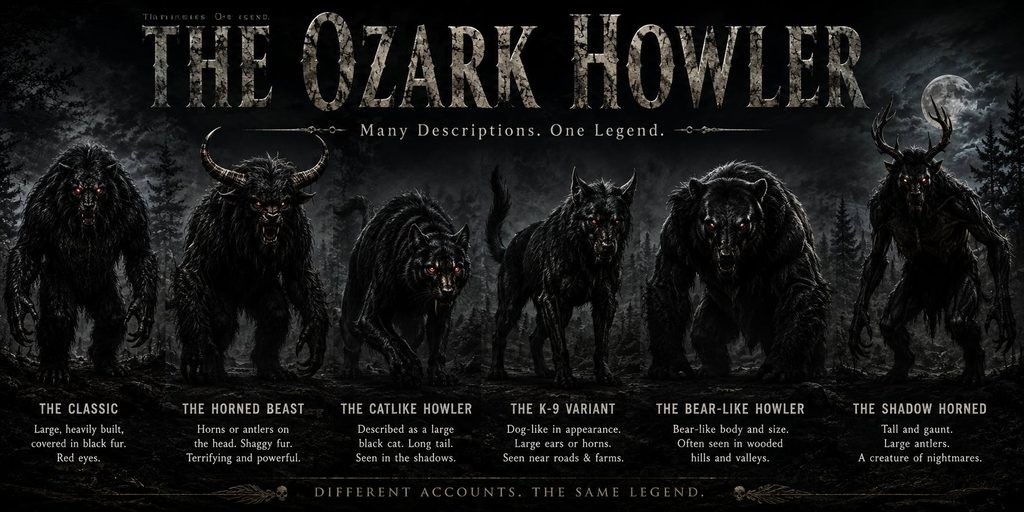
Descriptions of the Ozark Howler are remarkably distinctive in some respects, yet surprisingly inconsistent in others.
Unlike a recognized animal species, there is no standardized physical description, and accounts collected across different periods and locations do not always describe the same-looking creature.
Nevertheless, several features have become strongly associated with the Howler and form the classic image of the cryptid.
🐾 General Size & Build
The Ozark Howler is generally described as a large, heavily built animal, although estimates vary considerably between encounters.
Some of the older accounts describe an animal approximately the size of a large dog, while others portray something considerably larger, approaching the size of a bear or large panther.
One frequently repeated 1946 Oklahoma account described a creature standing approximately four feet at the shoulder, although this comes from an oral-history tradition rather than a zoologically documented observation.
The body is usually portrayed as stocky, muscular and powerful, rather than slender. Witnesses often emphasize the creature’s substantial shoulders, thick body and imposing presence.
This heavy build contributes to one of the Howler’s recurring ambiguities: depending upon the distance, lighting and circumstances of an encounter, witnesses have variously interpreted the animal as resembling a large cat, bear, dog or other unidentified mammal.
There is consequently no reliable scientific measurement for the creature’s size.
🖤 Fur & Colouration
The most persistent colour associated with the Ozark Howler is black or very dark brown.
Descriptions frequently mention:
- Dense or shaggy dark fur
- A black or charcoal-coloured coat
- A heavily furred body
- Occasionally greyish or brownish areas
- A darker appearance around the head and shoulders
The coat is generally imagined as relatively coarse and untidy rather than sleek.
Some accounts describe the animal as having the appearance of a large black cat, while others compare it to a shaggy black dog or bear.
This variation is important because the Ozarks contain several genuinely dark-coloured mammals capable of producing superficially similar silhouettes at night.
The legendary image of a completely black, shaggy beast therefore represents a recurring motif rather than a confirmed biological characteristic.
🐈 Cat-Like Characteristics
One of the more interesting features of the Howler tradition is the repeated comparison with large cats.
Some witnesses have described seeing what appeared to be a huge black panther or cougar-like animal moving rapidly through woodland or across a road.
These reports have helped create an association between the Howler and the longstanding American folklore surrounding the black panther.
Accounts describing the Howler as cat-like commonly mention:
- A muscular body
- Four-legged movement
- A long tail
- Powerful shoulders
- Rapid, almost effortless movement
- A dark coat
- A relatively large head
However, other descriptions portray the creature as much more canine or bear-like.
This variation becomes particularly significant when considering the region’s history of reported mountain-lion sightings.
A fleeting observation of a large dark animal moving through woodland at night can be extremely difficult to identify accurately, particularly when the observer already knows the local Howler legend.
🐕 Canine & Bear-Like Features
Other reports give the Howler a distinctly canine appearance.
These accounts describe something resembling an enormous black dog, sometimes with a heavy or shaggy coat and a powerful body.
The creature has occasionally been compared with wolves, large feral dogs and other substantial canids.
Still other accounts describe an animal with the bulk and posture of a black bear.
These apparently contradictory descriptions are one reason the Howler is difficult to define physically. Rather than every witness describing an identical animal, the folklore appears to have absorbed characteristics from several familiar forms of Ozark wildlife.
The result is an unusual composite:
The body of a large predator, the coat of a shaggy black animal, the silhouette of a great cat or dog, and anatomical features that appear distinctly unnatural.
👹 The Head
The head is one of the most important parts of the traditional Howler description.
Witness accounts commonly emphasize an unusually large or imposing head, sometimes with a broad face and prominent ears. In some versions of the legend the creature possesses a distinctly feline head, while others give it a more canine appearance.
The head is often described as appearing disproportionate to the body, reinforcing the impression of an unusually powerful animal.
However, unlike the horns, red eyes and dark coat, the precise shape of the head has never developed into a consistent feature across the entire tradition.
🔴 Glowing Red Eyes
Perhaps the most famous supernatural feature associated with the Ozark Howler is its bright red or glowing eyes.
Witnesses have described the eyes as appearing red, orange-red or intensely luminous in darkness.
The image is particularly striking because it transforms an otherwise ambiguous animal sighting into something apparently monstrous: two glowing points appearing from the darkness before the creature disappears back into the forest.
There is, however, an important distinction between glowing eyes and eyes that actually produce light.
No evidence demonstrates that the Howler possesses biologically luminous eyes.
The apparent glow could theoretically arise from eyeshine, reflected light from the eyes of a nocturnal animal.
Many mammals possess a reflective structure known as the tapetum lucidum, which improves vision in low-light conditions and can produce bright eye reflections when illuminated by a torch, vehicle headlights or another light source.
The exact colour of eyeshine varies between species and viewing conditions.
Consequently, the legendary red eyes should be treated as a reported characteristic, not evidence of a supernatural or unknown biological feature.
🐐 Horns & Antlers
The most unusual physical characteristic attributed to the Ozark Howler is the presence of horns, antlers or horn-like projections from the head.
Some descriptions portray the creature as having unmistakable horns, producing the bizarre appearance of a black, predatory animal combined with a goat, deer or other horned creature.
Other accounts do not mention horns at all.
This inconsistency is significant.
Horns and antlers have become central to the modern popular image of the Ozark Howler, but they are not present in every historical description. They may represent an element that became increasingly attached to the creature as the folklore evolved.
There is also considerable room for misinterpretation during fleeting nighttime encounters. Ears, branches, antlers belonging to a nearby deer, unusual shadows or vegetation silhouetted behind an animal could potentially create the impression of horns.
No physical horn, antler or skull attributable to an Ozark Howler has ever been recovered and scientifically documented.
🦴 Teeth & Mouth
Some modern artistic representations give the Howler exaggerated fangs and a large predatory mouth, but these details should be treated cautiously.
The historical tradition does not provide a sufficiently consistent anatomical record to establish unusually large teeth, elongated fangs or any other specialized dentition.
The creature is certainly portrayed as a predator in much of its modern mythology, but there is no verified carcass, skull or jaw from which its dental anatomy could be examined.
Consequently, exaggerated teeth belong primarily to the modern monster interpretation of the Howler rather than securely documented eyewitness anatomy.
🐾 Legs, Feet & Movement
The Howler’s method of locomotion varies between reports.
Many accounts describe an ordinary four-legged animal, often moving quickly through woodland or across roads. Others emphasize the creature’s unusual gait or powerful movement.
Reports sometimes describe:
- Heavy or unusually large feet
- A bounding or running gait
- Rapid movement through dense woodland
- The ability to disappear almost immediately into vegetation
- A low, powerful body posture
There is no authenticated footprint sequence demonstrating that the Howler possesses feet anatomically different from those of known Ozark mammals.
Consequently, claims concerning unusually large or distinctive tracks remain part of the anecdotal record rather than established morphology.
🦎 Tail
Descriptions of the tail are similarly inconsistent.
Some accounts portray the creature as having a long, conspicuous tail, contributing to its resemblance to a cougar or other large cat.
Other descriptions provide little or no information about a tail.
A long tail is particularly important in accounts involving supposed black panthers because both cougars and many other large mammals can appear dramatically different depending upon whether the tail is visible against the background.
The tail therefore belongs among the variable rather than defining characteristics of the Howler.
🔊 The Voice — The Feature Behind the Name
Although technically not a physical characteristic, the creature’s vocalisation is so central to its identity that it belongs in any description of the Howler.
The legendary animal is said to produce an extraordinarily powerful and frightening howl, capable of carrying through the forest over considerable distances.
Descriptions vary from:
- A deep, resonant howl
- A prolonged animal cry
- A sound resembling an elk bugle
- A strange mixture of a wolf, dog and large predator
- A deep, almost human-sounding call
- An eerie cry unlike anything the witness had previously heard
The sound is often described as being more disturbing than the creature itself.
This characteristic also provides one of the most obvious avenues for natural explanations. The Ozarks are home to numerous animals capable of producing surprisingly unsettling vocalisations, including coyotes, foxes, owls, dogs and other nocturnal wildlife.
A strange sound heard without a visible animal can therefore become especially susceptible to interpretation through the existing Howler legend.
🧬 The Classic Ozark Howler
When the various descriptions are combined, the classic modern image of the Ozark Howler is that of:
A large, powerful, shaggy black animal with a broad head, glowing red eyes, a long tail and prominent horns or antlers, capable of producing a deep, terrifying howl.
But this should not be mistaken for a scientifically established description.
The actual eyewitness tradition is considerably more complicated. Some witnesses describe a creature resembling a black panther, others a huge dog, others a bear-like animal, and some reports incorporate the distinctive horns and red eyes that have become synonymous with the legend.
🔎 What Is Actually Consistent?
When the folklore is stripped back to its recurring elements, several themes appear repeatedly:
| Reported Feature | Frequency in the Tradition | Confidence |
|---|---|---|
| Large or unusually substantial animal | High | 🟡 Anecdotal |
| Dark/black coat | High | 🟡 Anecdotal |
| Powerful or stocky build | Moderate–High | 🟡 Anecdotal |
| Cat-like appearance | Moderate | 🟡 Anecdotal |
| Canine appearance | Moderate | 🟡 Anecdotal |
| Long tail | Variable | 🟠 Uncertain |
| Glowing/red eyes | Recurring | 🟠 Uncertain |
| Horns/antlers | Famous but variable | 🟠 Uncertain |
| Shaggy fur | Recurring | 🟡 Anecdotal |
| Distinctive howl | Central to legend | 🟡 Anecdotal |
| Unusual footprints | Occasional | 🔴 Unverified |
| Biological specimen | None | 🔴 None |
The physical description of the Ozark Howler therefore presents an intriguing paradox. The creature has a remarkably recognizable identity in popular culture, yet the underlying eyewitness descriptions are far less uniform.
There is currently no zoological specimen, verified photograph, DNA sample, skull, carcass or authenticated footprint that establishes what the Howler actually looks like.
For now, its physical form exists primarily in the intersection between eyewitness testimony, regional folklore and the mysterious wildlife of the Ozark Mountains.
📍 Location & Country
- 🇺🇸 Primary Location: Ozark Mountains, northern Arkansas & southern Missouri
- 🌎 Region: The Ozarks / Ozark Plateaus
- 🏛️ Primary States: Arkansas and Missouri
- 🇺🇸 Country: United States
- 🌲 Core Landscape: Ozark National Forest, Boston Mountains, Mark Twain National Forest and surrounding wilderness
- 🏞️ Representative Focal Area: Buffalo National River & surrounding Boston Mountains, Arkansas
- 🗺️ Wider Range: Northern Arkansas, southern Missouri, with reports extending into eastern Oklahoma and neighbouring areas
- 👁️ Historical Association: Numerous Howler reports and regional folklore accounts
- 🌲 Primary Encounter Environment: Remote woodland, mountain roads, forest clearings and isolated rural areas
- 📍 Coordinates (Approx.): 35.9800° N, 92.7500° W
The Ozark Howler is not associated with a single isolated location but with the wider wilderness of the Ozark Mountains, a vast highland region extending principally across Missouri and Arkansas and into parts of Oklahoma.
The landscape is characterized by heavily forested hills, narrow valleys, rocky ridges, caves, springs and deeply dissected river systems, precisely the kind of remote terrain in which the Howler legend has traditionally been placed.
For the purposes of the Cryptid Legends Encyclopedia, the Buffalo National River and surrounding Boston Mountains of northern Arkansas provide an especially useful geographical focal point.
The area contains extensive protected woodland and rugged terrain, while the broader Boston Mountains form one of the principal physiographic regions of the Ozark Plateaus.
Reports of the Ozark Howler, however, extend well beyond this focal area. Stories have circulated throughout the Arkansas and Missouri Ozarks, with additional claims reaching into eastern Oklahoma and neighbouring parts of the region.
The creature’s supposed range therefore follows the cultural geography of the Ozarks rather than a scientifically established distribution.
The location should consequently be understood as the heartland of the legend rather than a confirmed habitat boundary.
🌲 Habitat
The Ozark Howler is traditionally associated with the most secluded and heavily wooded parts of the Ozark Mountains, particularly the rugged forest country of northern Arkansas and southern Missouri.
Reports and folklore accounts place the creature away from heavily populated areas and instead within the deep forests, mountain hollows, wooded ridges and isolated valleys that characterize the Ozark landscape.
The regional folklore archive Unlock the Ozarks, for example, describes the Howler as a creature of the “deep woods” and records reports extending across the Missouri and Arkansas Ozarks, with additional stories reaching Oklahoma and Texas.
Unlike a cryptid associated with one particular lake, cave or isolated landmark, the Howler’s supposed habitat is essentially the Ozark wilderness itself, a huge and varied landscape in which forest, rocky upland, streams and rural countryside exist in close proximity.
🌳 Dense Ozark Forest
The dominant environment associated with the Howler is mature woodland, particularly the extensive oak-dominated forests covering the hills and ridges of the Ozark region.
Around the Buffalo National River, which provides one useful representative landscape for the Arkansas Ozarks, the uplands are predominantly oak-hickory forest, while lower and wetter areas support species including sycamore, river birch, maple and willow.
More than 100 species of trees and shrubs have been documented within the Buffalo National River landscape.
These forests can provide exactly the kind of visual environment in which a large animal could remain difficult to identify.
Dense understory, uneven ground, shadows and rapidly changing elevation can reduce an observer’s view to only a few seconds when an animal crosses a trail or road.
For a creature traditionally described as dark, shaggy and elusive, the black-and-shadowed interior of an Ozark woodland forms a natural setting for the legend.
⛰️ Ridges, Hollows & Mountain Slopes
The Ozarks are not a conventional mountain range but an extensively eroded uplifted plateau, producing a landscape of ridges, steep-sided valleys, hollows and dissected uplands.
In the Boston Mountains, particularly rugged terrain has developed where resistant rocks have been deeply eroded by streams.
The resulting terrain is significant to the Howler tradition.
A witness travelling along a road may see only the edge of a wooded slope, while an animal moving through a hollow below can remain completely concealed. Conversely, sounds can travel through valleys and wooded corridors, making it difficult to determine where an unusual howl originated.
This combination of restricted visibility and confusing sound transmission is particularly relevant to a creature whose reputation depends as much upon its terrifying call as its physical appearance.
🌊 Rivers, Creeks & Bottomland Forest
The Howler is also associated with the broader network of streams, creeks and forested river corridors that dissect the Ozarks.
The Buffalo River, for example, rises in the Boston Mountains and passes through a landscape containing steep valleys, hardwood forest, bluffs, springs, waterfalls and extensive riparian habitat.
The National Park Service records more than 55 mammal species within the Buffalo National River area, demonstrating the considerable wildlife diversity supported by this mixture of habitats.
The forest immediately beside waterways differs from the drier uplands. Dense shrubs and moisture-loving trees create thicker vegetation, while streams and springs provide reliable sources of water.
If the Howler were ever demonstrated to represent an unknown terrestrial mammal, such corridors would theoretically provide water, vegetation and routes through otherwise rugged terrain.
At present, however, there is no biological evidence demonstrating that an unknown animal occupies these habitats.
🪨 Caves, Bluffs & Karst Country
One of the most distinctive features of the Ozark environment is its karst geology.
Limestone and dolomite have been gradually dissolved by groundwater, producing caves, sinkholes, springs and underground drainage systems. Buffalo National River alone contains more than 500 documented caves, alongside cliffs, canyons, waterfalls, springs and sinking streams.
These features have inevitably contributed to the atmosphere surrounding Ozark monster folklore.
A landscape containing hidden caves, deep ravines and inaccessible rock formations naturally lends itself to stories of creatures occupying places rarely visited by people.
However, the presence of caves should not be interpreted as evidence that the Howler lives underground.
No confirmed den, lair, nesting site or physical remains have ever been associated with the creature.
🌾 Forest–Farm Boundaries
The Howler tradition also intersects with the forest-edge environments surrounding isolated farms, hunting properties and rural roads.
This is important because the Ozarks are not an uninterrupted wilderness. Forested hills frequently meet fields, pasture, settlements and roads. The boundary between these environments creates natural opportunities for encounters with wildlife.
The folklore archive includes an especially notable 2006 Missouri account in which a farmer reported his livestock becoming frightened before he observed a dark, horned, cat-like animal moving along a fence line. The property itself consisted of woodland and rolling fields divided by a creek.
Such accounts help explain why the Howler is sometimes portrayed not simply as a deep-forest monster, but as an animal appearing briefly at the edge of human habitation before disappearing back into the woods.
🌙 A Creature of the Night
Perhaps the most consistent environmental feature of Howler reports is darkness.
Many accounts involve people travelling or working outdoors during the evening, night or early morning.
This corresponds naturally with the behaviour of many genuine Ozark mammals, several of which are most active around dusk or after dark.
Low light also creates a particularly difficult identification environment. A large black bear, a deer viewed from an unusual angle, a cougar, feral dog or other nocturnal animal may appear dramatically different when glimpsed for only a few seconds.
The legendary combination of black fur, glowing eyes and an enormous silhouette therefore becomes especially powerful in precisely the conditions in which reliable identification is most difficult.
🐾 A Wildlife-Rich Environment
The Ozarks provide an exceptionally diverse mammalian ecosystem. Buffalo National River alone supports more than 55 mammal species, occupying habitats ranging from riparian vegetation and open fields to wooded hillsides, dry glades and rocky outcrops.
Known predators and scavengers include black bears, bobcats, coyotes, foxes, raccoons and other carnivores, while white-tailed deer and numerous smaller mammals provide abundant prey and food resources throughout the ecosystem.
This biodiversity is important when assessing the Howler reports.
There is no shortage of animals capable of producing strange vocalizations, unusual tracks or fleeting silhouettes in the Ozark night.
Red fox screams, coyote vocalizations, owl calls and the sounds of larger mammals have all been proposed as possible explanations for reports of an unidentified Howler cry.
🧭 The Traditional Habitat Range
The traditional range of the Ozark Howler is best understood as a cultural rather than zoological distribution.
Reports are concentrated in:
- 🌲 Northern Arkansas
- ⛰️ The Boston Mountains
- 🌳 Ozark National Forest
- 🌊 Buffalo River and surrounding wilderness
- 🌲 Southern Missouri
- 🌳 Mark Twain National Forest and surrounding Ozark country
- 🏕️ Remote woodland and rural roads
- 🌾 Forest–farmland boundaries
- 🌎 Additional reports extending into eastern Oklahoma and parts of Texas
The Ozark Howler therefore has one of the broadest geographic “habitats” of any regional American, but this reflects the spread of the legend and its associated reports, not a scientifically demonstrated range.
🔬 Habitat Assessment
From a zoological perspective, the Ozarks unquestionably contain enough forest, water, food and secluded terrain to support a large terrestrial mammal. The region is biologically rich and contains extensive protected wilderness.
What remains unestablished is whether there is an unknown animal responsible for the Howler tradition.
No confirmed den, carcass, bone, biological sample, authenticated photograph or other physical evidence has demonstrated that an undiscovered species occupies the Ozarks.
The habitat is therefore entirely plausible for wildlife, but not evidence for the cryptid itself.
For the Cryptid Legends Encyclopedia, the Ozark Howler’s habitat is best understood as the meeting point between one of America’s most rugged forest ecosystems and one of its enduring wilderness legends, a creature said to move through the shadowed ridges, hollows and forests where the landscape itself can make an ordinary animal seem extraordinary.
🌑 Background & Legend
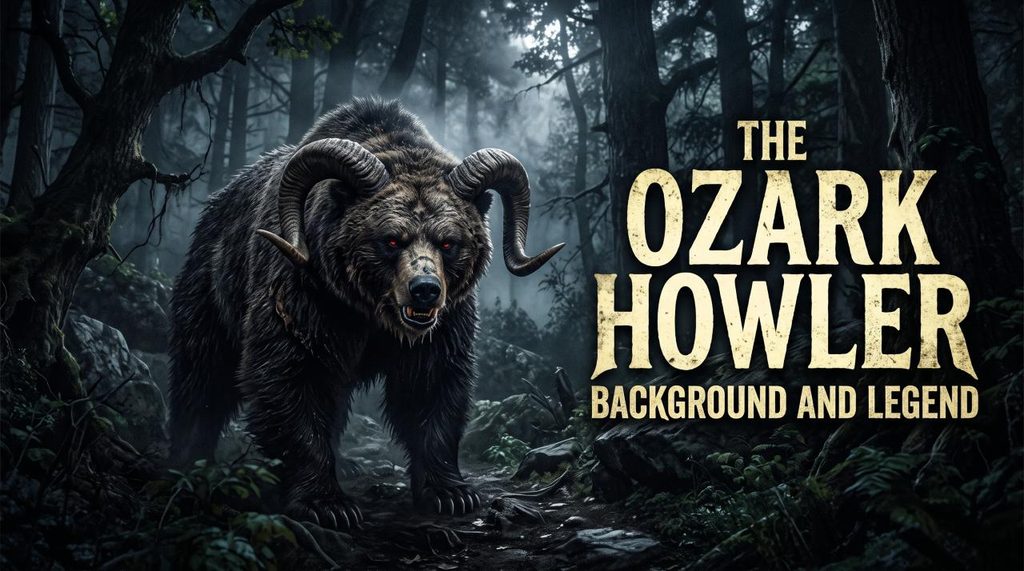
The Ozark Howler occupies an unusual place in American cryptid folklore.
Unlike creatures whose identities are built around a single famous encounter, the Howler exists as a broader regional tradition, a mysterious beast associated with the character of the Ozarks themselves.
The name describes both the creature’s supposed home and the feature most strongly associated with its legend: its extraordinary voice.
Over time, stories have transformed the Howler into a kind of wilderness monster of the Ozark imagination, representing something that belongs beyond the edge of settled country.
🌲 A Creature of the Ozark Wilderness
The Ozarks have long possessed a distinctive folklore tradition shaped by their geography and history.
The region’s isolated hollows, heavily forested ridges, caves, springs and remote settlements created an environment in which stories about strange animals could flourish.
For generations, people living, hunting and travelling through these landscapes encountered wildlife under conditions where identification was often difficult.
Within that cultural setting, the Howler became something more than an unidentified animal.
It became a creature of the deep woods, something encountered at the boundary between familiar countryside and wilderness.
The legend consequently tends to emphasize isolation. The Howler isn’t traditionally presented as an animal wandering through populated towns or appearing in daylight crowds.
Instead, it belongs to the places where roads disappear into forest, where hollows become dark after sunset and where an unexplained sound can seem to come from somewhere far deeper in the woods than its actual source.
🔊 The Importance of the Howl
The creature’s howl is arguably as important to its identity as its physical appearance.
Descriptions of the supposed call vary, but the recurring idea is an enormous, unnatural or deeply disturbing sound echoing through the forest.
This makes the Howler part of a much older tradition of mysterious wilderness sounds.
Long before modern recording equipment or wildlife identification guides, hearing an unfamiliar animal without seeing it created an obvious problem.
A sound could travel considerable distances through valleys and woodland, making its origin difficult to locate. The listener therefore had to construct an explanation from the sound itself.
In folklore, that process can turn an unfamiliar animal call into something considerably more frightening.
The Howler’s reputation reflects this perfectly: the unseen creature announces itself before it is ever supposedly seen.
👁️ The Monster Behind the Sound
As the legend developed, the Howler acquired a collection of recurring visual motifs.
It is commonly imagined as a large, dark and shaggy animal, sometimes resembling an enormous cat or dog, while other traditions add horns or antlers and intensely glowing eyes.
These features are important to the folklore because they make the creature deliberately difficult to classify.
It isn’t comfortably a wolf.
It isn’t comfortably a bear.
It isn’t comfortably a big cat.
Instead, the legendary Howler occupies the uncomfortable space between familiar categories, an animal that appears to have borrowed characteristics from several different predators while belonging to none of them.
That ambiguity is one of the reasons the creature has remained visually distinctive despite never acquiring a definitive physical description.
👹 The Horned Beast Motif
The horns or antlers are particularly interesting within the legend.
Horned beasts have an extensive history within European folklore, where animals with exaggerated horns or supernatural characteristics have frequently represented danger, wilderness and the unknown.
The Ozark Howler’s supposed horns therefore contribute to an established folkloric visual language.
They immediately make the animal appear unnatural.
A black animal glimpsed at night could potentially be interpreted as a bear, dog, cougar or another familiar creature. A black animal apparently carrying horns becomes something much harder for the witness to categorize.
Whether the horned appearance originated from genuine observations, storytelling embellishment, misidentification or later artistic interpretation is impossible to establish.
What matters historically is that the horns became part of the creature’s folkloric identity.
🌙 Glowing Eyes & the Nighttime Monster
The recurring description of red or glowing eyes performs a similar role.
Many nocturnal animals can appear to have illuminated eyes when light from a vehicle, flashlight or other source reflects from the eye’s reflective structures. Yet within folklore, glowing eyes have a much older symbolic association with supernatural creatures.
The combination of:
Black fur + glowing eyes + horns + enormous howl = creates an instantly recognizable monster.
It is therefore possible to view the modern image of the Ozark Howler as partly a folkloric composite, in which characteristics associated with several different nighttime experiences have gradually become attached to one legendary animal.
That does not prove that every original witness invented what they saw. It simply means that the creature described in modern folklore may not necessarily be identical to whatever originally generated the earliest stories.
🏔️ The “Ozark” Identity
The word Ozark is fundamental to the legend.
The Howler isn’t simply another American mystery animal given a geographical label after the fact. Its identity is inseparable from the regional landscape and culture.
The Ozarks themselves have a strong tradition of tall tales, supernatural stories, unusual animals and wilderness folklore. Stories could be passed between families, hunters, travellers and communities, changing slightly with every retelling.
This helped create a creature whose characteristics could remain recognizable while individual accounts varied.
In that sense, the Howler functions almost like a regional folk character.
It belongs to the Ozarks in the same way that other legendary creatures belong to particular landscapes: its existence within the story helps define the character of the place itself.
🪵 Frontier Folklore & the “Wild Country”
The wider cultural background of the Howler is also connected to America’s older frontier traditions.
As European-American settlement expanded into heavily wooded regions, unfamiliar landscapes produced stories about creatures occupying the spaces beyond settled communities.
These stories served several purposes.
They could entertain around a campfire.
They could frighten children away from dangerous places.
They could explain unexplained sounds or animal encounters.
They could warn travellers about isolated areas.
And sometimes they were simply good stories.
The Howler fits naturally within this tradition of wilderness folklore, where the forest is not merely scenery but an active source of mystery.
🐾 Folklore Rather Than a Fixed Creature
One of the most important things to understand about the Ozark Howler is that there has never been a single universally accepted description.
Different accounts have variously emphasized:
- A bear-like body
- A large black cat
- A dog-like animal
- A shaggy quadruped
- Horns or antlers
- A beard or mane
- A long tail
- Red or glowing eyes
- Exceptional size
- An enormous or unusual howl
This variation doesn’t necessarily destroy the legend.
In folklore, creatures can evolve.
A story passed between communities can accumulate characteristics over decades, with particularly memorable details becoming incorporated into later versions.
The result is a creature whose core identity remains stable while its exact appearance remains fluid.
🕯️ The Howler as a Modern Folk Legend
The Ozark Howler therefore sits somewhere between animal mystery, tall tale and regional folklore.
For believers, the recurring descriptions suggest that different people may have encountered something genuinely unusual.
For skeptics, the same recurring characteristics can be interpreted as evidence that an established folklore template influences how ambiguous nighttime encounters are described.
Both interpretations are important to understanding the legend.
The Howler does not need to be scientifically proven to have cultural significance.
Its stories have become part of the mythology surrounding the Ozarks, a region where the boundary between wildlife observation and wilderness storytelling can become remarkably thin.
🔥 The Campfire Creature
Perhaps the simplest way to understand the Howler’s place in Ozark folklore is as a campfire creature.
It is the animal you hear rather than see.
The shape that disappears between the trees.
The eyes briefly caught in headlights.
The strange sound coming from somewhere beyond the ridge.
The creature whose identity becomes more frightening precisely because the witness never gets a complete look.
That is what gives the Ozark Howler its staying power.
It doesn’t require a body, a skeleton or a perfect photograph to survive as folklore. The uncertainty is part of the story.
And that uncertainty is ultimately what makes the Howler such a distinctive figure within American cryptid tradition, not simply an alleged unknown animal, but a symbol of the dark, unexplored side of the Ozark wilderness itself.
🐾 The Ozark Howler — Historical Sightings & Famous Cases

The history of the Ozark Howler is difficult to separate from the wider folklore of the Ozark Mountains.
Unlike cryptids such as the Jersey Devil or Mothman, the Howler does not have a single clearly documented first encounter from which the entire legend developed.
Instead, the modern creature appears to have emerged from a mixture of older Ozark wilderness traditions, reports of mysterious black animals, regional “panther” stories and later descriptions of a distinctive horned, red-eyed beast accompanied by an unusual howl.
This makes the chronology particularly important.
🌲 Early Ozark & Frontier Traditions
Stories of strange animals inhabiting the isolated forests of the Ozarks pre-date the modern popularity of the name Ozark Howler.
Settlers and woodsmen developed a large body of folklore surrounding the region’s remote mountains, caves, forests and wildlife.
The Howler is sometimes connected retrospectively with older frontier stories about hairy wild creatures and mysterious “devil” animals.
One frequently repeated comparison is the “Yahoo” story associated with Daniel Boone, although this should not be treated as a documented Ozark Howler encounter.
Boone’s alleged account belongs to a broader tradition of American frontier wild-man stories and does not provide reliable evidence for a creature matching the later Howler description.
The same caution applies to attempts to connect the Howler directly to Native American traditions. The Ozarks have a rich Indigenous history and many traditional animal and supernatural stories, but there is no securely documented Indigenous tradition that can simply be identified as the modern Ozark Howler.
The modern legend appears to have developed later, particularly through twentieth-century regional storytelling.
👁️ The 1946 Red Oak, Oklahoma Account
One of the earliest frequently cited reports associated with the Ozark Howler tradition dates to 1946 near Red Oak, Oklahoma.
According to the later account, a group of returning Second World War veterans encountered a large, dark animal in the countryside.
The creature was described as unusually large and heavily built, with shaggy black hair, glowing red eyes and an extremely disturbing howl.
The animal was reportedly around four feet at the shoulder, making it substantially larger than the creature described in many later accounts.
The sound was particularly memorable. Rather than an ordinary canine bark or wolf-like howl, it was described as a deep and unusual cry, sometimes compared in later retellings with an elk bugle.
The story became important to later Ozark Howler folklore because several of the characteristics now regarded as classic Howler features were already present:
- black or extremely dark shaggy body
- unusually large physical size
- glowing or reflective eyes
- an extraordinary vocalisation
- nocturnal or low-light circumstances
- an encounter in a relatively isolated rural environment
There is, however, an important limitation.
The surviving documentation for the incident is largely retrospective folklore material rather than a contemporary zoological investigation. No specimen, photograph, verified trackway or biological sample resulted from the encounter.
It therefore represents an important folkloric case, rather than scientific evidence.
🐐 The 1950s — The “Black Goat” Creature
During the 1950s, accounts circulating through the Ozarks increasingly described a strange black, goat-like or devil-like animal.
Descriptions varied considerably. Some versions portrayed the creature as a large quadruped, while others emphasised its horns, shaggy coat and frightening appearance.
This period is significant because the Howler’s physical description began to acquire the combination that would become characteristic of the modern legend:
A large dark animal + horns or antlers + abnormal eyes + an unexplained howl.
The reports were generally transmitted through local storytelling rather than formal investigations.
Consequently, individual accounts are difficult to date precisely and even harder to independently verify.
The stories nevertheless demonstrate that the basic Howler motif was already circulating decades before the internet-era cryptid boom.
🚛 The 1980 Missouri Truck Driver Report
A frequently cited account from around 1980 in southwestern Missouri involved a truck driver travelling through the Ozarks.
The witness reportedly encountered a dark, cat-like animal which appeared unusually heavy and shaggy. Later retellings described:
- a black or very dark coat
- a long tail
- prominent ears or horn-like structures
- reddish or glowing eyes
- a powerful, somewhat cat-like body
- unusual facial or beard-like hair
The report became particularly interesting because the animal did not fit comfortably into a recognised Missouri species.
Yet the description also illustrates one of the central problems surrounding the Howler.
The Ozarks contain black bears, bobcats, coyotes, feral dogs and other wildlife capable of appearing dramatically different in poor lighting. A fleeting roadside observation therefore cannot establish that the animal represented an unknown species.
No physical evidence was recovered.
🐈 The “Black Panther” Reports of the 2000s
The early twenty-first century brought renewed interest in mysterious black animals across Arkansas and Missouri.
Residents in parts of the Ozarks and Boston Mountains periodically reported seeing what they believed to be black panthers, cougars or enormous dark cats.
These reports became intertwined with Ozark Howler folklore because the animals were sometimes described as:
- large
- black or nearly black
- long-tailed
- extremely fast
- apparently feline
- active at night
Wildlife officials, however, had a much less extraordinary explanation.
The Arkansas Game and Fish Commission (AGFC) has documented occasional mountain-lion sightings in Arkansas despite the species having been historically extirpated from the state. Such animals are generally regarded as transient individuals rather than evidence of an established breeding population.
This provides a plausible explanation for at least some reports of enormous black or dark cats.
The difficulty is that a genuine cougar does not explain the complete Howler description. Cougars do not possess horns or antlers, and their normal vocalisations do not correspond neatly to the legendary Howler’s terrifying call.
Consequently, the black-panther reports should be regarded as part of the wider Ozark mystery-animal tradition, rather than automatically classified as confirmed Howler sightings.
🌾 The 2006 Oregon County, Missouri Livestock Encounter
One of the more frequently repeated modern Howler cases occurred in April 2006 in Oregon County, Missouri.
A farmer reportedly noticed his livestock becoming disturbed and used binoculars to investigate.
According to the account, he observed a dark animal approximately comparable in size to a large dog or Great Dane. The animal was described as having a dark coat, a long tail and unusual projections around its head that were interpreted as horns or large ears.
The witness reportedly believed the animal resembled a combination of a large cat and a dog, with reddish-looking eyes.
The livestock reaction added another layer to the story, because animals sometimes respond strongly to unfamiliar predators.
Nevertheless, there was no recovered body, clear photograph, confirmed trackway or biological sample.
The incident therefore remains an eyewitness report, albeit one that fits the developing Howler tradition unusually well.
🚙 The 2009 Arkansas Ranger Encounter
Another notable account emerged around 2009, when an Arkansas state-park ranger reportedly encountered what she believed to be a large black panther-like animal crossing a road.
The creature was said to have appeared extremely dark and large before disappearing into the surrounding forest.
The encounter was subsequently discussed in connection with the Howler legend.
Wildlife authorities did not accept it as evidence of an unknown species, instead considering explanations such as an escaped captive animal or a misidentified known species.
The incident demonstrates an important recurring pattern in Howler investigations:
A witness can be completely sincere without the animal necessarily being an unknown creature.
A fleeting sighting at night provides very little opportunity to determine size, colour, body structure or the presence of horns accurately.
📸 The 2015 Devil’s Den Photographs
The most famous modern Ozark Howler case occurred in December 2015 at Devil’s Den State Park in Arkansas.
A camper identified in reports as John Meyers circulated photographs showing what appeared to be a strange dark animal near a campsite.
The images rapidly attracted attention because the creature appeared to possess horn-like projections and a distinctly unnatural appearance.
For a short time, the photographs were presented online and in local media as possible evidence of the legendary Ozark Howler.
The case quickly became controversial.
Closer examination and subsequent reporting indicated that the animal was not an unknown cryptid.
The images were widely treated as a hoax, with the supposed monster identified as a dog or puppy that had been altered or presented to resemble a horned creature.
The incident is now one of the clearest examples of why the Howler’s photographic evidence must be treated cautiously.
Rather than strengthening the case for the creature, the 2015 episode demonstrated how easily the appearance of the legendary animal could be artificially reproduced.
It also became one of the most widely circulated visual representations associated with the Ozark Howler.
🌲 Later Reports & The Continuing Legend
Reports did not end with the 2015 photograph controversy.
Unverified accounts have continued to circulate from Arkansas, Missouri and neighbouring parts of the wider Ozark region, particularly through paranormal programmes, social-media groups, podcasts and user-submitted videos.
These reports generally repeat familiar characteristics:
- a large dark animal
- an unusually powerful or shaggy appearance
- red or glowing eyes
- horns, antlers or unusually large ears
- a disturbing howl
- sightings around forest roads, campsites or isolated rural areas
However, no later report has produced a verified specimen or photograph capable of establishing the existence of an unknown animal.
Many alleged recordings are simply too brief or poorly resolved to identify the animal involved.
🔎 The Search for Physical Evidence
Unlike some cryptids with extensive alleged physical remains, the Ozark Howler has produced remarkably little material evidence.
The historical record is dominated by eyewitness testimony and folklore.
Footprints
Occasional mysterious tracks have been associated with Howler reports, but no trackway has been scientifically demonstrated to belong to an unknown Ozark animal.
Large black bears, bobcats, dogs and other mammals can leave confusing tracks in mud or soft ground, particularly when individual prints overlap or become distorted.
Hair
There is no scientifically authenticated Ozark Howler hair sample.
No museum or zoological institution possesses a confirmed biological specimen attributed to the creature.
Photographs
The 2015 Devil’s Den photographs remain the best-known visual case, but their status as a hoax makes them unusable as evidence for an unknown species.
No other photograph has achieved comparable evidential significance.
Audio
The Howler’s name comes directly from one of its most famous characteristics — its alleged cry.
Yet there is no authenticated recording demonstrating an unknown animal vocalisation.
The problem is particularly serious in the Ozarks because the region contains numerous animals capable of producing remarkably unsettling sounds, including coyotes, foxes, owls and other nocturnal wildlife.
Without a recording linked to a confirmed animal and a controlled location, an unusual sound cannot establish the presence of a cryptid.
📰 Media Attention & The Modern Howler
The Ozark Howler became increasingly visible outside the region through newspapers, regional magazines, television programmes, documentaries and internet culture.
Local media have periodically revisited the legend whenever a strange animal photograph or unusual sighting appears.
The 2015 Devil’s Den incident produced one of the strongest bursts of mainstream attention, while later paranormal and cryptid programmes have continued to investigate the creature.
Television coverage has frequently presented the Howler alongside other Ozark mysteries, particularly alleged black-panther sightings and reports of unexplained animal sounds.
This has created a feedback loop in which older folklore is repeatedly combined with new wildlife encounters.
A person already familiar with the Howler legend may therefore interpret an ambiguous animal encounter through the framework of the legend itself.
That does not necessarily mean the witness is deliberately exaggerating the experience, only that folklore can influence how an uncertain observation is interpreted and remembered.
🧭 What the Historical Record Actually Shows
After more than half a century of modern Howler reports, the historical record presents an intriguing but unresolved picture.
There is a persistent regional tradition involving an unusually frightening dark animal and a distinctive howl.
There are also individual eyewitness accounts that contain remarkably similar elements, particularly:
Dark coloration • large size • unusual eyes • powerful build • horns or antlers • mysterious vocalisation
But the evidential record becomes much weaker when physical proof is required.
No verified carcass has been recovered.
No skeleton or skull has been identified.
No authenticated hair or DNA sample exists.
No scientifically verified footprint has demonstrated an unknown animal.
No confirmed photograph or video has established the creature’s existence.
And the most famous modern photographic case, the 2015 Devil’s Den incident, was discredited.
The Ozark Howler therefore remains an excellent example of a cryptid whose historical importance is far greater than its physical evidence.
Its story survives through generations of Ozark folklore, eyewitness encounters, regional mystery-animal traditions and repeated media attention.
Whether those stories ultimately represent misidentified wildlife, folklore evolving around genuine but ordinary encounters, deliberate hoaxes, or something genuinely unknown remains unresolved.
For now, the historical record establishes the legend, but not the animal.
🔬 The Ozark Howler — Scientific Evidence & Explanations
The Ozark Howler presents an unusual scientific problem. There is a substantial body of eyewitness testimony and regional folklore, but almost no physical evidence that can be independently examined.
No confirmed specimen, skeleton, tissue sample, authenticated photograph, DNA sample or scientifically verified recording has established the existence of an unknown animal matching the Howler description.
That does not mean every person who has reported a strange animal or unexplained sound was mistaken or dishonest. It means that the available evidence has never crossed the threshold required to demonstrate the existence of a previously unknown species.
The question therefore becomes not simply “Is the Ozark Howler real?”, but what known animals, environmental conditions and cultural influences might have produced the reports?
🐾 What Evidence Actually Exists?
The evidential record is dominated by eyewitness accounts.
Witnesses have described unusually large dark animals, mysterious sounds, strange tracks and, occasionally, creatures apparently possessing horns or antlers.
Some reports are remarkably detailed. Others are second- or third-hand stories recorded years after the supposed encounter.
The problem is that virtually none has produced material evidence capable of being independently tested.
There is:
- ❌ No confirmed body or carcass
- ❌ No skeleton or skull
- ❌ No authenticated Howler DNA
- ❌ No scientifically verified hair sample
- ❌ No confirmed footprint sequence belonging to an unknown animal
- ❌ No authenticated photograph
- ❌ No verified audio recording demonstrating an unknown species
The famous 2015 Devil’s Den photographs came closest to becoming a modern physical case, but the Arkansas Game and Fish Commission stated that it had no documented Howler sightings in the area and the photographs were subsequently treated as a hoax.
Consequently, the Howler’s evidential foundation remains testimonial rather than biological.
🐈 The Cougar & “Black Panther” Explanation
One of the most obvious explanations for some Howler reports is the mountain lion, particularly the recurring reports of enormous dark cats.
The Ozarks have a long history of mysterious “panther” reports, and some witnesses themselves have identified what they saw as a cougar rather than a monster.
The distinction is important because mountain lions can produce several characteristics that appear in Howler reports:
- large body
- long tail
- powerful shoulders
- rapid movement
- stealthy behaviour
- nocturnal activity
- ability to disappear quickly into woodland
A fleeting observation of a large cat at night can therefore become considerably more dramatic when the witness is unable to identify it.
Modern Arkansas wildlife records also demonstrate that mountain lions can occur in the state as individual transient animals, despite there being no recognised established breeding population comparable to that found in western states.
The cougar hypothesis cannot explain every Howler characteristic, particularly the alleged horns and extraordinary vocalisations, but it provides a credible explanation for some of the large, dark, cat-like sightings that have become incorporated into the legend.
Indeed, the Unlock the Ozarks archive records that some people reporting apparent Howler encounters around the Boston Mountains themselves believed they were seeing a mountain lion or cougar.
🐻 The Black Bear Explanation
The American black bear is another important candidate.
Black bears are genuinely native to the Ozarks and are capable of appearing extraordinarily imposing when encountered unexpectedly.
A bear moving through dense vegetation can appear considerably larger than it actually is, particularly when only part of the body is visible.
At night, a witness may also have difficulty determining:
- the animal’s true height
- whether it is standing or walking
- the length of its limbs
- the shape of its head
- the presence or absence of a tail
- the distance separating the witness from the animal
A large black bear therefore fits several elements of the Howler tradition, especially dark colouration, heavy build and shaggy appearance.
It does not naturally explain the horns, however, and black bears do not possess the long feline-style tail described in several Howler accounts.
The bear explanation is consequently best viewed as a possible explanation for individual sightings, rather than a complete solution to the entire legend.
🦊 The Mystery of the Howl
If the physical description creates problems, the Howler’s voice presents an equally interesting scientific question.
Witnesses have described the sound in remarkably dramatic terms: deep, guttural, wolf-like, elk-like, woman-like or simply unlike anything they had heard before.
But the Ozarks are home to numerous animals capable of producing extraordinary nocturnal sounds.
🦊 Red Foxes
Red fox vocalisations are particularly notorious for sounding unlike what people expect from a small mammal.
Their screams can resemble:
- a human cry
- a woman screaming
- a banshee-like shriek
- a prolonged animal howl
A person hearing such a sound without seeing its source could easily construct a much larger explanation.
🐺 Coyotes
Coyotes are capable of producing combinations of howls, yelps and high-pitched calls that can travel considerable distances.
Several animals calling simultaneously can also create the impression of a much larger or stranger creature.
🦝 Raccoons
Distressed or fighting raccoons can produce aggressive screams and chattering noises that sound surprisingly unnatural to anyone unfamiliar with them.
🦌 Elk
The elk comparison is particularly interesting because elk bugling is an exceptionally distinctive sound.
The Unlock the Ozarks archive records early Howler descriptions comparing the supposed call to an elk bugle, albeit at a lower pitch. The same source also highlights red foxes, raccoons, fishers and elk as potential sources of frightening nocturnal sounds.
This doesn’t prove that an alleged Howler recording would be an elk, fox or coyote.
It demonstrates something more fundamental:
An unusual sound is not, by itself, strong evidence for an unknown animal.
🌲 Why Sounds Become So Difficult to Identify in the Ozarks
The landscape itself can amplify the mystery.
The Ozarks contain steep wooded hills, valleys, hollows and heavily vegetated areas where sound can travel unpredictably.
At night, when visual information is almost completely absent, the human brain has to determine the source of a sound using very limited information.
Distance can be difficult to judge.
Direction can be deceptive.
Echoes can make a single call appear to come from several locations.
And without seeing the animal responsible, there is no reliable way to determine its size.
Consequently, a surprisingly small animal can produce a surprisingly large mystery.
This is particularly relevant to a creature whose identity is defined primarily by its howl.
🐕 Feral Dogs, Coyotes & Other Known Animals
Not every report describes a recognisable big cat or bear.
Some Howler accounts sound more canine.
The Ozarks contain coyotes, domestic dogs, feral dogs and other medium-sized mammals capable of producing both unusual silhouettes and disturbing vocalisations.
A dark dog seen briefly against woodland can appear remarkably different depending upon:
- distance
- moonlight
- vegetation
- movement
- the observer’s expectations
- whether only the head or upper body is visible
A dog with large ears viewed at an angle could potentially become “horned” in a later retelling.
This is particularly important because the Howler’s description is not zoologically consistent.
One account may describe a cat.
Another resembles a bear.
Another sounds canine.
Another introduces horns.
That variability makes it difficult to construct a single biological animal capable of explaining all of the reports.
👁️ The Problem of the Red Eyes
The Howler’s famous red or glowing eyes also require caution.
Many nocturnal mammals possess reflective structures within their eyes that can produce striking eyeshine when illuminated by headlights or flash photography.
Depending upon the animal, angle and lighting conditions, eyeshine can appear:
- yellow
- orange
- green
- white
- reddish
A witness encountering an animal unexpectedly at night may remember the eyes as unusually bright or coloured.
The eyeshine therefore does not require a supernatural explanation.
It is nevertheless an important part of the folklore because glowing eyes dramatically increase the creature’s perceived otherness.
🐐 The Problem of the Horns
The alleged horns or antlers are perhaps the most scientifically problematic feature.
North American mammals capable of producing the basic Howler body descriptions do not possess the combination of large feline or canine body + permanent horns.
Black bears do not have horns.
Cougars do not have horns.
Wolves do not have horns.
Coyotes do not have horns.
Dogs do not have horns.
This leaves several possibilities.
The witness may have mistaken ears, branches or vegetation for horns.
The feature may have been added or exaggerated during retelling.
The “horns” may represent a folklore motif rather than an anatomical observation.
Or, in the most extraordinary interpretation, they could indicate an animal currently unknown to science.
There is presently no biological evidence supporting the final possibility.
The horns are therefore better regarded as one of the strongest indications that the modern Howler description has been shaped by folklore.
📸 The 2015 Devil’s Den Photograph
The December 2015 Devil’s Den case is particularly useful scientifically because it provides an example where an apparently extraordinary piece of evidence can be examined against the surrounding circumstances.
Photographs sent to 40/29 News purported to show an Ozark Howler along the Yellow Rock Trail.
The images attracted immediate attention because the animal appeared to possess the characteristic dark body, elongated tail and horn-like projections associated with the legend.
The Arkansas Game and Fish Commission was contacted by the station.
Its response was significant: officials said they knew of no documented Ozark Howler sightings in the area, and the photographs were subsequently reported as a hoax.
The episode illustrates an important principle of cryptozoological investigation:
A photograph is not automatically evidence simply because it depicts something unusual.
The provenance of the image, original file, photographer, location, circumstances and independent examination all matter.
In this case, the photograph ultimately failed to establish the existence of an unknown species.
🕸️ The Modern Hoax Problem
Perhaps the most important scientific and historical complication surrounding the Ozark Howler is the discovery that part of its modern cryptid history was deliberately manufactured.
Cryptozoologist Loren Coleman investigated the origins of the creature’s modern promotion and reported that he and other researchers had traced early material to an individual who had deliberately attempted to create a convincing cryptid story.
According to Coleman’s account, the hoax involved planting supposed old reports and constructing websites designed to make the Howler appear to possess a much older history than could actually be demonstrated.
This is extremely important when evaluating claims that the Howler has been documented continuously for centuries.
It does not automatically prove that every strange-animal story from the Ozarks is fake.
The Ozarks genuinely possess older folklore involving mysterious animals, black “devil cats” and unexplained nocturnal sounds.
What the hoax demonstrates is that researchers cannot simply take a modern chronology at face value.
Some apparently “old” Howler material may have entered circulation after the modern cryptid had already been invented or promoted.
This makes source criticism essential.
🧩 Folklore, Misidentification & Ostension
There is another possible mechanism behind the continuing sightings: ostension.
In folklore studies, ostension describes situations in which people interpret real events through the framework of an existing legend.
Once a community knows the story of a mysterious horned black beast, an unidentified animal crossing a road can acquire a ready-made identity.
A strange scream becomes the Howler’s howl.
A large black animal becomes the Howler.
Unusual eyes become the Howler’s red eyes.
An ambiguous shape around the animal’s head becomes horns.
The legend therefore becomes capable of generating new “sightings” without requiring a new species to exist.
This does not mean witnesses are necessarily lying.
A person can have a genuine, frightening and unexplained encounter while still being wrong about what caused it.
🧬 Could the Ozark Howler Be an Unknown Animal?
The possibility of an undiscovered animal cannot be logically disproved simply by pointing to the lack of evidence.
New species continue to be discovered around the world.
The Ozarks also contain extensive forest, caves, remote valleys and difficult terrain.
However, the proposed Howler presents an unusually demanding biological claim.
A population would apparently need to contain a large terrestrial mammal capable of surviving in a region containing roads, farms, hunters, hikers, trail cameras and extensive human settlement.
If it possessed the legendary combination of enormous size, horns, dark fur and a distinctive vocalisation, it would also be expected to leave some biological trace.
A genuine unknown mammal should eventually produce one or more of the following:
- identifiable hair
- scat
- footprints with consistent morphology
- environmental DNA
- photographs from multiple independent cameras
- carcasses
- bones
- feeding remains
- roadkill
- repeated genetic evidence
None has yet been demonstrated.
The absence of such evidence does not mathematically prove that the animal does not exist, but it substantially weakens the case for a breeding population of large unknown mammals.
🧪 What Would Actually Prove the Howler?
A future investigation could be considerably more rigorous than many historical cryptid searches.
The strongest approach would involve long-term camera trapping combined with environmental DNA sampling.
Camera traps could be positioned around locations producing repeated reports, while researchers could simultaneously collect:
- water samples
- soil
- hair caught on vegetation
- scat
- feeding remains
Any suspected biological material should be collected using strict contamination controls and independently analysed.
A single unusual photograph would be interesting.
A series of photographs showing the same unknown animal would be considerably stronger.
An uncontaminated hair sample producing DNA that cannot be assigned to any known regional species would be stronger still.
A body or living specimen, however, would settle the question conclusively.
⚖️ Scientific Assessment
The scientific case for the Ozark Howler is currently very weak.
The strongest part of the case is the persistence of eyewitness testimony and the fact that people genuinely encounter unidentified animals and hear strange sounds in the Ozark wilderness.
The physical evidence is another matter.
No authenticated biological material has established an unknown species, while the best-known modern photographs were dismissed as a hoax by the Arkansas Game and Fish Commission.
Known wildlife provides several plausible explanations for individual components of the legend:
Black bears can explain large, dark, shaggy animals.
Cougars can explain reports of large, long-tailed dark cats.
Coyotes, foxes and other nocturnal animals can explain frightening vocalisations.
Ordinary dogs and feral animals can account for some canine-looking encounters.
And the horns, glowing eyes and supernatural quality may represent elements added or amplified by folklore and later retelling.
The discovery of the deliberate late-1990s cryptid hoax makes the situation even more complicated, because it demonstrates that at least part of the modern Howler narrative was consciously manufactured.
🔎 Overall Verdict
There is currently no scientific evidence establishing the Ozark Howler as a distinct animal species.
The most conservative explanation is that the legend represents a combination of known Ozark wildlife, unusual nocturnal sounds, mistaken identification, folklore, storytelling and deliberate hoaxes.
That conclusion does not erase the individual experiences behind the stories.
Some witnesses may genuinely have encountered animals they could not identify.
What remains unproven is the much larger claim that those encounters represent one previously unknown, horned, bear-sized predator inhabiting the Ozark wilderness.
Until biological evidence appears, the Ozark Howler remains best understood as a cryptid of folklore rather than a scientifically recognised animal.
The Ozark Howler In Pop Culture & Literature
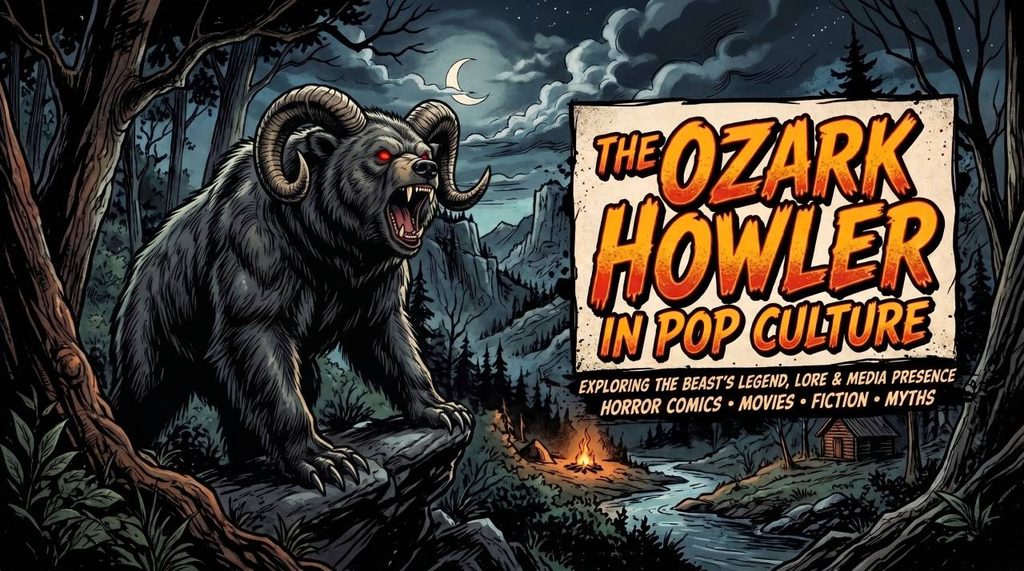
Although the Ozark Howler has never reached the mainstream recognition of creatures such as Bigfoot, the Mothman or the Jersey Devil, it has developed a surprisingly distinctive place in American cryptid literature, children’s fiction, comics, television and modern monster culture.
Unlike many legendary creatures that are simply mentioned alongside other cryptids, the Howler has repeatedly been used as a central character or subject in its own right.
📚 Tales of the Ozark Howler
One of the most frequently cited literary works connected directly to the creature is Tales of the Ozark Howler, attributed to Saul Ashton.
Modern editions describe the work as having originally appeared in 1936, supposedly as a small Ozark publication collecting folklore, eyewitness accounts and stories surrounding the creature. A later edition was republished in 2019.
However, this particular book requires an important qualification for a factual encyclopedia. The claimed 1936 publication history, the identity of Saul Ashton and the circumstances surrounding the supposed disappearance of the original book have been seriously questioned by researchers.
The Cryptid Atlas, for example, has argued that the Ashton/Cornus story itself appears to be part of a later fictionalized construction rather than a securely documented piece of 1930s Ozark publishing history.
Cryptid Legends therefore treats Tales of the Ozark Howler as a notable work associated with the modern literary mythology of the Howler, but not as unquestionable evidence for an independently documented 1936 tradition.
📖 Ozark Superstitions
The Howler also appears within the wider tradition of published Ozark folklore associated with folklorist Vance Randolph and Ozark Superstitions.
This is particularly interesting because the Howler tradition has sometimes been associated with names such as Hoo-Hoo, illustrating how regional folklore could use different names and descriptions for frightening or unusual creatures of the Ozark wilderness.
Later cryptid literature has drawn connections between these traditions and the modern Ozark Howler.
📖 The Hair of the Black Howler
In 1973, writer Timothy Godwin took the Howler considerably beyond traditional regional folklore in the science-fiction short story The Hair of the Black Howler, published in Cryptic Universe.
Rather than simply presenting the creature as an unexplained animal in the Ozarks, the story reimagined the Howler as a multidimensional, time-travelling creature, demonstrating how the legend could be transformed into speculative fiction.
The story represents one of the earliest documented examples of the Howler being deliberately transformed from a regional monster legend into a fantastical fictional character.
📚 Billy Bob’s Howler
The Ozark Howler has also appeared in Ross Malone’s Billy Bob’s Howler, a work of children’s/juvenile fiction built directly around the creature.
It belongs to the growing body of children’s literature that uses regional cryptids as protagonists or monsters, bringing the Howler beyond specialist cryptozoology and into accessible fictional storytelling.
The book is specifically identified in reference literature concerning the creature’s appearances in fiction.
📚 Hunt the Ozark Howler
One of the best-documented children’s books devoted specifically to the creature is Jan Fields’ Hunt the Ozark Howler, illustrated by Scott Brundage.
Published by ABDO/Calico in 2016, it forms part of the Monster Hunters series. The story follows the fictional Discover Cryptids crew as they travel to Arkansas to investigate reports of the Ozark Howler.
The book presents the creature through an adventure/mystery format, with the characters investigating tracks and reports while competing with another television crew.
This is a particularly significant pop-culture appearance because the Howler is not merely mentioned as part of a catalogue of monsters, it is the central mystery around which the story is constructed.
📚 Eric R. Asher’s Mason Dixon Series
The creature has also been incorporated into the supernatural/cryptid fiction of Eric R. Asher, appearing within the Mason Dixon monster-hunting universe.
The Howler is therefore part of a broader fictional world in which legendary creatures and supernatural threats become active elements of the narrative rather than simply folklore subjects.
References to the Howler’s appearance in the series are documented in literature concerning its fictional history.
📖 Ozark Howler & Ozark Howler Verse
The creature has also inspired regional poetry and literary works, including titles such as K. W. Peery’s Ozark Howler and Rufus Grey’s Ozark Howler Verse.
These works are important because they demonstrate that the Howler has developed beyond straightforward monster hunting and into a symbol of Ozark landscape, atmosphere and folklore.
📰 Comic Books
The Howler received its own comic-book treatment with Kelly Reno’s Tale of an Ozark Howler, published in 2008.
The comic places the creature itself at the centre of the story, giving the Howler a visual identity that helped reinforce the familiar modern image of the horned, dark-furred beast.
📺 In Search of Monsters — Travel Channel, 2019
The Ozark Howler received one of its most prominent television appearances in the Travel Channel series In Search of Monsters.
The Howler was the subject of Season 1, Episode 10, which aired in June 2019.
The programme examined purported photographs and audio recordings and presented theories concerning the creature’s possible origins, including the show’s sensational suggestion that the Howler could have demonic origins.
As with other paranormal-investigation programming, the episode should be regarded as entertainment and popular cryptid investigation rather than scientific confirmation.
Its importance to the Howler’s cultural history is nevertheless considerable: it introduced the creature to an international television audience alongside much better-known cryptids.
📺 Expedition X — “The Ozark Howler”, 2022
The Howler returned to television in 2022 in Discovery Channel’s Expedition X.
Season 5, Episode 2, titled “The Ozark Howler,” aired on 1 June 2022.
Hosts Phil Torres and Jessica Chobot travelled into the Ozarks to investigate reports of the creature, examining eyewitness accounts, surveillance footage and purported recordings of its distinctive howl.
The episode helped establish the Howler as one of the recurring regional cryptids considered worthy of investigation by modern paranormal television.
📺 Other Television & Documentary Appearances
The creature has also appeared in smaller documentary, paranormal and cryptid productions, particularly programmes exploring the wider folklore of the Ozarks.
These appearances tend to repeat the same core imagery, a large dark animal, horns or antlers, glowing eyes and an extraordinary howl, and have played a major role in standardising the visual version of the Howler now familiar to modern audiences.
🎮 Trading Cards & Cryptid Collecting
The Ozark Howler has also entered modern cryptid collecting culture through trading-card games.
The Ozark Howler appears in multiple MetaZoo sets, most notably as card #90/165 in the Wilderness set and as card #24 in the MZ1 Base Set
Its inclusion places the Howler within a much broader modern cryptid universe alongside creatures such as Bigfoot, Mothman, the Jersey Devil and other regional legends.
This is particularly significant for the Howler because trading-card culture has helped transform regional folklore creatures into collectible visual icons, giving the creature artwork, character design and a recognisable monster identity beyond the Ozarks themselves.
📚 Recent Cryptid Horror Fiction
The Howler has continued to appear directly in modern horror fiction.
Edward J. McFadden III’s Howler: Terror in the Ozarks was published by Severed Press in 2025.
The adventure-horror novel places the creature at the centre of a violent mystery surrounding a hunting preserve in the Ozark Mountains, presenting the Howler as a dangerous physical predator rather than simply a supernatural rumour.
Even more recently, Cal Finch’s Call of the Ozark Howler was published in June 2026. The novel follows a cryptozoologist investigating disappearances in Missouri, with the investigation eventually leading toward the legendary horned predator of Ozark folklore.
The creature also features in David Wood’s The Ozark Howler, the sixteenth entry in the Dane Maddock Universe. Published as modern adventure/thriller fiction, it uses the Howler as the mysterious predator behind disappearances in the Ozarks.
🐾 The Howler’s Cultural Identity
Unlike some cryptids whose popular image has been almost completely detached from their original folklore, the Ozark Howler has retained a remarkably consistent identity in popular culture.
Across books, comics, television and games, the same basic imagery repeatedly returns:
Dark shaggy fur • enormous size • horns or antlers • glowing eyes • catlike or bear-like body • and the terrifying howl
That consistency has helped turn the Howler into one of the signature monster figures of Ozark folklore, even though there remains no scientific evidence establishing it as a living species.
Its journey through popular culture is therefore an interesting one: from a regional Ozark monster story, to folklore literature, to children’s fiction and comics, and eventually to television investigations, cryptid trading cards and modern horror novels.
The Ozark Howler may remain unverified in the biological sense, but culturally it has become something much easier to prove, a genuine part of the modern folklore and monster culture of the American Ozarks.