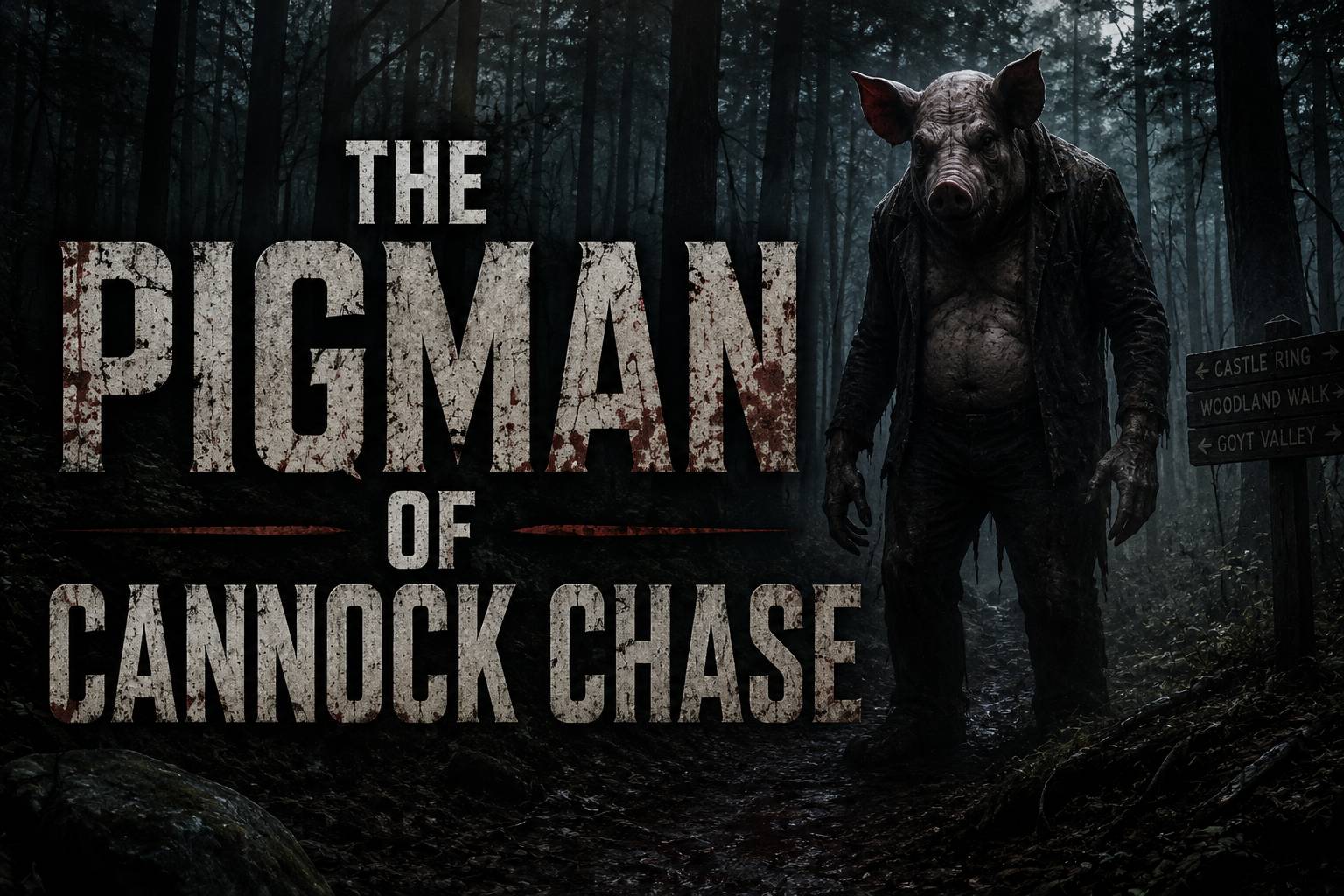
There are places where the forest seems to hold onto its secrets.
Across the ancient woodland and heath of Cannock Chase, paths disappear beneath the trees, mist gathers between the hills, and the landscape carries memories of soldiers, prisoners, forgotten camps and stories passed quietly from one generation to the next.
And somewhere within those stories is something far stranger.
For decades, visitors to Cannock Chase have whispered of a figure that is neither quite man nor beast, a grotesque pig-faced creature said to haunt the darkness of the Chase.
Some accounts describe a huge humanoid form moving upright between the trees; others speak of a creature with the head or features of a pig, glimpsed only briefly before disappearing back into the forest.
Unlike Britain’s older legendary beasts, the Pigman is not surrounded by centuries of established mythology. Instead, its story belongs to the world of modern folklore, a tale seemingly born from rumours, wartime mysteries and the unsettling atmosphere of Cannock Chase itself.
The legend became particularly associated with the forests around Castle Ring, where the ancient earthworks and surrounding woodland have provided a natural stage for generations of strange stories.
Here, a distant shape between the trees, an unexplained noise in the darkness or a fleeting movement along an isolated track can become something far more sinister once the story of the Pigman is known.
But what lies behind the legend?
Was the Pigman ever reported as a genuine creature by someone who believed they had encountered something they could not explain?
Did the story grow from older rumours surrounding Cannock Chase’s military history? Or is the creature entirely a product of modern storytelling, strengthened through repetition until folklore began to resemble eyewitness history?
The answers are far less certain than the legend itself.
What is certain is that the Pigman of Cannock Chase has become one of Staffordshire’s most distinctive modern monster stories, a dark piece of local folklore where the boundaries between rumour, memory, wilderness and imagination become difficult to separate.
And in a forest already filled with stories, that may be precisely why the Pigman continues to be seen.
🐗 Physical Appearance
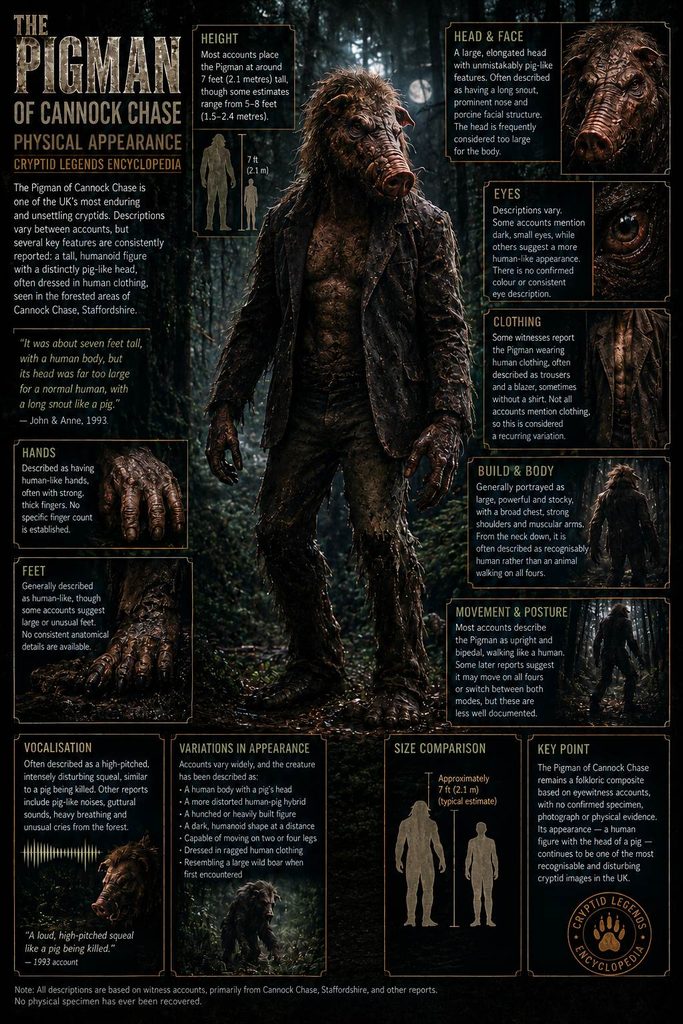
Descriptions of the Pigman of Cannock Chase are surprisingly consistent in their central features, despite the absence of any authenticated photograph, specimen or other physical evidence.
The creature is generally portrayed as a large humanoid figure with distinctly porcine facial characteristics, although individual accounts vary considerably in the exact appearance of the head, body, clothing and manner of movement.
The most frequently repeated description is of a creature approximately 7 feet (2.1 metres) tall, with the proportions and general physique of a large human male.
From the neck down, witnesses have described something recognisably humanoid rather than an animal walking on four legs.
The figure is often portrayed as broad, powerful or stocky, giving the impression of considerable physical strength.
The most distinctive feature is the head.
🐖 The Pig-Like Head
The Pigman is traditionally described as possessing an unmistakably pig-like or swine-like head attached to an otherwise human body. The head is frequently said to appear disproportionately large for a human, creating an immediately unnatural silhouette.
One of the better-known alleged encounters, reported by John and Anne while walking near Castle Ring in October 1993, describes a figure approximately seven feet tall whose body appeared human.
The witness stated that the creature’s head was far too large for a normal human, with an elongated face terminating in a snout-like nose. The account forms one of the principal descriptions repeatedly reproduced in later Pigman literature.
The porcine characteristics are generally concentrated around the front of the face rather than being described as a complete transformation into a conventional wild pig. In this respect, the Pigman is closer to the traditional human-animal hybrid archetype than to an unusually large boar.
The reported facial features include:
- A large, elongated or distorted head
- A prominent pig-like snout or elongated nose
- A generally porcine facial structure
- An appearance described by witnesses as grotesque or unnatural
- A head noticeably oversized compared with a normal human body
The exact details of the eyes, ears and teeth are considerably less consistent between accounts. Unlike some cryptid traditions, there is no reliable historical description establishing a particular eye colour, tusk structure or other specialised anatomical feature as a universal characteristic.
🧍 Humanoid Body
Below the head, the Pigman is normally described as essentially human in form.
The figure is generally portrayed as standing upright on two legs, with human-like arms, torso and proportions. Some retellings describe a particularly strong or muscular physique, reinforcing the impression of a large adult male rather than a conventional animal.
The alleged 1993 Castle Ring witness specifically described the body as looking like that of a man from the neck down.
Other accounts similarly describe a tall, imposing figure rather than a creature resembling a giant pig. This distinction is important because the Cannock Chase Pigman is sometimes confused with stories of enormous wild boars. Within the principal Pigman tradition, however, the creature is fundamentally humanoid.
👔 Clothing
One of the strangest recurring elements is that the creature has sometimes reportedly been wearing human clothing.
Accounts describe clothing ranging from ordinary-looking garments to ragged or poorly maintained clothes. One frequently reproduced description states that the Pigman wore trousers and a blazer but no shirt, creating an especially disturbing contrast between the familiar appearance of a dressed man and the unmistakably animal-like head above it.
The clothing is not present in every version of the legend, however, and should therefore be regarded as a recurring variation rather than a fixed anatomical or visual characteristic.
The image produced by these accounts is particularly unsettling: a very tall human-shaped figure apparently dressed like a man, but carrying the head of a pig.
🐾 Movement and Posture
Most of the classic Pigman accounts portray the creature as upright and bipedal.
The 1993 Castle Ring account describes a figure standing and behaving as a humanoid, while later internet reports have sometimes introduced considerably more animal-like behaviour. Some modern retellings claim that the creature can move on all fours before rising onto its hind legs, while others describe it running upright like a human.
These latter descriptions are considerably less securely documented and appear primarily in paranormal and online accounts rather than established historical sources.
Where the traditional description is concerned, the defining visual characteristic remains the contrast between:
a human-shaped body → upright posture → unusually large head → elongated pig-like snout.
🔊 Vocalisation
Although technically behavioural rather than physical, the Pigman’s alleged vocalisation is one of the most distinctive aspects of its reported appearance and is therefore relevant to how witnesses identify it.
The creature is commonly said to produce a high-pitched, intensely disturbing squeal, sometimes compared directly with the sound of a distressed or slaughtered pig.
In the 1993 Castle Ring account, the witnesses reportedly heard a loud squealing sound after entering their vehicle, described as resembling a pig being killed.
Other versions describe combinations of:
- High-pitched squeals
- Pig-like noises
- Guttural sounds
- Heavy breathing
- Unusual cries from within the woodland
The reported vocalisation has become sufficiently associated with the legend that hearing unexplained squealing in the Chase is sometimes interpreted as a potential Pigman encounter.
🐗 Variations in Reported Appearance
The modern Pigman tradition has accumulated additional characteristics as the story has circulated through paranormal books, websites, forums and investigator accounts.
Some versions portray the creature as:
- A completely human-bodied figure with a pig’s head
- A more heavily distorted human-pig hybrid
- A hunched or heavily built humanoid
- A dark, roughly humanoid figure seen at a distance
- A creature capable of moving between two-legged and four-legged locomotion
- A figure dressed in ragged human clothing
- A large, animalistic creature resembling an enormous wild boar when first encountered
There are also accounts in which the creature is confused with other Cannock Chase entities, particularly alleged Dogman/Werewolf-type figures. These stories should not automatically be treated as descriptions of the Pigman itself, as the Chase has accumulated several independent modern creature legends.
🎭 The Pigman Image in Folklore
Taken together, the recurring descriptions create a remarkably distinctive folkloric image:
A towering human-shaped figure, roughly seven feet tall, with a disproportionately large head and an elongated pig-like snout, sometimes dressed in human clothing and associated with a piercing porcine squeal.
This is the core appearance around which the Cannock Chase Pigman legend has developed.
However, there is no authenticated physical description that can be established scientifically. The seven-foot height, pig-like head and clothing originate from eyewitness and folklore accounts, while many additional characteristics have appeared through subsequent retellings.
Consequently, the Pigman’s appearance should be understood as a folkloric composite rather than a confirmed anatomical profile. The consistency of its central image is nevertheless significant from a cultural perspective: unlike many poorly defined British cryptids, the Cannock Chase Pigman has developed a recognisable visual identity of its own — the human figure with the face of a pig, lurking among one of Staffordshire’s most atmospheric landscapes.
📍 Location
🌎 Region: Cannock Chase, Staffordshire, England, United Kingdom
🇬🇧 Country: England, United Kingdom
🏴 County: Staffordshire
🏛️ Administrative Areas: Cannock Chase District / Stafford Borough / Lichfield District
🌲 Principal Folklore Area: Cannock Chase National Landscape
🏰 Notable Reported Hotspot: Castle Ring and surrounding woodland
🏘️ Nearest Settlements: Cannock, Hednesford, Rugeley and Cannock Wood
🌿 Landscape: Woodland, lowland heath, valleys, open heathland and historic parkland
🧭 Approximate Cannock Chase Coordinates: 52.72° N, 2.00° W
📌 Castle Ring Coordinates: 52.7132° N, 1.9360° W
🗺️ Castle Ring National Grid Reference: SK 04434 12827
🌲 The Cannock Chase Landscape
The Pigman of Cannock Chase is associated with the extensive wooded and heathland landscape of Cannock Chase in Staffordshire, rather than with a single isolated location.
Cannock Chase covers approximately 69 square kilometres (26 square miles) and forms a distinctive elevated landscape in the heart of the Midlands.
Its mixture of dense forest, open heath, valleys, secluded tracks and historic sites provides the setting for the modern Pigman legend.
The creature’s folklore is particularly associated with the southern and south-eastern portions of the Chase, with Castle Ring repeatedly appearing in accounts and later retellings.
Castle Ring is an ancient Iron Age hillfort occupying the highest point of Cannock Chase, at approximately 242 metres above sea level. The surrounding woodland and heath provide extensive areas of cover immediately beyond the hillfort.
Castle Ring is therefore an especially useful geographical reference point for the Pigman legend. It should not, however, be interpreted as meaning that sightings are confined to the hillfort itself.
🏰 Castle Ring
Castle Ring, Cannock Wood, Staffordshire
📍 Coordinates: 52.7132° N, 1.9360° W
🗺️ National Grid Reference: SK 04434 12827
The hillfort sits on the summit of a plateau at the south-eastern edge of Cannock Chase. Its prominent earthworks surround approximately 3.6–3.8 hectares, with banks and ditches forming multiple defensive circuits.
Historic England identifies it as a Scheduled Monument, while the local authority describes it as the highest point on Cannock Chase.
For the purposes of the Cryptid Legends map, Castle Ring is the best single focal point for the Pigman, because it provides a precise, recognisable landmark within the much larger territory of the legend.
🌲 Habitat
The Pigman of Cannock Chase is traditionally described as a creature of dense woodland, secluded forest tracks and remote heathland, with the darker and less frequently visited parts of the Chase providing the setting for many versions of the legend.
Unlike cryptids associated with a particular water body or mountain range, the Pigman is portrayed as a terrestrial woodland figure, encountered primarily after dark and away from populated areas.
🌳 Dense Woodland
The deepest woodland provides the classic environment associated with the Pigman. Mature trees, thick undergrowth, fallen timber and narrow paths create numerous places where a large animal—or something interpreted as one, could remain concealed from passing walkers.
The character of these woods is particularly important to the legend. During daylight, Cannock Chase is a popular recreational landscape, but after nightfall the same network of trees and paths becomes considerably more isolated.
Limited visibility, unfamiliar noises and the difficulty of judging distances between trees can make brief encounters especially unsettling.
Traditional accounts therefore tend to place the Pigman within or immediately alongside woodland rather than in open countryside, with witnesses supposedly catching only a fleeting glimpse before the creature disappears among the trees.
🌿 Heathland & Forest Margins
Cannock Chase is not exclusively continuous forest. Areas of open heath, grassland and scrub occur between wooded sections, creating natural transition zones between open and enclosed habitat.
These woodland margins are particularly compatible with the Pigman tradition. A large dark figure moving between trees and open ground could potentially be visible for only a few seconds before entering cover.
The contrast between exposed heathland and shadowed woodland also contributes strongly to the visual character of the legend.
Such edge environments are common in folklore involving mysterious beasts: they provide enough open ground for an alleged encounter while retaining nearby cover into which the creature can seemingly vanish.
🐗 Woodland Floor & Dense Understory
The Pigman’s supposed appearance as a heavy, animal-like humanoid has also encouraged comparisons with large woodland mammals.
The Chase contains habitat capable of supporting deer, foxes, badgers and other terrestrial wildlife, while areas of dense vegetation provide shelter and feeding opportunities for numerous species.
For the folklore itself, however, the woodland floor is significant because many alleged encounters are imagined at ground level. Rather than emerging from the sky, water or caves, the Pigman is traditionally depicted as moving along tracks, through vegetation or between trees.
Mud, leaf litter and soft ground would theoretically provide opportunities for footprints to be noticed. Despite this, no authenticated trackway attributable to a Pigman has been established.
🌙 Night-Time Environment
Darkness is arguably one of the most important environmental elements in Pigman stories.
The majority of the creature’s folklore involves night-time or low-light conditions, when the Chase becomes quiet and visual identification becomes difficult.
Headlights, torches and moonlight can illuminate only small portions of the surrounding landscape, while movement between trees can produce fragmented glimpses of an unfamiliar shape.
Animal eyeshine can also appear unusually bright when illuminated at night. Combined with shadows, distance and the expectation of encountering something frightening, this creates conditions particularly suited to the development of monster reports.
The recurring association with darkness does not establish a biological nocturnal behaviour for the Pigman, but it is a consistent feature of the folkloric habitat in which encounters are said to occur.
🏕️ Remote Paths & Recreation Areas
Although Cannock Chase attracts walkers, cyclists, campers and other visitors, its extensive network of paths creates numerous stretches where a person can become temporarily isolated from other people.
This has become an important part of modern Pigman folklore. Stories are particularly suited to isolated paths, forest clearings and areas away from major roads, where a witness might encounter something unexpected without other people immediately being present to corroborate the experience.
The contrast between a familiar recreational landscape and an apparently deserted forest after dark gives the Pigman legend much of its atmosphere: the creature is imagined as inhabiting a landscape that is ordinary by day but potentially threatening at night.
🪖 Wartime Landscape
Some versions of the Pigman legend connect the creature to the Chase’s former military and prisoner-of-war landscape, particularly abandoned or secluded areas associated with wartime activity.
This is primarily a feature of the story’s folklore rather than evidence of a habitat preference. Nevertheless, disused military sites, woodland clearings, old tracks and surviving wartime structures provide evocative settings for a legend involving secret experiments and an escaped creature.
The association is therefore best understood as part of the environmental storytelling surrounding the Pigman: the physical landscape supplies the mysterious setting onto which the later experimental-origin narrative has been attached.
🏰 Castle Ring & Elevated Woodland
Castle Ring and its surrounding woodland have become particularly prominent in modern Pigman stories. The combination of ancient earthworks, trees, isolated paths and changing visibility provides an especially atmospheric environment for alleged encounters.
Rather than representing a confirmed territorial centre for an unknown animal, Castle Ring’s importance appears to have developed through repetition within local folklore and paranormal literature.
Its ancient appearance and relative isolation make it an ideal setting for a modern British monster legend.
🧭 Traditional Habitat Profile
Primary environment: 🌲 Dense woodland and forest
Secondary environment: 🌿 Heathland, scrub and woodland margins
Terrain: 🪨 Woodland floor, forest tracks, clearings and uneven ground
Activity period: 🌙 Predominantly associated with darkness and low-light conditions
Human proximity: 🚶 Generally portrayed as occurring away from busy areas, particularly on isolated paths
Associated landscape: 🪖 Former military areas, wartime sites and secluded forest locations
Folkloric stronghold: 🏰 Woodland surrounding Castle Ring and other isolated parts of the Chase
Evidence for habitat: ❌ No verified physical evidence establishes the Pigman’s habitat
The habitat of the Pigman is therefore inseparable from the atmosphere of Cannock Chase after dark: enclosed woodland, open heath, ancient earthworks, isolated paths and the remnants of a heavily used military landscape.
Within the legend, these environments provide the creature with concealment and witnesses with only fleeting opportunities to observe it.
🐗 Background & Legend
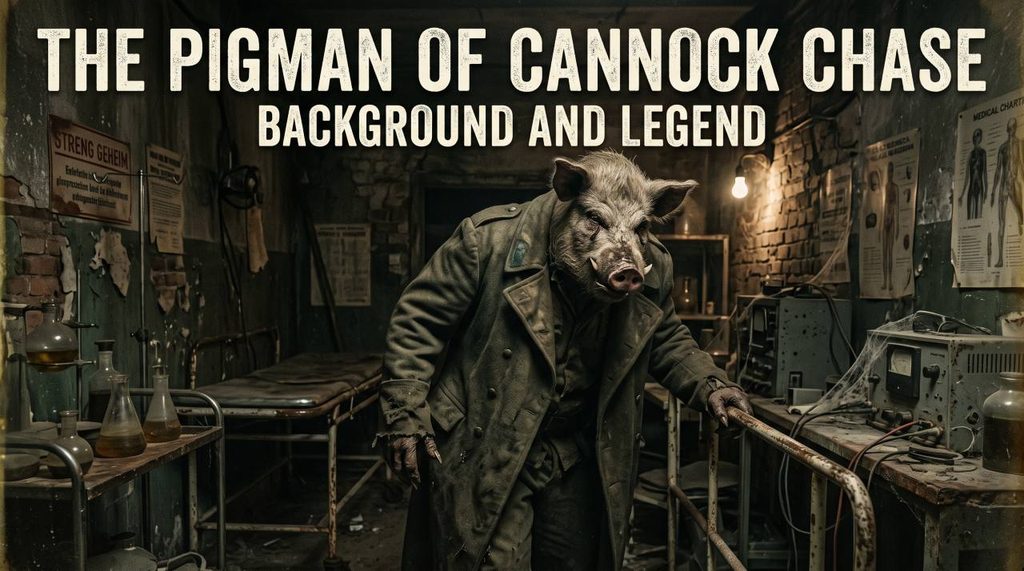
Long before the Pigman became an internet-era cryptid, Cannock Chase already possessed the kind of landscape from which unsettling folklore naturally grows: dense woodland, open heath, secluded tracks and the remains of a long military history scattered across the Staffordshire countryside.
Within that setting, a particularly disturbing legend eventually emerged, the story of a strange, pig-faced humanoid said to inhabit the Chase.
🌲 The Emergence of the Pigman Legend
The Pigman story is generally traced to the 1960s, although the precise point at which the legend was first told remains uncertain.
Historian Richard Pursehouse has described the story as emerging during this period amid rumours surrounding secret human experimentation during the Second World War.
This connection became an important part of the mythology, but there is no surviving contemporary evidence demonstrating that such an experiment actually occurred.
The basic legend that developed was considerably more sinister than a simple unidentified animal.
According to versions subsequently repeated in local folklore and paranormal literature, secret wartime experiments had supposedly taken place somewhere around Cannock Chase.
In the most extreme versions, researchers were alleged to have attempted to combine human and pig characteristics, producing a grotesque hybrid that eventually escaped into the surrounding countryside.
Exactly what happened differs considerably between tellings.
Some versions describe a human being deliberately altered through experimentation, while others tell of a bizarre breeding or genetic experiment involving pigs and humans.
Another particularly macabre variation claims that a woman was subjected to an experiment involving pig DNA and subsequently gave birth to a pig-headed or pig-like child. In later versions, the resulting creature is said to have survived and disappeared into the forests of Cannock Chase.
These details should be regarded as later folklore rather than established historical events. There is no reliable documentation identifying a wartime laboratory, experiment, scientist or surviving military record connected to such a creature.
⚗️ WWII, POW Camps & Secret-Experiment Lore
The wartime component nevertheless gives the legend an unusually strong local foundation.
Cannock Chase was heavily associated with military activity during both World Wars. Training camps existed around the Chase, while Brocton and Rugeley were associated with military installations and prisoner-of-war facilities.
German and Italian prisoners were held in the wider Cannock Chase area, and traces of this wartime landscape remain visible today.
For later storytellers, the combination of isolated woodland + military installations + prisoners + rumours of secret experiments provided fertile ground for a modern monster story.
There is an important distinction here. Secret and experimental military research genuinely existed during the Second World War, including chemical and biological research elsewhere in Britain.
That historical reality appears to have helped make the Pigman’s fictional premise sound superficially plausible. But the leap from documented wartime experimentation to a human–pig hybrid roaming Cannock Chase belongs to folklore.
As historian Emma Newlands has pointed out in discussions of the legend, the supposed biological experiment is extraordinarily implausible, and there is no evidence that anything resembling the story was undertaken at Cannock Chase.
The wartime connection therefore works best as the narrative foundation of the legend, rather than evidence for the creature itself.
🏰 Castle Ring & The Haunted Chase
As the story developed, particular locations on Cannock Chase became associated with the Pigman.
Chief among them is Castle Ring, an Iron Age hillfort and one of the most atmospheric locations on the Chase. Its elevated position, surrounding woodland and relatively secluded paths have made it a recurring setting for supernatural stories.
Castle Ring was not necessarily the original home of the Pigman legend, but it became one of the places most strongly connected with later accounts.
This was part of a wider process through which the Pigman became incorporated into Cannock Chase’s already extensive supernatural reputation. Stories of strange lights, ghosts, unexplained figures, UFOs, werewolf-like creatures and other alleged encounters have circulated around the Chase for decades.
The Pigman consequently became one creature within a much larger landscape of local mystery.
Rather than existing as an isolated monster story, it became attached to particular woods, roads, camps and landmarks, allowing visitors to associate the legend with real places that could still be explored.
🐗 From Local Story to Cryptid
The Pigman also changed as it passed from storyteller to storyteller.
Descriptions of the creature are not completely consistent. Some versions portray something essentially human-shaped with a pig’s head, while others describe a more animalistic creature, sometimes enormous, hairy or physically imposing. Details concerning its behaviour, intelligence, size and origins likewise vary.
This is characteristic of modern folklore: the central image remains recognisable while individual storytellers add details that make the story more frightening.
Paranormal researchers and local investigators subsequently helped preserve and popularise these accounts.
Authors such as Lee Brickley incorporated the Pigman into wider collections of Cannock Chase mysteries, placing the creature alongside the area’s other alleged supernatural phenomena.
The legend then moved naturally into the emerging world of internet cryptozoology.
Online forums, paranormal websites, YouTube investigations, Facebook groups and social-media posts allowed older stories to be repeatedly retold, often with additional details attached.
Accounts that were originally vague or second-hand could acquire increasingly specific descriptions as they were copied between sources.
This has made it difficult to establish which details belong to the earliest form of the legend and which appeared considerably later.
🕯️ Original Folklore vs Later Embellishment
One of the most important features of the Cannock Chase Pigman story is therefore the distinction between its core folklore and its later elaborations.
The relatively consistent core is simple:
A strange pig-like or pig-headed humanoid is said to inhabit the woods of Cannock Chase.
Around that core, later versions have accumulated stories of wartime experiments, hybridisation, secret laboratories, escaped creatures, frightening encounters and increasingly elaborate descriptions.
There is currently no secure evidence demonstrating that all of these elements were present when the story first emerged.
Indeed, modern researchers have noted that many contemporary accounts ultimately trace back to repeated retellings rather than identifiable first-hand witnesses.
That does not make the folklore uninteresting. Quite the opposite: the Pigman provides an excellent example of how a relatively modern British monster legend can develop from local history, rumour, landscape and storytelling, gradually becoming a fully recognisable cryptid.
Cannock Chase itself is central to that evolution. Its wartime ruins, ancient earthworks, dark forests and long tradition of supernatural tales provide the setting; the mysterious Pigman provides the monster.
And somewhere between those two lies the enduring appeal of the legend, a story that asks whether something genuinely strange once moved through the forests, while leaving the answer firmly within the realm of folklore.
🌲 Historical Sightings & Notable Reports
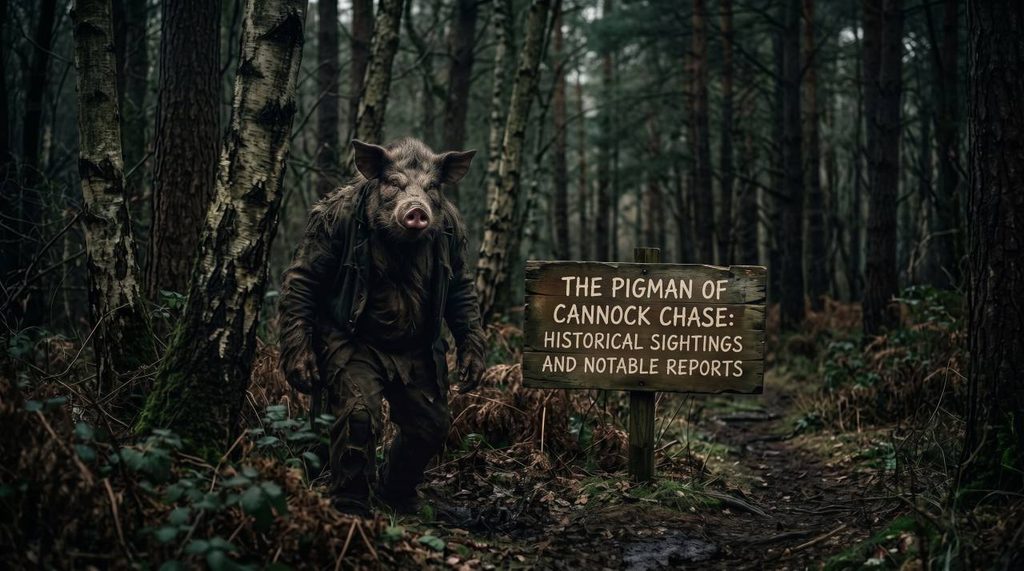
Unlike some British cryptid legends, the Pigman of Cannock Chase does not possess a long archive of contemporary newspaper reports, photographs, police records or physical evidence.
The surviving case history is instead built largely from oral testimony, later interviews, paranormal investigations and internet-era retellings.
This makes it difficult to establish a conventional chronological sighting record, but several reports have become particularly important in the development of the modern legend.
📜 The Alleged Wartime Sightings
Some modern accounts place the earliest Pigman reports during or shortly after the Second World War, when Cannock Chase was heavily associated with military activity, training camps and prisoner-of-war facilities.
These stories generally describe strange figures, noises or activity around military areas and later became incorporated into the explanation that a human–pig experiment had taken place on the Chase.
However, there is no surviving wartime report identifying a Pigman, nor is there documentary evidence that such an experiment occurred.
The wartime element therefore needs to be treated as part of the legend’s claimed backstory rather than an independently documented sighting period.
Historian Richard Pursehouse has stated that the Pigman story itself emerged in the 1960s, amid rumours concerning secret human experimentation during the war.
This distinction is important: the Second World War provides the setting for the origin story, while the 1960s represent the period in which the modern legend is said to have begun circulating.
🌲 The 1960s — The Legend Enters Local Folklore
According to Pursehouse’s historical research, the Pigman first emerged as a local story during the 1960s.
By this point Cannock Chase already possessed a strong association with military activity, wartime camps, unexplained occurrences and an atmosphere of secrecy. Stories about secret experiments could therefore become attached to an otherwise ordinary woodland encounter.
The surviving evidence from this period is largely folkloric rather than documentary. No authenticated contemporary newspaper account has been established which records a named eyewitness encountering a pig-headed humanoid during the 1960s.
This absence does not establish that nobody told such stories at the time, but it does mean that the frequently repeated claim that the Pigman has been continuously documented since the 1960s should be treated cautiously.
🗞️ Early Printed & Fortean References
Later researchers have pointed towards Fortean Times as an early source for printed Pigman material, with references appearing in paranormal/Fortean discussions rather than conventional contemporary crime or news reporting.
The precise earliest printed appearance is difficult to establish from the surviving online record, and later writers sometimes repeat earlier material without identifying its original source.
This is one reason the Pigman’s chronology can appear considerably older and better documented than the underlying evidence actually demonstrates.
A particularly useful example is the later critical discussion in Fortean Times, where Alan Murdie questioned the evidential chain surrounding Cannock Chase’s paranormal stories and highlighted the absence of independent firsthand witnesses.
A 2025 letter from Rob McKay of the Cannock Chase Sled Dog Group likewise stated that, despite his familiarity with the area, he did not know of anyone who had actually seen a Pigman.
👁️ October 1993 — The Castle Ring Encounter
One of the most frequently reproduced Pigman reports dates to October 1993 and allegedly occurred at Castle Ring, the Iron Age hillfort on Cannock Chase.
The account was supplied to paranormal researcher Lee Brickley by a couple identified as John and Anne. According to their testimony, they were walking around Castle Ring when they heard strange noises coming from the surrounding woodland.
As they returned towards their car, the husband looked back and reportedly saw an extremely unusual humanoid figure.
The creature was described as approximately 7 feet (2.1 metres) tall. From the neck down it reportedly resembled a human male and appeared to be wearing clothing, but the head was described as disproportionately large, with an elongated face and a snout-like nose.
The couple then reportedly heard a very high-pitched squealing sound, compared by the witnesses to the noise of a pig in distress, before retreating to their vehicle.
The account became one of the central eyewitness stories in the modern Pigman literature, and it has subsequently been reproduced by paranormal and cryptid writers.
There is an important evidential limitation, however: the report survives through its later publication by Brickley rather than through an independently located contemporary police or newspaper record.
Consequently, it is best classified as a retrospective eyewitness account, rather than a contemporaneously documented case.
🐗 The 2000s — A New Generation of Reports
During the early 2000s the Pigman became increasingly connected with the growing paranormal reputation of Cannock Chase.
One notable account was later published by Lee Brickley in 2014, concerning an alleged encounter which reportedly occurred in the mid-2000s around the Pye Green communications tower.
Brickley stated that he had been contacted by a man from the Walsall area who described camping on Cannock Chase with two companions.
The group had arrived after dark and were near the communications tower when the witness reportedly noticed what he initially thought was a large boar.
According to the account, the animal-like figure eventually rose onto its hind legs, revealing itself as a huge upright humanoid estimated by the witness at approximately 7 feet tall. He claimed that it then ran towards him at speed while producing a mixture of pig-like and highly unusual vocalisations.
The witness escaped to his vehicle and later told Brickley that he had no photographic evidence of the Pigman itself, although he claimed to have seen unusual lights in the area on other occasions.
The report is significant because it demonstrates how the Pigman narrative had developed beyond the Castle Ring tradition and had become associated with Pye Green and the wider network of unexplained phenomena reported on the Chase.
Again, the account remains anecdotal. There is no independently authenticated photograph, physical trace or official investigation confirming the encounter.
🌘 The 2010s — Internet Folklore & Paranormal Investigations
By the 2010s, the Pigman had become firmly established within the online folklore surrounding Cannock Chase.
Blogs, paranormal websites, YouTube investigators and social-media communities began repeating earlier reports while adding new stories of tall humanoids, strange noises and figures allegedly encountered after dark.
The Pigman was increasingly discussed alongside the Chase’s other paranormal traditions, including black-eyed children, werewolf-like creatures, big cats, strange lights and UFO reports. This created a broader supernatural landscape in which different legends sometimes became mixed together.
This period also saw the publication and promotion of Lee Brickley’s investigations, particularly:
- UFOs, Werewolves & The Pig-Man: Exposing England’s Strangest Location – Cannock Chase
- Haunted Cannock Chase
- Ghosts of Cannock Chase
Brickley’s work is important to the documentary history of the legend because he collected witness accounts and preserved stories that might otherwise have disappeared.
However, his books are paranormal investigations rather than academic zoological studies, and the reports contained within them remain dependent upon witness testimony.
🎙️ 2024 — The Castle Ring “Monster” Report
A further report helped revive interest in the Pigman during 2024.
A man identified only as Ralf, described as a bat enthusiast, reportedly visited Castle Ring at around 9pm on 3 September while attempting to listen for bats.
According to the account subsequently reported by Birmingham Live, he encountered something large within the woodland which he considered “definitely not human.”
The report became interesting to Pigman researchers because the witness was reportedly interested in wildlife rather than deliberately undertaking a paranormal investigation.
His account was subsequently discussed by investigators, including Vivien Powell in Animals & Men, where the report was presented as one of the reasons for taking another look at the Cannock Chase legend.
The report should nevertheless remain classified as unverified. The witness did not produce authenticated photographic or physical evidence demonstrating that the animal was a previously unknown humanoid creature.
🔦 Paranormal Field Investigations
Cannock Chase has attracted numerous organised paranormal investigations, particularly around Castle Ring, Pye Green and the German Military Cemetery.
Teams have conducted night-time investigations using cameras, night vision equipment, audio recording and other paranormal-investigation techniques.
Pigman has consequently become part of a wider phenomenon sometimes described as the “high strangeness” reputation of Cannock Chase.
The modern investigation scene is useful for documenting how the legend continues to generate reports, but it has so far failed to produce a piece of evidence capable of establishing the creature as a biological species.
One 2024 investigation by The Paranormal Detectives, for example, specifically included the Pigman among the creatures associated with Cannock Chase and explored the wider area in search of paranormal activity.
📰 2025 — Increasing Skepticism Over the Evidence
The Pigman received an interesting counterpoint in 2025, when discussion in Fortean Times drew attention to the weakness of the evidence behind many Cannock Chase creature reports.
Rather than producing a new confirmed sighting, the discussion highlighted a recurring problem: stories are repeatedly republished without an independent chain of witnesses leading back to an original event.
Rob McKay of the Cannock Chase Sled Dog Group wrote that he was familiar with the area and did not know of anyone who had actually seen a Pigman.
This does not disprove individual testimony, but it illustrates the difficulty of establishing how widespread genuine firsthand sightings really are.
📻 2026 — Mainstream Reassessment of the Legend
On 26 July 2026, BBC Radio WM and BBC West Midlands revisited the Pigman story in a detailed feature examining how the legend developed.
The report interviewed historian Richard Pursehouse, who placed the emergence of the story in the 1960s, as well as Dr Emma Newlands, a historian specialising in military history, and folklorist Dr Ceri Houlbrook.
The programme found that the Pigman remained a compelling part of Cannock Chase folklore but that there was no convincing evidence for the creature’s existence.
Houlbrook particularly emphasised the attraction of macabre local stories and the phenomenon of legend tripping, in which people visit locations hoping to encounter the creatures associated with them.
The 2026 coverage is particularly valuable because it places the Pigman firmly within the context of modern folklore rather than established zoology.
🔎 The Investigative Record
Taken together, the known Pigman case history reveals a striking pattern.
The strongest recurring elements are:
- Reports of a very tall humanoid, generally around 7 feet.
- A head or face resembling a pig or wild boar.
- Occasional reports of pig-like squealing or unusual vocalisations.
- A concentration of stories around Castle Ring and Pye Green.
- Repeated association with the military history of Cannock Chase.
- A tendency for reports to occur after dark.
- A complete absence of an authenticated specimen, footprint, photograph or biological trace.
The most frequently cited eyewitness cases, particularly the 1993 Castle Ring account and the later mid-2000s Pye Green account, are therefore important to the history of the legend, but they cannot currently be treated as independently verified cryptozoological cases.
⚖️ Reliability of the Historical Record
The Pigman is unusual because the history of the legend is considerably better documented than the creature itself.
There is good evidence that:
Cannock Chase has a genuine military history.
The Pigman became part of local folklore.
Researchers have collected reports from people claiming encounters.
The legend has been repeatedly discussed in newspapers, magazines, books, broadcasts and online communities.
What remains unestablished is the central claim:
That a living pig-headed humanoid has ever physically existed on Cannock Chase.
No authenticated physical evidence has emerged from the historical reports, and no investigation has produced a verified biological explanation requiring an unknown creature.
For the Cryptid Legends archive, the surviving cases are therefore best understood as historical folklore reports with varying levels of testimony, rather than confirmed encounters.
That distinction does not make the reports uninteresting. In fact, the development of the Pigman from a relatively obscure local story into one of Cannock Chase’s best-known supernatural figures is itself an important part of the creature’s history.
🔬 Scientific Evidence & Explanations
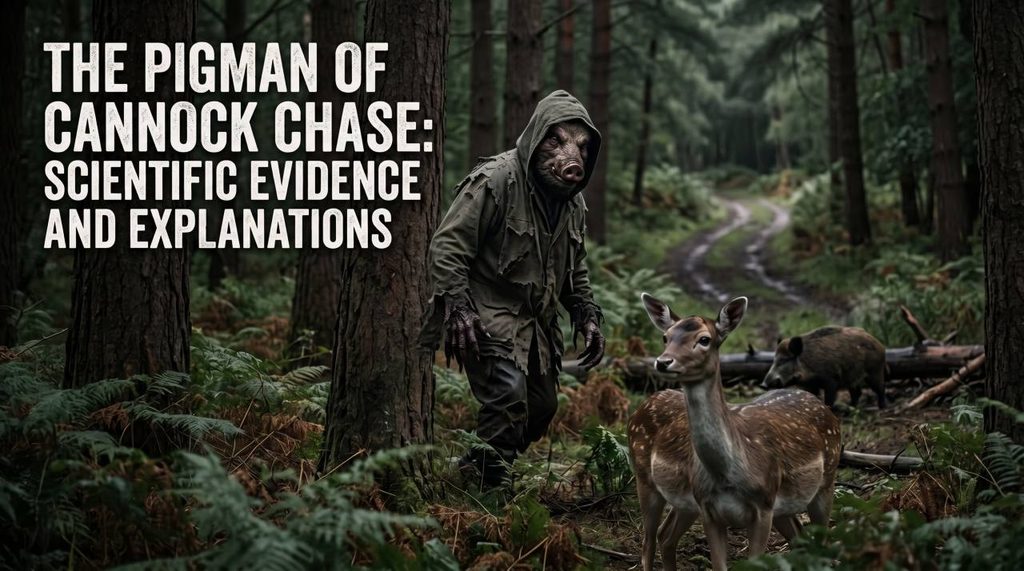
Unlike some British cryptid legends that have accumulated photographs, footprint casts, biological samples or other physical claims, the Cannock Chase Pigman has no authenticated physical evidence.
No body, bones, hair, tissue, biological sample or scientifically verified footprint has been produced, and there is currently no independently verified photograph or video demonstrating the existence of a pig-headed humanoid.
That does not mean every person who has reported something unusual was necessarily lying. It means that the observations themselves have never been independently demonstrated to represent an unknown creature.
🐗 What Could a “Pigman” Actually Be?
The descriptions attributed to Pigman encounters are remarkably suggestive of several possibilities. Reports generally describe a large, upright humanoid figure with an unusually large head, pig-like or elongated snout, and sometimes a very disturbing squealing sound.
The problem is that these characteristics can be produced by several ordinary circumstances, particularly in a heavily wooded environment at dusk or at night.
A person standing partly concealed among trees can appear substantially larger or more strangely proportioned than they really are. Clothing, hoods, masks and other objects can alter the apparent shape of a person’s head, while poor lighting makes it difficult to distinguish facial features.
Wild boar are another obvious source of confusion. Cannock Chase supports populations of wild animals, and a large boar moving through vegetation can present an observer with a dark, bulky silhouette and distinctive noises.
From a distance, an animal briefly standing or moving through uneven woodland could potentially be interpreted very differently from what it actually is.
There is, however, an important distinction: a wild boar does not explain every Pigman story.
Some accounts describe a clearly humanoid figure standing on two legs. Such reports therefore remain observations requiring interpretation rather than being conclusively identified as boars.
🌲 The Woodland Visibility Problem
Cannock Chase provides almost perfect conditions for ambiguous sightings.
The landscape contains dense woodland, plantations, heathland, winding paths and areas of uneven terrain. Visibility can change dramatically within only a few metres.
At dusk, depth perception becomes particularly unreliable. A person or animal partially obscured by vegetation may be visible for only a few seconds before disappearing into the trees.
An observer attempting to interpret an unfamiliar silhouette has very little information from which to reconstruct what they saw.
This is especially significant because many Pigman accounts describe encounters occurring around woodland edges and tree lines, rather than clear open ground where the complete body could be observed and its proportions independently assessed.
The famous image circulating online should therefore be treated cautiously. There are photographs on websites and social-media pages described as showing the Cannock Chase Pigman, but their provenance is generally unclear and none has been authenticated as evidence of an unknown humanoid.
📷 The Circulating “Pigman Photograph”
One particularly striking image occasionally associated with the legend depicts what appears to be a pig-faced or pig-headed figure crouching or partially hiding behind a tree.
The photograph is interesting from a folklore perspective because it visually resembles the creature described in modern Pigman accounts.
However, its origin, photographer, date and circumstances are not sufficiently established to treat it as scientific evidence.
It is therefore better catalogued as a claimed Pigman image rather than an authenticated sighting.
Possible explanations include a person wearing a mask or costume, a deliberately staged photograph, a manipulated or misidentified image, or simply an unusual object whose appearance has been interpreted according to the legend.
Without an original file, metadata, photographer testimony, exact location and independent examination, there is no reliable way to establish what the image actually depicts.
This distinction is particularly important because an image can become associated with a cryptid long after it was created. Once repeatedly reposted under a particular caption, the photograph itself can become part of the legend regardless of its original context.
🧬 Could the Pigman Have Been a Human–Pig Hybrid?
The most sensational explanation within the legend is that Pigman was supposedly created through secret human–pig experimentation during or shortly after the Second World War.
This is not supported by evidence.
The story generally claims that researchers attempted to combine human and pig biology, sometimes involving an alleged pregnancy in which a woman was supposedly implanted with experimental material before eventually giving birth to a pig-faced child.
Modern biomedical science does involve substantial research using pigs because pigs share a number of physiological characteristics with humans. Pig tissues and organs have been investigated for transplantation, and genetically modified pigs are an important area of biomedical research.
That genuine scientific connection, however, is very different from the legendary scenario.
There is no credible evidence that a human–pig hybrid was created at Cannock Chase, nor evidence that such an experiment produced a surviving humanoid creature.
Historian Richard Pursehouse, discussing the legend for BBC Radio WM in 2026, placed the emergence of the Pigman story in the 1960s, amid rumours about secret human experimentation during the Second World War.
The same BBC investigation interviewed historian Emma Newlands, who regarded the human–pig experimentation story as highly implausible.
🧪 The Wartime Experiment Theory
The wartime explanation is nevertheless important because it may explain why this particular monster developed in Cannock Chase.
Cannock Chase has a genuine military history, including wartime training activity, camps and military installations. That provides a real historical foundation onto which a secret-experiment story could easily be attached.
But the leap from:
Military activity → secret experiments → biological experimentation → human/pig hybrid → escaped creature
is entirely folkloric.
No surviving experimental records, military documents, medical records or biological evidence have been produced demonstrating such an event.
The story therefore appears to represent an example of legendary elaboration around genuine local history, rather than evidence that the history itself proves the creature existed.
👁️ Why Witnesses Can Be Convinced They Saw Something Extraordinary
There is also a well-known psychological problem associated with fleeting anomalous sightings.
When someone encounters an unfamiliar object under poor visual conditions, the brain attempts to construct a meaningful interpretation from incomplete information.
Once an observer knows that an area has a reputation for a particular creature, that expectation can influence how an ambiguous shape is subsequently remembered.
This does not require deliberate fabrication.
A person may genuinely remember seeing:
A very large, upright figure with a strange face
while the original observation may have lasted only seconds and occurred through trees, darkness or distance.
Later retellings can add details, the pig snout, enormous head, squealing, height and other characteristics, gradually producing a much more elaborate account than the original observation.
That mechanism is particularly relevant to a legend such as the Pigman because many of its alleged encounters are preserved through retelling rather than contemporary independent documentation.
🐾 Wild Boar, Deer and Other Wildlife
Wildlife should therefore remain among the leading mundane possibilities, particularly for reports involving movement, sounds or fleeting silhouettes.
Wild boar can produce loud squeals and grunts, while deer moving through woodland can create sudden rustling and fleeting upright silhouettes when viewed through vegetation.
Cannock Chase is also a landscape in which an observer can encounter wildlife unexpectedly, particularly away from busy roads and visitor areas.
Nevertheless, it would be too simplistic to claim that every Pigman sighting was definitely a boar. Some accounts specifically describe humanoid behaviour and proportions that witnesses considered distinctly unlike an animal.
The scientifically responsible position is therefore:
Wildlife offers plausible explanations for some observations, but there is insufficient evidence to identify the source of individual reports with certainty.
🕯️ Paranormal Interpretations
Not all Pigman traditions treat the creature as a biological animal.
Some modern accounts have incorporated ideas involving demons, supernatural entities, cursed beings, occult activity or manifestations associated with Cannock Chase’s wider paranormal reputation.
These interpretations belong to the folklore surrounding the creature rather than to scientific explanations.
Cannock Chase has accumulated a considerable collection of modern supernatural traditions, including reports of Black-Eyed Children, werewolves or dog-like humanoids, UFOs, unexplained lights and other phenomena.
This broader reputation can provide a cultural environment in which new stories are readily incorporated into the existing mythology.
Modern paranormal investigators have subsequently conducted night investigations on the Chase, particularly around areas associated with other reported phenomena.
These expeditions are useful for documenting how the legend is investigated and experienced today, but they have not produced independently verified biological evidence of a Pigman.
📚 What the Investigations Have Actually Found
Local researcher Lee Brickley has collected Pigman reports for many years and has published accounts from people claiming to have encountered the creature.
His work is valuable as a record of the modern legend and the testimony associated with it, but the material remains primarily anecdotal.
One frequently reproduced account concerns a couple who reportedly encountered a seven-foot humanoid around Castle Ring in October 1993.
Their description included an unusually large head, elongated snout and a high-pitched squealing sound. The account survives through later publication rather than a contemporary police or scientific investigation.
Another widely circulated testimony concerns a supposed 2006 encounter involving a camper who claimed to see a huge pig-like creature rise onto two legs before running towards him.
The latter account is particularly interesting because the witness initially considered that the sound and silhouette might belong to a large boar before concluding that what he saw was something else.
It demonstrates precisely why these reports are difficult to classify scientifically: the witness was attempting to interpret an observation in real time, under unusual circumstances, without physical evidence being recovered afterwards.
🔎 The Problem of Repetition
Perhaps the most significant evidence against the Pigman being a demonstrable zoological mystery is not one particular failed investigation, but the absence of progressively stronger evidence.
The legend has circulated for decades, yet there is still:
- 🦴 No verified remains
- 🧬 No biological sample
- 🐾 No authenticated footprint
- 📷 No independently verified photograph
- 🎥 No independently verified video
- 🧪 No medical or genetic evidence
- 👮 No documented police investigation establishing a creature
- 🔬 No zoological specimen
- 📑 No wartime documentation demonstrating the alleged experiment
Fortean journalist Alan Murdie has been particularly critical of the way Cannock Chase monster stories are repeated without independent eyewitness confirmation, arguing that repeated stories should not be confused with corroboration.
A 2025 Fortean Times letter from Rob McKay similarly questioned the existence of any firsthand Pigman sightings known locally.
🧠 A Modern Folklore Explanation
The evidence therefore points toward the Pigman functioning primarily as a modern folklore phenomenon.
The story possesses all the ingredients that allow a modern monster legend to survive:
A real and atmospheric landscape + genuine military history + rumours of secret experiments + frightening wildlife + ambiguous nighttime encounters + repeated storytelling + paranormal investigation + internet amplification.
Each generation can add another layer without requiring the original story to be true.
The Pigman consequently occupies an interesting position within British cryptozoology. Unlike older creatures rooted in medieval folklore, it appears to be a comparatively recent legend whose mythology developed during the second half of the twentieth century and subsequently evolved online.
⚖️ The Evidence Verdict
At present, there is no scientific evidence demonstrating that the Cannock Chase Pigman exists as an unknown biological creature.
The human–pig experiment remains unsupported, and the photographs and encounter reports circulating online have not reached a standard at which they can establish the existence of a previously unknown species or humanoid organism.
That does not make the Pigman uninteresting.
Quite the opposite: the lack of conventional evidence is part of what makes the case valuable to cryptozoology and folklore studies.
It provides an unusually clear example of how a modern British monster can develop from local history, rumour, ambiguous encounters and the human fascination with the unknown.
For Cryptid Legends, the Pigman is therefore best presented in two distinct ways:
As a creature: unverified and unsupported by physical evidence.
As a legend: remarkably persistent, locally distinctive and worthy of documenting in its own right.
📚 The Pigman in Pop Culture & Literature
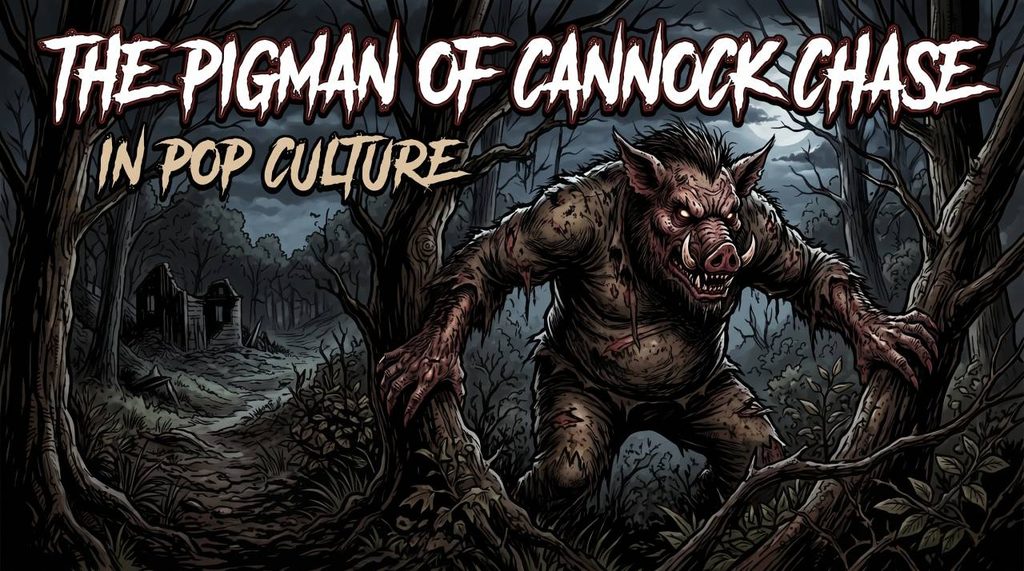
Unlike some British cryptids that have developed extensive film, television and literary franchises, the Pigman of Cannock Chase has remained largely a phenomenon of local folklore, paranormal publishing and modern internet culture.
Its appearances in popular media are relatively limited, but a small number of works have helped preserve and expand the legend.
📖 Books & Paranormal Literature
The most significant published work devoted directly to the Pigman is Lee Brickley’s UFO’s, Werewolves & The Pig-Man: Exposing England’s Strangest Location – Cannock Chase, published by Yam Yam Books in 2013.
The book is particularly important to the modern Pigman legend because it brings together the creature with the wider collection of strange phenomena associated with Cannock Chase, including UFO reports, werewolves, mysterious animals, ghosts and other paranormal stories.
Its Pigman material includes reported encounters and competing versions of the creature’s unusual origin story.
Brickley’s later Ghosts of Cannock Chase (2022) also identifies the Pigman among the area’s better-known supernatural legends, alongside the Black-Eyed Children and UFO reports.
While the book is primarily concerned with ghost stories and paranormal experiences rather than the Pigman alone, its inclusion demonstrates how the creature has become part of Cannock Chase’s broader supernatural identity.
Brickley’s Haunted Cannock Chase (2022) similarly references the Pigman as one of the legendary entities associated with the Chase.
These books are best regarded as paranormal and folklore collections rather than zoological investigations.
Their importance to the encyclopedia lies in documenting how the Pigman story has been circulated and developed within modern British cryptid culture.
🎙️ Podcasts & Online Paranormal Media
The Pigman has also found a natural home in the modern podcast and online paranormal community.
The Don’t Scare Claire podcast devoted an episode to Cannock Chase in August 2024, specifically discussing the area’s numerous alleged creatures and including a substantial segment on the Pigman.
The episode lists Brickley’s UFO’s Werewolves & The Pig-Man and Haunted Cannock Chase among its sources.
Online paranormal communities have likewise helped keep the story alive. Reddit, Facebook groups, paranormal websites and independent investigators periodically recycle older accounts, discuss alleged photographs and encourage night-time investigations of the Chase.
These discussions are culturally significant because they show the transition of the Pigman from local oral legend into internet-era cryptid folklore, although the accounts themselves remain anecdotal.
📺 Television & Documentary Appearances
The Pigman has received television and news attention, but there is currently no evidence of a major, widely released documentary or television series devoted exclusively to the Cannock Chase Pigman.
Its appearances have generally occurred within broader programmes or features concerning Cannock Chase’s paranormal reputation.
This is an important distinction: the Pigman has been covered by paranormal media, but has not developed the substantial dedicated screen presence enjoyed by cryptids such as Bigfoot, the Loch Ness Monster or Mothman.
Paranormal researcher Lee Brickley has also appeared on British television discussing Cannock Chase phenomena, helping bring the Pigman and the wider collection of Chase legends to a broader audience.
🎬 Film
There does not appear to be a major commercial feature film built specifically around the Cannock Chase Pigman.
The absence of a significant Pigman film franchise is notable in itself. The creature has remained much closer to the traditions of regional British folklore and paranormal storytelling than to the increasingly commercialised cryptid mythology surrounding some North American monsters.
🐗 The Pigman as Modern Folklore
The Pigman’s strongest presence in popular culture therefore remains the legend itself.
Books, podcasts, paranormal investigations, online discussions and local storytelling have repeatedly returned to the same basic image: a strange pig-faced or pig-headed humanoid moving through the dark woodland of Cannock Chase.
Over time, different storytellers have added new details, altered the creature’s supposed origins and connected it with other supernatural traditions.
The result is less a fixed character with a single canonical description than a living piece of modern British folklore, continually reshaped by the people who tell the story.
For Cryptid Legends, the Pigman is perhaps most interesting precisely because it has not become a mainstream fictional monster.
Its mythology remains closely tied to the landscape from which it supposedly emerged, the forests, heathland, wartime ruins and isolated paths of Cannock Chase.