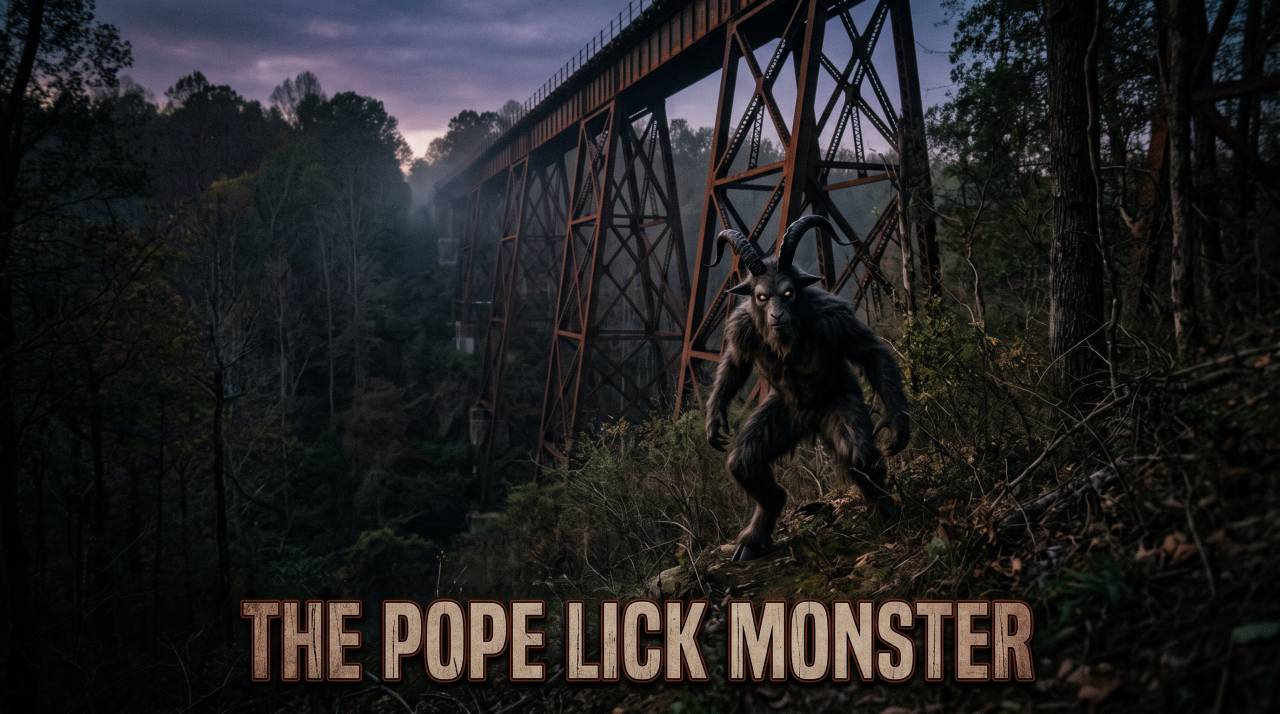
Pope Lick Creek, Jefferson County, Kentucky
There are places where the darkness seems to carry a story of its own.
In the wooded countryside of eastern Louisville, a railway trestle stretches high above Pope Lick Creek, a narrow steel bridge surrounded by trees, shadows and the constant threat of passing trains.
To those who know the folklore, however, the trestle is more than an abandoned-looking piece of railway infrastructure.
It is the domain of something far stranger.
They call it the Pope Lick Monster.
Descriptions vary, but the creature is most often portrayed as a grotesque half-man, half-goat or sheep, with a pale or distorted face, horns, cloven hooves and a powerful, unsettling presence.
Some versions of the legend claim that it can mimic familiar voices. Others say that it possesses a hypnotic ability, drawing unsuspecting visitors towards the railway tracks with an almost irresistible call.
And once the victim is on the trestle, there may be nowhere left to run.
The legend tells of a monster that deliberately lures people onto the tracks, waiting for the inevitable arrival of a train.
But the story of Pope Lick is darker than a simple monster tale.
Because the danger of the trestle is very real.
Over the decades, people have ventured onto the railway in search of the creature, sometimes as part of a terrifying game of legend-tripping. Several have been killed or seriously injured in accidents on or around the bridge.
Their deaths subsequently became woven into the mythology of the Pope Lick Monster, creating an unsettling boundary between folklore and fact.
There is no verified evidence that a creature ever stalked the trestle.
No confirmed photographs.
No physical remains.
No scientifically documented encounter.
Yet the legend has endured.
Perhaps because the Pope Lick Monster represents something deeply familiar within folklore: a creature waiting at the edge of a dangerous place, turning an already terrifying landscape into something supernatural.
From whispered stories of the creature’s supposed origins, to terrifying encounters passed between generations, to films, theatre, festivals and modern cryptid culture, the Pope Lick Monster has become one of Kentucky’s most distinctive legends.
But behind the monster is a real place.
And behind the legend are real people.
To understand the Pope Lick Monster, we must therefore look at both, the creature that folklore created, and the trestle that never needed a monster to be dangerous.
This is the legend of the Pope Lick Monster.
👹 Physical Appearance
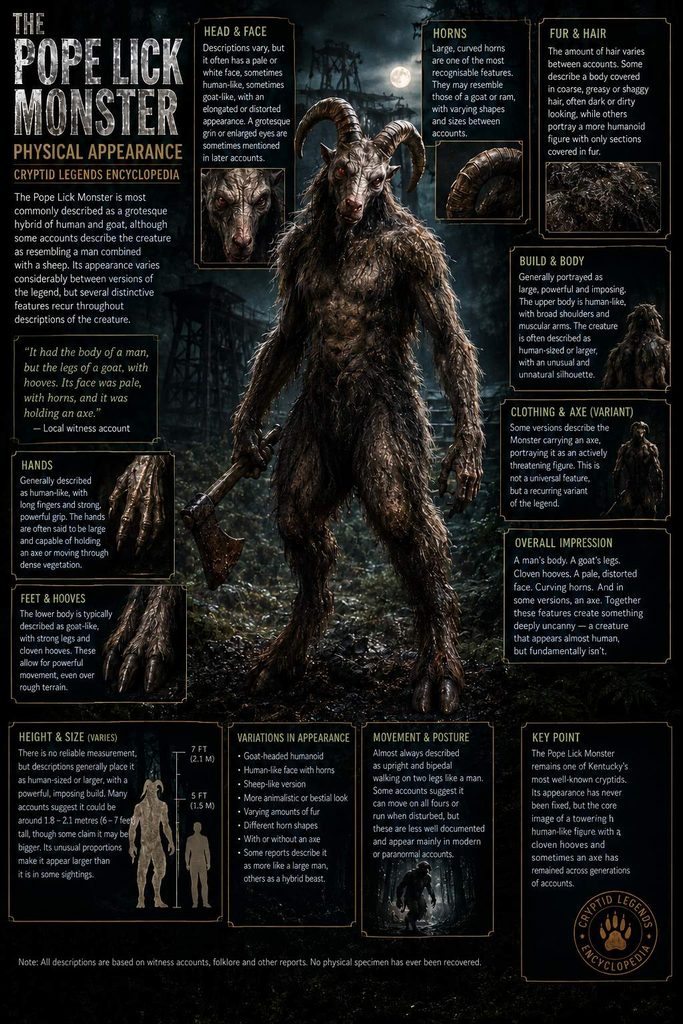
The Pope Lick Monster is most commonly described as a grotesque hybrid of human and goat, although some accounts describe the creature as resembling a man combined with a sheep.
Its appearance varies considerably between versions of the legend, but several distinctive features recur throughout descriptions of the creature.
🐐 A Human–Goat Hybrid
At the heart of the legend is a fundamentally humanoid figure with unmistakably animalistic characteristics.
The creature is generally imagined as standing upright on two legs, possessing a roughly human torso and arms, while its lower body is that of a goat or similarly hoofed animal.
This combination gives the Pope Lick Monster its distinctive silhouette, something recognisably human from a distance, yet unmistakably unnatural when viewed more closely.
Some retellings describe it as possessing a goat-like head, while others give it a more human or distorted face beneath a pair of prominent horns.
The precise proportions are rarely consistent.
👹 The Head and Face
The creature’s head is usually the most disturbing aspect of its appearance.
Folkloric descriptions commonly portray a pale or white-faced humanoid, sometimes with an elongated or distorted appearance. In more animalistic versions, the face is distinctly goat-like, with features resembling those of a large horned animal.
Horns are among the most recognisable characteristics associated with the Monster. Their size and shape vary between artistic interpretations and different versions of the legend, but they reinforce the creature’s resemblance to the traditional image of a goat-man.
Some modern depictions exaggerate the facial features considerably, presenting the Monster with a grotesque grin, enlarged eyes or an almost demonic expression.
These details should be regarded as later artistic interpretations rather than established characteristics of the original folklore.
🐐 Horns
The horns are particularly important to the creature’s visual identity.
They transform what might otherwise appear to be a strange humanoid into something distinctly supernatural.
Depending on the version, the horns may resemble those of a goat or ram, curving away from the head or projecting prominently from the skull.
Because descriptions of the Monster have been passed largely through oral tradition and later popular media, there is no single agreed-upon horn shape.
🦵 Goat-Like Legs and Hooves
Perhaps the most consistently animalistic feature attributed to the Pope Lick Monster is its lower body.
Descriptions commonly give the creature goat-like legs ending in cloven hooves. This is one of the details that firmly establishes the creature within the wider tradition of American Goatman legends.
The legs may be described as unusually powerful or muscular, allowing the Monster to move rapidly across the difficult terrain surrounding Pope Lick Creek.
In some artistic representations, the legs are covered in coarse animal hair, while other interpretations portray the creature with an almost completely humanoid body apart from its hooved feet.
🐑 Fur and Hair
The amount of animal hair attributed to the Monster varies considerably.
Some accounts describe a body covered in coarse, greasy or shaggy hair, giving it a distinctly goat-like appearance. Other versions portray a creature that is predominantly humanoid, with only sections of its body covered by fur.
Descriptions of dark or dirty-looking hair are particularly common in modern representations, although colour is not a consistently documented feature of the older legend.
The combination of matted hair, horns and a pale face has nevertheless become one of the creature’s most recognisable visual forms.
🪓 The Axe-Wielding Variant
One particularly sinister version of the legend portrays the Pope Lick Monster as carrying an axe.
In this interpretation, the creature is not simply a mysterious animal-like being lurking around the trestle, but an actively threatening humanoid figure capable of physically attacking those who encounter it.
The axe is not a universal feature of Pope Lick Monster folklore, however, and should therefore be regarded as one variant of the legend rather than a defining characteristic.
📏 Size and Build
There is no reliable measurement for the creature.
Descriptions generally portray it as human-sized or larger, with a powerful, imposing build.
Its unusual proportions, a humanoid upper body combined with goat-like legs and a large animalistic head, contribute considerably to its frightening appearance.
As with many cryptid legends, illustrations have often exaggerated the Monster’s size and musculature, making it appear considerably larger than a person.
🌑 The Overall Impression
What makes the traditional appearance of the Pope Lick Monster particularly disturbing is not necessarily any single feature, but the combination of familiar forms that should never exist together.
A man’s body.
A goat’s legs.
Cloven hooves.
A pale, distorted face.
Curving horns.
And, in some versions, an axe in its hands.
Seen in isolation, each characteristic is recognisable. Together they produce something deeply uncanny — a creature that appears almost human, but fundamentally isn’t.
The resulting image has helped make the Pope Lick Monster one of Kentucky’s most memorable pieces of dark folklore.
Whether envisioned as a goat-headed humanoid, a shaggy sheep-like beast, or a more demonic figure, the Monster’s appearance has never been fixed.
Like the legend itself, its physical form has continued to change as the story has passed from storyteller to storyteller.
📍 Location & Country
- 🗺️ Primary Location: Fisherville, Jefferson County, Kentucky
- 🏞️ Region: Eastern Jefferson County — Pope Lick Creek / Floyds Fork area
- 🌎 Country: United States
- 🌉 Specific Area: Pope Lick Creek Railroad Trestle — the active Norfolk Southern railway bridge associated with the Pope Lick Monster legend
- 📌 Coordinates (Approx.): 38.192° N, 85.488° W


🌲 The Location
Deep in the eastern outskirts of Louisville, Kentucky, the Pope Lick Monster’s legend is inseparable from a single imposing landmark: the Pope Lick Creek railroad trestle.
The steel railway structure stretches for roughly 800 feet above Pope Lick Creek, carrying an active Norfolk Southern railway line high above the surrounding landscape.
Historic bridge records place the present viaduct at approximately 810 feet in length, with its tracks standing around 90 feet above the creek and South Pope Lick Road below.
It is here, according to local folklore, that the strange half-man, half-goat creature known as the Pope Lick Monster is said to appear.
The surrounding landscape provides an appropriately eerie setting for the legend. Woodland, creek bottoms and the isolated railway structure create a natural boundary between the ordinary world and the strange territory of the folklore.
For generations, stories of the creature have been attached to this particular stretch of eastern Jefferson County, transforming an otherwise ordinary piece of railway infrastructure into one of Kentucky’s most infamous legendary locations.
Yet the trestle is not an abandoned relic.
Trains still use the railway.
The bridge remains active Norfolk Southern infrastructure, and entering the tracks or attempting to walk across the trestle is extremely dangerous and prohibited. The location has unfortunately become associated with real injuries and deaths involving people attempting to explore the legend.
For that reason, the Pope Lick trestle represents an unusual kind of cryptid location.
There is no confirmed evidence that a monster inhabits the area, but there is undeniable evidence that the location itself is dangerous.
That uncomfortable intersection between folklore, fear and genuine physical danger is one of the defining characteristics of the Pope Lick Monster legend.
⚠️ IMPORTANT
The Pope Lick trestle is private, active railway property. The tracks and bridge should not be entered or crossed.
The location can be explored through its surrounding public areas and from safe, lawful viewpoints, but legend-tripping onto the railway is not safe.
🌲 HABITAT
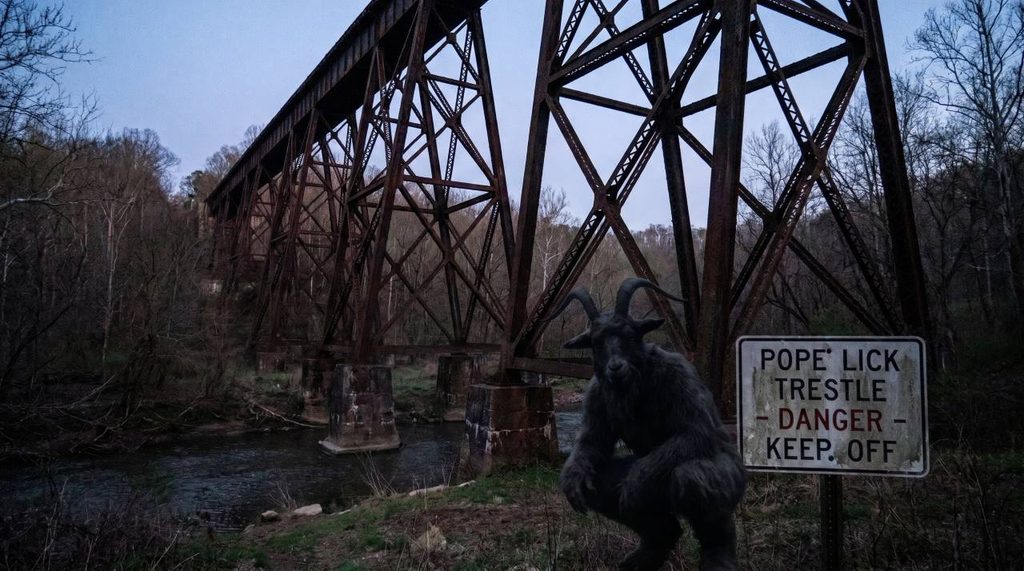
The Pope Lick Monster is traditionally associated with the woodlands, creek bottoms and railway landscape surrounding Pope Lick Creek in eastern Jefferson County, Kentucky.
Unlike many cryptids that are said to inhabit vast wilderness areas, the Pope Lick Monster’s supposed territory is remarkably specific.
Its legend is anchored to a relatively small landscape surrounding the Pope Lick Creek railroad trestle, where woodland, riparian habitat, open fields and railway infrastructure converge.
🌳 Woodland & Creek Bottoms
The area around Pope Lick Creek contains a mixture of woodland, riparian vegetation, fields and brush, creating a patchwork landscape of sheltered and open environments.
The nearby Pope Lick Park includes both riparian forests and prairie habitats, while the area’s older woodland contains mature trees and dense understory.
These environments provide plenty of natural cover and would make an atmospheric setting for a creature supposedly capable of remaining hidden from casual observation.
Along the creek itself, the environment becomes more enclosed. Riparian vegetation lines the watercourse, with trees, shrubs, undergrowth and steep stream banks providing natural concealment.
Environmental surveys of the wider Floyds Fork drainage have documented substantial tree cover and established root systems along the waterways, together with habitat used by fish and wildlife.
🌉 The Trestle
But the most important part of the Monster’s supposed habitat is not the forest.
It is the trestle itself.
According to the legend, the creature lurks beneath, around or upon the railway bridge, appearing among the shadows of the structure or waiting somewhere along the surrounding woodland.
The trestle rises approximately 90 feet above the landscape and extends for around 772 feet, crossing the creek and surrounding countryside.
The Parklands specifically identifies the area as the legendary home of the half-man, half-goat creature.
The combination of elevated railway, woodland, creek and relative isolation helped transform the location into a natural setting for an urban legend.
🌲 A Creature of the Liminal Landscape
The Pope Lick Monster occupies an interesting position within American folklore because its supposed habitat exists between civilisation and wilderness.
It isn’t traditionally described as roaming deep wilderness hundreds of miles from human habitation.
Instead, it is said to inhabit a place where two very different environments meet:
🌲 Woodland
Dense vegetation and natural cover.
💧 Creek
The watercourse and sheltered riparian environment below the trestle.
🌾 Fields & Open Ground
The agricultural and grassland landscape surrounding the creek.
🚂 Railway
A man-made structure cutting directly through the landscape.
🌉 Trestle
The defining landmark around which the legend is centred.
This makes the Pope Lick Monster’s “habitat” almost as important to the folklore as the creature itself.
👹 No Confirmed Territory
There is, of course, no scientifically established habitat for the Pope Lick Monster.
No den, nest, feeding site or physical remains have been documented, and there is no verified evidence establishing that an unknown animal occupies the area.
The earliest surviving newspaper reference to the trestle, dating from 1909, describes a train wreck but makes no mention of a monster or supernatural inhabitant.
The monster tradition appears in the surviving record much later, with its folklore developing around the trestle and becoming particularly prominent during the twentieth century.
Consequently, the woodland and trestle should be understood as the traditional setting of the legend rather than a confirmed biological habitat.
Yet that setting remains crucial.
The Pope Lick Monster is inseparable from the landscape that gave the story its identity — a dark creek valley, wooded surroundings and an imposing railway bridge suspended above it.
Here, the environment doesn’t merely provide a home for the monster.
It helps create the monster.
📜 Background & Legend
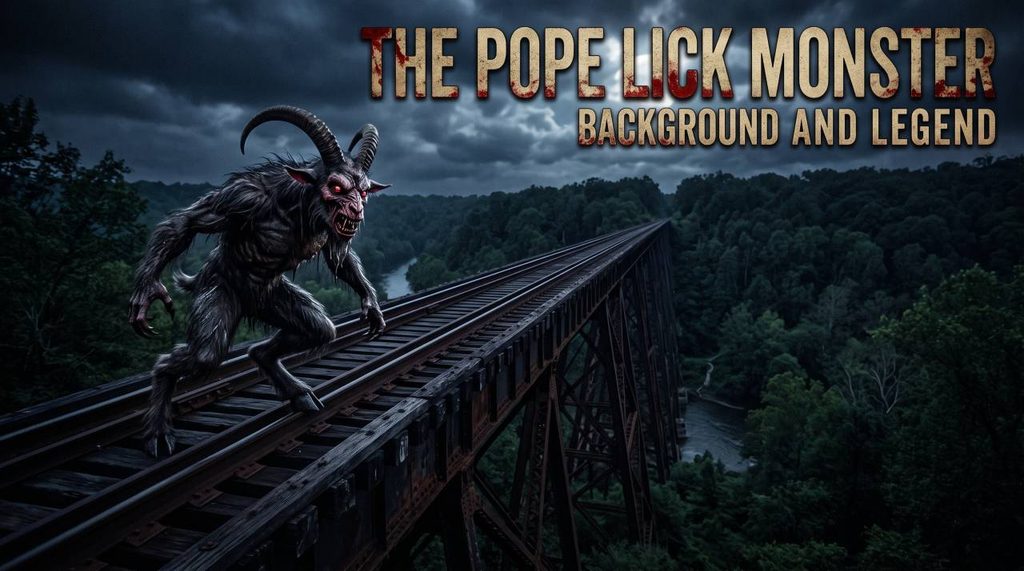
The Pope Lick Monster is one of those unusual cryptid legends where the story appears to have grown around a place rather than beginning with a single spectacular encounter.
Unlike creatures with a clearly defined first witness, the Pope Lick Monster has no universally accepted origin story.
Instead, generations of Louisville storytellers have passed down competing explanations for what the creature is, where it came from and why it supposedly haunts the area.
The result is a folklore tradition that has continually changed while retaining one central idea:
Something unnatural is waiting at Pope Lick.
🐐 The Goat-Man Tradition
At its core, the legend belongs to a much wider tradition of human-animal hybrid folklore.
The idea of a creature combining human and goat characteristics is considerably older than the Pope Lick story itself.
Goat-like supernatural beings appear throughout European mythology and folklore, while American folklore developed its own modern Goatman traditions during the twentieth century.
The Kentucky legend appears to have absorbed elements of this broader imagery and attached them to a very specific local setting.
The exact process is difficult to reconstruct.
A University of Louisville-area folklore study notes that surviving newspaper archives provide no evidence of a monster at the trestle during the early twentieth century.
The earliest located newspaper reference to the trestle itself dates to 1909, when the Courier-Journal reported a train wreck there, but made no mention of a supernatural creature.
The monster tradition therefore appears in the surviving written record much later, despite claims that the story circulated orally beforehand.
🎪 The Circus Story
Perhaps the most famous explanation for the Monster’s origins claims that it was once a human-goat hybrid displayed as a freak in a travelling circus.
According to this version, a circus train travelling through the area was caught in a terrible accident. Among the performers was the grotesque Goatman, who survived the wreck and escaped into the surrounding countryside.
The creature supposedly became embittered by years of mistreatment and began taking revenge upon human beings.
This story gives the Monster a particularly memorable origin: rather than simply being an unexplained beast, it was once human society’s curiosity, transformed into its enemy.
However, the circus explanation should not be treated as established history.
Research into the folklore has found surprisingly little evidence for an old, continuous circus tradition.
The University of Louisville project notes that one prominent version appears to have been developed relatively recently for a local Halloween attraction, meaning that although the story has become an important part of modern Pope Lick folklore, its antiquity is questionable.
🌑 Other Origins
Other versions are considerably darker.
One tale claims that the Monster was once a farmer or hermit who became obsessed with occult practices and sacrificed goats in exchange for supernatural powers.
Another version transforms the creature into the result of some form of unnatural experiment or transformation.
There are also stories involving a mysterious man who lived in the surrounding countryside and became associated with the Goatman imagery.
None of these explanations has been established as the original story.
Their very contradictions are revealing.
Rather than having a single fixed mythology, the Pope Lick Monster has behaved like a traditional piece of living folklore, each generation adapting the creature to whatever explanation seems most frightening, entertaining or believable at the time.
🗣️ The Voice of the Monster
The Monster’s supposed abilities are equally varied.
One of the most enduring claims is that it can mimic human voices.
According to the legend, the creature may call to people using the voice of somebody they know, encouraging them to investigate an apparently familiar sound.
Other versions describe its voice as strangely hypnotic or siren-like, capable of compelling people towards danger.
This is one of the most important motifs in the folklore because it changes the Monster from something that merely attacks people into something that manipulates them.
The victim is not necessarily chased.
They are persuaded.
They walk willingly towards the danger.
The folklore therefore gives supernatural meaning to something that might otherwise be difficult to explain: why would anyone deliberately venture into such a hazardous location?
🐐 A Monster That Changes With the Story
The Pope Lick Monster has never possessed a single canonical form.
Depending upon who tells the story, it can be:
- 🐐 A half-man, half-goat creature
- 🐑 A half-man, half-sheep hybrid
- 👤 A transformed human
- 🎪 An escaped circus freak
- 🌑 A supernatural or demonic being
- 🧪 The product of an unnatural experiment
- 🪓 A violent humanoid armed with an axe
Even its behaviour changes between versions.
Some stories make it a hypnotist. Others give it the ability to imitate voices. Some portray it as an ambush predator, while others claim that merely seeing it can cause such terror that a person loses control.
These inconsistencies are not necessarily weaknesses in the legend.
They are evidence of folklore in motion.
🕯️ The Legend as a Warning
At its deepest level, the Pope Lick story functions as a classic cautionary legend.
The Monster provides a supernatural explanation for an inherently dangerous situation while simultaneously making the warning memorable.
Don’t go there.
Don’t cross the tracks.
Don’t follow strange voices.
Don’t let curiosity overcome common sense.
Don’t accept a dare simply because your friends expect you to.
The Goatman becomes the embodiment of the consequences waiting at the edge of a forbidden place.
This is particularly characteristic of urban legends: the story does not necessarily need to be believed literally to influence behaviour.
A teenager hearing that a monstrous creature waits beyond the darkness may never know whether the story is true.
But they may still remember the warning.
👁️ From Folklore to Legend-Tripping
Eventually, however, the warning itself became part of the attraction.
The Pope Lick Monster developed into a legend-tripping tradition, in which curious visitors deliberately sought out the location to test whether the story was real.
This created a strange feedback loop.
The more people talked about the Monster, the more people wanted to experience the legend for themselves.
The more people visited, the more stories could be generated.
And the more real-world incidents occurred at the location, the easier it became for later storytellers to connect those events with the supernatural narrative.
The monster therefore became more than a character in a story.
It became an experience.
Louisville filmmaker Ron Schildknecht, whose 1988 film helped bring the legend to a much wider audience, later described this transformation as the story becoming increasingly about the experience itself rather than simply the original myth.
📺 The Birth of the Modern Pope Lick Monster
By the late twentieth century, the legend had begun moving beyond whispered local stories and into popular culture.
The 1988 short film The Legend of the Pope Lick Monster was particularly influential. Shot by Louisville filmmaker Ron Schildknecht, the film transformed an already circulating local legend into a piece of visual horror and helped establish the imagery that many people now associate with the creature.
From there, the Pope Lick Monster entered books, television programmes, Halloween attractions, podcasts, internet folklore and modern cryptid culture.
Yet the essential structure of the story remained remarkably simple:
A strange creature.
A forbidden place.
A terrifying warning.
And the fear that perhaps the story is true.
🧩 Folklore Rather Than Evidence
Despite decades of storytelling, there is no verified physical evidence for the Pope Lick Monster and no established body of credible eyewitness reports demonstrating that an unknown creature inhabits the area.
The contradictory origin stories, changing descriptions and different supernatural abilities all point towards a developing folklore tradition rather than a consistent biological mystery.
That does not make the legend unimportant.
Quite the opposite.
The Pope Lick Monster is an unusually revealing example of how a community can take a dangerous landscape, ancient monster imagery, local storytelling and youthful curiosity, and combine them into a legend that survives for generations.
The creature may never have existed outside the imagination.
But the story certainly did.
And in the case of Pope Lick, the story proved powerful enough to become a permanent part of Kentucky folklore.
🕯️ Historical Sightings & Events
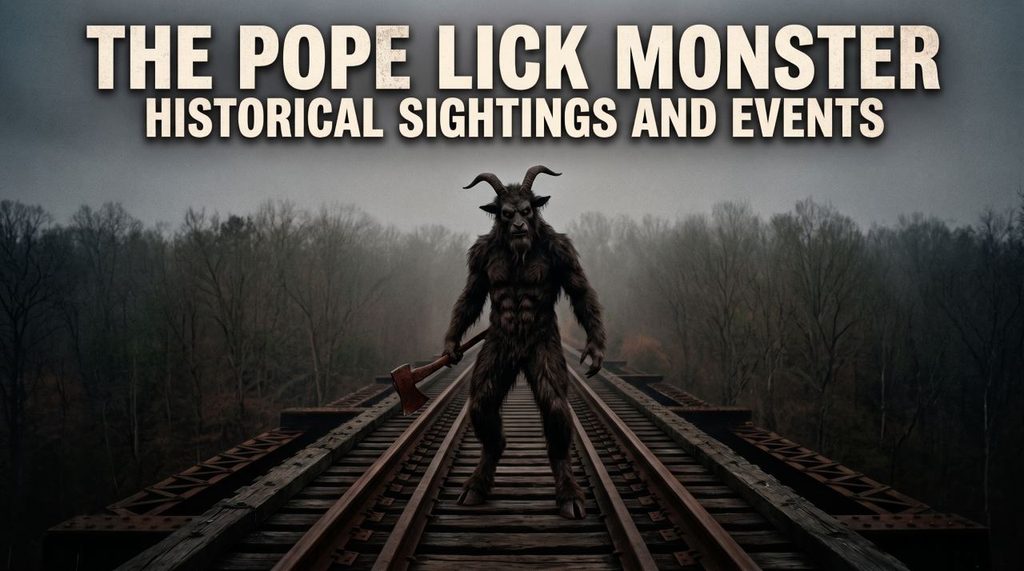
The Pope Lick Monster is unusual among American cryptids because its most enduring historical record is not a catalogue of documented encounters, photographs or physical evidence.
Instead, the legend has survived primarily through oral tradition, local storytelling and the experiences of people who have visited the trestle itself.
Folklorists studying the legend have found that different generations and different communities have told remarkably different versions of the creature’s story.
Even filmmaker Ron Schildknecht, whose 1988 short film The Legend of the Pope Lick Monster helped bring the legend to a wider audience, recalled finding numerous conflicting stories when speaking with local people.
What remains consistent is the trestle.
For decades, people have been drawn to the location in search of the creature described in the legend. This practice, sometimes known as legend-tripping, transformed the Pope Lick story from something people simply told into something some people attempted to experience for themselves.
And that distinction is critically important.
There are no scientifically verified sightings of a Pope Lick Monster, nor is there evidence that a creature has ever attacked or killed anyone at the site.
There is, however, a documented history of people being injured and killed by the very real hazards surrounding the legend.
👁️ Reported Encounters & The Folklore Record
Unlike cryptids associated with large collections of individual eyewitness reports, the Pope Lick Monster has never developed a reliable sighting database.
Stories generally describe encounters in or around the trestle, with witnesses supposedly seeing a strange goat-like humanoid, hearing voices, feeling hypnotised or encountering an unexplained presence. Other versions claim that the creature deliberately attempts to lure people onto the railway bridge.
These accounts belong to the realm of folklore and reported experience, rather than established fact.
Researchers studying the legend have noted that stories about what happened at the trestle often became more prominent than the monster itself.
People told stories about friends visiting the bridge, daring one another to cross it, encountering trains or narrowly escaping injury. Each generation could then add its own experiences to the legend.
In this sense, the Pope Lick Monster became something more than a creature in a story.
It became a story attached to a genuinely dangerous place.
⚠️ When Legend Met Reality
The distinction between the monster and the trestle’s real dangers cannot be overstated.
The Pope Lick trestle carries active railway traffic. It is not an abandoned railway bridge, and trains cannot simply stop or manoeuvre around people who enter their path.
The structure is also elevated high above the ground, leaving very limited options for anyone caught on the tracks.
Over the years, people have been struck by trains, fallen from the structure, or become trapped when attempting to escape an approaching locomotive.
Researchers at Ohio State University studying the Pope Lick legend have specifically documented how the folklore has been accompanied by real injuries and fatalities, noting that the danger of the trestle is indisputable even though the existence of the monster is not.
The following incidents are therefore included not as evidence of the Pope Lick Monster, but because they form an important and tragic part of the history surrounding the legend.
🚂 1980s — The First Well-Known Fatalities
The 1980s marked an important period in the modern history of the Pope Lick legend, with several serious incidents associated with the trestle.
One of the best-known victims was Jack “J.C.” Charles Bahm II, a 17-year-old who was struck and killed by a train while attempting to cross the trestle.
There are discrepancies between secondary sources concerning the exact chronology of some of the incidents from this period, including the death of David W. Bryant, who suffered fatal injuries after jumping from the trestle while attempting to avoid an approaching train.
For that reason, these early cases are best treated cautiously rather than allowing conflicting dates to become falsely established facts.
What is not in dispute is the broader reality: by this period, the Pope Lick trestle had already acquired a documented history of serious accidents involving people attempting to negotiate the railway structure.
The folklore surrounding the monster provided an additional reason for young people to venture onto the bridge, but the danger came from the railway itself.
🧗 1993 — A Desperate Rescue
Not every incident ended in death.
In 1993, a teenage girl became trapped on the trestle when an approaching train left her with nowhere safe to run. She survived by clinging to the side of the structure.
Jeffersontown firefighters responded to the emergency, with firefighter Sean Dreisbach later recalling the rescue. The ladder required to reach her was barely sufficient, and rescuers had to pull her to safety from the elevated structure.
Her survival is an important part of the history because it demonstrates just how quickly a visit to the trestle can become a life-or-death situation.
The monster was not required.
The train was enough.
🚂 1994 — The ATV Fatality
In 1994, another fatal accident occurred when a man riding an ATV onto the trestle became trapped after the vehicle overturned.
Unable to escape the railway line, he was struck and killed by an approaching train.
The incident became another part of the trestle’s growing reputation as a place where a seemingly reckless adventure could turn fatal within moments.
Again, there is no evidence that a supernatural creature was involved.
The circumstances were entirely consistent with the physical dangers of an active railway bridge.
🕯️ 2000 — The Death of Nicholas Jewell
In 2000, 19-year-old Nicholas Jewell died after encountering a train while on the trestle.
In attempting to avoid the approaching locomotive, he fell from the elevated structure.
The incident became another grim chapter in the trestle’s history and is frequently cited alongside the earlier fatalities when discussing the real dangers behind the Pope Lick legend.
Stories surrounding the monster sometimes describe it as hypnotising or frightening people into jumping from the bridge. But there is no evidence that anything supernatural caused Jewell’s death.
The documented danger was the approaching train and the enormous drop from the railway structure.
🕯️ 2016 — Roquel Bain
One of the most significant tragedies in the modern history of the Pope Lick legend occurred on April 23, 2016.
Roquel Bain, 26, from Ohio, was visiting the area with her boyfriend, David Knee. The pair had heard the Pope Lick Monster story and entered the railway trestle while looking for the creature.
While they were on the bridge, an approaching freight train forced them into an impossible situation.
Knee managed to cling to the side of the structure as the train passed.
Bain was struck and killed.
Her death received national attention because it was one of the clearest documented examples of someone entering the trestle specifically because of the monster legend.
Local authorities subsequently used the tragedy to reinforce warnings that the railway was active and that people should stay away from the tracks.
For the Pope Lick legend, this incident represents a particularly important dividing line between folklore and reality.
The monster remained unproven.
The consequences of searching for it were not.
🕯️ 2019 — Savanna Bright
On May 26, 2019, another tragedy occurred at the Pope Lick trestle.
15-year-old Savanna Bright and another teenage girl, Kaylee Keeling, were on the railway tracks when a train approached.
Bright was struck and killed.
Keeling survived and was taken for medical treatment.
The incident once again prompted local officials, residents and emergency personnel to warn the public about the dangers of entering the trestle. Reports also noted the longstanding history of deaths and injuries at the location.
Unlike the 2016 tragedy, there is no need to attribute this event to an attempt to find the Pope Lick Monster. Its inclusion in the legend’s history instead demonstrates something equally important:
The trestle remains dangerous regardless of whether anyone believes in the creature.
🚫 The Trestle Is Not a Cryptid Investigation Site
The tragedies surrounding Pope Lick have unfortunately become part of the monster’s mythology, sometimes being retold online as though the creature itself were responsible.
That is not supported by the evidence.
The Pope Lick Monster has never been proven to have killed anyone.
The trestle remains an active railway, and entering the tracks or attempting to walk across the bridge is extremely dangerous and prohibited.
Anyone interested in the Pope Lick Monster should experience the legend through its history, folklore, photography from safe public areas and historical research, not by attempting to reach the railway itself.
The legend may invite curiosity, but the location should never be treated as an adventure attraction.
🕯️ The Legend and the Losses
The story of the Pope Lick Monster has survived because generations of people have continued telling it.
But the people who lost their lives at Pope Lick were not characters in a monster story.
They were real people.
Some were teenagers. Some were visitors. Some were simply making dangerous decisions around an active railway. Behind every newspaper report and every retelling of the legend is a person whose family and friends were left behind.
That deserves to be remembered.
The Pope Lick Monster belongs to the folklore of Kentucky, a strange, frightening tale that has endured for generations.
The tragedies belong to real history.
The Pope Lick Monster has never been proven to have killed anyone. The people who lost their lives at Pope Lick were victims of trains, falls and the dangers of an active railway. The monster belongs to the folklore. The danger does not.
📚The Pope Lick Monster In Pop Culture & Literature
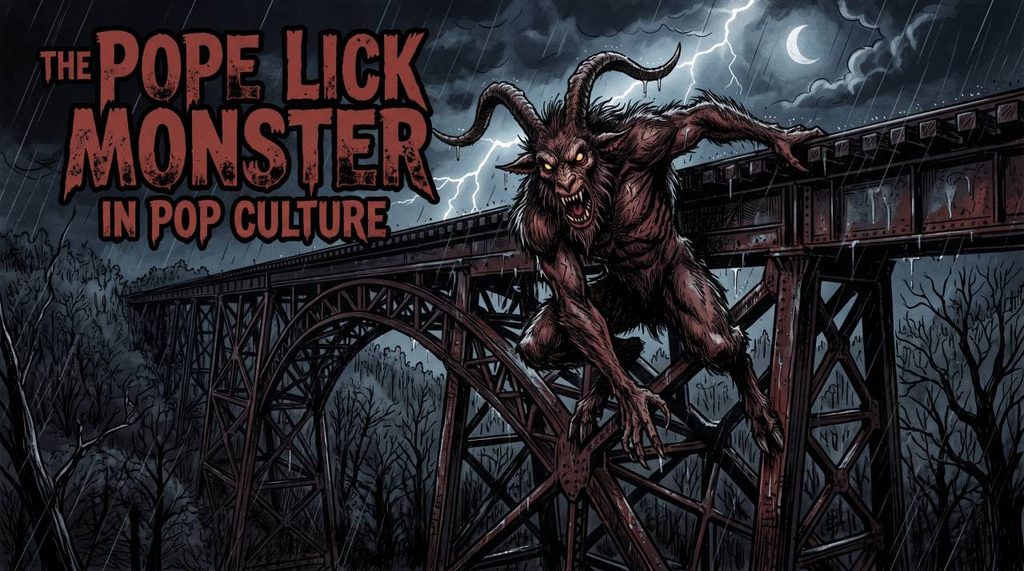
The Pope Lick Monster may have begun as a local Kentucky legend, but it eventually escaped the boundaries of the trestle and became part of a much wider tradition of American monster folklore.
Unlike some cryptids whose modern identities were shaped primarily by a famous photograph or a single eyewitness account, Pope Lick’s cultural identity was heavily influenced by storytelling, film, theatre, folklore research and modern cryptid media.
The creature’s transition from local legend to popular culture is particularly interesting because many of the works inspired by Pope Lick are not simply monster stories.
They often explore the darker ideas already embedded within the legend, youth, danger, isolation, temptation, recklessness and the consequences of challenging something much more powerful than yourself.
🎬 The Legend of the Pope Lick Monster — 1988
The most important piece of modern Pope Lick Monster media is undoubtedly Ron Schildknecht’s 1988 short film, The Legend of the Pope Lick Monster.
Made by Louisville filmmaker Ron Schildknecht, the 16-minute production was created on a modest budget of approximately $6,000 and premiered at Louisville’s Uptown Theater on December 29, 1988.
The film follows three teenagers who encounter the legendary creature and helped transform a largely local piece of oral folklore into something that could be experienced by a much wider audience.
Schildknecht’s research for the film was itself an important part of the legend’s history. Before the internet existed, he spoke with local residents, searched newspaper archives and gathered different versions of the story. What he discovered was that there was no single definitive Pope Lick Monster legend.
Different people described the creature differently, and different explanations existed for its origins and behaviour.
Interestingly, Schildknecht found that people often had more stories about their experiences at the trestle than they did about the monster itself.
That observation would become one of the most important characteristics of Pope Lick folklore: the legend and the dangerous location gradually became inseparable.
⚠️ A Film That Became Part of the Controversy
The film also became controversial because the trestle was, and remains, an active railway.
Some of the scenes were filmed at the actual Pope Lick location, while scenes depicting characters on the railway structure were filmed elsewhere for safety.
The concern was that portraying teenagers confronting a train on the trestle could encourage others to imitate what they saw.
Railroad officials were sufficiently concerned that a warning about the dangers of the trestle was associated with the film’s premiere. The controversy surrounding the production subsequently became part of the Pope Lick story itself.
This gives the film an unusual place in cryptid history.
It did not merely document or dramatise a legend.
It became part of the legend’s real-world history.
🎭 The Trestle at Pope Lick Creek — Naomi Wallace
Pope Lick also inspired one of the most significant literary and theatrical works associated with the location: Naomi Wallace’s The Trestle at Pope Lick Creek.
First produced in 1998, Wallace’s play is not a conventional monster story.
Set during the Great Depression, it follows teenagers Dalton Chance and Pace Creagan, who challenge one another to race across a railway trestle against an approaching locomotive.
The Pope Lick Monster itself is not the central subject.
Instead, Wallace uses the trestle and the dangerous game surrounding it as a vehicle for exploring youth, poverty, family, sexuality, class and the pressures of growing up in an economically devastated community.
The play was inspired in part by a story Wallace heard while growing up in Kentucky concerning a local boy who was killed attempting to outrun a train on a bridge.
In other words, Wallace took the real-world danger behind the folklore and transformed it into dramatic literature.
The result is important because it demonstrates how the Pope Lick story can function beyond straightforward horror. The trestle becomes a symbol of risk, escape and the seemingly impossible desire to outrun the circumstances of one’s life.
The play has subsequently been produced by theatres and universities in the United States and internationally, giving the Pope Lick name a life well beyond Kentucky folklore.
📺 Television, Documentaries & Modern Cryptid Media
As interest in American cryptids expanded during the late twentieth and early twenty-first centuries, the Pope Lick Monster increasingly appeared alongside better-known creatures such as Bigfoot, Mothman and the Jersey Devil.
Television documentaries and paranormal programmes have introduced the legend to audiences far outside Kentucky, while websites, podcasts, YouTube channels and online cryptid communities have continued retelling the story.
The rise of the internet also changed the way the legend could spread.
What was once passed between local teenagers, families and residents could now reach an international audience almost instantly.
The University of Ohio’s research into the legend notes that the rise of the internet contributed to a revival of interest in Pope Lick during the modern era, allowing different versions of the folklore to circulate far beyond its original geographical setting.
Yet the core ingredients have remained remarkably consistent:
The monster.
The trestle.
The approaching train.
And the warning not to go looking for it.
🃏 MetaZoo TCG & The Pope Lick Monster
The Pope Lick Monster has also entered modern cryptid collecting and trading-card culture through the MetaZoo Trading Card Game.
The creature was included in the MetaZoo Wilderness set as a Silver-rarity Dark Beastie, card number 091/165.

Its game mechanics incorporate one of the most recognisable elements of the legend itself: the train. The card’s special 4th Wall Effect references having a train within eyesight.
This is a particularly fitting adaptation.
Rather than simply putting a generic goat-like monster onto a card, MetaZoo incorporated the specific folklore associated with Pope Lick into its gameplay.
The train that represents the real-world danger of the trestle therefore becomes part of the creature’s supernatural identity within the game.
MetaZoo has helped place Pope Lick alongside dozens of other regional American legends, allowing a creature that originated in Louisville folklore to become part of a worldwide cryptid-collecting hobby.
For collectors, cards such as the Pope Lick Monster also serve as small cultural artefacts documenting how regional folklore continues to be reinterpreted by modern entertainment.
🎨 Art, Merchandise & Cryptid Culture
The creature’s distinctive appearance has made it particularly well suited to modern cryptid artwork.
The horned humanoid form, goat-like legs, pale face and association with an enormous railway trestle provide artists with an instantly recognisable visual language.
Pope Lick Monster artwork now appears across:
- 🎨 Cryptid and horror artwork
- 👕 T-shirts and merchandise
- 🃏 Trading cards and collectibles
- 📚 Cryptid books and encyclopedias
- 🎙️ Podcasts and online folklore programmes
- 📺 Paranormal and mystery television
- 🎃 Halloween and urban-legend culture
- 🌐 Websites and social-media communities
The creature has therefore undergone an interesting transformation.
The original folklore did not require a single definitive appearance.
Modern popular culture did.
As artists, filmmakers and game designers repeatedly reinterpret the creature, certain characteristics have become increasingly familiar — particularly the horns, goat-like anatomy and grotesque humanoid form.
Popular culture has effectively created a visual shorthand for Pope Lick.
🌒 From Local Legend to Modern Cryptid
The cultural history of the Pope Lick Monster demonstrates how folklore evolves.
It was never dependent upon one definitive photograph, one confirmed specimen or one universally accepted eyewitness account.
Instead, the legend survived because people kept telling it.
Filmmakers gave it images.
Playwrights gave it new meaning.
Television gave it a wider audience.
The internet gave it global reach.
And modern games and collectibles gave it a physical presence in the growing culture surrounding American cryptids.
Yet the most unusual aspect of Pope Lick may be that the legend’s cultural power comes partly from the fact that the location itself is real.
The trestle exists.
The trains exist.
The danger exists.
The stories exist.
The monster remains unproven.
That tension between folklore and reality is ultimately what has allowed the Pope Lick Monster to endure.
It is not simply a creature said to haunt a bridge.
It is a Kentucky legend built around a real place, shaped by generations of storytelling, and transformed by popular culture into one of America’s most recognisable Goatman traditions.
And perhaps that is why the warning at the heart of the legend remains more important than ever:
You don’t need to believe in the monster to take the story seriously.
The folklore belongs to everyone who continues to tell it.
The trestle belongs to the railway.
And it should never be entered in search of the creature.