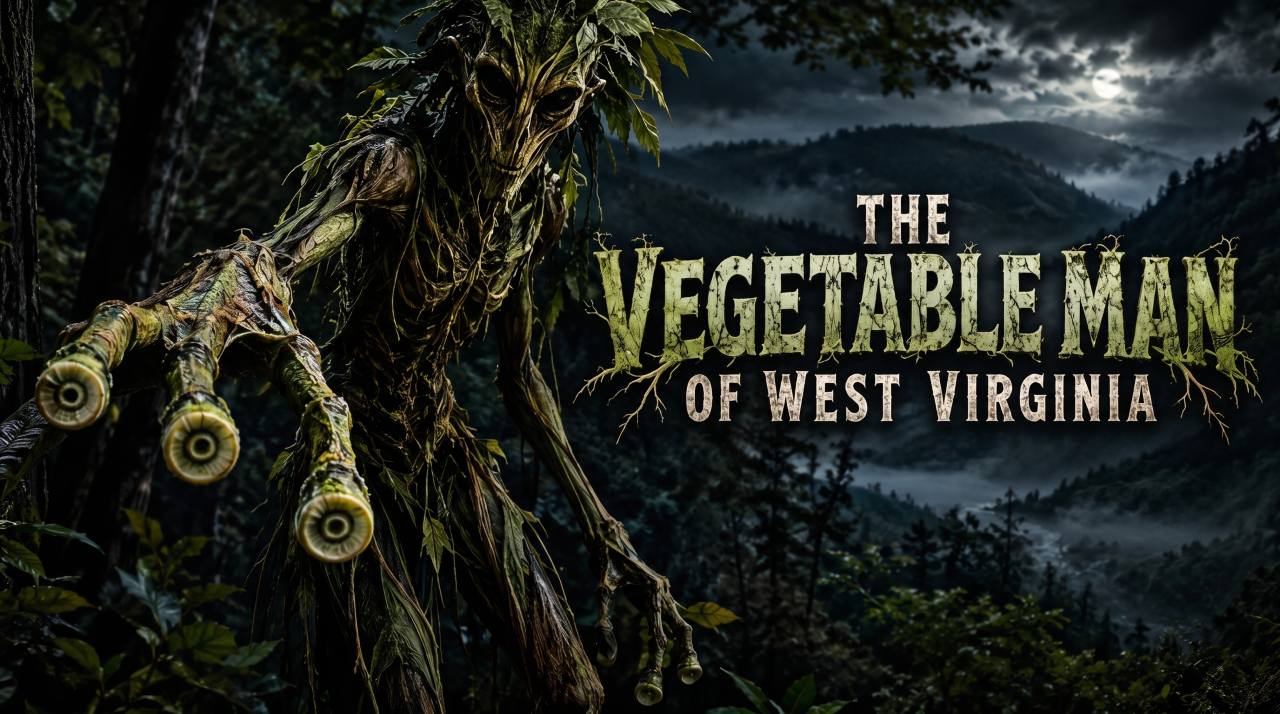
🌿👁️ The Vegetable Man Of West Virginia
Deep in the wooded hills of West Virginia, where coal country gives way to dense forest and quiet mountain roads, there exists one of the strangest cryptid legends in American folklore.
It is not a creature of ancient Appalachian mythology, nor a monster supported by generations of sightings.
Instead, the legend begins with a single extraordinary story.
In the summer of 1968, a young hunter near Grant Town, West Virginia, reportedly encountered something unlike anything he had ever seen, a towering, unnaturally thin humanoid whose appearance seemed almost plant-like.
Its body was described as greenish and flexible, its head surrounded by what appeared to be long green hair or foliage. Its eyes were said to shift through strange colours, while its elongated fingers ended in suction cups and needle-like points.
Then came the most disturbing part.
According to the account, the strange being communicated with the hunter without speaking normally, apparently conveying a message telepathically before taking hold of his arm.
Its fingers allegedly pierced his skin.
And something began to draw blood.
For a moment, the encounter was not simply an observation of something strange in the woods. It was an encounter with something that appeared to be alive, intelligent and profoundly alien.
Then, almost as quickly as it had appeared, the creature reportedly bounded away through the forest, leaving behind nothing that could conclusively establish what the hunter had encountered.
There were no photographs.
No confirmed tracks.
No recovered biological material.
No independent witnesses.
And, most remarkably, the story did not become public until years later, when UFO writer Gray Barker published the account in 1976.
That makes the Vegetable Man a particularly unusual entry in the Cryptid Legends Encyclopedia.
The story possesses all the ingredients of a classic encounter, a remote woodland, an inexplicable humanoid, strange physical characteristics, apparent telepathy and a frightening interaction with a human witness.
But beneath the horror lies an equally fascinating question:
Was the Vegetable Man ever a real encounter at all?
Or did a bizarre story emerge from the UFO and paranormal culture of the era and gradually transform into one of West Virginia’s strangest modern legends?
There is currently no evidence capable of answering that question.
What remains is a remarkably peculiar piece of Appalachian folklore, part cryptid encounter, part UFO-era mystery and part modern tall tale.
The Vegetable Man has never been proven to exist.
But somewhere in the folklore of West Virginia, the image remains:
A seven-foot figure among the trees.
Green. Silent. Watching.
With fingers that were never quite human.
👁️🌿 Physical Appearance
The Vegetable Man is described as one of the most unusual humanoid figures in West Virginian cryptid folklore, a creature whose appearance supposedly combined a recognisably human form with the thin, elongated structure and coloration of a living plant.
The principal description comes from Jennings Frederick, whose account was published years after the alleged 1968 encounter by UFO writer Gray Barker.
Because there is no independent physical evidence or contemporary documentation, the following description should be understood as reported folklore rather than an established anatomical profile.
📏 Height & Build
Frederick reportedly estimated the creature at approximately seven feet tall.
Despite its height, the Vegetable Man was not described as broad, muscular or heavily built. Quite the opposite, its body was portrayed as extraordinarily thin, elongated and almost stalk-like.
Its arms were particularly striking. They were reportedly no thicker than approximately a quarter in diameter, giving the creature an extremely slender, almost reed-like appearance.
This combination of considerable height and extreme thinness is one of the defining characteristics of the legend.
Rather than resembling a conventional large humanoid, the figure was envisioned as something almost botanical in its proportions.
🌱 Skin, Colour & Plant-Like Appearance
The creature was described as green, with Frederick reportedly comparing its body in shape and colour to the stalk of a plant.
This unusual appearance appears to be the origin of the name “Vegetable Man”, although the original account does not establish that this was the creature’s own name or that it literally possessed plant anatomy.
The description therefore falls somewhere between a humanoid creature and an anthropomorphic plant, a tall, green figure whose body supposedly possessed an unnatural flexibility and slenderness.
Some later artistic interpretations have taken this considerably further, portraying the figure as being covered in leaves, vines or other vegetation.
These should be treated as artistic interpretations rather than confirmed elements of Frederick’s original description.
👤 Face & Head
Despite the strange body, the Vegetable Man reportedly possessed semi-human facial features.
Frederick described the creature as having:
- 👁️ Large, yellow, slanted eyes
- 👂 Long, pointed ears
- 🧑 Semi-human facial features
- 🟢 A distinctly green appearance
The eyes were perhaps the most memorable feature.
During the encounter, Frederick reportedly observed the eyes changing from yellow towards red, with the colours apparently rotating or swirling.
According to the account, this produced a hypnotic effect that left him unusually calm and immobilised despite the frightening encounter.
Modern illustrations sometimes give the Vegetable Man an elongated or vegetable-shaped head, but the more defensible description is simply that Frederick perceived a green, extremely thin humanoid with semi-human facial characteristics, long ears and unusual yellow eyes.
🖐️ The Three-Fingered Hands
The hands are arguably the most distinctive physical feature attributed to the Vegetable Man.
Each hand was reportedly equipped with three extremely long fingers, with each finger measuring approximately seven inches.
Rather than conventional fingertips, Frederick described them as having needle-like points combined with suction-cup structures.
The result is one of the strangest anatomical descriptions found in American cryptid folklore:
Three elongated fingers.
Suction-cup-like structures.
Needle-like tips.
According to the account, these unusual appendages were capable of piercing the skin and supposedly drawing blood from Frederick’s arm.
The combination has subsequently become almost inseparable from the Vegetable Man’s identity and is reproduced in virtually every modern artistic representation of the creature.
💪 Arms & Physical Strength
The apparent fragility of the creature’s arms contrasted sharply with the strength attributed to them.
Although Frederick described the arms as extraordinarily thin, he reportedly found the creature’s grip difficult to escape.
The creature’s arm was said to have been thin and flexible, almost like a plant stem or reed, yet capable of holding onto him with considerable force.
This contradiction, a body that appears delicate but possesses surprising physical strength, is another recurring feature of the legend.
🩸 The Alleged Feeding Apparatus
The Vegetable Man’s fingers were not merely described as weapons.
According to Frederick’s account, the needle-like tips supposedly penetrated his arm while the suction-cup structures drew blood.
Frederick reportedly heard a suction-like sound during the process and interpreted the sensation as the creature extracting blood from him.
There is, however, an important distinction between the physical description and the interpretation:
The reported wounds are part of the encounter narrative, but no surviving medical documentation has established what caused them.
Consequently, the supposed blood-feeding mechanism remains entirely within the legendary account.
🦘 Movement
The Vegetable Man was also attributed with remarkable mobility.
After the encounter, Frederick reportedly watched the creature retreat into the woodland in great leaps, estimating that individual jumps could cover roughly 25 feet.
This would make its movement extraordinarily impressive for a seven-foot humanoid, although there is obviously no independent measurement of the distance.
The account therefore presents a creature that appears physically delicate and almost plant-like, yet is supposedly capable of sudden bursts of strength and remarkable leaps.
👁️ Overall Appearance
Taken together, the reported characteristics produce a remarkably distinctive image:
A roughly seven-foot-tall, extraordinarily thin green humanoid with a stalk-like body, semi-human face, long pointed ears, yellow eyes and extremely narrow arms terminating in three elongated, needle-tipped fingers equipped with suction-cup-like structures.
It is this combination of humanoid, botanical and seemingly extraterrestrial characteristics that makes the Vegetable Man stand apart from more conventional American cryptids.
Importantly, many modern illustrations add considerably more botanical detail than the original description supports.
Leaves, vines, root-like feet and elaborate plant anatomy are largely later artistic interpretations, rather than features that can confidently be attributed to Frederick’s 1968 account.
With no photographs, recovered biological material or independently documented remains, the reported physical appearance of the Vegetable Man ultimately rests upon a single decades-later account, making it an intriguing piece of cryptid folklore, but not a verified description of an unknown species.
📍 Location & Country
- 🗺️ Primary Location: Grant Town, Marion County, West Virginia
- 🏞️ Region: North-central West Virginia — Appalachian foothills
- 🌎 Country: United States
- 🌲 Specific Area: Wooded countryside around Grant Town, associated with Jennings Frederick’s reported July 1968 encounter
- 📌 Coordinates (Approx.): 39.557° N, 80.178° W
🌲 Location
The Vegetable Man is firmly associated with Grant Town in Marion County, West Virginia, a small community in the north-central part of the state.
The original account places Jennings Frederick’s encounter somewhere in the wooded area around Grant Town, rather than at a specifically identified landmark or named trail.
That distinction is important for the Encyclopedia. Unlike a cryptid such as the Pope Lick Monster, where a particular bridge forms the unmistakable centre of the legend, there is no confirmed “Vegetable Man site.”
The surrounding woodland is the setting given by the account, while the exact point where Frederick supposedly encountered the creature has not been established.
The landscape itself fits the atmosphere of the story remarkably well: dense Appalachian woodland, hills and rural countryside surrounding a small historic coal-mining community.
Grant Town was established in 1901, and the area’s industrial history sits alongside the forests and rural landscape that form the backdrop to the legend.
🌲🌿 Habitat
The reported habitat of the Vegetable Man is the wooded countryside surrounding Grant Town, Marion County, West Virginia, in the north-central Appalachian region.
Unlike some cryptids whose legends are tied to a particular cave, lake, bridge or isolated wilderness, the Vegetable Man has no established den, lair or specific territory.
The original account simply places Jennings Frederick’s encounter in the woods near Grant Town, making the surrounding forest the natural setting for the legend.
🌳 Appalachian Woodland
The landscape around Grant Town belongs to the broader Appalachian forest environment, characterised by wooded hills, slopes, hollows and patches of rural countryside.
West Virginia is exceptionally forested, with approximately 78% of the state covered by regrowth forest.
Forest composition varies considerably with elevation, slope, soil and exposure, but the Allegheny Plateau around north-central West Virginia contains extensive mixed hardwood woodland, including oak, hickory, yellow-poplar, black cherry, walnut, elm and ash, together with dense undergrowth such as rhododendron and laurel.
For the Vegetable Man legend, this creates an evocative environment: a tall, thin figure supposedly moving through dense woodland where visibility can be limited and the terrain naturally breaks up lines of sight.
⛰️ Hills, Hollows & Concealment
The terrain of north-central West Virginia is particularly suited to stories involving something glimpsed briefly between the trees.
The Appalachian landscape is heavily shaped by steep slopes, wooded ridges and hollows, creating countless areas where an observer could potentially hear something without immediately seeing its source.
That becomes especially relevant to the Vegetable Man story because the original account describes an encounter beginning with a strange sound before the creature was supposedly seen.
The woodland therefore serves as more than simple scenery within the legend. It provides the kind of enclosed, visually fragmented environment in which an unusual encounter could become difficult to interpret or reconstruct afterwards.
🏭 A Cryptid From Coal Country
There is another important characteristic of the Vegetable Man’s habitat: it is not an untouched wilderness.
Grant Town developed as a coal-mining community after the establishment of the Federal Coal and Coke Company mine in 1901, and the Federal No. 1 mine remained central to the community for decades.
The surrounding landscape consequently represents a mixture of industrial history, rural settlement and Appalachian woodland rather than a remote wilderness completely isolated from human activity.
This is an interesting contrast with the creature’s supposed appearance.
The legend describes something extraordinarily strange and almost alien hiding among the vegetation, yet its setting was a landscape already shaped by miners, hunters, railroads, roads and small communities.
🌿 Why This Habitat Fits The Legend
From a folklore perspective, the setting is almost perfectly suited to the Vegetable Man’s unusual identity.
A creature described as green, extremely thin and plant-like naturally becomes more mysterious when placed among dense Appalachian vegetation.
The forest could conceal an unusual figure surprisingly well, while the hills and undergrowth provide countless opportunities for fleeting glimpses, strange sounds and uncertainty about exactly what was encountered.
The fact that the original story involves a hunter travelling through woodland also gives the legend an appropriately rural context. Hunting, wildlife and familiarity with the surrounding countryside would have made an unexpected encounter with something completely unfamiliar particularly striking.
However, there is currently no evidence that the Vegetable Man actually inhabits these forests, nor any established pattern demonstrating that the creature prefers woodland environments. The habitat association comes from the location of the single alleged 1968 encounter.
🌲 The Vegetative Mystery
Perhaps the most fitting aspect of the Vegetable Man’s supposed habitat is also the simplest:
The creature was said to look as though it belonged among the vegetation itself.
Its reported green coloration, thin body and plant-like appearance have encouraged later interpretations portraying it almost as a humanoid extension of the forest, something that could stand motionless among trees and foliage before suddenly moving.
Whether that imagery originated entirely with the original account or was strengthened by later artists and storytellers is uncertain.
What is clear is that the woods of Marion County remain the geographical stage upon which the Vegetable Man legend was built.
There is no confirmed nest.
No known feeding ground.
No established range.
No recurring hotspot of sightings.
Only the wooded landscape around Grant Town, and a single extraordinary story of something green and impossibly strange appearing between the trees.
For now, the forest is the Vegetable Man’s habitat because that is where the legend places him, not because any population or biological presence has been demonstrated there.
🌿👁️ Background and Legend
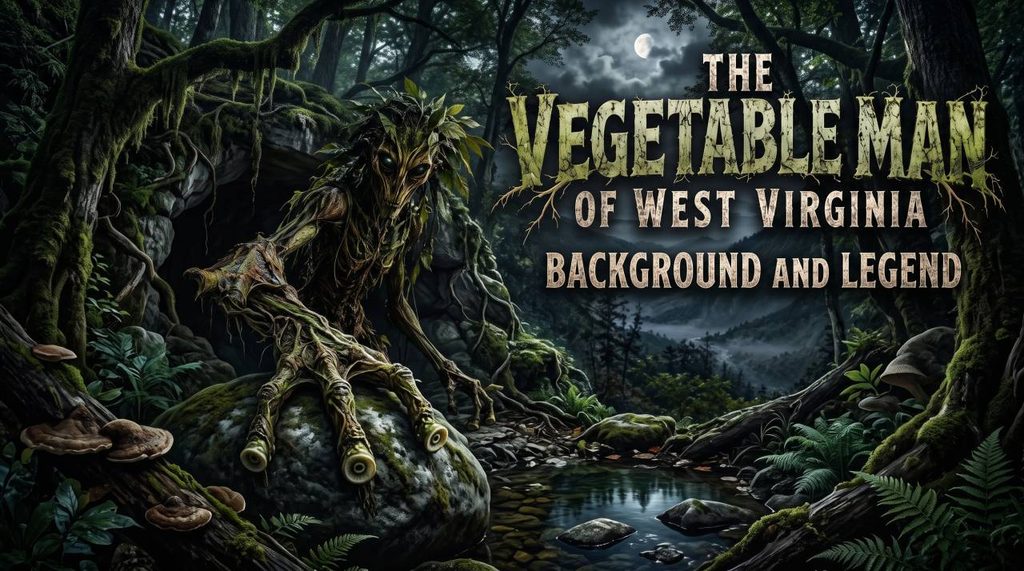
The Vegetable Man of West Virginia occupies a peculiar corner of Appalachian folklore.
Unlike many of the state’s better-known mysteries such as Mothman and The Flatwoods Monster, the legend does not appear to have roots in an old mountain tradition or generations of local storytelling.
Instead, its trail leads back to the UFO and paranormal publishing culture of the twentieth century, and particularly to one of West Virginia’s most influential, and controversial chroniclers of the strange.
🌲 A Strange Legend From Grant Town
The story is associated with Grant Town, Marion County, a small coal-mining community in north-central West Virginia.
The area already possessed the ingredients that have helped countless Appalachian legends flourish: wooded hills, isolated countryside, mining communities and a long-standing tradition of stories concerning ghosts, strange creatures and unexplained phenomena.
Yet there is currently no convincing evidence that a plant-like humanoid existed as an established local legend before the 1960s.
This is an important distinction.
The Vegetable Man does not appear to have emerged from a centuries-old Appalachian creature tradition.
Instead, the available evidence points towards a much more modern origin, with the legend entering the record through the world of UFO literature.
That makes the Vegetable Man particularly interesting from a folklore perspective.
It appears to represent the meeting point between Appalachian monster folklore and the extraordinary UFO culture of post-war America.
🛸 UFOs, Monsters & The West Virginia Connection
By the 1950s and 1960s, West Virginia had already become fertile ground for UFO and monster stories.
The Flatwoods Monster had become famous following the 1952 Braxton County incident, while the later Mothman reports around Point Pleasant would turn another West Virginia mystery into an international piece of paranormal folklore.
The Vegetable Man emerged during this broader period of fascination with flying saucers, strange humanoids and alleged encounters with beings that appeared to exist somewhere between extraterrestrial visitor and earthly monster.
The creature’s unusual characteristics fit that environment remarkably well.
It was not simply presented as an unidentified animal.
It was apparently intelligent.
It supposedly communicated with a human.
Its appearance was profoundly unlike anything familiar.
And the story eventually acquired an apparent connection with a mysterious flying object.
These elements placed the Vegetable Man much closer to UFO-contact mythology than to conventional American lake-monster or wild-man traditions.
📰 The Gray Barker Connection
The name most closely associated with the Vegetable Man is Gray Barker.
A West Virginia native and prominent UFO writer and publisher, Barker spent decades collecting and circulating stories concerning flying saucers, strange creatures, secret government activity and paranormal phenomena.
The Vegetable Man story appeared in the March 1976 edition of Gray Barker’s Newsletter, under the intriguing title “The Vegetable Man: A Semi-Abductee?”
This publication appears to be the earliest known printed source for the story.
That fact is crucial to understanding the legend.
Rather than discovering a long-established creature through independent historical research, Barker was apparently the person who brought the story into the wider paranormal record.
The account had reportedly been related to Barker by Jennings Frederick years after the alleged encounter, meaning that by the time the public encountered the story in print, it had already passed through a personal correspondence between the two men.
⚠️ The Barker Problem
This is where the Vegetable Man becomes considerably more complicated.
Gray Barker was not simply a collector of folklore.
He was also a known hoaxer whose reputation has become inseparable from his UFO writings.
The Clarksburg-Harrison Public Library, which holds the Gray Barker Collection, documents Barker’s history of deliberately creating and promoting hoaxes. Researchers studying his work have similarly described his willingness to manipulate, embellish and encourage unusual stories.
That does not prove that the Vegetable Man story itself was fabricated.
There is no surviving evidence demonstrating that Barker and Frederick deliberately invented this particular account together.
But it does mean that the primary source deserves considerably more scrutiny than a contemporary police report, newspaper investigation or independently documented eyewitness case would receive.
In practical terms, the entire legend rests upon a very narrow evidential foundation:
One alleged witness.
One principal published source.
A significant delay before publication.
No independent contemporary investigation.
That does not make the story automatically false.
It does, however, make it extremely difficult to establish as a genuine unexplained encounter.
🌱 Why “Vegetable Man”?
The name itself is almost as strange as the creature.
There is no clear evidence that “Vegetable Man” was a traditional name used by Grant Town residents before Barker’s publication.
Instead, it appears to have developed from the creature’s supposedly green, thin and plant-like appearance.
Later artists have naturally taken this concept even further, sometimes imagining a humanoid almost literally constructed from vegetation.
The original legend, however, is considerably stranger because it occupies an uncertain middle ground.
The being is humanoid, but apparently not human.
It appears plant-like, but is not explicitly described as an actual plant.
And within Barker’s UFO-oriented presentation, it can also be interpreted as something extraterrestrial rather than terrestrial.
The result is a cryptid that refuses to fit neatly into any single category.
👽 Cryptid, Alien or Something Else?
The original story leaves room for several interpretations.
A traditional cryptid interpretation treats the Vegetable Man as an unknown humanoid creature inhabiting the West Virginian woodland.
A UFO interpretation instead views it as a possible extraterrestrial visitor, particularly because of the story’s association with unusual aerial phenomena and the suggestion that the creature arrived or departed in connection with a flying craft.
There is also a third possibility:
The Vegetable Man may simply be a piece of paranormal folklore created during an era when UFOs, aliens and mysterious humanoids were increasingly becoming part of American popular culture.
That possibility becomes particularly compelling because the story did not generate a continuing wave of independent encounters.
The creature appeared in the literature, and then essentially disappeared.
🕯️ The Legend Takes Shape
Whatever its ultimate origin, the Vegetable Man has gradually acquired a life of its own.
Later writers, paranormal researchers and cryptid enthusiasts have repeatedly returned to the story, preserving the unusual description and adding the creature to growing catalogues of West Virginian mysteries.
Modern folklore enthusiasts have embraced the character as one of the state’s more obscure strange beings, while local cultural events have transformed the Vegetable Man from an obscure UFO tale into a piece of living West Virginia folklore.
In that sense, the legend no longer depends entirely upon whether the original encounter happened exactly as described.
The Vegetable Man has become something else:
A story about a story.
A strange account from the UFO era, attached to a real West Virginian community, preserved by a controversial paranormal publisher and eventually adopted by modern cryptid culture.
And perhaps that is what makes this particular mystery so fascinating.
There is no ancient mythology waiting beneath it.
No established species.
No growing population of eyewitnesses.
Instead, there is a single bizarre tale whose origins appear to sit somewhere between personal testimony, UFO culture, Appalachian folklore and the imagination of one of America’s most colourful paranormal publishers.
The Vegetable Man remains unexplained not because there is overwhelming evidence for something extraordinary, but because there is so little reliable evidence at all.
👁️ Historical Sightings & Reported Encounters
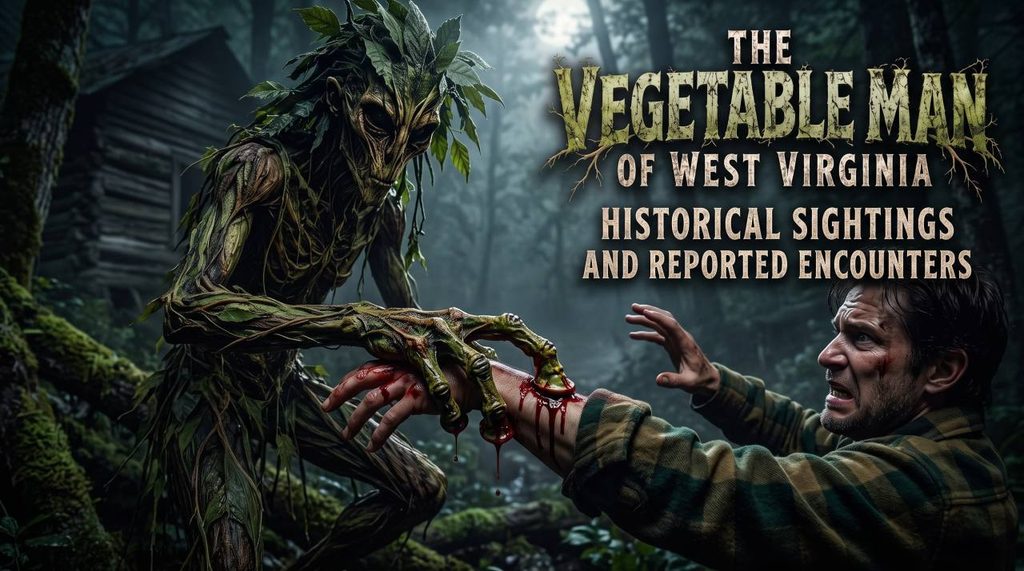
The historical record surrounding the Vegetable Man of West Virginia is remarkably small.
Unlike cryptids supported by decades of reports, multiple witnesses or recurring encounters, the Vegetable Man has essentially one central alleged sighting, the 1968 experience attributed to Jennings H. Frederick near Grant Town, Marion County.
Everything that followed was largely a matter of publication and retelling.
This makes the case unusual, but also relatively straightforward to examine. Rather than presenting later repetitions as new encounters, the historical record can be separated into the original alleged experience, the earlier Frederick family account associated with it, the story’s eventual publication, and the complete lack of a subsequent sighting trail.
🌲 The 1968 Jennings Frederick Encounter
The central event is traditionally placed in July 1968, when Jennings H. Frederick was reportedly hunting groundhogs in the woods around Grant Town.
According to the account later published by Gray Barker, Frederick encountered an approximately seven-foot-tall humanoid possessing an extraordinarily thin, plant-like body.
The being allegedly telepathically communicated with him and subsequently made physical contact, leaving injuries to his arm.
The details are extraordinary, but the circumstances surrounding the report are just as important.
Frederick did not report the encounter publicly in 1968.
According to the later account, he returned home and concealed what had happened because he feared that nobody would believe him. His wounds were reportedly explained to his family as injuries caused by briars.
Consequently, there is no known contemporary newspaper article documenting the encounter when it supposedly occurred, nor is there a known police investigation, medical report or independent witness statement from July 1968.
The story instead remained within Frederick’s personal account until it was eventually passed to Gray Barker.
📰 The 1976 Publication
The Vegetable Man entered the documented paranormal literature through Barker’s March 1976 edition of Gray Barker’s Newsletter, approximately eight years after the alleged encounter.
Barker presented the story under the title:
“The Vegetable Man: A Semi-Abductee?”
The article occupies pages 10–14 of the newsletter and represents the most important surviving source for the case.
It is significant because Barker did not merely publish a brief monster sighting. His account placed Frederick’s experience within a wider UFO framework, incorporating other unusual experiences associated with Frederick and his family.
This is where the historical case becomes difficult to separate from the paranormal culture in which it was published.
The original newsletter is therefore valuable as a primary source for what Barker reported Frederick saying, but it is not independent confirmation that the encounter actually happened.
The distinction is important:
The 1976 newsletter proves that Barker published the story. It does not independently prove that the 1968 encounter occurred.
📖 What Can Actually Be Attributed to Frederick?
The account contains a number of highly specific details attributed to Frederick, including the creature’s unusual anatomy, its apparent method of communication, the injuries he said he received and the creature’s remarkable movements.
Those details have subsequently been repeated across books, websites, podcasts and modern cryptid accounts.
However, virtually all of those versions ultimately lead back to Barker’s 1976 article.
There is currently no substantial body of independent testimony showing that another person encountered the same creature in the Grant Town area.
That means the various descriptions should not be counted as multiple sightings.
They are better understood as different generations of the same story.
🛸 The Earlier Ivah Frederick Account
Barker also connected Jennings Frederick’s story with an earlier alleged encounter involving his mother, Ivah Frederick, during the mid-1960s.
According to Barker’s account, she reportedly encountered a small, dark creature associated with a saucer-shaped object near the Frederick family area.
Barker further claimed that Jennings subsequently investigated the location and found unusual marks which he interpreted as evidence of the event.
This material is interesting because it suggests that the Vegetable Man story was presented as part of a broader Frederick family history of UFO and strange-creature experiences, rather than as an isolated monster report.
However, this earlier incident suffers from the same fundamental problem as the Vegetable Man encounter itself.
The surviving account comes through Barker’s later publication rather than an independently documented contemporary investigation.
There are also discrepancies in later references concerning the exact year of the earlier incident, with 1964 and 1965 both appearing in the wider literature.
For that reason, it is best regarded as a related but unverified historical account, rather than evidence for a second Vegetable Man sighting.
🔎 The Evidence Trail
One of the most striking characteristics of the case is what isn’t present.
There is no known surviving:
- 📸 Photograph of the Vegetable Man
- 👣 Verified footprint or trackway
- 🧬 Hair, tissue or biological specimen
- 🩸 Independent medical documentation of the reported injuries
- 👮 Police investigation or incident report
- 📰 Contemporary newspaper investigation documenting the encounter
- 👥 Independent eyewitness confirmation
- 📻 Subsequent radio or television investigation producing new evidence
- 🐾 Later series of encounters in the Grant Town area
The absence of such material does not establish that Frederick was lying.
It does, however, mean that there is very little remaining physical or documentary material with which the claim can be tested.
🕰️ The Long Silence
Perhaps the strongest historical feature of the case is the lack of a continuing sighting tradition.
After Frederick’s alleged encounter, no established succession of witnesses emerged claiming to have seen the same creature around Grant Town.
There is no recognised pattern of repeated Vegetable Man encounters comparable to cryptids whose legends developed through numerous independent reports.
Instead, the creature largely disappeared from the historical record and survived through paranormal literature and later cryptid retellings.
Modern sources continue to describe the 1968 incident, but these accounts should not be mistaken for new sightings. They are generally repetitions, summaries or interpretations of the original story.
🧩 Later Retellings Are Not New Sightings
As the story became increasingly obscure, details were sometimes expanded or presented with greater certainty.
This is particularly important when researching a creature whose original source is so narrow.
A dramatic detail appearing on a modern cryptid website does not necessarily represent another witness.
Likewise, an illustration, podcast discussion or documentary-style retelling does not constitute new evidence.
The safest historical approach is therefore to trace every claim back towards its earliest available source.
When this is done, the overwhelming majority of the Vegetable Man’s unusual characteristics lead back to Barker’s 1976 account of Jennings Frederick.
⚠️ The Gray Barker Factor
The reliability of the historical record is further complicated by Gray Barker himself.
Barker was an important figure in West Virginia’s UFO literature and played a major role in popularising stories surrounding strange creatures and unexplained phenomena.
He was also associated with deliberate UFO hoaxes and fictionalisation, something that has subsequently made his publications particularly difficult for researchers to evaluate.
That does not prove that Frederick fabricated the Vegetable Man story, nor does it establish that Barker invented it.
But it means the case cannot reasonably be treated in the same evidential category as a contemporaneous, independently investigated sighting.
The most defensible position is therefore:
Jennings Frederick is the alleged eyewitness.
Gray Barker is the principal published source.
The 1976 newsletter is the earliest known major documentary source.
Independent confirmation remains absent.
🧠 Possible Interpretations
The historical evidence leaves several possibilities open.
A genuine unexplained encounter remains one interpretation if Frederick’s account is accepted at face value.
A more ordinary explanation could involve a misidentified animal, unusual vegetation, an encounter with another person or an experience whose details became distorted through memory and later retelling.
Another possibility is that the story developed through the UFO culture surrounding Barker and Frederick, with the extraordinary elements becoming part of a paranormal narrative.
And there is the simplest possibility:
The Vegetable Man was a tall tale.
Given the absence of independent evidence and the unusual circumstances surrounding its publication, that possibility has to be taken seriously.
What cannot currently be established is which of these explanations is correct.
📜 The Historical Record
Ultimately, the Vegetable Man’s historical record is less a collection of sightings than a single unusual claim preserved in paranormal literature.
The 1968 Jennings Frederick encounter remains the foundation of virtually everything subsequently written about the creature.
The earlier Ivah Frederick account adds an intriguing layer to the story, but it too remains dependent on the same broader source tradition.
After that, there is no convincing trail of independent witnesses, physical evidence or recurring encounters.
That leaves the Vegetable Man in an unusual position within cryptozoology.
There is enough detail to make the story memorable, a strange humanoid in the West Virginia woods, an apparently intelligent encounter and a bizarre physical description, but not enough independent evidence to establish that a creature was actually present.
For Cryptid Legends, that distinction is worth preserving.
The Vegetable Man should not be presented as a proven animal, nor dismissed merely because the story is strange.
Instead, the historical record tells us something much more interesting:
One extraordinary encounter was reported, preserved by a controversial UFO publisher, and then carried forward for decades without producing another confirmed sighting.
Until independent documentation, witnesses or physical evidence emerge, the Vegetable Man remains exactly where the surviving evidence places him, in the uncertain territory between cryptid report, UFO folklore and modern Appalachian legend.
📚👽 The Vegetable Man In Pop Culture & Literature
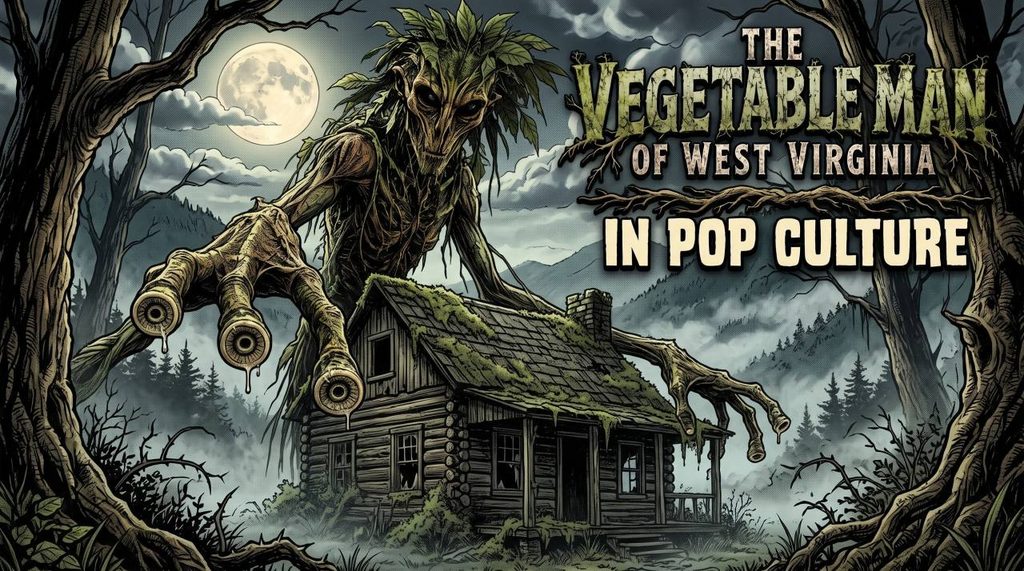
The Vegetable Man may be one of West Virginia’s most obscure cryptids, but his bizarre story has managed to survive for half a century through UFO literature, cryptid books, modern folklore and a growing local celebration in Fairmont.
Unlike some of West Virginia’s more famous mysteries, the Vegetable Man has never received a major motion picture or television production of his own.
His cultural footprint is considerably smaller, but the few works that have directly preserved the story are particularly important because they helped keep the original account from disappearing altogether.
📰 Gray Barker’s Newsletter — 1976
The story’s most important appearance in literature remains Gray Barker’s Newsletter No. 5, published in March 1976.
Barker titled the account:
“The Vegetable Man: A Semi-Abductee?”
The article occupies approximately pages 10–14 and represents the earliest known substantial publication of Jennings H. Frederick’s alleged encounter.
It is an unusual piece of paranormal literature, combining a mysterious humanoid encounter with the language and themes of the UFO-contact era.
Barker’s publication also included illustrations based upon the creature’s reported appearance, helping establish the visual identity of the Vegetable Man that later artists and writers would continue to develop.
For the history of the legend, this publication is arguably more important than any later appearance: without Barker’s newsletter, there may be no surviving Vegetable Man legend in its modern form.
The Gray Barker Collection at the Clarksburg-Harrison Public Library preserves material relating to Barker’s work and remains an important archive for researchers investigating the story.
📖 Alien Meetings — Brad Steiger, 1978
The Vegetable Man subsequently appeared in paranormal author Brad Steiger’s 1978 book Alien Meetings.
Steiger reproduced the encounter as part of his wider collection of alleged meetings between humans and mysterious non-human entities.
His account is particularly significant because it helped move the Vegetable Man beyond Barker’s relatively obscure newsletter and into the broader UFO-contact and extraterrestrial encounter literature of the late 1970s.
The creature’s extraordinary characteristics, including its thin green body, semi-human face, unusual eyes and bizarre fingers, were preserved within this literature and subsequently became part of the standard description repeated by later cryptid writers.
However, Alien Meetings should be regarded as a secondary literary treatment of the case, not independent confirmation of the original encounter.
📘 The World of UFOs — Daniel Cohen, 1978
Another direct literary appearance came in journalist Daniel Cohen’s 1978 book The World of UFOs.
Cohen included the Vegetable Man within a chapter examining mysterious entities associated with UFO reports.
Interestingly, Cohen treated the story with considerably more scepticism than a straightforward believer’s account.
His discussion presents the Vegetable Man alongside other strange humanoid reports while questioning the assumption that every such creature necessarily has a direct extraterrestrial origin.
Cohen specifically noted that there was no direct connection between the Vegetable Man and a UFO — the connection was assumed.
This makes The World of UFOs an especially useful historical source for Cryptid Legends because it demonstrates that even within UFO literature of the period, the interpretation of the Vegetable Man was not necessarily settled.
Cohen’s book therefore represents an important stage in the creature’s literary history: the legend had moved from a local West Virginia story into UFO literature, where writers were already debating what, if anything, the encounter represented.
🧒 Curious Creatures: The Vegetable Man
The Vegetable Man eventually received something rather different: his own children’s book.
Curious Creatures: The Vegetable Man was written by West Virginia author and Mothboys co-host Michael Strayer, with illustrations by Appalachian artist Ballyraven.
Rather than presenting the original account as a frightening encounter, the book transforms the character into a much more approachable figure.
In the story, Veggie Man becomes ill during a check-up of Earth and lands in West Virginia while searching for help. His journey eventually brings him into contact with a human who may be able to assist him in returning home.
The book represents an interesting evolution in the creature’s cultural identity.
The original 1968 story portrayed a deeply unsettling, blood-draining humanoid associated with UFO folklore.
Modern children’s folklore turns that same strange figure into a curious visitor in need of help.
The transformation illustrates how cryptids can gradually move from frightening local legends into characters used for storytelling, art and family-friendly folklore.
🎃 Veggie Man Day
Perhaps the most significant development in the Vegetable Man’s modern cultural history is that the creature now has his own annual folklore festival.
Veggie Man Day was established in Fairmont, West Virginia, bringing together artists, authors, vendors, musicians, speakers and enthusiasts to celebrate the Vegetable Man and the wider tradition of West Virginian folklore.
The inaugural event took place in 2024 at the Frank & Jane Gabor West Virginia Folklife Center.
The festival is particularly fitting because the Folklife Center is itself dedicated to preserving and presenting West Virginia’s cultural heritage, including folklore collections and archives.
🌿 Veggie Man Day 2026
The third annual celebration is scheduled for:
📅 Saturday, October 3, 2026
⏰ 11:00 AM – 4:00 PM
📍 Frank & Jane Gabor West Virginia Folklife Center
Fairmont, West Virginia
🎟️ Free admission
The official event listing describes the day as a celebration of Marion County’s strange cryptid and includes artisan vendors, guest speakers, live music, food trucks and exclusive Vegetable Man Day merchandise.
Vegetable Man Day 2026 — Official Event Information
The event has developed into something more than a celebration of a single cryptid. It brings together West Virginia cryptids, folklore, storytelling and Appalachian creative culture, effectively giving one of the state’s strangest legends a physical place within modern regional folklore.
🕯️ A Small Legend With A Growing Cultural Life
The Vegetable Man’s journey through popular culture is unusual.
He began as an obscure alleged encounter, entered paranormal literature through Gray Barker, was carried into later UFO books, and eventually became the subject of a children’s story and a dedicated West Virginia folklore festival.
There is still no major Hollywood production, long-running television series or extensive body of mainstream literature devoted to him.
But perhaps that suits the Vegetable Man.
He remains a strange little corner of West Virginia folklore, obscure enough that many people have never heard of him, yet distinctive enough to inspire writers, artists, researchers and an entire festival.
From the unsettling image of a green humanoid emerging from the Appalachian woods to the friendly children’s-book interpretation celebrated by modern folklore enthusiasts, the Vegetable Man has evolved considerably since his first appearance in print.
And on October 3, 2026, his story will once again be celebrated in the very state from which the legend emerged.
A cryptid born in the pages of a UFO newsletter now has a place in living West Virginia folklore.