The Yowie – Australia’s Wild Man of the Bush
There are places in Australia where the forest seems to close around you.
For generations, Aboriginal peoples across different parts of Australia have preserved traditions concerning mysterious beings of the wilderness, although these traditions differ considerably between nations and should not be treated as a single universal “Yowie” legend.
Some describe powerful wild or hairy beings associated with remote country, while others belong to entirely different cultural traditions and cannot simply be equated with the modern cryptid.
Later, European Australians began reporting their own encounters with strange, hairy, human-like creatures in the forests and mountains.
The stories gradually converged around a name that would become synonymous with Australia’s answer to Bigfoot:
The Yowie.
Modern accounts describe something enormous and powerfully built, usually covered in dark hair and capable of walking upright like a human being.
Witnesses have reported seeing figures standing motionless among trees, crossing roads, disappearing into rainforest, or moving through the bush with a speed that seemed impossible for their size.
Others claim to have found enormous footprints in mud or soft earth, impressions resembling human feet, but far larger.
And then there are the stories that are harder to forget.
The sudden smell of something foul in otherwise clean forest air.
A scream or booming call echoing through the mountains. Heavy footsteps approaching a campsite.
A dark figure watching from the tree line before vanishing without a sound.
Australia has produced no confirmed body, skeleton, DNA sample or scientifically authenticated photograph of an unknown giant primate.
Yet the Yowie has survived for generations, evolving from a complex collection of Indigenous traditions and colonial-era wild-man stories into one of the world’s best-known cryptids.
From the rainforests of Queensland to the mountains of New South Wales, reports continue to emerge from the Australian bush.
Some say they encountered a bear-like animal.
Some say they saw a man.
And some remain convinced that, for a few terrifying seconds, they were standing in the presence of something that should not exist.
The Yowie remains Australia’s great wilderness mystery, a creature somewhere between folklore, Aboriginal cultural tradition, unexplained encounters and modern cryptozoology.
And unlike the forests of North America, the Australian wilderness has its own ancient history, its own strange fauna, and its own stories of something enormous walking where humans rarely venture.
This is the legend of the Yowie.
🦶 Physical Appearance & Description

Descriptions of the Yowie vary considerably across Australia, partly because the name has been applied to a number of different traditions and reported creatures over a long period of time.
Nevertheless, modern eyewitness accounts tend to converge on the image of a large, hairy, human-like biped resembling an enormous ape or primitive hominin.
Unlike some cryptids whose appearance has become highly standardised through popular culture, there is no single universally accepted Yowie appearance.
Reports range from relatively human-looking, upright wild men to enormous, heavily built creatures with distinctly ape-like features.
📏 Estimated Height
Most modern reports place the Yowie somewhere around:
6–10 feet (1.8–3 metres)
Some exceptional accounts claim creatures considerably larger, approaching 10–12 feet (3–3.7 metres), although these estimates are entirely eyewitness-based and cannot be independently verified.
The reported size is one of the features that separates the Yowie from ordinary Australian wildlife and from descriptions of known Aboriginal forest-dwelling animals.
💪 Build
The Yowie is usually described as powerfully built and muscular, with a physique substantially heavier than that of an average human.
Common characteristics include:
- Broad shoulders and chest.
- Thick, muscular arms.
- Long arms that may extend toward or below the knees.
- Powerful legs.
- Large hands and feet.
- A barrel-like or heavily developed torso.
- An overall impression of enormous physical strength.
Some witnesses describe the creature as possessing a distinctly human body shape, while others report more pronounced ape-like proportions.
🦍 Body & Posture
The classic modern Yowie is fully bipedal, normally walking upright on two legs.
Witnesses have described it standing motionless like a human before suddenly moving into dense vegetation. Others claim it could alternate between an upright gait and a more ape-like crouching posture when moving quickly.
The apparent ability to move silently through difficult terrain is frequently emphasised in reports.
🧑 Face & Head
Facial descriptions are particularly inconsistent.
Commonly reported features include:
- A broad or heavy face.
- Pronounced brow ridges.
- Deep-set eyes.
- A broad, flattened or ape-like nose.
- A large mouth.
- Heavy jaw and cheek structure.
- Dark eyes, sometimes described as reddish or reflective at night.
Some witnesses describe an almost human-looking face, while others report something unmistakably simian.
The head is generally described as proportionally large, although not necessarily with the extreme cranial proportions sometimes depicted in modern Bigfoot artwork.
🖤 Hair & Colouration
The creature is overwhelmingly described as being covered in long, coarse hair or fur.
Reported colours include:
- Dark brown
- Black
- Reddish-brown
- Grey
- Occasionally lighter or almost reddish-gold shades
The Australian environment may also account for some of this variation. A creature living across rainforest, woodland and drier mountain environments could theoretically appear very different under different lighting conditions, while wet fur can appear considerably darker.
Some reports specifically mention hair hanging from the arms, shoulders and back, producing a shaggy silhouette.
👁️ Eyes
The eyes are less consistently described than those of creatures such as Mothman, but several Yowie reports mention noticeably reflective eyes when encountered at night.
This may simply represent normal eyeshine produced when a light source strikes an animal’s eyes. Australia’s nocturnal fauna can produce striking reflections, making eyewitness interpretations particularly difficult in darkness.
For that reason, glowing or red eyes should be regarded as a reported characteristic rather than a defining biological feature.
🖐️ Hands
Large, powerful hands are frequently included in modern descriptions.
Witnesses have reported:
- Long fingers.
- Broad palms.
- Heavy-looking hands.
- Human-like rather than clawed fingers.
Unlike the Maryland Goatman or some other cryptids, the Yowie is generally not described as possessing obvious claws.
🦶 Feet & Footprints
Large footprints are among the most frequently discussed physical evidence associated with the Yowie.
Reported impressions are generally:
Approximately 12–18+ inches (30–46+ cm)
Some alleged tracks are considerably larger.
Descriptions commonly include:
- Five toes.
- A broad heel.
- Human-like proportions.
- A relatively flat appearance.
- A long, narrow or broad forefoot depending on the report.
However, no Yowie footprint has been scientifically demonstrated to belong to an unknown primate. Australia contains numerous potential sources of misleading tracks, and individual footprint claims require careful examination for fabrication, misidentification and environmental distortion.
🧍 Overall Appearance
Putting the recurring descriptions together, the classic modern Yowie would appear as:
A towering, heavily muscled, human-like creature covered almost entirely in dark shaggy hair, with long arms, powerful legs, enormous feet and a broad, somewhat ape-like face.
📍 Location & Country
🌏 Primary Location: Springbrook National Park, Queensland
🏔️ Region: Gold Coast Hinterland, Southeast Queensland
🇦🇺 Country: Australia
🌲 Specific Area: Springbrook National Park, the surrounding Gold Coast Hinterland, Lamington Plateau and adjacent subtropical mountain forests
📐 Coordinates (Approx.): 28.209° S, 153.291° E
🌿 Habitat: Subtropical rainforest, eucalyptus woodland, steep mountain valleys, waterfalls and heavily forested wilderness
⭐ Status: One of Australia’s most frequently cited Yowie hotspots
👣 Famous Case: 1977 Springbrook Yowie encounter, involving a large group of student witnesses
Springbrook National Park provides one of the most atmospheric settings associated with the Australian Yowie.
Rising above the Gold Coast Hinterland, its ancient subtropical rainforest, steep valleys and isolated mountain terrain create the perfect backdrop for stories of a large, elusive creature moving through the Australian bush.
Springbrook National Park is widely considered one of the hotspots for Yowie sightings and the region has an unusually strong concentration of reported encounters.
The region gained particular notoriety following the 1977 Springbrook encounter, when a large group of students reportedly encountered a towering, hair-covered creature in the surrounding wilderness.
The story was reported in the Gold Coast Bulletin in November 1977 and later became one of the best-known Yowie cases in Australian cryptozoological literature.
Springbrook is best treated as the Yowie’s representative hotspot, rather than its exclusive location.
Alleged encounters extend across a vast area of eastern Australia, particularly throughout Queensland and New South Wales, with numerous reports emerging from rainforest, mountain and forest environments.
🌿 Habitat
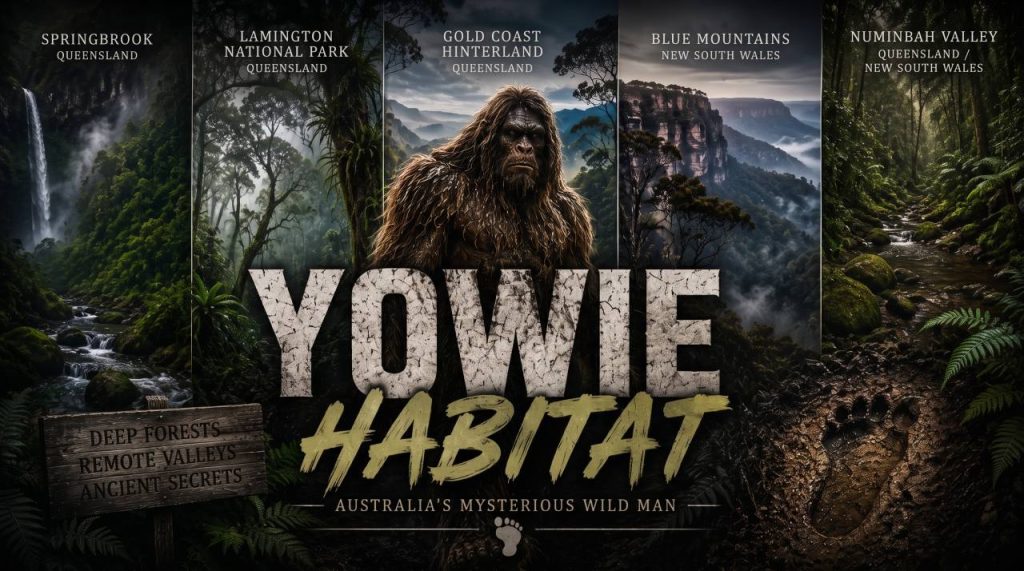
The Yowie is most often associated with the dense forests and mountainous wilderness of eastern Australia, particularly the subtropical rainforests of Queensland and the heavily forested ranges of New South Wales.
Unlike a creature supposedly restricted to one ecological niche, reports place the Yowie across a remarkably broad range of Australian environments, from humid coastal rainforest and mountain valleys to eucalyptus woodland and remote bushland.
🌳 Subtropical Rainforest
Some of the strongest Yowie traditions and modern reports come from the rainforest-covered mountains of southeastern Queensland, including the Gold Coast Hinterland.
Areas such as Springbrook, Lamington and the surrounding mountain ranges contain dense vegetation, deep gullies, waterfalls and extensive areas where visibility can be extremely limited.
These environments provide an atmospheric setting for reports of something large moving unseen through the forest.
🏔️ Mountain & Highland Forests
Yowie reports also frequently originate from the rugged ranges of New South Wales and southern Queensland.
Mountain forests offer:
- Steep slopes and ravines
- Dense undergrowth
- Remote valleys
- Numerous streams and water sources
- Extensive tree cover
- Large areas with relatively limited human access
The Great Dividing Range is therefore an important part of the modern Yowie landscape, with alleged encounters extending through numerous forests and mountain communities.
🌿 Eucalyptus Woodland & Bushland
Not every Yowie report comes from rainforest.
Accounts also place the creature within more open eucalyptus forests, dry sclerophyll woodland and remote Australian bushland. This is significant because it demonstrates how flexible the modern Yowie legend has become.
Witnesses have reported seeing large upright figures:
- Crossing bush tracks.
- Moving between eucalyptus trees.
- Standing beside roads.
- Disappearing into scrub.
- Travelling along creek beds and gullies.
💧 Waterways & Creek Systems
Many alleged encounters occur near creeks, rivers, waterfalls and other permanent water sources.
This has a straightforward ecological explanation: if an unknown large mammal existed, reliable water would naturally be an important resource. Australian forests can also become extremely difficult to traverse away from established waterways.
For the Yowie legend, however, these locations have acquired an additional significance, witnesses often describe hearing movement or strange vocalisations near water before seeing anything.
🌙 Nocturnal & Low-Light Environment
A striking number of modern Yowie reports occur around dawn, dusk or during the night.
This makes the Australian bush particularly deceptive. Dense vegetation, uneven terrain, mist, moonlight and artificial light from torches or vehicle headlights can dramatically distort perceptions of distance and size.
It also provides a plausible explanation for some reports involving apparently enormous silhouettes, reflective eyes or creatures that seem to disappear almost instantly.
🐨 A Unique Australian Wilderness
Australia’s forests contain an extraordinary range of unusual wildlife, including koalas, wallabies, wombats, large monitor lizards, owls, flying foxes and numerous nocturnal mammals. Several species can produce surprisingly loud calls or movements that are difficult to identify in darkness.
This makes Yowie reports especially interesting from a scientific perspective.
There is currently no confirmed evidence of an unknown large primate living in Australia’s forests, and no Yowie specimen, skeleton or DNA sample has been scientifically authenticated.
Nevertheless, the vastness and ecological diversity of eastern Australia’s wilderness has helped maintain the possibility in the public imagination.
The habitat therefore remains an important part of the mystery.
Deep rainforest. Mountain shadows. Remote valleys.
Places where a person can walk only a few metres from a track and disappear completely from view.
And where, according to generations of stories, something much larger may already be watching from the trees.
🐾 Background & Legend
The story of the Yowie is older and more complicated than the modern image of an Australian “Bigfoot” might suggest.
Long before the creature appeared in newspapers, books or cryptozoological literature, Aboriginal peoples across Australia maintained diverse traditions concerning mysterious beings associated with remote country, forests and the wilderness.
These traditions differed enormously between Aboriginal nations, languages and regions, and there was never a single universal Australian creature equivalent to the modern Yowie.
Some traditions concerned hairy, powerful or wild human-like beings, while others described supernatural entities with entirely different characteristics and cultural meanings.
These stories formed part of complex Indigenous understandings of the Australian landscape, rather than simply functioning as monster tales.
🪶 The Origins of the Yowie
The modern Yowie emerged from the intersection of these older traditions with European exploration and colonial folklore.
As Europeans moved deeper into Australia’s forests and mountain country during the nineteenth century, stories began appearing of strange creatures inhabiting remote wilderness.
The descriptions were inconsistent. Some accounts spoke of enormous hairy men.
Others described wild, primitive-looking people living beyond settled country.
Still others gradually developed into stories of mysterious creatures capable of frightening travellers or disappearing into the bush.
Over time, these different traditions began to converge within Australian popular culture.
The result was the creature now recognised as the Yowie.
🗣️ The Name “Yowie”
The word Yowie itself has a complicated history.
It is often presented in modern cryptozoology as an Aboriginal name for an Australian wild man, but its precise linguistic origins and traditional application are more complicated than that simplified explanation suggests.
Different Aboriginal languages possessed their own names for beings and spirits associated with wilderness, and several words have subsequently been connected with the modern Yowie concept.
This distinction is important.
The modern cryptid called the Yowie should not automatically be treated as though it represents one ancient Aboriginal creature shared throughout the entire continent.
Instead, the modern legend developed through the reinterpretation, blending and popularisation of multiple Australian traditions.
🌏 From Wild Man to Australian Cryptid
During the nineteenth and twentieth centuries, the Yowie gradually transformed from a collection of regional wild-being traditions into something resembling a modern cryptid.
The creature became increasingly associated with the idea of an unknown surviving animal hiding within Australia’s wilderness.
This interpretation was particularly influenced by the discovery of previously unknown Australian species and by growing Western interest in unexplored regions.
The possibility that isolated populations of unusual animals might survive beyond the knowledge of science provided fertile ground for Yowie stories.
By the twentieth century, the creature was increasingly portrayed as a physical, flesh-and-blood animal rather than solely a supernatural being.
That transformation would eventually place the Yowie alongside Bigfoot, Sasquatch and the Yeti as one of the world’s most famous wild-man mysteries.
🌲 The Australian Wild Man
At the heart of the legend is an enduring human fascination with the wilderness.
Australia’s immense forests and mountain ranges provided the perfect setting for stories of something ancient surviving beyond the edge of civilisation.
The Yowie consequently became more than a creature.
It became a symbol of the unknown Australian bush, a reminder that enormous areas of the continent remain difficult to explore and that the wilderness can still feel profoundly alien despite Australia’s modern infrastructure and technology.
For believers, this leaves open the tantalising possibility that an undiscovered population could still exist somewhere beyond the roads and settlements.
For sceptics, the Yowie demonstrates how folklore, misidentification, environmental conditions and storytelling can combine to create a remarkably persistent legend.
And somewhere between those interpretations lies the reason the Yowie has endured for so long.
It is not simply Australia’s version of Bigfoot.
It is a uniquely Australian mystery, shaped by ancient cultural traditions, colonial encounters, the mythology of the bush and the enduring belief that something may still be hiding beyond the last clearing.
👣 Historical Sightings, Famous Encounters & Yowie Expeditions

The Yowie has one of the largest bodies of alleged sightings associated with any Australian cryptid.
Reports stretch across generations and across an enormous portion of the Australian mainland, with particularly strong concentrations in Queensland and New South Wales.
Newspapers, local witnesses, researchers and later Yowie investigators have continued to document encounters involving enormous footprints, strange cries, tree disturbances and sightings of apparently human-like creatures moving through the bush.
Yet the history of the Yowie is also a history of uncertainty.
There is no authenticated specimen, skeleton, DNA sample or photograph that has established the existence of an unknown Australian primate.
Many famous encounters survive only through newspaper reports or later recollections, while some of the most dramatic cases come from dedicated Yowie researchers rather than independent scientific investigations.
That tension between a remarkably persistent body of testimony and the complete absence of confirmed biological evidence is what makes the Yowie story so fascinating.
🕯️ Early Australian Reports & the “Wild Man”
Accounts of mysterious hairy or wild human-like beings existed within Indigenous Australian traditions long before the modern cryptid called the Yowie emerged.
European settlers and explorers subsequently recorded stories of unusual hairy creatures and “wild men” in different parts of Australia, although these historical accounts are difficult to connect directly with the modern Yowie.
This is an important distinction.
There was no single continent-wide Yowie tradition shared by all Aboriginal peoples. Australia’s Indigenous cultures contain hundreds of distinct nations and languages, with their own traditions concerning supernatural beings, dangerous creatures and wild people.
Consequently, modern Yowie writers sometimes present these diverse traditions as though they were evidence of one ancient biological species. The historical reality is considerably more complicated.
📜 1789 – The Early “Wild Man” Account
Some modern Yowie histories point to an alleged 1789 encounter involving a hairy wild man, sometimes described as having been captured and transported towards England.
The story has subsequently become an important part of Yowie literature.
However, the provenance of this account is considerably weaker than later newspaper reports, and there is insufficient surviving documentation to establish that the creature involved was actually an unknown Australian primate.
It is therefore best treated as an early historical claim associated with the Yowie tradition, rather than confirmed evidence.
🌲 Nineteenth-Century Australian “Hairy Man” Reports
Throughout the nineteenth century, stories of strange hairy inhabitants of remote Australian country continued to appear in local traditions and later written accounts.
Some modern researchers have attempted to connect these reports with the Yowie.
Others argue that the stories represent a mixture of:
- Indigenous traditions
- European folklore
- Encounters with Aboriginal people
- Misidentified wildlife
- Tall tales
- Later reinterpretation through the emerging Yowie mythology
The lack of contemporary biological documentation makes it impossible to determine how many of these stories describe an actual unexplained encounter.
Nevertheless, they established the cultural background from which the modern Australian wild-man legend eventually developed.
👣 1940s–1950s – The Blue Mountains Reports
The Blue Mountains of New South Wales became one of the most important centres of modern Yowie lore.
Later investigators collected reports from locations including Megalong Valley, Katoomba, Jenolan Caves and surrounding mountain country.
Among the reports later catalogued by Australian Yowie researcher Rex Gilroy was an alleged 1949 Megalong Valley encounter involving Bert Carlen, Claude “Froggy” Veret and Iris McNiel.
Another report from 1952 allegedly involved a strange creature seen from a vehicle near Jenolan Caves Road.
These accounts are important because they pre-date the explosion of modern Yowie hunting in the 1970s, although the surviving evidence is largely testimonial and comes through later researchers.
The rugged Blue Mountains would subsequently become almost synonymous with Australia’s wild-man mystery.
🐾 1964 – Fish River, Oberon
One of the reports later recorded by the Australian Yowie Research Centre concerned pig shooters Eric Rolf and Morris Patton, who allegedly encountered a strange creature near Fish River, Oberon, New South Wales, in 1964.
The encounter was subsequently described as a Yowie incident and became part of the expanding catalogue of alleged Australian “man-ape” encounters.
As with many cases from this period, the account is interesting historically but lacks independent physical evidence.
🌲 1970s – The Yowie Explosion
The 1970s represented a major turning point.
Australian newspapers began reporting Yowie stories with increasing frequency, while dedicated investigators started compiling databases of encounters.
The creature was increasingly portrayed as Australia’s equivalent of Bigfoot or Sasquatch.
This period also saw the emergence of one of the most important names in Yowie research:
🔎 Rex Gilroy
Paranormal and cryptozoological researcher Rex Gilroy established the Australian Yowie Research Centre in 1976 and began systematically collecting reports, alleged footprints and witness testimony.
His work helped transform the Yowie from a collection of scattered bush stories into a recognisable Australian cryptozoological phenomenon.
Gilroy’s databases contain reports from across New South Wales and Queensland and remain an important source for understanding how the modern Yowie legend developed.
However, the database should be understood as a catalogue of reported encounters, not a scientifically validated dataset demonstrating that the creatures existed.
⭐ 1977 – The Springbrook Encounter
Few Yowie stories are more famous than the 1977 Springbrook incident in Queensland.
A group of approximately 20 students from The Southport School were returning from a camping trip near Springbrook when they reportedly encountered an enormous hairy creature.
One of the witnesses was Bill O’Chee, who would later become a Queensland politician and senator.
According to his contemporary account, the creature was approximately:
3 metres (10 ft) tall
It was described as:
- Completely covered in hair.
- Possessing a flat face.
- Moving with a strange sideways or “crab-like” gait.
- Capable of smashing through small trees and saplings.
- Approaching within approximately 10 metres of the camp.
The group reportedly saw the creature on multiple occasions and at one point observed it through binoculars.
O’Chee later told the Gold Coast Bulletin that approximately 20 students had witnessed it.
The case became one of the Yowie’s most famous multi-witness encounters.
🌲 The Springbrook Flap
The story becomes even more interesting because it was not an isolated report.
According to later Yowie research, at least five separate reports were recorded around Springbrook and the edges of Lamington National Park within approximately five months of the October 1977 incident.
One January 1978 witness reportedly described a creature approximately 9 feet tall, covered in hair, with a flat face, unpleasant odour and unusual sideways movement.
Whether these reports represented encounters with the same phenomenon, independent misidentifications or a growing local legend is impossible to establish.
Nevertheless, the cluster helped cement Springbrook as one of Australia’s premier Yowie hotspots.
👣 1977 – The Turon River Encounter
Another remarkable report from the same year allegedly came from George and Janice Gibbs near the Turon River at Hill End, New South Wales.
The couple reportedly encountered a 2.5-metre-tall hominid-like creature.
The incident became part of the growing collection of New South Wales Yowie reports catalogued by later researchers.
The coincidence of several apparently independent reports occurring during the same period contributed significantly to the growing belief that something unusual might be moving through the Australian bush.
🏔️ 1977 – Mt Barrington
Another New South Wales report from the period involved Luis Morrell and Ian McLaughlin, who reportedly encountered a 2.2-metre-tall, man-like, ape-like creature around Mount Barrington.
Again, the report contains no independently verified physical evidence, but it illustrates how frequently descriptions of the modern Yowie converged around the same basic concept:
A large, hairy, upright creature with unmistakably human or ape-like characteristics.
👣 1978 – The Springbrook Reports Continue
The Springbrook region continued generating reports after the famous 1977 encounter.
In August 1978, a 13-year-old boy named Shaun Cooper reportedly saw a dark, hairy creature near Nerang.
He described something resembling a gigantic version of King Kong, using long arms to strip bark from a tree.
The story was subsequently incorporated into the wider Springbrook Yowie literature.
Whether the encounter represented an unknown animal, a misidentified creature or a child’s interpretation of something moving through the bush cannot now be determined.
🔎 1980s – The Search Becomes Organised
During the 1980s, Yowie investigation increasingly became an organised pursuit.
Researchers began:
- Searching reported hotspots.
- Photographing alleged footprints.
- Collecting hair and other alleged biological material.
- Interviewing witnesses.
- Recording vocalisations.
- Establishing databases of sightings.
- Conducting overnight expeditions.
The Blue Mountains, Queensland rainforest and Great Dividing Range became particularly important areas for investigators.
The Yowie had effectively entered Australia’s emerging cryptozoological culture.
👣 1990 – Numinbah Valley Footprints
One of the more notable physical-evidence claims came in March 1990, when Sydney tourist Craig Turnbull reportedly discovered a series of large footprints in a creek bed in the Numinbah Valley, near the Queensland–New South Wales border.
The prints were reported as approximately:
40 cm long × 17 cm wide
Plaster casts were reportedly made and provided to Yowie researcher Rex Gilroy.
Gilroy subsequently organised an expedition to investigate the tracks and other reports across the Lamington Plateau, Woodenbong and Kyogle regions.
The tracks became another important episode in Yowie lore.
But once again, no independently authenticated biological evidence emerged from the investigation.
🏔️ 1990s – The Blue Mountains “Man-Ape”
The 1990s produced another wave of Yowie investigations across New South Wales.
Reports accumulated around:
- Katoomba
- Hazelbrook
- Springwood
- Megalong Valley
- Oberon
- Lithgow
- The Blue Mountains
- The Great Dividing Range
One of the most prominent modern researchers was Dean Harrison, whose later Australian Yowie Research work documented extensive investigations across Queensland and New South Wales.
Harrison has described repeated encounters during 1998–1999 around Hazelbrook in the Blue Mountains, involving what he believed was a Yowie returning repeatedly to the same location. According to his account, the animal became familiar with the sound of his vehicle and responded to his whistle.
These are fascinating accounts from the perspective of modern Yowie research, but they remain researcher testimony rather than independently verified zoological observations.
🌿 1997 – Acacia Hills, Northern Territory
Yowie reports have not been restricted to Queensland and New South Wales.
In 1997, mango farmer Katrina Tucker reportedly claimed to have encountered a hairy humanoid only metres away from her property around Acacia Hills in the Northern Territory.
A large footprint was reportedly photographed and collected as part of the investigation.
The account demonstrates the extraordinary geographic range of modern Yowie reports, which have been claimed across virtually every Australian state and territory.
🎥 The Modern Yowie Hunt
By the 2000s, Yowie investigation had evolved again.
Traditional plaster casts and notebooks were increasingly supplemented by:
📷 Digital photography
🎥 Trail cameras
🎙️ Audio recorders
🌡️ Thermal imaging
🔦 Night-vision equipment
🧬 DNA sampling
🗺️ GPS mapping
Researchers began attempting to approach the Yowie as though it were an undiscovered animal rather than simply a folkloric creature.
This represented an important philosophical change.
Instead of asking:
“Do people believe in the Yowie?”
researchers increasingly asked:
“Can we collect something that science can independently test?”
So far, that transition has not produced a confirmed unknown primate.
🎥 2009 – Kilkivan Research
Modern Australian Yowie researcher Dean Harrison has described another significant encounter during research near Kilkivan, Queensland, on 2 January 2009.
The event became one of the episodes highlighted by Australian Yowie Research in its account of modern field investigations.
Such accounts form an important part of the modern Yowie narrative, although, as with the earlier reports, they remain dependent upon eyewitness testimony.
🐾 The Yowie Today
The Yowie has never really disappeared.
Reports continue to emerge from the Australian bush, while dedicated researchers maintain sighting databases and conduct expeditions into alleged hotspots.
Modern Australian Yowie communities have also developed a substantial online presence, with investigators sharing:
- Footprint photographs
- Alleged hair samples
- Audio recordings
- Trail-camera images
- Night-time encounter reports
- Tree structures
- Knock and vocalisation reports
Contemporary media continues to report alleged encounters as well.
A 2024 investigation into Victorian reports, for example, documented claims from locations including Daylesford, Hepburn Springs, Mount Warrenheip and Mount Hotham, while emphasising that no definitive evidence has established the creature’s existence.
🔬 What Makes the Yowie Different?
After more than a century of alleged encounters, one question remains impossible to ignore:
Where is the body?
Australia is a huge continent, but a population of large, breeding primates would presumably leave biological traces.
Despite decades of searching, there has been no scientifically authenticated:
- Yowie skeleton
- Yowie carcass
- Yowie specimen
- Yowie DNA
- Confirmed photograph
- Verified footprint
- Reproducible biological observation
That doesn’t make every witness dishonest.
It simply means that testimony and physical evidence are very different things.
👣 The Yowie Legacy
From Aboriginal wild-being traditions and nineteenth-century “wild man” stories to the Springbrook encounter, Rex Gilroy’s expeditions, the Blue Mountains investigations and modern trail-camera searches, the Yowie has developed one of the richest cryptid histories in Australia.
Some cases are little more than fragments of local folklore.
Others involve multiple witnesses, contemporary newspaper coverage or alleged physical evidence.
None has yet crossed the final threshold into confirmed zoology.
For now, the Yowie remains suspended between Australian folklore and cryptozoological possibility.
And perhaps that is why the legend refuses to disappear.
Because somewhere beyond the last road, beneath the eucalyptus canopy and deep inside the rainforests of the Great Dividing Range, the Australian wilderness still provides exactly the kind of place where an unanswered question can survive.
Something large was seen.
Footprints were found.
The witnesses remain convinced.
But whatever was moving through those forests has never stepped far enough into the light for science to identify it.
🐾 The Yowie in Pop Culture
The Yowie occupies a fascinating position in Australian popular culture.
Unlike many cryptids that remain primarily creatures of horror films, documentaries and paranormal television, the Yowie has become something much broader, appearing in children’s entertainment, chocolate and confectionery, books, toys, merchandise, tourism, local businesses and Australian folklore attractions.
Over time, the frightening hairy creature of bushland encounters has even been transformed into a colourful children’s character.
That contrast, monster of the Australian wilderness versus lovable Australian mascot, is one of the most interesting aspects of the Yowie’s cultural history.
🍫 The Cadbury Yowie
Perhaps the single biggest pop-cultural phenomenon associated with the Yowie was the famous Cadbury Yowie chocolate.
Launched in Australia during the 1990s, Yowie chocolates combined a chocolate shell with a surprise animal collectible hidden inside, somewhat in the tradition of a chocolate-and-toy surprise.
The Yowie characters were given individual personalities and identities, transforming the creature from a frightening cryptid into a colourful children’s brand centred around Australian wildlife and conservation.
The concept became enormously popular.
The modern Yowie brand states that its story began in Australia in the mid-1990s and that it has subsequently created 166 unique collectible animals and Yowie characters.
The original Yowie phenomenon eventually expanded far beyond chocolate, producing:
- 🧸 Collectible figures
- 📚 Children’s books
- 👕 Clothing
- 🎮 Games
- 🎵 Music CDs
- 🧩 Activity products
- 🐾 Wildlife educational material
The Yowie therefore became one of the strangest examples of a cryptid being transformed into a mainstream children’s franchise.
📚 Yowie Books
The original children’s franchise was accompanied by a substantial series of illustrated books in which the Yowie characters protected their various domains and Australian wildlife from threats.
The books became major Australian children’s titles, with the series reportedly selling millions of copies.
This gave an entire generation of Australian children an introduction to the Yowie, although very different from the terrifying creature described in cryptozoological reports.
🧸 Yowie Collectibles & Figures
The collectible aspect of Yowie culture became particularly important.
Each chocolate contained an animal figure, encouraging children to collect and trade them.
This effectively created a miniature Australian wildlife collecting culture around the Yowie brand.
Collectors today still trade original Yowie figures and complete series, with Australian nostalgia communities frequently discussing their childhood collections.
For many Australians, therefore, the word “Yowie” evokes childhood memories of chocolate and tiny animal figures before it evokes cryptozoology.
That is an unusual legacy for a supposed wilderness monster.
☕ Yowie Coffee — Kilcoy, Queensland
One of the more unusual examples of the Yowie becoming part of modern Australian culture can be found in Kilcoy, Queensland, where the creature has become closely associated with a local coffee business.
Yowie Coffee operates a coffee kiosk and van at Yowie Park in Kilcoy, serving freshly roasted coffee and selling coffee beans.
The business’s website also features a dedicated history of the Kilcoy Yowie, directly connecting the company with the local legend.
The connection is particularly appropriate because the Yowie has long been associated with the rugged country around Kilcoy and the wider Sunshine Coast hinterland.
Rather than simply using the creature as a generic cryptid theme, Yowie Coffee incorporates the name into a real local business operating at a location itself called Yowie Park.
The business therefore represents an interesting example of how the Yowie has moved beyond sightings, folklore and cryptozoological investigation and into everyday Australian regional culture.
For visitors interested in the local legend, Yowie Park and Yowie Coffee offer an opportunity to encounter the creature’s name in a distinctly Australian setting — over a cup of coffee rather than in the depths of the bush.
🐾 Why It Matters to the Yowie Legend
Yowie Coffee is a small but fascinating piece of the creature’s modern cultural history.
It demonstrates how the Yowie has become intertwined with the identity of places where the legend has traditionally been told, particularly in Queensland.
The business also maintains a dedicated Kilcoy Yowie Story, preserving and presenting the local tradition alongside its coffee business
🌲 Yowie Park — Kilcoy
The connection goes further.
Yowie Park in Kilcoy, Queensland is an actual public location associated with the town’s Yowie identity.
Kilcoy has embraced the creature as part of its local character, with the surrounding region possessing a substantial history of alleged Yowie encounters and stories.
The result is an interesting example of cryptid tourism: rather than hiding the legend away as folklore, the local community has incorporated the Yowie into its identity.
And this makes Kilcoy particularly valuable to the Cryptid Legends Encyclopedia because the Yowie isn’t merely something represented on merchandise there, the creature has become part of the identity of the place itself.
🏪 Blackbutt Yowie
There’s also a newer development that is particularly interesting for the modern Yowie story.
In February 2026, a couple in Blackbutt, Queensland, launched Blackbutt Yowie, an online store and storytelling venture centred around the local Yowie legend.
The project sells Yowie-themed merchandise including:
👕 T-shirts
🧢 Hats
☕ Mugs
🚗 Plus Other Awesome Yowie Merch
It also promotes local sighting locations and encourages people to share their own encounters.
📺 Television & Children’s Media
The Yowie’s transformation into a friendly children’s character naturally led to television and animated media associated with the broader franchise.
Meanwhile, the cryptozoological Yowie has appeared repeatedly in Australian paranormal and unexplained-phenomena programming, particularly programmes examining alleged encounters and the mystery of Australia’s wild man.
This created two radically different versions of the creature:
🧸 The Children’s Yowie
Colourful, friendly and associated with wildlife conservation.
👹 The Cryptozoological Yowie
A huge, hairy, potentially dangerous creature reported in remote Australian forests.
Both now form part of the Yowie’s cultural identity.
📚 Books & Cryptozoological Literature
The Yowie has appeared extensively in:
- Australian cryptozoology books
- Bigfoot/Sasquatch literature
- Children’s fiction
- Folklore collections
- Paranormal books
- Local history publications
- Sightings databases
- Self-published field-investigation accounts
Researchers such as Rex Gilroy helped establish the Yowie as a serious subject within Australian cryptozoological culture, while later researchers have continued documenting alleged encounters and conducting expeditions.
The creature has consequently developed its own substantial literature ecosystem.
🎨 Art, Merchandise & Australian Cryptid Culture
Today the Yowie is increasingly represented through Australian cryptid artwork and merchandise.
Its distinctive silhouette lends itself particularly well to:
🖼️ Posters
👕 T-shirts
☕ Mugs
🧢 Caps
🧸 Figures
🔑 Collectibles
📚 Books
🎨 Cryptid artwork
The creature has effectively become one of Australia’s most recognisable cryptozoological mascots.
🗺️ Yowie Tourism
Perhaps the most fascinating modern development is the emergence of Yowie tourism.
Locations such as Kilcoy, Blackbutt, the Gold Coast Hinterland, Springbrook and parts of New South Wales increasingly incorporate Yowie stories into local folklore and tourism.
Some locations promote:
- Alleged sighting sites
- Local Yowie stories
- Yowie-themed businesses
- Cryptid merchandise
- Walking and exploration routes
- Local storytelling
This represents an important transition in the Yowie’s history.
The creature is no longer merely something supposedly seen in the Australian bush.
In some communities, it has become part of the identity of the bush itself.
🐾 From Monster to Mascot
Few cryptids have undergone such a dramatic transformation.
The creature described in frightening encounter reports — towering, hairy and lurking somewhere beyond the edge of the forest, eventually became a smiling chocolate mascot carried home from the supermarket by Australian children.
Yet both versions continue to coexist.
The Yowie of cryptozoology remains an alleged wild creature whose existence has never been scientifically demonstrated.
The Yowie of Australian popular culture has become something much more tangible: a character, brand, childhood memory, tourism symbol and increasingly a regional Australian cultural icon.
And perhaps that is the Yowie’s greatest achievement.
Whether the creature exists in the forest or not, the Yowie unquestionably exists in the Australian imagination.