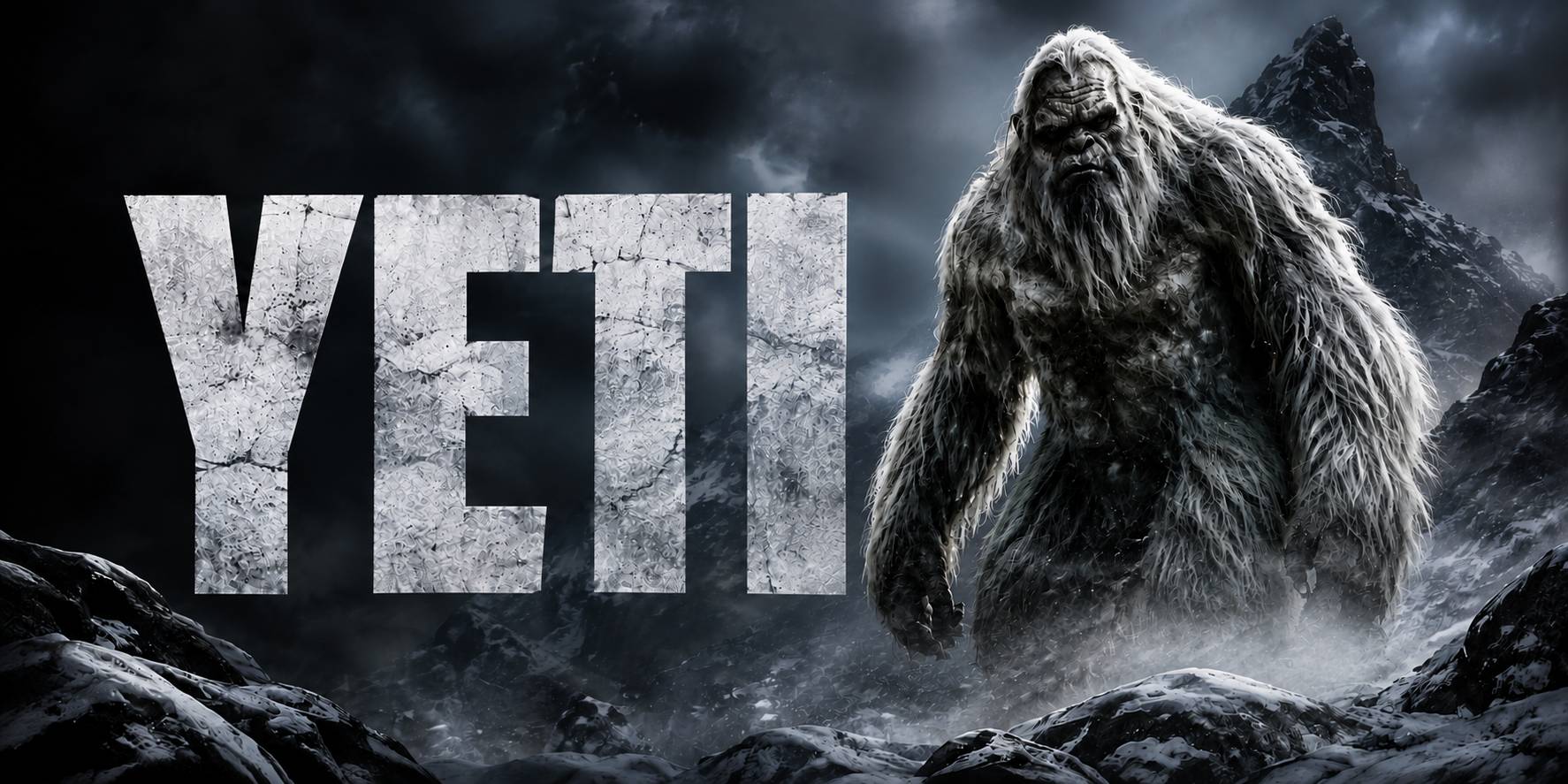
The Yeti, also known worldwide as the Abominable Snowman, is one of the oldest, most enduring, and most iconic cryptids ever recorded.
Said to roam the frozen slopes, glaciers, and remote valleys of the Himalayas, this mysterious ape-like being has fascinated explorers, mountaineers, scientists, and local communities for centuries.
While the modern world knows it as a towering white-furred monster of legend, the origins of the Yeti lie deep within the spiritual traditions and folklore of Nepal, Tibet, Bhutan, and the greater Himalayan region, where stories speak not simply of a beast, but of a mysterious guardian of the high mountains.
Unlike many cryptids born from a single dramatic encounter, the Yeti’s legend stretches back hundreds of years and is woven into the cultural identity of Himalayan peoples.
Local names such as Yeh-Teh, Migoi, Metoh Kangmi, and Dzu-Teh describe a variety of wild mountain beings whose appearances and behaviour differ between regions, blurring the line between folklore, religion, and eyewitness testimony.
To some communities the creature is feared as a dangerous mountain spirit; to others it is respected as a hidden inhabitant of the highest wilderness, rarely seen and never easily understood.
The Yeti entered global consciousness during the great Himalayan expeditions of the twentieth century, when explorers began reporting enormous footprints crossing untouched snowfields high above the tree line.
The famous 1951 Eric Shipton photographs transformed a regional legend into an international mystery, inspiring decades of expeditions, scientific investigations, and media fascination.
From the well-funded searches of American explorer Tom Slick to Sir Edmund Hillary’s investigations and modern DNA analysis of alleged Yeti relics, few cryptids have received such sustained scientific attention.
Today, despite more than a century of investigation, the Yeti remains one of cryptozoology’s greatest unsolved mysteries.
Scientific studies have attributed alleged Yeti hair, bones, and footprints to known Himalayan wildlife, particularly bears, yet eyewitness reports continue to emerge from some of the world’s most isolated mountain ranges.
Whether the legend represents an undiscovered species, centuries of mistaken identity, or one of humanity’s greatest surviving mountain myths, the Yeti continues to embody the mystery and majesty of the Himalayas themselves.
For generations, the frozen roof of the world has guarded its secrets. Among them, none has captured the imagination quite like the legendary Yeti.
👣 Physical Appearance
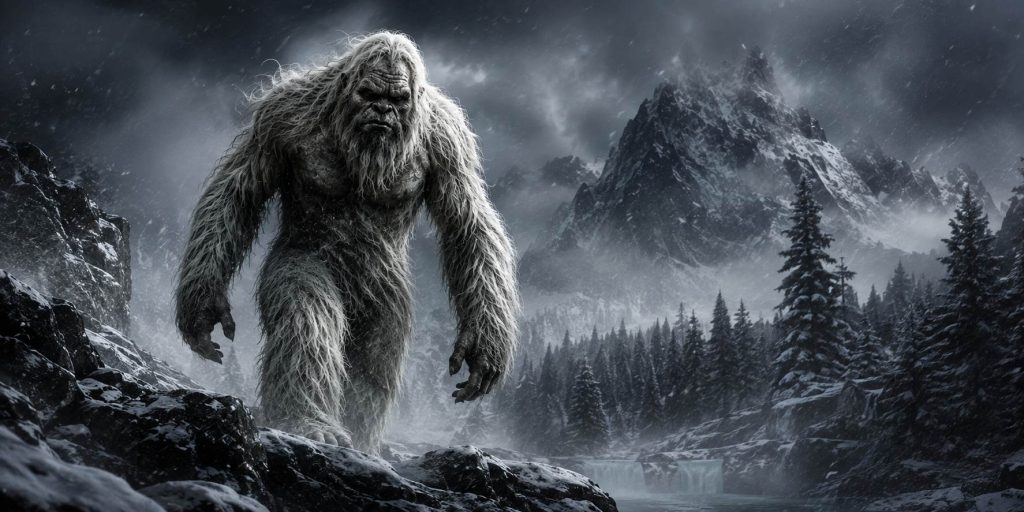
Unlike many legendary creatures, the Yeti has never been consistently described as a single species or even a single type of being.
Across Nepal, Tibet, Bhutan, and northern India, eyewitnesses and centuries of folklore portray a creature whose appearance varies according to region, altitude, and local tradition.
Some accounts describe an enormous ape-like giant standing well over 8 feet (2.4 metres) tall, while others speak of a much smaller, more agile “wild man” barely taller than an average human.
The most frequently reported descriptions portray the Yeti as a powerfully built, broad-shouldered biped covered in thick hair adapted for the extreme Himalayan climate.
Rather than the bright white fur often shown in films and cartoons, eyewitnesses more commonly describe the creature as dark brown, reddish-brown, grey, black, or even silver-grey.
The lighter colouring often associated with the Yeti is thought to have developed through popular culture, where the creature became known as the “Abominable Snowman.”
Its head is usually described as sitting low on the shoulders with very little visible neck. Witnesses frequently mention a sloping forehead, pronounced brow ridge, flat nose, and deep-set eyes that appear dark in daylight but occasionally reflective at night.
The face itself is generally reported as less hairy than the rest of the body, revealing leathery grey or dark skin beneath the fur.
The creature’s arms are commonly said to be unusually long, extending below the knees when standing upright, while its hands are large, broad, and equipped with powerful fingers capable of climbing steep rock faces and gripping ice-covered terrain.
Despite these ape-like characteristics, many reports describe the Yeti walking confidently on two legs with a remarkably smooth, deliberate stride.
Perhaps the most famous feature of the Yeti is its enormous footprints. Reports dating back to the nineteenth century describe tracks measuring anywhere from 12 to 18 inches (30–46 cm) in length, often displaying broad toes, deep impressions, and unusually wide heels.
In many cases the tracks appear almost human, while others show characteristics later attributed to melting bear footprints or overlapping fore and hind paw prints. These mysterious impressions remain one of the defining symbols of the Yeti legend.
Local folklore also recognises multiple types of Yeti-like beings, suggesting that the creature may not represent a single animal at all.
Sherpa traditions distinguish between names such as Yeh-Teh, Dzu-Teh, and Meh-Teh, each referring to different mountain creatures that vary in size, behaviour, and habitat.
Some are described as towering giants inhabiting permanent snowfields, while others resemble smaller ape-like creatures living within Himalayan forests below the glaciers.
This diversity of descriptions has fuelled debate for decades over whether the Yeti legend represents several different animals, mistaken identities, or multiple strands of Himalayan folklore that became merged into a single cryptid.
Whether interpreted as an undiscovered primate, an exceptionally elusive bear, or a supernatural guardian of the mountains, one consistent theme emerges from both eyewitness reports and local tradition: the Yeti is almost always portrayed as an immensely powerful creature, perfectly adapted to survive one of the harshest environments on Earth, leaving behind only fleeting glimpses and mysterious footprints in the snow.
📍 Location & Country
- 📌 Primary Location: Khumbu Region (Everest Region)
- 🏞️ Region: Solukhumbu District, Eastern Himalayas
- 🌍 Country: Nepal (with sightings also reported across Tibet/China, Bhutan and Northern India)
- 📍 Specific Area: Sagarmatha National Park, Mount Everest, Khumjung, Pangboche, Namche Bazaar, Menlung Glacier, Makalu-Barun National Park, and the surrounding high Himalayan valleys.
- 🗺️ Coordinates (Approx.): 27.9320° N, 86.7615° E
The Yeti is traditionally associated with the high Himalayas, a vast mountain system stretching across Nepal, Tibet (China), Bhutan, and northern India.
Although reports have emerged from many parts of this remote wilderness, the heart of the legend lies within Nepal’s Khumbu Region, home to the Sherpa people whose stories helped introduce the creature to the outside world.
Towering peaks, permanent glaciers, dense rhododendron forests, deep alpine valleys, and isolated Buddhist monasteries create one of the most inaccessible environments on Earth.
It was here that many of the Yeti’s most famous expeditions took place, including Eric Shipton’s legendary 1951 footprint discovery, Tom Slick’s extensive searches during the 1950s, and Sir Edmund Hillary’s scientific investigations into the famous Yeti relics kept at Khumjung and Pangboche monasteries.
For centuries, local communities have regarded these mountains not merely as wilderness but as sacred landscapes inhabited by powerful spirits and mysterious creatures.
Whether viewed as folklore, wildlife, or an undiscovered primate, the Yeti has become inseparable from the glaciers and snowfields of the Everest region, making the Khumbu the most iconic setting for one of cryptozoology’s greatest mysteries.
🏔️ Habitat
The Yeti is traditionally associated with one of the harshest environments on Earth, an immense wilderness of glaciers, alpine forests, rocky valleys, and snow-covered mountain passes stretching across the central Himalayas.
Rather than inhabiting a single mountain, folklore places the creature across an extensive network of isolated valleys and high-altitude forests where human visitors remain comparatively rare.
Most reports occur between 3,000 and 5,500 metres (9,800–18,000 feet) above sea level, particularly near the treeline where dense rhododendron forests give way to rugged alpine slopes, glacial moraines, and permanent snowfields.
These elevations provide an abundance of caves, rocky shelters, hidden ravines, and dense vegetation capable of concealing large mammals from casual observation.
Unlike the popular image of a creature living exclusively on frozen peaks, many Sherpa traditions describe the Yeti descending into lower forests during the warmer months in search of food before retreating to higher elevations during winter.
This seasonal movement mirrors the behaviour of Himalayan wildlife such as the Himalayan brown bear, Tibetan brown bear, Asiatic black bear, and snow leopard, all of which migrate between elevations as food availability changes.
The Himalayas themselves present formidable natural barriers. Deep river gorges, towering cliffs, dense conifer forests, unstable glaciers, and frequent avalanches make large portions of the region extremely difficult for humans to access.
Vast areas remain sparsely inhabited, with many valleys seeing little more than the occasional mountaineering expedition or local herders.
This isolation has helped preserve the Yeti legend for centuries and continues to fuel speculation that an undiscovered large mammal could remain hidden among the mountains.
Modern researchers generally regard these same habitats as home to known wildlife rather than an unknown primate. Nevertheless, the rugged terrain, extreme weather, and limited scientific surveying of some remote valleys mean the Himalayas continue to provide one of the world’s most enduring settings for cryptid folklore.
“Among glaciers, cloud forests, and windswept mountain passes where survival itself is a daily challenge, the legend of the Yeti has endured for generations, woven into the landscape as naturally as the snow that blankets its peaks
❄️ Background & Legend
Long before the Yeti became one of the world’s most famous cryptids, stories of mysterious mountain beings were deeply woven into the cultures of the Himalayas.
For the people who lived among these towering peaks, the Yeti was never simply a monster, it occupied a complex place somewhere between wildlife, spirit, and ancient folklore.
Across Nepal, Tibet, Bhutan and northern India, different communities developed their own names and traditions for these elusive beings.
Sherpa guides spoke of the Yeh-Teh, often translated as a “man-bear” or wild mountain creature, while Tibetan traditions referred to similar beings using names such as Metoh Kangmi, a phrase that would eventually become mistranslated by Western journalists as the now-famous “Abominable Snowman.”
Other Himalayan cultures describe related creatures including the Migoi, Dzu-Teh, and several regional variations, each reflecting local beliefs rather than a single universally accepted legend.
Unlike many Western monster stories, traditional Himalayan folklore rarely portrays the Yeti as an inherently evil creature.
In some villages it is respected as a guardian of remote mountains and glaciers, while elsewhere it serves as a warning to travellers who venture carelessly into dangerous wilderness.
Parents sometimes invoked the Yeti to discourage children from wandering into forests or onto unstable mountain slopes, much like other cultures used tales of woodland spirits or giants.
Many legends also describe the creature as intensely shy and territorial, avoiding human settlements whenever possible. Rather than hunting people, it is usually said to observe from a distance, disappearing silently into mist, snowfall or dense forests before it can be approached.
This elusive behaviour became one of the defining characteristics of the legend and later influenced countless eyewitness reports.
As Western mountaineering expeditions began exploring the Himalayas during the late nineteenth and early twentieth centuries, explorers encountered Sherpa stories alongside mysterious footprints left in fresh snow.
Newspaper reports transformed these local traditions into an international mystery, turning a regional piece of folklore into one of the world’s most enduring cryptid legends.
From that point onward, every unexplained footprint, distant silhouette or strange mountain encounter helped reinforce the Yeti’s reputation as the hidden giant of the Himalayas.
Today, the Yeti stands at the crossroads of mythology, exploration and cryptozoology.
Whether viewed as a misunderstood wild animal, an undiscovered primate, or simply one of the richest legends ever to emerge from the world’s highest mountains, it remains one of the defining icons of cryptid folklore, its mystery preserved by the same vast landscapes that first gave birth to the legend thousands of years ago.
👣 Historical Sightings & Expeditions

Unlike most cryptids, whose legends rely on scattered eyewitness accounts and local folklore, the Yeti boasts one of the longest and best-documented histories in all of cryptozoology.
Reports of mysterious ape-like beings inhabiting the Himalayan wilderness stretch back centuries through Tibetan, Sherpa and Bhutanese oral tradition.
By the nineteenth century these ancient stories had begun attracting the attention of Western explorers, mountaineers and scientists venturing into the world’s highest mountains.
Over the next 150 years, countless expeditions searched the glaciers, forests and high mountain passes for evidence of the mysterious creature.
Some returned with nothing but stories. Others photographed enormous footprints preserved in snow, collected strange hairs, examined ancient monastery relics, and interviewed eyewitnesses who insisted they had encountered something impossible.
Although modern science has challenged many of these claims, the historical record remains one of the richest and most fascinating in cryptozoology.
Ancient Himalayan Tradition
Long before Western explorers coined the phrase “Abominable Snowman,” communities living throughout Nepal, Tibet and Bhutan spoke of powerful mountain beings inhabiting the remote alpine wilderness.
Rather than viewing the Yeti as a simple monster, many Himalayan cultures regarded it as a mysterious neighbour of humanity, sometimes feared, sometimes respected, and occasionally considered a spiritual guardian of the mountains.
Different regions preserved different traditions, describing several varieties of wild mountain beings ranging from small, ape-like forest dwellers to towering, fearsome giants roaming glaciers and snowfields.
These traditions formed the foundation upon which every later expedition and investigation would build.
1832 – B. H. Hodgson’s Himalayan Encounter
One of the earliest known Western references appeared in 1832, when British naturalist Brian Houghton Hodgson travelled through northern Nepal.
Hodgson’s local guides claimed to have observed a large, hairy, bipedal creature moving across the mountainside. Although Hodgson himself only saw the animal at considerable distance, he initially speculated it might represent an unknown ape inhabiting the Himalayas.
Years later, after further consideration, Hodgson concluded the figure had most likely been a large Himalayan bear viewed under poor conditions, making this one of the earliest examples of the ongoing debate between extraordinary interpretation and conventional explanation.
1889 – Laurence Waddell and the Mysterious Footprints
The first detailed investigation of alleged Yeti footprints came from British explorer and physician Major Laurence Austine Waddell during his Himalayan expeditions in 1889.
While travelling near high-altitude snowfields, Waddell encountered unusually large footprints that local inhabitants confidently attributed to the mysterious wild man of the mountains.
Rather than accepting the folklore, Waddell carefully examined the impressions and concluded they had almost certainly been left by Himalayan bears, whose hind feet can overlap their forefeet in soft snow to produce surprisingly human-like tracks.
His observations established what would become one of the central scientific explanations for many later Yeti footprint discoveries.
1921 – The Everest Reconnaissance Expedition
The modern Yeti legend truly entered international consciousness during the 1921 British Mount Everest Reconnaissance Expedition, led by Lieutenant Colonel Charles Howard-Bury.
While exploring the Lhakpa La Pass at approximately 21,000 feet (6,400 metres), members of the expedition discovered enormous footprints crossing fresh snow high above the tree line.
Sherpa porters identified the maker as “metoh-kangmi,” a local term referring to a wild mountain creature often translated as “man-bear snowman.”
When British journalist Henry Newman reported the story for the press, he mistakenly translated the phrase as “Abominable Snowman.” The dramatic headline captivated readers worldwide and forever linked the Himalayan legend with its famous English nickname.
The mistranslation arguably created one of cryptozoology’s most enduring names.
1925 – N. A. Tombazi’s Close Observation
Perhaps one of the most compelling early reports came from N. A. Tombazi, a respected Greek photographer working for the Royal Geographical Society.
While surveying glaciers in 1925, Tombazi reported seeing a dark, upright figure approximately 200–300 yards away moving across a snowfield.
Through binoculars he observed what appeared to be:
- A human-like figure walking upright.
- Dark hair covering the body.
- No visible clothing.
- Smooth, deliberate movement across the mountainside.
When Tombazi later reached the location, he discovered a line of footprints measuring approximately 15–16 inches (38–40 cm) in length.
Although he never claimed certainty regarding the creature’s identity, his careful observations remain among the most respected eyewitness accounts in Yeti history due to his reputation as an experienced surveyor and his cautious, scientific approach.
1937 – Frank Smythe’s High-Altitude Tracks
Celebrated mountaineer Frank Smythe encountered another remarkable series of footprints while climbing in the Himalayas during 1937.
The large impressions stretched across fresh snow and appeared distinctly human in shape, reinforcing growing speculation that an unknown biped inhabited the world’s highest mountains.
Years later, however, further analysis suggested the prints were consistent with melting Himalayan bear tracks, whose appearance changes dramatically as snow softens beneath sunlight.
Even so, Smythe remained fascinated by the possibility that something unknown might inhabit the remote glaciers.
1951 – Eric Shipton’s Famous Footprint Photographs
No piece of alleged Yeti evidence has become more iconic than the photographs taken by legendary British mountaineer Eric Shipton during the 1951 Everest Reconnaissance Expedition.
While crossing the Menlung Glacier, Shipton and expedition doctor Michael Ward discovered an uninterrupted trail of enormous footprints crossing pristine snow.
One photograph, showing a single footprint beside an ice axe for scale, became one of the most famous images in cryptozoological history.
The footprint measured approximately 13 inches (33 cm) long and displayed:
- A broad heel.
- Distinct toe impressions.
- A surprisingly human-like outline.
The image appeared in newspapers around the world and inspired decades of scientific debate.
Supporters viewed it as compelling evidence for an unknown primate.
Sceptics argued the print represented a melting bear track, enlarged and distorted by sunlight and repeated freeze-thaw cycles.
To this day, Shipton’s photograph remains the single most recognisable image associated with the Yeti.
The Beginning of the Modern Search
By the early 1950s, the Yeti had evolved from a regional Himalayan legend into an international mystery.
Ancient folklore had merged with mountaineering history, while photographs, eyewitness reports and mysterious footprints fuelled worldwide fascination.
The decades that followed would see the largest expeditions ever organised in search of the elusive creature, including the ambitious investigations funded by American explorer Tom Slick and later scientific searches led by Sir Edmund Hillary, efforts that would forever shape both cryptozoology and the scientific investigation of the Yeti.
👣 Historical Sightings & Expeditions (Part 2)

The Golden Age of Yeti Exploration (1954–1986)
Following the publication of Eric Shipton’s remarkable footprint photographs in 1951, global fascination with the Yeti reached unprecedented levels.
For the first time, governments, newspapers, wealthy patrons and some of the world’s greatest mountaineers began organising dedicated expeditions to answer one question:
Could an unknown primate really inhabit the roof of the world?
The next three decades would become the most intensive search for any legendary creature in modern history.
1954 – The Daily Mail Himalayan Snowman Expedition
Inspired by worldwide publicity surrounding Shipton’s footprints, the British newspaper The Daily Mail financed one of the first major scientific expeditions dedicated entirely to investigating the Yeti.
Led by renowned zoologist Dr Charles Stonor, the expedition travelled through remote regions of Nepal, interviewing Sherpa communities, following reported trackways and examining ancient monastery relics said to belong to the mysterious creature.
Among the team’s objectives were:
- Investigating reported footprint trails.
- Collecting hair and biological samples.
- Examining alleged Yeti relics.
- Interviewing local eyewitnesses.
- Determining whether the creature represented an unknown species or misunderstood wildlife.
Although the expedition discovered additional footprints and gathered numerous local testimonies, no living animal was encountered.
Perhaps its greatest contribution was introducing a far more scientific approach to investigating Yeti claims, replacing sensational newspaper stories with careful documentation and zoological analysis.
1957–1959 – Tom Slick’s Legendary Yeti Expeditions
No individual invested more time, money or resources into searching for the Yeti than American oil millionaire Tom Slick.
Already famous for financing expeditions in search of Loch Ness, Sasquatch and other legendary creatures, Slick believed unexplored mountain wilderness still held biological surprises waiting to be discovered.
Beginning in 1957, he funded what became the largest Yeti expeditions ever organised.
His teams employed:
- Hundreds of Sherpa porters.
- Experienced Himalayan mountaineers.
- Professional zoologists.
- Hunters and trackers.
- Bloodhounds trained to follow unusual scents.
- Motion-picture cameras.
- Extensive photographic equipment.
Unlike earlier expeditions that simply hoped to encounter tracks, Slick’s operations actively searched valleys, glaciers and forests where Sherpas believed the creatures lived.
Da Temba’s Reported Encounter
One of the expedition’s most intriguing accounts came in March 1958, when Sherpa porter Da Temba claimed to have briefly observed a strange, upright figure moving across the mountains under moonlight.
According to expedition records, the creature appeared:
- Around 4½ feet (1.4 metres) tall.
- Covered in dark hair.
- Walking upright on two legs.
- Moving quickly before disappearing into rough terrain.
Although only a fleeting observation, it became one of the better-known eyewitness reports associated with Tom Slick’s searches.
No photograph or physical evidence accompanied the encounter.
The Pangboche Monastery Relics
During Slick’s expeditions, attention turned toward one of the most famous pieces of alleged Yeti evidence in history.
At Pangboche Monastery, Buddhist monks possessed what they claimed were sacred remains of a Yeti, including:
- A preserved scalp.
- A partially mummified hand.
The relics had reportedly been housed within the monastery for centuries and were revered by local communities.
Members of Slick’s expedition secretly removed one finger bone from the hand for scientific examination before replacing it with a human bone in an effort to avoid detection.
The incident later became one of cryptozoology’s most controversial episodes, raising ethical questions alongside scientific ones.
While many believers viewed the relics as compelling evidence, later forensic analysis would eventually demonstrate that neither specimen belonged to an unknown primate.
International Media Sensation
Tom Slick’s expeditions generated enormous worldwide publicity.
Newspapers across Europe and North America followed every development, often publishing dramatic headlines suggesting the mystery might soon be solved.
For many readers during the late 1950s, it genuinely appeared possible that science stood on the brink of discovering an entirely new species of large primate.
Despite years of searching, however, the expeditions ultimately returned without definitive proof.
Even so, Tom Slick’s work helped transform cryptozoology from a fringe curiosity into an organised field of investigation and inspired countless future researchers.
1960–1961 – Sir Edmund Hillary Investigates the Legend
Only a few years after becoming one of the first people to stand atop Mount Everest, Sir Edmund Hillary returned to Nepal with a very different objective.
Rather than climbing mountains, Hillary hoped to investigate the Yeti using careful scientific methods.
Working alongside zoologists and local guides, Hillary visited several Himalayan monasteries housing famous Yeti relics, including the celebrated Khumjung scalp.
The expedition also examined the Pangboche relics and interviewed numerous Sherpas regarding traditional Yeti beliefs.
Laboratory examinations of the alleged remains produced disappointing results for believers.
Rather than belonging to an unknown ape, the hair samples were found to originate from known Himalayan mammals, particularly the Himalayan serow, a goat-antelope native to the region.
Although Hillary remained respectful of local traditions, he concluded that no convincing physical evidence existed for the Yeti’s existence.
His investigation marked one of the first large-scale scientific attempts to separate folklore from zoological reality.
1986 – Reinhold Messner’s Extraordinary Encounter
One of the most respected mountaineers in history unexpectedly revived the Yeti debate during the 1980s.
In 1986, legendary Italian climber Reinhold Messner reported encountering a large, dark, upright creature while travelling through remote Tibet.
Initially shaken by the experience, Messner believed he had witnessed something genuinely unknown.
Unlike many eyewitnesses, however, he continued investigating the mystery himself for years afterwards.
Following extensive field research and interviews with local communities, Messner eventually reached a very different conclusion.
Rather than an undiscovered primate, he became convinced that many Yeti sightings could be explained by encounters with the Tibetan Brown Bear (Ursus arctos pruinosus), whose behaviour, size and ability to stand upright matched numerous historical descriptions.
His change of opinion remains one of the most influential contributions to the modern scientific interpretation of the Yeti.
The Search Continues…
By the close of the twentieth century, the Yeti had become arguably the most thoroughly investigated cryptid on Earth.
British newspapers, millionaire explorers, Everest pioneers and world-famous mountaineers had all searched the Himalayas.
They had photographed mysterious footprints, examined sacred monastery relics, collected hair samples and interviewed generations of local witnesses.
Yet despite decades of extraordinary effort, the central mystery remained unresolved.
The next chapter in the Yeti story would move away from mountain expeditions and into modern laboratories, where advances in genetics and forensic science would test every surviving piece of alleged evidence in an attempt to finally answer one of cryptozoology’s oldest questions.
🧬 Scientific Investigation & DNA Evidence

From Mountain Mystery to Modern Science
For much of the twentieth century, the search for the Yeti was driven by explorers, mountaineers and eyewitness testimony.
By the early twenty-first century, however, advances in forensic science and genetic sequencing had transformed the investigation entirely.
Rather than searching snowfields for footprints, researchers began asking a far more direct question:
If the Yeti exists, can its DNA prove it?
Hair samples, bone fragments, teeth, preserved monastery relics and alleged Yeti remains collected over decades were finally subjected to modern laboratory analysis.
For many scientists, genetics offered the best opportunity yet to settle one of cryptozoology’s oldest mysteries.
Early Scientific Explanations
Long before DNA testing became possible, zoologists proposed that many Yeti reports could be explained by known Himalayan wildlife.
Among the leading candidates were:
- Himalayan Brown Bear (Ursus arctos isabellinus)
- Tibetan Brown Bear (Ursus arctos pruinosus)
- Asiatic Black Bear (Ursus thibetanus)
- Himalayan Serow (Capricornis thar)
- Large langur monkeys
- Snow-distorted tracks created by overlapping bear footprints
Researchers quickly realised that bear footprints could appear remarkably human under certain conditions.
As a bear walks through deep snow, its hind foot often lands directly inside the impression left by the front foot.
After several freeze-thaw cycles, the two prints merge into a single elongated track complete with apparent toes and an arch, remarkably similar to the famous Shipton footprints.
This explanation remains one of the most widely accepted interpretations for many historical Yeti track discoveries.
The Pangboche Hand & Khumjung Scalp
Among the most famous pieces of alleged Yeti evidence were two sacred relics housed within Himalayan monasteries.
Pangboche Hand
The Pangboche Monastery claimed to possess the preserved hand of a Yeti, believed by local tradition to be hundreds of years old.
During Tom Slick’s expedition, one finger bone was secretly removed for examination.
Subsequent scientific investigations produced remarkable findings.
Researchers determined that:
- The hand itself was primarily human.
- Several bones had been replaced or reinforced using animal material.
- No evidence suggested it originated from an unknown primate.
The famous relic proved to be an elaborate mixture of human remains and modified animal bones rather than evidence of a mysterious Himalayan species.
Khumjung “Yeti Scalp”
Another celebrated relic was the so-called Yeti scalp displayed at Khumjung Monastery.
At first glance, the object appeared convincing:
- Thick coarse hair.
- Distinctive dome-shaped structure.
- Long regarded by local communities as genuine.
Laboratory examination eventually revealed a far less mysterious explanation.
Microscopic and later genetic analysis identified the material as the hide of a Himalayan serow, a goat-antelope native to the region.
While culturally important, the scalp provided no biological evidence for the existence of the Yeti.
Bryan Sykes’ Controversial DNA Study (2014)
In 2014, the Yeti returned to international headlines when geneticist Professor Bryan Sykes of the University of Oxford published one of the largest DNA investigations ever conducted on alleged cryptid samples.
His study analysed dozens of hair samples attributed to:
- Yeti
- Bigfoot
- Almasty
- Other mysterious primates
Most samples proved relatively mundane, matching known animals such as dogs, bears and raccoons.
However, two Himalayan hair samples produced an unexpected result.
Using a short section of mitochondrial DNA, Sykes reported that the sequences most closely resembled DNA recovered from an ancient polar bear dating back approximately 40,000 years.
The discovery led to sensational headlines suggesting the Yeti might represent:
- A previously unknown bear species.
- A surviving prehistoric lineage.
- A hybrid between polar bears and brown bears.
For a brief period, the study reignited worldwide speculation that the legendary creature might possess a genuine biological foundation.
However, many geneticists questioned the limited DNA fragment used in the analysis and called for more comprehensive genome sequencing.
👉 (For readers interested in the full controversy, see our dedicated article: What The 2014 Bigfoot, Yeti, Almas & Other Cryptids DNA Hair Study Actually Found)
Modern Genome Sequencing (2017–2018)
Only a few years later, advances in DNA sequencing allowed researchers to revisit many of the same samples using far more complete genetic data.
A team led by evolutionary biologist Dr Charlotte Lindqvist analysed multiple alleged Yeti specimens collected from across the Himalayas, including:
- Hair samples.
- Bone fragments.
- Teeth.
- Skin.
- Faecal material.
Unlike earlier studies that examined only small fragments of DNA, Lindqvist’s team sequenced complete mitochondrial genomes.
Their conclusions were striking.
Every alleged Yeti sample belonged to a known species.
Among the identified animals were:
- Himalayan Brown Bear.
- Tibetan Brown Bear.
- Asiatic Black Bear.
- Domestic Dog.
Perhaps most importantly, the mysterious hair sample previously interpreted by Sykes as belonging to an unknown polar bear lineage was shown to be ordinary Himalayan Brown Bear DNA once the complete genome had been analysed.
The study effectively resolved one of the most significant pieces of modern genetic evidence supporting the Yeti.
Scientific Consensus Today
Today, the overwhelming scientific consensus is that no verified biological evidence exists for an undiscovered Himalayan ape.
Every specimen subjected to rigorous forensic examination has ultimately been identified as belonging to a known animal.
Modern explanations for many Yeti reports include:
- Misidentified Himalayan bears.
- Snow-distorted bear footprints.
- Ancient monastery relics constructed from known animal remains.
- Folklore shaped through centuries of oral tradition.
- Human perception influenced by extreme mountain environments.
This does not necessarily mean every eyewitness fabricated their account.
Many researchers accept that experienced climbers and Sherpas may have encountered genuine wildlife under difficult conditions, later interpreting those encounters through the lens of long-standing local tradition.
Why the Mystery Endures
Despite decades of scientific investigation, the Yeti continues to capture imaginations around the world.
Several questions remain unanswered:
- Why do remarkably similar stories exist across multiple Himalayan cultures?
- Why do experienced mountaineers occasionally report unusual encounters even today?
- Could rare bear behaviour continue to generate convincing eyewitness accounts?
- Might unexplored regions of the Himalayas still hold biological surprises unrelated to the traditional Yeti legend?
While genetics has greatly narrowed the possibilities, science cannot completely explain the cultural longevity of one of humanity’s oldest mountain mysteries.
Whether viewed as a misunderstood bear, a powerful symbol of Himalayan folklore or an undiscovered creature still hiding among the world’s highest peaks, the Yeti remains one of cryptozoology’s most enduring legends.
🎬 The Yeti in Popular Culture

Few legendary creatures have undergone such a dramatic transformation in popular culture as the Abominable Snowman.
When the mysterious Himalayan “Wild Man” first reached Western audiences during the early twentieth century, newspapers portrayed the creature as a terrifying monster lurking among the world’s highest mountains.
The now-famous nickname “Abominable Snowman” quickly captured the public imagination, becoming one of the most recognisable monster names ever created.
Throughout the 1950s and 1960s, cinema, television and pulp fiction largely embraced this fearsome image, depicting the creature as a savage predator stalking isolated mountaineering expeditions.
As the decades passed, however, the legend began to evolve.
The frightening Abominable Snowman gradually transformed into the modern Yeti, a gentle giant, misunderstood guardian, comic sidekick or even heroic protagonist.
Animated films, children’s literature and family entertainment reshaped the creature into one of the world’s most beloved mythical beings, while horror films and cryptozoological documentaries continued to preserve its darker origins.
Today, the Yeti occupies a unique place in popular culture.
It is simultaneously:
- 👣 One of the world’s most famous cryptids.
- 🎥 A classic movie monster.
- ❄️ A beloved family-friendly character.
- 🏔️ A symbol of Himalayan mystery and adventure.
From Hammer Horror to Pixar, Tintin to Disney, MetaZoo to Magic: The Gathering, few legendary creatures have inspired such an extraordinary range of stories, artwork and collectibles.
🎥 The Yeti on Film
Few cryptids have enjoyed a cinematic career quite as long or as varied as the Yeti.
Since first capturing the imagination of Western audiences during the early twentieth century, the mysterious “Abominable Snowman” has appeared in horror films, science fiction, family adventures, animated classics, children’s television and modern survival thrillers.
Unlike Bigfoot, whose portrayals often remain grounded in North American wilderness folklore, the Yeti has continually reinvented itself.
Across more than seventy years of cinema it has evolved from a terrifying Himalayan predator into a sympathetic guardian of nature, before returning once again to its darker horror roots.
❄️ The Snow Creature (1954)
Country: United States
Widely regarded as the first feature-length Yeti film, The Snow Creature introduced American audiences to the Himalayan legend.
The story follows an expedition that captures a living Yeti before transporting it to the United States, where the inevitable escape unleashes chaos.
Although produced on a modest budget, the film established many of the familiar themes that would define Yeti cinema for decades:
- Remote mountain expeditions
- Scientific curiosity
- Humanity disturbing an ancient wilderness
- The deadly consequences of bringing the unknown home
Today it is considered an important milestone in classic 1950s creature features.
🏔️ Half Human (1955)
Country: Japan (Toho Studios)
Released only a year later, Toho’s Half Human offered a distinctly different interpretation.
Rather than presenting the creature purely as a monster, the film explored the Yeti through the lens of Japanese folklore and tragedy.
Its atmospheric snowy landscapes and sympathetic portrayal influenced many later monster films, although the movie remained relatively obscure outside Japan for many years.
👣 The Abominable Snowman (1957)
Country: United Kingdom
Studio: Hammer Films
For many cryptid enthusiasts, this remains the definitive Yeti movie.
Directed by Val Guest and starring Peter Cushing, Hammer Films abandoned the simplistic “monster attacks expedition” formula and instead presented the Yeti as an intelligent, mysterious and possibly more advanced species than mankind.
Rather than asking whether the Yeti exists..…the film asks whether humanity deserves to find it.
Its themes of scientific obsession, human arrogance and respect for the unknown remain surprisingly modern.
Many historians consider The Abominable Snowman to be one of Hammer’s finest non-Dracula productions and arguably the greatest Yeti film ever made.
⭐⭐⭐⭐⭐ Essential Viewing
🦍 Yeti: Giant of the 20th Century (1977)
Country: Italy / Canada
This cult monster movie took the legend in an entirely different direction.
Clearly inspired by King Kong, the creature was transformed into a gigantic prehistoric beast rather than a mysterious Himalayan primate.
While critically divisive, it has since become a favourite among fans of classic giant monster cinema.
😂 The Family-Friendly Yeti Era
Beginning in the late twentieth century, popular culture gradually transformed the terrifying Abominable Snowman into a much gentler character.
Several major productions helped redefine the creature for new generations.
Monsters, Inc. (2001)
Pixar introduced one of cinema’s most beloved Yetis.
The cheerful exile living in the Himalayas became an instant fan favourite and remains one of Pixar’s funniest supporting characters.
Smallfoot (2018)
Warner Bros. completely reversed the traditional legend.
Instead of humans searching for the Yeti……the Yetis believe humans (“Smallfeet”) are mythical creatures.
The film cleverly explores prejudice, fear of the unknown and questioning long-held traditions.
Abominable (2019)
DreamWorks presented perhaps the most emotional interpretation of the legend.
Its magical Yeti is portrayed as an intelligent, gentle and deeply compassionate creature whose extraordinary abilities connect it to the natural world.
For many younger audiences, this version has become the defining image of the modern Yeti.
🩸 The Return to Horror — The Yeti (2026)
After decades dominated by family-friendly portrayals, the legend returned to its darker roots with The Yeti (2026).
Directed by Gene Gallerano and William Pisciotta, the film follows a rescue expedition searching for two missing explorers in the frozen wilderness of northern Alaska.
As the team ventures deeper into the mountains, they discover that something ancient is hunting them through the snow. The filmmakers deliberately described it as a practical-effects survival horror intended to evoke the classic creature features of the 1950s.
Although reviews were mixed, many horror fans praised its old-school practical creature effects, brutal survival atmosphere and willingness to portray the Yeti as a genuinely terrifying apex predator rather than a misunderstood giant.
In many ways, the film represents a full-circle moment in Yeti cinema, bringing the creature back to the fearsome “Abominable Snowman” that first captivated audiences over seventy years earlier.
📺 The Yeti on Television & Documentaries
While cinema introduced the Abominable Snowman to global audiences, television ensured the legend would remain part of popular culture for generations.
From serious scientific documentaries to family entertainment, children’s cartoons and classic British science fiction, the Yeti has appeared in hundreds of television productions over the past seventy years.
Some programmes attempted to solve the mystery.
Others simply embraced the creature as one of the world’s greatest legendary monsters.
Together they transformed the Yeti from an obscure Himalayan folk legend into an internationally recognised cultural icon.
📡 The First Television Investigations
As public fascination with the Yeti exploded during the 1950s, television broadcasters quickly recognised the public’s appetite for expeditions into the Himalayas.
News reports regularly covered:
- Tom Slick’s ambitious Yeti expeditions.
- Sir Edmund Hillary’s scientific investigations.
- Newly discovered footprints.
- Himalayan monastery relics.
- Interviews with Sherpa eyewitnesses.
Unlike feature films, these broadcasts often presented the mystery as a genuine zoological question rather than pure entertainment.
The BBC, CBS, NBC and numerous European broadcasters produced early factual programmes asking whether an unknown primate could still inhabit the Himalayas.
Many of these broadcasts helped cement the Yeti’s reputation as perhaps the world’s most credible cryptid.
🛖 Doctor Who (1967–1968)
Country: United Kingdom
Perhaps the most famous television Yeti of all time appeared in the classic BBC science fiction series Doctor Who.
The creatures featured prominently in two Patrick Troughton serials:
- The Abominable Snowmen (1967)
- The Web of Fear (1968)
Rather than depicting the Yeti as biological animals, the series reinvented them as robotic creatures remotely controlled by the mysterious Great Intelligence.
Although vastly different from Himalayan folklore, these stories became fan favourites and introduced the creature to millions of British viewers.
The shaggy robotic Yetis remain among the most iconic monsters in Doctor Who history.
🎄 Rudolph the Red-Nosed Reindeer (1964)
One of the most beloved Yetis in television history appears in Rankin/Bass Productions’ Christmas classic.
Known simply as The Abominable Snow Monster of the North, or affectionately “Bumble,” the enormous white creature initially terrorises Rudolph and his companions before eventually becoming a gentle friend after Yukon Cornelius removes his dangerous teeth.
For many generations of children, Bumble became their very first introduction to the legend of the Abominable Snowman.
Today he remains one of the most recognisable Yetis ever created.
🕵️ Jonny Quest
Hanna-Barbera’s adventure series frequently explored cryptids and mysterious creatures.
One memorable episode, Monsters in the Monastery, centred around reports of a terrifying Himalayan Yeti.
Like much of Jonny Quest, the story blended real-world mythology with pulp adventure, helping introduce younger audiences to cryptozoology during the 1960s.
👻 Scooby-Doo and Saturday Morning Cartoons
Few legendary creatures have appeared in as many animated series as the Yeti.
Over the decades, numerous Scooby-Doo incarnations have featured Abominable Snowmen as either genuine supernatural beings or criminals disguised beneath elaborate costumes.
Similar appearances can be found throughout classic children’s television, including:
- The Real Ghostbusters
- Extreme Ghostbusters
- DuckTales
- Adventure Time
- The Simpsons
- Phineas and Ferb
- Ben 10
- American Dragon: Jake Long
These appearances gradually transformed the creature into a familiar member of the wider monster pantheon alongside Dracula, Frankenstein’s Monster, the Mummy and Bigfoot.
🔬 Documentary Television
Unlike many fictional cryptids, the Yeti has also remained a regular subject of serious documentary investigation.
Major broadcasters including:
- BBC
- National Geographic
- Discovery Channel
- Animal Planet
- History Channel
- Smithsonian Channel
have all produced documentaries examining the mystery.
Common themes include:
- Himalayan expeditions.
- Footprint discoveries.
- Sherpa folklore.
- Monastery relics.
- DNA testing.
- Bear identification.
- Modern eyewitness reports.
The tone of these documentaries has changed noticeably over time.
Early productions from the 1950s–1980s often treated the Yeti as a genuine zoological possibility.
Modern documentaries generally focus on explaining the legend through genetics, ecology and anthropology, while still acknowledging the enduring cultural importance of the mystery.
📚 The Yeti in Comics & Graphic Novels
Long before blockbuster films introduced the Abominable Snowman to mainstream audiences, comic books and graphic novels helped cement the Yeti as one of the world’s most recognisable cryptids.
From European adventure classics to American superhero comics and Japanese manga, the mysterious Himalayan giant has appeared in countless illustrated stories over the past seventy years.
Some portray the creature as a savage beast lurking among frozen peaks.
Others depict the Yeti as an intelligent, misunderstood guardian of nature, while many simply use the legend as the perfect backdrop for high-altitude adventure.
The flexibility of the myth has allowed comic creators to continually reinvent the creature for new generations of readers.
🧭 Tintin in Tibet (1960)
Creator: Hergé
Country: Belgium
Perhaps no comic has shaped the public image of the Yeti more profoundly than Hergé’s masterpiece Tintin in Tibet.
Widely regarded as one of the greatest graphic adventures ever written, the story follows Tintin’s desperate search for his missing friend Chang after an aircraft crashes high in the Himalayas.
Throughout the journey, mysterious footprints, eerie cries and local legends suggest the pair are being watched by the legendary Yeti.
Unlike traditional monster stories, however, Hergé presents the creature as compassionate rather than violent.
Without revealing too much, the Yeti becomes one of the most emotionally complex characters in the entire Tintin series, portraying loneliness, curiosity and unexpected kindness beneath its fearsome appearance.
Many readers consider this the single greatest fictional portrayal of the legendary creature.
⭐⭐⭐⭐⭐ Essential Reading
🦸 Marvel Comics
Marvel has featured several Yeti-inspired creatures throughout its long publishing history.
Although rarely based directly upon Himalayan folklore, giant ape-like beings resembling the Abominable Snowman have appeared in numerous titles involving:
- Wolverine
- Alpha Flight
- The Hulk
- Spider-Man
- The X-Men
Marvel often blends the Yeti legend with its own universe of mutants, hidden civilisations and ancient monsters, portraying the creature as either an isolated cryptid or a supernatural guardian of remote mountain temples.
The character Sasquatch from Alpha Flight also helped popularise giant ape-like cryptids within Marvel, although he is based primarily on North American Bigfoot rather than the Himalayan Yeti.
🦇 DC Comics
DC Comics has likewise incorporated the Abominable Snowman into numerous stories involving:
- Batman
- Superman
- Wonder Woman
- The Challengers of the Unknown
These appearances usually depict the creature as one of Earth’s unexplained monsters inhabiting remote mountain regions beyond modern civilisation.
Some stories portray the Yeti as a misunderstood animal defending its territory, while others embrace more supernatural or science-fiction explanations.
🦍 Independent Horror Comics
Outside the major publishers, the Yeti has become a recurring monster within horror comics.
Publishers including:
- Dark Horse Comics
- IDW Publishing
- Image Comics
- Antarctic Press
- Zenescope
have all featured stories inspired by Himalayan expeditions, lost monasteries and ancient mountain creatures.
Modern horror comics frequently return the Yeti to its darker roots, presenting it as an intelligent apex predator stalking climbers trapped by snowstorms and avalanches.
These stories often blend cryptozoology with psychological survival horror, echoing classic films such as The Abominable Snowman (1957).
🧟 Warren Publishing
During the 1960s and 1970s, legendary horror magazines including:
- Creepy
- Eerie
- Vampirella
published by Warren Publishing occasionally featured Yeti-inspired monsters among their anthology stories.
These black-and-white illustrated tales typically portrayed the creature as a terrifying supernatural force encountered during doomed Himalayan expeditions, fitting perfectly alongside vampires, werewolves and ancient curses.
For collectors of classic horror comics, these remain some of the most atmospheric Yeti illustrations ever published.
Manga & Japanese Comics
Japanese creators have long embraced the Yeti as part of broader mountain folklore.
The creature has appeared across numerous manga genres, including:
- Horror
- Adventure
- Fantasy
- Comedy
- Children’s stories
Rather than depicting the Yeti solely as a monster, Japanese interpretations often blur the line between cryptid, spirit and guardian of sacred mountains, reflecting traditional beliefs surrounding remote wilderness and hidden beings.
Its influence can also be seen indirectly in many snow-dwelling monsters and ape-like creatures throughout Japanese popular culture.
👣 A Perfect Comic Book Cryptid
The Yeti possesses every quality comic creators look for in a legendary creature:
- ❄️ An isolated and visually spectacular habitat.
- 🏔️ Ancient myths stretching back centuries.
- 👣 Mysterious footprints instead of definitive proof.
- 🌨️ Extreme weather that hides the creature from view.
- 🦍 A design that can range from terrifying monster to gentle giant.
This versatility has allowed the Yeti to appear in virtually every comic genre imaginable, from horror and mystery to children’s adventure and superhero fiction.
Unlike many cryptids whose comic appearances remain relatively niche, the Abominable Snowman has become one of the most enduring illustrated monsters in popular culture, standing comfortably alongside Bigfoot, Dracula, Frankenstein’s Monster and the Loch Ness Monster as one of the world’s most recognisable legendary beings.
🎮 The Yeti in Video Games
Few legendary creatures have enjoyed a gaming career quite as successful as the Yeti.
From early arcade games and platform adventures to modern open-world survival titles, the Abominable Snowman has become one of the most recognisable monsters in video game history.
Sometimes the creature serves as a terrifying boss guarding frozen mountain peaks.
Other times it appears as a friendly ally, comic relief, or even a fully playable character.
Its distinctive white fur, enormous size and remote Himalayan origins have made the Yeti an ideal creature for developers seeking memorable encounters in icy environments.
Today, the legendary snow giant has appeared in hundreds of games across almost every major platform.
🦍 SkiFree (1991)
Developer: Chris Pirih (Microsoft Entertainment Pack)
Few gaming monsters are more unexpectedly famous than the Yeti from SkiFree.
The premise appears simple:
The player skis endlessly down a snowy mountain avoiding trees, rocks and obstacles.
Then…
Without warning…
A gigantic white Yeti suddenly appears from the edge of the screen.
No matter how fast the player skis, the creature almost always catches them before devouring the unfortunate skier.
For millions of players during the 1990s, this became one of gaming’s most memorable jump scares.
Despite its simplicity, SkiFree’s Yeti has become an internet legend in its own right and remains one of the most iconic cryptid appearances in gaming history.
❄️ Spyro the Dragon Series
Insomniac Games introduced several memorable Yeti characters throughout the Spyro franchise.
Most notably:
Bentley the Yeti
First appearing in Spyro: Year of the Dragon (2000), Bentley completely subverted expectations.
Rather than being a fearsome monster, Bentley is a gentle, intelligent and surprisingly polite giant armed with an enormous club.
He later became a fully playable character, earning a devoted fan following.
His appearance helped introduce younger audiences to the legendary creature while demonstrating that Yetis could be heroic as well as frightening.
🏔️ Far Cry 4 – Valley of the Yetis (2015)
Ubisoft returned the legend to its horror roots with one of the franchise’s most memorable expansions.
After crashing in the Himalayas, players must survive freezing temperatures while investigating mysterious disappearances linked to terrifying Yeti-like creatures.
Unlike many previous portrayals, Ubisoft’s Yetis are brutal, intelligent predators capable of overwhelming even heavily armed players.
The expansion successfully blended:
- Survival horror
- Cryptozoology
- Himalayan folklore
- Open-world exploration
Many fans consider it one of the finest modern Yeti adaptations in gaming.
🛡️ Skylanders
The Skylanders series introduced one of gaming’s most popular heroic Yetis.
Slam Bam
An enormous four-armed ice Yeti, Slam Bam quickly became a fan favourite thanks to his:
- Incredible strength
- Ice-based attacks
- Friendly personality
- Unique visual design
Rather than portraying the creature as monstrous, Skylanders embraced the modern interpretation of the Yeti as a noble protector.
⚔️ Clash of Clans
In 2019, Supercell added the Yeti as a powerful troop to Clash of Clans.
Unlike traditional portrayals, this blue-furred giant carries magical “Yetimites” on its back, tiny creatures that leap toward enemy defences after the Yeti is damaged.
The unit rapidly became one of the game’s most distinctive and strategically valuable characters.
🃏 Yeti in Trading Card Games
Unlike many cryptids that only recently entered the world of trading card games, the Yeti has gradually found a place across fantasy, strategy and cryptid-themed card games over the past three decades.
Sometimes portrayed as a mysterious Himalayan cryptid…
Sometimes as a savage mountain predator…
Sometimes as a magical snow beast…
The Yeti has evolved into one of the most recognisable ice-themed creature archetypes in collectible card gaming.
❄️ MetaZoo
The Yeti officially joined MetaZoo relatively late in the game’s lifespan, appearing during the Torrential Tides expansion.
Unlike many of MetaZoo’s flagship cryptids, such as Bigfoot, Mothman and the Jersey Devil, the Yeti was not part of the original Cryptid Nation release, making its eventual appearance highly anticipated by collectors.
MetaZoo stays faithful to Himalayan folklore, depicting the creature as a towering white ape-like Beastie inhabiting remote snow-covered mountains.
The card represents one of cryptozoology’s most famous international legends and remains one of the expansion’s standout cryptid additions.
🧙 Magic: The Gathering
Perhaps surprisingly, Magic: The Gathering has featured 16 official Yeti creature cards throughout its history.
Rather than treating Yetis as cryptids, Magic presents them as a fully established fantasy race inhabiting frozen mountain ranges across the Multiverse.
Official Yeti cards include:
- 🏔️ Mountain Yeti
- ❄️ Karplusan Yeti
- 👣 Stalking Yeti
- 🧊 Frostpeak Yeti
- 🌲 Ohran Yeti
- 🌿 Sylvan Yeti
- ⚔️ Yeti Fur Team
- ⛰️ Glacial Yeti
- ❄️ Crag Yeti
- 🧭 Hulking Yeti
- 🪓 Frostwalk Yeti
- 🌨️ Icefall Yeti
- 🧊 Snowfield Yeti
- 🏔️ Avalanche Yeti
- ❄️ Frostcliff Yeti
- 👑 Isu the Abominable (Legendary Creature — Yeti)
Notable Yetis
👑 Isu the Abominable
First appearing in Kaldheim Commander, Isu the Abominable is the first—and currently only—Legendary Yeti in Magic.
His abilities revolve around snow permanents, allowing players to play snow cards directly from the top of their library while steadily growing larger as more snow permanents enter the battlefield.
He has become one of the defining commanders for snow-themed decks.
🏔️ Mountain Yeti
One of Magic’s earliest Yetis, Mountain Yeti debuted during the game’s early years with the classic Mountainwalk ability and Protection from White, representing the archetypal solitary monster lurking within inaccessible mountain ranges.
❄️ Karplusan Yeti
Originally printed in Ice Age, Karplusan Yeti possesses a unique combat ability allowing it to deal damage directly to another creature, which then deals damage back to the Yeti, making it one of the game’s more unusual early creature designs.
👣 Stalking Yeti
Appearing in Coldsnap, Stalking Yeti became one of the tribe’s strongest cards.
Upon entering the battlefield it immediately fights another creature before potentially returning to its owner’s hand, allowing repeated use throughout a game.
🧊 Frostpeak Yeti
Printed in Kaldheim, Frostpeak Yeti embraces Magic’s modern snow mechanics.
By spending snow mana it becomes unblockable for the turn, reflecting the elusive nature traditionally associated with the legendary Himalayan creature.
🧸 LooseCollector — The Crypt: Yeti
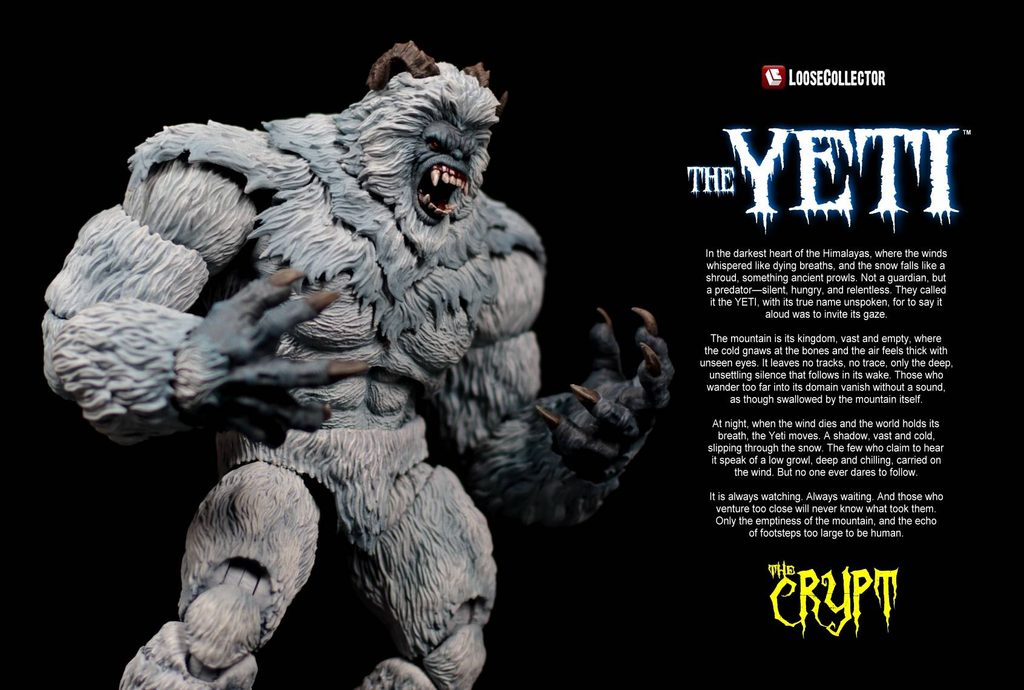
The LooseCollector Yeti is part of the company’s The Crypt line of premium articulated cryptid figures. It was announced in July 2025, with preorders opening at $109.99 and an announced Q1 2026 release.
The finished figure stands approximately 10 inches (25.4 cm) tall despite being a 1/12-scale figure, making it substantially larger than a conventional 1/12 human action figure.
It has 34 points of articulation and was promoted as LooseCollector’s largest figure at the time.
The figure includes two interchangeable head sculpts, interchangeable hands, removable hair and removable horns, giving collectors several ways to display the creature.
📌 Figure Details
- 🧸 Manufacturer: LooseCollector Collectibles
- 👹 Line: The Crypt
- 🏔️ Character: Yeti
- 📏 Scale: 1/12
- 📐 Height: approximately 10 in / 25.4 cm
- 🦾 Articulation: 34 points
- 🎭 Heads: 2 interchangeable head sculpts
- ✋ Hands: interchangeable hands
- 🧶 Hair: removable
- 🐐 Horns: removable
- 💵 Original announced price: $109.99
- 📅 Announced release: Q1 2026
- 🚚 Actual release: early 2026, with retailers receiving stock by February–April 2026
- 📦 Current retail status: sold out/out of stock at a number of original retailers, with secondary-market examples subsequently appearing