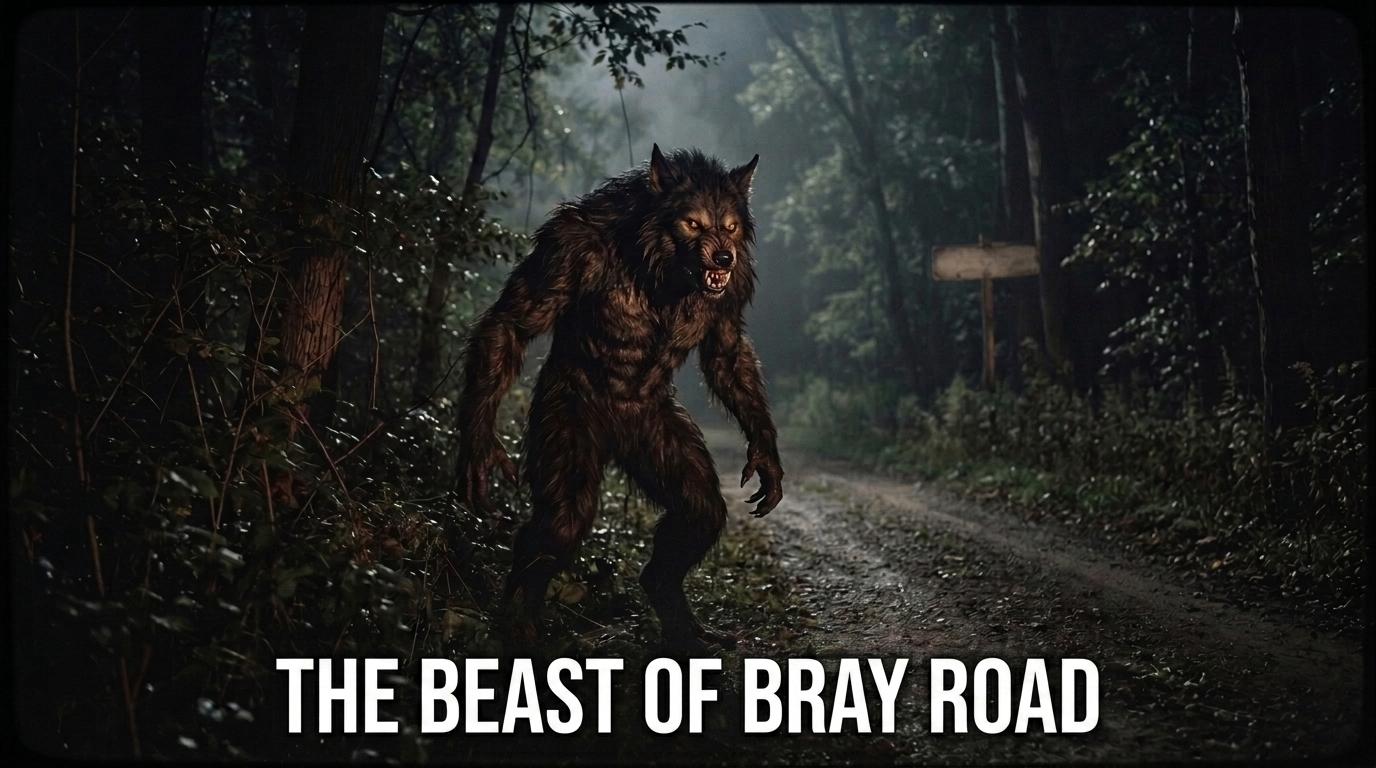
Hidden among the quiet backroads and forests of rural Wisconsin, stories persist of a towering wolf-like creature unlike any known animal.
For decades, motorists, farmers, and local residents have described encounters with a mysterious beast that walks on two legs, watches silently from the treeline, and vanishes into the darkness before anyone can explain what they have seen.
Known as the Beast of Bray Road, it has become one of North America’s most enduring werewolf legends.
🐺Physical Description / Appearance
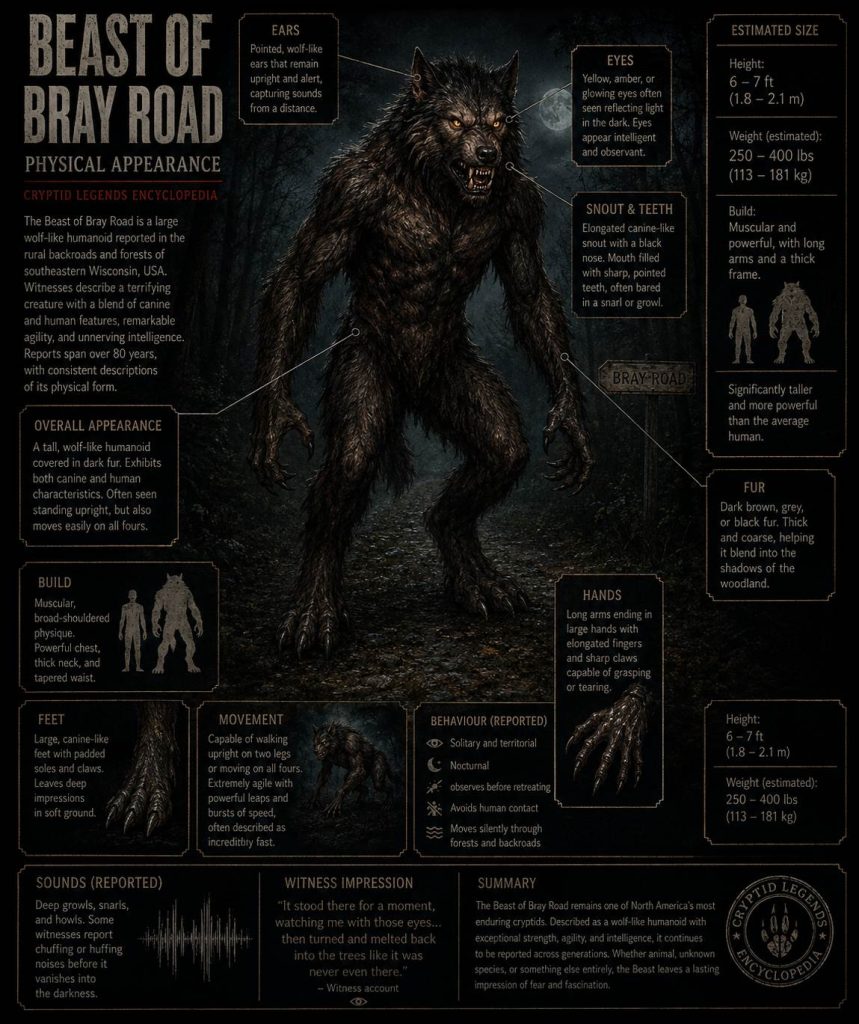
The Beast of Bray Road is commonly described as a large wolf-like humanoid exhibiting both canine and human characteristics. Witness descriptions have remained remarkably consistent over several decades.
Reported Characteristics:
- 🐺 Height: Approximately 6–7 feet (1.8–2.1 m) when standing upright
- ⚖️ Estimated Weight: 250–400 lbs (113–181 kg)
- 🦴 Muscular, broad-shouldered physique
- 🐾 Long arms ending in clawed hands
- 👣 Large canine-like feet
- 🦷 Elongated snout with sharp teeth
- 👂 Pointed wolf-like ears
- 👁️ Yellow, amber or glowing eyes
- 🖤 Dark brown, grey or black fur
- 🚶 Capable of walking on both two and four legs
- ⚡ Extremely agile with powerful leaps and bursts of speed
Many witnesses note that the creature appears unusually intelligent, often observing people before quietly disappearing back into woodland.
📍 Location & Country
- 📌 Primary Location: Bray Road, Elkhorn
- 🏞️ Region: Walworth County, Wisconsin
- 🌍 Country: United States
- 📍 Specific Area: Bray Road and surrounding farmland, forests and rural highways
- 🗺️ Coordinates (Approx.): 42.672° N, 88.545° W
Bray Road, near Elkhorn in Walworth County, Wisconsin, is the defining location of the Beast of Bray Road phenomenon and the place from which the cryptid takes its name.
Although similar upright, wolf-like creatures have subsequently been reported elsewhere in Wisconsin, Illinois and the wider Midwest, Bray Road remains the geographical heart of the legend.
The importance of Bray Road comes not simply from the number of alleged encounters associated with it, but from the way the modern case was documented there.
By the late 1980s and early 1990s, stories of an unusual wolf-like creature had begun circulating among residents of the Elkhorn area.
When local journalist Linda Godfrey began investigating the reports for The Week in 1991, she discovered that the local animal-control office had already accumulated several unusual reports in a file labelled “Werewolf.”
Godfrey’s investigation culminated in her December 29, 1991 article, “Tracking down ‘The Beast of Bray Road’,” which brought together accounts of a large, wolfish creature reportedly seen along and around the road.
The story subsequently attracted national attention and transformed what had been a collection of local rumours and eyewitness accounts into one of America’s best-known modern cryptid legends.
The road therefore occupies a unique position within the case: it is both a physical location associated with reported encounters and the place where the modern Beast narrative was effectively documented and named.
Today, Bray Road remains strongly identified with the cryptid in Wisconsin folklore.
The wider phenomenon has expanded considerably beyond the road itself, but for the Cryptid Legends Encyclopedia, Bray Road represents the most historically appropriate geographical anchor for the Beast of Bray Road profile.
The creature remains scientifically unconfirmed, and no specimen or other definitive physical evidence has established the existence of an unknown animal at Bray Road.
Its significance instead lies in the unusual concentration of eyewitness reports and the contemporary local investigation that transformed a rural Wisconsin mystery into an enduring piece of American cryptid folklore.
🗺️ Habitat
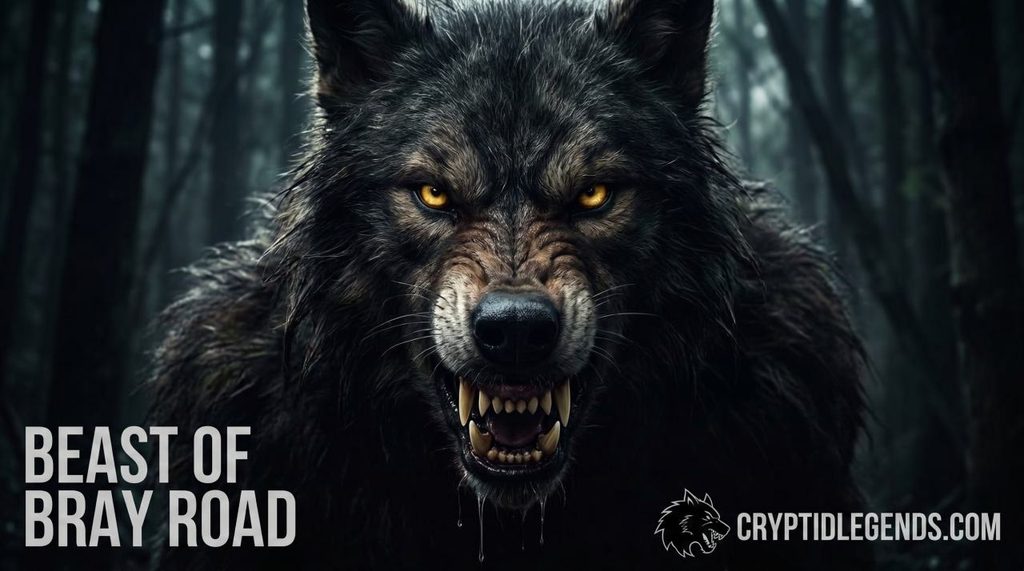
The Beast of Bray Road is fundamentally a southern Wisconsin rural-landscape cryptid, with the strongest concentration of reported encounters centred around Elkhorn and Walworth County.
Unlike cryptids traditionally associated with deep wilderness, the Beast is repeatedly placed within a landscape where farmland, roadside vegetation, woodland pockets, creek bottoms and scattered rural properties meet.
The creature’s namesake, Bray Road, is a rural road outside Elkhorn surrounded by agricultural land and patches of trees rather than continuous forest.
Contemporary reporting from 1991 described reports of a wolf-like animal moving on two legs around the Bray Road area, including accounts involving chickens and roadkill.
🌾 Farmland & Agricultural Country
Open agricultural land forms one of the most distinctive elements of the Beast’s reported environment. Witnesses have described the creature beside roads, around farm properties, in fields and near livestock.
The setting provides a striking contrast to the creature itself: wide-open fields during daylight, but concealed margins and poor visibility after dark.
Cornfields, pastures, fencerows and farm buildings can create numerous places where a large animal could remain concealed before crossing an exposed road or field.
Some reports have specifically placed wolf-like creatures moving through or alongside agricultural fields, including accounts of animals apparently pursuing deer.
🌳 Woodlots, Fencerows & Forest Margins
The Beast is also repeatedly associated with the wooded edges of farmland rather than remote wilderness.
Southern Wisconsin’s agricultural landscape contains numerous small woodlots, hedgerows, brushy boundaries and wooded drainage corridors. These fragmented habitats provide natural transition zones between open fields and denser vegetation.
Several reported encounters occurred when witnesses were travelling along roads bordering these wooded areas, while other accounts describe the creature disappearing into vegetation after being observed.
This makes the forest–field boundary particularly important to the legend. A large animal emerging briefly from woodland into an open field or roadside would be visible for only a short period before disappearing back into cover.
🌿 Creeks, Marshes & Low-Lying Woodland
The wider Elkhorn and Walworth County landscape contains small waterways, wet areas and low-lying wooded habitat interspersed with farmland.
These environments are particularly relevant when considering reports of the Beast around water or wooded creek areas. One early cluster of accounts involved young witnesses encountering a large animal near a creek before it reportedly rose onto two legs and moved away.
Such environments also provide natural wildlife corridors through an otherwise heavily agricultural landscape.
🦌 A Landscape Rich in Wildlife
The habitat associated with the Beast is not biologically empty. Southern Wisconsin supports populations of white-tailed deer, raccoons, coyotes, foxes, wild turkeys, waterfowl and numerous smaller mammals, with agricultural fields providing additional food resources.
This is important because many Beast reports involve animal behaviour: creatures apparently feeding on roadkill, moving through fields or travelling along rural roads.
The original 1991 investigation specifically recorded reports of the creature eating roadkill and stealing chickens, reinforcing the legend’s connection with the ordinary wildlife and livestock of the Wisconsin countryside.
🌙 Why So Many Encounters Occur at Night
Perhaps the most important environmental factor is visibility.
A substantial proportion of the famous Bray Road reports occurred during the evening or overnight, when headlights illuminate only a small portion of the surrounding landscape.
A large animal standing beside a road can therefore appear suddenly before disappearing into darkness.
The combination of:
- 🌾 Open agricultural fields
- 🌳 Small woodland patches
- 🌿 Brush and roadside vegetation
- 🦌 Abundant wildlife
- 🚜 Farms and isolated properties
- 🌙 Limited nighttime visibility
- 🛣️ Quiet rural roads
creates exactly the sort of environment in which brief and ambiguous wildlife encounters can become deeply memorable.
🐺 The Wider Wisconsin Range
Although Bray Road and Elkhorn remain the heart of the legend, reports eventually expanded beyond the original road into other parts of Walworth County and southeastern Wisconsin.
Similar upright, wolf-like creatures have subsequently been reported around communities including Lyons and Spring Prairie, demonstrating how the Beast evolved from a single local legend into a broader Wisconsin cryptid tradition.
The expansion is significant: the Beast is no longer simply an animal supposedly living on one road. In modern folklore it has become a regional creature associated with the rural landscape of southeastern Wisconsin.
📜 Background & Legend
The Beast of Bray Road is one of America’s best-known modern werewolf legends.
Although isolated reports of strange wolf-like creatures in Wisconsin date back to the 1930s, the legend gained widespread attention during the late 1980s and early 1990s following a series of eyewitness encounters near Bray Road outside Elkhorn.
Unlike traditional European werewolf folklore involving cursed humans, witnesses generally describe the Beast as an unknown animal or cryptid rather than a transforming person.
The case was extensively investigated by journalist Linda S. Godfrey, whose research brought national attention to the phenomenon. After interviewing dozens of eyewitnesses, she documented striking similarities between independent reports, helping establish the Beast of Bray Road as one of North America’s most credible modern cryptid cases.
The creature has since become a cornerstone of Wisconsin folklore, with theories ranging from an undiscovered canine species and escaped exotic animal to paranormal or supernatural explanations.
👣 First Original Sightings
Although the Beast of Bray Road became widely known during the late 1980s and early 1990s, reports of a mysterious wolf-like humanoid in rural Wisconsin stretch back much further.
Over the decades, independent witnesses have described remarkably similar creatures roaming forests, farmland, and isolated country roads.
🌙 1936 — The Night Watchman Encounter
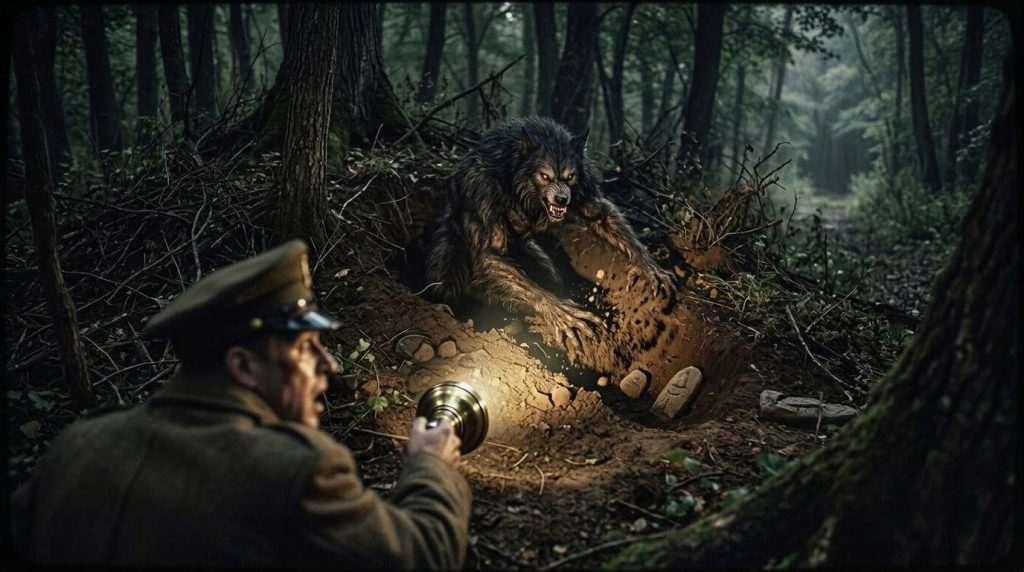
One of the earliest accounts often associated with the Beast of Bray Road legend dates to 1936, when night watchman Mark Shackleman reported a startling encounter near Jefferson, Wisconsin.
While patrolling during the early hours, Shackleman claimed to have discovered a towering wolf-like creature digging into an ancient Native American burial mound. According to his account, the creature stood approximately 7 feet tall, possessed the body of a man with the head and features of a wolf, and emitted a strong, putrid odour.
The witness later described the figure as resembling a “half-man, half-wolf”, adding that it appeared intelligent and briefly vocalised before disappearing into the surrounding darkness.
Although no physical evidence was recovered, the encounter became one of Wisconsin’s earliest documented werewolf-style reports and is frequently cited by researchers investigating the Beast of Bray Road phenomenon.
🚗 1989–1990 — The Bray Road Reports Begin
By the late 1980s, motorists travelling along Bray Road near Elkhorn began reporting encounters with an enormous wolf-like creature unlike any known animal.
Witnesses consistently described seeing a muscular, fur-covered figure capable of walking upright on two legs before disappearing into nearby woodland. Several observers also reported glowing yellow or amber eyes, pointed ears, and an unusually calm, intelligent demeanour.
The growing number of remarkably similar reports soon attracted local media attention.
🎃 Halloween Night 1991 — Doris’s Encounter
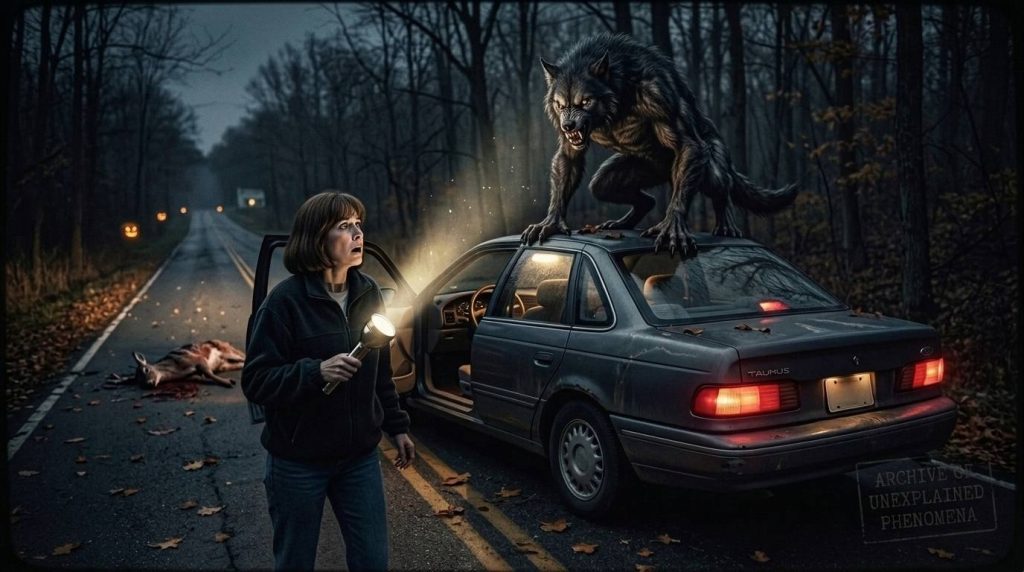
One of the most famous reports connected to the Beast of Bray Road legend occurred on Halloween night in 1991, when a
woman identified in accounts as Doris was travelling along a rural road near Elkhorn, Wisconsin.
According to the reported encounter, Doris was driving along the quiet country road when her vehicle struck an unknown object lying in the roadway. Believing she may have hit an animal or debris, she stopped the vehicle and got out to investigate.
As she examined the area, she reportedly encountered a large, wolf-like humanoid creature nearby. In some versions of the account, the creature suddenly approached the vehicle and jumped onto the roof of the car before quickly fleeing into the surrounding darkness.
Doris described the figure as a massive canine-like creature with:
- 🐺 A wolf-like head and long muzzle
- 📏 A height estimated around 6–7 feet tall
- 🖤 Dark fur covering its body
- 🦴 A powerful, muscular build
- 👁️ An unusual and intimidating appearance unlike any known animal
The encounter became one of the most widely discussed Beast of Bray Road reports due to its close-range nature and the unusual interaction between witness and creature.
The combination of a lonely Wisconsin road, Halloween night setting, and a mysterious upright wolf-like figure helped transform the account into one of the defining stories of modern American cryptozoology.
📰 Linda S. Godfrey’s Investigation
As reports continued to emerge throughout the early 1990s, journalist Linda S. Godfrey began investigating the growing number of eyewitness accounts for the local press.
After interviewing dozens of independent witnesses, Godfrey found striking similarities in their descriptions despite many having no connection to one another.
Her research was later published in The Beast of Bray Road, bringing international attention to the Wisconsin legend and firmly establishing the Beast of Bray Road as one of North America’s best-known modern cryptids.
🎬 The Beast Of Bray Road In Pop Culture

📚 Books
The creature achieved international recognition through The Beast of Bray Road by Linda S. Godfrey.
The book remains the definitive investigation into the case and introduced thousands of readers to the Wisconsin legend.
Godfrey later expanded her research through additional books exploring upright canine sightings across North America.
🎥 Film & Television
The Beast has appeared in numerous paranormal documentaries and television series, including episodes focusing on unexplained creatures, werewolf folklore and cryptozoology.
In 2005, the legend inspired the horror film The Beast of Bray Road, loosely based on reported sightings.
It has also featured in productions by channels such as the History Channel, Travel Channel, and independent paranormal investigators.
🎮 Gaming & Collectibles
The Beast of Bray Road appears in several independent cryptid-themed games, tabletop role-playing supplements and collectible artwork.
It is also featured in the MetaZoo trading card game, where it appears as one of the recognised North American cryptids alongside Mothman, the Loveland Frogman and the Flatwoods Monster.
🎨 Modern Legacy
Today, the Beast of Bray Road has become an enduring symbol of Wisconsin folklore.
Its distinctive werewolf-like appearance has inspired countless works of digital art, apparel, podcasts, YouTube investigations and horror media, while continuing to attract cryptozoologists and curious travellers to Bray Road in search of one of America’s most mysterious modern legends.