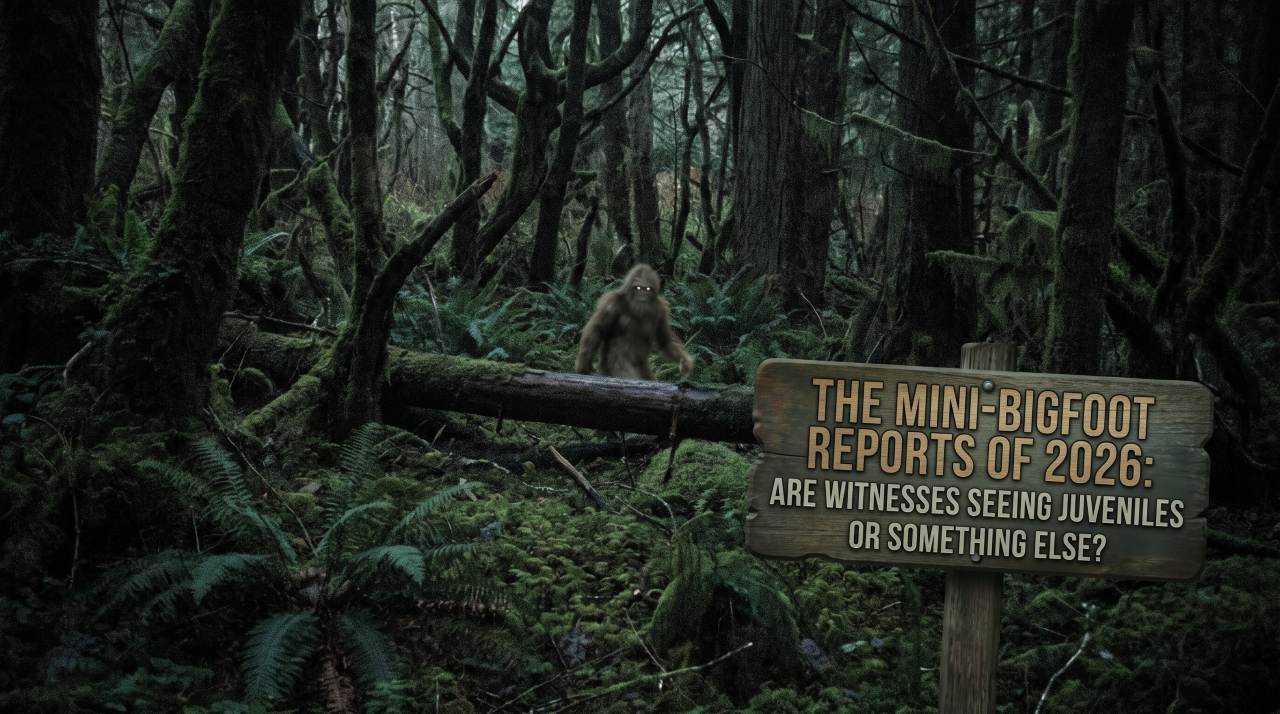
The Mini-Bigfoot Reports of 2026: Are Witnesses Seeing Juveniles or Something Else?
Bigfoot reports usually follow a familiar pattern.
The creature is enormous. Seven feet, eight feet, sometimes even taller. Witnesses describe a towering, heavily built figure disappearing between the trees before they can get a proper look.
But during August 2026, a rather different type of Bigfoot report began emerging from the northeastern United States.
These creatures weren’t enormous.
Some were reportedly only around three to five feet tall.
One particularly intriguing case produced two photographs of a small, apparently human-like figure standing in a remote marsh in upstate New York, which would become known as “The Syracuse Figure“.
A subsequent investigation by the Bigfoot Field Researchers Organization estimated the figure at approximately 4 feet 9 inches (1.44 metres).
Just over a week later, two separate witnesses in southwestern Pennsylvania described similarly small, upright, hair-covered creatures.
The reports have consequently been labelled “mini-Bigfoot” sightings.
But what does that actually mean?
Are these descriptions of juvenile Sasquatch?
Could they represent unusually small adults?
Are witnesses seeing known animals, people, or unusual human behaviour?
Or are we looking at something else entirely?
There is an even more fundamental possibility: perhaps the reports have more in common with the limitations of human observation than they do with an undiscovered population of small primates.
Let’s examine the cases.
The Syracuse Figure
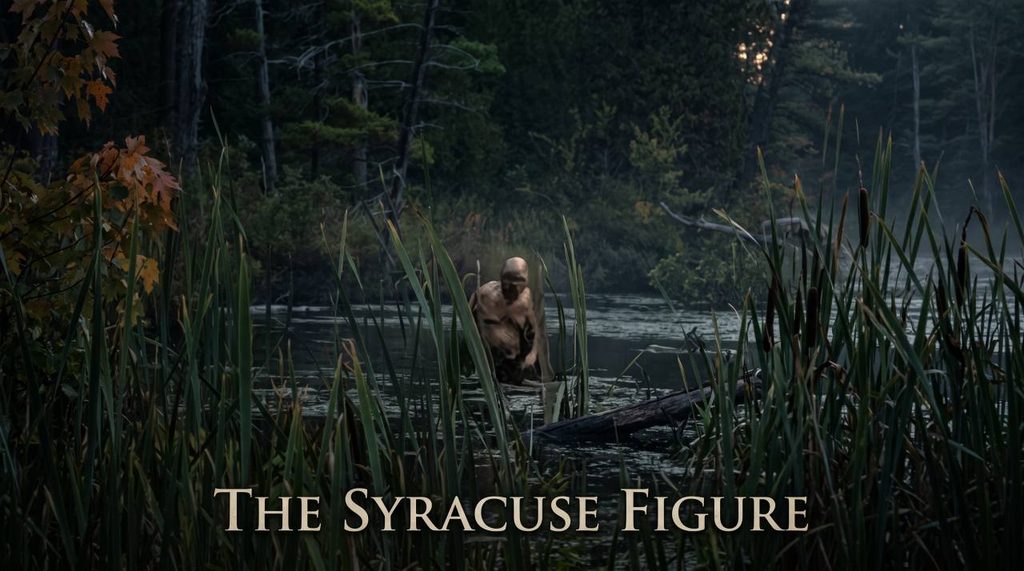
Artist interpretation of the Syracuse figure picture (not the original photograph)
The first and most visually intriguing case occurred on August 10, 2026, in rural Onondaga County, New York.
The precise location has not been publicly released.
The witness, identified by the initials K.D., had taken the day off work and decided to go hiking. She travelled to a remote glacial pond and bog in the area, arriving at approximately 1 p.m.
According to her account, the parking lot appeared empty.
She walked approximately half a kilometre down a forested and marshy path towards the pond.
Once she reached the water, she began taking photographs of the landscape.
Then she noticed something moving to her left.
At approximately 240 feet away, she saw what she initially believed to be a person wading along the edge of the pond.
Her first interpretation was not Bigfoot.
It was a human being.
More specifically, she thought she was looking at a naked man.
She took several photographs.
As the figure apparently turned its head towards her, K.D. became increasingly uncomfortable and decided to leave.
It was only later, when she examined the photographs more closely, that she felt the figure looked considerably stranger than she had initially assumed.
The two photographs became the centrepiece of an investigation by the Bigfoot Field Researchers Organization.
A Very Small Figure
One of the most important aspects of the case is the attempt to establish the figure’s size.
BFRO investigator Ben C. returned to the location with K.D. and attempted to recreate the original photograph.
He stood approximately where the figure had been observed and used the same general camera position, angle and orientation.
His own height was known:
6 feet (72 inches / 1.83 metres).
A tree visible in the original photographs also provided another potential scale reference, with a reported diameter of approximately 11 inches.
Using these reference points, Ben estimated that the photographed figure stood approximately:
4 feet 9 inches (57 inches / 1.44 metres)
That is considerably smaller than the typical size reported for adult Sasquatch.
The BFRO therefore considered the possibility that the figure could have been a juvenile Sasquatch.
But importantly, that is an interpretation of the evidence, not an established identification.
The BFRO’s own report leaves the question open, with the title:
“Human? Sasquatch? Other?”
The organization has also deliberately withheld the precise location, partly because it has not ruled out the possibility that the figure was actually a person.
That uncertainty is important.
Could It Have Been a Human?
This is where the Syracuse case becomes particularly interesting.
At first glance, the photograph can indeed look remarkably human.
The BFRO investigator himself noted that the figure could initially be interpreted as an older, overweight male, potentially with little or no clothing.
That sounds bizarre.
Why would someone be standing naked in a remote, muddy pond?
But an unlikely explanation is not automatically an impossible one.
There could be numerous reasons a person might enter an isolated area.
The witness also reported that the figure was in an extremely difficult location to reach. During his recreation attempt, Ben C. found deep mud, submerged trees, roots, dense vegetation and other obstacles around the pond.
The BFRO report says that reaching the approximate position of the figure was considerably more difficult than expected.
That makes the human explanation interesting, but it doesn’t eliminate it.
An isolated person, someone camping, someone behaving unusually, or even somebody deliberately avoiding other people could theoretically enter a difficult location.
And there is another possibility worth considering.
What if the figure really was human, but simply looked very strange because of the circumstances?
The original photographs were taken from approximately 240 feet away.
The figure was partially obscured by vegetation.
It was standing in water.
The image came from a smartphone rather than a controlled wildlife camera.
And the observer was looking at something she initially interpreted as a human before later becoming uncertain.
That combination creates considerable room for perceptual error.
The BFRO has argued that the estimated 4’9″ stature and difficult terrain make the human explanation less likely, but the organization itself has not ruled it out.
That distinction matters.
“Difficult to explain as a human” is not the same thing as “therefore it was a Sasquatch.”
What About the Face?
Another feature highlighted by the BFRO investigation is the apparent facial structure.
The investigator suggested that the photographs appear to show what could be interpreted as a brow ridge.
Brow morphology has long featured prominently in eyewitness descriptions of Sasquatch.
But once again, photographs this distant and partially obscured create a major problem.
A shadow beneath a forehead, hair hanging over the face, the angle of the head, vegetation and image compression can all alter the apparent shape of facial features.
A photograph can therefore provide a useful observation without necessarily providing a reliable anatomical diagnosis.
This is particularly important when dealing with an image that has already become associated with a particular hypothesis.
Once viewers know they’re looking at a purported Bigfoot photograph, the human brain naturally begins searching for Bigfoot-like characteristics.
The same image viewed without that context could potentially produce a very different interpretation.
The Pennsylvania Mini-Bigfoots
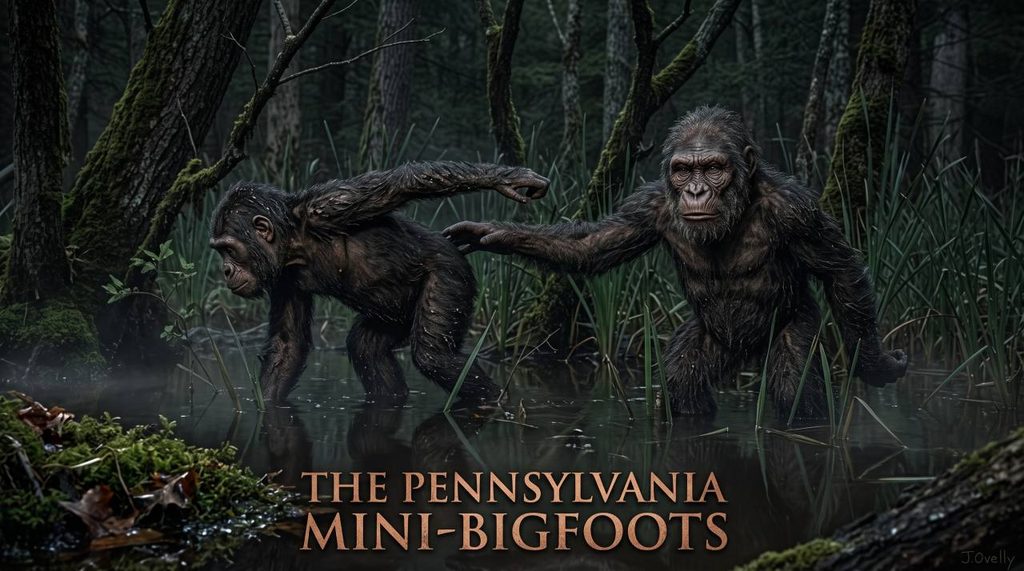
The Syracuse case might have remained an isolated curiosity.
Then came Pennsylvania.
On August 18 and 19, 2026, two separate witnesses in southwestern Pennsylvania reportedly encountered small, upright, hair-covered figures.
The reports were documented by Pennsylvania researcher Stan Gordon.
Unlike Syracuse, however, neither Pennsylvania encounter produced photographs.
There are also no reported biological samples, footprints, video or audio recordings from either incident.
What we have are eyewitness accounts.
That doesn’t make them worthless.
But it does mean the evidential category is very different from Syracuse.
Indiana County — Two Small Figures
The first Pennsylvania encounter reportedly occurred on August 18, 2026, at approximately 6:45 p.m. in rural Indiana County.
A woman was outside carrying out a chore near one of the buildings on her property.
She heard a disturbance coming from the nearby tree line.
According to Gordon’s account, she initially heard something that sounded as though objects were being thrown around.
When she looked towards the trees, she reportedly saw a small figure crouched approximately 60 feet away.
Then she noticed another.
Two figures.
Both were described as being approximately 3½ feet tall.
The witness reportedly described them as having:
- light-brown, medium-length hair;
- darker brown faces;
- round, dark eyes;
- long, slender arms;
- little or no visible neck;
- and proportions that reminded her of young children.
She reportedly watched as the figures stood up and ran around the area, apparently behaving as though they were playing.
Then the encounter took an unexpected turn.
The witness sneezed.
Both figures reportedly stopped and looked directly towards her.
She subsequently returned inside.
According to Gordon’s account, the witness later reported hearing similar cooing sounds at night, while her husband reportedly heard knocking sounds and the family dog became reluctant to go outside.
Those later observations are interesting in their own right, but they don’t independently establish that the creatures were responsible for them.
The central sighting remains the visual encounter.
And there is no photograph or physical evidence.
Westmoreland County — A Five-Foot Figure
The second report occurred the following evening, August 19, in neighbouring Westmoreland County.
At approximately 8:05 p.m., a woman was reportedly driving slowly along a rural road when she saw a hair-covered figure running up a hillside.
This creature was considerably larger than the previous night’s figures.
The witness estimated it at approximately 5 feet tall.
She described:
- charcoal-gray hair;
- a somewhat dome-shaped head;
- no apparent neck;
- long swinging arms;
- small, dark eyes;
- a relatively flat nose with flared nostrils;
- and no visible ears.
The encounter reportedly lasted only several seconds.
One particularly unusual detail concerned the creature’s movement.
The witness described what she believed was an approximately 180-degree turn that appeared unnatural to her, almost mechanical.
The figure then moved away up the hillside.
Again, however, there was no photograph, video, audio recording or physical evidence.
The case rests entirely upon the witness’s description as recorded by Gordon.
Three Reports — One Striking Similarity
Taken together, the three August cases produce an interesting pattern.
| Case | Date | Location | Reported height | Evidence |
|---|---|---|---|---|
| Syracuse Figure | Aug. 10 | Onondaga County, NY | ~4’9″ | Two photographs |
| Indiana County | Aug. 18 | Pennsylvania | ~3½ ft | Eyewitness account |
| Westmoreland County | Aug. 19 | Pennsylvania | ~5 ft | Eyewitness account |
There are similarities.
All involve relatively small upright figures.
The Pennsylvania witnesses independently described hair-covered creatures with long arms and little or no visible neck.
The Syracuse figure was also estimated at only 4’9″.
But we should be careful not to turn three unusual reports into a biological pattern.
The cases occurred in different locations.
The witnesses were different.
The evidence differs considerably.
And none of the cases has produced DNA, a specimen, a definitive footprint trackway or another form of physical evidence demonstrating the existence of an unknown primate.
So perhaps the most interesting question isn’t:
“Are these mini-Bigfoots?”
It is: Why are people reporting such small figures all of a sudden?
Short Does Not Necessarily Imply Young
The obvious explanation within a Bigfoot framework is that these creatures are juveniles.
And biologically, that is perfectly logical.
If Sasquatch were a real breeding primate, young individuals would have to exist.
A juvenile animal would naturally be smaller than an adult.
But that doesn’t automatically mean that every small Bigfoot report represents a juvenile.
There are several competing possibilities.
1. Juvenile Sasquatch
If the Sasquatch hypothesis is correct, a juvenile explanation would make biological sense.
A young individual could potentially explain a figure considerably smaller than the reported adult average.
The Syracuse figure is particularly interesting in this respect because the BFRO investigator considered its proportions apparently compatible with a young individual.
But the juvenile hypothesis creates additional questions.
Where are the adults?
Why are young animals apparently being encountered alone?
How old would a 3½-foot or 4½-foot individual actually be?
Would a juvenile Sasquatch have the same body proportions as an adult?
Would young animals be more curious and therefore more likely to approach human habitation?
Those are biological questions that can’t be answered simply by assigning the label “juvenile.”
2. Unusually Small Adults
Another possibility would be that some reports describe unusually small adult individuals.
That would be more problematic from a biological perspective.
Every real animal population contains variation in body size.
Humans provide an obvious example.
So do other mammals.
But if a hypothetical Sasquatch population normally consisted of animals around seven feet tall, repeatedly encountering adults around three-and-a-half to five feet tall would require an explanation.
Perhaps there could be substantial sexual dimorphism.
Perhaps regional populations could differ in size.
Perhaps environmental conditions could influence growth.
Or perhaps some individuals could possess developmental conditions affecting stature.
All of those are possibilities that could theoretically be investigated if physical evidence ever established that such an animal exists in the first place.
At present, we don’t have that evidence.
3. Humans
Humans remain one of the most important possibilities.
This is particularly relevant to Syracuse.
The witness herself initially believed she was looking at a human being.
The BFRO subsequently investigated the possibility that it could be a person.
The organization’s decision to withhold the exact location was partly intended to allow a potential human subject to identify themselves by providing information that only the actual person would know.
That is a fascinating investigative approach.
And there is no need for the hypothetical human to be a conventional swimmer.
Someone camping, trespassing, behaving unpredictably, deliberately avoiding other people, or simply doing something unusual could theoretically enter a remote area.
Even the apparent difficulty of reaching the location isn’t proof that nobody would do it.
Humans routinely do things that seem irrational to observers.
A person being somewhere unexpected is not evidence of a new species.
4. Bears and Other Wildlife
Then there is the enormous category of known wildlife.
This is where Bigfoot investigations can become surprisingly complicated.
Black bears can stand upright.
They can move through dense vegetation.
They can appear extremely unusual when partially obscured.
And a photograph taken at an unknown distance can make it difficult to establish exactly how large an animal actually is.
Other wildlife can also produce misleading silhouettes.
Deer, for example, can disappear behind vegetation until only portions of the body remain visible.
Multiple branches can create the impression of limbs.
Water, reflections and shadows can distort apparent proportions.
A moving animal doesn’t necessarily resemble the animal we recognise perfectly from a textbook photograph.
And this is one reason that a strange-looking image isn’t automatically an image of an unknown animal.
5. Perspective and the Problem of Estimating Height
The Syracuse case provides another important lesson.
The 4’9″ estimate wasn’t simply somebody looking at the photograph and guessing.
The investigator attempted a reconstruction using known measurements and his own six-foot height.
That makes the estimate much more useful than an arbitrary visual guess.
But it is still an estimate.
The farther away an object is, the more important small errors in position, camera angle, terrain and posture become.
The figure was approximately 240 feet away from the witness.
It was also partially obscured by vegetation and standing in a marshy environment.
Even if the estimate is broadly correct, we should distinguish between:
“The figure appears to be approximately 4’9″ based on the reconstruction”
and:
“We know the animal was exactly 4’9″ tall.”
Those are not equivalent statements.
The Psychology of an Unusual Sighting
There is another layer worth considering.
Witnesses don’t observe the world like measuring instruments.
Human perception is an active process.
We see an object, construct an interpretation, and then update that interpretation as more information becomes available.
That doesn’t mean witnesses are lying.
It doesn’t mean they are unintelligent.
And it doesn’t mean an unusual sighting didn’t happen.
It means that an observation and an interpretation are two separate things.
The Syracuse witness provides a perfect example.
She first saw:
“Someone wading in the pond.”
Only later, after looking closely at her photographs, did she become convinced that the figure looked unlike an ordinary person.
That progression is actually quite interesting because it shows how interpretation can change when additional information becomes available.
The Pennsylvania witnesses likewise supplied descriptions after encounters that were extremely brief in one case and visually obstructed in another.
There is no reason to assume deliberate fabrication.
But there is equally no reason to assume that human perception produced a perfect anatomical description.
What If These Really Were Juveniles?
This is where things become genuinely fascinating.
Suppose, purely hypothetically, that Sasquatch exists.
A 3½-foot individual wouldn’t necessarily be surprising.
The surprising part would be finding one without its parents.
Young primates generally have strong relationships with adults.
A hypothetical juvenile Sasquatch should therefore raise questions about family structure, social behaviour and dispersal.
Would juveniles remain with their mothers?
At what age would they become independent?
Would males and females disperse differently?
Would young Sasquatch be more adventurous than adults?
Could juveniles be responsible for a disproportionate number of close encounters because they are more curious?
These are testable predictions in principle.
And they lead to a much more interesting research programme than simply collecting more blurry photographs.
If researchers repeatedly encountered small individuals, they should actively search the surrounding area for evidence of larger accompanying individuals.
Trail cameras could be deployed.
Autonomous audio recorders could remain active.
Environmental DNA could be collected from water sources.
Tracks could be documented and cast.
Hair could be collected under controlled circumstances.
And crucially, monitoring should continue for months rather than hours.
If a population contained adults and juveniles, long-term monitoring should eventually give us opportunities to investigate their relationships.
The Evidence Problem
This is ultimately where the 2026 mini-Bigfoot reports currently stand.
The Syracuse case gives us something unusual:
Photographs.
But photographs alone haven’t established what the figure is.
The Pennsylvania cases give us:
Multiple eyewitness descriptions.
But they don’t have photographs or physical evidence.
Together, the reports are intriguing.
They are certainly worth documenting.
But they don’t yet constitute evidence for a newly discovered small primate.
And this distinction is important because cryptozoological reports can easily become stronger with repetition.
One website reports a sighting.
Another reports that sighting.
A third calls it a “mini-Bigfoot encounter.”
Soon the original eyewitness account has become:
“Three mini-Bigfoots were reported in 2026.”
But technically, that isn’t what happened.
Three people reported seeing unusual figures.
That’s the fact we can establish.
What those figures were remains unresolved.
A Different Kind of Bigfoot Investigation
The 2026 reports actually demonstrate why modern Bigfoot research could benefit from moving beyond individual encounters.
Imagine placing several high-quality trail cameras around the Syracuse marsh for an entire year.
Not one weekend.
Not one night.
Twelve months.
The cameras would record deer, raccoons, foxes, bears, humans and everything else moving through the environment.
If something unusual appeared, researchers would have context.
The same principle could be applied in Pennsylvania.
Repeated reports from a particular region could identify locations worth monitoring.
Instead of simply asking witnesses what they saw, researchers could ask:
What actually lives here?
That means trail cameras.
Thermal imaging.
Autonomous audio.
Trackway surveys.
Environmental DNA.
Known-animal comparison footage.
And careful documentation of the habitat itself.
If an unidentified animal really exists, the chances of finding something reproducible should increase with sustained monitoring.
So, Are They Juveniles — Or Something Else?
We don’t know.
And that’s precisely what makes these cases interesting.
The Syracuse Figure is the strongest of the three reports in terms of available visual material, but even there the photographs remain open to interpretation.
The BFRO’s own report explicitly leaves open the possibilities of a human, Sasquatch or something else.
Its investigator’s reconstruction estimated the figure at approximately 4’9″, and the juvenile-Sasquatch hypothesis was considered because of that unusually small stature.
The two Pennsylvania encounters add another intriguing piece to the puzzle.
On August 18, two approximately 3½-foot figures were reportedly seen in Indiana County.
On August 19, a separate witness in Westmoreland County reported a roughly five-foot figure.
Stan Gordon documented the accounts, but neither produced photographs, recordings or physical evidence.
There is therefore an interesting pattern, but not yet a biological discovery.
Perhaps these witnesses encountered juvenile animals.
Perhaps they encountered unusually small adults.
Perhaps humans, bears or other known animals were responsible for some of the observations.
Perhaps perspective and vegetation distorted estimates of size.
Or perhaps something genuinely unusual was present.
Short does not necessarily mean young.
That may ultimately be the most important lesson from the 2026 reports.
If Bigfoot exists, juveniles should exist too.
But labelling an unusually small figure as a juvenile doesn’t solve the identification problem.
It simply moves the question one step further:
What evidence demonstrates that the figure was a juvenile Sasquatch in the first place?
For now, we don’t have that evidence.
What we have are three intriguing reports, one set of photographs, several striking descriptions and a fascinating biological question worthy of investigation.
Cryptid Legends Verdict
The 2026 “mini-Bigfoot” reports are unusual enough to deserve documentation, particularly because the Syracuse photographs provide a rare opportunity to examine a purported small figure rather than relying entirely on memory or witness descriptions.
But the evidence currently falls far short of establishing a population of small Sasquatch.
The Syracuse figure remains unidentified.
The Pennsylvania reports remain eyewitness accounts.
The juvenile hypothesis is biologically conceivable but unproven.
Known-animal and human explanations remain relevant.
For now, the most scientifically responsible position is simply to keep the possibilities open while recognising the substantial evidential gap between “unidentified figure” and “unknown primate.”
If future investigators can obtain repeated trail-camera footage, physical samples, trackways, DNA or other independently verifiable evidence from the same locations, these cases could become considerably more informative.
Until then, the 2026 mini-Bigfoot reports are best viewed not as proof of a new population of small Sasquatch, but as another fascinating chapter in the much larger question:
What are people actually seeing in the forests?