Measuring Patty: The Height & Weight Estimates Behind the Patterson–Gimlin Film
With Capturing Bigfoot bringing the 1967 Patterson–Gimlin film back into the spotlight, we’re going back through the evidence surrounding Patty, starting with one of the most basic questions of all:
Just how big was she?
Over the decades, researchers have produced remarkably different answers.
Some estimates place Patty at around 6 feet 5 inches and 280 pounds.
Others put her at approximately 7 feet 3½ inches and somewhere between 700 and 800 pounds.
And one of the most controversial analyses calculated a staggering 1,957 pounds.
So why are the numbers so far apart?
The answer lies in something deceptively complicated:
What exactly are you measuring, and what assumptions are you making to get there?

📏 The Estimates at a Glance
| Researcher | Height estimate | Weight estimate | Basis / approach |
|---|---|---|---|
| Roger Patterson | ~7–7½ ft | ~500 lb | Eyewitness estimate / physical impression |
| Bob Gimlin | ~6’6″ | ~350 lb | Eyewitness estimate |
| John Green | ~7 ft | ~800 lb | Footprint proportions + on-site reconstruction |
| Grover Krantz | 6’6″ | ~500 lb | Anthropological/body-proportion calculations |
| D.W. Grieve | 6’5″ | 280 lb | Biomechanical analysis, assuming 24 fps |
| Jeff Glickman | 7’3½” | 1,957 lb | Computerized forensic/image analysis |
| Chris Murphy | 7’3½” | ~932 lb | Geometric/body-volume calculation |
| Jeff Meldrum | ~7’3½” | ~700–800 lb | Skeletal proportions/body-mass assessment |
The important point is that these aren’t simply researchers disagreeing about what Patty looked like.
They were often working from different measurements, different assumptions about the film, different camera positions and different ways of translating a two-dimensional image into a three-dimensional body.
🐎 Roger Patterson
Height: Approximately 7–7½ ft
Weight: Approximately 500 lb
Patterson was one of the two men actually present when the film was made, so his estimate is important, but it was still an eyewitness estimate rather than a measurement taken with a tape measure.
Accounts of Patterson’s estimate changed somewhat over time. Early descriptions placed the creature in the region of six to seven feet, while later estimates moved toward approximately seven feet or higher.
Some later sources give Patterson’s estimate as approximately 7’4″.
The roughly 500-pound figure is also associated with Patterson in later compilations of the estimates.
Why it matters
Patterson’s estimate provides an interesting starting point because it was made by someone who saw the figure moving through the landscape rather than analysing individual film frames decades later.
But it remains an estimate based on perception.
There was no calibrated object standing beside Patty.
🐴 Bob Gimlin
Height: Approximately 6’6″
Weight: Approximately 350 lb
Gimlin’s estimate was considerably lower than Patterson’s.
Sources commonly give Gimlin’s estimate as approximately 6’6″, with a weight around 350 pounds.
That difference is fascinating because Gimlin was standing considerably closer to Patty than Patterson for much of the encounter and had his own direct view of the figure.
It demonstrates one of the fundamental problems with eyewitness estimation:
Two people can watch exactly the same subject and come away with substantially different impressions of its size.
Gimlin’s estimate would later sit surprisingly close to the estimates produced by some biomechanical researchers.
👣 John Green
Height: Approximately 7 ft
Weight: Around 800 lb
John Green was one of the earliest serious investigators to examine the film site.
Green later returned to Bluff Creek with Jim McClarin, a man approximately 6’5″–6’6″ in height, and filmed a reconstruction using McClarin as a scale comparison.
Green wrote that comparison of the two films showed that Patty was not much under seven feet tall and was extremely heavily built.
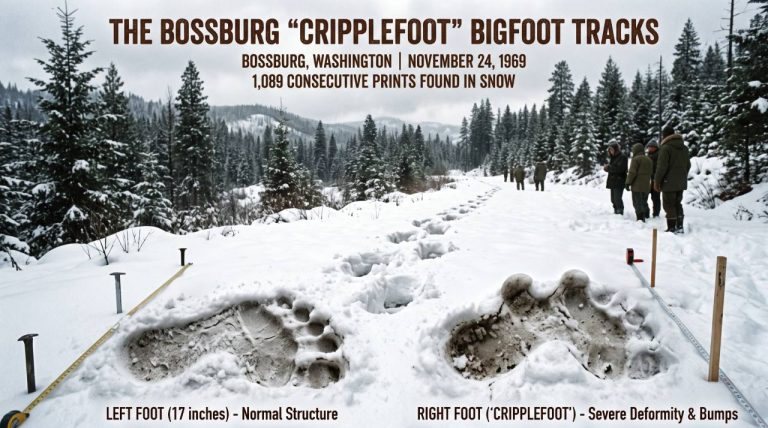
Green also published a more cautious description based on the known approximately 14½-inch footprint, estimating a creature around seven feet tall, nearly three feet across the shoulders, with unusually heavy proportions.
Weight is more difficult.
Historical summaries commonly associate Green and Bob Titmus with an estimate of approximately 800 pounds.
The interesting part
Green’s reconstruction is particularly useful because it wasn’t simply:
“She looks seven feet tall.”
He attempted to reproduce the scene with a person of known height and compare the resulting imagery.
But the result depends heavily on where the stand-in was positioned, where Patterson’s camera was positioned and how closely the reconstruction reproduces the original posture.
🦴 Grover Krantz
Height: 6’6″
Weight: Approximately 500 lb
Anthropologist Grover Krantz produced one of the most influential lower estimates.
His analysis put Patty at approximately 6 feet 6 inches tall, with a weight around 500 pounds.
Krantz’s approach was considerably more analytical than simply judging the footage by eye.
He considered factors including:
- film speed
- camera-to-subject distance
- stride length
- footprint dimensions
- body proportions
- shoulder width
- comparative human anatomy
Krantz argued that the figure’s proportions were unusual for a human, particularly the combination of height, torso width and limb proportions.
But his estimate illustrates one of the biggest problems in Patty’s measurements:
The film does not provide every number required by the calculation with absolute certainty.
Change the assumed camera speed or subject distance and the resulting height can change dramatically.
🧬 D.W. Grieve
Height: 6’5″
Weight: 280 lb
Donald W. Grieve, a biomechanics researcher, produced one of the lowest serious estimates.
His calculation placed Patty at approximately 6 feet 5 inches and 280 pounds, assuming a film speed of 24 frames per second.
That is an enormous difference from Glickman’s later 7’3½” / nearly 2,000-pound calculation.
But there is a crucial detail.
Grieve’s analysis was highly dependent on the assumed frame rate.
He reportedly considered the possibility of fakery effectively ruled out if the film had been shot at 16 or 18 fps, which he regarded as more probable than 24 fps.
In other words, the disagreement wasn’t simply about Patty.
It was partly about what the camera was doing when Patterson pressed the button.
💻 Jeff Glickman
Height: 7’3½”
Weight: 1,957 lb
This is the number that really blows the estimates apart.
Jeff Glickman, a forensic examiner working with the North American Science Institute, conducted an extensive computerized analysis of the Patterson–Gimlin film.
His 1998 analysis produced:
Height: 7’3½”
Chest circumference: Approximately 83″
Waist circumference: Approximately 81.3″
Weight: Approximately 1,957 lb
The height calculation was also remarkably close to a separate analysis by Chris Murphy.
Glickman’s weight estimate, however, has remained highly controversial.
Nearly 2,000 pounds is vastly heavier than the estimates produced by Krantz, Green, Grieve or the eyewitnesses.
And this is where height and weight become two very different problems.
Height can potentially be scaled.
Weight has to be inferred from volume, dimensions and assumptions about body density and composition.
If the underlying dimensions are wrong, the weight estimate can explode.
That is why Glickman’s height estimate has received considerably more attention than his extraordinary mass estimate.
📐 Chris Murphy
Height: 7’3½”
Weight: Approximately 932 lb
Chris Murphy provides an interesting middle ground.
Murphy’s analysis arrived at essentially the same height as Glickman:
7 feet 3½ inches.
But his calculation of weight was dramatically lower.
Using Patty’s estimated dimensions and assuming human body density, Murphy calculated approximately 932 pounds.
He explicitly noted that this was based on a human-density assumption and suggested that greater muscularity could potentially increase the figure substantially.
This gives us something important to think about.
Two researchers can accept approximately the same height while arriving at radically different estimates for mass.
That suggests the real disagreement isn’t necessarily:
“How tall is Patty?”
It can instead become:
“How much three-dimensional biological mass are we assuming exists inside that silhouette?”
🧑🔬 Jeff Meldrum
Height: Approximately 7’3½”
Weight: Approximately 700–800 lb
Jeff Meldrum’s work brings the discussion back toward the middle.
Accounts describing his assessment place Patty around 87½ inches — 7’3½” — with a mass estimate around 700–800 pounds, based on the apparent skeletal structure, body width and muscularity.
That produces an interesting combination:
Glickman: ~7’3½” / 1,957 lb
Murphy: ~7’3½” / ~932 lb
Meldrum: ~7’3½” / ~700–800 lb
The height is converging.
The weight isn’t.
And that distinction is probably one of the most important things to take away from the entire exercise.
🔎 So Why Are The Estimates So Different?
There isn’t one single “Patty measurement.”
There are several variables.
🎞️ 1. Film speed
The original camera’s exact frame-rate setting has long been debated.
If Patty’s apparent movement is interpreted at different frame rates, her apparent walking speed and the geometry used in some calculations change.
Grieve’s 24-fps calculation produced a substantially smaller Patty than analyses using other assumptions.
📷 2. Camera-to-subject distance
This is probably even more important.
To calculate the real height of something photographed at a distance, you need reliable information about:
Camera position + subject distance + focal length + image size.
If the assumed distance is wrong, the calculated height changes.
Recent mathematical analysis by Christopher Murphy, for example, argues that a camera-to-subject distance of approximately 151 feet produces the 7’3½” result, rather than the approximately 102-foot distance sometimes used in calculations.
👣 3. Foot size
Patty’s footprints are among the most frequently used scaling references.
But even here there is a problem:
we don’t know the exact relationship between foot length and total height for a hypothetical Sasquatch.
Human scaling ratios are not necessarily applicable to an unknown primate.
🧍 4. Posture
Patty isn’t standing at attention for a police mugshot.
She’s walking.
Her knees are flexed, her torso is inclined forward and her hips and shoulders are moving.
So researchers have to distinguish between:
Walking height
and
Fully erect standing height.
That distinction alone can create apparently contradictory numbers.
⚖️ 5. Weight is much harder than height
This may be the biggest lesson.
A photograph can potentially give us a scale.
But it cannot put Patty on a set of scales.
Mass estimates require assumptions about:
- body volume
- muscle mass
- fat distribution
- bone density
- body density
- torso dimensions
- limb dimensions
That’s why estimates ranging from 280 pounds to almost 2,000 pounds can emerge from the same film.
🎬 Going Back To Patty
Almost sixty years after the Patterson–Gimlin film was shot, we still don’t have a universally accepted measurement of the figure.
What we do have is a fascinating history of attempts to solve the same problem using very different methods.
Eyewitness estimates.
Footprints.
On-site reconstructions.
Anthropology.
Biomechanics.
Photogrammetry.
Computerised image analysis.
And increasingly sophisticated attempts to reconstruct the original filming conditions.
The result isn’t one neat number.
Instead, Patty has become a case study in just how difficult it can be to turn a few seconds of film into a three-dimensional biological measurement.
And as Capturing Bigfoot brings the Patterson–Gimlin film back under the microscope, that’s exactly where we want to start.
Before asking what Patty was, we need to establish what the film can actually tell us about her.
Next up: The footprint evidence. 👣