
The Albert Ostman 1924 Sasquatch Abduction Story
In 1957, Canadian prospector Albert Ostman came forward with an extraordinary story about an encounter he claimed had happened 33 years earlier, deep in the wilderness near Toba Inlet, British Columbia.
Ostman claimed that in the summer of 1924 he had travelled into the mountains in search of a fabled lost gold mine.
Before setting out, his guide reportedly told him stories of a white prospector who had repeatedly returned from the wilderness carrying bags of gold, only to disappear on a later expedition, with some locals supposedly blaming a Sasquatch for his fate.
Ostman claimed he initially dismissed such tales as little more than old stories about mountain giants. But according to his later account, the wilderness would soon become the setting for one of the strangest episodes in Sasquatch folklore.
While sleeping in his camp, he said he was suddenly lifted from the ground inside his sleeping bag and carried for hours through the darkness by a huge, hairy creature.
When he finally emerged from his sleeping bag, he claimed he found himself surrounded by a family of four Sasquatch.
For approximately six days, Ostman said he remained in their remote mountain refuge, observing the creatures at close range before eventually escaping by using tobacco to incapacitate the adult male.
His story would not become public until 1957, more than three decades after the alleged encounter, eventually becoming one of the most famous, ,and most controversial accounts in the history of Sasquatch lore.
But what actually happened at Toba Inlet?
There are no known independent witnesses to Ostman’s alleged captivity, no physical evidence demonstrating that the creatures existed, and no contemporary record from 1924 documenting his disappearance or return.
At the same time, the story contains remarkably detailed observations, was defended by researchers who personally interviewed Ostman, and bears intriguing similarities to older wildman folklore.
Was Albert Ostman recounting an extraordinary encounter that he genuinely experienced?
Was the story shaped by memory, folklore or storytelling traditions? Or was the entire episode something else?
More than a century after the alleged encounter, the Ostman case remains one of the most fascinating stories in cryptozoology, not because it proves that Sasquatch exists, but because of the extraordinary questions it raises about eyewitness testimony, folklore, memory and the enduring legend of the wild man.
Albert Ostman: The Man Behind the Story

Albert Ostman was a Swedish-born Canadian prospector whose name would eventually become permanently attached to one of the strangest stories in the history of Sasquatch research.
Born in Sweden in 1893, Ostman later emigrated to Canada, where he became accustomed to the demanding life of work in the Canadian wilderness.
He worked in construction and logging and also pursued prospecting, developing the outdoor experience that would later become an important part of his story.
By the time of his alleged encounter in 1924, Ostman was not presenting himself as a professional zoologist, explorer or investigator of mysterious creatures. He was a working man with experience of the Canadian backcountry, familiar with travelling, camping and prospecting in difficult terrain.
That background is significant because much of the later Ostman account is concerned with practical details: the equipment he carried, the food he brought with him, the terrain he travelled through, his attempts to find water, and his efforts to determine his position after becoming separated from his original route.
These details would eventually become part of what made the story so distinctive.
But there was another important feature of Ostman’s life at the time.
He was interested in prospecting.
And in 1924, that interest would take him towards one of British Columbia’s most remote coastal inlets, in search of a gold mine that was supposedly lost somewhere in the mountains.
That expedition would provide the setting for the extraordinary story he would tell decades later.
The Search for a Lost Gold Mine

According to Ostman’s later account, he had spent more than a year working on a construction job when he decided that it was time for a vacation.
Rather than simply leave the wilderness behind, however, Ostman saw an opportunity.
British Columbia was famous for stories of lost gold mines, and one was supposedly located near the head of Toba Inlet on the province’s rugged coast. Why not combine a holiday with the chance of finding a fortune?
Ostman travelled by Union Steamship to Lund, British Columbia, and from there hired a local guide to take him towards the head of Toba Inlet. The guide, whom Ostman later described as an older Indigenous man, was reportedly talkative during the journey.
The conversation soon turned towards the legendary mine.
The Prospector Who Kept Returning With Gold
According to Ostman’s recollection, his guide told him about a white prospector who had supposedly been visiting the lost mine and returning from the wilderness with gold.
The man was described as a heavy drinker who spent his money freely in saloons. Yet whenever his money ran out, he apparently had little difficulty obtaining more.
He would disappear into the mountains for several days.
Then he would return carrying a bag of gold.
This supposedly happened repeatedly until one expedition ended differently.
The prospector went back to his mine, and never came back.
According to Ostman’s later account, some people believed that a Sasquatch had killed him.
There is an important distinction here. The missing prospector, the lost mine and the alleged killing are not independently established events in the surviving evidence. They form part of the story that Ostman said his guide told him during the 1924 journey.
Nevertheless, within Ostman’s account, this conversation is crucial.
It was supposedly his first introduction to Sasquatch.
“Big People Living in the Mountains”
Ostman claimed that he had never previously heard the word Sasquatch, and asked his guide what kind of animal he meant.
The answer apparently surprised him.
According to Ostman, the guide said that Sasquatch had hair covering their bodies but were not animals. They were people, enormous people living in the mountains.
He reportedly described other stories he had heard: his uncle had supposedly seen tracks around two feet long, while another older Indigenous man had allegedly seen a creature standing more than eight feet tall.
Ostman said he did not believe the stories.
He regarded them as old fables about mountain giants. Perhaps such creatures had existed thousands of years ago, he reportedly suggested, but they could not still be living in the modern world.
His guide supposedly disagreed.
“There may not be many, but they still exist.”
Whether that conversation happened exactly as Ostman later remembered it cannot now be independently established. What is clear is that the Sasquatch story, as Ostman eventually told it, placed a remarkable piece of folklore directly at the beginning of his journey.
The sceptical prospector had arrived looking for a lost gold mine.
Before he had even reached his destination, he had supposedly been warned that enormous hairy people lived in the surrounding mountains.
Ostman continued anyway.
He would soon be alone in the wilderness.
Into the Toba Inlet Wilderness

The journey into Toba Inlet took Ostman away from the relatively settled world of coastal British Columbia and into an increasingly remote landscape of steep mountains, dense forest and waterways.
According to his later account, he and his guide eventually reached the head of Toba Inlet at approximately 4:00 p.m.
The guide was preparing to leave with the tide, while Ostman intended to remain behind and begin his search for the lost mine.
Before departing, the guide was reportedly given a simple instruction.
Ostman told him to come back for him in approximately three weeks.
He was now on his own.
Establishing Camp
Ostman selected a campsite near the mouth of a creek and settled in for the night.
His expedition was not a lightweight excursion. He carried a .30-30 Winchester rifle, a prospecting pick, an axe, a sheath knife and a sleeping bag, together with food and other supplies required for an extended stay in the wilderness.
His provisions reportedly included canned goods, bacon, beans, prunes, macaroni, pancake flour, cheese, hardtack, butter and milk. He also carried several rolls of snuff.
The weight of his equipment would become significant in his later story.
Ostman estimated that his pack weighed approximately 80 pounds.
For a man travelling alone through mountainous country, that was a substantial load.
Yet he intended to spend weeks exploring the area.
The next morning, Ostman began looking for a route towards the mountains and the supposed location of the lost mine.
The Hogback
According to his account, Ostman eventually found a route leading upwards and followed it onto a narrow ridge or elevated formation that he described as a “hog-back.”
The climb was difficult with such a heavy pack.
From higher ground, however, he was able to look back towards the inlet and see the surrounding waterways and islands spread out below him.
The landscape that had appeared accessible from the coast was becoming very different at ground level.
There were no roads leading into the country.
No houses.
No nearby settlement.
And no easy way for someone travelling alone to summon help.
Ostman continued exploring the surrounding terrain, searching for indications of the lost mine while attempting to make sense of the unfamiliar country.
At one point he discovered a deer trail leading towards a mountain pass.
The trail offered a possible route deeper into the wilderness.
Deeper Into the Mountains
The significance of these seemingly ordinary details becomes greater when considered alongside what Ostman would later claim happened to him.
He was not camping beside a logging road or travelling through an area populated by other people.
He was deliberately moving deeper into remote terrain, carrying enough equipment to remain there for an extended period.
His guide had already left.
His return was not expected for approximately three weeks.
And the man who had supposedly warned him about enormous hairy people living in the mountains was now nowhere nearby.
Ostman continued along the mountain trails, prospecting and exploring.
Eventually, according to his account, he settled into another camp.
The wilderness around him was quiet.
He had his rifle. He had his sleeping bag. He had his provisions.
And he believed he was alone.
It was during one of the nights that followed that Ostman claimed something came into his camp.
He would later say that he initially thought it was a man attempting to steal his belongings.
But when the creature seized him, he discovered that he was not dealing with an ordinary human being.
Ostman claimed that the enormous figure picked him up, sleeping bag and all, and carried him away into the darkness.
The long journey that followed would take him somewhere he could never have anticipated finding himself: into the territory of an entire family of Sasquatch.
The Night Ostman Was Taken

According to Albert Ostman’s later account, the night began like any other night in the British Columbia wilderness.
He had settled down in his sleeping bag, alone in his camp, with the surrounding mountains and forest disappearing into darkness.
Then something disturbed him.
At first, Ostman said he could not understand what was happening.
Something had entered his camp.
Before he could properly react, the sleeping bag itself was seized.
The enormous creature picked Ostman up while he was still inside it.
He was unable to see what was happening around him. Enclosed within the sleeping bag, he could do little more than remain there as the creature carried him away from his camp.
Ostman later estimated that he was transported for approximately two or three hours.
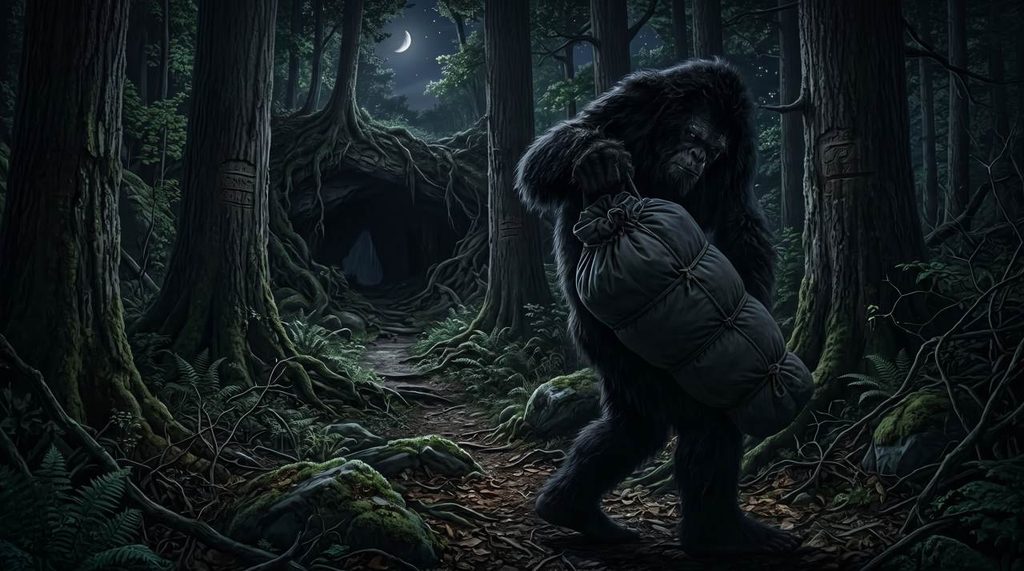
For much of that journey, he had no idea where he was being taken.
The experience must have been profoundly disorientating as described. The man who had entered the mountains expecting to spend several weeks prospecting was now being carried through the wilderness by something he believed to be one of the legendary mountain creatures his guide had told him about only days earlier.
And yet, according to Ostman, the creature did not attack him.
It simply carried him.
Eventually, the journey came to an end.
Ostman said that when he was finally able to emerge from the sleeping bag, he found himself in an unfamiliar location surrounded by steep terrain.
And then he saw them.
Four Figures in the Darkness

Standing nearby, according to Ostman’s account, was the creature that had carried him, a huge, hairy male.
But it was not alone.
Ostman claimed that there were four Sasquatch in total.
A large adult male.
An adult female.
A younger male.
And a younger female.
He had not been taken to an isolated creature’s lair.
He had apparently been brought directly into the middle of a family group.
The adult male was enormous by Ostman’s description, standing somewhere around eight feet tall and possessing extraordinarily long arms.
The other three creatures were smaller, although the female was still described as considerably larger than an ordinary human being.
For Ostman, this was no longer a distant wilderness legend.
If his account was accurate, he was looking directly at the creatures his guide had told him about.
The very creatures he had dismissed as old stories about mountain giants.
Yet the strangest part of the encounter was still to come.
The Sasquatch did not immediately kill him.
They did not, according to Ostman, attack him or attempt to eat him.
Instead, they kept him there.
Ostman would later claim that he had been brought into the family’s secluded mountain territory and would remain with them for approximately six days.
For nearly a week, he said, he observed the four creatures at close range.
He would later describe their appearance, behaviour, movements and interactions in extraordinary detail.
The sleeping bag that had carried him into the mountains had become the beginning of his captivity.
And somewhere in that remote wilderness, according to Ostman’s story, the prospecting expedition had become something altogether different:
a lone man trapped among a family of creatures that most people believed existed only in legend.
Six Days With the Sasquatch Family
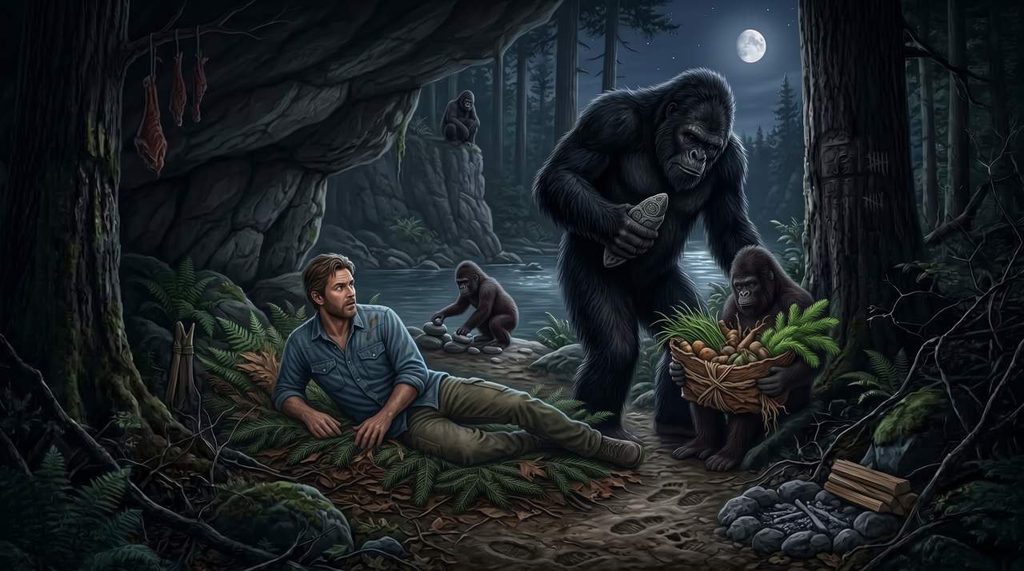
If Albert Ostman’s account is taken at face value, the most extraordinary part of his experience was not the initial abduction.
It was what happened afterwards.
Ostman claimed that he spent approximately six days in the company of four Sasquatch, an adult male, an adult female, a young male and a young female.
Rather than describing a brief encounter in which he caught sight of a creature before it disappeared into the forest, Ostman presented himself as an unwilling observer who had been given an unprecedented opportunity to watch an entire family at close range.
His descriptions were remarkably specific.
The Family Group
The largest of the four was the adult male who, according to Ostman, had carried him from his camp.
He described the creature as standing roughly eight feet tall, with an extremely powerful build and unusually long arms. Its body was covered in dark hair, while the other members of the group were somewhat smaller.
The adult female was also large, although Ostman’s account placed her below the male in size.
The two younger animals were considerably smaller and behaved differently from the adults.
Ostman’s terminology is interesting here.
He did not describe four identical monsters.
Instead, he portrayed what appeared to be a family unit containing adults and offspring of different sizes and ages.
That distinction would later become one of the features cited by supporters of the account, because it presented Sasquatch not simply as solitary wilderness creatures but as a social population capable of forming family groups.
Yet everything about that interpretation depends upon accepting Ostman’s observations as accurate.
There was no independent observer present to confirm what he claimed to have seen.
Watching the Creatures
Ostman said the family did not behave towards him as though he were ordinary prey.
They watched him.
He watched them.
For much of the time, the creatures apparently went about their normal activities while Ostman remained nearby.
According to his account, they were capable of moving around their territory, gathering and eating food, and interacting with one another.
The younger creatures in particular appear to have contributed to Ostman’s impression that he was witnessing a genuine family group rather than four unrelated animals.
He claimed that the adults were protective of the youngsters and that the younger members remained closely associated with them.
There was also apparently a striking difference between the behaviour of the adult male and the other members of the group.
The male was the creature Ostman feared most.
It was enormously powerful and was responsible for bringing him into the group’s territory.
But despite possessing the strength to kill him, Ostman claimed that it did not do so.
What Did They Eat?
Ostman’s observations also extended to the family’s diet.
According to his account, the creatures consumed vegetation and other naturally available foods rather than hunting him or attempting to eat meat from him.
This became one of the more significant elements of the story because it presented the Sasquatch family as functioning like a population of large omnivorous or herbivorous mammals within the surrounding ecosystem.
Ostman claimed that he watched them feeding on plants and other foods available in their environment.
The family therefore appeared, in his telling, to have an established routine.
They were not wandering aimlessly through the forest.
They appeared to have a territory.
They had a food supply.
They had adults and young.
And they seemed to understand their surroundings.
These details transformed Ostman’s encounter from a simple monster story into something resembling an account of an undiscovered animal species.
Communication
Perhaps even more intriguing were Ostman’s observations of communication.
He did not claim that the creatures spoke human language.
Instead, he described their communication as consisting of sounds and gestures.
The adults apparently used vocalisations and physical movements to communicate with one another and with the younger animals.
To Ostman, these interactions seemed meaningful.
He believed that the creatures understood one another and that the family operated according to a social structure that he could observe even though he could not understand their language.
This is one of the places where the limitations of the account become especially important.
Ostman was attempting to interpret the behaviour of an alleged unknown animal while having no established biological framework through which to interpret it.
A gesture that appeared purposeful to him might have had another explanation.
A sound he interpreted as communication might have been something else entirely.
And because no second observer was present, there is no independent way to determine how accurately he interpreted what he saw.
A Strange Kind of Captivity
Perhaps the strangest feature of the entire account is that Ostman claimed his captivity was not continuously violent.
There were moments of fear and considerable physical danger, but he did not describe six days of constant attacks.
Instead, he portrayed the family as strangely tolerant of his presence.
They kept him within their territory.
They watched him.
They occasionally approached him.
And they apparently allowed him to remain alive despite his obvious attempt to understand and eventually escape from them.
This creates one of the great peculiarities of the Ostman story.
If these were wild animals that regarded him as a threat, why did they not kill him?
If they regarded him as prey, why did they not consume him?
If they were intelligent wild people, why did they permit a human stranger to remain among them for almost a week?
Ostman’s answer was never entirely clear.
The behaviour was simply part of the mystery.
Six Days in Another World
For almost a week, Ostman claimed that he existed within this strange family group, observing creatures that mainstream zoology had never established as a living species.
He had entered the mountains looking for gold.
Instead, he believed he had discovered something far more extraordinary.
Yet there was one problem.
He was still a captive.
Whatever the family’s apparent tolerance towards him, Ostman knew that he could not remain there indefinitely.
Eventually, he decided that he had to escape.
And his unlikely escape plan involved one of the most memorable details of the entire case:
Tobacco.
The Tobacco Escape

By the sixth day, Albert Ostman was running out of options.
According to his account, the Sasquatch family had not physically mistreated him during his captivity. But his food supply was steadily disappearing, and he knew that remaining in the valley indefinitely was impossible.
He had already attempted to leave once.
The adult male had blocked the narrow opening through which Ostman believed he had originally been carried.
When Ostman indicated that he wanted to leave, the creature reportedly raised its hands and made a pushing motion towards him, accompanied by sounds Ostman remembered as resembling “Soka soka.”
Ostman had his rifle, but only a limited supply of ammunition remained.
He decided that shooting the creature should be a last resort.
There had to be another way out.
The Snuff Box
Ostman had noticed that the young male was becoming increasingly curious about his possessions.
Earlier, he had rolled an empty snuff box towards the youngster. The creature immediately picked it up, examined it and showed it to the others. The family apparently spent considerable time investigating the strange object.
Ostman began to wonder whether the young Sasquatch could become an unwitting part of his escape.
He remembered a story about a man who had supposedly saved himself from a charging bull by putting snuff into its eyes.
The problem was getting close enough.
Instead, Ostman devised another plan.
He would give the young male a box containing some snuff and hoped that it would eventually make its way to the adult male.
The following day, he gave the youngster another snuff box containing approximately a teaspoon of snuff.
According to Ostman, the young creature tasted it and then approached the adult male.
The older creature apparently licked the snuff.
Ostman interpreted the interaction as evidence that the male was interested in it.
The escape plan was beginning to take shape.
Six Days Later
Ostman claimed that by this stage he had been in the valley for six days.
He had observed the family’s routines closely.
The adults spent considerable time resting when they were not searching for food, while the youngsters were much more active, climbing and playing around the valley.
The female reportedly returned carrying grasses, twigs and other plant material, while the young male regularly climbed the surrounding mountains in search of sweet-tasting roots.
Ostman believed that the creatures moved between different locations depending upon the availability of food and that the valley was probably only a temporary stopping place.
But his own supplies were running out.
He needed to escape.
The Moment of Opportunity

One morning, Ostman was preparing coffee when the adult male and the young male approached his camp.
The smell of the coffee apparently attracted them.
Ostman sat eating hardtack with butter and drinking his coffee. He then took out a full box of snuff and took a large pinch.
Before he could close the box, the adult male reached towards him.
Ostman was apparently afraid that the creature would waste his remaining supply, but the Sasquatch seized the box.
Rather than taking a small amount as Ostman had expected, the creature reportedly emptied the entire box into its mouth.
It swallowed the snuff.
Then it licked the inside of the box.
Within minutes, Ostman claimed, something appeared to go badly wrong.
The creature’s eyes began to roll upwards.
It appeared sick.
It then grabbed Ostman’s coffee container and drank the contents, including the coffee grounds.
That did not help.
The creature reportedly bent forward, rolled away from Ostman and began making loud squealing noises.
Ostman immediately grabbed his rifle.
He believed this was his opportunity.
If the creature attacked him, he was prepared to shoot.
But instead of turning on Ostman, the adult male headed towards the spring.
It appeared to be desperately seeking water.
The Escape
Ostman moved quickly.
He packed his sleeping bag into his packsack and gathered the few remaining provisions he had.
The young male ran towards its mother.
Then, according to Ostman, the adult female began making the same distressed noises.
Ostman headed towards the narrow opening in the surrounding mountains.
He was almost through when he realised that the female was following him.
She was close behind.
Ostman later said that he fired a single shot over her head, striking the rock above her rather than shooting the creature itself.
The gunshot apparently stopped her pursuit.
Ostman escaped through the opening.
After nearly a week in the company of the four creatures, he was finally outside their secluded valley.
He was free.
Or at least, he believed he was.
Back Towards Civilisation
Ostman still had no clear idea where he was.
He had spent days inside an enclosed mountain basin and had only a rough estimate of the direction from which he had been carried.
His food was running low, his equipment had been left behind or lost, and he was exhausted.
Nevertheless, he began making his way down through the mountains.
Eventually, he reached the Salmon Arm branch of Sechelt Inlet, where he was able to obtain passage on a Union Steamship back towards Vancouver.
The prospecting expedition was over.
Ostman never found the lost gold mine.
But according to the story he would eventually tell more than three decades later, he had found something far more extraordinary.
He claimed that somewhere in the mountains near Toba Inlet, he had encountered an entire family of Sasquatch.
And the final weapon in his escape had not been his rifle.
It had been a box of snuff.
The bizarre detail would become one of the most memorable elements of the Ostman story, and, decades later, one of the details that would attract attention from researchers comparing his account with much older European wildman folklore.
The Journey Home

Escaping the valley was not the end of Albert Ostman’s ordeal.
It was only the beginning of his journey back to civilisation.
After leaving the Sasquatch family behind, Ostman claimed that he made his way through unfamiliar country with his supplies running low.
He had been isolated for days, had no clear map of the terrain, and had only his own memory and compass to help determine which direction would eventually lead him back towards inhabited country.
Eventually, he reached an area where he heard something that must have been an extraordinary relief after days of wilderness silence.
A motor.
Then another sound.
Someone shouted:
“Timber!”
A tree came crashing down.
Ostman had found a logging operation.
“I Am a Prospector and I Am Lost”
When Ostman emerged from the forest, the workers reportedly stared at him.
He had not shaved since leaving Toba Inlet and had gone days without properly washing. The men apparently asked where he had come from and remarked on his wild appearance.
Ostman gave them a remarkably ordinary explanation.
He told them that he was a prospector who had become lost.
According to his later account, he said that he had eaten very little and was exhausted. He also told them that he had become sick after eating a grouse.
The logging workers decided that he needed help.
They arranged for him to be taken down towards the beach by logging truck, where he could receive food and medical attention. At the camp, he was given a meal, clean clothes, a bath and a shave.
Slowly, the dishevelled prospector returned to something resembling his former self.
But there was one extraordinary thing he did not tell the men.
He did not tell them that he had supposedly been kidnapped by Sasquatch.
Ostman later explained why.
He believed that if he told the logging workers what had happened, they would simply conclude that he was crazy.
So the men who encountered Ostman immediately after his alleged ordeal heard nothing about a family of giant hairy creatures.
As far as they knew, they had simply found a lost prospector who was exhausted, hungry and unwell.
A Secret Carried Home
Ostman eventually continued his journey back towards civilisation.
And then something remarkable happened.
The story stopped.
There was no public newspaper account in 1924.
No known contemporary report describing a missing prospector returning from Toba Inlet claiming that he had been held captive by a family of giant hairy beings.
No physical specimen was produced.
No independent witness came forward to say that they had seen the creatures.
Instead, according to the account Ostman would eventually give decades later, he simply kept the experience to himself.
He would later say that he had been afraid of being ridiculed or considered insane.
Whatever actually happened in the mountains of Toba Inlet, the outside world knew nothing about the alleged encounter for more than three decades.
Ostman had entered the wilderness in 1924.
He claimed to have been abducted, held captive for approximately six days and eventually escaped.
But he would not publicly tell that story until 1957.
That gap of roughly 33 years is one of the most important facts in the entire Ostman case.
And it raises a question that cannot simply be dismissed as a footnote:
Why did Albert Ostman wait so long?
Why Did Ostman Wait 33 Years?
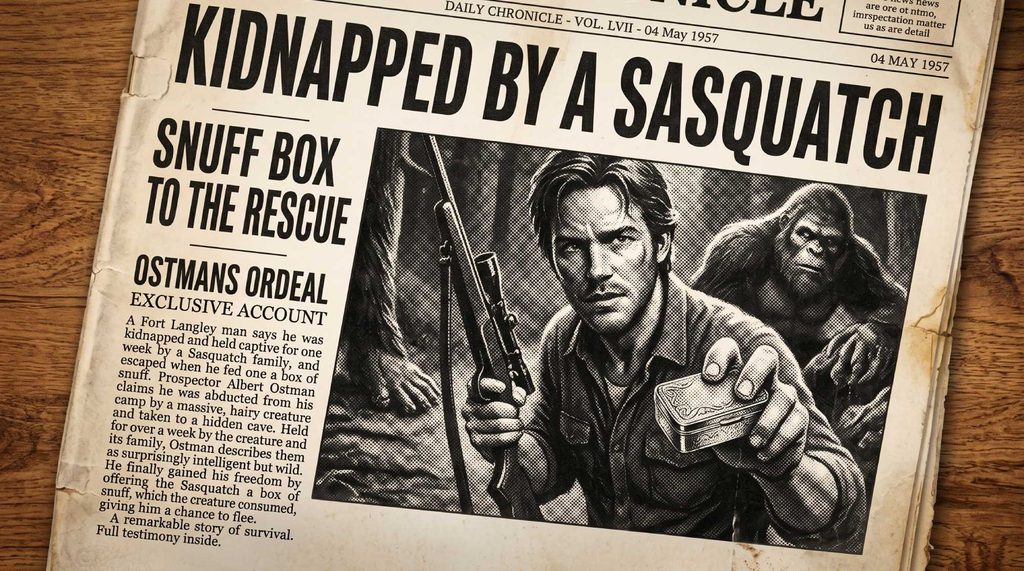
Albert Ostman said his encounter happened in the summer of 1924.
But the world would not hear his story until 1957.
That gap of more than three decades is one of the most important questions surrounding the case.
If Ostman’s account was genuine, why did an experienced prospector apparently remain silent for so long?
And if the story was not genuine, could those intervening years have provided an opportunity for memory, folklore and later storytelling to reshape what eventually became his public account?
The answer is not straightforward.
Ostman’s Explanation
Ostman later gave a simple explanation for his silence.
After escaping from the Sasquatch family and eventually reaching a logging operation, he told the workers that he was simply a lost prospector.
He did not tell them that he claimed to have been carried away and held captive by hairy mountain people.
According to the account later recorded by John Green, Ostman believed that people would think he was crazy if he told them what had happened.
That explanation is at least consistent with the circumstances of the time. In 1924, there was no established scientific discussion of Sasquatch as a potential unknown animal, and stories of hairy wild men could easily have been dismissed as folklore.
But there is an important distinction between explaining why Ostman might have remained silent and establishing that he actually remained silent.
The former is plausible.
The latter is much harder to demonstrate.
There is no known contemporary diary entry, newspaper report, police record, letter or other surviving document from 1924 in which Ostman describes the alleged encounter.
The first substantial version that has been publicly documented comes more than thirty years later.
Was He Really Silent?
There is one intriguing piece of evidence that complicates the story.
John Green later reported that an old friend had told him he had first heard of Sasquatch in the early 1930s from a trapper at Toba Inlet.
According to Green, the trapper claimed to know a young Swede who had been carried away by one.
If accurate, that would place a version of the basic story in circulation decades before Ostman went public in 1957.
At first glance, this sounds remarkably significant.
But it needs to be handled very carefully.
We do not possess a 1930s statement from the trapper.
We do not know the trapper’s name.
We do not have a dated letter, newspaper report, diary or other contemporary document recording what he supposedly said.
Instead, the evidence comes from John Green, who reported decades later that an old friend had told him about hearing the story in the early 1930s.
In other words, this is hearsay about earlier hearsay.
It is interesting because the reported story contains an unusual similarity to Ostman’s later account: a young Swedish man being carried away by a Sasquatch in the Toba Inlet region.
But it cannot be treated as independent confirmation of Ostman’s experience.
At most, it suggests the possibility that a story resembling the Ostman account may have been circulating in the area before 1957.
That distinction is crucial.
The 1924–1957 Timeline
The surviving evidence gives us a much clearer picture of the chronology:
1924 — The alleged encounter
Ostman later said he was carried away from his camp near Toba Inlet and held for approximately six days by a family of four Sasquatch.
1924 — Ostman returns to civilization
He encountered logging workers and, by his later account, told them only that he was a lost and exhausted prospector.
Early 1930s — The alleged earlier rumour
John Green later recalled an old friend’s account of hearing from a Toba Inlet trapper about a young Swede who had been carried away by a Sasquatch.
There is no surviving contemporary documentation establishing this independently.
1920s–1930s — Sasquatch stories are already circulating in British Columbia
This part of the historical background is considerably better documented.
J. W. Burns published an article in Maclean’s in 1929 describing reports of hairy giants or “mountain men” in British Columbia.
The article presented stories gathered from Indigenous informants and described creatures believed to inhabit remote mountain areas.
Later scholarship has also noted that the Sasquatch tradition was already being actively discussed in British Columbia during the 1920s.
These early accounts were not necessarily identical to the modern image of Bigfoot; descriptions could portray the creatures as enormous hairy human beings or “giant Indians” rather than the ape-like figure that would become dominant later.
1955 — William Roe’s alleged encounter
A very different but influential Sasquatch account was reported by William Roe, concerning an alleged encounter on Mica Mountain. The case subsequently became important in the development of the modern Sasquatch narrative.
1957 — Ostman finally goes public
Ostman’s story emerged after he encountered publicity surrounding other Sasquatch material. He eventually contacted John Green and wrote out his account in considerable detail.
That chronology leaves us with an important question.
The Story Did Not Emerge Into a Vacuum
It would be misleading to imagine that Ostman lived through thirty-three years in which the idea of Sasquatch simply did not exist around him.
It did.
Stories of hairy mountain people were already being discussed in British Columbia during the period in which Ostman claimed his encounter occurred.
By the late 1920s, such reports were appearing in popular publications, and the subject continued to circulate among researchers, writers, Indigenous communities, trappers and people interested in the province’s wilderness traditions.
That does not prove that Ostman’s story was invented from folklore.
It does, however, establish an important historical possibility:
The basic concept of a hairy, human-like mountain creature was available within the cultural environment surrounding his story.
And there is an especially interesting detail in Ostman’s own account.
He said that before entering the wilderness in 1924, he had never heard of Sasquatch.
According to his later recollection, it was his guide who introduced him to the concept.
The guide supposedly described Sasquatch as enormous, hairy “people” living in the mountains, including one said to have been more than eight feet tall. Ostman claimed that he dismissed these stories as old fables about mountain giants.
If Ostman’s recollection is accurate, then the folklore connection does not have to be imagined as something that entered his story decades later.
It was already part of the story he claimed to have heard immediately before the alleged encounter.
That makes the case more complicated, not simpler.
Memory, Storytelling and the 33-Year Gap
There is another important piece of evidence from John Green’s later investigation.
Green said that Ostman had written down his story before Green met him.
When asked to reconstruct the experience, Ostman reportedly gathered material from the period of his life in question, including an old shopping list from one of his prospecting trips, and used it to reconstruct the circumstances surrounding the encounter.
Green also reported that Ostman was willing to swear to the main elements of the story, but not necessarily every surrounding detail.
This is an interesting admission.
It means that even one of Ostman’s strongest defenders recognised that reconstructing an event more than thirty years later was not necessarily the same thing as retrieving a perfect recording of what happened.
Human memory is reconstructive. Details can fade, become reorganised, or acquire meaning from information encountered later.
That does not mean a decades-old memory is automatically false.
But it does mean that the distinction between what Ostman experienced in 1924 and how he remembered and described it in 1957 becomes extremely important.
The two things are not necessarily identical.
And there is another possibility.
Perhaps Ostman genuinely remembered an unusual experience from 1924, but the story surrounding that experience gradually absorbed elements of the Sasquatch folklore that he encountered during the following decades.
Alternatively, perhaps the entire episode was a story constructed at a later date.
Or perhaps his account was essentially accurate and the 33-year silence really was what he said it was: a frightened man deciding that nobody would believe him.
The available evidence does not allow us to distinguish conclusively between those possibilities.
One More Problem: What Was the Sasquatch Story in 1924?
This question becomes particularly important when we look beyond British Columbia.
The Sasquatch tradition was not a single, fixed story.
Different communities had different traditions concerning hairy or wild human-like beings, while twentieth-century writers and investigators gradually assembled these accounts into what became the modern Sasquatch phenomenon.
Ostman’s story therefore needs to be considered within a much wider folklore environment.
And this is where the case takes a remarkable turn.
Because there is an older European story involving a hairy mountain creature, a human traveller carried away into the wilderness, a family group, an enormous male, and, most intriguingly of all, tobacco playing a role in the escape.
The story comes from France.
It concerns a creature known as the Marfolat.
And when the two accounts are placed side by side, the similarities become difficult to ignore.
But there is a problem.
The French material did not become widely discussed by modern Sasquatch researchers until decades after Ostman’s 1957 account.
So the important question is not simply:
“Are the stories similar?”
They clearly are.
The real question is much more difficult:
How old is the Marfolat story, when was it first recorded, and could Ostman realistically have encountered it before he told his story in 1957?
That is where the folklore investigation begins.
The Marfolat: A French Wildman Story With Striking Parallels

The Albert Ostman story becomes considerably more interesting when it is compared with a much older European wildman tradition.
In the mountains of southeastern France, particularly around the Dauphiné and the area of Allevard in Isère, folklore describes a hairy mountain being known as the Marfolat.
The Marfolat belongs to a much broader European tradition of wild men, hairy, human-like beings associated with forests, mountains and remote places. But one particular Marfolat story is unusually relevant to the Ostman case.
It involves a human traveller being carried away into the mountains by a gigantic hairy creature, encountering a group of similar beings, and eventually escaping through an interaction involving tobacco.
Those similarities are striking.
But before drawing any conclusions, there is a fundamental question to answer:
How old is the story?
The 1902 Documentation
One of the earliest documentary references currently identifiable in modern discussions of the Marfolat is dated 1902 and associated with Allevard.
A French critical-thinking course produced by the university-linked CorteX network specifically lists the “Marfolat d’Allevard, 1902” among historical examples used in discussing extraordinary claims.
That gives us an important chronological marker.
However, it would be misleading to describe 1902 as the origin of the Marfolat legend.
The Marfolat is presented as a regional folkloric tradition, meaning that an oral story may have existed before anybody wrote it down. The date of a surviving publication is therefore not necessarily the date when the underlying story began.
For our purposes, the distinction matters enormously.
If the particular Bourne story can be traced to a publication predating Ostman’s 1924 expedition, then the chronology becomes potentially significant.
If the story can only be demonstrated in publications appearing after 1957, the apparent similarity would be much less useful as evidence for possible influence on Ostman.
So we need to separate three different questions:
When did the Marfolat tradition originate?
When was the specific Bourne narrative first recorded?
When could that narrative realistically have become accessible to Albert Ostman?
Those are not necessarily the same date.
The Story of Bourne

The particular French account associated with the Marfolat concerns a young man identified as Bourne, described as a lumberjack travelling through the mountains.
According to the traditional account, Bourne encountered a huge hairy being which seized him and carried him away into the mountains.
The creature brought him to a remote refuge inhabited by a group or family of similar hairy beings.
Among them was an enormous adult male, described in terms that immediately invite comparison with the later Sasquatch literature.
The creatures were human-like in appearance but covered in long brown hair.
Bourne was effectively a captive among them.
Eventually, however, an opportunity to escape presented itself.
And this is where the story takes its most remarkable turn.
Tobacco becomes part of the escape.
Bourne had a smoking pipe with him.
The creature became interested in it and took hold of it, creating a distraction that allowed Bourne to escape.
On its own, none of these elements would be particularly extraordinary.
European wildman stories frequently involve travellers encountering hairy beings in remote mountains.
Captivity narratives are also widespread in folklore.
Tobacco appearing in an encounter between a European traveller and an unknown creature is not inherently impossible either.
But the question becomes more interesting when the whole sequence is compared with Ostman’s account.
Ostman and Bourne: The Structural Comparison
The similarities are worth examining individually rather than simply declaring the stories “the same.”
| Element | Bourne / Marfolat tradition | Albert Ostman |
|---|---|---|
| Human protagonist | Young French lumberjack | Swedish-Canadian prospector |
| Environment | Remote European mountains | Remote British Columbia wilderness |
| Initial encounter | Hairy giant encounters traveller | Hairy giant approaches sleeping prospector |
| Capture | Human is seized and carried away | Ostman claimed he was carried away inside his sleeping bag |
| Destination | Remote mountain refuge | Remote mountain basin/valley |
| Creatures encountered | Group/family of hairy beings | Family of four Sasquatch |
| Adult male | Very large, human-like, long-armed | Approximately eight feet tall, extremely large, long-armed |
| Appearance | Long brown hair / human-like form | Hairy, human-like Sasquatch |
| Captivity | Human remains with creatures | Ostman claimed to remain for approximately six days |
| Escape mechanism | Tobacco/pipe creates opportunity | Snuff/tobacco causes adult male to become sick and distracted |
| Outcome | Human escapes | Ostman escapes |
| Setting | European mountain wilderness | British Columbian mountain wilderness |
Any single similarity could be dismissed as a common feature of wildman folklore.
But the combination is what makes the comparison noteworthy.
A hairy mountain being is one thing.
A human being carried away by one is another.
A family group is another.
A gigantic adult male is another.
A period of captivity is another.
But when tobacco appears at the climax of both narratives as part of the protagonist’s escape, the comparison becomes considerably more specific.
That is the point at which the Marfolat story deserves serious examination.
The Tobacco Detail
The tobacco element is particularly interesting because it is not simply present somewhere in the background of both stories.
It occurs at essentially the same dramatic point.
In the French narrative, Bourne’s tobacco or smoking pipe attracts the attention of the hairy creature and contributes to his opportunity to escape.
In Ostman’s account, tobacco becomes his deliberate escape strategy.
He reportedly offered snuff to the young Sasquatch, after which the adult male consumed a large quantity, became violently sick and disoriented, and was distracted long enough for Ostman to seize his rifle and flee.
The details are not identical.
That distinction is important.
Bourne’s tobacco functions as a distraction.
Ostman’s tobacco functions as a physical incapacitant.
Nevertheless, in both narratives tobacco becomes the unusual object that breaks the human protagonist out of an otherwise seemingly impossible captivity.
This is much more specific than simply saying that “both men escaped.”
It is a potentially important structural parallel.
But it is not yet proof of literary borrowing.
Similarity Is Not Transmission
This is where an evidence-first investigation needs to slow down.
Finding two stories with striking similarities does not establish that one was copied from the other.
There are at least several possibilities.
The similarities could be coincidental.
Both stories could have developed independently from a broader European and North American wildman tradition.
The Ostman story could have been influenced by some other wildman account that has not yet been identified.
Ostman could have encountered the French story, directly or indirectly, before 1957.
Or the similarities could represent something more complicated: an older folkloric pattern being adapted into a modern encounter narrative.
There is also a crucial chronological problem.
The modern discussion of the Marfolat/Bourne comparison appears to have become prominent after Ostman’s 1957 account, including a later French newspaper republication in the 1970s.
That later publication obviously could not have influenced Ostman’s original 1924 experience.
Nor could it have influenced his 1957 account if the republication occurred afterward.
So the 1970s material cannot be used as evidence that Ostman obtained the story from that source.
What matters is whether the underlying Bourne narrative was already published or otherwise accessible before 1957.
And that takes us back to the importance of the early documentation.
A Potentially Important Chronological Window
If the Bourne story can be securely documented in a publication available before 1924, it becomes relevant to the question of whether Ostman could theoretically have encountered it before his alleged experience.
If it can be documented between 1924 and 1957, it becomes relevant to a different question:
Could the story have influenced the way Ostman remembered or reconstructed his experience over the following three decades?
Those are two very different hypotheses.
A source encountered before 1924 could potentially have influenced the original story Ostman later claimed to have experienced.
A source encountered after 1924 but before 1957 could not explain the original event if Ostman’s chronology is accurate, but could potentially have influenced his later recollection, interpretation or presentation of it.
And if no plausible route of transmission can be demonstrated at all, then the similarities become evidence of parallel folklore structure, rather than evidence of direct borrowing.
This is precisely why the publication history matters.
The Problem of the Missing Paper Trail
At present, the strongest argument is not that the Marfolat story proves anything about Ostman.
It is that the two narratives contain a remarkable cluster of corresponding elements, while the precise route by which the stories might have influenced one another remains uncertain.
That uncertainty needs to stay in the article.
The temptation in cryptozoological literature is to look at the similarities and immediately declare that Ostman must have copied the French story.
That would go beyond the evidence.
Conversely, dismissing the comparison simply because the stories come from different continents would also be premature.
The correct approach is to investigate the transmission chain.
Who first recorded the Bourne story?
Where was it published?
In what language?
Was it translated?
Was it reproduced in newspapers, books or folklore collections?
Was the material available in Canada?
Could a Swedish-born prospector living in British Columbia realistically have encountered it?
And, most importantly, was the specific tobacco-and-captivity sequence already documented before Ostman told his story in 1957?
Those questions can potentially tell us much more than the similarity itself.
A Remarkable Parallel — But Not Yet a Smoking Gun
The Marfolat comparison therefore deserves a place in the Ostman investigation, but with the evidence kept firmly separated from interpretation.
We can establish that an early documented Marfolat tradition exists and that the Bourne narrative contains several striking structural parallels with Ostman’s later account. A French critical-thinking source, for example, specifically identifies an Allevard Marfolat reference dated 1902.
What we cannot yet establish from that date alone is that the specific Bourne narrative, in the form resembling Ostman’s story, was published in 1902, or that Ostman ever encountered it.
That distinction may ultimately prove decisive.
Because if the complete Bourne story, including the unusual tobacco escape, can be traced to a source available to Ostman before 1957, the folklore hypothesis becomes substantially more interesting.
If it can be traced to a source available before 1924, the question becomes even more intriguing.
But if the similarities only became documented after Ostman’s account was already public, then the apparent connection may tell us more about the way later researchers compared folklore traditions than about the origin of Ostman’s story itself.
For now, the evidence leaves us with something genuinely unusual:
Two geographically separated wildman narratives, involving human travellers carried into the mountains, groups of hairy humanoids, enormous adult males and tobacco playing an unexpected role in escape.
That does not prove that one story came from the other.
But it is certainly unusual enough to warrant further investigation.
The Evidence for Ostman

So far, the Ostman story has accumulated plenty of reasons for caution.
There is the thirty-three-year delay before the account became public. There is the absence of physical evidence.
There is the possibility of folklore influencing memory. And there is the remarkable similarity between parts of the story and the much older Marfolat tradition.
But an investigation into the Ostman case cannot stop there.
There is also a substantial body of material that has been used by supporters of the story to argue that Albert Ostman was not simply inventing an entertaining tale.
Some of that evidence concerns the way Ostman behaved when questioned.
Some concerns the details he provided.
And some comes from people who personally interviewed him and came away convinced that, whatever ultimately happened at Toba Inlet, Ostman was telling them what he genuinely believed had happened.
That is not the same as proving Sasquatch existed.
But it is evidence that deserves to be examined.
The Solemn Declaration
One of the most frequently cited pieces of evidence is Ostman’s sworn statement.
After his story became public in 1957, Ostman signed a Solemn Declaration concerning the truth of his account under Canadian law.
He was also examined by A. M. Naismith, a police magistrate in British Columbia.
Naismith subsequently produced an affidavit dated August 20, 1957, describing his examination of Ostman.
According to the surviving account of that affidavit, Naismith found Ostman to be sixty-four years old, in full possession of his mental faculties, pleasant in manner and possessing a good sense of humour.
More importantly, Naismith said that he questioned Ostman thoroughly and deliberately cross-examined him in an attempt to find weaknesses in either the man’s character or his story. He reported that he could find neither.
That is certainly noteworthy.
Ostman was not merely telling a story to a journalist over a cup of coffee.
He was prepared to attach his name to the account formally and to submit himself to questioning by a magistrate.
But there is an important limitation.
A solemn declaration demonstrates that Ostman was willing to swear that his story was true.
It does not independently demonstrate that the events described in the declaration actually occurred.
A sincere witness can swear to something that is mistaken.
Likewise, a confident witness can sincerely remember an event differently from how it actually happened.
The declaration therefore tells us something important about Ostman’s commitment to his story, but it cannot turn testimony into physical evidence.
The Magistrate’s Examination
The Naismith examination is nevertheless interesting because it gives us something that is often missing from extraordinary eyewitness cases: an account of how the witness behaved under sustained questioning.
Naismith was not simply recording Ostman’s statement.
He was actively looking for contradictions.
The later descriptions of the interview portray Naismith as deliberately trying to expose weaknesses in Ostman’s account, yet reporting that he could not find a flaw significant enough to discredit either Ostman personally or the story he was telling.
This became an important part of John Green’s defence of Ostman.
Green later said that he had Ostman questioned not only by Naismith but also by people with scientific and medical backgrounds.
That brings us to perhaps the strongest argument made on Ostman’s behalf.
John Green’s Assessment
John Green spent years collecting Sasquatch reports and eventually became one of Ostman’s principal defenders.
His position was not simply that Ostman sounded convincing.
Green said he had known Ostman personally for more than a decade and considered him a very believable man.
He also described Ostman as remarkably composed when subjected to difficult questioning.
According to Green, Ostman was questioned by a magistrate, a zoologist, a physical anthropologist and a veterinarian, with the latter two described as specialists in primates.
Green said that skeptical journalists had also questioned him extensively. In Green’s recollection, none of these interrogators succeeded in trapping Ostman in an obvious contradiction or discrediting his account through questioning alone.
That does not establish that Ostman’s story was true.
But it does make a simple explanation such as “he was obviously making it up and couldn’t keep his story straight” difficult to sustain.
There is a difference between saying that a story contains implausible events and saying that its narrator was demonstrably caught fabricating them.
Ostman appears to have maintained the central account consistently throughout the period in which researchers questioned him.
And Green believed that consistency was significant.
The Descriptions That Interested Researchers
The strongest part of Green’s argument concerned not the abduction itself, but Ostman’s descriptions of the creatures.
Remember the historical context.
When Ostman’s account emerged in 1957, the popular image of Sasquatch was not necessarily the same as the modern image of a completely hair-covered, enormous ape-like animal.
Green later argued that contemporary popular descriptions often portrayed Sasquatch more like giant, hairy human beings, sometimes with the hair concentrated on the head and with a much more human social organisation.
Ostman’s description was different.
He described the creatures as being covered in hair over most of their bodies, with exposed skin on areas such as the palms and soles.
He described the adult male as approximately eight feet tall, with a barrel-shaped chest, powerful shoulders, unusually long forearms, broad hands, short fingers and large, chisel-like fingernails.
He also described a pronounced hump or raised area across the back, a large neck and a distinctive head shape.
Some of these details were extremely specific.
Ostman did not simply say:
“They were big and hairy.”
He attempted to describe anatomy.
He estimated the young male at roughly seven feet tall and around 300 pounds.
He estimated the adult female at more than seven feet and perhaps 500–600 pounds.
He described differences between the sexes and ages, including differences in body proportions and hair.
Whether those estimates were accurate is another question entirely.
But the specificity of the description is undeniable.
The “Unusual for 1957” Argument
This is where Green’s argument becomes particularly interesting.
Green later acknowledged that Ostman could have learned a great deal about Sasquatch descriptions from books and other sources if he were telling the story today.
But, according to Green, that was not the situation in 1957.
Green argued that some of Ostman’s descriptions were contrary to the popular image of Sasquatch at the time and that subsequent reports later described certain physical characteristics resembling those Ostman had mentioned.
His conclusion was not that this constituted proof.
Rather, he considered it one reason to take Ostman’s testimony seriously.
This argument has two sides.
If Ostman really did describe features that were not widely available in the contemporary literature, then it becomes more difficult to explain the details simply as the product of reading popular Sasquatch books.
But there is an important methodological problem.
A later report resembling an earlier description does not demonstrate that the earlier description was correct.
Nor does the absence of a feature from the literature prove that nobody could have known about it.
It is therefore suggestive evidence, rather than independent confirmation.
What Ostman Described That Has Not Been Confirmed
And here Green himself provides an important counterweight.
In his later discussion of the case, Green explicitly acknowledged that some of Ostman’s descriptions had not been confirmed by subsequent reports.
Among them were the creatures’ apparent use of woven blankets made from strips of cedar bark and moss.
Green also said he knew of no other reports describing females leaving a home location to gather food and bring it back.
Most significantly, Green questioned the idea that Sasquatch necessarily lived in family groups.
He considered family groups a widespread assumption, but said that the bulk of the evidence available to him did not support that interpretation.
This is important because it prevents us from presenting Green as someone who simply accepted every detail of Ostman’s story.
He did not.
He believed Ostman.
But he also recognised that parts of the account remained unsupported.
That distinction is crucial.
The Interviews With Zoologists and Primatologists
Green also reported that Ostman was questioned for hours by Daris Swindler and a veterinarian associated with the Seattle primate centre.
Green said that the physical descriptions and behaviours Ostman reported “rang true” to these specialists.
An older account attributed to zoologist Ivan T. Sanderson similarly records detailed discussion of Ostman’s descriptions.
Sanderson was impressed by the anatomical specificity of the account, including the description of the large male’s posture, proportions, hands, nails, hair distribution and other physical characteristics.
He argued that some of these details were unusual enough, in his view, to make simple invention less convincing.
Again, however, this needs to be kept in perspective.
These interviews were expert reactions to Ostman’s testimony.
They were not independent observations of the creatures.
The zoologists did not examine a specimen.
They did not visit the animals.
They did not recover biological material from Toba Inlet.
They assessed a man’s descriptions.
That makes their opinions relevant to the question of whether Ostman’s testimony sounded internally plausible, but they cannot independently verify the existence of the animals he described.
Ostman’s Consistency
Another argument in his favour is the apparent stability of the central narrative.
Across the surviving accounts, the basic sequence remains recognisable:
Ostman travelled into the Toba Inlet wilderness.
He was taken while asleep.
He was carried away inside his sleeping bag.
He encountered a group of four creatures.
He remained with them for several days.
He observed their behaviour and physical characteristics.
He eventually used tobacco or snuff to create an opportunity to escape.
He returned to civilisation and initially kept the story to himself.
The details surrounding those events vary in presentation between sources, and some later accounts are clearly retellings rather than independent records.
But the core story remained remarkably stable.
This is one reason the case has survived for so long.
There is no obvious late-stage transformation in which Ostman suddenly added an entirely different encounter.
And Green’s own account makes an interesting point here: when Ostman reconstructed the story decades later, he reportedly used surviving material from the period, even an old shopping list from one of his prospecting trips, to help reconstruct the circumstances surrounding his journey.
Green said Ostman was willing to swear to the main elements of the story, but not necessarily every surrounding detail.
That is actually more nuanced than simply calling the account “consistent.”
Ostman apparently distinguished between what he considered certain and what he was reconstructing after more than three decades.
Sincerity Is Not the Same as Accuracy
This may be the most important point in the entire evidence-for-Ostman case.
The evidence from Naismith, Green and the later interviewers can reasonably be used to argue that Ostman appears to have been a sincere and unusually confident witness.
But sincerity and accuracy are different questions.
A person can be completely sincere while misremembering an event.
A person can also construct an explanation for something they genuinely experienced and later become completely convinced that the explanation is correct.
And an eyewitness can remember the central event accurately while unconsciously filling gaps in the surrounding narrative.
The thirty-three-year gap makes those possibilities especially relevant here.
John Green himself effectively acknowledged this distinction.
He described Ostman as believable and said that he stood by his story, yet he also acknowledged that there was no supporting evidence for the encounter and that some of the behavioural details had never been confirmed.
That leaves us with a fascinating evidential position.
The case for Ostman is not primarily a case of physical evidence.
It is a case built around the witness himself.
His apparent composure.
His consistency.
His willingness to make a solemn declaration.
His ability to withstand prolonged questioning.
The specificity of his descriptions.
And the fact that some of those descriptions appeared unusual in the Sasquatch literature of the 1950s.
Those are legitimate reasons to take the testimony seriously.
But none of them independently establishes that four unknown creatures existed in the Toba Inlet wilderness.
What, Exactly, Has Been Established?
By this point, it is useful to separate the evidence into two categories.
What the record can establish:
Albert Ostman told a detailed story.
He committed that story to writing.
He signed a solemn declaration concerning its truth.
He was questioned by a magistrate and by people with scientific backgrounds.
He apparently maintained the central account over many years.
Some observers considered his descriptions unusually detailed or internally plausible.
John Green, who knew him personally, regarded him as sincere and believable.
What the record cannot establish:
That Ostman was actually carried away by a Sasquatch.
That the four creatures he described were a previously unknown primate.
That his anatomical estimates were accurate.
That his interpretation of their behaviour was correct.
That the creatures lived in a family group.
That they used bark-and-moss blankets.
Or that any physical trace of the encounter survived.
That distinction is the heart of the case.
The evidence gives us a remarkably persistent testimony.
It does not give us a corresponding specimen.
And that is precisely why the Ostman story remains controversial.
The testimony may be difficult to dismiss as a simple tale told by a witness who collapsed under questioning.
But the absence of independent evidence means that the story cannot cross the much higher threshold from credible testimony to demonstrated encounter.
And that brings us to the other side of the investigation.
If Ostman’s story is taken literally, what problems does it create?
The next question is therefore not whether Ostman was sincere.
It is whether the event he described was physically and biologically plausible.
The Problems With the Ostman Story

The case for Ostman deserves to be heard.
So do the problems.
And once the testimony itself has been examined, the next step is to take Ostman’s account literally and ask a much harder question:
If everything happened exactly as he described it, does the story actually make sense?
This is where the case begins to encounter some serious difficulties.
None of these problems individually proves that Ostman fabricated his experience.
But taken together, they help explain why the story has remained controversial for more than half a century.
The 33-Year Problem
The most obvious difficulty has already been examined.
Ostman said the encounter occurred in 1924, yet the story did not become public until 1957.
His explanation was that he feared people would think he was crazy.
That is certainly possible.
But thirty-three years is a very long period between an alleged extraordinary event and its first documented account.
It also means that researchers have no contemporary 1924 record against which to compare the later testimony.
There is no surviving newspaper report describing Ostman’s disappearance.
No known police investigation.
No contemporary account from the logging workers who supposedly encountered him after his escape.
And no physical evidence that can independently establish what happened.
The delay therefore creates a fundamental evidential problem:
Almost everything we know about the encounter comes from Ostman’s much later recollection.
As John Green himself later acknowledged, when Ostman reconstructed the story he was attempting to mentally return to events more than thirty years in the past. Ostman could apparently vouch for the main elements, but not necessarily every surrounding detail.
That does not make the memory false.
But it makes the memory itself the centre of the case.
The Food Problem
Perhaps the most substantial biological criticism concerns something much less dramatic than the abduction itself:
Food.
Ostman described the Sasquatch family as primarily vegetarian.
He reported seeing them collect and eat things such as grass, roots, tubers and the tender tips of spruce and hemlock. The creatures apparently brought this vegetation back to their shelter, where they consumed it.
That creates a difficult question.
The four creatures Ostman described were enormous animals.
The adult male alone was supposedly around eight feet tall, while the adult female and two younger animals were also considerably larger than humans.
If such creatures existed, they would require substantial quantities of energy simply to maintain their bodies.
Primatologist John Napier, who examined the Ostman story in Bigfoot: The Yeti and Sasquatch in Myth and Reality, considered the available vegetation inadequate to support animals of the size Ostman described.
The food problem became one of his principal objections to accepting the story.
The criticism is worth taking seriously.
But it also needs to be stated carefully.
Napier’s argument was based on the diet described by Ostman and assumptions about the creatures’ nutritional requirements.
It is not a mathematical disproof that unknown large primates could have existed in British Columbia.
We do not know what a hypothetical Sasquatch would eat.
Nor do we know its metabolism, digestive physiology, ranging behaviour or precise body mass.
And there is another complication.
Ostman was only observing the animals for approximately six days.
He was not conducting a dietary study.
He could easily have failed to notice food sources the animals obtained elsewhere, particularly during periods when he was asleep or unable to see what they were doing.
The food objection therefore raises a serious biological problem, but it does not independently settle the case.
The Captivity Problem
An even stranger question concerns the behaviour of the alleged captors.
Ostman said that he was held for approximately six days.
Yet he was apparently not physically restrained.
He retained his rifle. He retained at least some of his equipment.
And although the adult male prevented him from leaving the immediate area, Ostman described the creatures as generally non-aggressive toward him.
This produces an unusual scenario.
A group of creatures supposedly powerful enough to carry a grown man, sleeping bag and equipment through the wilderness for several hours somehow kept him in captivity without tying him up, seriously injuring him or taking away his weapon.
Ostman himself said he did not use the rifle because the creatures had not harmed him.
That raises another question.
Why did they want him there?
Ostman interpreted the behaviour as captivity. But he could not know what the creatures intended.
He speculated about their behaviour and eventually came to believe that the young female might have been intended as a mate for him.
That interpretation is particularly difficult to test. The creatures never communicated their intentions to him in a language he understood.
Their behaviour could therefore be interpreted in several different ways.
They might have been curious. They might have been territorial. They might have been guarding him. They might have regarded him as a potential threat.
Or, if the story is accepted literally, they might genuinely have been keeping him there for reasons Ostman could only speculate about.
The problem is that the entire interpretation depends upon one man’s reading of animal behaviour.
The Capture Problem
The initial abduction creates another physical question.
Ostman said he was asleep inside his sleeping bag when something picked him up and carried him away.
He estimated that the journey lasted somewhere around two or three hours.
He was not simply walking beside the creature.
He claimed to have been carried while still inside his sleeping bag, along with his belongings.
If accurate, that would represent an extraordinary feat of strength and endurance.
But there is another problem.
How did Ostman sleep through it?
He was an adult man carrying substantial equipment, and his sleeping bag would have provided little protection from the movement of a long, uneven journey through mountainous terrain.
Even assuming an extremely strong animal could physically carry him, the account requires Ostman to remain sufficiently asleep throughout the journey that he did not wake until the creatures had reached their destination.
That is possible in principle.
It is certainly not impossible for a person to remain asleep during movement.
But combined with the distance, terrain and physical circumstances described, it becomes another unusual component of the story.
The Six-Day Silence
There is also the question of what Ostman actually observed during those six days.
His account contains a remarkable amount of behavioural detail.
He described the creatures communicating through sounds and gestures.
He described their food-gathering.
He described the young male’s curiosity about his belongings.
He described the shelter.
He described what he interpreted as family relationships.
He described the female apparently washing and arranging leaves.
He even described blankets made from narrow strips of cedar bark packed with dry moss.
These details are fascinating.
But they also create an evidential problem.
Almost none of them can be independently checked.
John Green himself acknowledged this.
Green pointed out that no later reports he knew of had described anything comparable to Ostman’s bark-and-moss blankets.
He also said that he knew of no other reports supporting Ostman’s description of females leaving a home location to gather food and bring it back.
And although family groups became a widespread assumption within Sasquatch literature, Green himself said that the bulk of the evidence available to him did not convince him that Sasquatch necessarily lived in family groups.
This is an important concession from Ostman’s principal defender.
Some of the most distinctive elements of his story remained one-off observations.
The Tobacco Escape
The final escape is perhaps the most memorable part of the account.
Ostman said he deliberately gave the adult male a large quantity of snuff.
The animal supposedly consumed it, became extremely sick and disorientated, and began behaving erratically.
Ostman then seized his rifle and escaped.
The story is undeniably dramatic.
But it also raises questions.
Ostman claimed to know that the creature liked tobacco because of its interest in the snuff he carried.
Yet he had no way of knowing how much the animal could tolerate, what effect nicotine would have on it, or whether it would react in the way he expected.
And there is an important distinction between the tobacco itself and the broader Marfolat comparison examined earlier.
The existence of a similar tobacco-related escape motif in European folklore does not prove that Ostman’s account was borrowed.
But it makes this particular detail more interesting than an ordinary escape narrative.
If the French story can be securely documented in a form accessible to Ostman before 1957, the parallel deserves considerably more attention.
For now, however, it remains a striking similarity rather than demonstrated transmission.
The Missing Evidence
Then there is the simplest problem of all.
After an alleged encounter lasting approximately six days, what was left behind?
No specimen.
No body.
No biological sample.
No photograph.
No contemporary footprint cast.
No independently witnessed Sasquatch.
No surviving physical object that can be securely connected to the creatures.
And no contemporary witness who saw Ostman being carried away or returning from captivity.
This does not mean that evidence necessarily should have survived.
Ostman was in a remote wilderness in 1924.
He was not equipped for scientific investigation. He did not know that he would eventually become one of the most famous witnesses in Sasquatch history.
But the absence of corroboration still matters.
The entire case ultimately rests upon the testimony of one man.
But Was Ostman Lying?
This is where the investigation needs to become more nuanced.
It would be easy to look at all of these problems and conclude that Ostman must simply have invented the story.
But that is not actually what the evidence demonstrates.
And this is where John Green becomes particularly important.
Green knew Ostman personally.
He questioned him extensively. He preserved and published his account. And he remained convinced that Ostman was sincere.
Green’s position is especially interesting because he did not claim that every part of the story had been independently verified.
Quite the opposite.
He openly acknowledged that there was no supporting evidence for the encounter. He also acknowledged that some of Ostman’s observations had not been confirmed by later reports.
Yet Green continued to regard Ostman as a credible witness.
Green’s Two Different Questions
Green’s defence of Ostman effectively separates two questions that are often treated as though they were identical:
Was Albert Ostman lying?
and
Did Albert Ostman actually encounter Sasquatch?
Those are not the same question.
A person can sincerely describe something that did not happen in precisely the way they remember it.
A witness can misidentify an animal.
Memory can change over time.
A genuine but poorly understood experience can acquire an explanation later.
And, of course, a person can also deliberately fabricate a story.
The evidence has to distinguish between those possibilities.
Green believed Ostman was telling the truth as he understood it.
He pointed out that Ostman’s descriptions of the creatures were unusually detailed and, in his view, differed from the popular Sasquatch image of the 1950s. Green argued that some of those descriptions were subsequently echoed in later reports.
He also noted that Ostman had been questioned for hours by zoologist Daris Swindler and a veterinarian associated with the Seattle primate centre, who reportedly told Green that the physical descriptions and behaviours Ostman described “rang true.”
That is certainly interesting.
But again, there is a boundary that the evidence cannot cross.
Those specialists were assessing Ostman’s testimony.
They were not examining a Sasquatch.
They did not independently observe the creatures he described.
They did not recover biological material.
Their reactions therefore strengthen the argument that Ostman’s account was detailed and internally plausible to some experienced observers, but they cannot independently establish that the creatures existed.
Green’s Own Reservations
Perhaps the most revealing part of Green’s position is that his defence of Ostman was never quite as absolute as later retellings sometimes make it appear.
Green acknowledged that there were parts of the story he could not reconcile with other Sasquatch reports.
The bark-and-moss blankets were one example.
The food-gathering behaviour was another.
The family-group structure was another.
And above all, Green acknowledged the fundamental problem:
There was still only Ostman’s story.
That makes Green’s assessment unusually useful.
He was not saying:
“Ostman had proof.”
He was essentially saying:
“I knew the man, I questioned him, I found him believable, and I could not dismiss his account, but I cannot produce independent evidence that the event occurred.”
That is a considerably more defensible position.
Sincerity Is Not Proof
This distinction once again, may ultimately be the most important one in the entire Ostman investigation.
The evidence can reasonably support the conclusion that Ostman was a persistent and apparently sincere witness.
It can support the fact that he maintained the central elements of his account.
It can support the fact that people who questioned him found his testimony interesting and, in some cases, convincing.
It can even support the observation that some of his physical descriptions appeared unusual within the Sasquatch literature of his time.
But none of that establishes the existence of the creatures.
The distinction is between credibility of testimony and verification of the event described.
Ostman’s testimony may be difficult to dismiss.
The event itself remains unverified.
And that leaves the case in a peculiar middle ground.
It is not a case where a witness was obviously caught fabricating a story.
But neither is it a case where an extraordinary encounter left behind extraordinary physical evidence.
Instead, there is a detailed account from a man who maintained that something extraordinary happened to him, an account containing both unusually specific observations and some remarkably difficult claims.
The question, then, becomes much more interesting than simply asking whether Albert Ostman was a liar.
What if Ostman was telling the truth as he remembered it, but what he remembered was not necessarily what actually happened?
That possibility brings us back to the central problems of the case:
Memory, folklore, interpretation and the extraordinary difficulty of reconstructing an event more than three decades after it supposedly occurred.
The 1972 Documentary — Ostman on Camera and the Evolution of His Story

By the early 1970s, Albert Ostman’s extraordinary account had already been part of the Sasquatch literature for more than a decade.
The story had appeared in newspapers in 1957. John Green had interviewed Ostman and preserved his account in greater detail.
Researchers had questioned him about the circumstances, his descriptions and his recollection. Yet there was still something missing from the historical record.
Ostman himself had never been seen by the wider public telling the story.
That changed with Bigfoot: Man or Beast?
The documentary, generally dated to 1972, brought together a remarkable collection of early Sasquatch witnesses and researchers, including Fred Beck, Albert Ostman, John Green, René Dahinden and Grover Krantz.
Ostman’s appearance is particularly important because it preserves something that newspapers and books cannot: the witness himself, recounting an event that he claimed had occurred almost half a century earlier.
The footage therefore occupies an unusual position in the Ostman case.
It is not evidence that Sasquatch existed in 1924.
But it is evidence of what Albert Ostman himself was saying in the early 1970s.
Ostman Tells the Story Himself
The documentary introduces Ostman as a prospector who claimed to have been taken by a Sasquatch while camping near Toba Inlet in British Columbia.
When Ostman begins describing the encounter, the basic outline is immediately recognisable from the earlier written accounts.
He says that there were four creatures.
There was what he called the “old man”, which he estimated to have been at least eight feet tall and extremely heavy. There was an “old lady”, together with a young male and a young female.
He explains that he had no measuring equipment with him and therefore his estimates were necessarily approximate. Nevertheless, he gives surprisingly specific physical descriptions.
The young male, for example, is described as roughly seven feet tall and around 300 pounds, with a large chest, a relatively narrow forehead and distinctive body proportions. Ostman describes the hair as thick over the body but different in length and texture on different parts of the body.
The adult female is described as around seven feet tall and considerably heavier, while the adult male is portrayed as substantially larger again, with enormous shoulders, long forearms, broad hands and a barrel-shaped chest.
He also describes the creatures as being covered in hair except for areas such as the palms, soles, nose and eyelids.
These details are important because they allow us to compare the filmed account against the material recorded earlier rather than relying on someone remembering what Ostman supposedly said.
The Family in the Basin
The central episode is also substantially unchanged.
Ostman says that he was carried away during the night while still inside his sleeping bag. The journey lasted approximately three hours, after which he was deposited in a basin or valley surrounded by mountains.
As daylight appeared, he realised that four large, hairy creatures were standing around him.
The family structure remains the same: an adult male, adult female, young male and young female.
Ostman also retains the unusual behavioural details that made the story so distinctive.
The creatures communicate with one another through rapid sounds or chatter. The younger animals are curious about Ostman and become increasingly accustomed to his presence. The adult female gathers vegetation. Ostman uses some of his own food and supplies while watching the family.
Most importantly, he continues to describe the creatures as strangely non-aggressive toward him.
They prevent him from leaving. But they do not simply attack him.
That distinction is central to the story.
Ostman had a rifle.
He knew that he was effectively trapped.
Yet according to his account, he spent approximately six days living alongside the creatures rather than attempting to shoot his way out.
The documentary therefore preserves not simply the claim of an abduction, but the much stranger claim that a human being was held by a group of unknown animals or hominids without being seriously injured.
The Tobacco Escape
The final part of the story remains one of its most memorable elements.
Ostman had been carrying snuff with him. The adult male became interested in it after watching Ostman use it.
Eventually, according to Ostman’s account, the male took a quantity of snuff and swallowed it.
Ostman says the creature rapidly became sick.
That gave him the opportunity he had been waiting for.
He gathered his possessions, seized his rifle and made his escape through the opening in the valley.
The female pursued him, and Ostman fired a shot over her head to frighten her away.
He then continued through the wilderness until he eventually encountered a logging operation and returned to civilisation.
The important point here is that the fundamental sequence remains intact:
Snuff → illness → opportunity → escape → rifle shot → flight through the wilderness.
There is no obvious transformation of the story into a substantially different episode decades later.
What Does Seeing Ostman on Film Actually Add?
This is where the documentary becomes particularly interesting.
Seeing Ostman tell the story can make the account feel more immediate. Written testimony is necessarily filtered through newspapers, researchers, transcription and later publication. Film allows us to observe the man who was actually making the claims.
We can hear his voice. We can see his manner of speaking. We can observe where he becomes more detailed and where he appears less certain.
But this must not be confused with independent corroboration.
A convincing witness is still only a witness.
The camera does not take us back to Toba Inlet in 1924.
It does not demonstrate that the creatures existed. It does not establish that Ostman was actually carried away in his sleeping bag. It does not independently verify the six-day captivity.
What it does establish is that, roughly 48 years after the alleged encounter, Albert Ostman was still publicly giving an account whose central structure closely resembles the one preserved in the 1957 material.
That is useful evidence when assessing the history of the testimony.
It is not physical evidence for Sasquatch.
The Importance of the Documentary Record
The footage also preserves something that later books can easily obscure: the fact that Ostman’s account had become part of the established Sasquatch narrative by the early 1970s.
By then, the story was no longer simply a newspaper curiosity.
It had entered the growing body of material being discussed by researchers such as John Green and René Dahinden, alongside other famous cases and alleged evidence.
Yet Ostman’s story retained a peculiar position.
It was extraordinary enough to attract attention, but problematic enough that even researchers interested in Sasquatch could not simply treat it as proof.
John Green’s own later assessment illustrates this tension particularly well. He considered Ostman a believable witness and believed that some of his physical descriptions were strikingly consistent with later reports.
At the same time, Green acknowledged that there was no supporting physical evidence for the encounter and that some elements of Ostman’s description had never been independently confirmed.
The documentary therefore captures the case at an important historical moment.
Ostman is no longer merely a name in a newspaper article.
He is a living witness, sitting in front of a camera and repeating the story in his own voice.
What Could Have Happened?

After examining the surviving accounts, the 33-year reporting gap, Ostman’s appearance on film, the consistency of the central narrative, the problems surrounding the story, and the possible folklore parallels, it is tempting to ask for a final answer.
But the surviving evidence does not allow one.
What it allows us to do is identify several possible interpretations of what happened to Albert Ostman.
None can currently be demonstrated conclusively.
A Genuine Encounter
The most straightforward interpretation from the perspective of Sasquatch believers is that Ostman experienced essentially what he said he experienced.
Under this explanation, he really was carried away from his camp in 1924, encountered a group of four unknown creatures, remained with them for approximately six days and eventually escaped after the adult male became incapacitated by tobacco.
This interpretation takes Ostman’s testimony largely at face value.
There are aspects that supporters can point to: the stability of the central narrative, the detailed descriptions, the fact that Ostman continued telling substantially the same story decades later, and the favourable impressions formed by some people who personally questioned him.
But accepting this interpretation requires accepting something much larger than the credibility of one witness.
It requires accepting that the creatures he described were real, that a previously undocumented population of large hairy animals or hominids existed in the Toba Inlet region, and that Ostman happened to encounter an entire family group without leaving independently verifiable physical evidence behind.
The testimony is therefore potentially interesting evidence for the claim.
It is not independent confirmation of the claim.
A Genuine but Misidentified Encounter
A second possibility is that Ostman experienced something genuinely unusual but interpreted it incorrectly.
The difficulty here is that this cannot easily be reduced to a simple animal misidentification.
Ostman was not describing something he briefly saw moving through trees.
His account involved an extended encounter lasting several days.
Nevertheless, an unusual person, animal, group of people, sequence of encounters, or combination of events could theoretically have been transformed in his memory into something very different from what actually occurred.
The wilderness setting also matters.
A frightened or disoriented traveller encountering unfamiliar people, animals or environmental hazards could interpret events through the information already available to him.
And by Ostman’s own account, that information included stories about Sasquatch.
This possibility therefore does not require assuming that Ostman simply invented everything.
It allows for the possibility that something happened, while leaving open the question of what that something actually was.
Memory and Folklore
A third interpretation occupies a more complicated middle ground.
Perhaps Ostman really did experience an unusual event in 1924, but the story he eventually told in 1957 was not an untouched recording of that experience.
Human memory is reconstructive rather than a literal recording of the past. Over a period of more than three decades, memories can become blended with later information, stories, interpretations and assumptions.
That possibility is particularly relevant in Ostman’s case because the alleged encounter already sat within a landscape of wildman folklore.
Before the incident, Ostman said his guide had told him stories of enormous mountain people.
Afterwards, he apparently encountered a rapidly growing body of Sasquatch literature and public discussion.
The result could have been a genuine but poorly understood experience gradually becoming organised around the Sasquatch concept.
The Marfolat story belongs naturally within this possibility.
The parallels between the Bourne/Marfolat narrative and Ostman’s later account, a large hairy creature, being carried into the wilderness, a family or group, captivity and tobacco playing a role in escape, are striking enough to deserve attention.
But similarity does not demonstrate that Ostman borrowed the story.
To establish direct influence, we would need much stronger evidence showing that Ostman had encountered the specific Marfolat account before his 1924 experience, or evidence that the narrative entered his memory between 1924 and 1957.
Without that evidence, the comparison remains a potentially important folklore parallel rather than an explanation of the case.
It is also possible that similar stories emerged independently from recurring wildman themes: the mysterious forest, the giant stranger, abduction into the wilderness, captivity and escape.
The parallels are therefore worth investigating without turning them into proof of transmission.
A Constructed Story
The final major possibility is that the central story was not a recollection of an extraordinary encounter at all.
Ostman may have fabricated the account.
That could mean a deliberate hoax, an elaborate personal story, an attempt to gain attention, or something more complicated that cannot now be reconstructed.
This explanation does not necessarily require every part of the story to have been consciously invented at the same moment.
A story can be embellished, refined or reconstructed over time while still being presented by its teller as essentially true.
There is also no surviving evidence demonstrating that Ostman received money from the story or had some obvious financial motive for creating it.
That does not prove sincerity.
But equally, the absence of a clear motive does not prove fabrication.
The important point is that the surviving record cannot establish either conclusion.
Perhaps the Most Difficult Possibility
There is also a possibility that does not fit neatly into any single category.
Ostman could have genuinely experienced something that frightened or confused him, interpreted it according to the folklore available to him, and then remembered that interpretation as the event itself.
In that scenario, the question of whether Ostman was “telling the truth” becomes more complicated.
He could have been sincere.
He could have genuinely believed every major element of his account.
And yet the creatures he described might not have existed in the way he believed they did.
This distinction is important because sincerity and accuracy are not the same thing.
Likewise, a person can be mistaken without deliberately lying.
What We Are Left With
The Ostman case therefore resists a simple conclusion.
The genuine-encounter interpretation takes the testimony at face value.
The misidentification interpretation accepts that something unusual may have happened while questioning the interpretation.
The memory-and-folklore interpretation allows for a real experience that became reshaped over decades.
The constructed-story interpretation treats the narrative itself as the product of invention or elaboration.
And the surviving evidence is not strong enough to eliminate every alternative.
That may be frustrating for anyone looking for a definitive answer.
But uncertainty is itself part of the historical record.
There is no physical specimen from Toba Inlet.
No contemporary photograph.
No independent eyewitness to the alleged captivity.
No documented 1924 investigation.
No surviving 1924 statement from Ostman against which his 1957 account can be tested.
What remains is the testimony of one man, preserved through newspapers, interviews, books and eventually film.
And that is precisely why the Albert Ostman case remains so interesting.
Not because it proves Sasquatch exists.
Not because it can be dismissed with certainty.
But because it sits directly on the boundary between eyewitness testimony, memory, folklore and the possibility of an encounter with something genuinely unknown.
The Legacy of Albert Ostman
Whatever ultimately happened at Toba Inlet, Albert Ostman’s story became one of the defining narratives of twentieth-century Sasquatch folklore.
When the account first reached the public in 1957, the idea of Sasquatch was already becoming increasingly familiar in British Columbia and beyond. But Ostman’s story was unlike the fleeting sightings and tracks that dominated much of the emerging literature.
This was supposed to be something entirely different.
A man claimed that he had not merely seen a Sasquatch.
He claimed that he had lived among them.
For approximately six days, according to his account, he had watched a family group at close range, observed their behaviour and learned enough about their routine to eventually exploit an opportunity to escape.
That extraordinary claim ensured that the story would survive.
From Newspaper Sensation to Sasquatch Classic
Ostman’s account appeared during an important period in the development of modern Bigfoot and Sasquatch culture.
The 1950s saw increasing newspaper coverage of giant footprints, wilderness sightings and stories of hairy wildmen. By the time Ostman went public, Sasquatch had begun transitioning from regional folklore into a much broader North American phenomenon.
His story fitted perfectly into that emerging tradition while also standing apart from it.
The alleged encounter was unusually long.
The creatures were described as a family.
Their behaviour was described in detail.
And, unlike a distant sighting, Ostman claimed to have observed them at close range for days.
John Green’s subsequent work helped preserve the account for later generations, while researchers and writers continued to cite it as one of the most remarkable eyewitness stories associated with Sasquatch.
The 1972 documentary Bigfoot: Man or Beast? added another layer to that history by preserving Ostman himself on camera.
The man who had first made the claim publicly in his sixties could now be seen and heard recounting it decades after the alleged encounter.
A Story That Outlived Its Witness
Albert Ostman died in 1975.
But his story did not disappear with him.
It continued through books, documentaries, websites, interviews and increasingly elaborate retellings of the Sasquatch mystery.
Some versions presented it as one of the strongest eyewitness accounts in the subject.
Others treated it as a classic example of the problems surrounding extraordinary testimony.
The same basic story could therefore be used to support radically different interpretations of Sasquatch.
For believers, Ostman represented an unusually detailed close encounter.
For sceptics, the 33-year delay and absence of corroborating evidence remained fundamental weaknesses.
For students of folklore, the parallels with older wildman traditions made the case interesting regardless of whether Sasquatch existed.
And for anyone interested in the psychology of testimony, Ostman’s story provides an unusually long record of a single extraordinary claim being preserved and retold across decades.
Why the Case Still Matters
The enduring fascination of the Ostman case may ultimately have less to do with whether the creatures were real than with the questions the story forces us to ask.
How accurately can someone remember an extraordinary event after thirty years?
How does folklore influence the way unusual experiences are interpreted?
When does additional detail represent better recollection, and when might it represent reconstruction?
How much weight should be given to a witness who appears sincere but has no independent evidence to support his account?
And perhaps most importantly:
What is the difference between believing that someone is telling the truth and knowing that what they remember actually happened?
Those questions extend far beyond Sasquatch.
They apply to eyewitness testimony, historical mysteries, unexplained experiences and folklore throughout human history.
The Ostman case also demonstrates why extraordinary stories should not necessarily be treated as either unquestionable evidence or worthless nonsense.
A claim can be fascinating without being proven.
A witness can appear sincere without necessarily being accurate.
A folklore parallel can be striking without demonstrating borrowing.
And an unexplained story can remain unexplained without automatically becoming evidence for a particular explanation.
The Toba Inlet Mystery
More than a century has now passed since Albert Ostman claimed that something carried him away from his camp in the wilderness of British Columbia.
The mountains and forests around Toba Inlet remain.
The lost gold mine remains part of the story.
The sleeping bag remains at the centre of the alleged abduction.
The four creatures remain frozen in Ostman’s description: an enormous male, a female and two young animals.
And the tobacco episode remains one of the strangest escape stories in the history of cryptozoology.
But the one thing that cannot be recovered is the moment itself.
There is only the story Albert Ostman left behind.
Perhaps he encountered something unknown. Perhaps he encountered something familiar and misunderstood it.
Perhaps an unusual experience became transformed through decades of memory and folklore. Perhaps the entire episode was constructed.
The historical record cannot tell us which of these possibilities is correct.
And that is where the Ostman story ultimately belongs, not as proof of Sasquatch, and not as a mystery that can be dismissed simply because it sounds extraordinary, but as one of the most remarkable and enduring eyewitness accounts in the history of the wildman phenomenon.
The evidence dictates the questions.
The answers remain with the wilderness.


