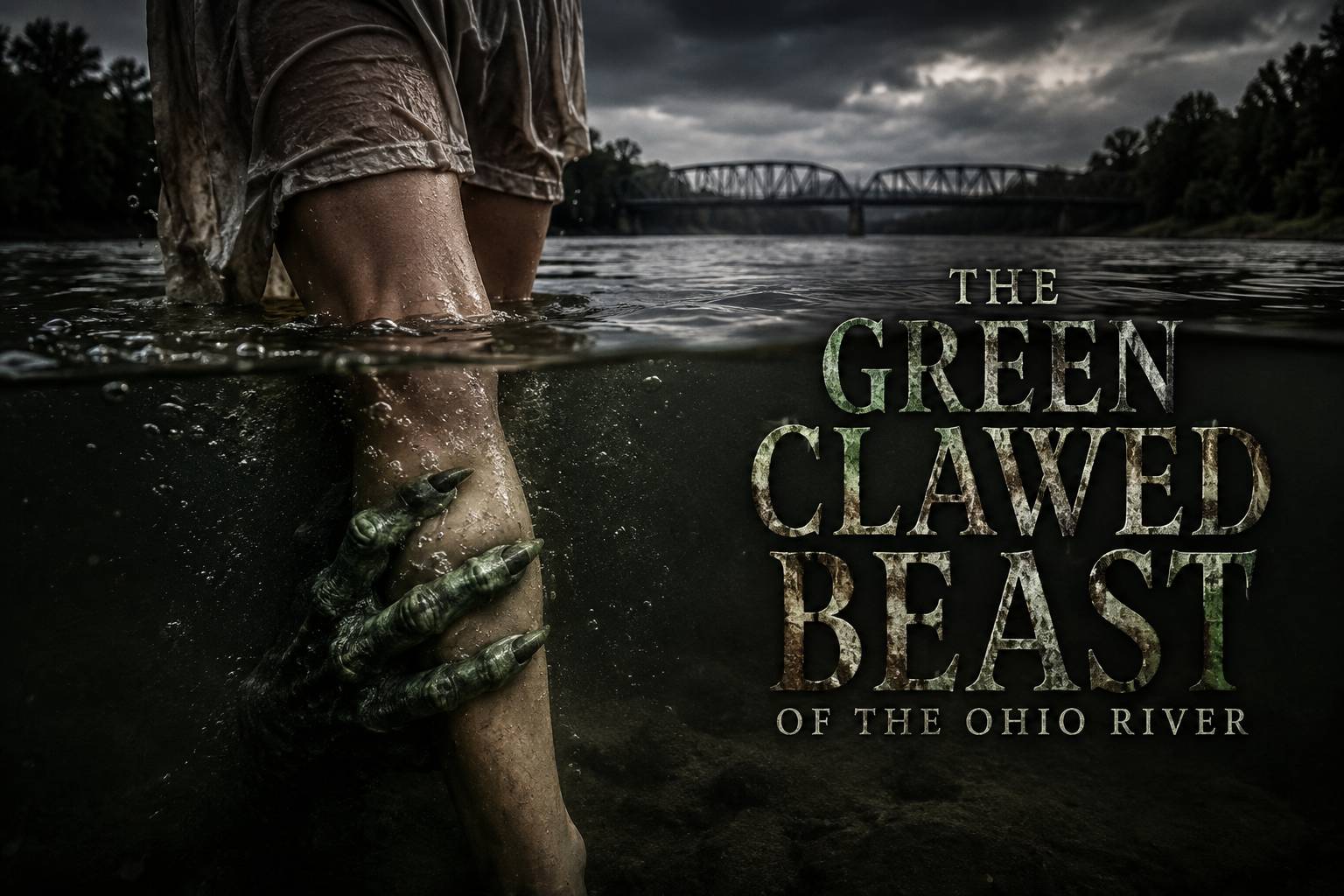
August 1955. Evansville, Indiana.
On a sweltering summer afternoon, a woman entered the muddy waters of the Ohio River near Evansville.
What happened next would become one of the stranger, and far less widely known, episodes in American cryptid folklore.
According to contemporary newspaper accounts and later retellings, Naomi Johnson, a 35-year-old local housewife, was wading in the river when something beneath the surface suddenly seized her leg.
It was not described simply as an animal.
It was a hand.
A large, powerful hand with clawed fingers.
The mysterious thing reportedly tightened its grip around Johnson’s leg and attempted to pull her beneath the water. She struggled desperately against it, managing to break free, only for the unseen attacker to seize her again.
Then, in an act of pure desperation, Johnson grabbed an inner tube and struck it against the water.
Whatever had hold of her released its grip.
Johnson escaped to shore shaken and bruised. But according to later accounts, the encounter had left behind something even stranger: a large greenish, hand-shaped mark on her leg.
There was no body in the river.
No creature was captured.
No photograph emerged.
And no physical specimen ever came to light.
Instead, there was a story, a frightening account of something seemingly impossible lurking beneath the surface of one of America’s great rivers.
The creature itself was never clearly seen.
That is perhaps the most unsettling part of the story.
Johnson reportedly never saw the being responsible for the attack. What she experienced was an unseen presence beneath the murky water, identified only through the sensation of its powerful grip, its claw-like hand and the injuries supposedly left behind.
Later accounts would give the mysterious attacker a name:
The Green Clawed Beast.
Was it an unknown aquatic animal?
A misidentified creature beneath the surface?
A misunderstanding made more frightening by the conditions of the river?
Or something genuinely unexplained?
The surviving evidence cannot provide a definitive answer.
What remains is a strange 1955 account of a woman being seized underwater by something she could not see, followed by decades of retelling that gradually transformed a terrifying encounter into one of Indiana’s most obscure river-monster legends.
Beneath the muddy waters of the Ohio River, something reached for Naomi Johnson.
Whatever it was, the river gave nothing back.
Physical Appearance
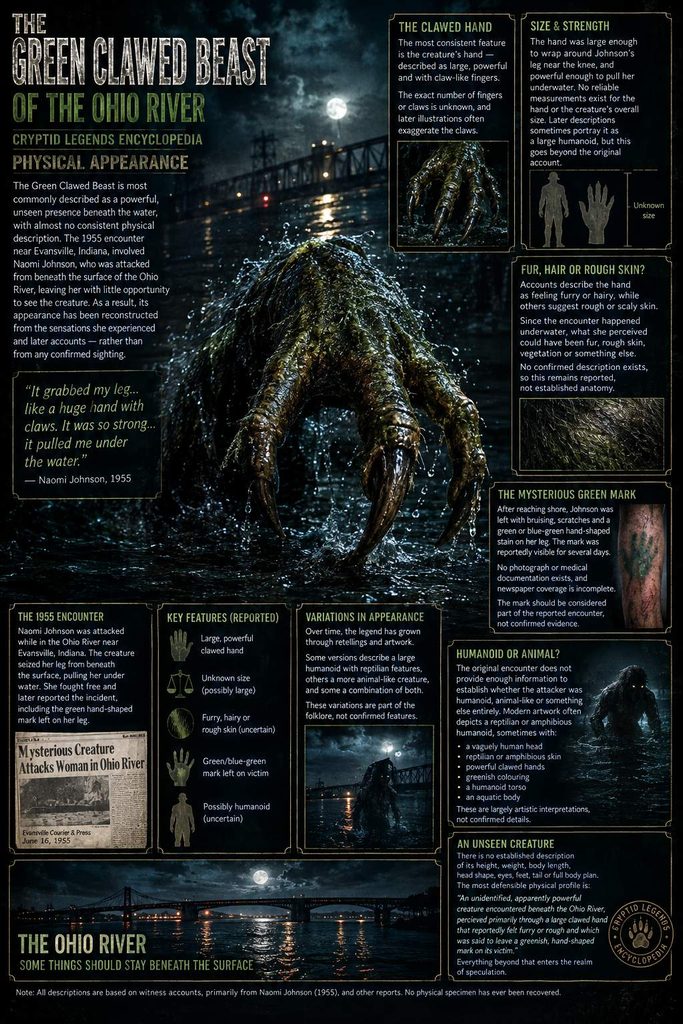
Perhaps the strangest aspect of the Green Clawed Beast is that almost nobody can describe the creature itself.
The 1955 encounter near Evansville, Indiana, was not a conventional sighting. Naomi Johnson was reportedly attacked from beneath the surface of the Ohio River, leaving her with little opportunity to see whatever had seized her.
Consequently, the creature’s appearance has been reconstructed almost entirely from the physical sensations she associated with the attack and from descriptions repeated in later accounts.
What emerges is not a detailed portrait of a monster, but something considerably more mysterious:
A powerful, unseen presence beneath the water, and a huge clawed hand.
✋ The Clawed Hand
The most consistent physical characteristic associated with the creature is its hand.
Johnson reportedly described the thing that seized her leg as resembling a large, powerful hand with claw-like fingers.
The grip was strong enough to pull her beneath the surface, and the attack reportedly happened more than once as she struggled to escape.
This hand is the defining feature from which the creature ultimately received its name:
The Green Clawed Beast.
Unlike many cryptid descriptions, however, there is no reliable account establishing exactly how many fingers or claws the hand possessed, how long the claws were, or whether they were actually anatomical claws rather than something that felt claw-like during a frightening underwater struggle.
Later illustrations commonly exaggerate the claws into long, predatory talons, but these artistic interpretations should not be confused with an eyewitness description.
🖐️ Size & Strength
The hand was reportedly large enough to wrap around Johnson’s lower leg near the knee and powerful enough to pull her underwater.
The available accounts therefore suggest a creature possessing considerable physical strength.
However, there is no trustworthy measurement for the hand itself, and no confirmed estimate of the animal’s overall size.
Descriptions sometimes portray the Green Clawed Beast as an enormous humanoid river monster, but that image goes considerably beyond what the original encounter can establish.
The safest interpretation is simply that whatever Johnson experienced appeared, by sensation and force, to possess a large and unusually powerful grasp.
🐾 Fur, Hair or Rough Skin?
One of the more intriguing details concerns the texture of the hand.
Later accounts attributed to Johnson describe the hand as feeling furry or hairy, while other retellings characterise the creature as having rough or possibly scaly skin.
This creates an unusual problem for attempts to classify the creature.
A genuinely aquatic animal with a mammal-like furry hand would be highly unusual, while a reptilian or amphibious creature possessing a hand capable of being perceived as hairy presents a different set of problems.
There is also an important limitation here: Johnson experienced the creature underwater, during an apparent struggle for her life.
What she perceived as hair could potentially have been actual fur, rough skin, aquatic vegetation, or another texture encountered in the murky water. Without seeing the creature, there is no way to determine which interpretation is correct.
Consequently, the Encyclopedia records the description as reported, rather than treating fur or scales as established anatomy.
🟢 The Mysterious Green Mark
The most distinctive physical clue in the story is not actually a part of the creature.
After reaching shore, Johnson was reportedly left with bruising, scratches and a green or blue-green hand-shaped stain on the area where she had been seized.
Later accounts describe the mark as being approximately the shape and size of a large hand and reportedly remaining visible for several days.
This alleged mark is one of the reasons the creature became known as the Green Clawed Beast.
It is also one of the most frequently embellished details in later versions of the story.
No surviving photograph or medical documentation has been established that would allow the mark to be independently examined.
Contemporary newspaper material concerning the incident is also incomplete, meaning that later descriptions cannot always be separated cleanly from the original reporting.
The mark should therefore be regarded as part of the reported encounter, not as confirmed physical evidence of an unknown animal.
👤 Humanoid or Animal?
The Green Clawed Beast occupies an unusual position among American river-monster legends because the original encounter does not provide enough information to establish whether the attacker was humanoid, animal-like or something else entirely.
Modern artwork frequently depicts a grotesque amphibious or reptilian humanoid, sometimes with:
- 👁️ A vaguely human head
- 🦎 Reptilian or amphibious skin
- 🐾 Powerful clawed hands
- 🟢 Green or greenish colouring
- 🧑🦲 A humanoid torso
- 🌊 An aquatic or semi-aquatic body
These characteristics are largely products of later artistic interpretation and cryptid tradition, rather than details securely established by Johnson’s encounter.
The original story gives us something much more limited, and arguably much more frightening.
Something was beneath the water.
Something grabbed her.
And whatever it was, she never obtained a clear view of its body.
🌊 An Unseen Creature
This lack of a conventional sighting is central to the Green Clawed Beast’s identity.
There is no established description of its:
Height.
Weight.
Body length.
Head shape.
Eyes.
Feet.
Tail.
Torso.
Or complete body plan.
Even its supposed green coloration comes primarily from the mysterious mark reportedly left on Johnson’s leg, rather than from a confirmed observation of the creature itself.
For this reason, depictions of the Green Clawed Beast should be understood as interpretations of the legend, rather than reconstructions of a known animal.
The most defensible physical profile is therefore surprisingly simple:
An unidentified, apparently powerful creature encountered beneath the Ohio River, perceived primarily through a large clawed hand that reportedly felt furry or rough and which was said to leave a greenish, hand-shaped mark on its victim.
Everything beyond that enters the realm of speculation.
And perhaps that uncertainty is precisely what makes the Green Clawed Beast so effective as a piece of folklore.
We are not given the image of a monster standing on the riverbank.
We are given a hand emerging from the darkness beneath the water.
A grip around the leg.
Claws in the murk.
And something unseen pulling downward.
📍 Location & Country
- 🗺️ Primary Location: Dogtown, Evansville, Vanderburgh County, Indiana
- 🌊 Waterway: Ohio River
- 🏞️ Region: Southwestern Indiana — Ohio River Valley
- 🌎 Country: United States
- 📌 Specific Area: The Ohio River near the historic Dogtown district of Evansville, where Naomi Johnson reportedly encountered the creature while swimming in August 1955
- 📍 Coordinates (Approx.): 37.95° N, 87.63° W
- 🧭 Modern Map Reference: Dogtown Boat Ramp / Old Henderson Road area
The Green Clawed Beast is inseparably associated with the Ohio River near Dogtown, a historic riverside district on the western side of Evansville, Indiana.
According to the surviving accounts, Naomi Johnson was swimming in the river during the hot afternoon of August 1955, accompanied by her friend Mrs. Chris Lamble.
Later versions place the women approximately 15 feet from the shoreline when something beneath the murky water seized Johnson around the knee and attempted to pull her underwater.
The precise point where the encounter occurred has not been established. There is no surviving official location marker identifying the exact stretch of river, and the available historical material refers to the broader Dogtown area rather than a precise modern coordinate.
For that reason, the Encyclopedia map should treat the coordinates above as an approximate geographic marker for the legendary encounter, rather than suggesting that the exact spot is known.
The setting itself is an important part of the legend.
The Ohio River is a vast, constantly changing waterway, and in 1955 its muddy, relatively opaque waters would have provided an environment in which an unseen object or animal could remain almost completely concealed from a swimmer at the surface.
That makes the original account particularly atmospheric: Johnson reportedly never saw the creature’s body. She experienced it almost entirely through the sudden grip of something beneath the water.
Today, the Dogtown area remains accessible from the surrounding Evansville road network, with the Dogtown Boat Ramp providing a modern geographic reference point for the area.
However, the modern landscape should not be interpreted as the exact site of the 1955 encounter.
The map therefore marks the locality of the legend, not a confirmed monster lair.
🌊 Habitat
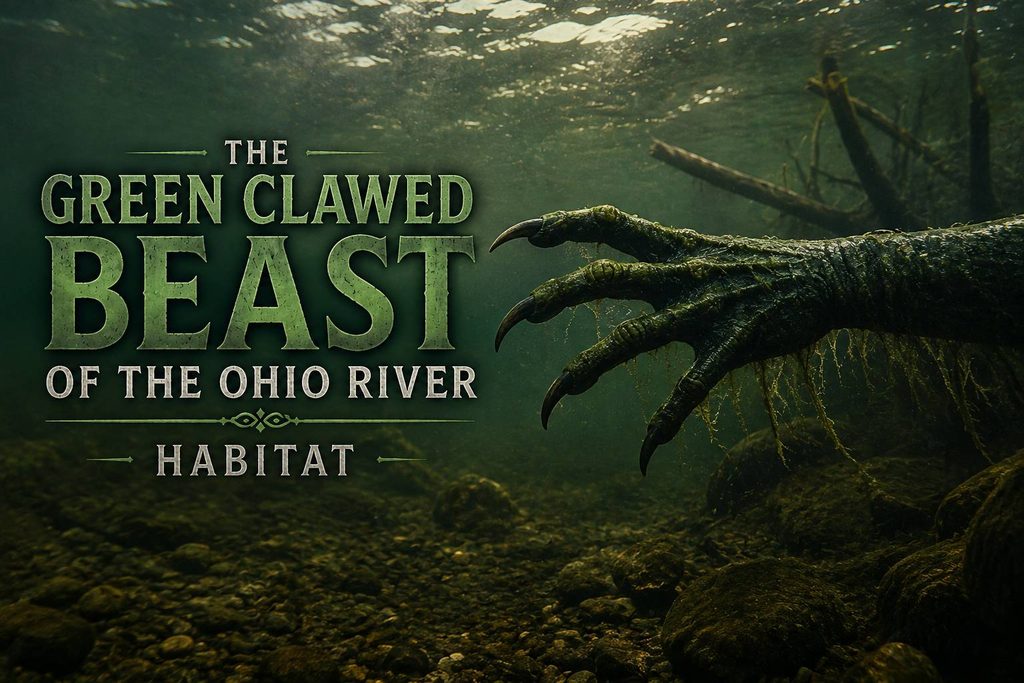
If the Green Clawed Beast exists beyond the boundaries of folklore, its legendary habitat is about as fitting as could be imagined for an aquatic cryptid.
The creature is traditionally associated with the Ohio River near Evansville, Indiana, particularly the historic Dogtown area where Naomi Johnson was reportedly attacked in 1955.
This is not a remote mountain lake or an inaccessible wilderness.
It is a huge, working river passing directly through a populated part of the American Midwest.
And yet, beneath its surface, visibility can be extremely limited.
🌊 The Ohio River
The Ohio River forms one of the defining waterways of the eastern United States, flowing for roughly 981 miles through or along six states before joining the Mississippi River.
At Evansville, the river is broad and powerful, with a constantly changing environment of currents, submerged structures, debris, deeper channels and shallower margins.
For a creature supposedly capable of remaining beneath the surface, such an environment would provide enormous opportunities for concealment.
The Green Clawed Beast’s legend therefore depends less upon an isolated “monster lair” and more upon the simple mystery of what might be moving beneath a large, opaque river.
The original encounter was reportedly particularly close to shore. Later accounts place Johnson approximately 15 feet from the riverbank when something suddenly seized her leg beneath the water. She reportedly never saw the attacker itself.
That detail is important.
The legend does not require a creature to emerge dramatically from the depths.
It only requires something unseen to be there.
🌫️ Murky Water & Limited Visibility
The conditions described in later accounts are particularly significant to the story.
Johnson was reportedly swimming in the river during an extremely hot August afternoon.
The water around Evansville was described in contemporary and retrospective accounts as relatively calm, but the river itself was sufficiently opaque that a person swimming at the surface could have little opportunity to identify something beneath them.
For the purposes of the folklore, this creates an almost perfect setting.
A person can feel something touch their leg without seeing what caused it.
A sudden movement beneath the surface can become impossible to interpret.
And in the confusion of an underwater struggle, the difference between a large fish, submerged debris, vegetation or something genuinely unknown becomes extraordinarily difficult to establish.
That uncertainty is fundamental to the Green Clawed Beast legend.
🐟 A River Full of Potential Explanations
The Ohio River is home to a wide variety of aquatic life, and large fish and other animals have historically inhabited its waters.
Among the creatures sometimes suggested as possible explanations for the 1955 encounter are large catfish, gar and turtles.
A particularly interesting possibility raised by later investigators is the alligator gar, a large predatory freshwater fish with a long body, powerful jaws and heavily armoured scales.
However, the alligator gar explanation should also be treated cautiously. The reported sensation was of something resembling a large clawed hand, rather than a fish biting the swimmer, and there is no evidence identifying an actual animal involved.
The important point is that a large river already contains plenty of ordinary things capable of producing an extraordinary experience.
That does not prove that an animal caused Johnson’s encounter.
It simply demonstrates why an underwater event in such an environment is difficult to identify with certainty.
🏞️ Riverbank Environment
The area associated with the legend was not a wilderness untouched by people.
Historic Dogtown was a riverside district of Evansville, and swimming in the Ohio River was sufficiently familiar in the mid-twentieth century that Johnson’s 1955 excursion was not inherently unusual.
The contrast between the ordinary and the terrifying is therefore one of the strongest atmospheric elements of the legend.
A hot summer afternoon.
Children playing beside the river.
Two women swimming close to shore.
Calm water.
And then something beneath the surface suddenly grabs a human leg.
The surroundings did not need to be supernatural.
The river itself was enough.
🌑 What Would the Beast’s Habitat Actually Require?
If we temporarily approach the Green Clawed Beast as a hypothetical unknown aquatic animal rather than a folkloric entity, there is remarkably little information with which to construct a biological habitat.
There is no confirmed body size.
No confirmed anatomy.
No confirmed diet.
No confirmed method of locomotion.
No confirmed sightings establishing whether it even entered the water deliberately.
Consequently, claims that the creature possesses a permanent underwater cave, breeding grounds, nesting sites or a particular preferred depth belong to modern speculation, not the original evidence.
The only habitat we can confidently assign to the legend is the Ohio River itself.
Everything beyond that remains hypothetical.
🌊 A Monster Hidden by Its Environment
This makes the Green Clawed Beast rather different from many famous land-based cryptids.
A Sasquatch sighting supposedly occurs in a forest where investigators can search for footprints, hair or other traces.
A lake monster can theoretically be watched from the shoreline.
But the Green Clawed Beast’s original story gives us something much more elusive.
The witness was already in the monster’s environment.
The water surrounded her.
The creature was below her.
And visibility was limited to the surface around her.
The encounter therefore became almost entirely tactile rather than visual.
There was no distant silhouette.
No clear face.
No unmistakable body.
Only the sensation of something powerful closing around her leg.
🕳️ The Unknown Beneath the Surface
The Ohio River’s enormous scale makes the legend particularly effective as folklore.
A person standing on the bank sees only the surface.
Beneath it lies an entirely different world of depth, current, sediment and aquatic life.
For the Green Clawed Beast tradition, that unseen world becomes the perfect place for an unknown creature to exist.
But there is an important distinction between a creature being able to hide in such an environment and evidence that one actually does.
The Ohio River provides a plausible setting for an unexplained underwater encounter.
It does not provide evidence for an undiscovered monster.
👹 Habitat Summary
Legendary Habitat: Ohio River
Primary Locality: Dogtown area, Evansville, Indiana
Environment: Large freshwater river
Reported Encounter: Close to shore, approximately 15 feet from the bank
Water Conditions: Reportedly calm at the time, with limited underwater visibility
Folkloric Behaviour: Aquatic or semi-aquatic; attacks from beneath the surface
Confirmed Lair: None
Confirmed Range: None
Biological Evidence: None
The Green Clawed Beast does not need a haunted swamp or an isolated lake to inspire fear.
Its legend places it somewhere much more familiar:
Beneath the surface of a great American river.
And that may be the most unsettling part of the story.
Because when the water is dark enough, you cannot see what is beneath you.
📖 Background & Legend
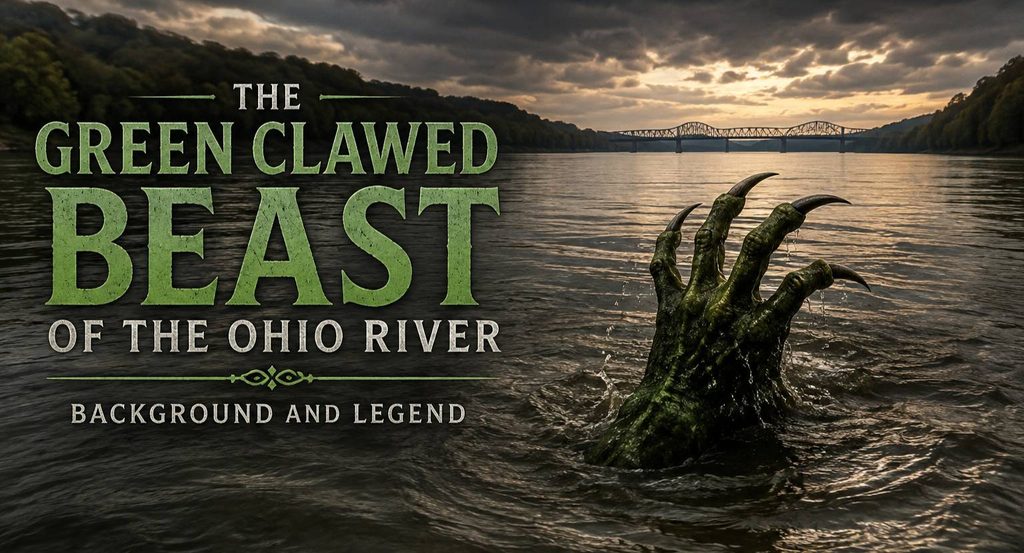
The story of the Green Clawed Beast of the Ohio River is one of the stranger aquatic legends to emerge from the American Midwest.
Unlike many famous cryptids, the creature does not have a long tradition of sightings stretching back generations.
Instead, its entire legend appears to have grown from a single extraordinary encounter reported in 1955, when Evansville-area woman Naomi Johnson was allegedly seized by something beneath the surface of the Ohio River.
There was no dramatic creature emerging from the water.
No photograph.
No body.
No footprint.
According to the story, there was only a sudden, terrifying sensation of something powerful grabbing her leg.
And then the struggle began.
🌊 The Story of Naomi Johnson
On a hot August day in 1955, Johnson and her friend Louise Lample went swimming in the Ohio River near the Dogtown area of Evansville, Indiana, while Johnson’s children remained on the shore.
Johnson was reportedly only a short distance from land when something beneath the water suddenly seized her.
Later accounts describe the attacker as possessing a large, rough, claw-like hand, apparently covered in something resembling hair or coarse skin. The creature allegedly pulled Johnson beneath the surface before she managed to break free.
But the encounter was not over.
According to the story, the unseen hand grabbed her a second time as she attempted to escape. Johnson eventually reached an inner tube being used nearby and managed to pull herself towards shore.
The experience left her frightened and physically injured, with later retellings claiming that a strange greenish or blue-green mark resembling a handprint remained on her leg.
The creature itself was never properly seen.
That single detail has remained central to the legend.
The name “Green Clawed Beast” is therefore somewhat misleading if interpreted literally: the original encounter was with an unseen underwater assailant, while its now-familiar appearance developed through later retellings of what Johnson reportedly experienced and described.
👹 From Unseen Attacker to River Monster
As the story circulated, the anonymous thing beneath the Ohio River gradually acquired a more recognisable identity.
Later accounts transformed the mysterious hand into the image of a large, aquatic humanoid or monster, generally depicted as greenish, hairy or scaly, and possessing powerful clawed hands.
Some versions portray the creature as a hulking amphibious beast capable of remaining underwater and attacking swimmers from below.
Others leave its exact appearance deliberately vague.
This uncertainty is important because there is no established contemporary description of Johnson seeing the complete animal.
Much of the familiar monster imagery belongs to subsequent folklore and cryptid literature, rather than a verified 1955 observation.
The result is a classic example of how an unexplained event can evolve into a cryptid legend.
A hand becomes a creature.
A strange mark becomes evidence.
And an encounter beneath dark water becomes a monster said to inhabit the river.
🎬 The Creature From the Black Lagoon Influence
The timing of the story is particularly interesting.
Creature from the Black Lagoon, the famous 1954 Universal monster film, had been released only the previous year, and later accounts associate Johnson’s description with the imagery of the film’s amphibious Gill-man.
This does not establish that the encounter was inspired by the movie.
However, it provides an important cultural backdrop for understanding why an unexplained aquatic attack in 1955 could so easily acquire the appearance of a classic humanoid river monster.
Johnson was later reported as comparing the mysterious attacker to the creature from the film, although the precise wording and chronology of these recollections vary between sources.
The possibility of cultural influence therefore remains interesting, but it should not be confused with evidence that the original incident was fabricated.
📰 A Story That Changed as It Was Retold
One of the biggest difficulties with the Green Clawed Beast is the limited surviving primary documentation available to modern researchers.
The story is repeatedly traced back to Evansville newspaper coverage in August 1955, including reports in the Evansville Press. Later writers have reproduced or summarised elements of those reports, but many of the details now circulating online come through secondary sources.
Consequently, the story has accumulated discrepancies.
The date is variously given as August 14 or August 21, 1955.
Johnson’s name has also appeared differently in some later accounts.
The precise nature of the injuries and the duration of the unusual green mark likewise varies.
These inconsistencies do not necessarily mean that nothing happened.
They demonstrate something much more common in folklore: the further an unusual story travels from its original telling, the more difficult it becomes to separate the original account from later additions.
👽 The Curious Hopkinsville Connection
One of the strangest additions to the Green Clawed Beast story concerns the famous Kelly–Hopkinsville encounter in Christian County, Kentucky.
Some later sources place Johnson’s encounter on August 21, 1955, the same date on which the Kelly–Hopkinsville incident began, roughly 50 miles away in a straight-line sense, across the Ohio River and into western Kentucky. The road distance between Evansville and Kelly is considerably greater, at roughly 70 miles.
The two stories have subsequently become associated in UFO and cryptid literature.
Some later accounts even report that Johnson was shown descriptions or illustrations of the strange beings reported at Kelly and believed they resembled whatever had grabbed her in the Ohio River.
Cryptopia, for example, explicitly presents this connection and attributes a statement to Johnson identifying the attacker with one of the supposed “little green men.”
Other modern paranormal sources have similarly highlighted the coincidence in timing and geography, sometimes suggesting that the two incidents represented different manifestations of the same phenomenon.
However, Cryptid Legends treats this connection cautiously.
The original Green Clawed Beast story and the Kelly–Hopkinsville encounter are separate reports, and there is no established evidence demonstrating that they involved the same entity or phenomenon.
The connection appears primarily through later retellings and interpretations, although the reported contemporary/near-contemporary references to Johnson reacting to the Hopkinsville story make the association an interesting part of the legend’s history.
It is therefore best regarded as a curious piece of folklore surrounding the case, rather than established evidence of an extraterrestrial or interdimensional connection.
🕵️ The Mysterious Air Force Colonel
Another enduring element of the legend concerns an alleged visit to the Johnson household by a man claiming to be an Air Force colonel.
According to later accounts, the supposed officer questioned Johnson about her experience, took notes concerning what she had encountered, and warned the family against discussing the incident further.
The story has naturally attracted comparisons with the Men in Black mythology that became increasingly prominent during the UFO culture of the 1950s and following decades.
But once again, the evidence becomes considerably thinner at this point.
There is no independently verified Air Force record establishing that such an officer visited the Johnson family, and the account survives primarily through later paranormal and cryptozoological retellings.
It therefore belongs firmly in the “reported folklore” category rather than the documented history of the incident.
🌊 The Legend Beneath the River
Ultimately, the Green Clawed Beast’s mythology rests upon a remarkably simple premise:
Something grabbed a woman beneath the waters of the Ohio River.
Everything that came afterwards, the green handprint, the monstrous appearance, the alleged government interest, the UFO connection and the eventual identity of the creature as a river monster, helped transform that frightening encounter into a lasting cryptid legend.
There have been no verified photographs of the creature.
No recovered specimen.
No confirmed second encounter.
No physical evidence demonstrating that an unknown animal inhabited the Ohio River.
And yet the story persists.
Perhaps that is because the original mystery requires very little imagination.
A person enters a vast river.
The water closes around them.
Something touches their leg.
They cannot see what it is.
And for one terrifying moment, the unknown is directly beneath the surface.
The Green Clawed Beast may ultimately be a product of folklore, a misidentified animal, an embellished account, or something that remains unexplained.
But the story that emerged from that August day in 1955 has become one of the Ohio River’s strangest pieces of monster folklore.
👁️ Historical Sightings & Modern Reports
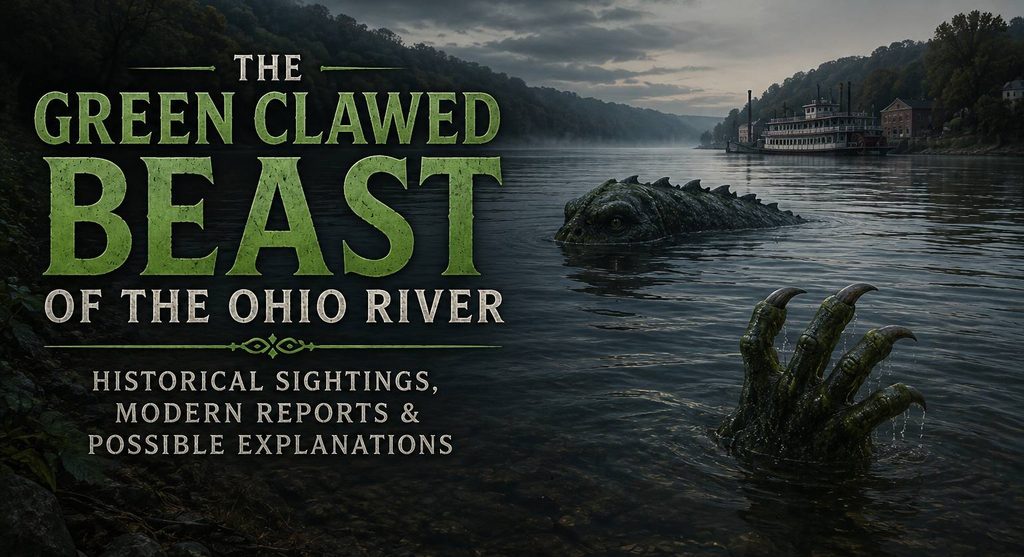
The Green Clawed Beast is unusual among American cryptid legends because its reputation rests overwhelmingly upon one principal reported encounter rather than a long succession of independent sightings.
The 1955 account attributed to Naomi Johnson remains the central incident around which virtually the entire legend revolves.
Later writers, paranormal researchers and cryptozoological publications have repeatedly revisited the story, but these retellings should not be mistaken for new eyewitness encounters.
There is no substantial body of later reports establishing a consistent population of Green Clawed Beasts along the Ohio River.
📜 A Cryptid With Very Little Contemporary Evidence
Despite the story’s survival for decades, the evidential record remains remarkably thin.
The original newspaper reporting is difficult to access in complete form today, with much of the surviving information being preserved through quotations, archival references and later accounts.
No comprehensive series of police, medical or wildlife records has emerged to independently document the encounter or identify the animal involved.
This creates an unusual situation.
The story itself has survived.
The evidence has not.
The absence of documentation does not prove that Johnson’s experience did not occur.
It does, however, mean that modern investigators cannot independently reconstruct exactly what happened beneath the Ohio River that day.
👣 No Established Physical Evidence
There is also no convincing trail of physical evidence associated with the Green Clawed Beast.
No authenticated:
- 🦴 Specimen or remains
- 🧬 DNA or tissue sample
- 🩸 Biological material
- 👣 Footprints or tracks
- 📸 Verified photographs
- 🎙️ Recorded vocalisations
- 📡 Sonar evidence
- 🐾 Confirmed animal remains
has been produced as evidence for an unknown creature inhabiting the river.
The reported greenish mark on Johnson’s leg is sometimes presented as physical evidence, but no surviving medical documentation has established its cause, and the details of the mark vary between later retellings.
Consequently, the case remains an eyewitness-based mystery rather than a biologically supported cryptid case.
🌊 The Lack of Subsequent Encounters
Perhaps the biggest problem for the idea of an unknown breeding population is the absence of a convincing pattern of later encounters.
The Ohio River is an enormous and heavily used waterway. People have lived, worked, fished and travelled along it for generations, yet there is no comparable catalogue of independently documented attacks or sightings that would establish the Green Clawed Beast as a recurring phenomenon.
Occasional modern references to the creature tend to lead back to the 1955 Johnson story, rather than providing genuinely new evidence.
This makes the Green Clawed Beast fundamentally different from cryptids such as Bigfoot, where thousands of alleged encounters have accumulated over many decades.
Here, the legend is essentially built around a single unexplained event.
And that distinction matters.
🔬 Possible Explanations
With so little physical evidence available, the Green Clawed Beast can only be approached through possible explanations rather than a definitive identification.
None of the following explanations can be demonstrated to be what happened to Naomi Johnson. They are simply potential ways of interpreting an encounter that was never independently resolved.
🐟 Large River Animals
The Ohio River contains a variety of substantial aquatic animals capable of surprising a swimmer.
Large catfish are an obvious possibility. Several species can reach considerable sizes, live close to the bottom and remain difficult to see in murky water.
Gar, particularly large individuals, are another possibility. Their elongated bodies, scales and powerful jaws could produce an alarming underwater encounter, although the reported sensation of a clawed hand does not provide a particularly neat match.
Neither explanation has been demonstrated as the animal involved in Johnson’s encounter.
They simply illustrate an important point:
A large unidentified object moving beneath murky river water does not necessarily have to be a monster.
🐢 Turtles & Other Aquatic Wildlife
Large snapping turtles have also been suggested as a possible source of an unexpected underwater encounter.
A powerful animal suddenly grabbing or striking a person’s leg could produce considerable panic, particularly where visibility is poor.
Again, however, the reported description of a hand with claw-like fingers does not correspond neatly with a turtle’s anatomy.
The explanation therefore remains possible rather than persuasive.
🌿 Vegetation, Debris & Underwater Objects
A less exotic possibility is that the experience involved something that was not an animal at all.
Rivers can contain submerged vegetation, branches, discarded objects and other debris. A swimmer moving through shallow water can encounter these without being able to see them clearly.
Something catching around a leg could initially feel surprisingly strong, particularly when the swimmer is already startled.
However, the repeated description of an apparent hand and the struggle associated with the original account make this explanation impossible to establish retrospectively.
🩹 The Reported Green Mark
The alleged greenish handprint or stain is one of the most intriguing elements of the legend.
If genuine, it would seem to provide something tangible beyond the sensation of being grabbed.
Unfortunately, there is no surviving medical record establishing what produced the mark.
Bruising, pressure injuries, abrasions, staining from environmental material or other ordinary causes could potentially create unusual discolouration.
Conversely, without examining the original injury, it is impossible to determine whether the description accurately represents what was observed.
The green mark therefore remains an interesting reported detail, not confirmed biological evidence.
🎬 Cultural Influence & Monster Imagery
Another possibility concerns the development of the creature’s appearance after the original event.
Creature from the Black Lagoon had been released in 1954, shortly before the 1955 encounter, and later accounts connect Johnson’s recollections with the film’s amphibious monster.
That does not establish that the original incident was inspired by the movie.
But it provides an obvious cultural environment in which an unexplained underwater encounter could acquire the characteristics of a green, humanoid, aquatic monster.
As the story passed from newspaper reporting into paranormal and cryptozoological literature, the mysterious underwater attacker could consequently become increasingly recognisable as a conventional “river monster.”
🧠 Memory, Retelling & Folklore Development
The passage of time presents another difficulty.
The Green Clawed Beast has been repeatedly retold over many decades, and different versions contain different dates, names and additional details.
Some elements appear consistently enough to suggest that they derive from the original story, while others appear primarily in later accounts.
This is exactly the environment in which folklore develops.
An unusual experience becomes a story.
The story is repeated.
New details are attached to it.
Eventually, the later version can become more famous than the original account.
That process does not necessarily mean that the original witness invented her experience. It means that the modern Green Clawed Beast legend cannot be assumed to represent the 1955 account in every detail.
❓ What Can Actually Be Established?
The most cautious interpretation is also the simplest.
Something was reported to have happened to Naomi Johnson in the Ohio River in 1955.
The incident became associated with a mysterious creature.
The story was subsequently retold and developed into the legend of the Green Clawed Beast.
Beyond that, the evidence becomes increasingly uncertain.
There is currently no physical evidence establishing an unknown aquatic animal, no convincing sequence of independent modern sightings and no confirmed biological material.
The large Ohio River provides several plausible sources for an unusual encounter, but none has been proven responsible.
The Green Clawed Beast therefore remains exactly what makes it interesting as a cryptid:
An unexplained encounter preserved in folklore, but without enough evidence to turn the mystery into a zoological discovery.
🎬 The Green Clawed Beast Of The Ohio River In Pop Culture & Literature
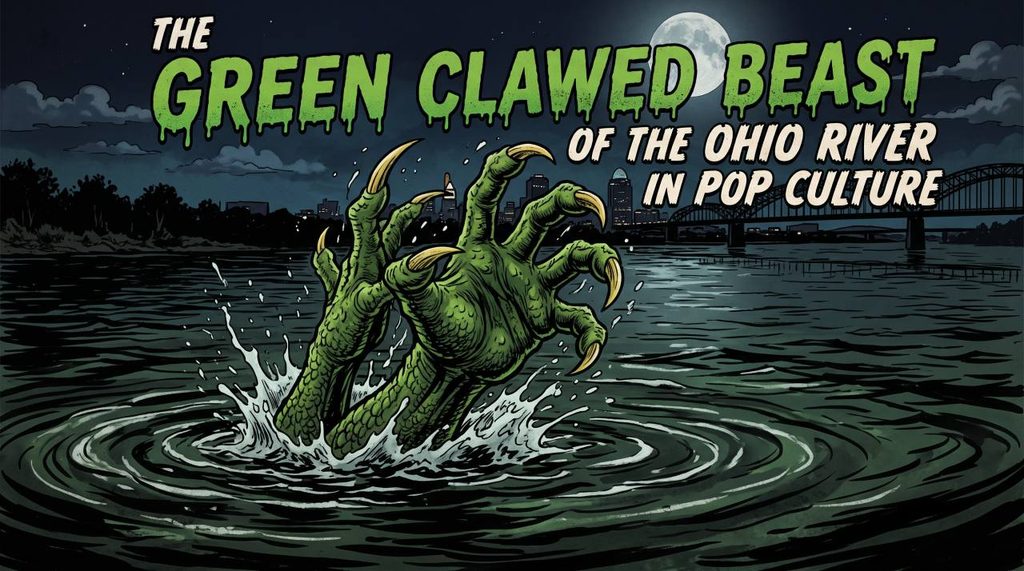
Although the Green Clawed Beast is considerably more obscure than many American cryptids, the strange 1955 Ohio River encounter has found its way into modern cryptozoological entertainment, television and popular culture.
Its appearances have generally focused on the original mystery rather than establishing a large body of subsequent encounters.
📺 Monsters and Mysteries in America
The Green Clawed Beast received one of its most significant mainstream cryptid-media appearances in the Discovery/Destination America series Monsters and Mysteries in America.
The creature features in Season 2, Episode 7, “Green Clawed Beast, Big Muddy Monster, Ohio Grassman,” originally aired in January 2014.
The episode presents three separate American monster legends, with the Green Clawed Beast segment returning to the story of the mysterious creature said to have attacked a woman in the Ohio River.
The programme uses the case as an example of an American river monster and dramatizes the frightening underwater encounter, bringing the obscure Evansville legend to a considerably wider television audience.
The Green Clawed Beast was also credited among the programme’s creature portrayals, demonstrating how the case had become part of the wider American cryptid-media landscape by the 2010s.
📚 Cryptid Books & Popular Literature
The Green Clawed Beast has appeared primarily in cryptozoological and paranormal literature, where the 1955 encounter has been preserved and expanded upon for modern audiences.
Unlike major cryptids such as Bigfoot, Mothman or the Jersey Devil, however, the Green Clawed Beast does not possess a large dedicated literary canon of its own.
Most written references treat it as a relatively obscure regional cryptid and concentrate on the Naomi Johnson encounter, the reported green mark and the unusual circumstances surrounding the story.
This literary afterlife has nevertheless been important to the creature’s survival.
Without a continuing stream of independent sightings or physical evidence, books, magazines and later cryptozoological writing have effectively become the archive through which the Green Clawed Beast has remained known.
The distinction between original reporting and later retelling is particularly important with this case, as some of the more elaborate details surrounding the creature have appeared or become prominent only in later literature.
🃏 MetaZoo CCG — Green Clawed Monster
The Green Clawed Beast also received a place in modern cryptid collecting culture through MetaZoo, although the game uses the slightly different name “Green Clawed Monster.”
The creature appears in the 2022 MetaZoo: Wilderness set as card #6/165, a Gold Water Beastie.

The standard card identifies it as:
Green Clawed Monster
💧 Aura: Water
👹 Type/Tribe: Beastie — Humanoid
⭐ Rarity: Gold
🔢 Set: Wilderness #006
❤️ Life Points: 30
🪤 Trait: Trap
Its game mechanics are appropriately aquatic and dangerous. The card costs 2 Neutral + 3 Water Aura, and its contract effect allows the player to automatically inflict Paralyze on a target Beastie. Its attack, “Drowning,” deals 20 damage.
The card also has a River Terra bonus of +20 LP, reinforcing its connection to its legendary watery habitat.
The card even contains a characteristic MetaZoo 4th Wall Effect:
This Page costs no Aura to Contract if you swam today.
The Wilderness release also included a First Sighting version of Green Clawed Monster, numbered 26-F, with a print run of /99, giving collectors another version of the creature to seek out.
MetaZoo subsequently featured the creature again in the HiROQUEST: GENESIS collaboration set, where Green Clawed Monster appears as card 63/66, another Water-type Beastie.
For collectors, this makes the Green Clawed Monster particularly interesting: a relatively obscure regional legend from Evansville has been preserved not only through paranormal literature and television, but also as part of one of the modern collectible-card games built around cryptids and folklore.
🐾 From Local Legend to Cryptid Culture
The Green Clawed Beast has never achieved the enormous cultural footprint of Bigfoot or Mothman, but its appearances demonstrate how even a relatively obscure regional story can survive.
A newspaper story from 1955 became a recurring subject of cryptozoological writing.
That story eventually reached television audiences through Monsters and Mysteries in America.
And decades later, the creature became a collectible MetaZoo Beastie, immortalised in card form as the Green Clawed Monster.
Its journey through popular culture is therefore almost as unusual as the legend itself:
One mysterious encounter → regional folklore → cryptozoological literature → television monster → collectible cryptid.
For a creature with so little physical evidence and so few independent reports, popular culture has played an unusually important role in keeping the Green Clawed Beast alive.