Common Features of Bigfoot and Sasquatch Reports
Bigfoot and Sasquatch reports often describe more than a fleeting glimpse of a large, ape-like figure disappearing into the wilderness.
Across decades of eyewitness accounts, certain features appear repeatedly in reports such as an overwhelming foul odour, rocks thrown from the tree line, unexplained knocks against wood, unusual vocalisations, and encounters that seem to occur most frequently under the cover of darkness.
In this article, Cryptid Legends examines some of the most commonly reported features associated with Bigfoot and Sasquatch encounters, exploring their place in the wider history of the legend, the similarities between accounts, and the possible natural explanations behind them.
From the notorious stench associated with certain regional variants to the strange sounds reported in remote forests, we’ll separate recurring claims from established evidence and examine what these patterns can, and cannot, tell us about one of North America’s most enduring cryptid mysteries.
Unusual and Foul Odours
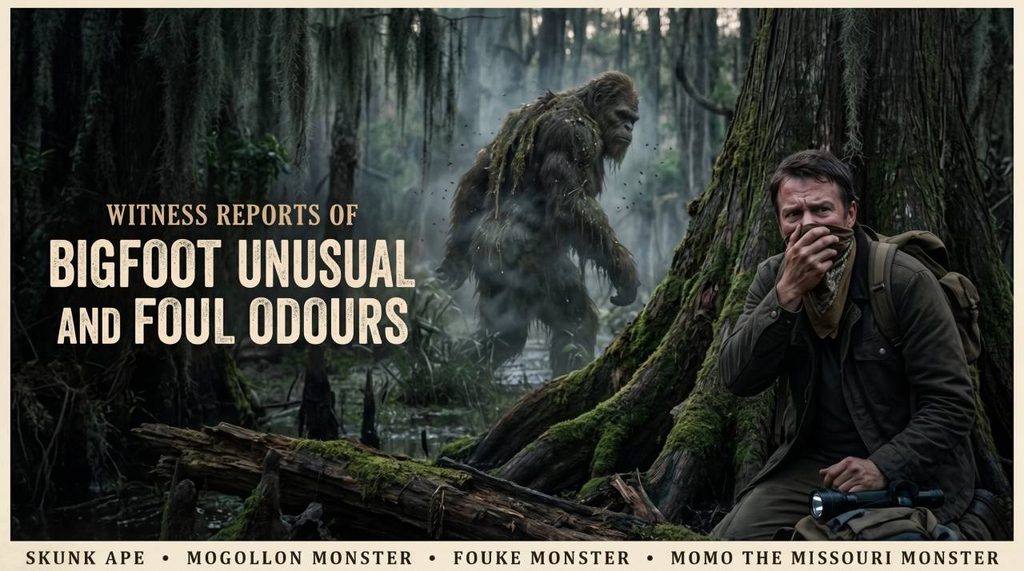
Of all the unusual details described in Bigfoot and Sasquatch sighting reports, few are quite as distinctive as the foul odour that witnesses sometimes claim accompanies an encounter.
While accounts vary considerably in their descriptions of a creature’s appearance, behaviour and size, reports of an overpowering, unpleasant smell appear repeatedly in Bigfoot-related folklore and eyewitness testimony.
The descriptions can be remarkably vivid. Some witnesses compare the smell to skunk spray or a wet dog, while others describe something closer to rotting meat, sewage, rotten eggs, decaying vegetation or an intensely musky, animal-like stench.
In certain accounts, the odour is reportedly so strong and nauseating that it attracts attention before the witness has even seen anything unusual. In others, the smell is noticed during or after an encounter, adding another unsettling detail to an already confusing experience.
What makes this feature particularly interesting is that the association between foul odours and Bigfoot-like creatures extends well beyond the Pacific Northwest.
Several regional cryptid legends across the United States have developed similar reputations, with the smell sometimes becoming one of their defining characteristics.
A Stench Shared by Regional Legends

The Skunk Ape — Florida and the southeastern United States
Perhaps the clearest example is Florida’s Skunk Ape, whose very name reflects its supposed pungent odour.
Often portrayed as a Bigfoot-like creature inhabiting the swamps and wetlands of the southeastern United States, it has been associated with smells compared to skunk spray, rotten food, dead animals and an exceptionally strong, rancid animal odour.
The smell is so closely associated with the Skunk Ape that it has become one of the most recognisable elements of the legend.
Some accounts describe an unpleasant smell preceding a sighting, while others associate it with the creature’s immediate surroundings.
The Mogollon Monster — Arizona
The Mogollon Monster, sometimes called the Arizona Bigfoot, is another example in which the smell features prominently in descriptions of the creature.
Reports and regional retellings have compared its supposed odour to dead fish, skunk, decaying peat moss and the musk of a snapping turtle.
These comparisons are striking because they suggest something more complex than a single, familiar smell.
However, the descriptions come from anecdotal reports and folklore rather than a scientifically documented animal, and it is difficult to establish how consistently the details appeared in the earliest accounts.
The Fouke Monster — Arkansas
The Fouke Monster, also known as the Boggy Creek Monster, is a hairy, bipedal creature associated with the swamps and bottomlands around Fouke, Arkansas.
Its modern legend became widely known following reports in the early 1970s and the subsequent popularity of The Legend of Boggy Creek (1972).
Descriptions of the creature have included an unpleasant odour likened to a combination of skunk and wet dog.
As with other regional Bigfoot legends, this adds a sensory element to the accounts beyond the creature’s reported appearance.
It is worth distinguishing, however, between details recorded in early witness accounts and characteristics that became more prominent through later retellings.
The Honey Island Swamp Monster — Louisiana
Louisiana’s Honey Island Swamp Monster is also associated with a powerful, unpleasant smell.
Descriptions of the creature commonly refer to an odour resembling rotting vegetation, stagnant swamp water or decomposing organic matter.
The swamp setting makes this comparison particularly interesting.
Wetlands naturally contain decaying plant material and other sources of unpleasant smells, so an odour noticed during an encounter in such an environment would not, by itself, establish that an unknown animal was responsible.
Nevertheless, the foul smell has become part of the wider Honey Island Swamp Monster legend.
Momo, the Missouri Monster — Missouri
The foul-odour motif is not limited to the southern swamps. One of the most memorable examples comes from Momo, the Missouri Monster, a Bigfoot-like creature associated with a series of reports around Louisiana, Missouri, during the early 1970s.
An account from July 1971 described two women who reportedly stopped for a picnic near Louisiana and noticed a strong smell before seeing a large, hairy figure near the woods.
The incident became one of the early stories associated with Momo.
The creature’s reputation grew further in July 1972, when fifteen-year-old Doris Harrison reportedly saw a large, hairy figure near her family home.
According to accounts of the incident, a putrid odour drifted through an open window as she watched the figure near the edge of the woods.
The story became a central part of the Missouri Monster legend, attracting widespread attention and inspiring searches around the area.
The smell was not merely a detail attached to the creature’s name after the fact: it appears in historical accounts of the reports themselves.
Missouri’s Department of Conservation has revisited the story, documenting how the early encounters helped bring the small town into the national spotlight.
However, Momo also illustrates the importance of separating the history of a report from the truth of the explanation offered for it.
The accounts establish that people reported seeing and smelling something they associated with a monster; they do not establish that an unknown species was present.
Is the Smell a Common Feature of Bigfoot Reports?
These regional examples sit within a wider pattern of reported Sasquatch encounters.
Accounts collected across North America sometimes describe a pungent smell resembling rotten eggs, sewage, a dead animal or an exceptionally strong animal musk.
The specific comparison varies, but the broader theme is familiar: a smell that witnesses regard as unusually powerful, unpleasant or difficult to explain.
This makes odour an interesting feature to examine alongside other recurring claims, such as wood knocking, rock throwing and unusual vocalisations.
It is a sensory detail rather than a visual description, and in some accounts it is reported even when the witness has little or no clear view of the supposed creature.
It is tempting to interpret the repetition of this detail as evidence that witnesses are independently describing the same animal.
Yet recurring descriptions need to be considered carefully. Reports can influence one another, particularly when a creature already has a popular reputation for a particular characteristic.
Witnesses may also interpret an unfamiliar smell through comparisons with animals or substances they already know.
Consequently, similarities between accounts are worth documenting, but they cannot automatically be treated as independent corroboration.
Establishing how often the smell occurs across reports would require a systematic review of the original accounts, including their dates, sources and potential relationships to earlier stories.
What Could Explain the Odour?
If a witness genuinely encounters a strong, unexplained smell in the wilderness, several possibilities deserve consideration before attributing it to an unknown primate.
- Known wildlife: Skunks are an obvious example, while other animals can produce strong musky smells or leave behind pungent scent markings. A dead or decomposing animal can also produce an intense odour.
- Decomposing vegetation and wetland environments: Rotting plants, stagnant water and organic material breaking down in damp conditions can create powerful smells, particularly in swamp and marsh habitats.
- Environmental gases and other sources: Descriptions of rotten eggs or sewage may bring gases such as hydrogen sulphide to mind. However, a witness’s description alone cannot identify a particular chemical or establish that it was present.
- Misidentification and interpretation: An unusual smell may be real while its source remains uncertain. If a witness also sees a shadowy figure or hears unexplained sounds, the two experiences may become linked in their memory even if they originated from separate causes.
- Expectation and cultural influence: Once a creature becomes associated with a particular smell, people who know the legend may be more likely to interpret an unfamiliar odour as part of an encounter. This does not mean a witness is necessarily being dishonest; it is a reason to examine the circumstances of each report.
These possibilities do not explain every individual account, nor can we identify the cause of a particular smell without evidence from that incident. They simply demonstrate that an unexplained odour is not necessarily evidence of an unknown animal.
An Intriguing Detail, but Not Proof
The foul odour associated with Bigfoot and its regional counterparts remains one of the more distinctive recurring features of the wider legend.
From the Skunk Ape of Florida and the Mogollon Monster of Arizona to the Fouke Monster, Honey Island Swamp Monster and Momo of Missouri, the motif appears across several regional traditions.
It is understandable that witnesses might regard an overwhelming smell as an important part of an encounter, especially when it appears alongside other unusual observations.
A smell is also a different kind of detail from a fleeting visual impression: it may linger in the environment, even if its source is never identified.
Nevertheless, an odour cannot confirm what was present, and similar descriptions do not automatically establish a shared biological explanation.
Nor should the fact that a detail seems unusual be taken as proof that it would be difficult to invent, misinterpret or repeat after exposure to an existing story.
For now, foul odours remain a recurring claim worth documenting and comparing, rather than a verified characteristic of an undiscovered species.
The most useful question is not simply how often the smell appears in Bigfoot stories, but what evidence exists in individual cases to explain it.
Rock Throwing and Alleged Object-Throwing

Among the more unusual behaviours described in Bigfoot and Sasquatch reports is the alleged throwing of rocks and other objects.
Unlike a fleeting glimpse of a figure moving between trees, an object striking a cabin, landing near a witness or hitting a vehicle is an event that can potentially be investigated in more detail.
Yet even when a rock is genuinely found at the scene, establishing who or what threw it can be considerably more difficult.
Accounts range from stones reportedly hurled from concealed positions in the forest to rocks striking remote camps and vehicles.
Some witnesses describe objects being thrown after they have attempted to approach or frighten a supposed creature, while others report being targeted without any obvious provocation.
The behaviour has also become associated with regional wildman traditions beyond North America, making it an intriguing subject when comparing reports from different places and periods.
But are these accounts evidence of a distinctive animal behaviour, misidentifications, human interference or something else?
To explore the question, it is worth starting with one of the earliest and most famous incidents in modern Bigfoot history.
Ape Canyon — Washington, 1924

In July 1924, a group of gold prospectors working near Mount St. Helens in Washington reported encounters with large, hairy, ape-like creatures that became known as the Ape Canyon attackers, or Mountain Devils.
The story attracted considerable attention after accounts appeared in regional newspapers.
According to a contemporary report reproduced in the Rainier Review on 18 July 1924, the prospectors claimed to have encountered the creatures several times.
They described firing at one of them and later experiencing what they interpreted as an attack on their remote cabin.
The most relevant detail for this article occurred during the night. The men reported that rocks came through an opening in the cabin roof used as a chimney, with the bombardment allegedly continuing for several hours.
They also described noise and movement around the building, which they attributed to the creatures they believed were nearby.
The incident has since become a landmark in Bigfoot folklore, but the details deserve closer examination.
The prospectors’ original claims were not independently verified as evidence of unknown animals. Searchers visited the area, and the story attracted scepticism almost immediately.
One alternative explanation involved boys from a nearby YMCA camp, who reportedly came forward suggesting that they might have been responsible for the supposed attack.
It has also been questioned whether the rocks could have been thrown or rolled from the surrounding terrain by people rather than by an unknown creature.
Another important detail emerged in later retellings. In a 1966 interview with Roger Patterson, Fred Beck reportedly said that the prospectors had not actually seen the ape-men throwing the rocks during the night.
This distinction matters: the men attributed the bombardment to the creatures because of their earlier encounters, but that attribution is not the same as directly observing the act.
Ape Canyon therefore provides a fascinating early example of alleged rock-throwing associated with Bigfoot-like creatures, but it cannot be treated as a confirmed demonstration of the behaviour.
The historical record establishes that the prospectors made the claims; it does not establish the identity of whatever, if anything, was responsible for the rocks.
The Rock Apes of Vietnam — 1960s and Early 1970s

Decades after the Ape Canyon incident, accounts of alleged rock-throwing by unusual primate-like creatures emerged from another part of the world: Vietnam during the Vietnam War.
American servicemen used the term Rock Apes for animals or creatures they reportedly encountered in mountainous and forested areas.
Some accounts described monkeys or other unfamiliar wildlife, while others portrayed larger, hairy, sometimes apparently bipedal figures.
The terminology was not consistent, and the label should not be assumed to have referred to one clearly defined animal in every account.
The rock-throwing motif was central to many of these stories. In some recollections, rocks were reportedly thrown towards military positions or patrols.
Other accounts described soldiers throwing stones at animals to drive them away, only for the animals to throw stones back.
This detail is important because it suggests that at least some stories concerned possible retaliatory behaviour rather than unexplained attacks.
The surviving material also varies in quality. Some accounts appear in veterans’ recollections, memoirs or later interviews, while others have circulated through cryptozoological books and websites.
These sources can preserve useful testimony, but retrospective memories may be difficult to verify, and dramatic stories can change as they are repeated.
There are also plausible zoological considerations. Vietnam supports several species of primates, including macaques and langurs, and soldiers operating in unfamiliar terrain may have had limited opportunities to identify animals clearly.
Primates can manipulate and throw objects, so a report of an animal throwing a stone does not, by itself, require an unknown species.
On the other hand, descriptions of much larger, upright, hairy creatures remain unverified and should not simply be treated as established sightings of an undiscovered hominid.
The Rock Ape accounts are particularly interesting because they demonstrate how a similar behaviour can become associated with different kinds of alleged creatures in different circumstances.
However, they should not be merged uncritically with North American Sasquatch reports.
The historical context, terminology, possible animal identities and reliability of individual accounts all differ.
Selected Modern Bigfoot Reports
Rock-throwing claims have continued to appear in more recent Bigfoot and Sasquatch reports.
Some describe stones landing close to witnesses in remote woodland, while others involve rocks reportedly striking vehicles or campsites.
One example recorded by the Bigfoot Field Researchers Organization describes a 2020 incident near Quilcene, Washington.
According to the witness, a small rock came from the tree line and struck the bonnet of a vehicle while the occupants were driving along a road.
The witnesses interpreted the event as a possible Bigfoot encounter because they believed the rock had travelled towards the vehicle from the surrounding trees.
This is the kind of account that makes the behaviour interesting to investigate: there is a specific claimed event, a reported location and a physical object said to have struck a vehicle.
Nevertheless, the witness’s interpretation remains a separate question. The report does not independently establish who threw the rock, whether the object was deliberately thrown, or whether a Bigfoot was present.
Other reports describe rocks striking tents or landing around people who are camping in remote areas.
Some have been collected by organisations that investigate Bigfoot sightings, including the North American Wood Ape Conservancy.
Its published account of a 1997 field expedition in northern California describes repeated sounds interpreted by the team as rocks being thrown, including incidents near camps beneath cliffs.
Crucially, the investigators acknowledged that they did not actually observe the rocks in flight. They heard sounds consistent with rocks striking other rocks and rolling away, but the source of those sounds remained uncertain.
The team considered the incidents noteworthy, yet the report does not establish that an unknown animal caused them.
This illustrates an important distinction between a witness reporting an unusual event and an investigator identifying its cause. Rocks can fall naturally from slopes, be displaced by animals or be thrown by people.
A sound in darkness may be consistent with a rock being thrown without revealing where it originated or what set it in motion.
For that reason, individual reports are most useful when they include precise locations, photographs of the objects and surrounding terrain, witness positions, possible trajectories, independent witnesses and any relevant physical evidence.
Such details would help investigators assess alternative explanations rather than relying solely on the assumption that a Bigfoot was responsible.
Why Would a Bigfoot Throw Rocks?
If some reports genuinely describe an animal deliberately throwing stones, several possible explanations could be considered. These are hypotheses, not established explanations for the reports.
- Defensive behaviour: An animal might throw an object when it feels threatened or wants to discourage an approaching person or animal.
- Territorial or warning displays: Throwing an object could potentially serve as a warning or display, although there is no verified evidence establishing this as a behaviour of an unknown Bigfoot-like species.
- Harassment or deterrence: An animal might attempt to drive an intruder away without making direct physical contact.
- Curiosity or object manipulation: Some primates manipulate objects in ways that can appear deliberate or investigative. Whether this could explain any particular report would depend on the animal involved and the circumstances.
- Human activity or environmental causes: Pranks, deliberate hoaxes, falling stones and other ordinary events must also be considered, especially when no one directly observes the object being thrown.
These possibilities cannot be used to explain every report without examining the individual circumstances.
Nor would an apparent motive, such as territorial defence, establish that the supposed thrower was a Bigfoot.
A Recurring Claim Worth Investigating
Rock throwing is one of the more striking behaviours associated with Bigfoot and Sasquatch folklore because it involves an alleged physical interaction between a witness and something in the surrounding environment.
From the reported bombardment at Ape Canyon in 1924 to the Rock Ape stories of Vietnam and more recent reports of stones striking vehicles or camps, the motif appears in accounts separated by decades and thousands of miles.
However, recurring claims do not necessarily indicate a common source. The historical accounts differ in their circumstances, the reliability of the available records and whether witnesses actually saw an object being thrown.
Some describe an apparent deliberate act, while others report only hearing rocks strike nearby surfaces.
The central question is therefore not simply whether rocks have been reported in Bigfoot encounters, but whether any particular incident provides reliable evidence that an unknown animal was responsible.
Until a report can be independently corroborated and alternative explanations properly assessed, rock throwing remains an intriguing feature of the legend rather than a verified behaviour of an undiscovered species.
Vocalisations in the Wilderness
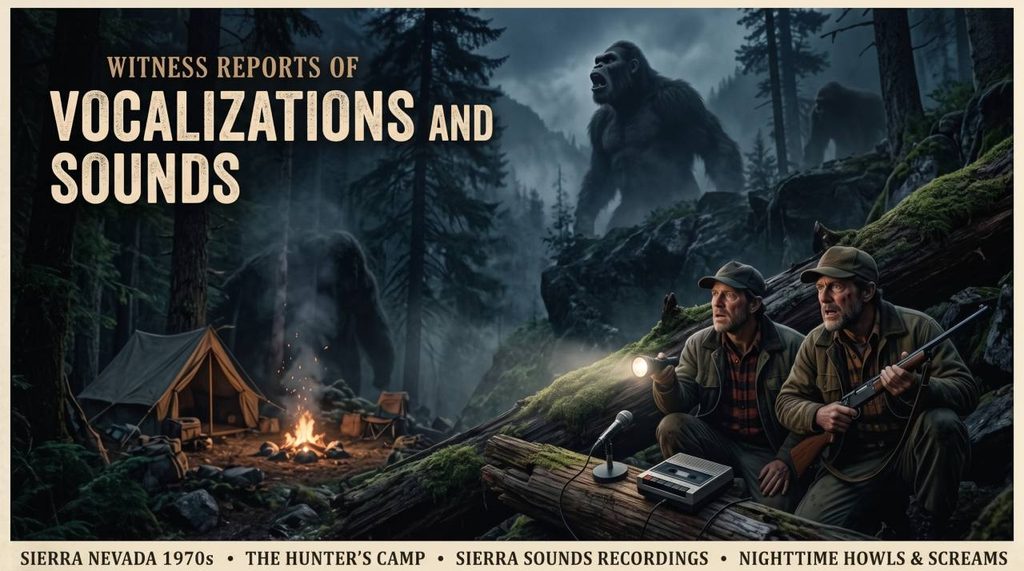
Sightings are only one part of the Bigfoot and Sasquatch phenomenon.
Across decades of reports, witnesses have described hearing strange sounds coming from forests, mountains and remote wilderness areas, sometimes without ever seeing the source.
These accounts range from distant howls and piercing screams to deep growls, rhythmic whoops, whistles, wood knocking and vocalisations that some listeners claim resemble human speech.
For witnesses, these sounds can be among the most unsettling aspects of an encounter.
A strange noise heard in darkness may be difficult to locate, particularly in dense woodland where echoes, terrain and distance can distort the apparent direction of a sound.
Some reports describe isolated calls, while others involve prolonged exchanges in which witnesses believe something is responding to their own noises.
But what are people actually hearing? Could some reports involve known wildlife, human activity or unusual acoustic conditions?
And what should we make of recordings that have become famous within Bigfoot research?
One of the most famous examples is a collection of recordings known as the Sierra Sounds, which has remained under discussion for more than half a century.
The Sierra Sounds — Strange Voices in the California Wilderness
The Sierra Sounds are among the best-known audio recordings associated with Bigfoot research.
The recordings originated during a series of visits to a remote hunting camp in California’s Sierra Nevada mountains in the early 1970s, involving outdoorsman Ron Morehead and investigative reporter Al Berry.
According to their accounts, unusual sounds began coming from the surrounding wilderness during their stays at the camp.
The men described hearing calls from the nearby forest, sometimes accompanied by knocking or pounding sounds.
They also reported exchanges in which the men responded to the noises and sounds appeared to come back from the darkness.
Some of the vocalisations were recorded, preserving material that could later be replayed and examined rather than relying entirely on eyewitness recollections.
The recordings became known as the Sierra Sounds and were subsequently released to the public.
They contain a range of unusual noises, including guttural vocalisations, whistles, grunts, whoops and rapid sequences of sounds that some listeners interpret as resembling speech.
What makes the recordings particularly interesting is their variety. Rather than consisting solely of a single distant howl, some passages contain complex changes in pitch and rhythm.
Certain sequences sound almost conversational to some listeners, although that impression does not establish that the source was speaking a language.
The Sierra Sounds have consequently become a focal point for discussions about whether Bigfoot reports describe an animal capable of producing an unusually broad range of vocalisations.
The ‘Samurai Chatter’
Perhaps the most famous portion of the Sierra Sounds is a rapid sequence of vocalisations commonly nicknamed samurai chatter.
The name reflects the impression some listeners have that the sounds resemble the fast, animated dialogue heard in old Japanese samurai films.
The sequence has attracted considerable attention because it does not sound like a conventional isolated animal call.
To some listeners, it has a speech-like quality, with rapid bursts of sound, shifts in pitch and apparent changes in rhythm. Others hear unusual but potentially human vocalisations whose unfamiliar character encourages listeners to interpret them as something non-human.
One of the people who later examined the recordings was R. Scott Nelson, a retired US Navy cryptologic linguist.
Nelson argued that the sounds contained features consistent with language and concluded that they represented a non-human language. His interpretation has been cited repeatedly in Bigfoot literature and discussions of the recordings.
The original recordings were also discussed in a technical contribution by R. Lynn Kirlin and Lasse Hertel, published in the 1980 volume Manlike Monsters on Trial.
Their work examined estimates of pitch and vocal-tract length from the recorded vocalisations attributed to Bigfoot. The existence of this analysis is significant to the history of the recordings, but it should not be confused with scientific authentication of a Sasquatch source.
Ultimately, the Sierra Sounds present an intriguing collection of audio material, but the identity of the sound source remains unconfirmed.
For a more information on the history of Sierra Sounds and to listen to the recordings yourself, check our dedicated article: The Sierra Sounds: The Strange Bigfoot Audio That Remains Unexplained.
Howls, Screams and Whoops
Beyond the Sierra Sounds, Bigfoot reports describe a wide variety of vocalisations.
Some witnesses report long, drawn-out howls that appear to carry across valleys or through dense forest.
Others describe short, explosive screams, deep growls, guttural grunts or sequences of whooping calls.
These descriptions are not always consistent. A sound described by one witness as a howl may be called a scream by another, and written descriptions rarely preserve enough acoustic information to identify a source reliably.
There are several known animals capable of producing calls that can sound startling or unfamiliar to people who encounter them outside their usual context.
Foxes, deer, owls and other wildlife can produce vocalisations that are surprisingly loud, harsh or human-like.
Coyotes and other canids produce howls, yelps and group calls, while bears can grunt, huff, growl and vocalise when distressed or interacting with other animals.
The sounds of known primates are also worth considering when examining reports of ape-like creatures. Chimpanzees, for example, produce loud pant-hoots and screams, while gibbons are known for their far-carrying calls.
Orangutans produce long calls known as long calls, particularly from adult males, which can travel considerable distances through forest habitat.
These examples do not establish that a particular Bigfoot report was a misidentified animal.
They demonstrate that the natural world contains a wide range of vocalisations, some of which may be unfamiliar to a witness or difficult to identify from a brief encounter.
Without a clear recording, a reliable location and enough contextual information, it can be difficult to distinguish an unknown sound from the calls of known wildlife or other sources.
Wood Knocking and Rhythmic Pounding
Not every sound attributed to Bigfoot is vocal. Another recurring feature of reports is wood knocking: a sharp, percussive sound resembling a branch or wooden object striking a tree trunk.
Some witnesses describe hearing a single loud knock, while others report repeated knocks or exchanges between different locations in the forest. In certain accounts, the sounds are interpreted as deliberate signals, with one knock followed by another from farther away.
The Sierra Sounds include reports of knocking and pounding in the vicinity of the camp, making them relevant to this broader category of alleged behaviour.
In his account of the encounters, Al Berry described sounds of wood or rocks being struck as something approached the camp from a ridge.
However, a knock is not automatically evidence of an animal communicating. Branches can strike trees in the wind, dead wood can crack or fall, and people may deliberately produce knocking sounds.
The acoustic properties of a sound can sometimes help distinguish between these possibilities, but the sound alone may not reveal its source.
Some Bigfoot researchers interpret repeated knocks as a form of communication between individuals. That remains a hypothesis rather than an established behaviour of an unknown species.
To demonstrate communication, investigators would need to establish more than the presence of repeated sounds: they would need evidence that the sounds were deliberately produced and that their timing or pattern reflected a meaningful response.
Whistles, Grunts and Speech-Like Sounds
Other reports describe whistles, low grunts, chattering or vocalisations that witnesses find difficult to compare with familiar animal calls.
Whistles are particularly difficult to interpret from a description alone. Many birds and mammals whistle, while wind and other environmental sounds can sometimes produce tonal effects.
Human-made whistles and calls must also be considered, especially in locations where other people may be present.
Grunts and guttural sounds are equally broad categories. Bears, deer, wild boar and many other mammals can produce low-frequency or harsh vocalisations under particular circumstances. Some sounds may also be distorted by distance, echoes or recording equipment.
The speech-like descriptions are more contentious. In addition to the Sierra Sounds, some Bigfoot reports describe apparent chatter, syllable-like sounds or calls that seem to contain distinct patterns.
Yet human listeners are particularly good at finding familiar patterns in ambiguous sounds. This can make an unfamiliar sequence seem meaningful even when there is insufficient evidence to establish that it contains language.
A convincing demonstration of an unknown animal producing language-like sounds would require careful acoustic analysis, repeatable observations and evidence connecting the sounds to a known source.
Ideally, investigators would also obtain visual or other physical evidence of the animal responsible.
Could the Different Sounds Belong to One Species?
One challenge when comparing Bigfoot vocalisation reports is their sheer diversity. Accounts describe everything from deep roars and long howls to high-pitched screams, whistles, wood knocks and rapid speech-like sequences.
Known animal species can produce several different types of calls, often serving different functions.
However, establishing that a collection of sounds belongs to one species requires more than grouping together noises that witnesses find unusual.
Researchers would need to examine whether recordings share consistent acoustic characteristics, whether those characteristics fall within a plausible biological range, and whether the sounds can be reliably distinguished from those of known animals or humans.
This is especially important because Bigfoot reports come from a vast geographical area and span many decades.
A howl recorded in one region and a speech-like sequence recorded in another should not automatically be assumed to have the same source simply because both have been attributed to Sasquatch.
The Sierra Sounds are valuable to this discussion because they preserve audio that can be revisited and examined.
However, the recordings do not provide independent confirmation that the source was Bigfoot, and their unusual character cannot by itself establish a new species.
What Do the Sounds Actually Tell Us?
Vocalisations are an intriguing part of Bigfoot reports because sound can preserve details that a fleeting visual encounter cannot.
A recording can be replayed, compared and subjected to acoustic analysis, while a witness’s written description may leave considerable room for interpretation.
The Sierra Sounds remain one of the most famous examples, particularly because of their rapid, speech-like passages and the claims made about their possible meaning.
They also illustrate the difference between recording an unusual sound and identifying the animal or person that produced it.
Howls, screams, whoops, whistles and wood knocks continue to feature in Bigfoot reports, but none of these sound categories is exclusive to an unknown primate.
Each individual account needs to be assessed on its own merits, taking into consideration the recording quality, location, environmental conditions, potential wildlife and the reliability of the available testimony.
Until a vocalisation can be reliably connected to an independently identified Bigfoot-like animal, the source remains unconfirmed.
The sounds may be strange, compelling or difficult to explain, but the most useful next step is to establish what produced them rather than assuming the answer in advance.
🦍 Physical Descriptions, Long Arms and Eyeshine
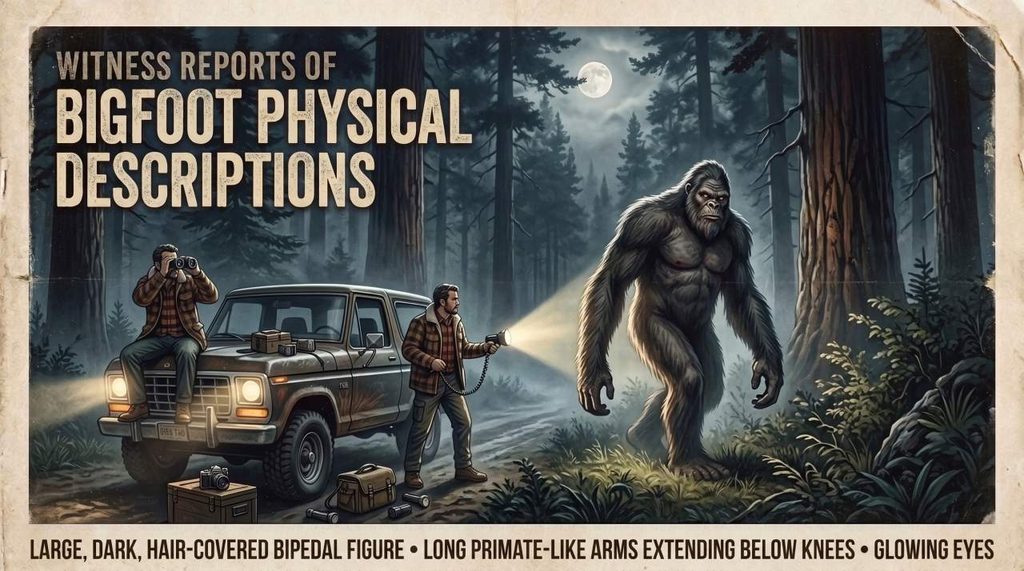
Across Bigfoot and Sasquatch reports, witnesses frequently describe a large, dark, hair-covered figure with a powerful upper body and distinctly ape-like proportions.
Broad shoulders, a large head, a short or seemingly absent neck, and a heavy chest appear in many accounts, although descriptions vary considerably.
Long Primate-Like Arms
One particularly recurring detail is the length of the arms.
Witnesses sometimes describe arms hanging towards or below the knees, giving the figure proportions noticeably different from those of an ordinary human.
In his famous 1955 account, William Roe described an apparent Sasquatch with unusually thick arms reaching almost to its knees.
Similar descriptions appear in other reports, including accounts of figures seen crossing roads or moving through woodland.
The reports also vary in height, build and apparent gait. Some describe immense, muscular figures, while others portray tall but comparatively slender animals.
These differences could reflect variation between witnesses, viewing conditions and misidentification, rather than necessarily indicating multiple types of creature.

👁️ Eyeshine and Unusual Eye Colours
Another striking feature in Bigfoot reports is the apparent reflection or glow of the eyes in darkness.
Witnesses have described red, orange, yellow, green and other colours, sometimes claiming that a pair of bright points remained visible even when the surrounding figure was difficult to distinguish.
There is an important distinction here: eyes reflecting light are not the same as eyes producing their own light.
Many animals possess a reflective layer behind the retina called the tapetum lucidum, which returns light through the eye and can make the eyes appear to shine when illuminated by headlights or a flashlight.
The colour and brightness can vary with the species, lighting and viewing angle. Red eyeshine, for example, can occur in known wildlife, including opossums and some birds.
Humans do not possess a tapetum lucidum, and the great apes do not have this typical reflective layer either.
If Sasquatch were a previously unknown great ape, reports of vivid eyeshine would therefore raise an interesting anatomical question, but eyewitness descriptions alone cannot establish what caused the effect.
Some reports may involve ordinary animal eyeshine, while others could be influenced by distance, darkness, reflected light or mistaken observations.
Ultimately, long arms, broad shoulders, dark hair and unusual eyeshine form a recognisable pattern within Bigfoot folklore.
They are useful details to compare across reports, but without a confirmed specimen or reliable physical evidence, they remain descriptions of alleged encounters rather than established characteristics of an unknown species.
🌲 Tree Structures and Alleged Nesting Sites
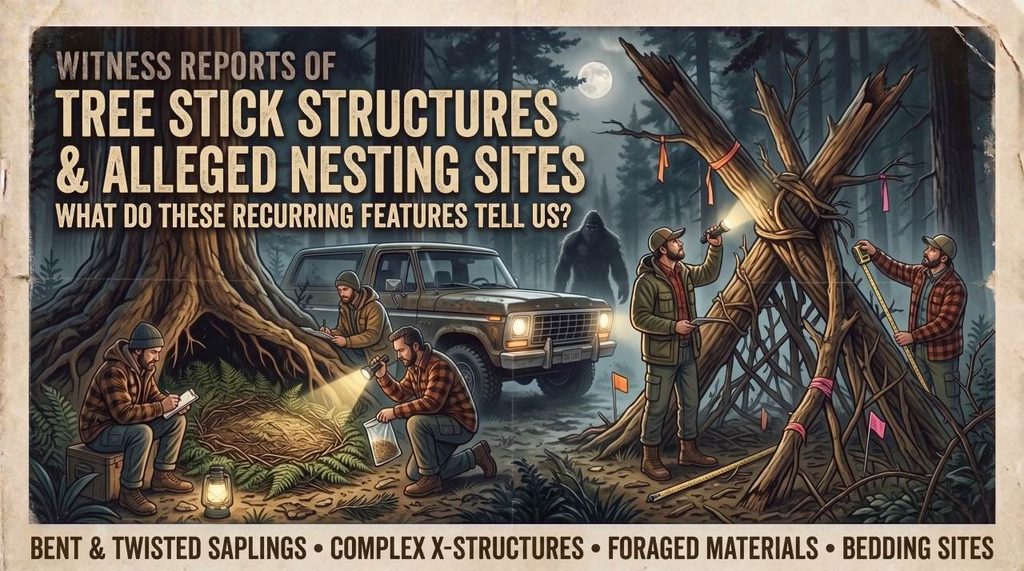
In recent years, photographs of unusual arrangements of branches and saplings have circulated widely within Bigfoot communities.
Often described as tree structures, these formations may involve bent trees, interwoven branches, snapped limbs or small, teepee-like arrangements of sticks.
Some enthusiasts interpret them as possible shelters, nesting sites or markers created by Sasquatch.
However, the existence of an unusual structure does not establish its origin.
Wind, snow, falling trees, human interference and other natural processes can produce confusing arrangements of vegetation, while people can deliberately construct similar formations. Even where a structure appears intentional, determining who or what built it requires additional evidence.
The nesting-site hypothesis raises further questions.
If an undiscovered primate regularly constructed shelters or nests, researchers would want to establish consistent construction patterns, document fresh examples forming, and look for supporting evidence such as identifiable hair, DNA, footprints or clear camera footage of the builder.
A photograph of intertwined branches alone cannot demonstrate that a nest was used by an unknown animal.
Tree structures remain an interesting feature of modern Bigfoot investigations, but their interpretation should follow the evidence rather than precede it.
Until a structure can be reliably linked to its maker, it is best regarded as an unexplained or unusual arrangement of vegetation, not proof of Sasquatch activity.
What Do These Recurring Features Tell Us?
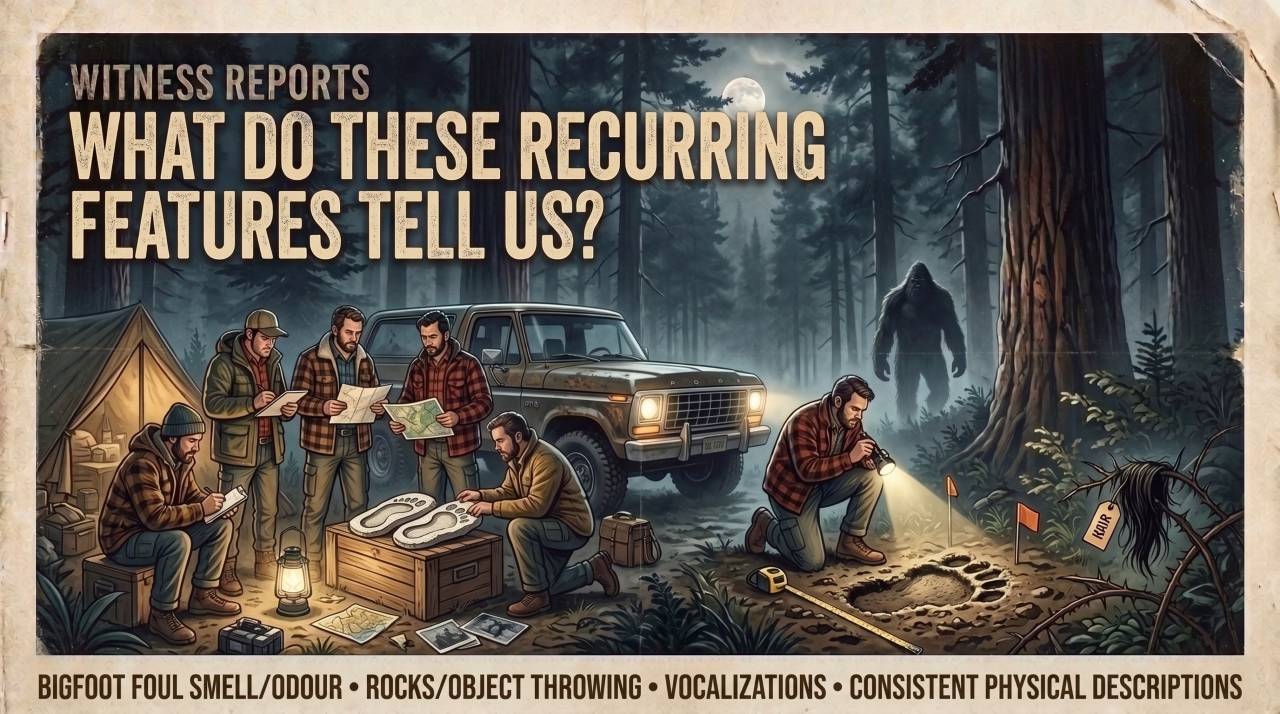
Across decades of Bigfoot and Sasquatch reports, certain details appear repeatedly: unusually long arms, broad shoulders, dark hair, foul odours, strange vocalisations, rocks allegedly thrown from the darkness, and encounters occurring at night.
These similarities are intriguing, particularly when comparing accounts from different regions and periods.
However, the reports also vary in important ways, including the creature’s height, build, colouring, behaviour and apparent abilities.
One question is whether these recurring descriptions reflect observations of the same unidentified animal, or whether they have been shaped partly by folklore, popular culture, expectations and the limitations of human perception.
Bigfoot has become a familiar figure in books, television, films and online discussions, meaning that later witnesses may already have an image of the creature in mind.
This does not mean every witness is mistaken or dishonest, but it does make it difficult to establish how independent apparently similar descriptions really are.
Research examining Bigfoot reports has also considered whether shared expectations could influence how witnesses interpret ambiguous encounters.
Eyewitness testimony can provide valuable starting points for investigation, but even sincere observations are vulnerable to errors of distance, lighting, memory and identification.
A fleeting silhouette in woodland, an unfamiliar animal call or a pair of reflective eyes in darkness may leave a powerful impression without providing enough information to identify its source confidently.
Ultimately, recurring features help us understand how Bigfoot encounters are described and how the legend has developed.
They do not, by themselves, demonstrate that an undiscovered primate exists. Stronger evidence would require independently verifiable physical material, reliable documentation and findings that can withstand scientific examination.
The mystery remains compelling precisely because there is a difference between a pattern worth investigating and a conclusion the evidence can support.
For Bigfoot and Sasquatch, that distinction remains essential.