Bigfoot and Bears: Does the Science Explain the Sightings?
For decades, reports of Bigfoot have fuelled one of North America’s most enduring cryptozoological mysteries.
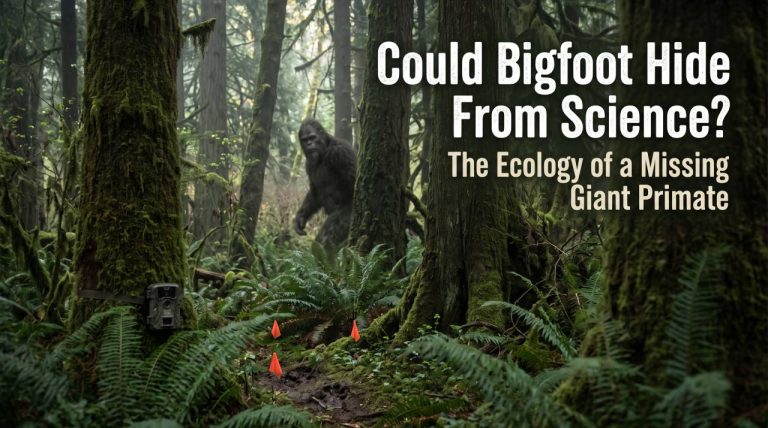
From the dense forests of the Pacific Northwest to the remote wilderness of Alaska, witnesses have described encounters with enormous, hairy, bipedal figures lurking among the trees.
But could at least some of these encounters have a much more familiar explanation?
The American black bear is a widespread and adaptable animal, capable of appearing surprisingly large under the right conditions.
In poor visibility, at a distance, or during a fleeting encounter in thick woodland, could a bear be mistaken for something far more mysterious?
And if misidentification plays a role in Bigfoot reports, might we expect those reports to reflect the distribution of bears across North America?
In a 2024 paper published in the Journal of Zoology, researcher Floe Foxon investigated precisely this possibility.
In Bigfoot: If it’s there, could it be a bear?, Foxon analysed the relationship between reported Sasquatch sightings and estimated black bear populations across the United States and Canada, while accounting for factors including human population and forest area.
The study found a statistically significant association between bear abundance and reported sightings, providing a scientific basis for examining the bear hypothesis.
Yet an intriguing question remains. California has hundreds of entries in the Bigfoot Field Researchers Organization’s (BFRO) sighting database, while Alaska has comparatively few.
This apparent disparity becomes particularly interesting when we consider Alaska’s enormous bear population and its comparatively small human population.
If bears contribute to Bigfoot reports, should a region with so many bears not produce more sightings?
Or could the number of people living in an area, their access to wilderness, and their opportunities to encounter wildlife help explain the difference?
Here at Cryptid Legends, we believe the evidence should dictate the conclusion.
In this investigation, we’ll examine Foxon’s research, compare the reported sightings and estimated populations of California and Alaska, and explore what the numbers can, and cannot, tell us about one of cryptozoology’s most persistent mysteries.
Because a statistical relationship may offer a compelling explanation, but understanding what it really means requires us to look beyond the headline figures.
The Bear in the Bigfoot Debate
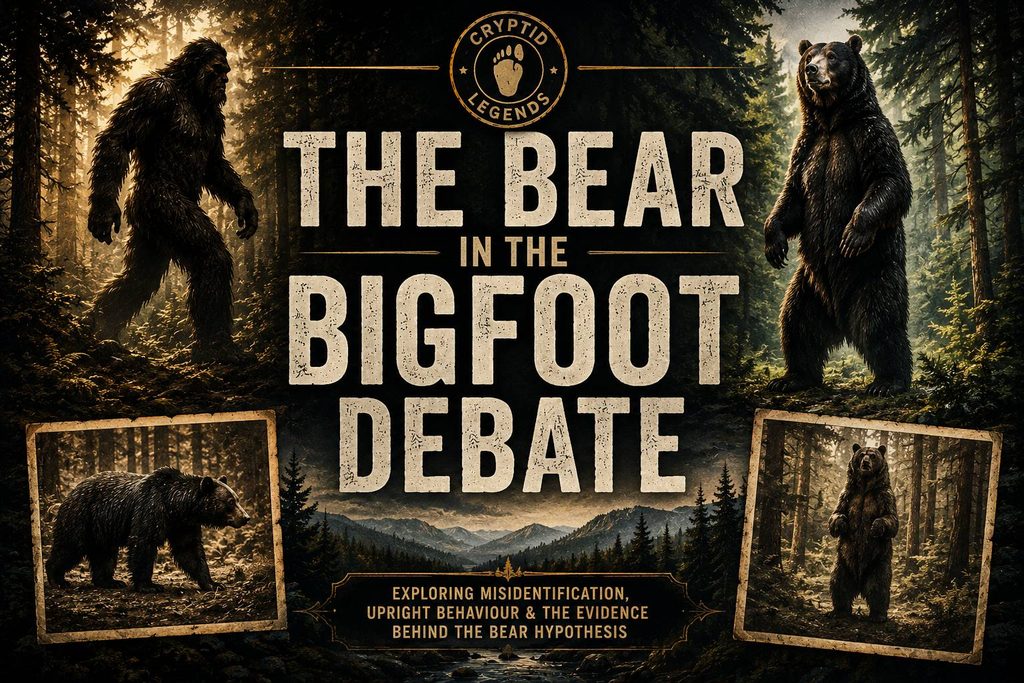
Before comparing California and Alaska, we need to examine why bears have become one of the most plausible candidates for misidentifications in the Bigfoot debate.
The argument is not simply that bears inhabit the same wilderness where sightings occur.
It is that their anatomy, behaviour and appearance could, under certain circumstances, produce an encounter that an observer might interpret very differently from what was actually there.
The American black bear (Ursus americanus) is widespread across much of North America, inhabiting forests, mountains and other environments associated with numerous Bigfoot reports.
Its thick coat, powerful build and ability to move through dense vegetation make it an obvious candidate to consider when investigating reports of large, dark, hairy figures.
But one particular aspect of bear behaviour deserves closer attention: their ability to stand and move on two legs.
Bears on Two Legs: A Potential Source of Misidentification
Bears are facultative bipeds.
In simple terms, this means they are normally quadrupedal animals, moving on all four limbs, but can adopt a bipedal posture and, for short periods, take steps while standing on their hind legs.
Unlike humans, they are not adapted for habitual upright walking, and this behaviour should not be confused with the sustained, efficient bipedal locomotion of a human.
Nevertheless, the ability to rise upright creates an interesting problem for eyewitness identification.
A black bear standing on its hind legs can present a markedly different silhouette from the familiar image of a bear moving on all fours.
Its body becomes taller, its forelimbs are raised or held away from the ground, and its broad torso may be partially obscured by vegetation. At a distance, these features could potentially contribute to the impression of a large, upright figure.
The circumstances of an encounter could make that distinction harder still. Imagine seeing a dark shape between trees for only a few seconds, with the animal partly concealed by undergrowth and the light fading.
Without a clear view of its head, limbs, proportions or movement, an observer may have limited information with which to identify it.
If the animal is standing upright, the familiar outline of a bear may be less immediately apparent.
There is, however, an important qualification. Standing upright and walking upright are not the same thing.
Bears frequently rise onto their hind legs to investigate their surroundings, and they can take steps in that position, but they do not ordinarily travel through the landscape as sustained, habitual bipeds.
A clear, prolonged observation of an animal walking steadily on two legs would therefore require closer examination than a fleeting glimpse of an upright silhouette.
This distinction is central to the Bigfoot debate. A report describing a dark, upright figure seen briefly through woodland presents a different identification problem from a detailed observation in which the witness can clearly describe the animal’s gait, anatomy and behaviour.
The quality of the observation matters just as much as the description itself.
A Plausible Explanation Is Not a Proven Explanation
The bear hypothesis should not be stretched beyond what the evidence supports.
The fact that bears can stand upright does not establish that any particular Bigfoot witness saw one, nor does it demonstrate that bear misidentification accounts for most reports.
Different sightings may have different explanations, and some accounts may be too vague or incomplete to assess reliably.
Witness sincerity is also a separate issue from identification accuracy. A person can genuinely believe they encountered an unknown animal while having misinterpreted a familiar one under difficult viewing conditions.
Conversely, the possibility of misidentification should not be used as a substitute for examining the details of an individual report.
This is where a broader scientific approach becomes useful. Rather than attempting to settle the question through selected anecdotes, researcher Floe Foxon examined whether reported Sasquatch sightings showed a statistical relationship with estimated American black bear populations across the United States and Canada, while accounting for factors including human population and forest area.
If bear misidentification contributes to the reports, we might expect bear abundance to be associated with sighting frequency.
But whether that pattern appears in the data, and how much it can tell us about individual encounters, is the next question we need to investigate.
What Does the Scientific Research Actually Say?
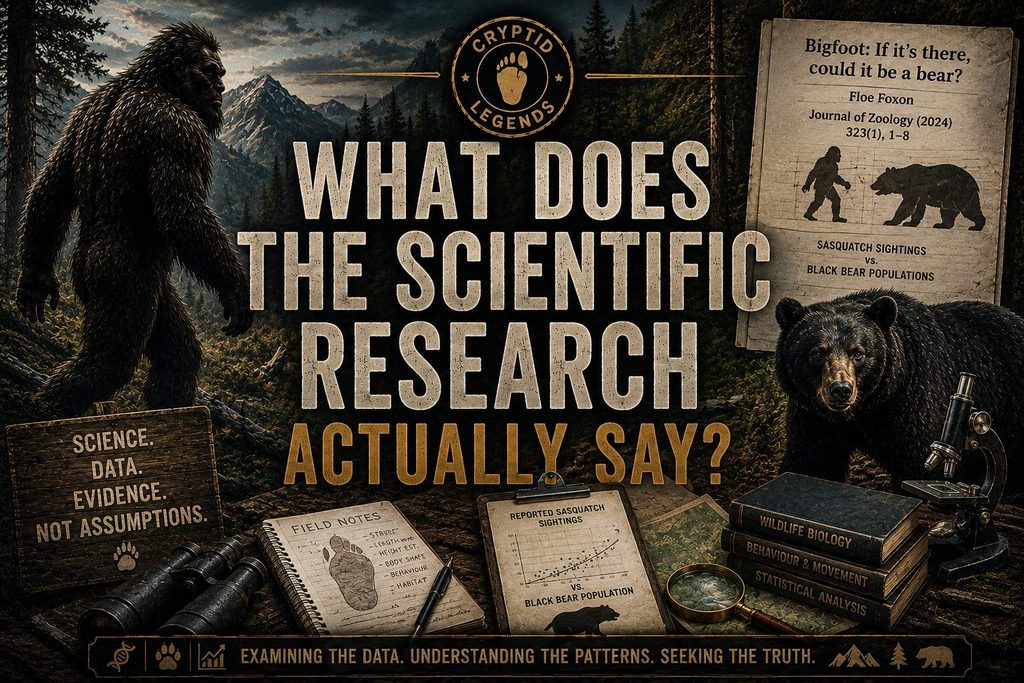
The idea that bears could account for some Bigfoot sightings is not simply speculation based on their appearance.
It has also been examined using statistical methods to investigate whether reported sightings follow patterns that might be expected if bear encounters contribute to the reports.
In 2024, researcher Floe Foxon published a paper in the Journal of Zoology titled Bigfoot: If it’s there, could it be a bear?
The study expanded on earlier work by examining reported Sasquatch sightings across the United States and Canadian provinces in relation to estimated American black bear populations.
Rather than looking at bear numbers alone, Foxon also accounted for two other important factors: human population and forest area.
These matter because the number of reports an area generates may depend not only on the animals living there, but also on how many people are present to encounter wildlife and how much suitable habitat exists.
What Did the Study Find?
Foxon reported a statistically significant association between estimated black bear abundance and reported Sasquatch sightings.
In the fitted model, every additional 1,000 bears was associated, on average, with an approximately 4% increase in reported sightings, with a 95% confidence interval of 1–7%.
The study also estimated that, across the states and provinces examined using data from 2006, there were approximately 5,000 black bears for every reported Sasquatch sighting after accounting for human population and forest area.
These figures are worth examining carefully. The 4% result describes the relationship estimated by the statistical model; it does not mean that every additional 1,000 bears will always produce exactly 4% more reports.
Likewise, the estimate of 5,000 bears per reported sighting is a model-based relationship, not a biological ratio demonstrating that one Bigfoot encounter occurs for every 5,000 bears.
Most importantly, the study did not establish that the witnesses had actually seen bears.
It examined patterns in reported sightings and their relationship with estimated bear populations.
A statistical association is consistent with the possibility that bear encounters contribute to Bigfoot reports, but it cannot identify the animal involved in an individual encounter or prove that bear abundance causes the reports.
Why the Other Variables Matter
Human population is an obvious consideration. An area with more people may generate more reports simply because more potential witnesses are present.
Forest area matters too, although forest coverage alone cannot tell us how many people actually visit remote woodland or how often they encounter bears.
Other influences may also affect the number of reports recorded: access to wilderness, tourism, outdoor recreation, local interest in Bigfoot, willingness to report an experience and the coverage of the database being examined.
These factors are not interchangeable, and a model that accounts for some variables cannot automatically eliminate every possible source of bias.
There is also an important distinction between a reported sighting and a verified animal encounter.
A database entry documents that a report was submitted; it does not independently confirm the identity of the creature described.
The number of entries therefore cannot be treated as a direct count of actual Bigfoot, bear or even independently verified wildlife encounters.
What This Means for Our Investigation
Foxon’s research provides a scientific reason to take the bear hypothesis seriously as a possible explanation for at least some reports.
The association between bear abundance and reported sightings is consistent with that possibility, but it does not settle the wider question of what witnesses have encountered.
This is where the comparison between California and Alaska becomes particularly interesting. California has a much larger human population and substantially more entries in the BFRO database.
Alaska, meanwhile, has a far smaller population but supports large numbers of bears across an enormous wilderness landscape.
If human population, bear abundance and habitat all help shape reported sightings, how should we interpret such different numbers between these two states?
And does Alaska’s comparatively low number of recorded reports challenge the bear hypothesis, or does it reveal just how complicated these comparisons can be?
California: More People, More Sightings?

California is an interesting place to begin our comparison.
It combines a huge human population with extensive areas of forest, mountain wilderness and habitat occupied by American black bears.
It also has one of the largest collections of reported Bigfoot encounters in the BFRO’s state-by-state database.
But do the numbers support the idea that bears could account for some of those reports?
To explore that question, we first need to establish what we know about California’s population, its bears and the sightings recorded there.
The Numbers Behind California
According to the US Census Bureau, California had an estimated 39.4 million residents in July 2025, making it the most populous US state.
The California Department of Fish and Wildlife (CDFW) estimates that approximately 60,000 black bears live within the state.
Unlike Alaska, California is currently home to just one bear species: the American black bear.
The grizzly bear, or California’s population of brown bears, disappeared from the state, with the last documented sighting in 1924.
The BFRO’s online database lists approximately 470 California reports.
Its main state index currently gives a total of 471, while the individual California listing displays 468, illustrating why database figures should be treated as a dated snapshot rather than a fixed total.
These are submitted reports, not independently verified encounters with an unknown animal.
Taken together, these figures establish the scale of the question: tens of millions of residents, tens of thousands of black bears and hundreds of recorded Bigfoot reports.
But the relationship between those numbers is not as straightforward as it might initially appear.
More People, More Opportunities for Reports?
California’s enormous population offers one possible explanation for its high number of reports.
More residents potentially means more people travelling through forests, camping, hiking, hunting, working outdoors or driving along roads bordering wildlife habitat.
Each activity creates opportunities to encounter animals, and, occasionally, to misidentify them.
However, the total population of a state is not the same as the number of people who regularly enter bear habitat.
Millions of Californians live in densely populated urban areas, while others spend considerable time in rural or mountainous regions.
For understanding wildlife encounters, where people go and what they do may be more informative than the state’s overall population alone.
California’s black bears also occupy a range of environments, including natural, rural and residential areas.
Their presence is not restricted to remote wilderness. This creates opportunities for encounters across different settings, although the circumstances of an encounter will affect how easily an animal can be identified.
Reporting behaviour introduces another complication. A person who believes they have seen Bigfoot may submit a report, tell friends, post online or never mention the experience again.
Awareness of the subject, familiarity with the BFRO and willingness to report an unusual encounter can all influence how many accounts enter a database.
These are plausible influences, but the totals alone do not tell us how large their effects are.
Could Some California Reports Be Bears?
The bear hypothesis is biologically plausible in at least some circumstances.
California has a substantial black bear population, and a bear briefly glimpsed through vegetation, seen in poor light or standing upright could be misidentified by an observer who does not get a clear view.
Yet the existence of 60,000 bears does not tell us how many people encounter them, how often those encounters result in mistaken identities, or how many Bigfoot reports could reasonably be attributed to them.
We would need detailed information about individual reports, viewing conditions, location, behaviour and any available supporting evidence to assess that question properly.
Nor should we assume that every report describes the same kind of encounter.
A fleeting silhouette at the edge of a forest presents a very different identification problem from a prolonged observation in good daylight.
Treating all reports as equivalent would overlook precisely the details needed to distinguish plausible misidentifications from accounts that are harder to explain.
California therefore gives us a setting in which both explanations and reporting opportunities are abundant.
Its large human population may help explain why so many reports have accumulated, while its black bears provide a plausible candidate for at least some encounters.
But the state-level figures cannot establish how many reports, if any particular ones, were caused by bear misidentification.
And this is where Alaska becomes especially interesting.
If California’s high report count partly reflects its large human population, what should we make of a state with far fewer residents, enormous wilderness areas and a much larger bear population than California?
Alaska: Where Are All the Reports?
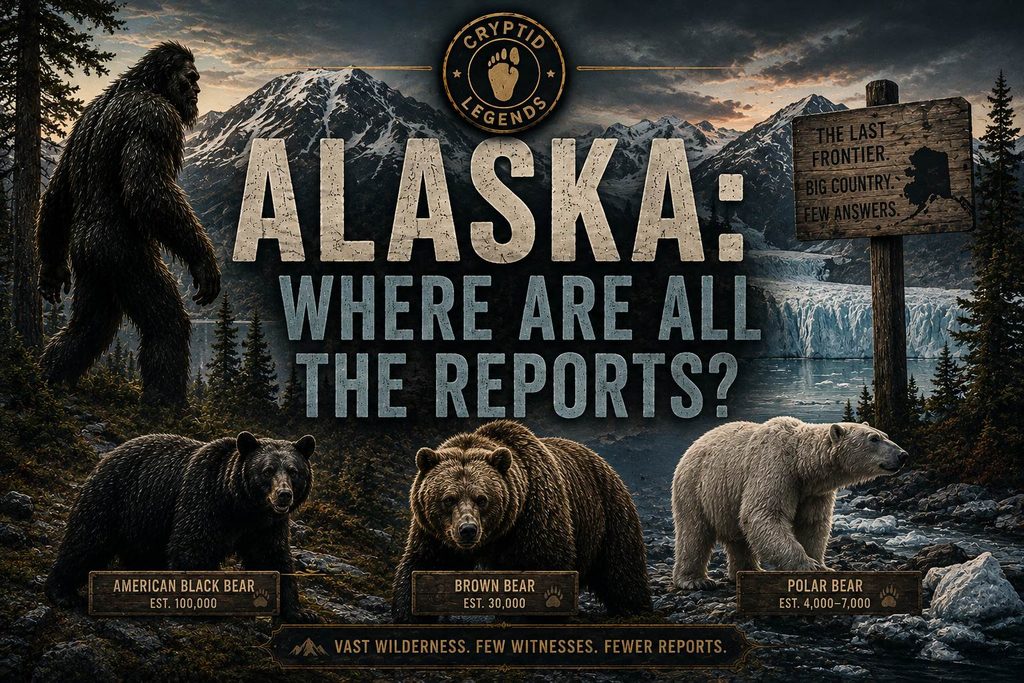
If California provides us with a state where a huge human population overlaps with a substantial black bear population, Alaska presents a very different picture.
It is one of North America’s great wilderness regions, home to large populations of bears and vast areas of sparsely inhabited terrain.
Yet the number of Bigfoot reports listed in the BFRO database is dramatically lower than California’s.
At first glance, this seems like a challenge for the bear hypothesis.
If bears contribute to Bigfoot misidentifications, and Alaska has so many bears, why does it have so few recorded reports?
The answer may be more complicated than simply counting people, bears and sightings.
The Numbers Behind Alaska
The US Census Bureau estimated Alaska’s population at 737,270 in July 2025 — fewer than three-quarters of a million people across an enormous state.
Alaska is also home to substantial bear populations. The Alaska Department of Fish and Game estimates approximately 100,000 American black bears live in the state.
An official statement from the Governor of Alaska gives an estimate of around 30,000 brown bears, alongside an estimated 4,000–7,000 polar bears.
These are estimates rather than precise statewide headcounts, and bear populations vary by region.
The BFRO database, by contrast, lists just 22 Alaska reports.
Its state listing includes reports from several parts of Alaska, with the most recent report listed as a May 2022 daylight sighting near Valdez-Chitina-Whittier.
The contrast with California is substantial:
- California: approximately 39.4 million people, 60,000 black bears and around 470 BFRO listings.
- Alaska: approximately 737,000 people, 100,000 black bears and 22 BFRO listings.
California has roughly 53 times Alaska’s human population, yet Alaska has a larger estimated black bear population.
It also has brown bears, which are absent from California today. Nevertheless, the BFRO database contains more than twenty times as many California listings.
That is an intriguing difference. But before treating it as evidence for or against the bear hypothesis, we need to consider what makes Alaska different.
A Vast Wilderness Does Not Mean More Human Encounters
Alaska’s immense wilderness might seem to offer ideal conditions for an undiscovered large animal to remain unnoticed.
However, large areas of wilderness do not automatically translate into large numbers of human–wildlife encounters.
Much of Alaska is remote, difficult to access or far from major population centres.
Its residents are unevenly distributed, and the number of people who regularly visit particular bear habitats is much smaller than the state’s total area might suggest.
Weather, terrain, seasonal conditions, transport and the practical difficulties of travelling through remote landscapes all affect where people can go and what they are likely to encounter.
This creates an important distinction between wildlife abundance and opportunities for eyewitness reports.
A region can support many bears while still having relatively few people passing through particular areas.
Even when people do encounter bears, most encounters will not necessarily result in a mistaken identification, much less a report to a Bigfoot organisation.
California has its own extensive wilderness, of course, but its much larger population creates a different pattern of human activity.
More residents, visitors and outdoor recreationists may mean more opportunities for encounters to occur and be reported.
The extent to which that explains the difference between these states, however, cannot be determined from population totals alone.
Alaska’s Bears Are Not All the Same
There is another complication when we compare the two states: the species involved.
Foxon’s 2024 study specifically examined estimated American black bear populations in relation to reported Sasquatch sightings. It did not simply count every bear species as equivalent.
Alaska’s black bears therefore provide the most directly relevant comparison with the study, while its brown bears introduce an additional biological consideration.
Brown bears can be considerably larger and have different body proportions from black bears.
Their appearance and behaviour may influence how a witness interprets a fleeting encounter, but we cannot assume that brown bears produce the same reporting pattern as black bears.
Nor should polar bears be added indiscriminately to a comparison of forest-dwelling animals: they inhabit a very different ecological setting.
Alaska’s impressive total bear population therefore does not directly translate into a prediction about Bigfoot reports.
To make that prediction properly, we would need to consider species, habitat, human activity, opportunities for encounters and the likelihood that an encounter would be reported.
Does the Low Number of Reports Challenge the Bear Hypothesis?
It certainly raises a worthwhile question. If bear abundance is associated with reported Bigfoot sightings, as Foxon’s model found across the United States and Canada, why does Alaska have so few entries compared with California?
But this comparison is not a direct test of Foxon’s statistical model. The study examined historical data from 2006 and accounted for human population and forest area.
Our state comparison uses more recent population and bear estimates alongside current cumulative BFRO database listings. Those figures cover different time periods and are not directly interchangeable.
Furthermore, the BFRO database records submitted reports, not every wildlife encounter or every claim made about Bigfoot.
Its totals can reflect reporting practices and database coverage as well as the underlying frequency of encounters.
A low number of listings does not, by itself, establish that people rarely see unusual animals in Alaska; equally, a high number does not establish that a particular animal was misidentified.
Alaska’s figures therefore do not automatically disprove the bear hypothesis. Instead, they highlight the need to understand how human presence, habitat, wildlife distribution and reporting behaviour interact.
The bear hypothesis remains a plausible explanation for some encounters, but the contrast between these states cannot tell us how many reports it explains.
And that brings us to the central question of our investigation: when California and Alaska are placed side by side, what can the numbers genuinely tell us, and where do the conclusions go beyond the evidence?
What Does the California–Alaska Comparison Actually Tell Us?
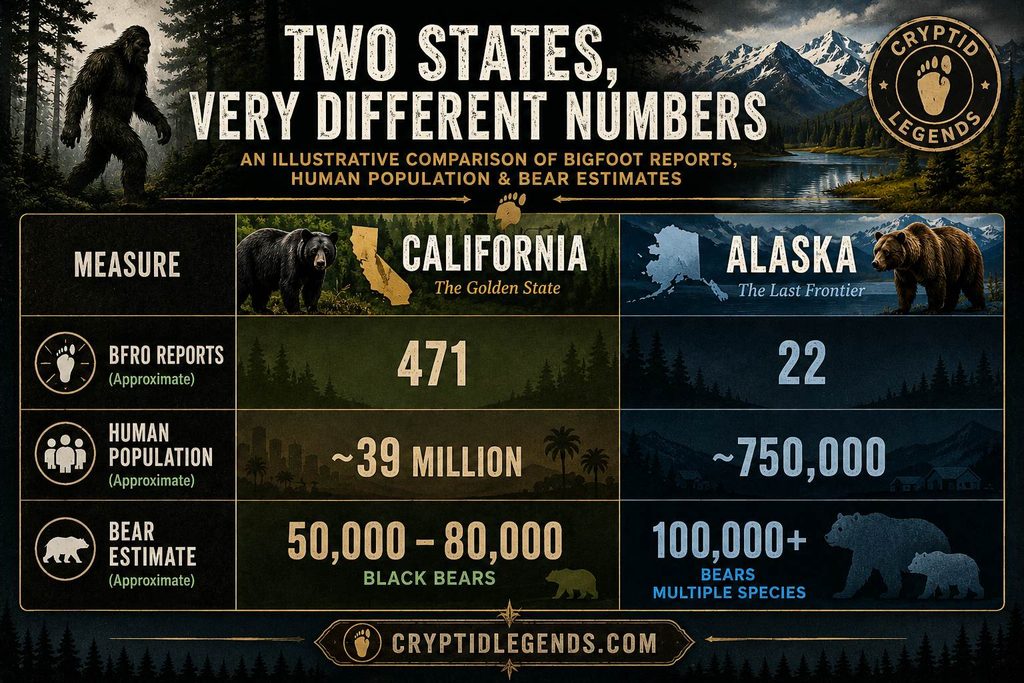
We now have two states with very different populations, landscapes and bear populations, and a striking difference in the number of Bigfoot reports recorded by the BFRO.
But when we put the figures side by side, the results are more complicated than the simple argument that more people produce more sightings, or that more bears should produce more misidentifications.
The comparison is useful precisely because it forces us to examine those assumptions.
The Numbers Side by Side
Using the approximate figures established in the previous sections, we can summarise the contrast:
| Measure | California | Alaska |
|---|---|---|
| Human population (2025 estimate) | 39.4 million | 737,270 |
| Estimated black bears | Around 60,000* | Around 100,000 |
| BFRO database entries | Approximately 470 | 22 |
*California’s Department of Fish and Wildlife gives a current estimated range of 49,000–71,000 black bears, with 60,000 used here as a rounded central estimate. The BFRO counts are database snapshots, not verified animal encounters.
At first glance, the bear figures seem to complicate the picture. Alaska has a larger estimated black bear population despite having fewer than one-fiftieth of California’s residents.
Yet California has more than twenty times as many BFRO listings.
If bear abundance were the only factor determining reported Bigfoot sightings, we might expect Alaska’s much larger black bear population to produce a very different result.
But bear abundance is not the only factor, and the total number of residents is not a perfect measure of how many people encounter bears.
Does the Human Population Explain the Difference?
California has approximately 53 times Alaska’s population, while its BFRO report count is roughly 21 times higher.
This is an important distinction: the difference in recorded reports is smaller than the difference in population.
To illustrate this, we can divide the number of database entries by the number of residents.
Using the rounded figures above, California has approximately 12 BFRO entries per million residents, compared with around 30 per million in Alaska.
In other words, Alaska has more recorded entries per resident in this crude comparison. That does not mean an Alaskan is more likely to encounter Bigfoot.
The calculation simply divides accumulated reports by the entire state population; it does not account for how long people spend outdoors, where they travel, the time period covered by the reports or their likelihood of submitting an account.
Nevertheless, the result shows why population alone cannot explain everything. If reports increased in direct proportion to the number of residents, we would expect California’s total to be closer to 53 times Alaska’s. Instead, it is around 21 times higher.
That difference raises questions about reporting patterns, outdoor activity, access to wilderness and other influences. It does not, by itself, tell us which factor matters most.
Shouldn’t Alaska’s Bears Offset Its Smaller Population?
This is the central question behind our comparison. Alaska has an estimated 100,000 black bears, compared with California’s estimated 60,000.
If more bears mean more opportunities for misidentification, shouldn’t Alaska’s larger bear population help compensate for its much smaller human population?
Not necessarily.
First, bears cannot generate eyewitness reports without people being present to see them.
A large bear population spread across remote or sparsely populated territory may produce fewer opportunities for human encounters than a smaller population living closer to roads, settlements and heavily visited recreational areas.
Second, statewide bear estimates do not tell us how many bears overlap with people in the places and circumstances where Bigfoot reports occur.
The distribution of bears, their local density, habitat, seasonal movements and human access all matter.
Two states can have similar or even reversed population totals without offering equivalent opportunities for sightings.
Third, an encounter with a bear does not automatically become a Bigfoot report.
Many people identify bears correctly; others may see only a fleeting silhouette, while some encounters may never be reported at all. The number of reports depends on more than the number of animals present.
Finally, Alaska has brown bears as well as black bears, whereas California’s current bear population consists of black bears.
That makes Alaska’s overall bear abundance an interesting part of the comparison, but we should not simply add every bear species together and treat the resulting total as interchangeable with the black bear population used in Foxon’s study.
The crucial point is that bear abundance and reported sightings are separated by several steps: people must encounter animals, interpret what they see, decide to report it, and have that report recorded in the database.
Our state-level figures do not measure each of those steps.
Does This Contradict Foxon’s Study?
Not directly.
In his 2024 paper, Bigfoot: If it’s there, could it be a bear?, Floe Foxon found a statistically significant association between estimated black bear populations and reported Sasquatch sightings across US states and Canadian provinces.
His model also accounted for human population and forest area. On average, the model associated each additional 1,000 black bears with a 4% increase in reported sightings.
That finding supports the idea that bear abundance may help explain the geographical pattern of Bigfoot reports.
It does not mean every state must follow a simple bear-to-report ratio, or that bear numbers alone can predict the number of reports in any particular location.
There is also a limitation in comparing the study directly with our figures. Foxon’s analysis used historical data from 2006, whereas our comparison uses more recent population estimates and current cumulative BFRO listings.
These are not matched datasets, so we cannot use our California–Alaska figures to reproduce or disprove his model.
To make a stronger comparison, we would need compatible data from the same period, consistent definitions of a report, comparable estimates of bear populations and suitable measures of human presence and habitat.
We would also need to consider whether differences in reporting behaviour affect the database totals.
What Remains Unexplained?
The comparison leaves us with several reasonable conclusions, but no definitive answer.
California’s much larger human population may help explain why it has accumulated many more reports. Alaska’s larger black bear population makes it an interesting test case for the bear hypothesis, but its enormous size and sparse population complicate any simple prediction about how often people should encounter wildlife.
Alaska’s higher number of reports per resident is also worth noting, but it cannot be interpreted as evidence of a higher encounter rate without better information about exposure to wildlife and reporting behaviour.
Most importantly, neither state’s database total tells us how many reports describe misidentified bears.
To establish that, researchers would need to assess individual accounts and compare the details with what is known about bear anatomy, behaviour, habitat and movement.
The California–Alaska comparison does not prove that bears explain Bigfoot reports, but neither does it overturn the bear hypothesis.
Instead, it illustrates why broad statistical patterns and individual eyewitness accounts need to be examined separately.
The bear hypothesis remains a plausible explanation for at least some reports.
The next question is how far that explanation can reasonably take us, and what evidence would be needed to distinguish a likely misidentification from an encounter that remains unresolved.
Conclusion: An Explanation Worth Investigating
The comparison between California and Alaska began with an intriguing question: if bears contribute to Bigfoot sightings, why does a state with such a large bear population have so few reports compared with a state with a much larger human population?
After examining the figures, the answer is not as straightforward as either side of the debate might prefer.
California’s much larger population offers a plausible reason for its greater number of recorded reports.
More people may mean more opportunities for wildlife encounters, more potential witnesses and more accounts submitted to organisations such as the BFRO.
Alaska, meanwhile, has an estimated black bear population larger than California’s, but its vast territory and much smaller population complicate any attempt to predict how many encounters should be reported.
Neither state’s figures can tell us how many witnesses mistook bears for Bigfoot.
They do, however, demonstrate why human population, wildlife abundance, habitat and reporting behaviour must all be considered when interpreting sighting databases.
Floe Foxon’s 2024 study adds an important scientific dimension to this discussion.
Its finding of a statistically significant association between black bear abundance and reported Sasquatch sightings is consistent with the possibility that bears account for some reports.
But an association is not proof that a particular sighting involved a bear, nor does it establish that every report can be explained by misidentification.
What Evidence Would Help Settle the Question?
Progress depends on moving beyond the number of reports and examining their quality.
Several kinds of evidence could help researchers distinguish plausible bear misidentifications from encounters that remain unresolved.
Detailed eyewitness accounts: Reports should be assessed according to the quality of the observation, including viewing distance, lighting, duration, obstructions and whether the animal’s movement was seen clearly.
A fleeting glimpse of an upright silhouette is much harder to interpret than a prolonged observation in good conditions.
Anatomy and locomotion: Descriptions of body proportions, limb length, head shape and gait can be compared with the known anatomy and behaviour of bears and other animals.
A bear standing on its hind legs is biologically plausible; a detailed account of sustained bipedal walking would require a more careful assessment of the observed movement and the reliability of the description.
Geographical and ecological data: Researchers could compare reports with bear distributions, habitat, seasonal movements, human activity and access to wilderness.
Ideally, the analysis would use data from matching time periods and distinguish black bears from other species rather than treating all bears as equivalent.
Reliable physical evidence: Well-documented photographs and video, verified tracks, biological samples and other physical evidence could help assess individual claims.
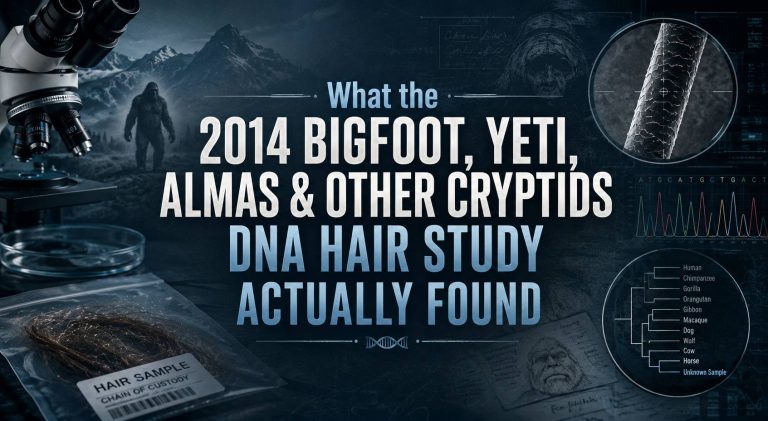
Such material would need reliable provenance and appropriate testing. DNA results, for example, would require contamination controls and independent verification; an unidentified or inconclusive sample would not automatically establish the existence of an unknown primate.
Systematic reporting data: A stronger study would also examine how reports are collected and recorded, rather than assuming that database entries reflect all encounters equally.
Consistent definitions, transparent methods and reproducible analyses would make comparisons between states and over time more meaningful.
None of these approaches guarantees that every report will receive a definitive explanation. Some accounts may remain too vague or lack the evidence needed for a reliable conclusion.
That uncertainty should be acknowledged rather than filled with speculation.
An Open Question, Guided by Evidence
So, does the science explain Bigfoot sightings?
The evidence examined here supports a cautious answer: bears are a credible candidate for at least some reported encounters, and the statistical relationship identified by Foxon gives us a reason to investigate that possibility seriously.
The California–Alaska comparison also shows why simple counts of people, bears and reports cannot settle the matter on their own.
That is not proof that Bigfoot exists, but neither is it a demonstration that every report is a misidentified bear. To reach firmer conclusions, we need evidence capable of distinguishing between those possibilities.
At Cryptid Legends, our position is straightforward: a compelling story is not the same as a verified discovery, and a plausible explanation is not the same as a demonstrated one.
We should be willing to consider ordinary explanations where the evidence supports them, recognise uncertainty where it remains, and revise our conclusions when better evidence becomes available.
The bear hypothesis may explain some of the reports. How many remains an open question.
And until stronger evidence emerges, that is where the investigation should stand, not with a mystery declared solved, or a creature declared real, but with the evidence examined, the limitations acknowledged and the questions that remain clearly identified.
References & Further Reading
Scientific Research
Foxon, F. (2024). Bigfoot: If it’s there, could it be a bear? Journal of Zoology, 323(1), 1–8.
The central scientific paper examined in this investigation.
Foxon analysed the relationship between reported Sasquatch sightings and estimated American black bear populations across US states and Canadian provinces, accounting for human population and forest area.
Bear Population Data
California Department of Fish and Wildlife (CDFW). Black Bear: Population, Habitat and Range. – CDFW – Black Bear Population
Official information on California’s black bear distribution and estimated statewide population.
Connor, T. et al. (2025). Estimating wildlife populations and their dynamics using multiple data sources and a hierarchical integrated model: The case of California’s black bears. Ecological Solutions and Evidence, 6(3). –Read the research – Wiley Online Library
A 2025 research paper involving California Department of Fish and Wildlife researchers. It estimated California’s average statewide black bear population over the preceding five years at approximately 59,851, with a 90% credible interval of 49,412–70,611.
Alaska Department of Fish and Game (ADF&G). Black Bear – Species Profile. – ADF&G – Black Bear
Official statewide estimate of approximately 100,000 American black bears in Alaska, with information about their distribution, ecology and seasonal behaviour.
Alaska Department of Fish and Game (ADF&G). Brown Bear – Uses. – ADF&G – Brown Bear
Provides the agency’s statewide estimate of approximately 30,000 brown bears in Alaska.
Population Statistics
United States Census Bureau. QuickFacts – California. – US Census Bureau – California
Official population estimate for California, including the July 2025 estimate of 39,355,309 residents.
United States Census Bureau. QuickFacts – Alaska. – US Census Bureau – Alaska
Official population estimate for Alaska, including the July 2025 estimate of 737,270 residents.
Bigfoot Sightings Database
Bigfoot Field Researchers Organization (BFRO). Geographical Database of Bigfoot Sightings and Reports. – BFRO – Geographical Sightings Database
The database used for our comparison of reported sightings in California and Alaska. Its entries represent submitted reports and should not be interpreted as independently verified animal encounters.
Research note: Population figures and BFRO listing totals are estimates or database snapshots, not fixed values. Bear population estimates, Census figures and submitted sighting reports refer to different periods and should be interpreted accordingly.
Foxon’s statistical analysis used historical 2006 data, rather than the current BFRO totals presented in this article.