
The Kraken: From Scandinavian Folklore to the Monster of the Deep
🌊 Before the Kraken: Monsters of the Northern Seas
Long before sailors spoke of the Kraken, the northern seas were already filled with stories of things that were never meant to be seen.
For the people who lived along the Scandinavian coastline, the ocean was both a source of life and an enormous wilderness whose depths remained almost completely unknown.
Fishing boats ventured into cold, unpredictable waters where storms could appear suddenly, fog could erase the horizon and the sea floor remained hidden beneath hundreds or thousands of metres of water.
It was a world in which an unfamiliar shape appearing through the mist could become something extraordinary.
Scandinavian folklore contained numerous stories of mysterious creatures inhabiting these waters. Some were enormous whales, some resembled serpents, while others were creatures that seemed almost impossible to classify.
Among the most intriguing was the Hafgufa, described in medieval Icelandic and Scandinavian tradition as an enormous sea monster capable of swallowing men, ships and even whales.
In the Norwegian Konungs skuggsjá, or King’s Mirror, from the thirteenth century, the creature was described as being so enormous that it could appear more like an island than an animal.
The Hafgufa was not necessarily the Kraken.
Nor should every medieval sea-monster story be retroactively labelled as one.
But these traditions reveal something important about the northern imagination: the idea of enormous, unknown creatures beneath the waves was already centuries old.
The ocean did not need to be understood to be feared.
Sometimes, the darkness beneath the boat was enough.
And eventually, one particular monster would come to dominate the waters of Norway.
The Kraken.
⚓ The Kraken of Scandinavian Folklore

The Kraken was not originally the gigantic tentacled monster familiar from modern films.
Its older descriptions were stranger, and in some ways considerably more unsettling.
The word kraken is Norwegian in origin and is associated with krake, a term connected with fabulous or monstrous sea creatures. By the seventeenth and eighteenth centuries, stories of an enormous creature inhabiting Norwegian waters had become increasingly prominent.
Fishermen reportedly knew the creature as something best avoided, although there was an unusual advantage to finding one.
Where the Kraken was, the fishing could supposedly be extraordinary.
According to later Norwegian traditions, huge numbers of fish could gather around the creature. Fishermen might therefore deliberately risk approaching the area, hoping to take advantage of the abundance before the monster submerged again.
But the danger was obvious.
The creature could rise from the sea and appear like an island or a group of rocks. Its enormous body could emerge gradually from beneath the surface, giving sailors little indication of what they were actually looking at.

And when it disappeared, the water could become violently disturbed.
The Kraken was therefore not simply a monster that attacked ships.
The sea itself became the warning.
Suddenly shallower water.
Unusual quantities of fish.
Something enormous beneath the surface.
Then an immense shape rising where no island should have been.
For sailors living centuries ago, that would have been enough.
📜 From Sailors’ Tales to Natural History
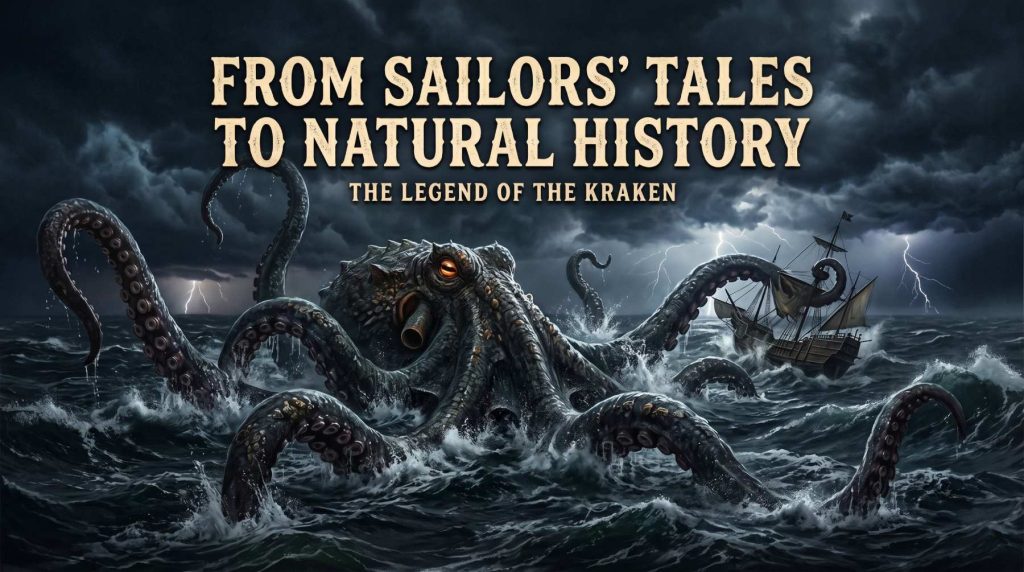
The Kraken became especially famous when it entered the pages of Erik Pontoppidan, the Danish-born bishop of Bergen.
Pontoppidan was not simply collecting campfire stories. He was interested in the natural world and published his Natural History of Norway, first in Danish in 1752–1753, with an English translation appearing in 1755.
The work attempted to document Norway’s geography, animals, plants, minerals and inhabitants, and it also included accounts of sea monsters.
This is one of the most important moments in the Kraken’s history.
A creature that had belonged to maritime folklore was now being discussed inside a work of natural history.
Pontoppidan gathered testimony from fishermen and other local sources and described the Kraken as an enormous marine creature, sometimes called Kraken, Kraxen or Krabben. His description presented it as a gigantic, rounded and flattened animal with numerous branching appendages.
The scale he attributed to it was extraordinary.
Pontoppidan reported that its back could appear like a collection of small islands and gave an enormous circumference for the creature. He also described long appendages capable, according to the reports he collected, of threatening even large vessels.
But Pontoppidan’s Kraken was not quite the creature modern audiences imagine.
He did not simply describe a colossal squid rising from the abyss.
His attempts to understand the animal were shaped by the natural history of his own time, and his discussion of the Kraken included comparisons with other marine organisms.
The important point is that the Kraken had crossed a fascinating boundary.
It was no longer merely a monster from a sailor’s story.
Someone was seriously asking:
What kind of animal could this actually be?
🐙 The Giant Squid Enters the Story
The answer would eventually begin to emerge from the deep.
For centuries, enormous squid were known mostly from fragments, stranded remains and stories from sailors. Their existence was difficult for scientists to establish because the animals live far below the surface and are rarely encountered alive.
Even when strange remains appeared, they were not always recognised correctly.
The scientific story changed dramatically during the nineteenth century.
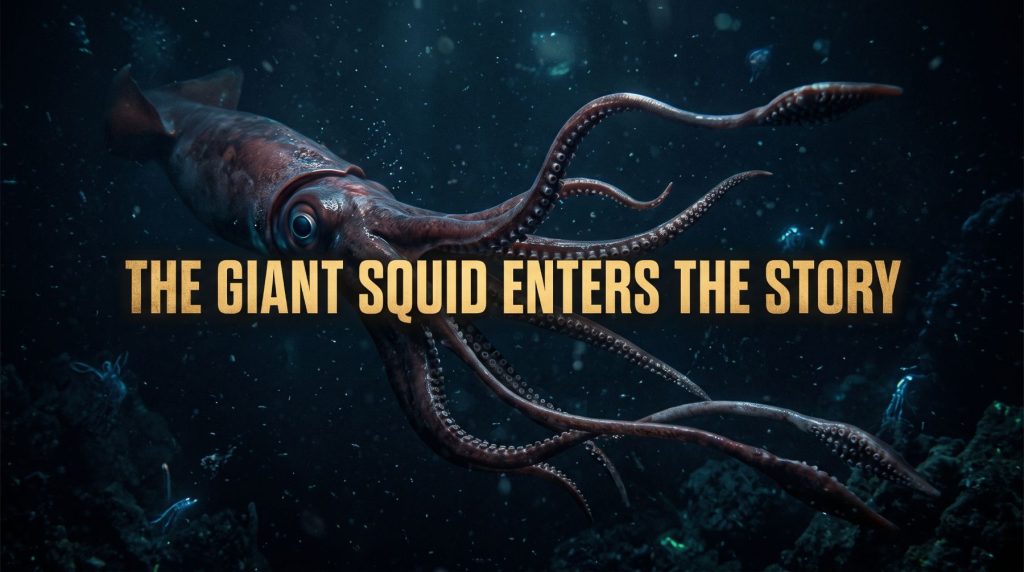
In 1857, Danish zoologist Japetus Steenstrup formally described the giant squid Architeuthis dux. Steenstrup recognised that enormous squid could explain at least some of the extraordinary stories that had circulated among sailors for generations.
The giant squid was real.
And it was enormous.
Modern estimates suggest that Architeuthis can reach around 13 metres in total length, although determining the maximum size of an animal that is so rarely observed is difficult.
Then came another extraordinary development.
In 1861, the French vessel Alecton encountered a giant squid near Tenerife and attempted to capture it. The animal escaped, but the encounter helped push the giant squid further into public and scientific consciousness.
Suddenly, the idea of a colossal creature with long tentacles living in the deep ocean no longer seemed quite so ridiculous.
There really was something down there.
Something with enormous eyes. Something with powerful arms. Something capable of growing to extraordinary proportions.
And something that humans had almost never seen alive.
The Kraken had found its real-world counterpart.
👁️ Could a Giant Squid Have Inspired the Kraken?
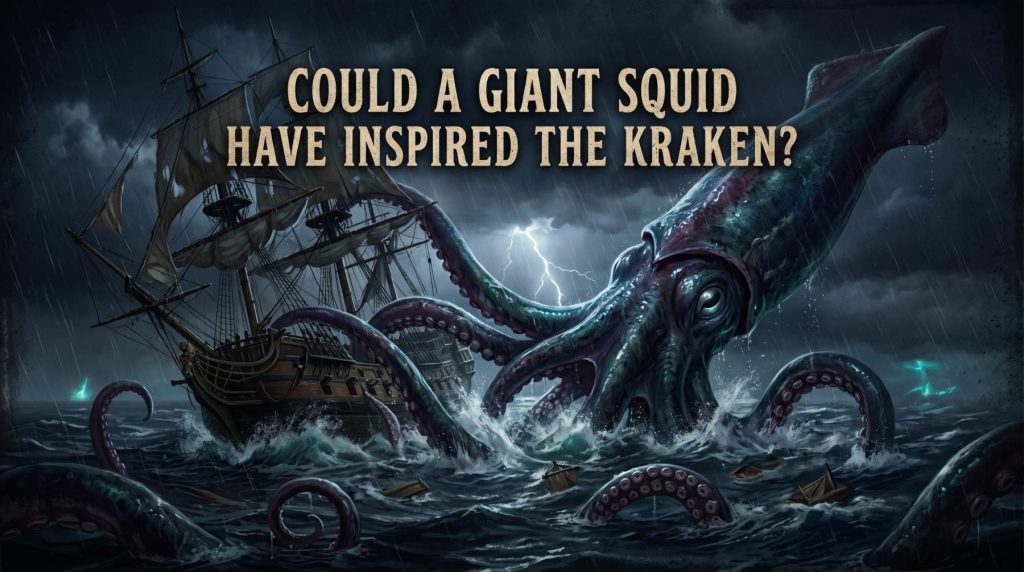
It is tempting to end the mystery here.
Kraken = giant squid.
But history is rarely that simple.
The giant squid is certainly a compelling candidate for some sea-monster traditions. Its enormous size, long appendages, unusual appearance and deep-ocean habitat make it an obvious source of inspiration.
The American Museum of Natural History describes the giant squid as a possible living animal behind the Kraken tradition.
There is even an intriguing historical connection through Steenstrup, who recognised the giant squid as the real animal behind stories that had previously seemed monstrous.
But we should be careful about claiming that the giant squid created the Kraken legend.
The problem is chronology.
The Kraken had already been described in Scandinavian tradition before scientists recognised Architeuthis. Older northern sea-monster traditions also included creatures that do not neatly resemble a giant squid.
And some modern historians have argued that the association between giant squid and older sea-monster stories was strengthened by nineteenth-century naturalists and writers, rather than being an obvious explanation that sailors had always understood.
In other words, the giant squid may help explain parts of the legend without explaining all of it.
Perhaps sailors occasionally encountered squid.
Perhaps they found enormous tentacles or beaks washed ashore.
Perhaps whales bore mysterious sucker scars.
Perhaps stories accumulated around rare encounters with unfamiliar marine animals.
Or perhaps several different phenomena eventually became blended into one enormous creature.
The Kraken may therefore be less a single misunderstood animal than a legend assembled from centuries of encounters with the unknown ocean.
🌑 The Kraken Rises Again

Once the giant squid had entered scientific consciousness, the Kraken began to change.
The old Scandinavian creature had been an animal of fishermen, islands, currents and mysterious waters.
The modern Kraken became something far more dramatic.
Literature, illustrations and eventually cinema transformed it into a gigantic monster with countless tentacles, enormous strength and a particular appetite for ships.
The creature became increasingly detached from its original Scandinavian folklore.
It appeared in adventure stories.
It became associated with pirates, lost worlds and maritime horror.
And eventually, popular culture gave the Kraken the appearance most people recognise today: a colossal cephalopod rising from the ocean to wrap its tentacles around a ship.
The transformation is fascinating.
A creature that once belonged to Norwegian fishing lore became a global symbol of the terrifying unknown.
The Kraken no longer needed Norway.
It could appear anywhere the ocean was dark enough.
And the deeper science explored the oceans, the more convincing the idea became that the deep sea might still contain creatures capable of surprising us.
Because the real giant squid was already proof that something remarkably close to a sea monster could exist.
🐙 Myth, Monster or Memory?
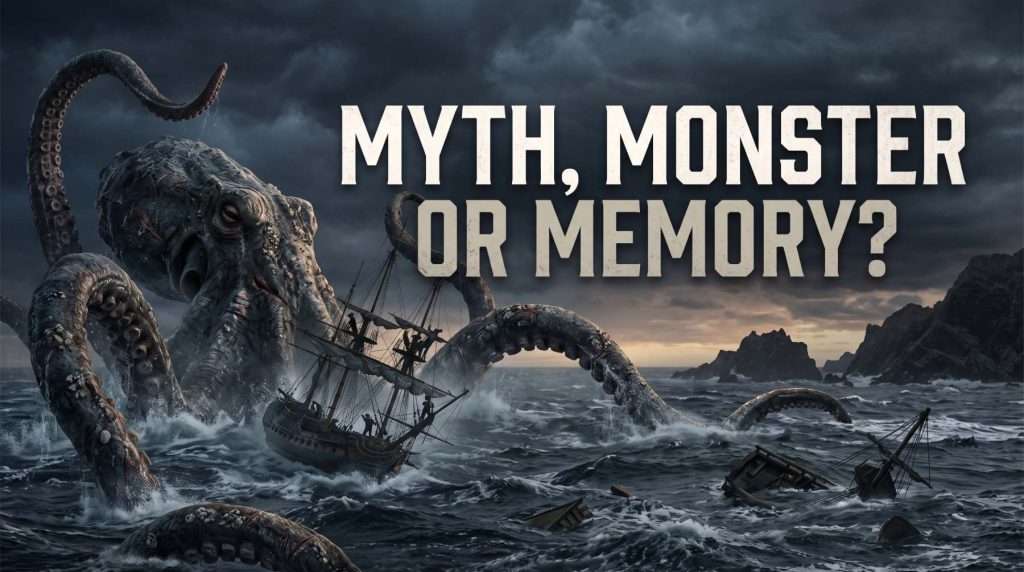
The Kraken was never simply a giant squid waiting to be discovered.
Its story is much older and stranger than that.
It emerged from a Scandinavian world where the sea was vast, dangerous and poorly understood. It existed alongside other northern sea monsters and became especially prominent in Norwegian folklore.
It was recorded by naturalists such as Erik Pontoppidan, who treated reports of the creature as something worthy of investigation.
Centuries later, science discovered that the ocean really did contain an enormous animal with tentacles long enough to make the old stories seem suddenly less impossible.
But perhaps that is what makes the Kraken so enduring.
The legend did not survive because the Kraken was proven real.
It survived because the ocean itself remained mysterious enough to make the impossible feel just slightly possible.
Today, we know that giant squid exist in the darkness.
We know they can reach extraordinary sizes.
We know that sailors of the past encountered things they could not easily identify.
And we also know that folklore has a remarkable ability to transform a strange encounter into something far larger than the original event.
So perhaps the Kraken was never one creature.
Perhaps it was a name given to the unknown.
A shape beneath the waves. A shadow beside a ship. A strange carcass on a distant shore.
Or simply the ancient human fear that something enormous might be moving beneath us, where we cannot see it.
And somewhere, thousands of metres below the surface, in a darkness almost completely untouched by sunlight, a giant squid is still moving through the deep.
For once, the monster is real.


