
The Cottingley Fairies: The Photographs That Fooled the World
In the summer of 1917, two young girls wandered beside a quiet Yorkshire stream carrying nothing more than a camera. When they returned, they claimed they had photographed fairies dancing among the flowers.
The photograph they brought back appeared impossible, tiny winged figures hovering beside the young girls among the greenery of Cottingley Beck.
To most people it seemed like a childhood fantasy captured on film. Yet within only a few years, those photographs would fool respected photographers, spiritualists, newspaper editors, and even Sir Arthur Conan Doyle — the creator of Sherlock Holmes himself.
Whether viewed as one of history’s greatest photographic hoaxes or as an enduring mystery of belief, the Cottingley Fairies remain one of Britain’s most fascinating paranormal stories.
More than a century later, the images continue to raise questions about photography, folklore, deception, and the extraordinary things people are willing to believe.
The Two Girls Behind the Mystery
Before the world knew the name Cottingley, before newspapers across Britain debated whether fairies had been photographed, the story began quietly inside an ordinary family home in Yorkshire.
Elsie Wright was born in 1901 and lived with her parents, Arthur and Polly Wright, in the village of Cottingley near Bradford, West Yorkshire. She was a creative and imaginative child with a strong interest in art, and she also grew up around photography through her father.
Arthur Wright was an enthusiastic amateur photographer. At their home he maintained photographic equipment, including a darkroom where he developed his own photographs.
In an era before digital images and instant cameras, photography was a fascinating craft, part science, part art, and to many people almost a form of magic.
This familiarity with cameras and developing photographs would later become one of the most important details in the entire Cottingley story.
In 1917, during the First World War, Elsie’s cousin Frances Griffiths came to stay with the Wright family. Frances, born in South Africa in 1907, had arrived in Yorkshire while her father was serving overseas.
The two cousins quickly became close, spending their days exploring the countryside around Cottingley.
One of their favourite places was Cottingley Beck, a small stream surrounded by woodland and greenery that became the unlikely setting for one of the most famous photographic mysteries in history.
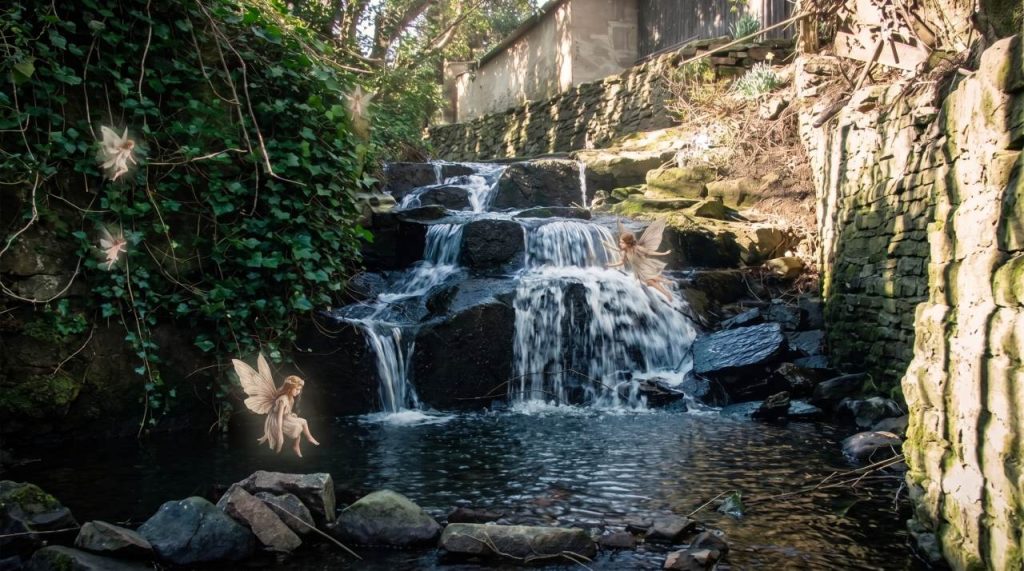
To the girls, it was simply a place to play.
To the world, it would later become known as the place where fairies were supposedly photographed.
One afternoon, Frances returned home muddy and excited after playing near the beck. According to later accounts, she told Elsie’s mother Polly that she had been seeing fairies among the trees and flowers.
To adults, it sounded like the imagination of a child. To Elsie and Frances, however, it became an idea worth investigating.
“If nobody believed them,” the girls later explained, “they would prove it.”
Their solution was simple: borrow Arthur Wright’s camera.
Arthur agreed to let the girls take the camera, unaware that the photographs they were about to create would eventually become one of the most debated images of the twentieth century.
The First Photographs of the Cottingley Fairies
Arthur Wright’s camera was a serious piece of equipment, not a child’s toy. In 1917, photography was still a careful and technical process.
Unlike today, where a photograph could be taken, checked, and deleted instantly, every image required patience. The glass photographic plates had to be prepared, exposed correctly, and then developed in a darkroom.
For Elsie, this process was familiar. Her father’s home darkroom gave her an understanding of photography that was unusual for a child of her age. She knew that a camera did not simply capture an image, it transformed a moment into something permanent.
When Elsie and Frances returned from Cottingley Beck with Arthur’s camera, they claimed they had captured something extraordinary.
They had not simply taken a photograph of themselves playing beside the stream. They claimed they had photographed tiny winged creatures hidden among the plants and flowers.
Arthur, unaware of what his daughter and niece believed they had found, developed the photographic plates himself.
The result was the first image that would eventually become known around the world.
Alice and the Fairies
The photograph showed nine-year-old Frances Griffiths lying on the grass near Cottingley Beck, with several small winged figures appearing to dance in front of her.

Rare early contact print of “Alice and the Fairies” also known as “Frances and the Fairies” (1917). Kindly provided by Steve Busti, Museum of the Weird.
This century-old photographic artefact was the first of five Cottingley Fairies photograph taken by Elsie Wright using her father Arthur Wright’s camera.
The tiny creatures seemed delicate and almost dreamlike, standing among the natural surroundings as if they belonged there.
To Elsie and Frances, the image was proof that the fairies they claimed to have seen were real.
To Arthur Wright, however, something did not look right.
As an experienced amateur photographer, Arthur immediately noticed details that troubled him. The figures did not appear to have the same depth and presence as the surrounding landscape. Rather than seeing evidence of another world, he suspected that his daughter and niece had created some kind of trick.
The idea that two children had photographed actual fairies was not something Arthur accepted easily. His practical explanation was far simpler: the girls had made something themselves and placed it in front of the camera.
The photograph that would later fascinate millions of people around the world failed to convince the very first person who examined it.
The Second Photograph
However, the girls were not finished.
Determined to prove that their encounter was genuine, Elsie and Frances returned to Cottingley Beck once again with Arthur’s camera. A second photograph was taken, this time showing Elsie herself alongside a small winged figure resembling a tiny gnome or fairy creature resting on a rock.
When Arthur developed the second plate, his doubts only increased.
To him, the explanation seemed obvious. The girls had created figures themselves and were using his camera to photograph them. After two separate occasions producing impossible images, Arthur decided enough was enough.
He refused to allow the girls to borrow his camera again.
Ironically, this decision may have prevented the story from ending there. If Arthur had continued lending them his equipment, the Cottingley Fairies may have remained nothing more than a family curiosity.
Instead, the photographs disappeared back into private life, waiting quietly for someone else to discover them.
A Family Divided
Although Arthur remained unconvinced, not everyone in the Wright household dismissed the photographs so quickly.
Elsie’s mother, Polly, became increasingly fascinated by the possibility that her daughter and niece had captured something unusual. Like many people of the period, she lived in a world where stories of spirits, unexplained phenomena, and unseen realms were widely discussed.
The years following the First World War were a time of enormous grief and uncertainty. Millions of families had lost loved ones, and many people searched for comfort in the possibility that there was more to existence than the physical world alone.
For Polly, the photographs represented something intriguing rather than impossible.
Within the Wright family home, the debate that would eventually spread across Britain had already begun.
Arthur saw a clever childhood trick.
Polly saw a possibility.
And Elsie and Frances saw something that had started as a game but was beginning to take on a life of its own.
A Letter to South Africa
Although the photographs remained largely unknown outside the Wright family, there is evidence that Frances Griffiths spoke about them long before newspapers, investigators or Arthur Conan Doyle became involved.
Towards the end of 1918, Frances wrote to her friend Johanna Parvin in Cape Town, South Africa, where she had spent much of her childhood before moving to Yorkshire.
The letter was an ordinary piece of family correspondence, filled with the everyday concerns of a young girl living through the final months of the First World War.
“I am learning French, Geometry, Cookery and Algebra at school now. Dad came home from France the other week after being there ten months, and we all think the war will be over in a few days…”
Enclosed with the letter were two photographs. One showed Frances in a bathing costume in the family’s back garden. The other was something rather more unusual.
“I am sending two photos, both of me, one of me in a bathing costume in our back yard, while the other is me with some fairies. Elsie took that one.”
On the reverse of the fairy photograph, Frances added one final observation that has become one of the most charming details in the entire Cottingley story:
“It is funny, I never used to see them in Africa. It must be too hot for them there.”
Whether this reflected genuine childhood belief, playful imagination or an already well-established joke between cousins remains impossible to know.
What the letter does demonstrate, however, is that the fairy photographs were already part of Frances’ world long before they became the subject of international debate.
The Forgotten Photographs
For several years, the Cottingley photographs remained largely unknown outside the family circle.
There was no worldwide attention. No newspapers. No famous investigators. No connection to Arthur Conan Doyle.
They were simply two unusual photographs kept among family possessions, strange images from a childhood adventure beside a Yorkshire stream.
But the story was not over.
Hidden away for years, the photographs were eventually shown to people who were far more willing to believe that humanity might not be alone in the world.
And when that happened, the quiet mystery of Cottingley Beck would become one of the most famous paranormal stories of the twentieth century.
A Mystery Rediscovered

For almost two years, the photographs remained little more than a family curiosity. Arthur Wright had dismissed them, the girls had no further access to his camera, and life in the Wright household returned to its familiar routine.
Had events ended there, the Cottingley Fairies would almost certainly have faded into obscurity, remembered only as an imaginative childhood prank beside a Yorkshire stream.
Instead, fate intervened in an unexpected way.
In 1919, Polly Wright attended a meeting of the Bradford branch of the Theosophical Society, an organisation devoted to exploring spiritual philosophy, hidden knowledge and the possibility that unseen worlds existed alongside our own.
During a lecture on fairy life, Polly mentioned the remarkable photographs her daughter and niece had taken at Cottingley Beck.
What began as a casual conversation immediately captured the attention of those present.
The photographs were passed around the meeting, examined with growing fascination and discussed long after the lecture had ended.
For many attendees, they appeared to offer something that countless investigators had spent years searching for, possible photographic evidence of the fairy world.
Among those who would soon hear of the photographs was a man whose enthusiasm would transform a forgotten family story into an international sensation.
Edward Gardner Enters the Story
Edward Lewis Gardner was not a journalist or a professional photographer. He was one of Britain’s leading members of the Theosophical Society and had spent years studying mystical traditions, folklore and reports of supernatural phenomena.
Unlike Arthur Wright, who had viewed the photographs with the practical eye of an amateur photographer, Gardner approached them with an entirely different question.
What if they were genuine?
Intrigued by the reports from Bradford, Gardner arranged to visit the Wright family in the summer of 1920. He travelled to Cottingley to meet Elsie and Frances for himself, determined to understand how two young girls had produced such extraordinary images.
Gardner found neither accomplished tricksters nor attention-seeking performers. Instead, he encountered two polite, seemingly sincere young cousins who calmly repeated the same remarkable story they had told since 1917, that they had photographed fairies while playing beside Cottingley Beck.
Years later, Gardner would recall being impressed by what he described as the girls’ “transparent honesty.”
Whether this reflected genuine belief, remarkable composure, or simply the confidence of two children who had never imagined their photographs would become famous remains one of the enduring questions surrounding the case.
A World Ready to Believe
To understand why Gardner took the photographs so seriously, it is necessary to understand the world in which he lived.
The First World War had ended less than two years earlier. Across Britain and Europe, millions of families were grieving fathers, sons, brothers and husbands who would never return home. Entire communities had been reshaped by unimaginable loss, and for many people the search for comfort extended beyond conventional religion.
Spiritualism experienced an extraordinary surge in popularity during the years that followed the war.
Séances, psychic mediums and claims of communication with the dead attracted enormous public interest.
Newspapers reported paranormal claims with surprising regularity, while organisations devoted to investigating supernatural phenomena gained thousands of followers.
In such an atmosphere, the possibility that unseen worlds might occasionally reveal themselves no longer seemed as impossible as it once had.
The Cottingley photographs appeared at exactly the right moment.
The Man Who Believed
Gardner became convinced that further investigation was essential. If the girls had genuinely photographed fairies once, perhaps they could do so again.
Determined to remove any suggestion that the original camera or photographic plates had somehow influenced the results, Gardner arrived with new equipment.
He supplied Elsie and Frances with high-quality quarter-plate Cameo cameras and carefully marked photographic plates before they set off once again for Cottingley Beck.
Unlike Arthur Wright, who had reluctantly allowed his camera to be borrowed before refusing further requests, Gardner actively encouraged the girls to continue their remarkable work.
For Elsie and Frances, the request must have seemed extraordinary.
What had begun as two curious photographs beside a quiet Yorkshire stream was now being treated as a serious scientific investigation.
The stage was set for the next chapter in the mystery.
Return to Cottingley Beck
With new cameras in their hands and fresh photographic plates carefully prepared, Elsie Wright and Frances Griffiths once again made the familiar walk towards Cottingley Beck.
The narrow stream and its surrounding woodland had changed little since the summer of 1917. To anyone watching from a distance, the cousins appeared to be doing nothing more unusual than spending another afternoon exploring one of their favourite childhood haunts.
This time, however, their audience extended far beyond Yorkshire.
Edward Gardner had placed considerable faith in the girls’ honesty. Convinced that the original photographs deserved serious investigation, he hoped these new images would provide further evidence that the elusive fairy world had, somehow, been captured on camera.
To reduce any possibility of interference, Gardner supplied new photographic equipment and marked the plates before handing them to the girls.
The stage had been carefully set.
If the fairies appeared again, many believed the mystery would become impossible to dismiss.
Three More Extraordinary Photographs
Over the following weeks, Elsie and Frances returned with three new photographs. Like the originals, each appeared to show graceful winged figures interacting naturally with the girls among the flowers and woodland surrounding Cottingley Beck.
One image showed Frances reaching towards a dancing fairy, seemingly frozen in mid-air.
Another depicted Elsie receiving a small bouquet of flowers from tiny winged companions.
The final photograph appeared to show several fairies reclining among the grass, as though resting beneath the summer sunshine.
Taken together, the five photographs appeared to tell an extraordinary story. They suggested that the girls had not witnessed a single chance encounter, but had formed an ongoing friendship with an unseen community of fairy beings hidden within the Yorkshire countryside.
For those already inclined to believe, the growing collection of images seemed increasingly difficult to dismiss.
The Photographs Reach Sir Arthur Conan Doyle
While Edward Gardner continued his investigation, news of the remarkable photographs reached one of the most famous men in Britain.
Sir Arthur Conan Doyle was known throughout the world as the creator of Sherlock Holmes, the fictional detective whose powers of observation and logical reasoning had captivated millions of readers.
Yet beyond his literary success, Doyle had become deeply interested in spiritualism and the possibility that life extended beyond the physical world.
The years following the First World War had changed him profoundly.
Like countless families across Britain, Doyle had experienced devastating personal loss. His son Kingsley had died following complications from injuries sustained during the war, while several other close family members had also passed away within a relatively short period.
The search for evidence that consciousness survived death became more than an intellectual curiosity, it became a deeply personal conviction.
When Gardner presented the Cottingley photographs, Doyle did not see children’s fantasy.
He saw the possibility of proof.
An Opportunity Too Important to Ignore
In 1920, Arthur Conan Doyle had been asked to write a Christmas article for The Strand Magazine, the very publication that had introduced Sherlock Holmes to the world.
The subject was to be fairy life, a topic that perfectly aligned with Doyle’s growing interest in spiritualism.
The timing could hardly have been more remarkable.
Here, apparently, were photographs taken not by professional mediums or self-proclaimed mystics, but by two ordinary Yorkshire girls. If genuine, they represented something unprecedented: visual evidence supporting centuries of folklore.
Doyle understood the significance immediately.
Before allowing the photographs to be published, he sought expert opinion. The images were examined by photographic specialists, including Kodak.
While the company could not certify that fairies had been photographed, its analysts reported that they found no obvious evidence of photographic fakery or manipulation within the negatives themselves. Other experts expressed greater reservations, suggesting the images showed signs of retouching or artistic intervention.
The opinions were divided.
For Doyle, however, the balance of evidence pointed in one direction.
He chose to believe.
The World Sees the Fairies
In December 1920, readers of The Strand Magazine were greeted by a headline unlike anything they had seen before.
“Fairies Photographed – An Epoch-Making Event.”
Written by Arthur Conan Doyle, the article introduced the first two Cottingley photographs to an international audience. Reproduced in one of Britain’s most respected magazines, the images spread rapidly through newspapers and conversations across the country.
Almost overnight, the quiet stream at Cottingley Beck became one of the most famous locations in the paranormal world.
Some readers gazed upon the photographs with genuine wonder. Others responded with immediate scepticism. Scientists, photographers, folklorists and journalists all examined the remarkable images, each bringing their own experiences and expectations to the debate.
The question was no longer confined to one Yorkshire family.
Now, an entire nation was asking the same extraordinary question.
Had two young girls really photographed fairies?
Britain Debates the Impossible
The publication of the Cottingley photographs in The Strand Magazine marked the moment the mystery escaped the quiet woodland of West Yorkshire and entered homes across Britain.
Almost overnight, the photographs became one of the most talked-about curiosities in the country. Readers examined every detail of the tiny winged figures, newspapers debated their authenticity, and letters poured in from people eager to offer opinions of their own.
For some, the photographs represented an extraordinary breakthrough, a glimpse into a hidden world that folklore had described for centuries. Others dismissed them almost immediately as clever trick photography or the product of youthful imagination.
Few stories divided public opinion quite so completely.
What everyone agreed upon, however, was that they had never seen anything quite like them.
A Question Without an Answer
Despite the excitement, no clear consensus emerged.
Believers pointed to the girls’ consistent accounts, the absence of obvious photographic tampering, and the sincerity that Edward Gardner believed he had witnessed during his meetings with them.
Sceptics, meanwhile, questioned the appearance of the fairy figures themselves. Some remarked that the tiny dancers looked suspiciously similar to illustrations from popular children’s books, while others argued that the poses appeared too theatrical to be living creatures.
Both sides believed the evidence supported their conclusions.
The Cottingley Fairies had become something more than a set of unusual photographs.
They had become a national debate.
The Experts, The Believers and The Sceptics
The publication of the Cottingley photographs did not end the mystery. Instead, it created a far greater one.
Once the images reached the public, they entered a world of competing interpretations.
To believers, they represented a remarkable glimpse of a hidden realm. To sceptics, they were an impressive but ultimately explainable piece of photographic trickery.
The debate was no longer taking place beside Cottingley Beck.
It was taking place in newspapers, scientific circles and photographic communities across Britain.
A Photograph Was Not Always Proof
In the early twentieth century, photography carried a level of authority that is difficult to appreciate today.
For many people, a photograph represented reality itself. A camera recorded what was placed before it, and therefore the image became a form of evidence. Unlike a drawing, a story or a witness account, a photograph appeared to remove human interpretation from the process.
This belief gave the Cottingley photographs their extraordinary power.
They were not simply claims that fairies existed. They were photographs that appeared to show them.
To supporters of the images, this distinction was everything.
If these tiny winged figures had truly been captured on glass photographic plates, then centuries of folklore and fairy traditions suddenly appeared to have a foundation in reality.
But to others, the very thing that made the photographs fascinating was also what made them worthy of suspicion.
A camera could record an object perfectly.
But it could not tell the viewer whether that object was genuine.
Those Who Believed
Among those who accepted the possibility that the photographs were genuine, many were not simply accepting a fantasy. They believed they were approaching the images with an open mind and allowing the evidence to speak for itself.
Edward Gardner remained one of the strongest supporters of the photographs. Having met Elsie and Frances personally, he believed their behaviour showed none of the signs of deception. To him, the children’s sincerity was an important part of the evidence.
Others were drawn to the photographs because they appeared to fit within a much older tradition of encounters with unseen beings.
Across Britain and Europe, stories of fairies, spirits and nature beings had existed for centuries. The Cottingley images appeared to offer something folklore had never possessed before: a visual record.
For some believers, the photographs represented more than the existence of fairies. They suggested that the natural world contained mysteries beyond ordinary human perception.
In the years following the First World War, when many people were searching for reassurance, wonder and evidence of something beyond everyday life, that possibility held enormous emotional appeal.
The Doubts Begin
Yet not everyone was convinced.
Almost from the moment the photographs appeared, experienced observers began questioning what they were seeing.
One of the earliest concerns was the appearance of the fairy figures themselves.
Rather than resembling traditional descriptions from Yorkshire folklore, the creatures appeared remarkably similar to the illustrations found in children’s books and fairy artwork of the Victorian and Edwardian period.
Their delicate wings, human-like bodies and graceful poses seemed closer to artistic creations than unknown beings from the natural world.
Some observers also questioned the behaviour of the figures.
The fairies appeared perfectly positioned for the camera, arranged almost like actors on a stage. They did not seem unaware of the photographer’s presence. They posed.
To sceptics, this was not the behaviour of living creatures accidentally captured by a camera.
It was the appearance of carefully arranged models.
The Fairy Hairstyles
One of the most memorable criticisms came from those who examined the images from a cultural rather than purely photographic perspective.
Observers noted that the fairies appeared surprisingly fashionable. Their hairstyles and appearance seemed to reflect the artistic styles popular among young women of the early twentieth century rather than the mysterious creatures described in traditional folklore.
To believers, this could simply have been the natural appearance of fairy beings.
To sceptics, it was a significant clue.
Why would creatures supposedly existing outside human society appear dressed according to the fashions of the very people photographing them?
A Debate Without Resolution
The arguments continued because neither side possessed what they considered decisive proof.
Believers pointed to the girls’ consistency, the opinions of supportive investigators and the lack of obvious photographic manipulation.
Sceptics pointed to the strange appearance of the figures, the similarities to illustrations and the possibility that simple materials could have produced the effect.
The photographs occupied an unusual place between two worlds.
They were too remarkable to ignore.
Yet too questionable to fully accept.
And as the debate continued, the Cottingley Fairies became something larger than a question about tiny winged creatures hidden beside a Yorkshire stream.
They became a question about photography itself.
Could an image reveal the truth?
Or could it simply reveal what people wanted to believe?
The Coming of the Fairies

The debate surrounding the Cottingley photographs was already capturing public attention, but in 1922 the story reached a new level of fame with the publication of Sir Arthur Conan Doyle’s book, The Coming of the Fairies.
The book gathered together the photographs, the investigations surrounding them and Doyle’s own arguments for why he believed they represented genuine evidence of fairy life.
For Doyle, this was not simply a curious story from a Yorkshire village.
It was part of a much larger question.
Could humanity’s understanding of the natural world be incomplete? Could there be forms of life existing around us that science had not yet discovered?
The Cottingley photographs appeared, to Doyle, to offer a rare opportunity to investigate such possibilities.
A Wider World of Fairy Belief
Although the photographs made the story famous, the idea of fairies was far from new.
For centuries, stories of supernatural beings living alongside humanity had been woven into the folklore of Britain and Ireland. Tales of fairies, pixies, spirits and nature beings had been passed down through generations, appearing in local traditions, poetry and literature.
The Cottingley photographs arrived at a unique moment in history. They appeared to bridge the gap between ancient folklore and modern technology.
Folklore had provided stories.
Photography appeared to provide evidence.
That combination made the photographs extraordinary.
Doyle’s Defence
Within the pages of The Coming of the Fairies, Doyle carefully presented the reasons he believed the photographs deserved serious consideration.
He pointed to the character of Elsie and Frances, arguing that two young girls would have had little reason or ability to create such an elaborate deception.
He highlighted the opinions of photographic specialists who had failed to find obvious evidence of manipulation. He also considered the possibility that the photographs represented something science had not yet explained.
Doyle did not see himself as abandoning reason.
He believed he was following evidence wherever it led.
To his supporters, this showed intellectual courage, a willingness to investigate possibilities beyond accepted knowledge.
To his critics, however, it showed that even one of the greatest minds of the age could be influenced by hope and expectation.
The Fairies Become Famous
The publication of The Coming of the Fairies ensured that the story would not disappear.
The photographs were reproduced for new audiences, discussed in newspapers and debated among believers and sceptics around the world. The names Cottingley and Conan Doyle became permanently linked.
For Elsie and Frances, however, life remained far removed from the attention surrounding the photographs.
The two cousins had never set out to become famous. What had begun as an afternoon beside a Yorkshire stream had become an international controversy involving photographers, scientists, spiritualists and one of the most famous writers of the twentieth century.
The fairies had travelled far beyond Cottingley Beck.
A Legacy Was Born
Looking back, the importance of The Coming of the Fairies was not simply that it promoted belief in the photographs.
Its greater significance was that it preserved the mystery.
The book captured a moment when the world stood between belief and disbelief, when photography was still a powerful symbol of truth, and when many people were asking whether there were still hidden wonders waiting to be discovered.
For decades afterwards, anyone encountering the Cottingley photographs would encounter them through the lens that Doyle helped create.
They were no longer just five photographs taken by two children.
They had become one of the most famous mysteries in the history of the paranormal.
Life After the Fairies

While newspapers debated the authenticity of the Cottingley photographs and Sir Arthur Conan Doyle defended their importance, the two girls at the centre of the mystery remained remarkably ordinary.
For Elsie Wright and Frances Griffiths, there was no sudden transformation into celebrities or public figures. They were still children growing up in Yorkshire, attending school, spending time with their families and continuing with everyday life.
The world had become fascinated by the tiny figures appearing beside Cottingley Beck.
But for the girls who had created those images, the attention brought something far more complicated.
A Childhood Story Becomes Something Bigger
When the first photographs were taken in 1917, Elsie and Frances could never have imagined where they would eventually lead.
What began as a private adventure beside a familiar stream had gradually passed through the hands of their family, the Theosophical Society, Edward Gardner and finally Arthur Conan Doyle himself.
By the early 1920s, the photographs no longer belonged solely to the girls.
They belonged to the world.
The images appeared in magazines, books and newspapers. People argued over them in public meetings and private conversations. Some considered them proof of another realm of existence, while others saw them as an elaborate childhood trick.
Yet behind the controversy were still two young cousins who had simply enjoyed creating a little mystery.
Elsie Wright
Elsie, the older of the two cousins, continued to have an interest in art and photography. Her early experience with cameras and photographic processes would later become one of the details examined by sceptics, particularly because she had developed practical knowledge of photography through her teenage years.
Unlike many people involved in the controversy, Elsie did not spend her life seeking attention from the photographs. As the years passed, she largely avoided public discussion of the fairies, allowing the mystery to continue without her involvement.
Decades later, when the truth of the photographs finally emerged, Elsie would describe the creation of the images as a childhood prank that had grown far beyond anything she and Frances could have anticipated.
Frances Griffiths
Frances’ relationship with the story was more complicated.
Having grown up partly in South Africa before moving to Yorkshire during the First World War, Frances had always regarded the fairy photographs as part of an unusual and unforgettable childhood experience.
Even after later admitting that the first four photographs were staged, Frances maintained that her memories of seeing fairies as a child were genuine and continued to believe that the fifth photograph might show something different.
Her lifelong connection to the story became one of the most fascinating aspects of the Cottingley mystery.
For Frances, the fairies were not simply a photograph.
They were part of her childhood.
A Secret Carried Through Generations
For more than sixty years, the full truth of what happened beside Cottingley Beck remained hidden.
The photographs continued to be discussed, exhibited and debated. New generations discovered the mystery, often knowing little about the two cousins who had started it all.
Elsie and Frances carried the secret into adulthood, watching as the world continued to search for answers.
The longer the photographs survived, the more difficult the story became to untangle.
Were they victims of a misunderstanding?
Creators of one of history’s greatest photographic hoaxes?
Or simply two children whose imagination had collided with a world desperate to believe?
For decades, the Cottingley Fairies remained suspended between fact and fantasy.
The final answer would not come from a newspaper investigation or scientific examination.
It would come from the women themselves.
The Truth Emerges: The Confession
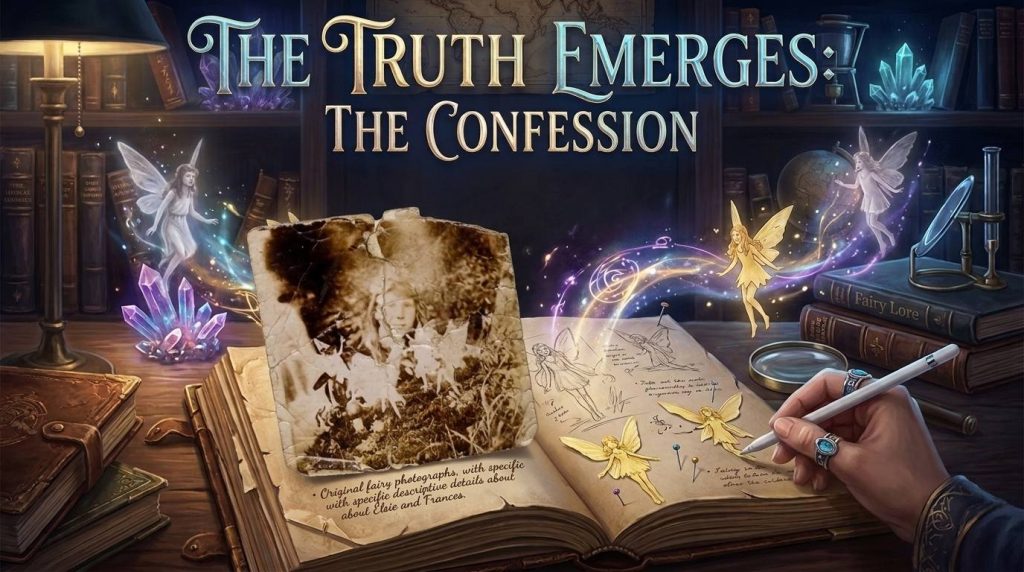
For more than sixty years, the Cottingley Fairies remained one of the world’s most famous photographic mysteries.
Generations had grown up with the images. Some viewed them as evidence of hidden wonders in the natural world.
Others regarded them as one of the most impressive photographic deceptions ever created. But despite decades of discussion, one question remained unanswered.
What had really happened beside Cottingley Beck?
The answer would eventually come not from a new scientific discovery, but from the two people who had stood beside the stream from the very beginning.
The Fairies Enter a New Era
By the middle of the twentieth century, interest in the photographs had faded, but the story never completely disappeared.
The images continued to appear in books and discussions about paranormal phenomena, photography and folklore. As new generations discovered the photographs, fresh questions were raised about their authenticity.
In the 1960s and 1970s, renewed media interest brought Elsie Wright and Frances Griffiths back into the public eye. Interviewers returned to the now-famous story, asking the two women about the photographs they had taken as children.
At first, the mystery remained.
The women did not immediately reveal the full truth.
Instead, they spoke about the events carefully, describing the photographs and their memories of Cottingley Beck while allowing the debate to continue.
The Investigation Continues
As interest grew, photographers and investigators began examining the images with increasingly advanced techniques.
One of the most important investigations came from photographer Geoffrey Crawley, editor of the British Journal of Photography, who spent years studying the original negatives and prints.
Crawley’s analysis revealed details that earlier investigators had missed. The fairy figures appeared to match illustrations from popular fairy books of the period, and the photographs showed signs that the images had been carefully constructed rather than capturing living creatures.
The evidence increasingly pointed towards a simple explanation.
The fairies had not been photographed. They had been created.
The Confession of 1983
In 1983, after decades of speculation, Elsie Wright and Frances Griffiths finally revealed the truth.
The first four Cottingley photographs had been staged using carefully drawn cardboard cut-outs, positioned in the landscape and held in place with hatpins.
The fairy figures had been copied from illustrations, including images from Princess Mary’s Gift Book, a popular children’s publication from 1915.
The remarkable photographs that had convinced so many people were not images of another world.
They were the work of two imaginative children creating a scene from their own imagination.
For Elsie, the explanation was simple. She had always known the photographs were a childhood creation, and she later described the fairy pictures as something that began as a playful joke that grew far beyond anything she and Frances could have imagined.
A Secret That Became Bigger Than Them
The revelation raised an obvious question.
Why had they allowed the story to continue for so long?
The answer appears to have been as complicated and human as the mystery itself.
When the photographs were first created, there was no intention of deceiving the world. They were children playing with a camera. But once adults became involved, the situation changed completely.
The photographs were no longer just a private joke.
They had become important to other people.
Edward Gardner saw evidence of another world. Conan Doyle saw hope and possibility. Thousands of readers saw something magical.
The girls found themselves at the centre of a story that had grown beyond their control.
The Fifth Photograph
Yet even after the confession, one final mystery remained.
The fifth photograph.
Known as “Fairy Sunbath”, the image showed Elsie and Frances lying among the grass, surrounded by several fairy figures.
Unlike the other photographs, Frances Griffiths continued to maintain that this image might have been different. Although she accepted that the earlier photographs had been staged, she believed the fifth image represented something she could not fully explain.
Elsie disagreed and maintained that the final photograph was also created.
This difference between the two cousins became one of the most fascinating aspects of the entire story.
After more than sixty years, the Cottingley Fairies still refused to become a simple tale with a simple ending.
The Mystery Changes
The confession changed how the world viewed the photographs.
The debate over whether fairies had been captured on film was effectively settled. The images were recognised as one of history’s most famous photographic hoaxes.
But the story itself did not disappear.
If anything, it became more interesting.
Because Cottingley was never only about whether fairies existed.
It was about why people believed. It was about the power of images. It was about hope during uncertain times.
And it was about two children whose imagination created a mystery that would survive for more than a century.
The Evidence Behind the Hoax

Once Elsie Wright and Frances Griffiths revealed the truth behind the Cottingley photographs, the mystery surrounding the fairies themselves was finally resolved.
The images had not captured unknown creatures hiding among the trees and flowers of Yorkshire.
They had captured something equally fascinating.
The creativity and imagination of two children.
The photographs that had convinced so many people were created using simple materials, careful positioning and a basic understanding of photography. Yet the final results were convincing enough to survive decades of examination and debate.
The secret behind the photographs was not advanced technology.
It was clever preparation.
The Fairy Figures
The most important discovery was the source of the fairy figures themselves.
The tiny winged beings were not models or supernatural creatures. They were carefully drawn illustrations cut from paper and positioned within the landscape.
The figures were based on fairy illustrations that appeared in popular children’s books of the period, particularly Princess Mary’s Gift Book, published in 1915.
The book contained contributions from several well-known authors and artists, and its fairy illustrations reflected the romantic Edwardian image of fairies that was popular at the time — delicate figures with elegant wings, flowing clothing and graceful poses.
This detail would later become one of the strongest clues that the photographs were staged.
The Cottingley fairies looked less like creatures from traditional Yorkshire folklore and more like figures that had stepped directly from a storybook.
Creating the Illusion
The method used by Elsie and Frances was surprisingly simple.
The paper figures were placed in front of the camera while the girls positioned themselves behind them. The shallow depth of the scene helped create the illusion that the fairies were part of the landscape.
In the famous photograph “Alice and the Fairies”, Frances appears sitting beside the tiny figures as they dance in front of her. To the viewer, the scene suggests an impossible encounter.
But the effect relied on careful composition.
The fairy figures were close to the camera, while Frances was positioned further away, creating the appearance that the tiny creatures were standing beside her.
It was a simple photographic trick, but one that worked remarkably well.
The Hatpins
One of the most charming details of the entire story is how the fairies were held in place.
The paper cut-outs were supported using ordinary hatpins pushed into the ground.
Such a small detail helps explain why the photographs remained mysterious for so long. There was no elaborate machinery, no complicated photographic process and no sophisticated equipment.
The deception was built from everyday objects available to two children.
Paper.
Pins.
And a camera.
Why Did They Fool So Many People?
With modern eyes, it may seem obvious that the photographs were staged.
The figures appear flat. Their poses seem theatrical. The fairies look similar to illustrations rather than living creatures.
But viewing the images from the perspective of 1917 tells a different story.
Photography was still a relatively young and powerful technology. Many people believed that photographs represented an almost unquestionable record of reality.
The images were also small, often reproduced poorly in newspapers and books, making details difficult to examine.
Most importantly, the photographs arrived at a moment when many people wanted to believe.
After the devastation of the First World War, the idea that a hidden world of beauty and wonder existed alongside everyday life held a powerful emotional appeal.
The Investigators Look Again
Although some critics had expressed doubts as early as the 1920s, the strongest technical investigations came decades later.
In the late twentieth century, advances in photographic analysis allowed researchers to examine the images in far greater detail.
Photographer Geoffrey Crawley conducted one of the most significant examinations, publishing his findings in the British Journal of Photography during the early 1980s.
His analysis identified similarities between the fairy figures and existing illustrations, supporting the conclusion that the photographs had been created using cut-out images.
Other investigators also examined details within the photographs, including the positioning of the figures and evidence of manipulation.
The conclusion became increasingly clear.
The Cottingley Fairies were not evidence of another world.
They were evidence of human creativity.
A Remarkable Childhood Creation
Yet even after the technical evidence was understood, something about the photographs continued to fascinate people.
Because the real story was not simply that two children created a hoax.
It was that two children created an illusion powerful enough to capture the imagination of an entire generation.
Elsie and Frances did not possess advanced equipment or professional special effects.
They had imagination, curiosity and a camera. The world supplied the rest.
The evidence had finally explained how the fairies were made.
But one question remained.
Why did one photograph continue to resist becoming just another solved mystery?
The answer lay with the final image — the photograph Frances Griffiths never fully abandoned.
The Fifth Photograph: The Last Mystery

Even after the truth behind the Cottingley photographs was revealed, one final question continued to linger.
The fifth photograph.
Known as the “Fairy Sunbath”, the image showed Elsie and Frances lying among the grass, surrounded by several small fairy-like figures appearing to rest nearby.
Unlike the other photographs, this image remained a point of disagreement between the two cousins.
The Photograph That Divided the Cousins
Elsie Wright maintained that the fifth photograph had also been created using the same method as the earlier images, carefully positioned cut-out figures placed within the landscape.
Frances Griffiths, however, viewed the photograph differently.
Although she eventually admitted that the first four images had been staged, she continued to believe that the final photograph might have captured something she could not explain.
Her belief did not mean that historians accepted the image as genuine. Modern researchers generally consider all five photographs part of the same childhood creation.
Yet Frances’ connection to the image remained deeply personal.
Memory, Belief and Childhood
Perhaps the most fascinating part of the fifth photograph is not whether it shows something impossible.
It is what it reveals about memory.
The Cottingley photographs were created when Frances and Elsie were children. They were part of a summer adventure, a game and a world of imagination.
Decades later, those childhood memories existed alongside a lifetime of public attention, interviews and debate.
For Frances, the fairies were never simply pieces of paper.
They represented a moment from childhood that had stayed with her forever.
A Mystery That Changed Shape
The fifth photograph did not preserve the mystery of whether fairies existed.
Instead, it preserved something perhaps more interesting, the mystery of belief itself.
The image became the final reminder that the Cottingley story was never only about proving or disproving fairies.
It was about imagination, memory and the extraordinary power of a photograph to make people question what they see.
The Cottingley Fairies Today

More than a century after two cousins walked beside a Yorkshire stream with a camera, the Cottingley Fairies remain one of Britain’s most famous stories of folklore, photography and belief.
The photographs that once divided the public are now preserved as important pieces of photographic history.
Although they are no longer considered evidence of real fairy encounters, they continue to attract interest because of the extraordinary journey they inspired.
The images, original negatives, cameras and related material are now held by the National Science and Media Museum in Bradford, where they form part of the history of photography and visual culture.
Rather than simply presenting the photographs as a famous hoax, the collection tells a much richer story, one involving childhood imagination, changing ideas about photography, spiritualism, journalism and the human desire to believe in something beyond the ordinary.
A Piece of History Preserved
The survival of original material connected to Cottingley has allowed historians and collectors to revisit the story in remarkable detail.
The cameras used by Elsie and Frances, the original photographic materials and surviving documents provide a direct connection to the events that began in 1917.
Among collectors, original Cottingley material remains highly sought after because few photographic stories have had such a lasting cultural impact.
The photographs are no longer viewed only as images of fairies.
They are historical artefacts representing one of the most fascinating moments where photography, folklore and public belief collided.
A Personal Connection to the Mystery
The continued fascination with Cottingley is also reflected among private collectors who have preserved pieces of this extraordinary story.
Some years ago, collector Steve Busti of the Museum of the Weird acquired what he describes as the original contact print of the famous Cottingley image featuring Frances and the fairy scene.
The photograph, now more than a century old, shows the marks of its age, a fragile survivor from the earliest days of one of the world’s most famous photographic mysteries.
Objects like this provide a tangible connection to history, allowing modern audiences to encounter not just the story itself, but the physical evidence left behind by the people who created it.
Why Cottingley Still Captivates
The reason the Cottingley Fairies remain remembered today is not because the photographs proved that fairies exist.
It is because the story touches something much more universal.
It is a story about childhood imagination.
About the power of photographs. About how easily wonder can take hold.
And about how a simple afternoon beside a Yorkshire stream became a mystery that travelled around the world.
The fairies may have been created from paper and imagination.
But the story they inspired was entirely real.


