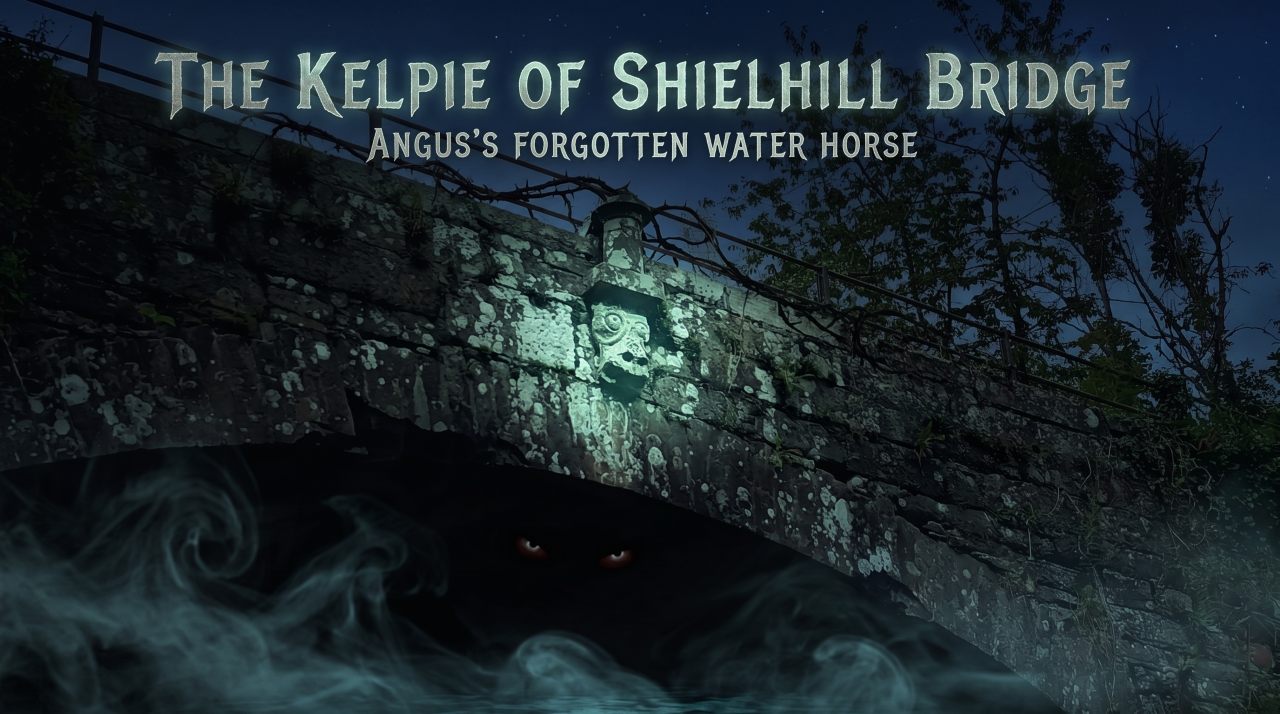
The Kelpie of Shielhill Bridge — Angus’s Forgotten Water Horse
On the banks of the River South Esk, an old stone bridge carries a secret.
Long after the last traveller has crossed its weathered stones, the river continues to move beneath the ancient arches of Shielhill Bridge.
Water slips between the rocks.
The trees move in the wind.
And somewhere among the centuries-old masonry, a strange face looks back towards the river.
A horse.
Not quite a horse as we know it.
Its features are distorted into something older and more unsettling, a grotesque head carved into the stone beneath an ancient sundial. For generations, local tradition has connected that carving with one of Scotland’s most feared supernatural creatures: the kelpie.
According to the folklore of Shielhill, this was no ordinary bridge.
It was built with the help of a water horse.
The kelpie supposedly hauled stones from the River South Esk, using its immense strength to help construct the crossing.
And when the work was complete, the creature’s presence was supposedly left behind in stone, a carved representation of the very beast whose legend had become intertwined with the bridge.
Today, the old bridge still stands.
The river still flows beneath it.
And the strange stone head remains.
But how much of the story belongs to folklore, and how much can actually be traced through history?
What is the story of the Kelpie of Shielhill Bridge?
And why does this obscure Angus crossing contain one of Scotland’s most unusual physical reminders of the water-horse tradition?
A Forgotten Kelpie of Angus
When people think of Scottish kelpies, the enormous steel horses rising beside the River Carron at Falkirk may be the first images that come to mind.
But long before modern sculptures transformed the kelpie into one of Scotland’s most recognisable symbols, the creature belonged to a much darker tradition.
The kelpie was a supernatural water horse said to inhabit Scotland’s rivers and lochs.
Often appearing as a magnificent horse, the creature could lure unsuspecting travellers, particularly children, onto its back. Once mounted, the victim might discover that they could not escape. The kelpie would then plunge into the water, dragging its passenger beneath the surface.
But the kelpie wasn’t always merely a monster waiting in the darkness.
Across Scotland, the folklore surrounding these creatures is remarkably varied.
Some traditions describe them as dangerous spirits.
Others associate them with particular stretches of water, bridges and buildings.
And at Shielhill, the kelpie became woven into the story of an actual piece of Scottish architecture.
The Bridge of the Water Horse

Old Shielhill Bridge crosses the River South Esk in Angus.
The existing stone bridge dates from the 18th century, and its weathered masonry provides a striking contrast with the modern road infrastructure that now carries traffic across the river.
But the bridge has another story.
According to local tradition, the kelpie itself was involved in its construction.
The creature supposedly carried stones from the river and helped build the crossing.
It is an intriguing reversal of the usual kelpie story.
Rather than destroying travellers, drowning unsuspecting victims or lurking beneath the water, the supernatural horse becomes a labourer, an almost impossible construction worker whose strength helped humans create a permanent crossing over the river.
Yet the story contains something even more unusual.
The kelpie did not disappear entirely.
It was apparently left behind in the stonework itself.
The Kelpie Carved into the Bridge

At the centre of the old bridge is an historic sundial dating from 1770.

Beneath it is the feature that makes Shielhill so remarkable from a folklore perspective: a carved stone head traditionally identified as the water kelpie.
The carving is not a modern interpretation or a sculpture installed for tourists.
It forms part of the historic fabric of the bridge.
Seen from below, the grotesque horse-like face is considerably more striking than it appears in many distant photographs of the bridge. Weathered by centuries of exposure, the carving emerges from the old masonry overlooking the River South Esk.

It is easy to understand how such an unusual feature could become attached to the supernatural traditions of the surrounding landscape.
The stone face seems almost to be watching the water.
And that is precisely where the folklore becomes particularly atmospheric.
The kelpie is supposedly associated with the river.
Its image is carved into the bridge.
And below it, the South Esk continues to flow.
A Date in Stone
The sundial itself provides an important historical anchor for the tradition.
The bridge belongs to the 18th century, while the sundial carries the date 1770, providing a tangible connection between the surviving structure and the period in which the bridge was constructed.
This matters because Shielhill is not simply a modern story attached retrospectively to an old landmark.
The physical object genuinely exists.
The bridge genuinely crosses the South Esk.
The sundial genuinely survives.
And the carved horse-like head genuinely forms part of the structure.
What cannot be established from the physical monument alone is whether the carving was originally intended specifically as a representation of a supernatural kelpie, or how precisely the folklore became attached to it.
That distinction is important.
The stone is evidence of history. The supernatural interpretation belongs to folklore.
Both are fascinating, but they are not the same type of evidence.
The Kelpie Tradition of Scotland
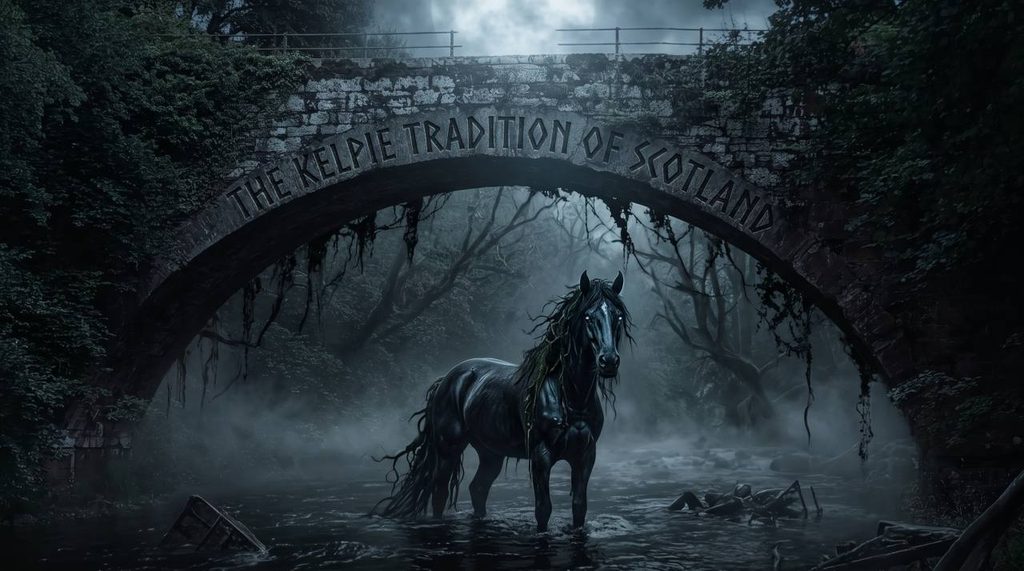
The story of Shielhill makes more sense when placed within Scotland’s broader kelpie tradition.
Kelpies were traditionally associated with bodies of water throughout Scotland, particularly rivers and lochs. Their stories often served as warnings about dangerous water and the consequences of approaching unfamiliar places.
The apparent horse form was particularly effective.
A beautiful horse standing beside a river might attract curiosity rather than fear.
But in folklore, the creature’s true nature was revealed only after someone climbed onto its back.
The kelpie therefore occupied an unusual position between the familiar and the supernatural.
It looked like an ordinary animal.
It lived in a recognisable Scottish landscape.
But it represented something dangerous and fundamentally otherworldly.
At Shielhill, that creature became permanently connected with a human structure spanning the very environment it supposedly inhabited.
Visiting Old Shielhill Bridge

I decided to visit Shielhill Bridge myself to photograph the location and document the surviving kelpie carving for Cryptid Legends.
Approaching the bridge in person gives a very different impression from seeing it in an isolated photograph.
The old stonework sits within the Angus landscape beside the River South Esk, with the modern bridge nearby providing a striking reminder of how the crossing has changed over time.
From the surrounding area, the bridge initially appears to be exactly what it is: an old Scottish stone crossing.
It is only when you begin examining the structure closely that the unusual details reveal themselves.
The sundial is one of the first clues.
And beneath it, tucked into the masonry, is the weathered horse-like face associated with the kelpie tradition.
Getting close to the carving proved more difficult than simply photographing the bridge from above. The most revealing perspective was from beneath the bridge, where the stone head could be photographed against the surrounding masonry.
After seeing the carving at close range, however, it becomes considerably easier to understand why it has attracted folklore for generations.
It is an unusual face.
It is old.
It is directly associated with the river.
And it occupies an extremely prominent position on a bridge whose own history reaches back centuries.
Standing beside the River South Esk, surrounded by woodland and running water, it was not difficult to imagine how the landscape itself could inspire tales of something unusual living beneath or beside the river.
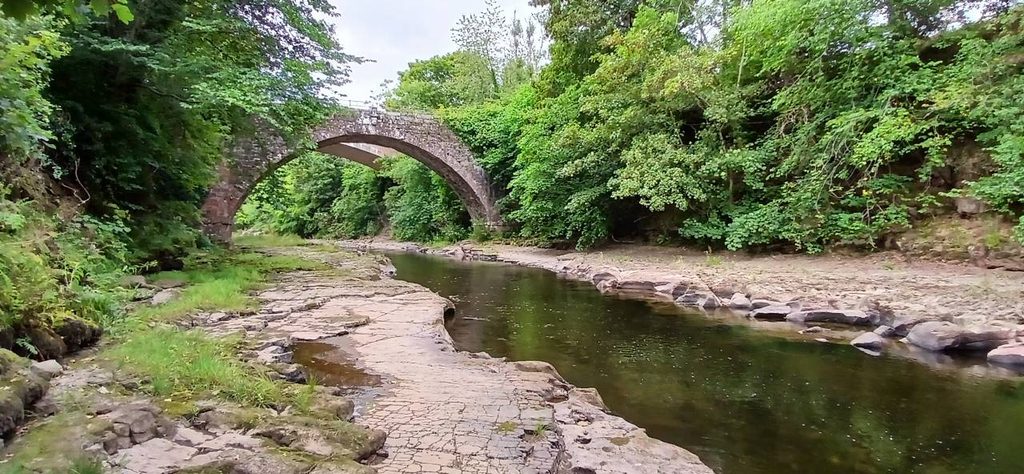
For me, this was one of the most enjoyable parts of the visit. The kelpie carving was the primary reason for coming, but experiencing the actual landscape associated with the tradition made the story feel much more tangible.
📸 Original Cryptid Legends Field Photography
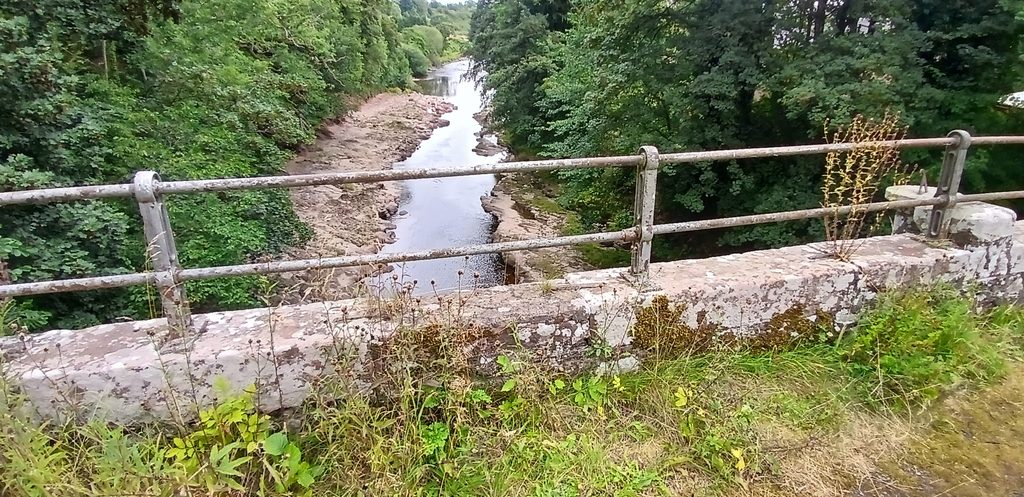
The photographs accompanying this article were taken during a personal visit to Old Shielhill Bridge by Cryptid Legends.
The aim was not simply to photograph the famous kelpie carving, but to document the entire location, the bridge, its architecture, the River South Esk, the sundial and the surrounding landscape.
Shielhill Bridge is not merely a prop for folklore.
It is a historic structure with its own architectural and cultural significance, and the kelpie tradition forms one part of that larger story.
A Kelpie in Stone — But What Does It Prove?
The existence of the carving does not demonstrate that kelpies were real animals.
Nor does the folklore surrounding Shielhill provide zoological evidence for an unknown species inhabiting the River South Esk.
There is no verified biological evidence establishing the existence of supernatural water horses.
But that does not make the story unworthy of investigation.
Quite the opposite.
Shielhill provides an excellent example of how folklore can become physically embedded within the landscape.
A supernatural creature that once existed in oral tradition now has a tangible representation in an historic bridge.
The story can therefore be approached from several different directions:
Folklore:
What did people believe about kelpies and why?
History:
When was the bridge constructed and what can be established about its origins?
Architecture:
Why was the unusual carving created?
Literature:
How was the Shielhill tradition recorded and transmitted?
Cryptozoology:
Could any historical accounts of water-horse encounters represent misidentified animals or unusual phenomena?
These questions do not all have the same answers.
And they do not need to.
Why Shielhill Matters
In an age when the most famous Scottish folklore sites attract thousands of visitors, places like Shielhill can easily disappear from public attention.
There are no enormous modern sculptures here.
No visitor centre dedicated to kelpies.
No giant tourist attraction.
Just an old bridge, a river, a sundial and a weathered face carved into stone.
Yet that may be precisely what makes Shielhill so fascinating.
The kelpie tradition here feels connected to the landscape itself.
Stand beside the bridge and the story suddenly becomes easier to imagine.
The river is still there.
The old stones are still there.
And the carved horse still looks towards the water.
Whatever the original intention behind the carving, centuries of folklore have transformed it into something more than an architectural curiosity.
It has become the face of the Shielhill kelpie.
Folklore, Mystery and the Unknown
Cryptozoology is often concerned with the possibility of undiscovered animals.
But the history of cryptids is also deeply connected with folklore, stories passed from one generation to another, often describing strange creatures inhabiting familiar landscapes.
The kelpie belongs firmly within that tradition.
There is no scientific evidence that a supernatural water horse inhabits the River South Esk.
But there is something real at Shielhill:
A real bridge, a real river, a real historic sundial and a real carved horse-like figure that has become inseparable from the local legend.
And sometimes the most interesting mysteries aren’t the ones where we can prove that a monster exists.
They’re the ones where we can still see the physical traces left behind by the stories people once told about them.
The Forgotten Water Horse
Today, traffic passes over the modern crossing beside the old bridge.
The River South Esk continues its journey through Angus.
And beneath the ancient masonry, the weathered kelpie remains.
Perhaps it was always intended as nothing more than an artistic carving.
Perhaps it was deliberately created as a representation of the water horse.
Or perhaps the folklore grew around an unusual face in the stone and transformed it into something much more mysterious.
We may never know exactly where the story began.
But the result has survived.
A centuries-old bridge.
A 1770 sundial.
A strange horse carved into stone.
And a Scottish water-horse legend that has endured quietly beside the River South Esk.
The kelpie of Shielhill may be forgotten by many who pass through Angus, but its stone face is still there, waiting beneath the bridge.
🐴🌊
Cryptid Legends — exploring the creatures, folklore, evidence and mysteries hidden within our landscapes.


