Recent Ontario Sasquatch Reports Renew Interest in Canada’s Bigfoot Legends
In June 2026, renewed attention returned to Ontario after a series of reported encounters with a large upright figure sparked discussion among witnesses, researchers, sceptics, and the wider public.
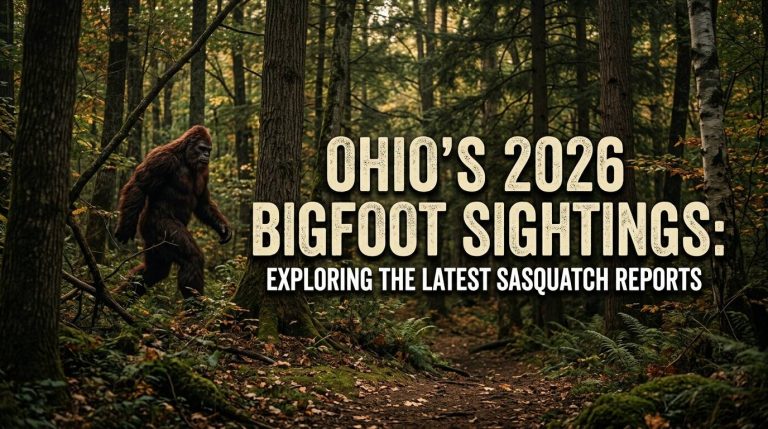
Reports from rural Ontario have described encounters with a mysterious creature resembling the traditional image of Sasquatch, a tall, powerful, human-like figure moving through woodland environments.
Some witnesses reported unusual behaviour, strange sounds, and other details that have historically appeared throughout Sasquatch accounts.
Unlike many modern cryptid stories that circulate mainly through enthusiast communities, the Ontario reports gained wider attention, bringing the Sasquatch debate back into public discussion.
For believers, the sightings represented another possible piece of a much larger mystery. For sceptics, they raised familiar questions about misidentification, wildlife encounters, and the reliability of eyewitness testimony.
The debate itself is nothing new, Canada has been telling stories of mysterious wild beings long before the modern word “Bigfoot” became popular.
🌲 Sasquatch in Ontario: A Province of Wilderness and Mystery

Ontario may not immediately come to mind as the centre of modern Bigfoot culture compared with regions such as the Pacific Northwest of the United States or the coastal forests of British Columbia.
However, the province contains some of the largest wilderness areas in North America, with vast forests, countless lakes, and remote regions where stories of unexplained encounters have persisted for generations.
Modern Sasquatch reports from Ontario include alleged sightings, strange vocalisations, track discoveries, and encounters with unusual figures moving through woodland environments.
Areas such as Algonquin Provincial Park and the remote forests of northern Ontario have long attracted the attention of Sasquatch researchers and enthusiasts collecting witness accounts.
However, stories of mysterious wild beings in Ontario did not begin with the modern Bigfoot phenomenon.
Long before the term “Sasquatch” became widely known, communities across Canada shared stories of strange creatures said to inhabit the wilderness beyond human settlements.
These legends often reflected a much older fascination with the unknown, the idea that vast forests and isolated landscapes might still contain beings rarely seen by humans.
One of Ontario’s most famous examples is the legend of Old Yellow Top, a mysterious wild-man figure reported in the Cobalt and Temiskaming region during the early 20th century.
Emerging during Ontario’s mining boom era, the creature was described by witnesses as a large, hairy, human-like figure with a distinctive lighter-coloured patch of hair on its head.
The Old Yellow Top reports are not simply an early version of Bigfoot, but they form part of the same broader tradition of Canadian wilderness mysteries, stories of unusual beings appearing at the edges of civilisation.
This long history adds another layer to Ontario’s modern Sasquatch reports. The 2026 sightings are not appearing in isolation; they continue a much older pattern of Canadians looking into their forests and wondering what may still remain undiscovered.
Ontario itself offers a unique environment for such legends, combining two very different landscapes:
🌲 Remote boreal wilderness in the north
Vast forests, lakes, and sparsely populated regions where encounters can remain isolated and difficult to investigate.
🌾 Southern farmland and fragmented forests
A landscape where woodland pockets exist close to human communities, creating different possibilities for sightings and misidentifications.
The 2026 reports were particularly interesting because some occurred in areas not traditionally associated with classic “deep wilderness” Bigfoot imagery.
This has led to further discussion among researchers about how adaptable a hypothetical unknown animal would need to be or whether these encounters represent something more familiar being viewed under unusual circumstances.
🗺️ Report Location: Southwestern Ontario
Approximate area of recent 2026 Sasquatch reports
📍 Chatham-Kent Region, Ontario, Canada
The latest reports gained attention partly because they occurred outside the traditional image of Sasquatch habitat.
🦶 The 2026 Ontario Sasquatch Reports: A New Wave of Encounters?
The renewed interest in Ontario’s Sasquatch legends began in April 2026, when a series of reported encounters emerged from the Chatham-Kent region of southwestern Ontario.
Unlike many famous Bigfoot reports that originate from remote mountain forests or wilderness areas, these accounts came from a landscape of rural roads, farmland, and scattered woodland, making them especially unusual.
Over three consecutive days, witnesses reported seeing large upright figures in the areas surrounding Dresden, Thamesville, and Raglan.
The reports shared several details commonly associated with Sasquatch encounters:
- A large human-like figure estimated between 7 and 8 feet tall
- Dark or cinnamon-coloured hair descriptions
- Strong earthy or unusual odours
- Reports of wood-knocking sounds
- Claimed footprints and unusual activity near wooded areas
One of the most discussed accounts came from Thamesville, where a witness reported seeing a large figure emerge from woodland before describing a powerful earthy smell and later hearing knocking sounds from the forest.
A further report from Raglan involved a witness whose dog reportedly reacted to a large dark figure near the treeline, followed by additional reports of wood knocks.
In June 2026, another unrelated incident was reported near Spectacle Lake in the Madawaska Valley region of eastern Ontario. A group of campers reported hearing repeated knocking sounds from the surrounding forest, with some also describing unusual coloured lights moving through the trees.
🔎 Evidence and Explanations
Despite the attention surrounding the reports, no confirmed physical evidence has been released.
There are currently:
❌ No verified photographs
❌ No confirmed video footage
❌ No DNA evidence
❌ No independently examined footprints
As with many Sasquatch reports, possible explanations include misidentified wildlife, environmental sounds, human activity, or mistaken observations.
Sceptics point out that Ontario has populations of animals capable of creating unusual encounters, including black bears, which can occasionally stand upright and appear surprisingly human-like at a distance.
For Sasquatch researchers, however, the reports remain interesting because of the repeated patterns found across decades of sightings: upright movement, forest environments, unusual sounds, and witness descriptions of a large unknown figure.
At present, the Ontario 2026 reports remain unverified eyewitness accounts, but they have added a new chapter to Canada’s long-running Sasquatch mystery.
🌲 Ontario’s Long History of Wild-Man Legends

Although the recent Ontario Sasquatch reports have renewed public interest in mysterious creatures of the wilderness, stories of strange beings connected to Canada’s forests are far older than the modern idea of Bigfoot.
For generations, the wilderness has occupied a unique place in Canadian storytelling. Vast forests, isolated lakes, and remote landscapes created a natural setting for legends about creatures that existed beyond the boundaries of human settlement.
Long before the word “Sasquatch” became widely recognised, communities across Canada shared stories of mysterious wild beings, figures described as powerful, elusive, and connected to the unknown parts of the natural world.
These stories developed within a much older human tradition: the belief that unexplored wilderness may contain things rarely seen by humans.
European settlers arriving in North America also carried their own folklore traditions, including stories of the “wild man” — a mysterious figure living outside civilisation and representing the untamed wilderness.
Over time, these ideas blended with local landscapes, producing new regional legends shaped by forests, mountains, lakes, and isolated communities.
Ontario was particularly suited to these kinds of stories. The province contains enormous wilderness regions, from the forests and lakes of the Canadian Shield to the remote northern landscapes stretching toward Hudson Bay. For early settlers, trappers, loggers, and miners, these environments could feel both beautiful and unknown.
As communities expanded into these areas, stories emerged of unusual tracks, strange sounds, and encounters with mysterious figures moving through the forests. Some became local folklore, while others entered newspapers and early mystery literature.
One of Ontario’s most famous examples would later emerge from the mining communities of northern Ontario: the strange case of Old Yellow Top.
🟡 Old Yellow Top: Ontario’s Famous Wild Man Mystery

Long before Ontario became associated with modern Sasquatch reports, the province already had one of Canada’s most unusual wild-man legends.
Known as Old Yellow Top, and sometimes referred to by researchers as the “Pre-Cambrian Shield Man,” this mysterious figure emerged from the forests surrounding Cobalt, Ontario, during the region’s famous silver mining boom of the early 20th century.
The nickname reflects the creature’s connection to the ancient landscape of the Canadian Shield, one of the oldest geological regions on Earth, covering much of northern Ontario.
With its rugged rock formations, dense forests, countless lakes, and isolated mining communities, the Shield became the perfect setting for a wilderness mystery.
Unlike many Sasquatch reports that describe a dark-haired creature blending into the forest, Old Yellow Top gained its identity from a distinctive feature, a reported patch or mane of lighter yellowish hair on its head.
Witnesses described a large, upright, human-like figure covered in dark hair, giving rise to comparisons with later Sasquatch accounts.
The earliest reported encounter came in 1906 near the Violet Mine, where workers involved in the construction of the mine’s headframe reportedly saw a strange two-legged creature moving through the area.
The timing is significant: this was during Cobalt’s transformation from a remote wilderness location into a bustling mining town filled with prospectors, workers, and fortune seekers.
Years later, further reports continued to keep the legend alive. In 1923, prospectors working near the Cobalt area reportedly encountered what they first believed was a bear before noticing unusual characteristics, including the distinctive lighter hair on its head. Later reports in 1947 and 1970 added to the mystery, creating a legend that stretched across generations.
The 1970 encounter became one of the most famous stories connected to Old Yellow Top. A group of miners travelling by bus reportedly saw the creature crossing the road, with the driver forced to react suddenly.
The event was particularly memorable because some witnesses had previously dismissed the stories of Old Yellow Top before claiming they had encountered something unusual themselves.
What makes Old Yellow Top fascinating is not simply the question of whether the creature existed, but the way the legend survived.
For decades, miners and local residents continued telling stories of a mysterious figure wandering the forests around Cobalt. The creature became part of the identity of the region, a northern Ontario mystery born from a time when wilderness exploration, mining, and folklore all overlapped.
Old Yellow Top occupies a unique place in cryptid history. It is not quite the same as modern Sasquatch, yet it represents the same enduring human fascination with the possibility that unknown beings may still exist beyond the edges of civilisation.
🔎 What Could Old Yellow Top Have Been?
Like many cryptid legends, Old Yellow Top has inspired a range of explanations over the years.
One possibility is that the creature was a case of misidentified wildlife, with some suggesting that bears or other large animals seen briefly through the forest could have been mistaken for a strange upright figure.
In the rugged terrain around Cobalt, poor visibility, distance, and unusual conditions could easily have influenced eyewitness interpretations.
Others have suggested that the legend may have grown through local folklore and mining-era storytelling, with each retelling adding to the mystery surrounding the creature.
For cryptozoology enthusiasts, however, Old Yellow Top remains fascinating because of the consistency of the reports: a large, hairy, human-like figure, a distinctive yellowish patch of hair, and sightings continuing across several generations.
Whether viewed as an unknown animal, a misunderstood encounter, or a product of regional folklore, Old Yellow Top remains an important part of Ontario’s mystery history.
🦶 From Old Yellow Top to Sasquatch: Ontario’s Continuing Mystery
The story of Old Yellow Top shows that Ontario’s fascination with mysterious wild beings did not begin with modern Bigfoot culture.
From early mining communities exploring the Canadian Shield to today’s Sasquatch reports spreading through modern media, the same question continues to capture the imagination:
What might still exist beyond the edges of the known wilderness?
The 2026 Ontario sightings represent the latest chapter in a much older Canadian tradition, one where forests, folklore, and unexplained encounters continue to inspire curiosity.