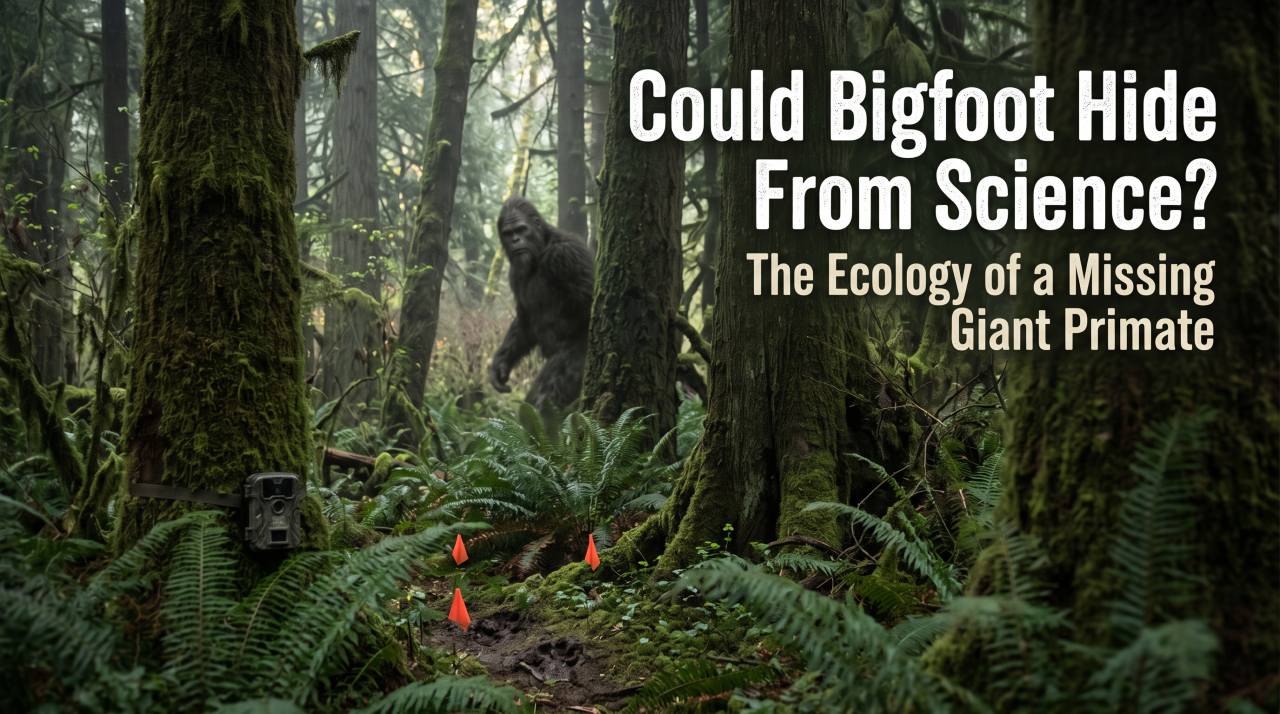
Could Bigfoot Hide From Science? The Ecology of a Missing Giant Primate
For more than half a century, the greatest challenge facing the Sasquatch mystery has not been eyewitness testimony, it has been collecting hard scientific evidence.
A large, unknown primate should leave behind DNA, hair, bones and other ecological clues.
Yet the forests where Bigfoot is reported are among the most challenging environments on Earth for preserving biological evidence.
Could a creature survive in these remote wilderness areas while remaining almost invisible to modern science?
1. The Bigfoot Evidence Problem
Every animal that exists on Earth leaves traces of its presence.
A deer moving through a forest leaves tracks. A bear leaves hair, scat, feeding remains and DNA. A bird leaves feathers, nests and calls. Even the smallest organisms leave behind biological signatures that reveal they were there.
So if Sasquatch were a real, undiscovered giant primate species, the central scientific question would not simply be:
“Would we see it?”
The more important question is:
“What evidence should a living Sasquatch leave behind?”
A large unknown primate would not exist in isolation from its environment. Like every other animal, it would interact with the landscape around it, feeding, travelling, reproducing, shedding cells, and eventually dying.
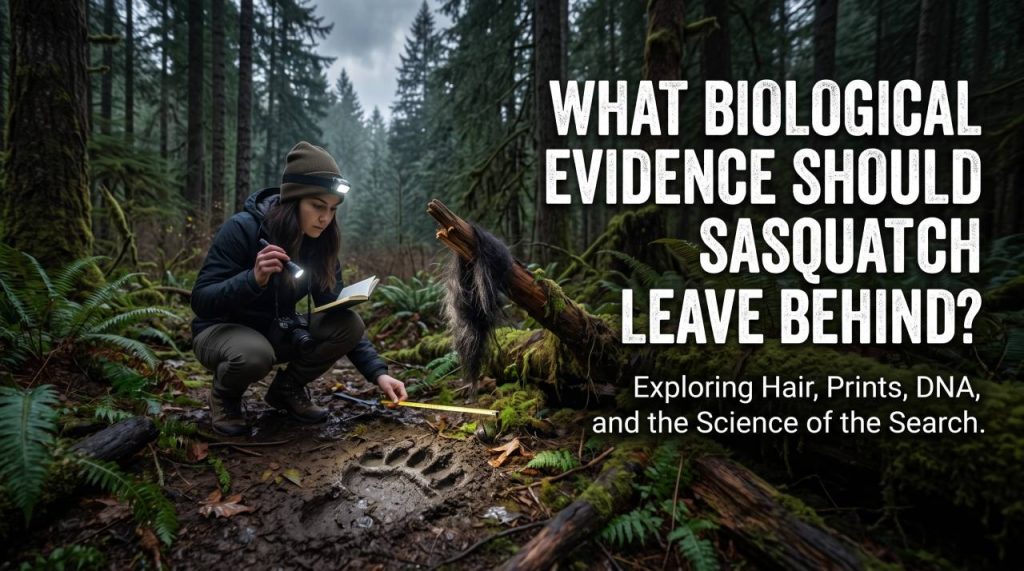
In theory, a living Sasquatch population should leave behind a range of biological and ecological clues:
🧬 What Biological Evidence Should Sasquatch Leave Behind?
🦴 Skeletal Remains
The remains of deceased individuals.
Potential evidence:
- bones from natural deaths
- accidental deaths
- remains preserved in favourable environments
However, whether those remains survive depends heavily on the environment where the animal lived and died.
🧬 DNA Evidence
The genetic traces left behind by a living organism.
Potential sources:
- hair follicles
- skin cells
- saliva
- urine
- faecal material
- environmental DNA (eDNA) from soil and waterways
Modern wildlife science can identify animals without ever seeing them directly by analysing these traces.
🧑🦱 Hair Samples
A large, hairy primate would theoretically shed hair throughout its life.
Potential sources:
- rubbing against vegetation
- bedding areas
- grooming
- movement through dense forests
However, finding hair is not the same as finding identifiable genetic evidence. Environmental conditions play a major role in whether those traces survive.
💩 Scat
One of the most valuable forms of biological evidence from living animals.
Scat can contain:
- DNA from intestinal cells
- information about diet
- evidence of parasites
- clues about population health
Many elusive species are studied through scat because researchers can gather information without ever observing the animal.
👣 Footprints & Track Evidence
Footprints are among the most frequently reported forms of Sasquatch evidence, with thousands of alleged tracks documented over decades.
Researchers, including dedicated field investigators, have collected and studied footprint casts from reported encounters in North America, and across the globe such as with Orang Pendek, examining features such as:
- track dimensions
- toe arrangement
- stride length
- pressure patterns
- dermal ridge details
- consistency across trackways
Some researchers argue that certain casts display unusual anatomical characteristics that are difficult to explain through known animals or simple misidentification.
However, footprint evidence remains one of the most debated areas of Sasquatch research. Questions remain regarding:
- Comparison with known human and animal footprints. reported forms of Sasquatch evidence, although interpretation remains highly debated.
- Authenticity of individual trackways.
- Potential hoaxes.
- Interpretation of unusual features.
🌲 Ecological Impacts
A species is not just an individual, it is part of an ecosystem.
A breeding population could potentially influence:
- food sources
- competition with other animals
- predator relationships
- vegetation patterns
- movement corridors
Over generations, a large animal population may leave a wider ecological footprint.
The Question Of Detectability
However, the existence of evidence does not guarantee that humans will find it.
This is where the concept of detectability becomes important.
A species may exist while remaining difficult to detect if:
- its population is small,
- its habitat is enormous,
- its behaviour avoids human contact,
- evidence disappears quickly,
- researchers are looking in the wrong places.
A rare animal living across millions of acres of wilderness will be far harder to study than a species living in a small, accessible habitat.
But there is also an important scientific challenge:
The larger and more widespread a species becomes, the greater its ecological footprint should be.
A single unknown animal could theoretically leave very little evidence.
A large, stable breeding population surviving for generations would be expected to leave increasingly detectable traces.
This balance between concealment and evidence lies at the heart of the Sasquatch mystery.
2. The Perfect Hiding Place?
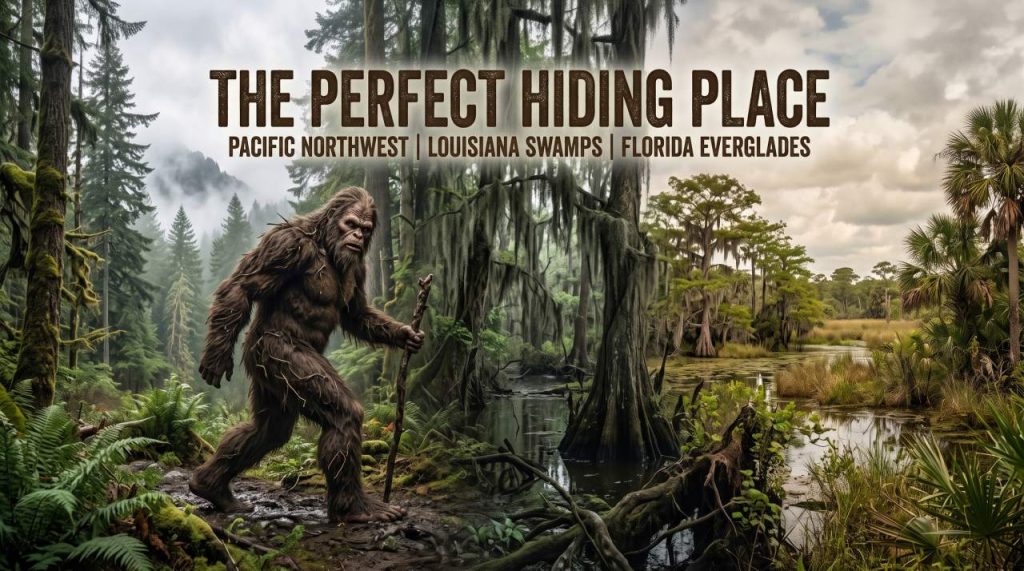
For decades, Sasquatch reports have been concentrated in some of the most remote and challenging landscapes in North America.
From the vast forests of the Pacific Northwest to mountain wilderness, coastal regions, and southern swamps, these environments share one important feature:
They are difficult places to observe, search, and recover biological evidence.
But the same isolation that could potentially conceal a large animal also creates a scientific challenge:
How much evidence would survive in these environments long enough for humans to find it?
🌲 Pacific Northwest Forests
The Traditional Home Of Sasquatch Reports
The Pacific Northwest has become synonymous with the Sasquatch mystery. From the forests of Washington and Oregon to the remote wilderness of British Columbia and Northern California, generations of sightings have emerged from a landscape defined by isolation and immense scale.
These forests contain some of the very qualities that make them compelling in the search for a hidden species: vast wilderness areas, rugged mountain terrain, dense forests, remote valleys, and regions where human presence can be surprisingly limited.
To an animal adapted to avoiding detection, this environment would offer many advantages. Thick vegetation can reduce visibility, mountainous terrain creates natural barriers, and enormous areas of wilderness make systematic searching incredibly difficult.
However, the same characteristics that make these landscapes difficult for humans to explore also create challenges for finding biological evidence.
Rain, soil chemistry, fungi, bacteria, scavengers and the natural processes of decomposition all work continuously to break down organic material.
A large animal may leave traces of its existence, but those traces do not necessarily remain preserved long enough to be discovered.
The forest can conceal life, but it can also erase the evidence left behind.
🦴 The Fossilisation Problem
One of the most common sceptical arguments is:
“If Bigfoot existed, where are the fossils?”
However, the fossil record is not a complete record of every animal that ever lived.
Most organisms:
- die,
- decompose,
- disappear.
Fossilisation requires a rare combination of events:
- rapid burial
- favourable chemistry
- protection from scavengers
- geological preservation
A large animal dying in a wet forest is far more likely to return to the ecosystem than become a fossil.
☠️ The Death Of A Forest Giant
A hypothetical Sasquatch carcass in a forest environment would likely follow a natural decomposition process:
Days
- scavengers locate remains
- insects colonise tissue
Months
- soft tissue disappears
- bones become exposed
Years
- weathering begins
- moisture and acidic soils affect remains
Decades
- bones may become fragmented or unrecognisable
The forest is not a preservation chamber. It is a recycling system.
🌍 The Evidence Preservation Problem Across Cryptid Habitats
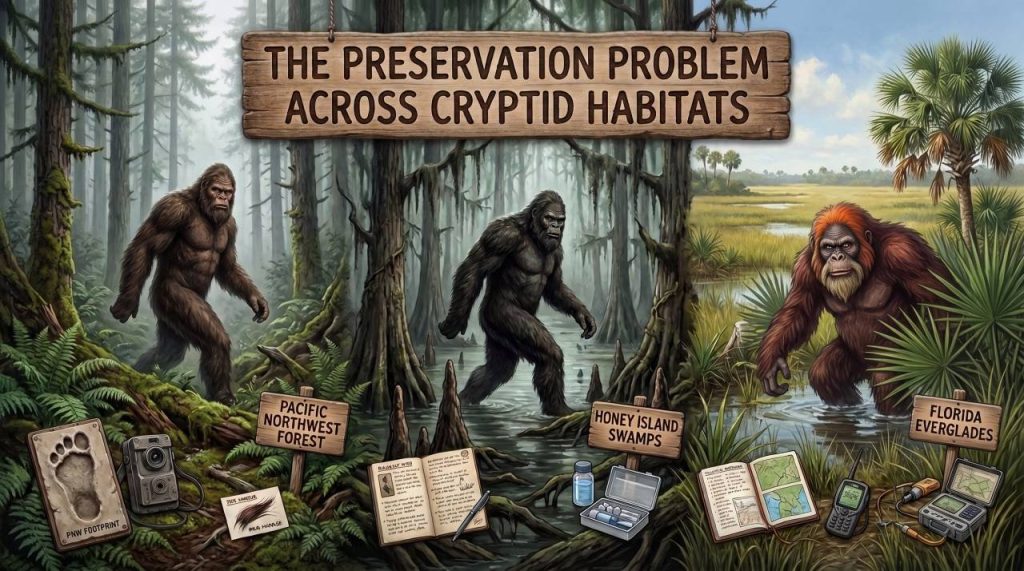
The challenge is not limited to Pacific Northwest forests. Many traditional cryptid habitats are environments where evidence can be difficult to preserve.
🌲 Pacific Northwest Forests
Bigfoot / Sasquatch
Challenges:
🌧 heavy rainfall
🍂 acidic soils
🌲 dense vegetation
🦠 microbial activity
🐺 scavengers
🏔 difficult terrain
A carcass may disappear back into the ecosystem before it is ever discovered.
🐊 Southern Swamps
Skunk Ape / Honey Island Swamp Monster
Swamps create a different set of challenges:
🌿 dense vegetation
🌊 changing water levels
🦠 rapid biological activity
🐊 aquatic scavengers
🌫 limited visibility
Water movement can scatter remains, while warm humid conditions accelerate decomposition.
However, swamp environments can occasionally preserve material through peat and low-oxygen burial, showing that preservation depends on the exact conditions, not simply the habitat type.
🌧 Wetlands & Coastal Environments
Other reported Sasquatch habitats include:
- river valleys
- coastal forests
- marshlands
Challenges include:
- erosion
- flooding
- sediment movement
- difficult access
- large search areas
🌍 Preservation Bias: Where Evidence Survives
Not all environments preserve biological remains equally.
When an animal dies, the outcome depends heavily on the conditions surrounding its remains. Some environments naturally slow decomposition and protect evidence for thousands of years, while others rapidly return organic material back into the ecosystem.
Imagine, hypothetically, that a Sasquatch existed and an individual died in different environments.
❄️ A Sasquatch In Permafrost
If a Sasquatch died in a permanently frozen environment, the cold could dramatically slow decomposition.
Frozen conditions can preserve:
- soft tissue
- hair
- bones
- genetic material
This is why scientists have recovered remarkably preserved remains of animals such as mammoths from frozen landscapes.
A frozen Sasquatch remains would have a much greater chance of surviving long enough to be discovered.
🏜 A Sasquatch In A Desert
A desert environment creates a completely different preservation process.
Extreme dryness can remove moisture from remains, slowing bacterial activity and creating natural mummification.
A body exposed in an arid landscape may survive far longer than one lying in a warm, wet forest.
🪨 A Sasquatch In A Cave
A cave environment could potentially provide another opportunity for preservation.
Protection from:
- sunlight
- rainfall
- temperature changes
- surface disturbance
combined with mineral-rich conditions, can help preserve remains.
A hypothetical Sasquatch that died inside a remote cave could leave behind evidence far more likely to survive than one exposed on a forest floor.
🌋 A Sasquatch In A Rapid Burial Environment
Some of the world’s most dramatic fossil discoveries occurred because animals were buried quickly.
Volcanic deposits, sediment layers, or other rapid burial events can isolate remains from scavengers and decomposition.
Without this type of unusual event, most animals simply disappear.
🌲 Compared With Wet Forests And Swamps
Now compare those environments with the places where Sasquatch is most often reported:
🌲 Pacific Northwest forests
🌿 southern swamps
🌧 humid wilderness environments
Here, decomposition and recycling are usually the dominant processes.
A carcass exposed to:
- rainfall,
- microbes,
- fungi,
- insects,
- scavengers,
- soil chemistry,
is far more likely to break down and return its nutrients to the ecosystem than become a preserved specimen.
The Preservation Paradox
The habitats most often associated with Bigfoot are also habitats where evidence may be hardest to preserve and recover.
This does not prove that a hidden primate exists, but it does mean that the absence of fossils or naturally preserved remains is more complicated than simply asking:
“Why haven’t we found a skeleton?”
The more important scientific question becomes:
“How much evidence should survive in the environments where Sasquatch is traditionally reported?”
3. The Bigfoot DNA Problem
Why Has Genetic Evidence Remained Elusive?
Of all the evidence questions surrounding Sasquatch, DNA is perhaps one of the most scientifically important.
Every living animal constantly leaves behind microscopic traces of its existence. Modern wildlife researchers can identify species without ever seeing them directly by studying the biological material they leave behind.
A living Sasquatch, if it existed, would be expected to leave genetic traces through:
🧬 skin cells
🧬 saliva
🧬 urine
🧬 hair
🧬 faecal material
This creates one of the biggest questions in the mystery:
If Sasquatch is a living animal, why has no genetic evidence been widely accepted as proof of an unknown primate species?
The answer is not simply about whether DNA exists.
The real challenge is whether DNA survives, whether it is collected, and whether scientists can confidently determine what it came from.
🧑🦱 The Hair Evidence Question
Hair has long been one of the most frequently discussed forms of Sasquatch evidence.
The logic is simple:
A large, hairy primate moving through forests should naturally shed hair as it travels, rests, and interacts with its surroundings.
However, there is an important difference between finding hair and finding identifiable genetic evidence.
A random hair sample may tell researchers very little.
To provide strong evidence, scientists would ideally need:
- a well-documented sample location,
- uncontaminated material,
- preserved genetic material,
- enough DNA to analyse,
- genetic markers showing an unknown species.
A strand of hair without usable DNA may simply remain an unidentified biological sample.
🌲 Why Don’t We Find Hair Everywhere?
A common argument is:
“If Bigfoot existed, forests should be full of hair.”
However, hair is not as easy to recover as many people imagine.
Once an animal sheds hair into the environment, it immediately begins interacting with natural processes.
- Rain can move it.
- Wind can disperse it.
- Sunlight can damage genetic material.
- Fungi and bacteria can break it down.
- Other animals can disturb or remove it.
The forest floor is not a storage area for biological evidence, it is an active ecosystem where material is constantly being recycled.
Even researchers studying known animals do not simply walk through forests hoping to find useful hair. They often use targeted methods such as:
- hair traps
- known travel routes
- feeding areas
- den sites
- locations where animals regularly interact with their environment.
Finding usable genetic material from an unknown animal by chance in millions of acres of wilderness would be extremely difficult.
💩 Scat: The Strongest Biological Clue?
If Sasquatch existed as a large terrestrial mammal, scat would arguably be one of the most valuable forms of evidence.
Animal droppings can reveal remarkable amounts of information, including:
- DNA from intestinal cells
- diet
- parasites
- microbiome information
- population genetics
This is one reason wildlife researchers frequently use scat when studying elusive species.
However, scat also has limitations.
Like any biological material, it does not remain unchanged forever.
Rainfall, insects, microbes, temperature, and decomposition all gradually break it down.
A sample discovered days after deposition may contain far more information than one exposed to the environment for weeks or months.
The challenge is therefore not simply:
“Would Sasquatch leave scat?”
It almost certainly would.
The challenge is:
How many animals would exist, where would they travel, and where would researchers need to look?
🌊 Environmental DNA: Finding Animals Without Seeing Them
One of the most exciting developments in modern biology is environmental DNA, or eDNA.
Scientists can sometimes detect animals by collecting genetic traces left behind in:
- rivers
- lakes
- soil
- sediment
This raises an interesting question:
Could a Sasquatch crossing a stream leave behind detectable DNA?
Possibly.
However, detecting eDNA depends on many factors:
- how much biological material entered the environment
- how quickly it degraded
- how water movement dispersed it
- where researchers collected samples
- whether enough genetic material remained for analysis.
A river does not act like a perfect biological archive. DNA can become diluted, damaged, or transported away from its original source.
The DNA Paradox
DNA is one of the most powerful tools modern science has for discovering hidden species. However, genetic evidence is not simply a matter of an animal existing and DNA being found.
For DNA evidence to reveal an unknown species, a chain of events must occur: an animal must leave behind genetic material, that material must survive in the environment, researchers must locate and collect it, and enough usable DNA must remain for scientists to identify something genuinely new.
The absence of confirmed Sasquatch DNA remains one of the biggest challenges facing the mystery.
But the question is more complicated than simply asking:
“If Bigfoot existed, wouldn’t we have DNA?”
The deeper scientific question is:
“How much detectable DNA would a rare animal leave behind in a vast, constantly changing wilderness ecosystem, and would humans actually find it?”
4. The Missing Bones Question

Why Haven’t We Found A Sasquatch Skeleton?
One of the most frequently asked questions in the Sasquatch debate is deceptively simple:
“If Bigfoot exists, why hasn’t anyone found a skeleton?”
At first glance, it seems like a compelling argument. Every animal eventually dies, so it seems reasonable to expect that a breeding population of large primates would leave behind skeletal remains.
However, nature is rarely that straightforward.
Most wild animals die unnoticed. Their remains are quickly incorporated back into the ecosystem through a combination of scavenging, decomposition and weathering.
Even in areas inhabited by well-known mammals such as bears, mountain lions and wolves, complete skeletons are surprisingly uncommon discoveries.
🦴 From Skeleton To Soil
A skeleton lying on a forest floor is not a permanent fixture.
After death, scavengers may scatter bones over a wide area while insects, fungi and microorganisms continue breaking down the remaining organic material.
Over time, weather, moisture and acidic soils gradually weaken exposed bones until they fragment and eventually return their minerals to the surrounding environment.
The process is slow, but remarkably effective.
The forest is constantly recycling itself.
🌲 Environment Matters
The likelihood of discovering skeletal remains depends greatly on where an animal dies.
A skeleton preserved within a cave, buried beneath sediment, frozen in permafrost or protected in an exceptionally dry environment has a far greater chance of surviving than one left exposed in a wet temperate forest or swamp.
This is why archaeologists and palaeontologists often recover remarkable discoveries from environments that naturally preserve remains, while dense forests rarely offer the same opportunity.
🐻 A Comparison With Known Wildlife
Perhaps the most important question is not:
“Why haven’t we found a Sasquatch skeleton?”
Instead, we might ask:
“How often do people find complete skeletons of other large mammals living in the same habitats?”
Despite healthy populations of bears, cougars and other elusive wildlife throughout North America’s forests, complete skeletal discoveries by hikers or members of the public remain relatively uncommon.
Most remains are never encountered, and those that are found are often incomplete or heavily weathered.
This comparison does not demonstrate that Sasquatch exists.
However, it does remind us that the absence of easily discovered skeletons is not unique to a hypothetical unknown primate.
🔬 The Scientific Challenge
While the fossil argument is often overstated, the missing bones question should not be dismissed entirely.
If Sasquatch represented a long-established breeding population, scientists would reasonably expect that, sooner or later, some skeletal material might be recovered, documented and verified.
The debate therefore becomes one of probability rather than possibility.
Is the absence of confirmed skeletal remains exactly what we would expect from a rare animal living in remote forests?
Or:
Would decades of reported sightings eventually be expected to produce stronger physical evidence?
Those questions remain central to the scientific investigation of the Sasquatch mystery.
5. The Population Problem

When Does Evidence Become Inevitable?
So far, we’ve explored why individual forms of evidence such as bones, hair, scat and DNA can be surprisingly difficult to recover in remote wilderness environments.
However, another question lies at the heart of the Sasquatch mystery:
How many Sasquatch would need to exist for their presence to become increasingly difficult to hide?
A single undiscovered animal might leave very little evidence during its lifetime. A breeding population, however, presents a different challenge.
For any species to survive over generations, it must maintain a population large enough to reproduce, preserve genetic diversity and withstand disease, accidents and natural mortality. As that population grows, so too does its ecological footprint.
More individuals would be expected to produce:
- more footprints and trackways,
- more shed hair,
- more scat and DNA,
- more feeding signs,
- more accidental encounters,
- and, ultimately, a greater chance of skeletal remains being discovered.
This introduces the concept of a detectability threshold.
Every species reaches a point where its numbers make complete secrecy increasingly unlikely. Exactly where that threshold lies for a hypothetical Sasquatch population remains unknown, depending on factors such as habitat, behaviour, population density and the amount of scientific effort devoted to searching.
The question is therefore not simply whether Sasquatch could avoid detection, but how many individuals could realistically remain hidden before the cumulative weight of biological evidence became increasingly difficult to ignore.
6. The Ecological Footprint

Would The Forest Notice?
Even the most elusive animals leave an imprint on the ecosystems they inhabit.
Whether through feeding, movement, competition or reproduction, every species interacts with its environment in ways that extend beyond the individual.
If Sasquatch represented a long-established breeding population, researchers might expect subtle ecological clues to accumulate over time.
These could include changes to:
- feeding behaviour,
- movement corridors,
- seasonal food sources,
- vegetation disturbance,
- interactions with other wildlife.
Unlike footprints or hair, these signs would not necessarily point directly to an unknown primate. Instead, they would contribute to a broader ecological picture of an animal occupying its niche within the landscape.
The challenge is that forests are extraordinarily complex ecosystems. Countless species overlap, interact and alter their surroundings every day, making it difficult to distinguish evidence of an unknown animal from the normal processes of nature.
The forest records every living thing.
The question is whether we yet understand all of the stories it is telling.
7. Conclusion
The Evidence Gap
For more than half a century, the Sasquatch mystery has challenged scientists, researchers and enthusiasts with a simple but profound question:
What evidence should a hidden species leave behind?
Throughout this investigation, we have explored why the answer is more complex than it first appears.
Bones do not always survive.
Hair degrades.
DNA is fragile.
Scat decomposes.
Forests recycle.
Habitats influence preservation.
Population size influences detectability.
None of these factors prove that Sasquatch exists.
Equally, none of them alone can demonstrate that it does not.
The scientific challenge lies in understanding the difference between evidence that never existed and evidence that existed but was never preserved, recovered or recognised.
Perhaps that is why the Sasquatch mystery continues to endure.
It is not simply a question of belief or disbelief, but an ongoing investigation into how biology, ecology and the natural world shape the evidence we expect to find.
As scientific tools continue to improve, from environmental DNA analysis to remote sensing and artificial intelligence, the search for answers will become increasingly sophisticated.
Whether Sasquatch ultimately proves to be an undiscovered primate or one of the world’s most enduring legends, the question remains one of the most fascinating in modern cryptozoology:
Could a large primate hide from science, or are we simply asking the wrong questions?