Bossburg “Cripplefoot”: The 1,089-Track Bigfoot Mystery of Washington State (1969)
In November 1969, a series of enormous footprints discovered near the small community of Bossburg, Washington became one of the most controversial and extensively discussed pieces of Bigfoot evidence in history.
Unlike many alleged Sasquatch tracks, the Bossburg prints were unusual not simply because of their size, but because one footprint appeared severely deformed.
The right foot showed a distinctive twisting pattern, with unusual bulges and displaced toes.
Researchers nicknamed the unknown track maker responsible for the tracks “Cripplefoot”, believing the footprint suggested a creature suffering from a severe congenital deformity or injury.
The discovery attracted some of the most respected Bigfoot investigators of the era, including René Dahinden, Bob Titmus, and later anthropologist Grover Krantz and primatologist John Napier.
To this day, the Bossburg tracks remain one of the most fascinating, and disputed footprint cases in Sasquatch history
The Discovery
24 November 1969 — The First Tracks
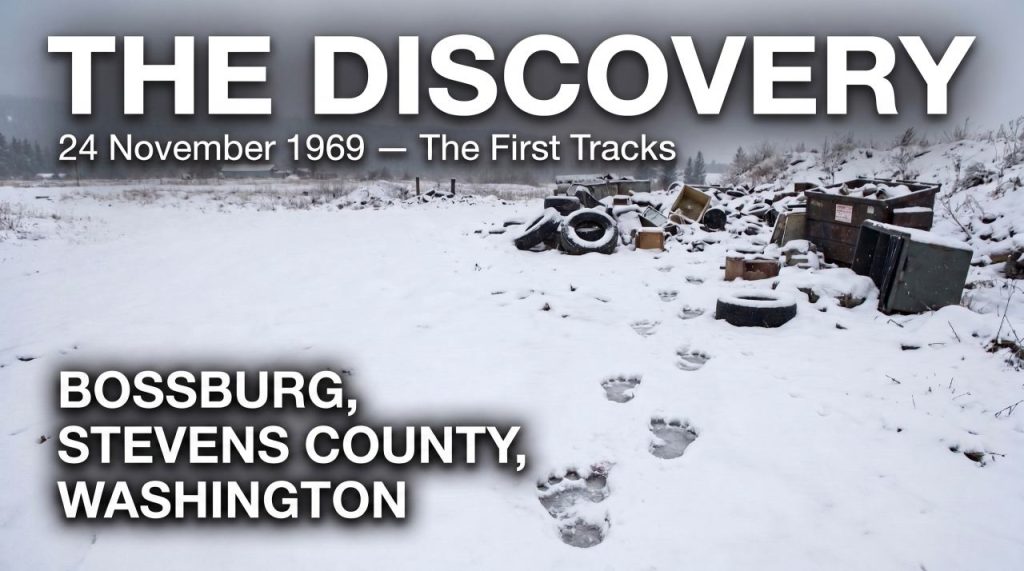
The story of Cripplefoot began not deep within the wilderness, but near an unlikely location, a garbage dump outside the small Washington community of Bossburg.
On 24 November 1969, local butcher Joe Rhodes discovered a series of enormous footprints in the snow near the dump area.
At first, the discovery appeared to be another report of unusual tracks in the Pacific Northwest, a region already becoming closely associated with stories of a mysterious creature known as Bigfoot.
However, these footprints contained something that immediately separated them from many previous Sasquatch reports.
They were not simply large. One of the footprints appeared to be badly deformed.
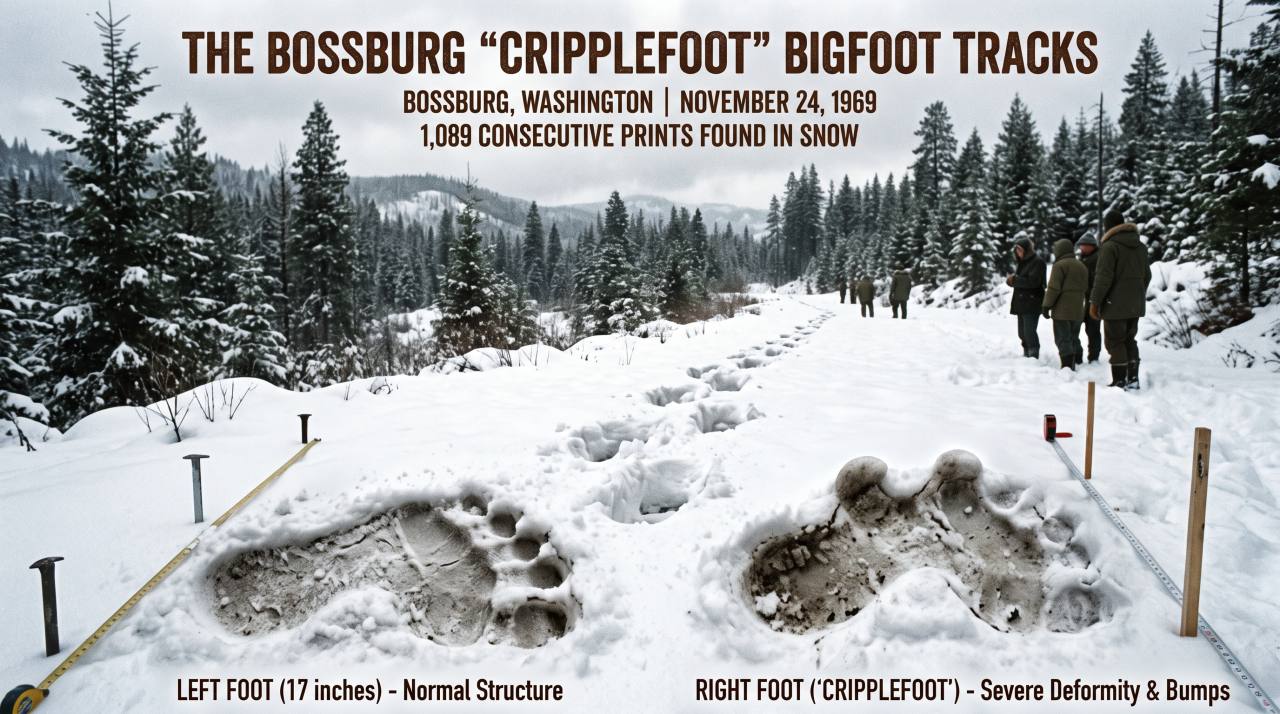
The trackway showed impressions far beyond the size of an ordinary human footprint, measuring approximately 17–18 inches in length.
The prints displayed a broad, human-like appearance, but it was the right footprint that captured the attention of investigators.
Unlike the normal-looking left footprint, the right impression appeared twisted and irregular, showing unusual bulges along the outer edge, displaced toe impressions, and an altered pattern of pressure through the foot.
To those examining the tracks, it appeared as though whatever had created them was walking with a significant injury or deformity.
The unusual footprint soon gained a nickname among Bigfoot researchers and enthusiasts:
“Cripplefoot.”
The name reflected the central mystery of the case, not just the possibility of an unknown creature leaving enormous tracks, but the possibility that the creature itself may have been injured or physically abnormal.
The location also made the discovery unusual.
Unlike many famous Bigfoot reports that originated deep within remote forests, the Bossburg tracks were found close to human activity.
This immediately raised questions from both investigators and sceptics. Was this evidence of an unknown animal moving through a populated area, or could there be another explanation?
As news of the discovery spread, Bigfoot researchers travelled to Bossburg to document what remained of the unusual footprints before the evidence disappeared.
Among those who arrived was Canadian Sasquatch researcher René Dahinden, whose investigation would transform a strange local discovery into one of the most famous footprint cases in Bigfoot history.
The Investigation Begins
René Dahinden Arrives — 27 November 1969
News of the unusual footprints quickly spread through the growing Sasquatch research community.
Within days, one of Canada’s most experienced Bigfoot investigators, René Dahinden, travelled to Bossburg to examine the evidence firsthand.
Dahinden was already well known within Sasquatch research circles. Having investigated numerous reports across the Pacific Northwest, he understood the importance of documenting unusual physical evidence before it was damaged or lost.
By the time he arrived on 27 November, however, the original site had already attracted attention from curious visitors. Many of the footprints had been disturbed, making careful documentation even more important.
Dahinden photographed the remaining impressions and produced plaster casts of the best-preserved examples, including the unusual right-foot deformity that would later make the case famous.
Experienced Investigators Join the Search
Dahinden was not alone in examining the Bossburg evidence.
Among those involved was Bob Titmus, a Canadian wildlife filmmaker and experienced Sasquatch investigator. Titmus had spent years documenting alleged Bigfoot evidence and was regarded as one of the leading field researchers of the period.
Also involved was John Willison Green, a Canadian journalist and author who had become one of the most prominent chroniclers of Sasquatch reports. Green’s writing helped bring many Pacific Northwest Bigfoot investigations to a wider audience.
Together, these investigators helped transform what began as a local footprint discovery into a serious investigation within the Sasquatch research community.
The Search Expands
As investigators continued examining the Bossburg area, attention turned from the original damaged footprints to the possibility that more evidence could be found nearby.
Dahinden and local trapper Ivan Marx investigated an area where a bait site had reportedly been established, with meat placed in an attempt to attract the unknown animal believed to have left the tracks.
It was during this search that the investigation took a dramatic turn.
According to accounts from the investigators, Marx discovered a fresh trail of enormous footprints crossing the snow-covered landscape.
What began as a single strange footprint discovery had now become something far larger.
A reported 1,089-print trackway was waiting to be documented.
The 1,089-Print Trail
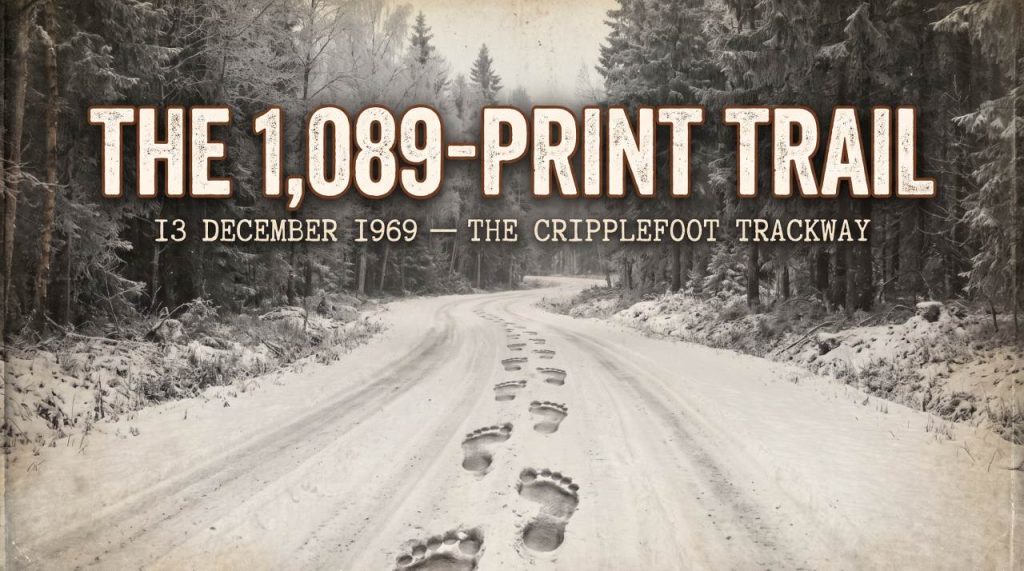
13 December 1969 — The Cripplefoot Trackway
The discovery of the extended trackway transformed the Bossburg case from an unusual footprint report into one of the most famous physical evidence cases in Bigfoot history.
What had begun with a single unusual footprint near a rural Washington dump had now become something far more extraordinary, a reported trail stretching across the winter landscape for more than a thousand consecutive steps.
On 13 December 1969, René Dahinden and local trapper and Bigfoot researcher Ivan Marx were investigating the Bossburg area when they reportedly encountered a fresh line of footprints in the snow.
According to accounts from those involved, the trail consisted of approximately 1,089 individual footprints, following the path of an unknown track maker across snow-covered terrain.
The discovery immediately raised the importance of the case. A single unusual footprint could be questioned, misunderstood, or even dismissed. However, a long trackway offered investigators something different: a repeated pattern that could be studied over distance.
The footprints reportedly showed the same unusual characteristics seen in the earlier Bossburg discovery.
The left footprint appeared large and human-like, measuring approximately:
- 17½ inches in length
- around 6½ inches wide at the ball of the foot
- approximately 5½ inches across the heel
The right footprint displayed the feature that had made the case famous — the apparent deformity that gave the unknown track maker its nickname:
“Cripplefoot.”
Investigators reported that the right foot showed a consistent abnormal pattern, including:
- an altered foot angle,
- unusual outer bulges,
- displaced toe impressions,
- and a distinctive walking pattern.
For researchers examining the evidence, this was the key mystery.
The question was no longer simply:
“Could someone make a large fake footprint?”
Instead, it became:
“Could someone reproduce the same abnormal footprint pattern over more than one thousand consecutive steps?”
A Trail Across the Landscape
The reported trackway crossed a variety of terrain, adding to the fascination surrounding the case.
Investigators documented the trail passing through areas including:
- snow-covered ground,
- a river area,
- a railroad crossing,
- a roadway,
- and a fence approximately 43 inches high.
At one reported fence crossing, investigators claimed that hairs were found caught on barbed wire, which they believed may have been left behind by the animal responsible for the tracks.
The trail also appeared to show a natural walking route rather than a random series of isolated impressions. For those who believed the evidence was genuine, the consistency of the trackway was one of the strongest arguments in favour of an unknown creature.
However, sceptics would later question whether the same features that impressed investigators could also have been deliberately created by a skilled hoaxer.
Why the Trackway Became So Important
The Bossburg case gained attention because it combined several unusual elements rarely seen together in Bigfoot investigations:
- a large number of footprints,
- a repeated abnormal gait pattern,
- physical casts and photographs,
- experienced field investigators,
- and later examination by scientists.
For many Bigfoot researchers, the Cripplefoot trail represented one of the strongest footprint cases ever documented.
For sceptics, however, the same evidence raised difficult questions about documentation, human involvement, and whether a carefully constructed hoax could imitate a biological footprint pattern.
The discovery of the 1,089-print trail ensured that Bossburg would become one of the most debated Sasquatch cases of the 20th century, a mystery that would soon attract the attention of scientists interested in the anatomy and mechanics behind the strange footprints.
The Anatomy of Cripplefoot
A Footprint Unlike Any Other
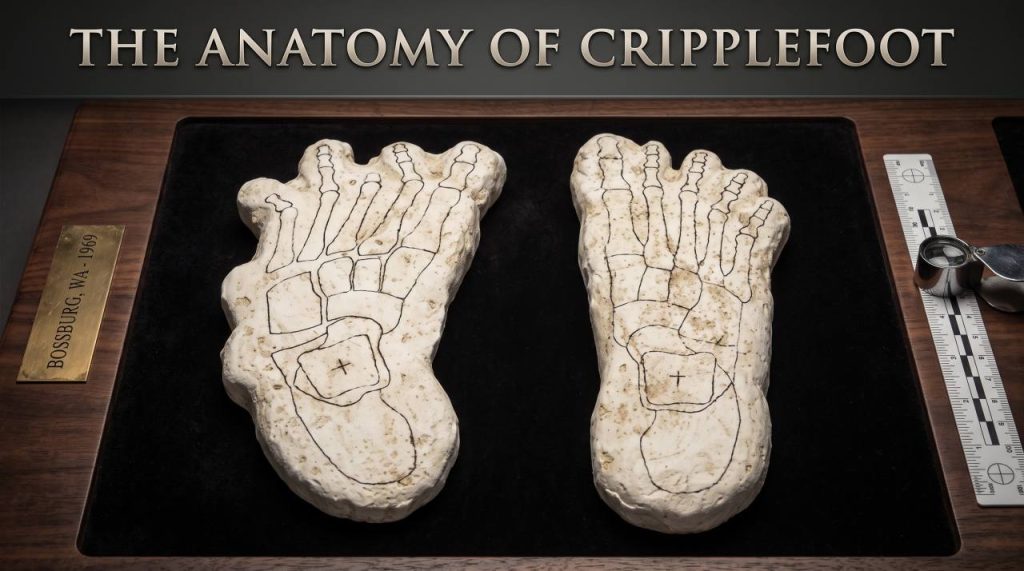
The most unusual aspect of the Bossburg tracks was not their size alone, but the apparent mechanics behind them.
Large footprints had been reported in many Bigfoot investigations, but the Cripplefoot tracks attracted attention because they appeared to show the movements of a foot that was physically abnormal.
The right footprint did not simply appear smaller, larger, or differently shaped than the left. Investigators believed it showed signs of a distorted walking pattern, as though the track maker was carrying an injury or lifelong deformity.
The impression appeared to show several unusual features:
- an altered angle of the foot,
- uneven pressure distribution,
- a rotated appearance,
- and an abnormal arrangement of the toe impressions.
Rather than a normal foot pressing evenly into the snow, the right track seemed to suggest a foot moving through the walking cycle differently from the left.
This created one of the central mysteries of the case.
If the footprints were genuine, what could have caused such an unusual gait?
Researchers considered whether the pattern could represent an injury, congenital deformity, or another physical abnormality affecting the creature’s movement.
The nickname “Cripplefoot” came from this interpretation, the idea that the unknown track maker may have been an injured or disabled individual moving through the landscape.
The Gait Pattern Question
For investigators, the most important feature was not one isolated footprint, but the repetition of the same abnormal pattern throughout the trackway.
A footprint can be misleading when viewed alone. Snow conditions, terrain, and pressure can all alter an impression.
However, a long series of tracks provides additional information.
Investigators studying Cripplefoot focused on whether the right-foot abnormality appeared consistently over many steps:
- Did the foot continue to rotate in the same direction?
- Did the same areas of the foot carry pressure?
- Did the stride suggest compensation for an injury?
- Could the unusual pattern be reproduced naturally?
These questions moved the Bossburg case beyond a simple debate about footprint size.
The central issue became one of biomechanics, the relationship between the structure of a foot and the way an animal moves.
A Challenge for Hoax Explanations
The unusual anatomy also became the strongest argument used by researchers who believed the tracks deserved serious consideration.
Creating a large artificial footprint was one thing.
Creating a large footprint that appeared to represent a specific physical abnormality, then maintaining that same abnormal walking pattern over an extended trackway, was a much more complicated challenge.
This was the aspect of Cripplefoot that attracted the attention of scientists.
The question was no longer simply whether someone could make a Bigfoot-shaped footprint.
It was whether someone could reproduce the mechanics of a damaged foot.
The unusual anatomy of the Bossburg tracks would eventually lead the case beyond the world of field investigators and into scientific examination.
Among those who studied the evidence was British primatologist Dr John Napier, whose analysis of the casts would become one of the most frequently discussed aspects of the entire Cripplefoot mystery.
Scientific Examination
John Napier’s Analysis
The Primatologist Who Studied Cripplefoot
The Bossburg tracks gained a new level of attention when the evidence was examined by Dr John Napier, a British primatologist and one of the most respected experts to study alleged Sasquatch evidence.
Napier was not a field investigator searching for proof of Bigfoot. His interest was focused on anatomy, locomotion, and the mechanics of movement.
As a scientist who had studied primates and human evolution, he approached the Cripplefoot casts from a different perspective, not simply asking whether the tracks were mysterious, but whether the physical characteristics of the footprint were anatomically consistent.
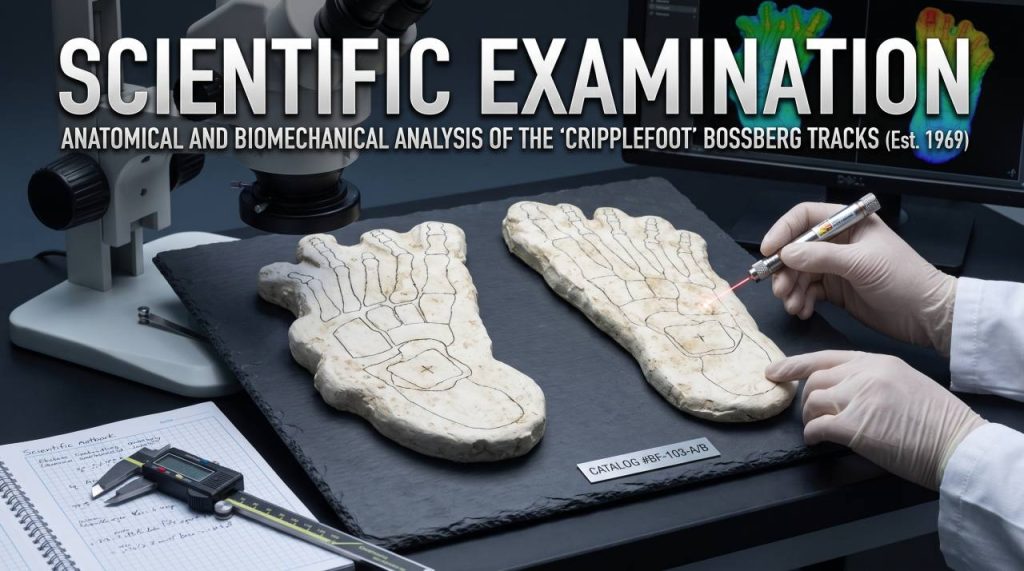
Napier examined photographs and plaster casts of the unusual right footprint, paying particular attention to the features that had made the Bossburg case famous:
- the apparent rotation of the foot,
- the unusual toe alignment,
- the distribution of pressure through the print,
- and the relationship between the damaged right foot and the normal-looking left footprint.
His analysis led him to suggest that the impression showed characteristics consistent with a serious foot abnormality, comparing the pattern to a condition known as talipes equino-varus, commonly referred to as clubfoot.
This condition involves abnormal positioning of the foot, often causing the foot to turn inward and affecting the way a person or animal places weight while walking.
For Napier, the significance was not simply that the footprint looked unusual. It was that the apparent deformity seemed to be reflected through the mechanics of the track.
A convincing fake footprint would need to reproduce not only the shape of a damaged foot, but also the way that foot would interact with the ground during movement.
Napier argued that the repeated characteristics of the Cripplefoot impressions presented a difficult challenge for a simple hoax explanation.
He famously wrote:
“To conceive of a hoaxer so subtle… would be very difficult.”
However, Napier remained cautious in his conclusions.
He did not claim that the tracks proved the existence of Sasquatch. Instead, his argument was narrower: the footprints themselves appeared to show anatomical details that were difficult to explain as a casual fabrication.
The Bossburg case therefore represented an unusual situation in cryptozoological research, alleged evidence from an unknown creature being examined through the principles of comparative anatomy.
For many Bigfoot researchers, Napier’s analysis became one of the strongest arguments in favour of the tracks’ authenticity.
For sceptics, however, the question remained whether a skilled hoaxer could have produced an artificial footprint pattern convincing enough to mislead even experienced investigators.
The debate over Cripplefoot’s anatomy would continue, and another scientist would later examine the evidence from the perspective of anthropology and biomechanics: Dr Grover Krantz.
Grover Krantz’s Analysis
Anthropology, Biomechanics, and the Cripplefoot Mystery
Following John Napier’s examination of the Bossburg tracks, the evidence also attracted the attention of Dr Grover Krantz, an anthropologist at Washington State University who became one of the most well-known scientific researchers to study Bigfoot reports.
Krantz approached the Cripplefoot evidence from the perspective of human anatomy, evolution, and biomechanics, the study of how bones, muscles, and body structure influence movement.
Where Napier focused primarily on the apparent deformity of the footprint itself, Krantz was particularly interested in what the entire trackway suggested about the creature’s movement.
For Krantz, the most important aspect of Bossburg was not simply the size of the footprints, but the consistency of the walking pattern.
A single unusual footprint could potentially be explained by many factors:
- unusual pressure in the snow,
- distortion of the ground surface,
- or a misleading impression.
However, a trackway extending for hundreds of steps provided a much larger dataset.
Krantz examined whether the repeated characteristics of the footprints suggested a consistent gait pattern.
The apparent abnormality of the right foot appeared to continue throughout the trail, raising the question of whether the tracks represented a genuine individual with a physical impairment.
The central issue became one of biomechanics:
Could an artificial footprint reproduce the movement of a living creature?
A hoaxer could potentially create a large footprint impression, but according to researchers who supported the authenticity of the tracks, maintaining the same abnormal gait pattern over a reported 1,089 footprints would be considerably more difficult.
Krantz argued that the trackway appeared to show the mechanics of a real walking subject rather than a series of unrelated impressions.
However, like Napier, Krantz did not claim that the Bossburg tracks represented definitive proof of Sasquatch.
His argument was focused on the evidence itself, that the footprints displayed characteristics that deserved serious analysis and were not easily dismissed as a simple mistake or crude fabrication.
This distinction became an important part of the Bossburg debate.
The supporters of the tracks argued that the combination of:
- the large trackway,
- the repeated deformity,
- and the apparent gait pattern
made Cripplefoot one of the most compelling footprint cases in Bigfoot history.
Critics, however, questioned whether the same features that fascinated researchers could have been deliberately created, especially when considering the wider controversies that later surrounded some of the individuals involved in the case.
The scientific examination of Cripplefoot had shown why the footprints captured so much attention, but it had not resolved the larger mystery.
Were the Bossburg tracks the impressions of an unknown creature moving through Washington snow, or one of the most sophisticated footprint hoaxes ever created?
That question would continue to define the legacy of the Cripplefoot case.
The Problems With Bossburg
Controversy, Hoax Claims, and Unanswered Questions
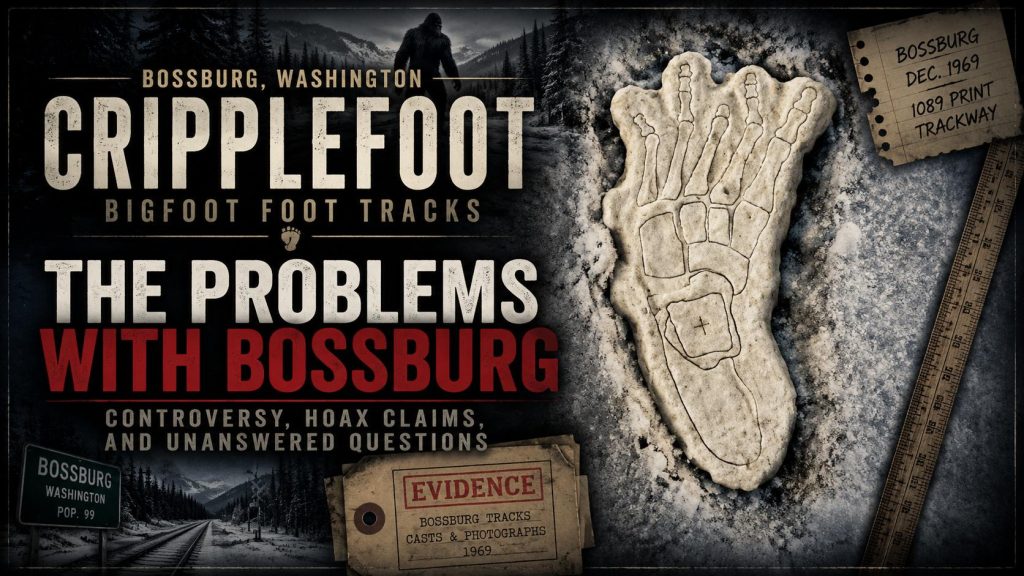
Despite the attention from experienced investigators and scientific examination by researchers such as John Napier and Grover Krantz, the Bossburg Cripplefoot case has remained controversial.
The unusual anatomy of the footprints made the case fascinating, but the wider circumstances surrounding the evidence created questions that have continued for decades.
For many critics, the biggest challenge was not simply the footprints themselves, it was the people, documentation, and events surrounding the investigation.
Ivan Marx and the Later Controversies
Ivan Marx remains one of the most important and complicated figures in the Bossburg story.
During the original investigation, Marx was involved in the discovery of the extensive 1,089-print trackway alongside René Dahinden. His role places him directly within the early history of the case.
However, Marx’s reputation later became controversial because of other Bigfoot claims he promoted during the 1970s.
In 1970, Marx announced that he had filmed the creature responsible for the Bossburg tracks. The footage was presented as showing the “Cripplefoot” Sasquatch, attracting interest from researchers and the wider Bigfoot community.
However, when other investigators examined the claims surrounding the film, serious questions emerged.
Researcher Peter Byrne, among others, investigated aspects of the footage and argued that inconsistencies existed between Marx’s description of the event and what appeared in the film. The footage was subsequently considered by many researchers to be a staged production.
The controversy damaged confidence in Marx among some members of the Bigfoot research community.
However, an important distinction remains:
The later film controversy does not automatically prove that the original 1969 Bossburg footprints were fabricated.
The debate remains whether:
- Marx’s later claims affected perceptions of the original evidence,
- or whether they reveal deeper problems with the entire Bossburg investigation.
The Joe Metlow “Captured Bigfoot” Claim
The Bossburg story became even more complicated in early 1970 when prospector Joe Metlow claimed that he had captured a living Sasquatch connected to the Cripplefoot mystery.
Metlow reportedly claimed:
- that a living creature had been captured,
- that evidence existed,
- and that a frozen Bigfoot foot could be viewed.
The claims attracted considerable attention, with reports of financial interest and potential buyers.
However, no verified evidence was ever produced.
The incident became another controversial chapter surrounding Bossburg, adding sensational claims to an already heavily debated case.
Questions About The Evidence
Beyond the controversies involving individuals, critics have raised several questions about the physical evidence itself.
Chain of Custody
Unlike modern scientific investigations, the documentation of the Bossburg evidence was informal by today’s standards.
Casts, photographs, and observations were distributed among private researchers rather than preserved through a formal scientific archive.
This creates challenges when attempting to independently evaluate historical evidence decades later.
Could The Tracks Have Been Hoaxed?
The central sceptical argument is that the unusual nature of the tracks may not necessarily prove authenticity.
Critics have suggested possible explanations including:
- specially constructed artificial feet,
- deliberate creation of an abnormal footprint,
- careful planning of the extended trackway.
The question is not whether someone could create a large footprint.
The question is whether someone could maintain the same unusual pattern across a reported 1,089-step trail.
The Unresolved Debate
The Bossburg case remains difficult because the evidence contains elements that support both interpretations.
Those who believe the tracks were genuine point to:
✓ the consistency of the abnormal footprint pattern
✓ the size and length of the trackway
✓ examination by experienced investigators
✓ the interest shown by Napier and Krantz
Those who remain sceptical point to:
✓ lack of biological evidence
✓ informal documentation methods
✓ later controversies involving key figures
✓ the possibility of deliberate deception
Ultimately, the Bossburg Cripplefoot tracks remain one of the most fascinating examples of how difficult unusual evidence can be to evaluate.
The case is not remembered because it produced a definitive answer.
It is remembered because it created a scientific and historical debate that continues more than half a century later.
Cryptid Legends Evidence File Details:
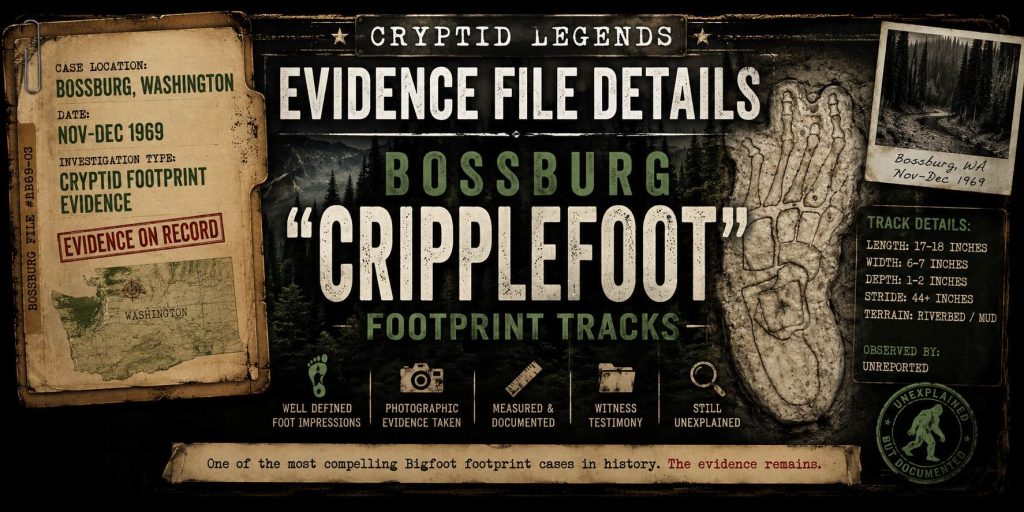
Case Type: Footprint Evidence
Creature: Sasquatch / Bigfoot
Location: Bossburg, Washington, USA
Date: November–December 1969
Primary Witnesses:
Joe Rhodes, René Dahinden, Ivan Marx
Investigators:
Bob Titmus, John Willison Green, Grover Krantz, John Napier
Evidence Type:
Plaster casts, photographs, trackway analysis
Scientific Interest:
⭐⭐⭐⭐☆
Unusual footprint anatomy and biomechanical interpretation
Documentation:
⭐⭐⭐⭐☆
Extensively discussed and examined, but surviving evidence documentation is informal by modern standards
Verification:
⭐⭐⭐☆☆
A historically important case with disputed interpretation
Skeptical Issues:
⭐⭐⭐⭐☆
Later controversies, lack of biological evidence, and questions surrounding possible fabrication
Cryptozoological Importance:
⭐⭐⭐⭐⭐
One of the most famous and debated Bigfoot footprint cases ever recorded