Could 1960s Costume Technology Have Created Bigfoot’s “Patty”? Hollywood’s Ape Suits Before the Patterson–Gimlin Film
Hollywood’s Ape Suits Before the Patterson–Gimlin Film
For almost sixty years, the Patterson–Gimlin Film has remained one of the most controversial pieces of footage in the history of cryptozoology.
At the centre of the debate is the figure itself, the large, dark, hair-covered creature commonly known as “Patty” — and one deceptively simple question:
Was Patty a living, unknown primate… or a person wearing a costume?
One of the most persistent objections to the costume hypothesis is that Hollywood simply could not have produced anything resembling Patty in 1967. But that argument often relies on cherry-picking the worst-looking ape and gorilla suits of the era.
The reality is considerably more interesting.
1967 was not the beginning of ape-costume technology.
Long before Roger Patterson raised his 16mm camera at Bluff Creek, filmmakers had already been putting human performers inside full-body gorilla costumes, constructing masks, applying artificial hair, building padding and creating increasingly convincing creatures for the screen.
In fact, by the time Patterson and Bob Gimlin filmed their famous encounter in October 1967, Hollywood had been experimenting with ape and creature costumes for decades.
And the timeline becomes particularly intriguing.
In 1953, professional gorilla performer George Barrows appeared in Robot Monster wearing a suit he had helped create himself.
Just one year later, Barrows would appear as Goliath in Gorilla at Large — a production that gives us an unusually useful glimpse at what a dedicated gorilla costume could actually look like more than a decade before Patty.
Then there was Godzilla in 1954, demonstrating another side of the rapidly developing art of the man-in-suit creature.
And by 1967, the year Patty was filmed, commercial costume manufacturers were producing dedicated gorilla suits for sale, while production was already underway on what would become Planet of the Apes.
That chronology matters.
Planet of the Apes is often brought into the Patterson–Gimlin debate as an example of how sophisticated Hollywood ape makeup had become, but the first film was not released until 1968. Production had already begun in May 1967, however, placing its development directly within the same technological era in which Patty appeared.
So perhaps the better question is not:
“Could anyone make a convincing ape suit in 1967?”
We already know the answer to that.
They could.
The more difficult question is whether the materials, construction techniques and costume-making expertise available at the time could have been combined to create the particular figure we see walking across that Bluff Creek sandbar, and whether a regular person, rather than a major Hollywood studio, could have produced or modified a commercially available gorilla or ape costume to create something resembling the Patty we know today.
Could a conventional gorilla costume have been modified?
Could its fur have been altered to produce Patty’s unusually smooth, close-laid appearance?
Could the shoulders have been enlarged and the arms extended?
Could a mask have been reshaped and concealed beneath facial hair?
And perhaps most intriguingly of all:
Could a costume that looks remarkably ordinary in a close-up photograph become something far more convincing when filmed from a distance on grainy 16mm film?
These questions do not prove that Patty was a costume.
But they do challenge one of the simplest arguments against the hoax hypothesis: that the technology simply wasn’t there.
To investigate that question, we need to step back from Bluff Creek and look at what Hollywood, professional performers and commercial costume makers were actually building before Patty ever walked into the frame.
🦍 2. Robot Monster (1953): George Barrows and the Professional Gorilla Performer

Before Patty ever appeared at Bluff Creek, there was George Barrows, a specialist gorilla performer whose career provides an intriguing glimpse into the world of ape costumes more than a decade before the Patterson–Gimlin Film.
Barrows is best remembered for his appearance as Ro-Man in the notoriously low-budget 1953 science-fiction film Robot Monster.
The character was supposed to be a robotic alien from the Moon, but the production’s tiny budget created an unusual solution: rather than building or renting the intended robot costume, director Phil Tucker turned to his friend Barrows, who already possessed something much more useful, a gorilla suit he had made himself.
The production added a space helmet, transforming the otherwise unmistakably simian-looking costume into the bizarre Ro-Man.
That detail is easy to overlook, but it is important to our investigation.
Barrows wasn’t simply an actor who happened to be put inside a studio costume. He had constructed his own gorilla suit.
And Robot Monster was hardly a lavish Hollywood production. The film was made extraordinarily quickly and on a very small budget, with most of its locations around Los Angeles and Bronson Canyon.
The finished production became famous for its unconventional monster, but behind the ridiculous-looking Ro-Man was something considerably more relevant to our question: a wearable gorilla costume already existed independently of the film’s production.
🎭 The professional “gorilla man”
Barrows belonged to a fascinating niche of mid-century entertainment: performers who specialised in appearing as apes and gorillas for films, television and live entertainment.
This was not necessarily the same thing as the elaborate creature-effects departments we associate with modern Hollywood. A specialist performer could own or construct a costume and then use it across different productions.
Barrows subsequently returned to gorilla work in films including Gorilla at Large (1954), Black Zoo (1963), The Ghost in the Invisible Bikini (1966) and Hillbillies in a Haunted House (1967), as well as numerous television appearances.
His gorilla work was therefore not a one-off experiment for Robot Monster, it was a recurring part of his professional career.
This is significant because it demonstrates that the manufacture and operation of ape costumes was already a specialised skill well before the 1960s.
And there is another intriguing detail.
According to later accounts of Barrows’ career, the gorilla suit he built was used not only for Robot Monster, but also for Gorilla at Large and other productions. The suit is now reported to be held in the collection of the Natural History Museum of Los Angeles County.
🧵 A costume didn’t necessarily require a major studio
This is perhaps the most important lesson we can take from Barrows.
When people discuss the possibility of Patty being a costume, the comparison is often framed around major Hollywood productions, elaborate studios, specialist makeup departments and expensive effects.
But Barrows provides a different example.
Here was a professional performer who had made his own gorilla suit, which could then be used in multiple productions.
That doesn’t mean his suit looked like Patty. In fact, Robot Monster gives us a deliberately exaggerated and almost comic version of an ape costume because of the added helmet and the film’s deliberately strange design.
But the underlying fact remains: a person outside the enormous machinery of a major effects production was capable of constructing and operating a full-body gorilla costume suitable for professional screen work in 1953.
And that brings us to an even more interesting film.
Just one year later, George Barrows would return to the screen as Goliath, the giant gorilla, in Gorilla at Large.
This time there was no robot helmet to disguise the costume.
Instead, we can see the gorilla suit itself.
And when we examine Goliath closely, the comparison with Patty becomes considerably more interesting.
Because suddenly we’re no longer asking whether somebody in 1967 could have imagined a furry humanoid creature.
We’re looking at a professionally filmed gorilla costume from 1954, thirteen years before the Patterson–Gimlin Film, and asking what its construction, fur, face, proportions and overall appearance can tell us about what was realistically achievable before Patty ever entered the picture.
That is where Goliath becomes our next case study.
🦍 3. Gorilla at Large (1954): The Comparison That Deserves a Closer Look

If there is one film that deserves considerably more attention in discussions about whether a 1960s costume could have produced something resembling Patty, it may be Gorilla at Large (1954).
It is not as famous in the Bigfoot debate as Planet of the Apes. It does not have the cultural status of King Kong. And it certainly doesn’t carry the technological mystique of Godzilla.
But visually, Goliath the Gorilla may be one of the more interesting comparisons of all.
George Barrows once again performed inside a gorilla costume, this time portraying Goliath, the star attraction of a California amusement park.
The film was produced by Panoramic Productions and distributed by 20th Century Fox, and was photographed in Technicolor and 3-D. Barrows’ performance was not a brief background appearance either: Goliath is an important part of the film’s story and appears throughout its major sequences.
And when Goliath is viewed today, something immediately stands out.
This does not look like the crude, cartoonish ape costume that is sometimes presented as representative of what was possible in the 1950s.
It certainly isn’t a real gorilla, and it isn’t indistinguishable from one. Contemporary and retrospective observers have described the costume as stylised and somewhat cartoonish, and its oversized hair and facial design are unmistakably products of their era.
But that is precisely why it is useful to our investigation: despite those limitations, Barrows creates a large, imposing humanoid animal figure that works remarkably well within the film.
👁️ Look Beyond the Gorilla
The most interesting comparison with Patty isn’t whether Goliath looks exactly like a real gorilla.
He doesn’t.
The question is whether the underlying construction concept looks radically different from what would have been required to produce Patty.
For me, this is where the comparison becomes particularly striking.
Goliath already possesses several of the basic visual characteristics that make Patty so distinctive:
- a completely fur-covered humanoid body
- a large, powerful upper torso
- pronounced shoulders
- long-looking arms
- large hands and feet
- a dark, continuous coat of hair
- a head and face designed to obscure the human performer underneath
- and, most importantly, a silhouette that reads immediately as a large bipedal creature rather than an ordinary human being.
None of those characteristics proves anything about Patty’s construction.
But they do make it difficult to maintain that the basic visual concept was beyond the capabilities of costume makers in the 1950s or 1960s.
And there is another reason Gorilla at Large deserves attention.
🖤 The Face
Goliath’s face is perhaps more relevant to the Patty comparison than it first appears.
The face is not simply a human face placed inside a furry hood. It has been constructed to produce the impression of an animal head, with the human performer concealed behind a combination of mask, hair and shadow.
The eyes are particularly important.
Seen under the heavy brow and surrounding dark material, they can appear remarkably deep and dark on screen. The effect is very different from looking at an ordinary person wearing a furry suit with an obvious pair of human eyes staring through two holes.
That distinction matters when considering Patty.
Patty’s face has long been one of the most debated aspects of the Patterson–Gimlin Film. Rather than displaying an obviously human face surrounded by fur, the figure appears to have a relatively broad, dark and heavily obscured facial area, with the eyes sitting deep within the surrounding hair.
Whether that appearance comes from anatomy, a mask, lighting, shadow or some combination of those factors remains an open question.
But Gorilla at Large demonstrates that costume designers were already using essentially the same basic principle: hide the human face, reshape the visible head and allow hair and shadow to do part of the work.
And that is a considerably more relevant comparison than simply pointing to the most obviously fake gorilla costume one can find.
🧍 The Silhouette
The same applies to the body.
Goliath was designed to be imposing. Barrows’ body disappears beneath the costume, creating a much broader upper torso than an ordinary man would naturally possess.
That is important because one of the recurring observations about Patty is the apparent width and mass of the shoulders and upper back.
A costume does not necessarily need to reproduce every anatomical feature independently.
A human performer can be made to look substantially larger simply by changing the silhouette around the body.
Padding, enlarged shoulder structures, additional material around the torso and carefully arranged hair can all change the apparent proportions of the person underneath.
This is where the distinction between “Can a costume create a creature?” and “Can a costume create a convincing illusion of a creature?” becomes important.
The latter was already being done.
🧵 And Then There Is the Fur
Perhaps the biggest visual difference between Goliath and Patty is the treatment of the hair.
Goliath has the unmistakable appearance of a traditional movie gorilla. The fur is relatively abundant and the overall styling is deliberately theatrical.
Patty, by contrast, appears to have an unusually smooth, close-laid coat.
The hair does not seem excessively fluffy or teased. Instead, it follows the contours of the body in a relatively uniform layer, contributing to the figure’s strange, almost naturalistic appearance.
That difference might initially seem to argue against a conventional gorilla costume.
But it could also raise another possibility:
What happens if the same basic artificial fur is finished differently?
Brushing, grooming, trimming, layering and arranging synthetic or animal hair can substantially alter its appearance. A costume designed to look like a theatrical gorilla does not necessarily have to remain in that finished state.
This becomes particularly interesting when we later examine the claims made by commercial costume manufacturer Philip Morris, who recalled that fur on the alleged Patterson suit could be brushed down to change its appearance.
That claim is retrospective and should not be treated as proof of what happened at Bluff Creek.
But it gives us a historically relevant question to investigate:
Could a conventional commercial gorilla costume have been cosmetically altered enough to produce something considerably less “gorilla-like”?
🔧 How Much Modification Would Actually Be Necessary?
This is where the Gorilla at Large comparison becomes especially provocative.
If someone started with a commercially available gorilla costume in the 1950s or 1960s, would they have needed to invent an entirely new creature from scratch?
Probably not.
At least in principle, the basic costume could provide a starting point.
The hypothetical process might look something like this:
Commercial gorilla suit → Alter the facial treatment → Add or rearrange facial hair → Conceal the eyes and mouth more effectively → Lay the fur down rather than leaving it heavily fluffed → Increase shoulder and upper-body bulk → Alter the apparent proportions of the arms → Modify or disguise hands and feet → Conceal seams, fasteners and other costume features
The result would no longer need to look like the original stock gorilla.
It would be a modified creature costume built upon an existing gorilla-suit foundation.
And that distinction is crucial.
The costume hypothesis does not necessarily require Patterson or someone working with him to have possessed the resources of 20th Century Fox.
If a commercially produced gorilla suit could already provide the basic body, fur and mask, then the question becomes much more modest:
Could an ordinary person with enough time, materials and practical ingenuity have altered it?
That is a very different question from whether someone could have designed and manufactured an entire creature from nothing.
🎥 Why the Film Itself Matters
There is also the issue of presentation.
A costume viewed under bright studio lighting from several feet away is not necessarily going to look the same as that costume filmed outdoors, at a greater distance, through a 16mm motion-picture camera.
The Patterson–Gimlin Film is not a high-resolution close-up.
Patty is moving through a natural environment, surrounded by trees, vegetation, changing light and uneven terrain. The viewer does not get to walk around the figure and inspect its construction from every angle.
That doesn’t make the film meaningless.
Quite the opposite — the difficulty of interpreting the footage is precisely why it has remained controversial.
But it does mean that the visual conditions under which a costume is photographed have to be considered.
A costume that looks obviously artificial in a studio photograph may produce a very different impression when seen for a few seconds at distance, moving naturally through a wilderness setting.
⚖️ But Goliath Is Not Patty
There is an important limitation to this comparison.
Goliath does not reproduce Patty.
The gait is different. The proportions are different. The fur treatment is different. The facial construction is different. And the performance is unmistakably that of a professional gorilla character rather than the mysterious walking figure captured at Bluff Creek.
We should not pretend otherwise.
Nor should we take the fact that George Barrows was an accomplished gorilla performer as evidence that Patterson used his techniques.
That would be going far beyond the evidence.
What Gorilla at Large actually establishes is something more limited — but still significant.
By 1954, thirteen years before the Patterson–Gimlin Film, a professional performer could disappear inside a full-body gorilla costume and appear on colour film as a large, imposing, completely fur-covered humanoid creature.
And the costume was not created with 1960s technology.
It was already there in the 1950s.
That makes Gorilla at Large a particularly useful historical benchmark.
🦍 The Forgotten Comparison
Perhaps that is why this film deserves a closer look in the Patty debate.
When discussions turn to what could supposedly have been achieved in 1967, we often jump immediately to Planet of the Apes, King Kong or Godzilla, productions that involved very different designs, budgets and technical requirements.
But Gorilla at Large asks a simpler question.
What could a person actually look like when placed inside a dedicated gorilla costume more than a decade before Patty?
The answer is surprisingly interesting.
Goliath isn’t Patty.
But visually, the distance between the two is arguably much smaller than the popular “1960s costumes were too crude” argument suggests.
And if a stock gorilla costume could subsequently be modified by an individual rather than a major studio, the gap becomes smaller still.
That does not solve the Patterson–Gimlin mystery.
It simply removes one of the most persistent objections from the table.
A convincing ape-like humanoid costume was not beyond the technological capabilities of the era.
The question is whether somebody actually used those capabilities to create Patty.
That is where the investigation gets considerably more interesting.
🦖 4. Godzilla (1954): The Man-in-the-Suit Era
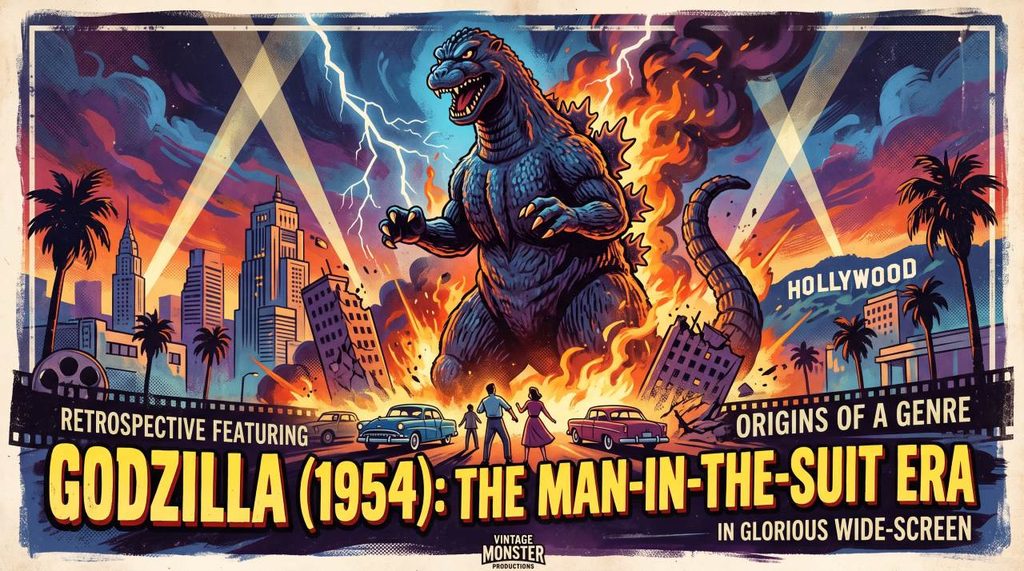
If Gorilla at Large demonstrates what could be achieved with a dedicated ape costume, Godzilla (1954) demonstrates something broader: by the middle of the 1950s, filmmakers were already capable of constructing large, full-body creature suits designed specifically to transform a human performer into something that bore little resemblance to an ordinary person.
Of course, Godzilla was not a gorilla.
And that distinction matters.
The original Godzilla suit was designed around an entirely different creature, a gigantic reptilian monster with a massive head, tail, dorsal plates and an exaggerated body shape. It therefore cannot be used as a direct comparison for Patty’s appearance.
But it is important evidence for the underlying technology.
🧵 Building a Creature Around a Human Body
The first Godzilla suit was not simply a person wearing a loose rubber costume.
Its construction involved an internal framework, including bamboo and wire components, covered with materials that provided the necessary bulk and structure. Cushioning and layers of latex and rubber were then used to create the monster’s external form.
The result was a wearable creature with a highly exaggerated silhouette, broad shoulders, enormous limbs, a huge head and a body shape that concealed the proportions of the performer underneath.
The suit was also extraordinarily heavy by modern standards, reportedly weighing around 100 kilograms.
That created its own problems.
The performer had to work inside a physically demanding costume while maintaining enough mobility to walk and perform the monster’s movements. Heat, weight and restricted visibility all became part of the practical challenge.
Yet the technique worked.
A human performer could be transformed into a creature whose proportions, surface texture and silhouette were fundamentally different from the person inside it.
That is the relevant point for our investigation.
🎬 The Importance of the Man-in-the-Suit
The significance of Godzilla is therefore not that the suit looked like Patty.
It doesn’t.
Nor does it demonstrate that somebody in northern California could have reproduced the Japanese production’s exact techniques in 1967.
Instead, it establishes an important historical precedent:
The basic concept of constructing a large creature around a human performer was already established in commercial cinema thirteen years before the Patterson–Gimlin Film.
And unlike a static monster prop or a stop-motion model, the performer inside the Godzilla suit was physically controlling the creature.
The monster could walk.
It could turn.
It could raise its arms.
It could interact with its environment.
It could perform continuously in front of a camera.
That is a fundamentally different technological achievement from simply building a model.
🦍 But Patty Was a Different Problem
There is an important distinction between creating a creature and creating a convincing imitation of a creature that is supposed to be physically real.
Godzilla was never intended to fool the audience into believing that a genuine giant reptile had been filmed. Its exaggerated appearance, miniature sets and destructive behaviour were part of the spectacle.
Patty is different.
The Patterson–Gimlin Film presents its subject as something that supposedly exists naturally in the wilderness.
That means a hypothetical Patty costume would have faced a different challenge.
It would not need to look like a movie monster.
It would need to look like an animal.
And that brings us back to the gorilla costumes.
The important historical progression is therefore not:
Godzilla → Patty
It is:
Professional gorilla costumes → increasingly sophisticated creature suits → commercially available costumes → possible modification into a more naturalistic humanoid animal.
By 1954, the first stages of that progression were already well established.
The question now becomes whether those developments continued into the 1960s, and, crucially, whether the necessary materials and expertise were available to ordinary people outside major Hollywood studios.
That leads us away from Godzilla and back toward the world of gorilla performers, independent productions and commercial costume manufacturers.
🦍 5. Other Gorilla & Ape Productions of the 1950s–60s

George Barrows and Gorilla at Large are not isolated examples.
Across the 1950s and 1960s, gorilla characters continued appearing in horror, science-fiction, comedy and adventure productions, often outside the enormous budgets and effects departments of major Hollywood productions.
That matters because the costume hypothesis does not require us to demonstrate that Hollywood’s most expensive studios could construct a convincing ape.
We need to establish something more practical:
Were gorilla costumes an established, reusable technology that could exist outside a major studio?
The answer appears to be yes.
🎬 Bride of the Gorilla — 1951
One of the earlier examples is Bride of the Gorilla, a 1951 American B-movie directed by Curt Siodmak.
The film follows a plantation manager who becomes a gorilla-like creature after being cursed, with the gorilla played by professional ape performer Steve Calvert.
AFI records the production as a relatively small-scale Jack Broder Productions picture, shot in only seven days according to Siodmak’s later account.
Calvert is particularly relevant because he belonged to the same specialist world as George Barrows: professional performers who made careers out of appearing as gorillas and other apes.
This is important context.
The gorilla costume was not necessarily something a major studio had to invent from scratch every time a script called for an ape. There were performers who already possessed the equipment, knew how to operate it and could be hired to perform inside it.
By the early 1950s, therefore, there was already a small but established entertainment niche surrounding the gorilla man.
🦍 Konga — 1961: A Particularly Important Example
If Bride of the Gorilla demonstrates the existence of the professional ape performer, Konga (1961) gives us something even more useful for the Patty question.
The British horror film featured a chimpanzee that is transformed into a giant ape. For the creature’s human-sized mutated form, the production did something remarkably straightforward:
It rented George Barrows’ gorilla costume.
Barrows himself did not travel to England to perform in it. Instead, producer Herman Cohen hired the costume and selected another actor, Paul Stockman, to wear it.
According to accounts of the production, Stockman was chosen largely because he was approximately six feet tall, the same height as Barrows, and therefore a suitable fit for the existing costume.
That is a fascinating detail.
It means the costume was not merely a one-off prop permanently attached to its original performer.
It was a piece of equipment that could be rented, transported and worn by another person.
In other words, the technology had become portable.
A gorilla costume could exist independently of the actor who created or normally wore it.
And that brings us significantly closer to the question at the heart of this investigation.
If a commercially or independently produced gorilla costume could be purchased, rented or otherwise obtained, then someone attempting to create a different creature would not necessarily have needed to manufacture every component themselves.
They could start with an existing platform.
🧑🔧 The Specialist Was Part of the Technology
There is another lesson hidden inside these productions.
The costume itself was only one part of the equation.
The performer mattered too.
George Barrows, Steve Calvert and others developed specialist skills in portraying gorillas because the challenge was not simply putting on a furry suit. The performer had to move in a way that sold the illusion.
Barrows continued appearing as gorillas throughout the following decade, including Black Zoo (1963) and Hillbillies in a Haunted House (1967). His work demonstrates that the role of the professional ape performer remained active right up to the period in which Patty was filmed.
This becomes particularly relevant when we eventually discuss one of the strongest objections to the costume hypothesis:
The gait.
A costume can provide the appearance of an animal, but it cannot walk by itself.
The person inside has to understand how to move.
That is why we will deliberately leave questions about Patty’s stride, posture and movement for a later section rather than pretending that costume construction alone solves the mystery.
🧵 From One Performer to a Reusable Costume
Taken together, these productions reveal something easy to miss when looking backwards from modern Hollywood.
During the 1950s and 1960s, the gorilla costume was not simply a piece of studio magic.
There were specialist performers, independent productions and reusable costumes circulating between productions.
A costume could be made by one person, worn by another and eventually rented to an entirely different production.
Konga is particularly revealing because George Barrows’ existing costume was effectively treated as a piece of production equipment. The filmmakers did not need to commission an entirely new gorilla from scratch. They needed a suitable performer who could fit the costume.
That is a very different technological proposition from designing a creature from nothing.
🦍 How Much Does This Actually Tell Us About Patty?
It still doesn’t prove anything about the Patterson–Gimlin Film.
None of these productions establishes that Patterson owned a gorilla costume. None demonstrates that Patty was constructed from one of these particular suits. And none explains the more difficult questions surrounding Patty’s movement and apparent anatomy.
But they do weaken a particular argument.
The idea that a person in 1967 would have needed access to a giant Hollywood effects department simply to obtain a convincing full-body ape costume does not fit comfortably with the historical record.
Gorilla costumes already existed as physical, reusable objects.
Professional performers worked inside them.
Independent and lower-budget productions used them.
Existing costumes could be transferred between performers and productions.
And specialists such as George Barrows continued working with them into the very decade in which Patty appeared.
So the technological question becomes increasingly specific.
It is no longer:
“Could somebody in 1967 make a gorilla costume?”
They clearly could.
It becomes:
“Could somebody have taken an existing gorilla costume and modified it enough to create a more naturalistic, human-sized, long-armed, broad-shouldered creature resembling Patty?”
That is a much more interesting question.
And fortunately, by the mid-1960s, there was another development that gives us an even better benchmark for what could be achieved.
Major Hollywood studios were now developing extraordinarily sophisticated ape faces, hair systems and prosthetic makeup.
That brings us to Planet of the Apes, and to a rather important problem with using the film as evidence that Patty was supposedly impossible.
🦍 6. Planet of the Apes (1968): The Timing Problem

There is perhaps no film mentioned more often in discussions of Patty and ape costumes than Planet of the Apes.
At first glance, it seems like an obvious comparison.
The original film, released in 1968, featured remarkably convincing apes played by human actors. The makeup was expressive, detailed and sophisticated enough to survive close-ups, a huge achievement for its time.
But there is an important problem with using Planet of the Apes as evidence that 1960s technology was too primitive to produce something like Patty.
The film was being made in 1967.
According to the American Film Institute, principal production took place from 22 May to early August 1967 in locations across Utah, Arizona and California. The Patterson–Gimlin Film was shot later that same year.
In other words, the famous ape makeup of Planet of the Apes wasn’t some technological breakthrough that arrived after Patty.
It belonged to essentially the same technological moment.
🎭 John Chambers Pushes Ape Makeup Forward
The man responsible for the film’s groundbreaking ape makeup was makeup artist John Chambers.
Chambers approached the problem differently from the traditional full-face masks and heavily built-up makeup that had characterised many earlier productions.
He studied real apes and experimented with prosthetic materials, ultimately developing lightweight facial appliances that could work with the actors’ own facial movements.
The result was remarkably expressive.
The actors could smile, speak, frown and react while retaining convincing simian facial characteristics.
Chambers’ work was so significant that he later received an Honorary Academy Award for his makeup achievement.
The production’s makeup operation was enormous: AFI records contemporary reports that the ape makeup could take several hours to apply, with a substantial portion of the film’s budget devoted to the work.
The Library of Congress similarly describes the ape makeup as one of the production’s major technical challenges, noting that the film was shot between May and August 1967 and that the prosthetics were both labour-intensive and time-consuming.
This is important context.
1967 was not a technological dark age.
Hollywood makeup artists were experimenting with foam latex, prosthetic appliances, lifecasting and specialised hair work at a very high level.
But there is an important distinction.
🧑🎨 Hollywood’s Ceiling Is Not the Same as Patty’s Requirements
The Planet of the Apes production had enormous advantages over anyone attempting to create a Bigfoot costume independently.
20th Century Fox had a major studio infrastructure.
John Chambers had a large team.
AFI records that nearly $1 million of the film’s approximately $5 million budget was being spent on makeup, while contemporary reports described a huge makeup operation involving dozens of artists.
That is obviously a completely different proposition from somebody modifying a commercially available gorilla suit in a workshop or garage.
We should therefore be careful not to make the argument:
“Planet of the Apes could make convincing apes, therefore Patterson could make Patty.”
That doesn’t follow.
The resources were radically different.
Instead, Planet of the Apes establishes something more limited and historically useful:
The technological capabilities available in 1967 were capable of producing highly convincing artificial ape characteristics.
That raises the technological ceiling.
It doesn’t tell us where an ordinary person’s ceiling was.
👁️ Masks Were Already Becoming More Sophisticated
The evolution of the ape face is particularly interesting.
Earlier gorilla costumes generally depended upon a larger, more conventional mask. The performer essentially disappeared behind a constructed animal head.
Chambers’ approach was much more sophisticated. Rather than simply placing a rigid animal face over the actor, the production used individually fitted prosthetic components that interacted with the actor’s own face.
The Los Angeles Times later described Chambers’ approach as using specially fitted simian appliances, including features such as eyebrows and lips, while studying real apes to reproduce their facial expressions.
That matters when considering Patty because it demonstrates how far the human-face-to-animal-face transformation had progressed by the year she was filmed.
But again, Patty presents a different problem.
The Planet of the Apes characters were deliberately recognisable as actors wearing makeup.
They needed to speak.
They needed to emote.
They needed to perform close-up dialogue scenes.
Patty supposedly needed to do none of those things.
If the costume hypothesis is correct, the performer only needed to create the impression of a large, silent, non-human animal moving through a forest.
That potentially changes the engineering problem considerably.
🧵 And Not Every Ape in Planet of the Apes Was Made the Same Way
There is another detail worth remembering.
The elaborate makeup seen on the principal ape characters was not necessarily representative of every ape appearing in the film.
Background performers could use simpler approaches because the camera did not need to examine their faces in the same detail.
That principle is relevant to our investigation.
A costume doesn’t have to survive a studio close-up if the circumstances of filming never provide one.
The Patterson–Gimlin Film gives us a figure viewed primarily at a distance, moving through a natural environment.
That doesn’t automatically make an artificial figure convincing.
But it means we shouldn’t judge the feasibility of the costume hypothesis solely by asking whether a hypothetical Patty suit would survive the kind of close inspection given to Dr. Zaius or Cornelius.
Those were entirely different filmmaking requirements.
📅 The Timing Is the Real Story
The most important fact about Planet of the Apes is therefore not its appearance.
It is its date of production.
The ape makeup was being developed and applied during 1967.
The film crew was shooting actors in ape makeup while the Patterson–Gimlin Film was still months away.
So when somebody points to Planet of the Apes and says:
“Look how sophisticated the ape makeup had become by 1968.”
there is an interesting response:
Yes — and much of that sophistication already existed in 1967.
The film’s February 1968 release date can make the technology appear slightly more distant from Patty than it actually was. But production had already begun in May 1967.
That puts the two events firmly within the same technological era.
🦍 What Does This Actually Prove?
Again, not that Patty was a Hollywood-quality prosthetic creation.
And certainly not that Patterson had access to John Chambers or 20th Century Fox’s makeup department.
What it demonstrates is something considerably more modest:
The technological frontier of artificial ape representation had advanced much further by 1967 than the simplest costume arguments imply.
There were professional gorilla performers.
There were reusable gorilla costumes.
There were commercial costume manufacturers.
There were specialist mask and prosthetic makers.
There were increasingly sophisticated synthetic hairs, padding systems and facial appliances.
And major studios were simultaneously pushing the limits of what could be achieved with practical ape makeup.
The important question is therefore becoming clearer.
We don’t need to establish that Patterson could have reproduced Planet of the Apes.
He didn’t need to.
If the costume hypothesis is correct, he only needed to create something convincing enough to appear, for a relatively brief period, as an unknown bipedal creature moving through the wilderness.
And that brings us to perhaps the most important question of the entire investigation:
What if he didn’t need to build the costume from scratch at all?
What if an existing commercial gorilla suit could provide the starting point?
By the 1960s, there was an American company specifically manufacturing such costumes.
Its name was Morris Costumes.
7. Morris Costumes: A Gorilla Suit Was Available in 1967

The historical argument becomes considerably more interesting when we move from Hollywood studios to something much more ordinary:
A commercial gorilla costume that could actually be bought.
By the middle of the 1960s, a person did not necessarily need access to a major film studio’s wardrobe department to obtain a full-body gorilla suit. There was already a small costume business in Charlotte, North Carolina, producing and selling them.
That business was Morris Costumes, founded by Philip and Amy Morris.
The company’s origins were considerably more modest than its later reputation might suggest. According to later accounts from the Morris family, Philip and Amy had accumulated costumes through their work in travelling ghost shows, circuses and entertainment.
By the mid-1960s, the couple were operating a costume business from their home in Charlotte. Amy was involved in sewing the costumes, while Philip’s background as a magician, performer and showman gave the business a natural connection to the theatrical and sideshow world.
A surviving account from the family places the formal founding of Morris Costumes in 1965, when the couple began renting costumes from the basement of their Charlotte home.
A 2017 obituary for Philip Morris likewise describes him and Amy opening a small costume-rental operation in their basement during the mid-1960s.
And gorilla costumes were not an incidental product.
They were part of the business’s roots.
From Magic Acts to Gorilla Suits
The reason is revealing.
Gorilla costumes had an established place in the entertainment industry, particularly in magic and carnival-style acts in which a performer could apparently transform into a gorilla.
Later accounts from the Morris family describe the couple making their own gorilla costumes because there was a market for them among entertainers who could not afford expensive Hollywood-built costumes.
Philip Morris subsequently described how the gorilla suits were made in the family’s basement operation, with Amy involved in sewing the fur-covered portions and Philip working on elements such as the feet and moulds.
The important point is not that every detail of the later family history can be independently reconstructed, it cannot, but that the Morris business itself genuinely grew out of a small, home-based costume operation rather than a major Hollywood effects department.
That matters enormously to the Patterson–Gimlin question.
Because the argument is no longer:
Could a Hollywood studio have built an artificial ape in 1967?
We have already established that it could.
The question becomes:
Could an ordinary customer have bought a gorilla suit from a specialist costume maker in 1967?
Here the evidence is much stronger.
According to the University of Texas’s historical compilation of ape suits, Morris and his wife were producing realistic gorilla and bear costumes and advertising them in show-business magazines in 1967. The same source gives a price of $435 for the gorilla outfit and $335 for the bear outfit.
That is a remarkable piece of context.
In the very year that Roger Patterson filmed Patty, a commercial gorilla costume was not merely theoretically possible.
It was being advertised for sale.
And this is where the story takes another turn.
The Philip Morris–Patterson Story
Philip Morris eventually claimed that one of his gorilla suits had actually been purchased by Roger Patterson.
But this part of the story requires a very different evidential standard.
Unlike the existence of Morris Costumes, the 1967 advertising, or the company’s history as a costume maker, the alleged Patterson transaction is not supported by a surviving 1967 purchase record that conclusively identifies Patterson as the buyer.
Instead, it rests primarily upon Philip Morris’s recollection many years later.
Morris publicly discussed the claim decades after the Patterson–Gimlin Film was made.
A 2008 report by Charlotte public-radio station WFAE interviewed Morris directly about the story. Morris said that, in 1967, he was sewing gorilla suits with Amy in their basement for travelling circuses and magicians when he received a telephone call from a man identifying himself as Roger Patterson.
Morris recalled Patterson asking to buy a gorilla suit and saying that he wanted it for a joke or gag.
In that interview, Morris recalled selling Patterson the suit for $425.
That figure is already one reason we need to be careful.
Other accounts give $435.
The University of Texas source, for example, records the 1967 gorilla costume price as $435, while the 2004 Charlotte Observer account of Morris’s story also reports a $435 sale.
The discrepancy is small, but it is exactly the sort of thing that should not be quietly averaged away.
Morris’s recollections were made decades after the alleged transaction, and different interviews and secondary accounts preserve slightly different details.
The important point is therefore not:
“Morris definitely sold Patterson a $435 suit.”
It is:
“Philip Morris later claimed that he sold Patterson one of his gorilla suits in 1967, with surviving accounts placing the price at approximately $425–$435.”
That is a much more defensible statement.
What Kind of Suit Was It?
Morris’s later description becomes particularly interesting when we look at the construction.
According to the account of Morris’s interviews reproduced from Greg Long’s The Making of Bigfoot, Morris said that his standard gorilla suits were made from Dynel, a synthetic fibre, and that he produced them in black or brown.
He described the suits as essentially one-size-fits-all, rather than individually tailored to each customer. He also recalled that a suit could accommodate someone up to approximately six feet tall.
Again, however, we should be precise about what kind of evidence this represents.
These are Morris’s later recollections, not a surviving 1967 manufacturing specification.
That distinction becomes especially important when the suit allegedly associated with Patty is discussed, because other people who later claimed involvement in the film described a different costume construction.
Bob Heironimus, for example, gave accounts involving a darker, heavier material and a different configuration of the suit. Those contradictions are part of the evidence and should not be hidden.
For our purposes, however, one fact remains significant regardless of whether Morris’s particular Patterson story is ultimately accepted:
Morris was making wearable gorilla costumes in this period.
And the suits were intended to be practical entertainment equipment, not museum pieces.
A Costume Designed to Be Worn by Different People
This is another detail that deserves attention.
Morris later described his gorilla costume as a standard suit, rather than something custom-built around a particular individual.
That makes sense commercially.
A costume intended for magicians, travelling performers and circus acts had to be wearable by different people. It therefore did not need the precision tailoring associated with a film actor’s bespoke wardrobe.
And this connects with something we encountered earlier in this investigation.
George Barrows’ gorilla costume had already demonstrated, years earlier, that a gorilla suit could function as a reusable piece of performance equipment.
Konga would later rent Barrows’ existing suit and put another performer inside it. The idea of a gorilla costume being an independent object that could be bought, transported and worn by different performers was therefore hardly revolutionary.
The Morris story potentially takes that concept one step further:
By 1967, such a suit could be commercially purchased rather than constructed from scratch by the person intending to wear it.
That changes the practical problem considerably.
The Advertising Evidence
Perhaps the most important evidence here is actually the least sensational.
It isn’t Morris’s claim about Patterson.
It is the evidence that Morris Costumes was advertising gorilla suits in 1967 at all.
The University of Texas compilation records 1967 advertising for the costumes in show-business publications and gives the gorilla suit’s price as $435.
Later research into the surviving advertising has raised an interesting complication: an advertisement from the December 1967 issue of Amusement Business has been reported as listing a gorilla suit at $435, reduced from a substantially higher figure.
That does not neatly agree with Morris’s later recollection that the suit cost $335 in August and was subsequently raised to $435.
Rather than choosing whichever number best supports the costume hypothesis, it is better to acknowledge the inconsistency.
The precise price is uncertain.
The broader fact is not.
Morris Costumes was marketing gorilla suits to the entertainment trade during the same year that the Patterson–Gimlin Film was made.
Then Comes the Most Extraordinary Part of Morris’s Story
Morris claimed that after the initial purchase, Patterson telephoned him again.
According to Morris, Patterson wanted advice on making the costume appear more convincing.
The questions, as Morris later remembered them, concerned the visible zipper, extending the arms and increasing the apparent size of the shoulders.
Morris said he suggested brushing the fur over the zipper, putting something such as a stick inside the sleeves to extend the arms, and using football shoulder pads to increase the shoulder bulk.
These details have become some of the most frequently repeated parts of the Morris story.
But there is a crucial qualification:
We cannot independently establish that this telephone conversation actually happened.
There is no surviving 1967 recording of the call, no contemporaneous letter from Patterson asking Morris for modification advice, and no surviving invoice conclusively tying the alleged purchase to Patterson.
The evidence is Morris’s later recollection.
That doesn’t make the recollection worthless.
But it means it belongs in a different evidential category from the 1967 advertising itself.
And Morris’s story became public surprisingly late.
WFAE reported in 2008 that Morris said he had kept quiet about his interpretation of the film for years, explaining that he regarded the supposed Bigfoot performance as another entertainment trick and did not want to expose another performer’s method. The same report says Morris only began telling his story publicly after Patterson’s death.
A 2004 Charlotte Observer article likewise placed Morris at the centre of the emerging debate after he publicly connected one of his gorilla suits with Patterson.
That timing is important.
It means we should not present Morris as a contemporary 1967 witness saying, “I supplied the Patty costume.”
He wasn’t.
He was a costume maker who later said that he had done so.
What Can We Actually Establish?
If we strip away the disputed elements, something rather interesting remains.
Documented or independently reported:
- Philip and Amy Morris established a costume business in Charlotte during the mid-1960s.
- The business grew from a home/basement operation.
- Gorilla costumes were an important part of its early business.
- Morris Costumes was advertising gorilla suits in the entertainment trade by 1967.
- Contemporary-period advertising material has been reported showing a commercial gorilla suit being offered for sale.
- Later accounts describe the suits as being made from synthetic Dynel and designed as standard, wearable costumes.
Claimed by Philip Morris later, but not independently established:
- Roger Patterson personally purchased one of those suits.
- The purchase occurred in approximately August 1967.
- Patterson paid approximately $425–$435.
- Patterson subsequently telephoned Morris for modification advice.
- Morris advised him on concealing the zipper, extending the arms and enlarging the shoulders.
- The resulting modified costume was the one seen in the Patterson–Gimlin Film.
That distinction is absolutely crucial.
Because even if every part of Morris’s Patterson story were ultimately rejected, the historical problem for the “1960s costumes were incapable of producing Patty” argument would still remain.
Commercial gorilla suits existed. They were being manufactured. They were being sold. And they were being advertised in 1967.
The Patterson-specific claim is therefore not necessary to establish the technological possibility.
It is something much more interesting:
A possible connection between an existing commercial costume and the creature filmed at Bluff Creek.
And that is where the investigation gets considerably more serious.
Because if a commercially available gorilla suit already supplied the basic body, fur, mask and wearable structure, the hypothetical hoax no longer requires Patterson to have invented an entire creature costume from nothing.
It requires something potentially much simpler:
A stock gorilla suit — modified.
And now we can finally start asking exactly what those modifications might have involved.
8. Could You Actually Turn a Stock Gorilla Suit Into Patty?

The Morris story becomes most interesting when we stop asking whether a gorilla suit existed in 1967 and start asking what could actually have been done with one.
A stock commercial gorilla costume would not have needed to emerge from the manufacturer looking exactly like Patty.
In fact, the costume hypothesis does not require that at all.
It only requires the starting point to provide the basic ingredients: a wearable body covering, artificial fur, a head or mask, arms, legs, hands and feet. From there, modifications could potentially change the creature’s appearance considerably.
This is where the distinction between what we know and what we can reasonably reconstruct becomes important.
Philip Morris later described several modifications that he said Roger Patterson had asked about after receiving his alleged suit.
Morris recalled questions about hiding the rear zipper, extending the arms and making the shoulders appear more massive.
He said he suggested brushing the fur over the zipper, using sticks inside the sleeves to extend the arms and using football shoulder pads to increase the shoulder bulk.
We cannot establish independently that Patterson actually carried out those modifications.
But they provide something extremely useful for our investigation:
A practical example of how a conventional gorilla costume could potentially be altered without having to manufacture an entirely new creature suit.
The Fur: Shaggy Gorilla to Smooth Coat
One of the most visually interesting differences between many traditional gorilla costumes and Patty is the appearance of the fur.
The stereotypical carnival or stage gorilla is often deliberately shaggy, fluffy and exaggerated. That makes the costume read immediately as a gorilla from an audience several metres away.
Patty looks different.
The coat appears comparatively close-laid and smooth, almost like a black bears, particularly across the torso and limbs. Rather than looking like a mass of deliberately fluffed theatrical hair, the surface often appears to follow the underlying body more closely.
That difference doesn’t necessarily require a different material.
It could potentially be produced through how artificial fur is finished and arranged.
Morris later specifically recalled telling Patterson to brush the Dynel fur downward over the rear zipper so that the closure would be hidden.
That is an important detail, but we should be careful about what it proves.
It demonstrates that Morris considered brushing the synthetic fur a practical way of manipulating its appearance.
It does not independently establish that Patty’s entire coat was brushed down.
That remains an inference.
Nevertheless, the possibility is worth considering. If a costume maker deliberately fluffed or teased artificial fur to produce a more dramatic theatrical appearance, reversing that process, brushing or laying the fibres in a consistent direction, could potentially produce a substantially cleaner silhouette.
Morris also later claimed that Patterson requested additional “gorilla fur” after receiving the costume, which he said was supplied as extra Dynel.
Again, that is Morris’s retrospective account, rather than surviving 1967 documentation.
But if accurate, it introduces another possibility: the original commercial costume did not necessarily have to remain visually identical to the costume that eventually appeared at Bluff Creek.
It could have been altered, repaired or supplemented.
Patty’s Face: Mask, Hair and the “Black Eyes”
The head presents another potentially important problem for a costume hypothesis.
A conventional gorilla mask can look unmistakably like a gorilla.
Patty doesn’t.
Her head has a much more ambiguous appearance: a relatively small-looking facial area surrounded by hair, a broad dark region around the eyes, an indistinct nose and mouth, and a silhouette that can appear almost human from some angles and distinctly animal-like from others.
A mask does not necessarily need to be completely redesigned to produce that effect.
Hair can conceal boundaries.
Dark makeup can reduce the visibility of exposed skin.
And distance can remove enormous amounts of visual information.
Morris’s later account is particularly interesting here.
He recalled Patterson asking how to prevent the wearer’s skin from becoming visible through the eye openings.
Morris said he advised applying black makeup around the person’s eyes and onto the eyelids, so that when the performer looked through the mask, the exposed skin would not stand out against the dark facial area.
That is one of the more specific claims in the entire Morris testimony.
And once again, the wording matters.
We cannot say:
“Patty’s black eyes were created using Morris’s technique.”
We can say:
“Philip Morris later described this as a technique he recommended for concealing the wearer’s skin around the eye openings of a gorilla costume.”
Whether anybody actually used it at Bluff Creek is a separate question.
The same applies to the rest of the face.
Additional artificial hair could potentially obscure the edges of a mask. The nose and mouth could be partially hidden by fur or shadow. A mask’s original contours could become much less obvious when viewed beneath a layer of hair and filmed from a considerable distance.
The result would not necessarily need to look convincing in a close-up photograph.
It would need to look convincing as a moving figure in the particular circumstances in which the film was shot.
That distinction is fundamental.
The Silhouette: Shoulders, Arms and Proportions
Then we reach perhaps the most straightforward part of the hypothetical modification.
The silhouette.
Patty’s enormous shoulders and apparently long arms are among the features most frequently discussed in arguments over whether the figure could be human.
But a costume doesn’t have to follow the wearer’s natural anatomy.
That is precisely what padding exists to change.
Morris later said that when Patterson allegedly asked how to make the shoulders more massive, he recommended football shoulder pads. He also described inserting sticks into the sleeves to make the arms appear longer.
Whether that was actually done to Patty remains unproven.
But physically, the concept is hardly exotic.
A performer wearing a padded costume can have an artificially enlarged torso and shoulders. The apparent length of the arms can be changed by altering where the costume’s sleeves terminate and where the performer’s hands sit inside them. Gloves, oversized hands and footwear can further distort the proportions.
And this is where a stock costume becomes particularly interesting.
The hypothetical isn’t:
“Could Roger Patterson manufacture a seven-foot-tall artificial hominid from raw materials in the wilderness?”
It is:
“Could an existing gorilla costume have been altered to exaggerate particular anatomical features?”
That is a much smaller engineering problem.
A Possible Modification Path
If we reconstruct the hypothesis using only modifications that were physically conceivable with period materials, rather than claiming that each one definitely happened, the process might look something like this:
Commercial gorilla suit → alter facial treatment → add/reposition artificial hair → brush or finish the fur → increase shoulder bulk → alter apparent arm length → conceal rear closure → modify or disguise hands and feet → film the finished figure at distance on 16mm
The important word throughout that sequence is could.
We have evidence that commercial gorilla costumes existed.
We have evidence that they were being made from synthetic fur.
We have a later account from Morris describing several surprisingly simple modification techniques.
What we do not have is a surviving 1967 instruction sheet saying:
“Here is how Roger Patterson modified this particular suit into Patty.”
Nor do we possess a conclusively authenticated surviving costume that can be placed on a mannequin and demonstrated to reproduce every characteristic visible in the film.
That missing evidence matters.
But so does the evidence on the other side.
The existence of a stock costume means that a hypothetical hoaxer did not necessarily need the resources of 20th Century Fox, a professional makeup department or the ability to manufacture a creature from scratch.
He could potentially have started with something that had already been designed to turn a human being into a gorilla.
And then modified it.
But Could an Ordinary Person Really Have Done It?
This is ultimately the question our investigation set out to answer.
Yes, in principle, there is nothing about the individual modifications described above that appears to require technology unavailable to an ordinary person in 1967.
Synthetic fur existed.
Gorilla masks existed.
Costume padding existed.
Football shoulder pads existed.
Makeup existed.
Gloves and oversized footwear existed.
Basic sewing, adhesives, fasteners and hand tools obviously existed.
And, crucially, commercial gorilla costumes were already being manufactured specifically for people outside Hollywood.
That doesn’t prove Patterson made Patty.
It doesn’t prove Morris supplied the costume.
It doesn’t prove that the fur was brushed down, that football pads were used, that sticks extended the arms or that black makeup was applied around the performer’s eyes.
Those remain hypotheses and retrospective testimony.
But it does substantially weaken a much simpler objection:
“A costume like Patty’s was impossible in 1967.”
The historical record doesn’t support that conclusion.
The technology was there.
The materials were there.
The costumes were there.
And at least some of the proposed modifications were simple enough to be carried out with ordinary materials and practical ingenuity.
Which brings us to the much harder part of the case.
Because showing that a person could build something resembling Patty is not the same as showing that the person in the film actually was wearing a costume.
The real test is what happens when we examine the figure itself.
The gait. The proportions. The hands. The feet. The apparent muscle movement. The folds and creases in the back. The way the fur moves. And the strange combination of apparently human and apparently non-human characteristics that has kept the Patterson–Gimlin Film controversial for nearly sixty years.
That is where the costume hypothesis either begins to become convincing, or starts to fall apart.
11. What the Costume Hypothesis Still Has to Explain

It would be easy, after examining the history of Hollywood creature costumes and the commercial gorilla suits available in 1967, to reach an overly simple conclusion:
A costume was possible, therefore Patty was a costume.
But that would be just as problematic as claiming that a costume was impossible simply because the figure looks remarkably convincing.
The existence of suitable technology establishes possibility.
It does not establish what actually happened at Bluff Creek.
And this is where the Patterson–Gimlin Film remains so difficult.
The figure walking across the sandbar does not simply look like a person wearing an obvious gorilla suit.
Whatever Patty was, the overall impression comes from dozens of visual characteristics operating simultaneously, body proportions, movement, posture, fur, apparent musculature, hands, feet, facial structure and the way the figure interacts with the terrain.
Some of those characteristics have been cited as evidence against a costume.
Others have been interpreted as evidence that a costume could plausibly reproduce them.
The result is a debate that has survived for almost six decades.
The Gait
Perhaps the most important issue is how Patty walks.
The figure’s gait has been studied repeatedly because it doesn’t resemble the exaggerated, bent-legged walk commonly associated with someone pretending to be a gorilla.
Patty appears to maintain a relatively unusual combination of posture, stride and leg movement while crossing uneven ground.
Particular attention has been given to the apparent flexion of the knees and the way the legs move beneath the body.
To proponents of the authenticity hypothesis, this looks like evidence of anatomy fundamentally different from that of a human performer.
To costume proponents, however, the gait is not necessarily impossible to reproduce. A person wearing a loose-fitting, padded costume could adopt an altered posture and walking style, particularly if the costume’s proportions encouraged a different centre of gravity.
That leaves us with an important distinction:
The gait may be difficult to explain as a conventional costume performance. It is not automatically impossible to explain as one.
And because the film is short, filmed from a distance and contains relatively little uninterrupted footage of the figure, there is only so much anatomical information that can be extracted from the movement.
The Knee and Leg Anatomy
The apparent relationship between Patty’s thighs, knees and lower legs is another recurring point of debate.
The figure appears to have powerful upper legs and a distinctive leg configuration that some researchers have argued is inconsistent with ordinary human anatomy.
The apparent knee position can also change dramatically depending upon the frame being examined, the angle of the body and the degree of knee flexion.
This is precisely why individual still frames can be misleading.
A moving three-dimensional body is being reduced to a sequence of relatively small, grainy film frames.
Clothing, artificial fur, shadows and changing posture can all alter where the human leg appears to begin and end.
But equally, simply saying “it’s just the suit” doesn’t solve the problem.
If Patty were a human performer, the costume would need to create a convincing illusion of altered leg proportions while the underlying human joints were still moving inside it.
That’s a genuine challenge.
The Shoulders and Apparent Musculature
Then there is Patty’s upper body.
The figure appears extremely broad through the shoulders and upper torso, with an impression of substantial muscular mass beneath the hair.
This is one area where the historical costume evidence actually gives us a plausible mechanism.
As we have seen, Philip Morris later claimed that football shoulder pads could be used to increase the apparent shoulder size of his gorilla costume.
Padding can dramatically change a human silhouette.
But Patty’s appearance isn’t produced by the shoulders alone.
The apparent bulk continues through the torso, arms and thighs, creating the impression of a large, powerful animal rather than simply a person wearing oversized shoulder pads.
The question therefore becomes one of integration.
Could padding, costume construction and posture combine to produce the entire silhouette?
Probably.
Could we demonstrate conclusively that this is what happened in the Patterson–Gimlin Film?
No.
The Hands and Feet
Hands and feet create another problem.
A human performer inside a gorilla costume needs somewhere to put their hands and feet.
That sounds obvious, but it becomes important when examining Patty’s apparent proportions.
The hands appear large and animal-like, while the feet contribute to the impression of a creature substantially larger than an ordinary human.
A costume could obviously incorporate oversized gloves and footwear.
That technology was hardly beyond 1967.
But oversized extremities introduce their own difficulties.
The performer still needs to move naturally inside them.
The gloves must allow sufficient control.
The footwear must permit walking over rough terrain.
And the costume cannot become so cumbersome that the person’s movements look obviously restricted.
This is therefore another example where the issue isn’t simply:
“Could somebody make a big hand?”
They could.
The harder question is:
“Could they make a big hand that behaved convincingly while the performer walked naturally across uneven ground?”
That’s a much more interesting problem.
The Face
Patty’s face remains one of the most visually ambiguous parts of the film.
At different points, the head can appear almost human, distinctly ape-like, or somewhere in between.
The dark eye region, apparent brow, nose, mouth and surrounding hair have all been interpreted in different ways.
As we have already seen, a gorilla mask could have provided a starting point, while artificial hair and dark makeup could potentially have concealed some of the obvious signs of a human performer.
But the distance of the footage cuts both ways.
At that range, small facial details disappear.
That could make a good costume appear more convincing than it would at close range.
But it also means that claims about exactly what Patty’s face contains must be treated cautiously.
A dark patch in a grainy frame is not automatically an eye.
A shadow is not automatically a facial crease.
And an apparent anatomical feature cannot necessarily be established from a single frame.
The face therefore remains intriguing, but difficult to use as a standalone “proof” of either explanation.
The Back, Fur and Body Surface
Another frequently discussed feature is the appearance of creases and folds across Patty’s back and body.
Some researchers have interpreted these as evidence of a costume.
Others have argued that they resemble anatomical structures beneath a layer of hair rather than loose fabric.
Once again, both possibilities need to be considered.
A costume necessarily has construction points.
Material can bunch, stretch, fold and move independently of the person wearing it.
But a layer of artificial fur can also obscure those construction features surprisingly effectively, particularly when viewed from a distance.
And then there is the fur itself.
Patty’s coat appears to move with the body rather than behaving like a rigid outer shell. The hair changes direction and appearance as the figure turns and walks.
That has been cited as evidence of a genuine hair-covered body.
But artificial fur is also flexible.
The relevant question isn’t whether artificial fur can move.
It obviously can.
The question is whether the particular way Patty’s coat moves would be expected from the materials available in 1967.
That’s considerably harder to establish from the film alone.
Range of Motion
Perhaps the biggest cumulative challenge is range of motion.
Whatever Patty is, the figure doesn’t simply stand still.
She walks, turns, swings her arms and negotiates uneven terrain.
A convincing costume therefore has to work dynamically.
A suit that looks excellent while standing still but restricts the performer when walking would quickly reveal itself.
This is one reason the Patterson–Gimlin Film has remained so compelling.
The figure isn’t merely a static creature prop.
It moves.
And it moves in a way that, at least to many viewers, looks surprisingly natural.
That doesn’t automatically make the figure authentic.
But it does mean the costume hypothesis has to explain considerably more than simply producing the right silhouette.
The Real Problem: Everything Works Together
And this may be the most important point in the entire debate.
The costume hypothesis isn’t challenged by one impossible feature.
It is challenged by the combination of features.
A person could potentially wear artificial fur.
A person could potentially wear a mask.
Shoulders could be padded.
Arms could be visually lengthened.
Hands could be enlarged.
Feet could be disguised.
Facial skin could be concealed.
The fur could potentially be manipulated.
None of those things, individually, represents a technological impossibility in 1967.
But Patty isn’t just a collection of those modifications.
They all have to work simultaneously.
The costume has to look convincing while the performer walks.
The altered proportions have to remain convincing through movement.
The face has to remain convincing from the camera’s perspective.
The hands and feet have to move naturally.
The fur has to behave appropriately.
The costume has to allow sufficient range of motion.
And the whole thing has to survive the unforgiving scrutiny of a moving 16mm camera without immediately revealing the person underneath.
That is a much higher bar than simply proving that somebody could manufacture an ape suit.
And this is precisely why the Patterson–Gimlin Film remains debated. The costume technology was there. That much our historical investigation can establish.
But whether that technology could have been assembled into the particular moving figure captured at Bluff Creek, with its distinctive gait, apparent anatomy, proportions, musculature and overall realism, is a much harder question.
Some features can be plausibly explained by costume construction.
Some remain genuinely difficult to explain.
And none, by itself, provides an unquestionable answer.
That distinction matters.
“Difficult to explain” is not the same as “impossible.”
But neither is “technologically possible” the same as “therefore it happened.”
The Patterson–Gimlin Film survives precisely in that uncomfortable middle ground.
And perhaps that is why, nearly sixty years later, Patty remains one of the most convincing, and most fiercely disputed, figures in the history of cryptozoology.
12. So, Could 1960s Costume Technology Have Created Patty?
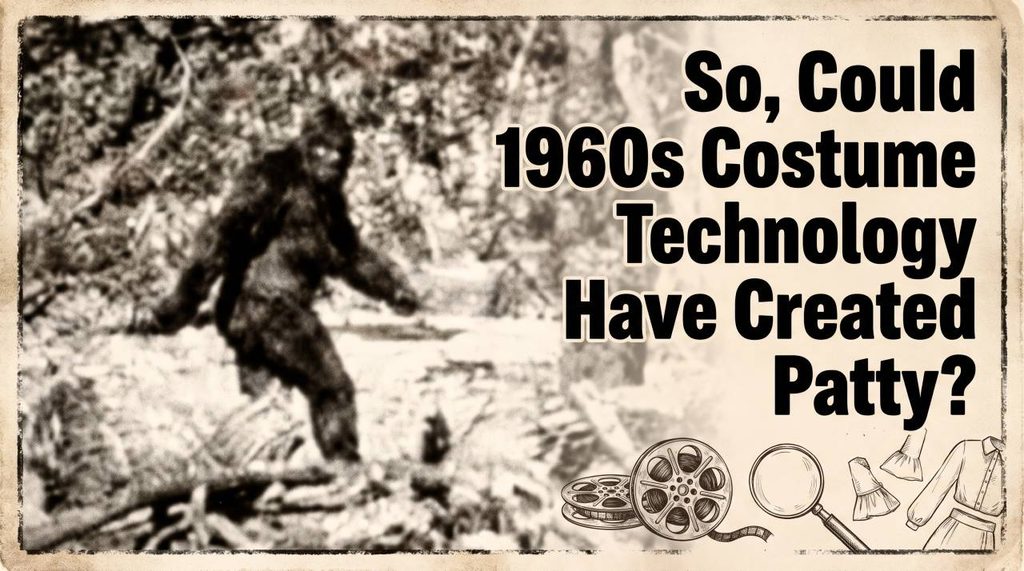
After working backwards from the Patterson–Gimlin Film, the answer to our original question is surprisingly straightforward.
Yes — 1960s costume technology could have created something resembling Patty.
That doesn’t mean it did.
But the historical record makes it difficult to argue that the technology simply wasn’t available.
Long before October 1967, professional performers were already working inside full-body gorilla costumes. George Barrows had constructed and performed in his own suits.
Films such as Gorilla at Large had demonstrated how effectively a human performer could be transformed into a large, fur-covered ape-like figure. The man-in-the-suit creature tradition was already well established.
And by 1967, the technology had moved beyond Hollywood.
Morris Costumes was manufacturing gorilla suits commercially, from a comparatively small home-based operation, and advertising them to the entertainment market.
A person didn’t necessarily need a major studio, an army of makeup artists or a Hollywood special-effects department.
A commercially produced gorilla costume could provide the starting point.
From there, relatively ordinary materials and techniques could potentially alter its appearance — padding the shoulders, manipulating the fur, disguising closures, changing the apparent proportions and modifying the face.
That is perhaps the most important conclusion of this investigation.
The costume hypothesis does not require someone in 1967 to invent a technology that did not exist.
It requires someone to make use of technologies and materials that did exist.
But that leaves us with the much more difficult question.
Did anybody actually do it?
Our investigation cannot answer that conclusively.
Philip Morris’s later claim that he sold a gorilla suit to Roger Patterson is intriguing, but it remains a retrospective recollection rather than a contemporaneous purchase record. The precise details of the alleged transaction contain inconsistencies, and other accounts of the supposed costume have also conflicted.
Likewise, demonstrating that artificial fur could be manipulated, that padding could alter the silhouette or that a mask could conceal a performer’s face does not prove that those techniques were used at Bluff Creek.
And the film itself still has to be confronted.
Patty’s gait, apparent knee flexion, proportions, musculature, hands, feet, facial structure, fur movement and overall realism remain the central challenges for anyone proposing a conventional human performer inside a costume.
Some of those features may have plausible costume explanations.
Some remain genuinely difficult.
None provides an indisputable answer.
So perhaps the most defensible conclusion is neither “Patty was obviously a man in a suit” nor “no costume of the period could possibly have produced her.”
It is something considerably more interesting.
The technology existed.
The materials existed.
The costumes existed.
The people capable of making and wearing them existed.
What remains uncertain is whether those ingredients were actually assembled into the figure that walked across the Bluff Creek sandbar in October 1967.
And that distinction is important.
Because after nearly sixty years, the Patterson–Gimlin Film isn’t controversial because nobody in 1967 knew how to make an ape costume.
It is controversial because the particular figure captured on that piece of film remains extraordinarily difficult to explain with certainty.
Perhaps Patty was an unknown primate.
Perhaps she was an exceptionally effective costume.
Or perhaps, as the debate has suggested for generations, the truth lies somewhere in the details we have yet to establish.
The technology question, however, can finally be put to rest.
1960s costume technology was not incapable of creating Patty.
The real mystery is whether it actually did.