Beyond Bigfoot: Asia’s Forgotten Wildman Legends
While Bigfoot dominates North American folklore and the Yeti has become the world’s most famous Himalayan mystery, across Asia dozens of lesser-known wildman traditions have emerged from remote mountains, forests, and valleys.
From the frozen peaks of the Hindu Kush to the mist-covered forests of China, from the rain-soaked jungles of Meghalaya to the secluded mountains of Japan, generations of hunters, shepherds, travellers, and villagers have whispered of encounters with mysterious hairy humanoids that seemingly vanish into the wilderness before they can be understood.
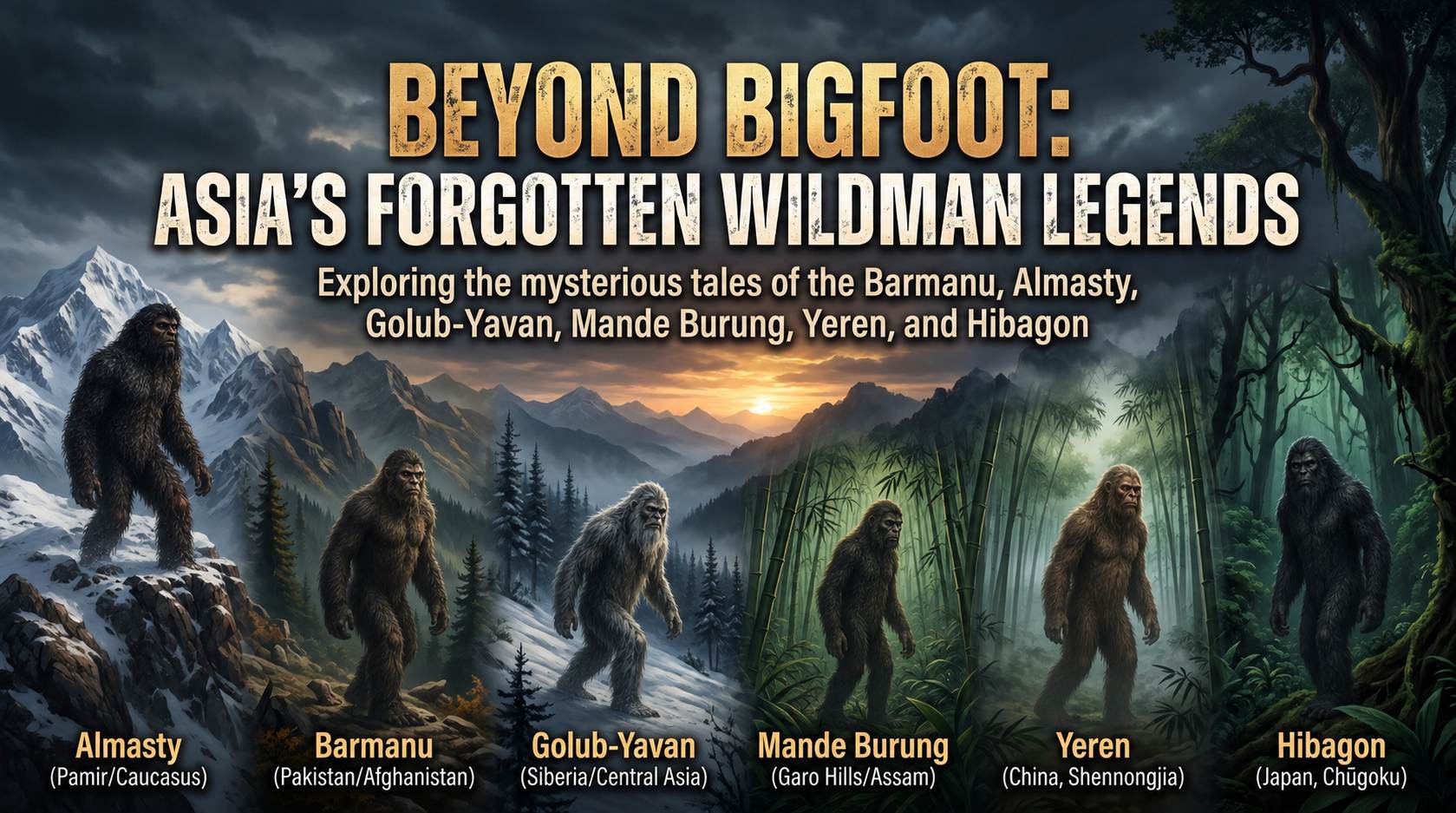
Known by names such as the Barmanu, Almasty, Golub-Yavan, Mande Burung, Yeren, and Hibagon, these enigmatic figures have become woven into the folklore and cultural heritage of their regions.
Some are regarded as elusive forest guardians, others as terrifying mountain dwellers, while a few have inspired modern investigations in search of scientific answers.
Could these legends preserve memories of misidentified wildlife, rare human encounters, forgotten traditions, or simply the enduring power of folklore? Or do they hint at mysteries that remain hidden within some of Asia’s most remote and least explored landscapes?
Join Cryptid Legends as we journey beyond the familiar tales of Bigfoot and the Yeti to explore Asia’s forgotten wildman legends—examining their history, the evidence behind the stories, and the enduring mysteries that continue to capture imaginations across the continent.
The Wildman Tradition Across Asia
Although separated by thousands of miles, the wildman legends of Asia share a number of recurring themes.
From the high-altitude valleys of the Hindu Kush to the ancient forests of East Asia, these stories often emerge from landscapes where human exploration has historically been limited and where wilderness remains a powerful part of local identity.
Across these regions, witnesses have described mysterious upright figures covered in hair, possessing human-like features, unusual strength, and an ability to disappear into their surroundings.
Some traditions are centuries old, passed down through generations of oral storytelling, while others emerged through modern sightings, newspaper reports, and organised investigations.
Yet these legends are not identical. Each reflects the environment, culture, and history of the people who tell them.
The Barmanu of Pakistan belongs to the rugged world of the Hindu Kush, while the Mande Burung of India is tied to the dense forests of Meghalaya.
The Yeren became the focus of one of China’s largest wildman investigations, while Japan’s Hibagon represents a distinctly modern cryptid phenomenon.
From ancient folklore to modern field investigations, each legend offers a unique glimpse into humanity’s relationship with the unknown.
In the following sections, we examine the stories, sightings, investigations, and evidence behind Asia’s forgotten wildman traditions.
Barmanu — Pakistan’s Hidden Wildman of the Hindu Kush

The Forest Man of the Mountains
High in the remote valleys of northern Pakistan, where the rugged peaks of the Hindu Kush dominate the landscape, generations of local communities have shared stories of a mysterious wildman said to roam the mountains and forests.
Known as the Barmanu (also written Barmanou), this legendary creature is one of Asia’s lesser-known wildman traditions.
While the Yeti became the famous symbol of Himalayan mystery, the Barmanu remains a more local legend, a creature associated with isolated valleys, shepherds, and the unexplored wilderness of Pakistan’s mountain regions.
The name is often translated as “forest man” or “wild man,” and descriptions place the Barmanu somewhere between human and animal: a powerful, hairy humanoid believed to inhabit remote areas away from human settlements.
Appearance of the Barmanu
Traditional descriptions of the Barmanu share many similarities with other wildman legends around the world.
Witnesses have described a creature that is:
- Upright and human-like in posture
- Covered in thick reddish-brown, dark, or grey hair
- Broad-shouldered and muscular
- Long-armed with large hands and feet
- Possessing a human-like but unusual face
Some reports describe a flat nose, heavy jaw, deep-set eyes, and a strong unpleasant smell. Unlike many depictions of monsters, the Barmanu is usually portrayed as a shy and elusive creature, avoiding humans rather than attacking them.
Accounts vary in size, with some witnesses describing a figure close to human height while others claim a larger, more powerful being approaching two metres tall.
Encounters from the Chitral Mountains
Modern interest in the Barmanu increased during the late 20th century, particularly through reports from shepherds and villagers in the Chitral region of Khyber Pakhtunkhwa.
Among the most frequently discussed witnesses was Lal Khan, a shepherd who claimed to have encountered a fully hairy upright figure in the mountains during the 1980s. His account became one of the cases that attracted outside researchers to investigate the legend.
Other reports described unusual tracks discovered in remote mountain areas, including large human-like impressions found by local shepherds. One widely discussed account involved Mohammad Nabi, who claimed an encounter with a smaller Barmanu-like creature and later reported finding large footprints nearby.
Although these stories generated interest among cryptozoologists, none produced photographs, biological samples, or physical remains that could confirm the creature’s existence.
Jordi Magraner’s Barmanu Investigations
The most significant modern investigation into the Barmanu was carried out by Spanish zoologist Jordi Magraner.
Beginning in the late 1980s, Magraner spent years in the Chitral region documenting local reports, interviewing witnesses, and searching areas connected with sightings. Rather than treating the Barmanu only as folklore, he investigated the possibility that the legend could represent an unknown animal.
Magraner collected numerous eyewitness accounts and reported possible tracks and unexplained sounds from remote valleys. However, despite years of research, no confirmed specimen, DNA evidence, or photographic proof was obtained.
His work remains one of the most detailed investigations ever conducted into a South Asian wildman tradition. Tragically, Magraner was killed in Afghanistan in 2002 while working in the region.
Evidence and Scientific Perspective
The Barmanu remains unconfirmed by modern science.
Reported footprints and sightings have alternative explanations, including known wildlife such as Himalayan brown bears, Asiatic black bears, and other mountain animals that can sometimes appear surprisingly human-like when standing upright or moving through difficult terrain.
Scientists have also noted that remote mountainous environments can make identification difficult, particularly when sightings occur briefly, at distance, or under poor visibility.
No verified hair samples, DNA evidence, photographs, or specimens have demonstrated the existence of an unknown primate in the Hindu Kush.
The Enduring Mystery of the Barmanu
Today, the Barmanu remains one of Pakistan’s most fascinating wildman legends.
Whether it represents encounters with misunderstood wildlife, a powerful tradition of mountain folklore, or an unknown creature yet to be discovered, the story of the Barmanu reflects humanity’s enduring fascination with the wilderness beyond our understanding.
Hidden among the valleys of the Hindu Kush, the Forest Man remains a symbol of one of Asia’s greatest cryptid mysteries, a legend that continues to inspire explorers, researchers, and storytellers searching for answers among the mountains.
⛰️ Almasty — Central Asia’s Ancient Wildman

The Wildman of the Mountains and Steppes
Across the towering mountain ranges, windswept valleys, and remote grasslands of Central Asia, stories have long persisted of a mysterious wildman known as the Almasty (or Almas).
Unlike the Barmanu, which is closely tied to northern Pakistan, the Almasty’s legend stretches across a vast region, with reports emerging from Mongolia, Kazakhstan, Kyrgyzstan, the Caucasus, southern Siberia, and parts of western China.
For centuries, nomadic peoples, hunters, shepherds, and travellers have spoken of strange hairy humanoids living beyond the reach of civilisation.
While local traditions differ from region to region, the core description remains remarkably consistent—a powerful, upright creature that inhabits remote mountains and forests, rarely allowing itself to be seen.
Today, the Almasty is considered one of the oldest and most widespread wildman traditions in Eurasia, occupying a unique place between folklore, anthropology, and cryptozoology.
Appearance of the Almasty
Traditional descriptions portray the Almasty as more human-like than many other wildman legends.
Witnesses have commonly described a creature that is:
- Standing between 1.6 and 1.9 metres (5–6½ feet) tall
- Covered in reddish-brown or dark brown hair
- Strongly built with broad shoulders and long arms
- Possessing a flat, human-like face with heavy brows
- Walking upright with a confident, deliberate stride
Unlike the gigantic Sasquatch often depicted in North American folklore, many accounts describe the Almasty as closer to human height, leading some researchers to speculate that the legend may have been influenced by memories of archaic human populations rather than an enormous ape-like creature.
The Almasty is generally portrayed as shy and solitary, avoiding contact with people whenever possible, although folklore occasionally describes individuals stealing food, livestock, or tools from isolated camps.
Legends Across Central Asia
The Almasty differs from many regional cryptids because it is not confined to a single valley or mountain range.
Instead, stories have been recorded across thousands of kilometres, suggesting a deeply rooted tradition shared by numerous cultures.
Historical references dating back to the nineteenth century describe explorers hearing accounts of wild, hairy people inhabiting the mountains of Central Asia.
Local communities often regarded these beings not as monsters, but as elusive inhabitants of the wilderness existing alongside wolves, bears, and other mountain wildlife.
One of the most significant periods of interest came during the 1960s, when reports from Mongolia attracted national attention.
In 1962, a herder claimed to have encountered a naked, hairy humanoid in the Altai Mountains before it disappeared into the landscape.
Just two years later, an official Mongolian commission documented multiple eyewitness reports of similar creatures, along with alleged footprints and simple grass nests believed by some to have been constructed by the mysterious beings.
Although these reports generated considerable excitement, none produced conclusive physical evidence.
Investigations and the Search for a Relict Human
The Almasty became one of the most seriously investigated wildman traditions during the Soviet era.
Russian, Mongolian, and later European researchers travelled throughout Central Asia collecting eyewitness testimony, examining reported footprints, and searching remote mountain regions where encounters had been reported.
Unlike many cryptid investigations, some researchers approached the Almasty not as an unknown ape, but as the possible survivor of an archaic human species.
This idea gained further attention following discoveries of Neanderthals and, more recently, Denisovans—ancient human relatives that once inhabited parts of Eurasia.
Although no scientific evidence links these extinct populations to the Almasty legend, the possibility has remained one of cryptozoology’s most enduring hypotheses.
Despite decades of investigation, however, every alleged hair sample tested through modern genetic analysis has been identified as belonging to known animals, most commonly bears or other native wildlife.
Evidence and Scientific Perspective
Like many wildman traditions, the Almasty has generated numerous eyewitness accounts but very little verifiable physical evidence.
Large footprints, reported nests, and occasional hair samples have all been investigated over the years. Advances in DNA testing have allowed many of these claims to be examined scientifically, with samples consistently matching known species rather than an undiscovered primate or surviving archaic human.
Sceptics argue that many sightings can be explained by misidentified brown bears, particularly when viewed standing upright or at a distance in poor light.
Others suggest that generations of oral tradition have reinforced expectations, encouraging witnesses to interpret unusual encounters through the lens of local folklore.
While the scientific consensus remains that no evidence supports the existence of an unknown wildman, the Almasty continues to occupy a fascinating place in discussions surrounding human evolution, folklore, and the enduring mysteries of Central Asia.
The Legacy of the Almasty
Few wildman legends have travelled as widely or endured as long as the Almasty. From the forests of the Caucasus to the mountains of Mongolia, stories of mysterious hairy humanoids have survived for centuries, becoming woven into the traditions of countless communities across Central Asia.
Whether inspired by misunderstood wildlife, distant cultural memories, or the powerful influence of folklore, the Almasty remains one of Asia’s most enduring cryptid legends.
Its story serves as a reminder that the world’s greatest mysteries are often found where history, mythology, and science meet at the edge of the unknown.
🌲 Yeren — China’s Legendary Wildman

The Wildman of Shennongjia
Deep within the mist-covered forests of central China lies one of the country’s greatest cryptozoological mysteries.
Hidden among the mountains of Shennongjia, where dense woodland, steep ravines, and ancient forests have remained largely untouched for centuries, stories have long circulated of a mysterious hairy humanoid known simply as the Yeren (野人), literally, the “Wild Man.”
Unlike many regional legends that survived only through oral tradition, the Yeren became the subject of one of the largest official investigations into a wildman anywhere in the world.
During the late twentieth century, the mystery captured the attention of scientists, journalists, and government researchers, transforming a local legend into a national phenomenon.
Today, the Yeren remains one of Asia’s most famous cryptids and an enduring symbol of China’s unexplored wilderness.
Appearance of the Yeren
Descriptions of the Yeren vary across China’s vast landscape, but many eyewitness accounts share remarkably similar characteristics.
Witnesses have commonly described a creature that is:
- Standing between 1.7 and 2.2 metres (5 ft 7 in–7 ft 2 in) tall
- Covered in reddish-brown or dark brown hair
- Broad-chested with long, muscular arms
- Possessing a human-like face with pronounced brow ridges
- Walking upright with long purposeful strides
Many reports also mention an overpowering odour and unusually large footprints, features frequently associated with wildman traditions across the world.
Unlike the towering giants often portrayed in popular culture, many eyewitnesses described the Yeren as powerfully built but recognisably human in its proportions.
From Ancient Legend to National Obsession
Stories of wild people living in China’s forests date back thousands of years, appearing in ancient texts and regional folklore long before the modern era.
Interest exploded during the 1970s when numerous reports emerged from the forests of Shennongjia in Hubei Province. Witnesses claimed to have seen large hairy humanoids crossing roads, moving through dense woodland, or disappearing into the mountains before they could be approached.
The growing number of reports attracted national attention, and newspapers quickly fuelled what became known as China’s “Yeren Fever.” Public fascination spread across the country as fresh sightings, footprint discoveries, and alleged evidence dominated headlines.
Unlike many cryptid stories, the Yeren was no longer just folklore, it had become a subject of official investigation.
China’s Wildman Expeditions
Beginning in 1977, teams supported by the Chinese Academy of Sciences and other organisations launched expeditions into Shennongjia to search for evidence.
Researchers collected footprints, hair samples, witness testimony, and environmental observations while exploring some of the region’s most inaccessible forests.
Public enthusiasm was so great that organisations even offered substantial rewards for anyone able to provide convincing evidence of a living Yeren.
Despite years of searching, however, every promising discovery eventually pointed toward known wildlife. Hair samples were identified as belonging to familiar species, while footprints could not be conclusively linked to an unknown animal.
Although the expeditions failed to prove the Yeren’s existence, they remain among the largest scientific investigations ever conducted into a cryptid.
Evidence and Scientific Perspective
The Yeren has produced hundreds of eyewitness reports but no verified physical evidence.
Modern DNA analysis has consistently identified alleged hair samples as belonging to bears, serow, monkeys, or other known animals.
Scientists also note that Asiatic black bears can briefly walk upright, potentially explaining some encounters reported in dense forest.
Anthropologists suggest that the legend may also preserve fragments of older folklore or memories of unusual encounters with wildlife in one of China’s most biodiverse regions.
Today, the scientific consensus is that no evidence currently supports the existence of an undiscovered wildman in Shennongjia.
Nevertheless, the sheer scale of the investigations has ensured that the Yeren remains one of cryptozoology’s most significant case studies.
The Legacy of the Yeren
More than perhaps any other Asian wildman, the Yeren demonstrates the remarkable intersection of folklore, science, and public curiosity.
Although decades of investigation have failed to uncover convincing biological evidence, the mystery transformed a regional legend into one of China’s most enduring cryptid stories.
Shennongjia itself has become inseparable from the legend, drawing researchers, tourists, and enthusiasts eager to explore the forests where the Wild Man is said to roam.
Whether remembered as folklore, a case of mistaken identity, or an unsolved mystery, the Yeren remains one of the defining wildman legends of Asia and a cornerstone of modern cryptozoological history.
🌧️ Mande Burung — India’s Mysterious Forest Man
The Wildman of Meghalaya’s Ancient Rainforests
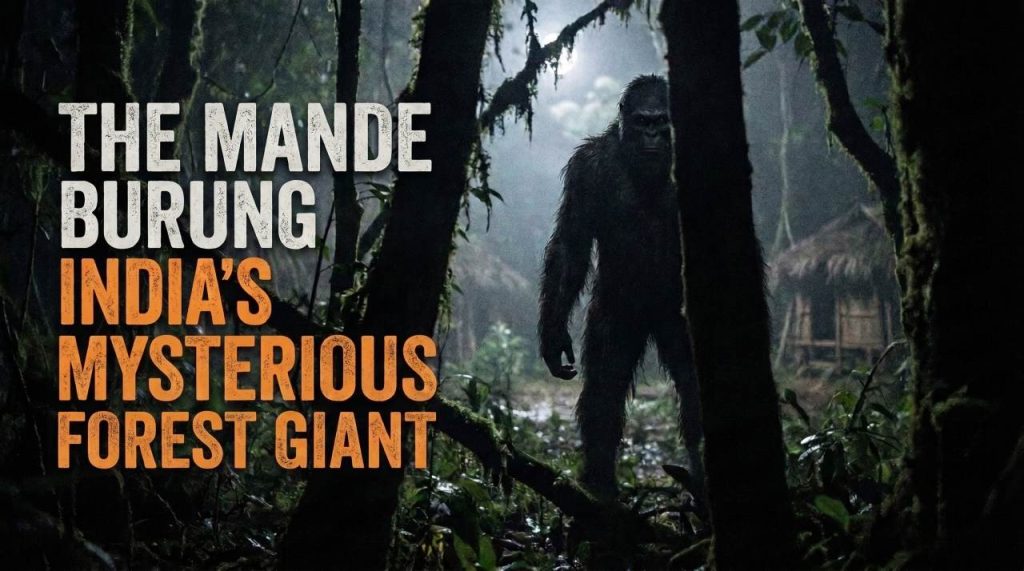
Far from the snow-covered peaks of the Himalayas, in the lush subtropical rainforests of Meghalaya in northeastern India, another wildman legend has endured for generations.
Hidden among dense jungle, towering limestone cliffs, and mist-covered valleys, local Garo communities speak of a mysterious creature known as the Mande Burung (or Mande Barung), a name that translates simply as “Forest Man.”
Unlike many cryptid legends that exist only in scattered folklore, the Mande Burung has remained an important part of Garo oral tradition for generations.
Elders have long told stories of enormous hairy beings roaming the forests of the Garo Hills, rarely seen but never entirely forgotten.
To many local communities, these tales are woven into the identity of the landscape itself, where dense jungle and rugged terrain have long concealed wildlife still being studied today.
As modern expeditions ventured into Meghalaya during the early twenty-first century, the legend would once again attract attention, not only from cryptozoologists, but also from scientists eager to examine the evidence.
Appearance of the Mande Burung
Descriptions of the Mande Burung have remained surprisingly consistent across many reported encounters.
Witnesses commonly describe a creature that is:
- Standing between 2 and 3 metres (6½–10 feet) tall
- Covered in thick dark brown or black hair
- Broad-shouldered with a muscular build
- Possessing long arms and large hands
- Walking upright with a distinctly human-like gait
Several accounts also mention an unpleasant musky odour, deep-set eyes, and unusually large footprints left in soft forest soil.
Unlike many monstrous creatures found in folklore, the Mande Burung is generally portrayed as elusive rather than aggressive. Most reported encounters describe the creature quietly observing people before disappearing into the dense rainforest with remarkable speed.
A Legend Rooted in Garo Tradition
For the indigenous Garo people, stories of the Forest Man have been passed from one generation to the next for centuries.
Rather than existing as simple campfire tales, the Mande Burung forms part of the region’s rich oral heritage, reflecting both the mystery and respect inspired by Meghalaya’s vast wilderness.
The forests surrounding Balpakram National Park are particularly associated with the legend. Often referred to as one of India’s most mysterious landscapes, the area is home to dramatic cliffs, deep gorges, extensive cave systems, and remarkable biodiversity.
It is easy to understand how such an environment has nurtured stories of elusive creatures living beyond the reach of human settlements.
Even today, some local residents regard the Forest Man not simply as a monster, but as another inhabitant of the ancient rainforest, a creature that prefers to avoid people whenever possible.
Modern Sightings and Expeditions
Interest in the Mande Burung expanded significantly in 2002, when forestry official James Marak reported encountering a large upright hairy figure while participating in a tiger census in the Garo Hills.
His description of a massive bipedal creature moving through the forest quickly attracted widespread attention and brought the legend back into the national spotlight.
In the years that followed, additional reports of large footprints and unusual signs encouraged further investigation.
The mystery gained international exposure when a BBC documentary team visited Meghalaya and collected hair samples believed by some to belong to the creature.
These samples were later subjected to DNA analysis but were identified as belonging to known wildlife rather than an unknown primate.
Cryptozoologist Richard Freeman later led expeditions into the forests around Balpakram National Park, interviewing local witnesses and searching for physical evidence.
Although his team documented traditional accounts and investigated reported nests, footprints, and hair samples, none of the material ultimately demonstrated the existence of an unknown species.
Science and the Search for Answers
The Mande Burung represents one of the better investigated wildman legends in South Asia.
Unlike earlier generations, modern researchers have been able to apply DNA analysis to alleged evidence.
Hair samples collected during investigations consistently proved to belong to known animals, including the Himalayan goral, while other physical traces failed to reveal anything beyond ordinary wildlife.
Scientists suggest that some reported sightings may involve misidentified bears viewed briefly through dense vegetation or poor lighting. Meghalaya’s challenging rainforest environment, with limited visibility, steep terrain, and abundant wildlife, can make accurate identification particularly difficult.
At the same time, researchers acknowledge that the legend itself remains an important element of Garo cultural heritage regardless of whether it represents an undiscovered species.
The Legacy of the Mande Burung
Although no scientific investigation has confirmed the existence of the Forest Man, the Mande Burung continues to occupy a unique place in India’s cryptid folklore.
Unlike many lesser-known wildman traditions, it has attracted modern expeditions, international media attention, and laboratory analysis of alleged evidence. Each investigation has contributed to a better understanding of both the legend and the remarkable rainforest ecosystem in which it survives.
Whether remembered as an undiscovered primate, a series of wildlife misidentifications, or a powerful tradition preserved through generations of Garo storytelling, the Mande Burung remains one of Asia’s most compelling wildman legends.
Deep within the rain-soaked forests of Meghalaya, where ancient trees disappear into mist and the jungle still guards many secrets, the legend of the Forest Man continues to walk the line between folklore and scientific curiosity.
Related Traditions: Ban-Manush and the Forest Men of Bengal
“The Mande Burung is not the only ‘forest man’ tradition found in South Asia. Across Bengal and Bangladesh, stories of the Ban-Manush, literally ‘forest person’, describe mysterious human-like beings said to inhabit remote wilderness. Like many Asian wildman traditions, the legend exists somewhere between folklore and cryptozoology, with limited documentation making it difficult to separate ancient cultural memory from reports of unusual wildlife or human encounters.”
🏔️ Golub-Yavan — The Forgotten Wildman of the Pamirs

A Mystery Hidden Among the Roof of the World
Of all Asia’s wildman traditions, few are as mysterious—or as poorly understood—as the Golub-Yavan.
Unlike the Yeren of China or the Mande Burung of India, the Golub-Yavan has never inspired major scientific expeditions, international headlines, or decades of intensive investigation.
Instead, it survives as a collection of scattered stories whispered among the towering mountains and isolated valleys of Tajikistan’s Pamir Mountains, one of the most remote regions on Earth.
Often called the “Blue Man of the Pamirs”, the origin of this nickname remains uncertain.
Some researchers believe it stems from interpretations of the creature’s name rather than descriptions of its appearance, and there is little evidence that witnesses consistently reported a blue-coloured animal.
Like much surrounding the Golub-Yavan, even its name remains part of the mystery.
Overshadowed by the famous Yeti and largely forgotten outside specialist cryptozoological circles, the Golub-Yavan remains one of Asia’s most elusive wildman legends.
Appearance of the Golub-Yavan
Reliable descriptions are exceptionally rare, making the Golub-Yavan one of the least well-defined cryptids featured in this article.
Traditional accounts generally describe a creature that is:
- A large upright, human-like figure
- Covered in dark brown, grey, or indistinct shaggy hair
- Broad-shouldered with long arms
- Powerfully built and capable of moving quickly through mountainous terrain
- Extremely elusive and rarely observed for more than a few moments
Unlike other wildman traditions, there is no universally accepted description of the creature’s height, facial features, or behaviour.
The scarcity of detailed eyewitness reports has allowed the mystery to endure largely free from embellishment.
A Legend Lost in the Pamirs
Known as the “Roof of the World,” the Pamir Mountains stretch across one of the most isolated landscapes in Central Asia. Towering peaks, glacial valleys, and sparsely populated settlements have long fostered stories of strange beings inhabiting places rarely visited by outsiders.
Within this rugged environment, fragments of local folklore speak of mysterious wild people living beyond the highest valleys.
These stories were never documented with the same enthusiasm as the Yeti or the Almasty, and many survive only through scattered references in Soviet-era accounts, travel literature, and later cryptozoological compilations.
Unlike neighbouring wildman traditions, the Golub-Yavan never developed into a widely recognised cultural icon. Instead, it remained a quiet piece of mountain folklore, known primarily within remote communities and largely overlooked by the outside world.
Elusive Sightings and Limited Investigation
The greatest mystery surrounding the Golub-Yavan is not the creature itself—but the remarkable lack of information.
A handful of reports from the twentieth century describe rumours of encounters by shepherds, hunters, and border patrols operating in the remote Pamirs. Some stories speak of unusual footprints, while others describe fleeting glimpses of large hairy figures disappearing among rocky slopes.
Unlike the Barmanu, Yeren, or Mande Burung, however, these accounts were never followed by organised scientific expeditions or sustained investigation.
No comprehensive witness database exists, no biological samples have been subjected to modern DNA analysis, and no major research programme has focused on the legend.
As a result, separating authentic local tradition from stories repeated through cryptozoology books and internet folklore has become increasingly difficult.
Science and Skepticism
From a scientific perspective, the Golub-Yavan remains one of the least studied wildman legends in the world.
The Pamir Mountains are home to a range of large mammals, including bears, wolves, and snow leopards, any of which could contribute to unusual sightings under difficult conditions. Combined with the region’s extreme remoteness, harsh weather, and limited historical documentation, these factors make independent verification exceptionally challenging.
Without photographs, verified footprints, DNA evidence, or physical remains, scientists regard the Golub-Yavan as an example of regional folklore rather than evidence for an undiscovered species.
Yet its obscurity also highlights an important point: not every cryptid becomes the subject of national headlines or scientific expeditions. Some simply remain part of the oral traditions of the communities that first told their stories.
The Legacy of the Golub-Yavan
Perhaps the Golub-Yavan’s greatest mystery is not whether it exists, but how little the outside world knows about it.
Overshadowed by better-known wildman traditions across Asia, the legend has remained hidden among the mountains of the Pamirs, preserved through scattered accounts rather than widespread publicity. Its very obscurity has become part of its identity, offering a glimpse into a tradition that has largely escaped the spotlight of modern cryptozoology.
Whether the Golub-Yavan represents misunderstood wildlife, a forgotten piece of mountain folklore, or simply the human tendency to fill unexplored landscapes with mystery, it remains one of Asia’s most intriguing and least explored wildman legends.
Sometimes, the rarest stories are not those supported by the greatest body of evidence, but those that have almost disappeared altogether.
🍁 Hibagon — Japan’s Mysterious Mountain Wildman

A Modern Mystery Born in the Forests of Hiroshima
While many of Asia’s wildman legends have roots stretching back centuries, Hibagon is remarkably different.
Emerging not from ancient mythology but from a wave of eyewitness reports during the early 1970s, Hibagon quickly became one of Japan’s most intriguing cryptid mysteries.
For several years, the quiet forests surrounding Mount Hiba in Hiroshima Prefecture became the focus of national attention as hikers, farmers, schoolchildren, and local residents reported encounters with a strange ape-like figure unlike anything they had seen before.
Unlike Japan’s famous yōkai, supernatural beings such as the Kappa or Tengu, Hibagon was generally described as a flesh-and-blood creature.
Witnesses believed they were seeing an unknown animal rather than a mythical spirit, giving the legend a distinctly modern character that continues to fascinate cryptid researchers today.
Appearance of the Hibagon
Although individual reports varied, descriptions of Hibagon remained surprisingly consistent throughout the sighting wave.
Witnesses commonly described the creature as:
- Around 1.4 to 1.6 metres (4½–5½ feet) tall
- Short, broad, and powerfully built
- Covered in dense dark brown to jet-black hair
- Possessing unusually long arms
- Walking upright with a confident, human-like stride
- Having a pale or greyish face with deep-set eyes and a flattened nose
Unlike the towering Sasquatch or Yeti, Hibagon was noticeably smaller and stockier.
Several witnesses remarked that it appeared incredibly muscular despite its relatively modest height, giving it the appearance of a compact mountain ape or an early hominin rather than a giant forest giant.
The Sighting Wave That Captivated Japan
The Hibagon legend truly began in 1970, when reports of a strange upright creature started emerging from the forests around Mount Hiba.
Over the next several years, sightings multiplied.
Children walking home from school claimed to have watched a dark hairy figure observing them from the edge of the forest.
Farmers reported seeing an unknown animal crossing mountain roads on two legs, while hikers described brief encounters with a muscular creature that disappeared into dense woodland before they could approach.
The reports attracted widespread media coverage across Japan. Newspapers eagerly followed the mystery, police investigated several claims, and curious visitors travelled to the region hoping to catch a glimpse of the elusive creature for themselves.
Yet despite the excitement, the evidence remained frustratingly elusive.
No clear photographs emerged, no biological samples were recovered, and no definitive footprints could be linked to an unknown species.
Perhaps the most curious aspect of the mystery is that the sightings appeared to fade almost as quickly as they had begun. By the mid-1970s, reports had become increasingly rare, leaving behind one of Japan’s most unusual cryptid flaps.
Searching for a Scientific Explanation
Unlike many famous wildman legends, Hibagon never attracted large-scale scientific expeditions. Instead, researchers focused on examining whether known wildlife could explain the reports.
Japan’s native Japanese macaque, the country’s largest monkey, became one of the leading candidates.
Viewed briefly while standing upright, particularly in poor lighting or dense woodland, a large macaque could potentially create an impression of a small upright ape-like figure.
Others suggested misidentified black bears, unusual viewing angles, or the influence of intense media attention during the early 1970s may have contributed to the growing number of reports.
Without physical evidence such as DNA, verified hair samples, or skeletal remains, mainstream science continues to regard Hibagon as an unresolved wildlife mystery rather than evidence of an undiscovered primate.
The Legacy of Hibagon
More than fifty years after the first reports, Hibagon remains one of Japan’s best-known cryptids.
Unlike many forgotten wildman traditions, its popularity owes much to a brief but extraordinary period during which ordinary people believed something unknown was moving through the forests of Mount Hiba.
Newspapers documented the excitement, police investigated reports, and the mystery briefly became part of Japan’s national conversation.
Today, Hibagon survives as both a beloved piece of regional folklore and a fascinating chapter in modern cryptozoology.
Whether the witnesses encountered an unknown animal, misidentified wildlife, or experienced the effects of expectation and suggestion during a period of intense publicity remains open to debate.
Whatever the explanation, Hibagon occupies a unique place among Asia’s wildman legends. It reminds us that not every mystery belongs to the distant past.
Sometimes a legend can emerge within living memory, capture the imagination of an entire nation, and quietly fade back into the forests before anyone can discover the truth.
🏔️ Where Does the Yeti Fit Into Asia’s Wildman Traditions?

The Legend That Cast the Longest Shadow
Among all the mysterious wildman traditions of Asia, one name towers above the rest.
The Yeti.
For generations, stories of a mysterious creature wandering the high valleys and frozen slopes of the Himalayas have captured the imagination of explorers, mountaineers, scientists, and storytellers around the world.
Known as the “Abominable Snowman” in Western popular culture, the Yeti has become the most famous of all Asian wildman legends. Images of a large, hairy creature moving through remote Himalayan landscapes have shaped how many people imagine unknown animals hidden in Earth’s wilderness.
Yet the Yeti is only one part of a much larger wildman tradition.
Across Asia, from the forests of China to the mountains of Pakistan, communities have told stories of mysterious hairy humanoids adapted to their own landscapes and cultures.
The Barmanu, Almasty, Mande Burung, Yeren, Golub-Yavan, and Hibagon each represent their own unique traditions, not simply copies of the Himalayan legend.
The Yeti and the Wildman Family Tree
The similarities between these legends are impossible to ignore.
Many share common features:
- A remote mountainous or forest habitat
- A powerful upright body shape
- Thick hair covering the body
- Avoidance of humans
- A reputation for leaving mysterious tracks
These similarities have led some researchers to group them together as part of a broader “wildman” phenomenon—a worldwide collection of stories describing unknown human-like creatures living beyond the edges of civilisation.
However, each tradition developed independently within its own cultural landscape.
The Yeti belongs to the frozen high-altitude world of the Himalayas.
The Barmanu belongs to the valleys and forests of the Hindu Kush.
The Almasty belongs to the mountains and steppes of Central Asia.
The Yeren belongs to China’s ancient forests.
The Mande Burung belongs to the tropical wilderness of Meghalaya.
The Hibagon belongs to Japan’s modern mountain folklore.
They may share similarities, but each legend carries the identity of the people and landscapes that created it.
Science and the Search for the Yeti
Like the other wildman traditions explored in this article, the Yeti has attracted decades of investigation.
Expeditions have searched Himalayan valleys for footprints, photographs, hair samples, and other evidence. Some famous discoveries, including alleged Yeti hair and remains, have generated excitement before later being identified as known animals such as bears.
Modern genetic analysis has provided one of the strongest tools for examining the mystery. Several alleged Yeti samples have been tested and have matched known species, particularly Himalayan and Tibetan bears.
Despite this, the Yeti remains culturally powerful because the Himalayan environment itself continues to inspire questions about what may still remain undiscovered.
The Enduring Mystery
Whether the Yeti represents misunderstood wildlife, ancient folklore, rare encounters with known animals, or something still unknown, its importance goes far beyond the question of whether it exists.
The Yeti inspired generations of people to explore some of Earth’s most remote landscapes.
It helped create global fascination with wildman legends.
And it opened the door for forgotten traditions like the Barmanu, Almasty, Mande Burung, Yeren, Golub-Yavan, and Hibagon to be rediscovered.
Perhaps the greatest lesson of Asia’s wildman legends is not simply the search for a creature.
It is the reminder that every mountain range, forest, and remote valley contains stories shaped by the people who call those places home.
The Yeti may be Asia’s most famous mystery, but it is only one voice in a much larger chorus of forgotten wildman legends.