West Virginia Cryptids: The Dark Heart of Appalachian Monster Lore
Deep in the mist-shrouded folds of the Appalachian Mountains lies a region that has become synonymous with some of the most famous creature sightings in the world.
West Virginia isn’t just a place on the map—it’s a landscape of shadowed valleys, abandoned mining towns, and dense ancient forests where stories don’t fade… they grow.
For decades, locals and researchers alike have reported encounters with strange beings that defy easy explanation—creatures that walk the line between folklore, misidentification, and something genuinely unknown.
Welcome to the world of West Virginia cryptids—where every rustle in the trees might mean something is watching.
Why West Virginia Is a Hotspot for Cryptid Sightings
West Virginia’s reputation as a cryptid hotspot isn’t accidental. Several real-world factors create the perfect environment for folklore to thrive:
🌲 The Landscape Is Genuinely Eerie
The Appalachians are among the oldest mountain ranges on Earth—around 480 million years old.
They’ve been worn down over immense spans of time, leaving: Dense hardwood forests, narrow valleys (“hollows” or “hollers”), steep ridges, thick fog and mist, plus countless caves, mines, and abandoned roads.
Unlike the Rockies, where you can often see for miles, Appalachian forests can feel incredibly enclosed. You may only be able to see 20 or 30 metres ahead before the trees block your view.
That creates a powerful psychological effect: you constantly feel like something could be watching you.
⛏️ 2. Abandoned Mining Towns
West Virginia has hundreds of former coal mining communities, many now deserted.
These areas naturally fuel stories of: strange lights, unexplained sounds and abandoned tunnels and shafts.
🦌 3. Real Wildlife Misidentification
Black bears, coyotes, deer, and nocturnal animals can appear very different under low light or stress conditions, especially in motion.
🌙 4. Heavy Fog and Low Light Conditions
The Appalachian climate often produces mist and fog that distort depth perception and shape recognition.
📖 5. Deep Oral Storytelling Culture
Generations of Appalachian folklore have preserved and amplified unusual encounters, passing stories down long before modern media existed.
Many mountain communities were historically isolated for generations. Before modern roads, some villages had little contact with neighbouring valleys.
That meant stories were passed down through families rather than being replaced by outside influences.
You’ll hear tales of: Strange wild men, ghosts, witches, devils, unknown creatures in the woods and mysterious lights.
Folklore became part of everyday life.
The Most Famous West Virginia Cryptids
Across West Virginia, certain names appear again and again in eyewitness accounts, newspaper archives, and modern retellings of Appalachian folklore.
These are not isolated campfire stories, but recurring figures that have become deeply embedded in the region’s identity.
Some emerged from single, highly documented incidents that quickly spread into national headlines.
Others evolved gradually through decades of local storytelling, shifting shape as they passed from one generation to the next. Together, they form the core mythology of the state’s modern cryptid lore.
Below are the most well-known and frequently reported West Virginia cryptids—each with its own origin, behaviour, and place within the broader Appalachian mystery.
👁️ The Flatwoods Monster

Flatwoods Monster is one of the most visually distinctive cryptid reports in North American folklore.
First reported in 1952 in Braxton County, witnesses described a towering humanoid figure with a glowing, pulsating head, metallic-like body, and a face partially obscured by a hooded or spade helmet-like structure.
The encounter began when local residents reported a bright object streaking across the sky, followed by a burning sensation and an encounter with the entity on a nearby hillside. The creature allegedly emitted a foul, choking mist before retreating into the darkness.
What makes this case stand out is the consistency of witness descriptions despite panic conditions, and the early classification of the event as both a UFO and cryptid encounter—placing it at the intersection of extraterrestrial and terrestrial folklore.
🦅 Mothman

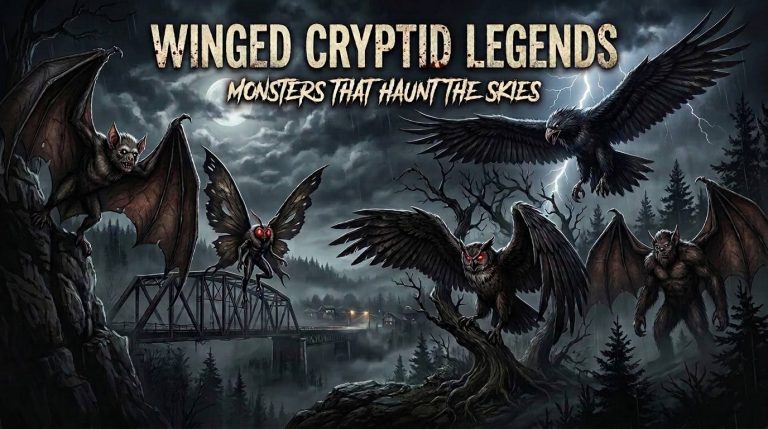
Mothman is arguably West Virginia’s most internationally recognised cryptid. First reported in the Point Pleasant area during 1966–1967, witnesses described a large winged humanoid with glowing red eyes and a wingspan far exceeding that of any known bird.
Unlike many cryptids, Mothman sightings were tightly clustered around a specific time period, often accompanied by reports of strange electrical disturbances, black military-style vehicles, and UFO activity.
The legend became permanently embedded in American folklore following the collapse of the Silver Bridge in 1967, which some connected speculatively to earlier sightings.
While no scientific link exists, the timing cemented Mothman as an omen figure in modern myth.
🧱 The Grafton Monster

Grafton Monster is a hulking humanoid cryptid reported near Grafton in the 1960s.
Descriptions typically portray a featureless or near-featureless body, smooth skin, and a thick, heavy build lacking a clearly defined head or facial structure.
Unlike winged or humanoid “alien-like” cryptids, the Grafton Monster feels more physical and grounded, often interpreted as a misidentified animal, industrial worker legend, or unknown forest-dwelling creature.
Its significance lies in its contrast to other West Virginia entities: it is less supernatural in appearance, but more physically imposing, reinforcing the idea of Appalachia as a landscape hiding large, unknown terrestrial anomalies.
🐐 The Sheepsquatch

Sheepsquatch is a more recent addition to Appalachian folklore, described as a large, white, wool-covered creature with horns, sometimes bipedal, sometimes quadrupedal depending on the account.
Sightings often place it in rural woodland areas and abandoned farmland, where it is said to move with surprising speed despite its bulky appearance. Some reports describe glowing eyes and an aggressive or territorial behaviour.
Unlike older cryptids rooted in early 20th-century folklore, Sheepsquatch appears to be a modern evolutionary myth—potentially influenced by livestock misidentification, regional storytelling, and internet-era amplification of Appalachian monster lore.
👁️Indrid Cold

Indrid Cold is a humanoid entity reported in connection with the 1966–67 Point Pleasant sightings in West Virginia.
Witness accounts describe a human-like figure with an unnaturally calm presence and a fixed smile, often interpreted as a non-human intelligence rather than a physical cryptid.
Unlike traditional Appalachian creatures, Indrid Cold is commonly associated with UFO phenomena and anomalous psychological encounters, placing it at the intersection of cryptid folklore and extraterrestrial narrative frameworks.
🐍 Snallygaster

The Snallygaster is one of the earliest recorded cryptid legends from the Mid-Atlantic region, with its strongest historical roots in Maryland folklore, though it later became associated with the broader Appalachian mythos.
Early newspaper reports from the 19th and early 20th centuries describe it as a bird-like, dragon-esque predator, sometimes depicted with tentacle-like appendages, a beak lined with sharp teeth, and a reputation for attacking livestock in rural communities.
Its origins are often traced back to German immigrant folklore, particularly the term “schnelle Geister” (meaning “quick spirit”), which was gradually transformed through oral storytelling and sensationalised newspaper reporting into a more monstrous, hybrid creature.
Over time, the Snallygaster evolved from immigrant superstition and local scare stories into a staple of American cryptid folklore, representing an early example of how European myth, rural fear, and media exaggeration combined to create enduring legendary creatures.
🌲 Why These Legends Persist
Whether interpreted as folklore, misidentified wildlife, or something genuinely unexplained, West Virginia remains one of the richest cryptid regions in the world.
West Virginia’s cryptid legends don’t sit neatly in the past. They continue to evolve with each new account, each retelling, and each shadow seen at the edge of the tree line.
Because in West Virginia, the real mystery isn’t just what people think they saw…
It’s why so many different people, across so many years, keep seeing something at all.