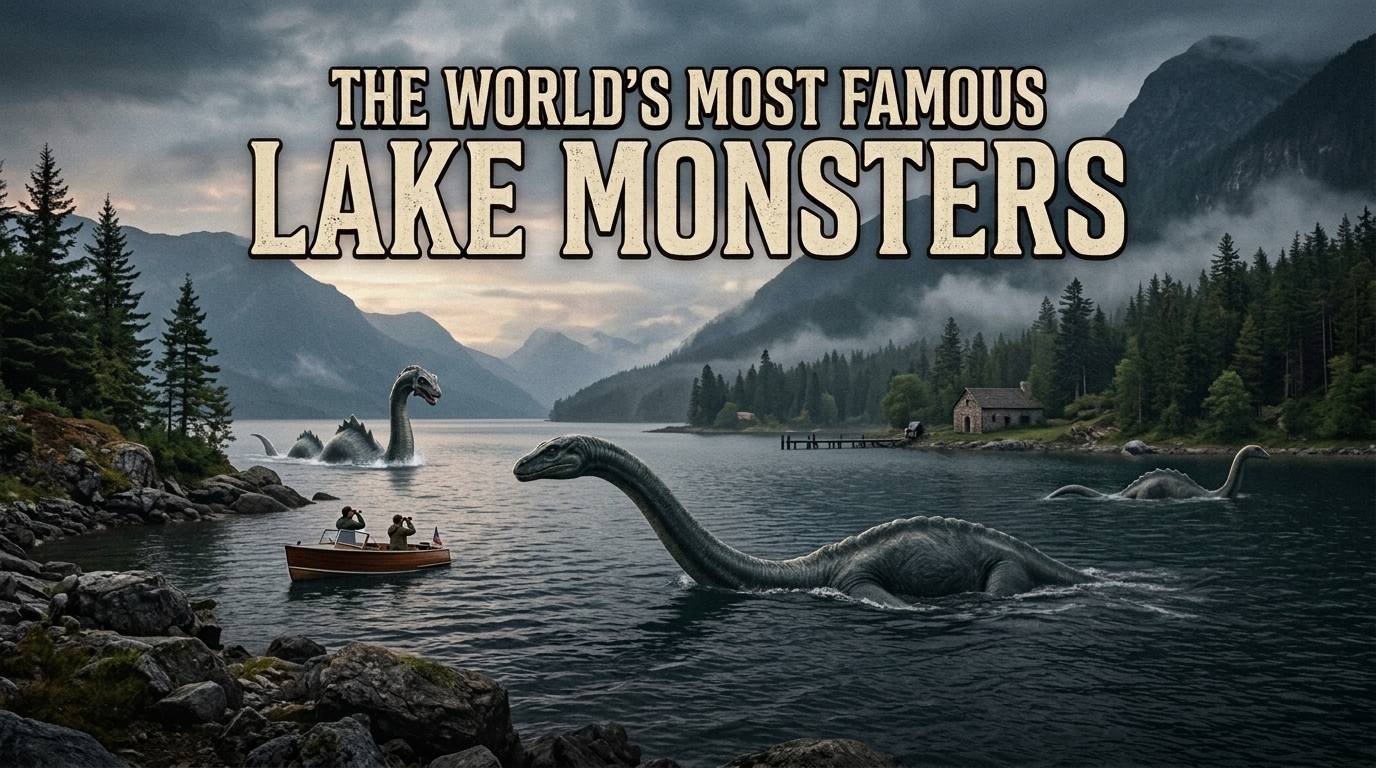
The World’s Most Famous Lake Monsters
For centuries, people around the world have reported strange creatures lurking beneath the surface of remote lakes.
From Scotland’s legendary Loch Ness Monster and Canada’s mysterious Ogopogo to America’s Lake Champlain creature Champ and Argentina’s elusive Nahuelito, lake monster legends have captured the imagination of generations.
Described as enormous serpents, prehistoric-looking animals, strange humps breaking the surface, or unknown creatures moving through the depths, these mysterious beings have become some of the most enduring legends in cryptozoology.
Across cultures and continents, stories of aquatic monsters often share similar themes: unexplored waters, unexplained sightings, and the possibility that something unknown may still be hidden beneath the waves.
While many sightings have inspired scientific investigations, photography, sonar searches, and debate among researchers, the fascination with lake monsters continues to grow.
From ancient folklore to modern eyewitness encounters, these legendary creatures remain some of the greatest mysteries of the natural world.
Join Cryptid Legends as we explore the world’s most famous lake monster legends and the stories that continue to keep these waters shrouded in mystery.
🌍 Why Are Lake Monsters Among the World’s Greatest Cryptid Legends?
Among all categories of cryptids, lake monsters hold a unique place in human imagination.
Unlike forests, mountains, or remote wilderness areas, lakes appear familiar and accessible, yet beneath the surface they can contain vast, unexplored environments that remain hidden from human observation.
Many of the world’s largest and deepest lakes contain enormous underwater areas that are difficult to study completely.
Darkness, depth, changing water conditions, and limited visibility create the perfect setting for mystery.
A strange shape seen briefly from the shoreline, an unusual movement beneath the water, or an unexplained disturbance can quickly become the beginning of a legend.
Water has always been closely connected with myths and mystery. Across cultures, lakes and rivers have been viewed as places where the known world meets the unknown.
Stories of water spirits, serpents, and mysterious creatures have appeared throughout history, reflecting humanity’s fascination with what may exist beyond our understanding.
Lake monsters predate the “cryptid” label by centuries.
Nessie, Champ, Ogopogo, Storsjöodjuret, and Selma all have roots that go back well before modern cryptozoology existed as a field of study, several trace to Indigenous or pre-industrial oral traditions, church records, or 18th-century travelers’ accounts.
That head start matters: these aren’t viral internet cryptids invented for content, they’re old stories that television, tourism boards, and the internet later amplified.
Longevity itself becomes evidence, in the eyes of believers, “why would people have kept saying this for 300 years if there was nothing there?”
A handful of genuinely hard-to-explain pieces of evidence keep the door open.
Most lake monster “evidence” collapses under scrutiny, with hoaxed photos, misidentified logs, optical illusions on calm water.
But nearly every major lake monster case has at least one piece of evidence that resists a tidy explanation: the 1954 Loch Ness sonar contact that tracked a boat for 800 meters, the 1977 Mansi photograph of Champ that photo analysts couldn’t debunk but also couldn’t identify, the 1926 mass sighting of Ogopogo witnessed by roughly 30 people at once.
It only takes one unresolved data point per lake to keep an entire legend credible for another generation.
🐉 Loch Ness Monster (Nessie) — Scotland
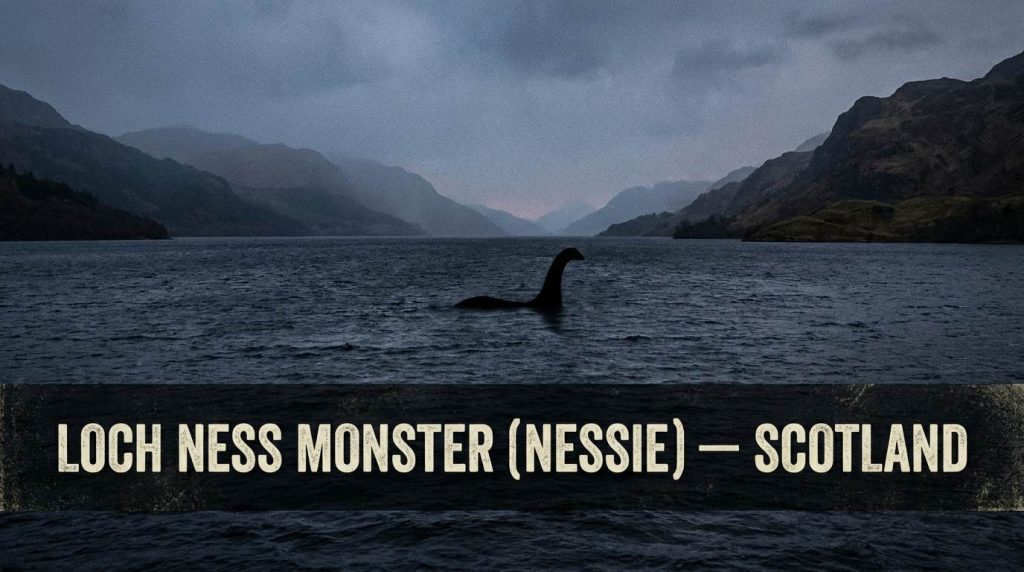
No lake monster is more famous than Scotland’s legendary Loch Ness Monster, affectionately known around the world as “Nessie.”
Reported to inhabit the deep, freshwater waters of Loch Ness in the Scottish Highlands, Nessie has become an enduring symbol of cryptozoology, inspiring decades of investigation, debate, and popular culture.
Although stories of mysterious creatures in Loch Ness stretch back centuries, the legend gained worldwide attention in 1933 when a series of eyewitness reports described a large, unidentified animal moving through the loch.
Newspapers across Britain quickly seized upon the story, transforming a local mystery into an international phenomenon.
Interest intensified further in 1934 with the publication of the famous “Surgeon’s Photograph,” an image that appeared to show a long-necked creature rising from the water. Decades later, the photograph was revealed to be an elaborate hoax, yet it remains one of the most iconic images in cryptid history.
Since then, thousands of reported sightings have been recorded, describing everything from dark humps breaking the surface to long-necked creatures, powerful wakes, and large unidentified shapes moving beneath the water.
These reports have inspired numerous scientific investigations, including sonar surveys, underwater photography, submersible searches, and more recently, environmental DNA (eDNA) studies aimed at identifying the species living within Loch Ness.
Over the years, countless explanations have been proposed. Skeptics have suggested sightings may result from waves, floating logs, swimming deer, large fish, seals, or optical illusions, while others have speculated about giant eels or even the unlikely survival of a prehistoric marine reptile.
Despite decades of research, no conclusive evidence has confirmed the existence of an unknown large animal in the loch.
Whether viewed as folklore, mistaken identity, or one of the world’s greatest unsolved mysteries, Nessie continues to captivate millions of people every year.
The legend has become an integral part of Scottish culture and tourism, ensuring that the mystery of Loch Ness remains one of the most famous and enduring cryptid stories ever told.
🐍 Champ — Lake Champlain Monster (United States & Canada)

Often described as America’s answer to the Loch Ness Monster, Champ is the legendary lake creature said to inhabit Lake Champlain, a vast freshwater lake stretching approximately 120 miles (193 km) along the border between New York, Vermont, and Quebec.
For centuries, stories of an enormous aquatic creature lurking beneath its waters have made Champ one of North America’s most famous cryptids.
Long before European settlers arrived, Indigenous peoples of the region, including the Abenaki and Iroquois (Haudenosaunee), shared traditions of mysterious creatures inhabiting the lake.
While these oral traditions have become closely associated with Champ in modern folklore, historians continue to debate how directly they relate to today’s lake monster legend. Nevertheless, the lake has long been regarded as a place of mystery and powerful natural forces.
Modern reports began appearing during the early nineteenth century, with one of the earliest widely publicized accounts dating to 1819, when Captain Crum claimed to have observed a large serpent-like creature swimming through the lake.
Throughout the nineteenth and twentieth centuries, numerous witnesses described seeing a long-necked animal, dark humps rising above the surface, or an enormous creature leaving unusual wakes across the water.
Champ’s most famous piece of alleged evidence emerged in 1977, when Sandra Mansi photographed what appeared to be a dark, long-necked object protruding from Lake Champlain.
Published several years later, the image quickly became one of the most recognizable photographs in cryptozoology and is often compared to the famous “Surgeon’s Photograph” of the Loch Ness Monster.
While skeptics have suggested the object may simply have been a partially submerged tree stump or floating log, supporters argue the photograph remains one of the strongest visual cases for an unknown lake creature.
Over the decades, researchers have conducted sonar surveys, underwater investigations, and wildlife studies in an attempt to explain the sightings.
Suggested explanations include giant lake sturgeon, unusually large gar, floating debris, wave effects, or misidentified animals. Despite these efforts, no definitive evidence has confirmed the existence of an unknown species inhabiting the lake.
Whether regarded as folklore, mistaken identity, or a genuine cryptozoological mystery, Champ has become an enduring symbol of Lake Champlain and remains one of the world’s most celebrated lake monster legends.
The creature continues to inspire eyewitness reports, scientific curiosity, local festivals, and countless comparisons with Scotland’s legendary Nessie.
🐉 Ogopogo — Okanagan Lake Monster (Canada)

Often regarded as Canada’s most iconic lake monster, Ogopogo is the legendary creature said to inhabit Okanagan Lake in British Columbia.
Stretching approximately 84 miles (135 km) through the picturesque Okanagan Valley, the deep freshwater lake has inspired stories of mysterious creatures for centuries, making Ogopogo one of North America’s best-known cryptids.
Long before European settlement, the Syilx (Okanagan) Nation shared traditions of N’ha-a-itk, a powerful spiritual being believed to inhabit the lake.
According to these traditions, the waters were to be treated with great respect, and travellers were once said to offer gifts before crossing the lake safely.
While N’ha-a-itk is a sacred figure within Indigenous culture rather than simply a “lake monster,” these ancient stories helped shape the modern legend that would later become known as Ogopogo.
The name “Ogopogo” first gained popularity during the early twentieth century, inspired by a humorous English music hall song called The Ogopogo.
As reports of an unknown creature in Okanagan Lake increased, the playful nickname gradually replaced earlier names and became firmly associated with the mysterious animal said to inhabit the lake.
Over the years, hundreds of eyewitnesses have described seeing a large serpent-like creature with several humps rising above the water, a long undulating body, or unusual wakes moving across the lake’s surface.
Among the most famous pieces of alleged evidence is a 1968 film captured by Arthur Folden, showing an unidentified object creating a distinctive wake across the water.
Although skeptics have suggested the footage may depict a swimming animal, floating debris, or an optical illusion, it remains one of the best-known videos associated with the legend.
Researchers and wildlife experts have proposed numerous explanations for Ogopogo sightings, including floating logs, boat wakes, large fish, swimming mammals, and wave patterns created by changing weather conditions.
Despite decades of sightings and investigation, no conclusive evidence has demonstrated that an unknown large animal inhabits Okanagan Lake.
Whether viewed as an enduring legend, a misunderstood natural phenomenon, or an unsolved cryptozoological mystery, Ogopogo has become an enduring symbol of British Columbia and remains one of the world’s most celebrated lake monster legends, attracting visitors, researchers, and curious travellers from around the globe.
🐲 Nahuelito — Lake Nahuel Huapi Monster (Argentina)

Often described as South America’s answer to the Loch Ness Monster, Nahuelito is the legendary creature said to inhabit Lake Nahuel Huapi in the Patagonian region of Argentina.
Surrounded by the dramatic Andes Mountains and vast wilderness, the lake has become the centre of one of South America’s most famous cryptid mysteries.
Reports of strange creatures in the region have existed for generations, with some stories linked to Indigenous traditions of the area, including the Mapuche people.
The name “Nahuelito” is derived from Nahuel Huapi, a name connected to the Mapuche language. However, the modern lake monster legend as recognised today developed primarily through later eyewitness reports, newspaper stories, and investigations during the twentieth century.
The creature is usually described as a large aquatic animal, plesiosaur or sometimes appearing as a long-necked, serpentine being similar to other famous lake monsters.
Witnesses have reported seeing unusual shapes moving through the water, large dark objects near the surface, and mysterious disturbances across the lake. Some accounts have compared the creature to a prehistoric reptile, while others describe it more like an enormous unknown fish or serpent.
Interest in Nahuelito increased significantly during the early twentieth century, particularly after reports were published in Argentine newspapers during the 1920s.
One of the most famous early accounts came from rancher Martin Sheffield, who claimed to have seen a large creature in the lake and encouraged expeditions to search for evidence. These reports helped transform local stories into a nationally recognised mystery.
Over the decades, alleged photographs, eyewitness accounts, and investigations have continued to fuel interest in Nahuelito.
Researchers have suggested several possible explanations, including large fish, otters, floating debris, waves, or misidentified animals. Some cryptozoologists have also proposed the idea of a surviving prehistoric creature, although no scientific evidence has confirmed the existence of an unknown large animal in Lake Nahuel Huapi.
Despite the lack of definitive proof, Nahuelito remains one of Argentina’s most fascinating cryptid legends.
The combination of ancient landscapes, remote wilderness, and mysterious sightings has ensured that the legend continues to capture the imagination of locals, researchers, and cryptid enthusiasts around the world.
🐍 Lagarfljót Worm — Iceland

One of Iceland’s oldest and most mysterious lake monster legends, the Lagarfljót Worm (Lagarfljótsormurinn) is a serpent-like creature said to inhabit Lagarfljót, a large lake near the town of Egilsstaðir in eastern Iceland.
Often described as Iceland’s answer to the Loch Ness Monster, the legend combines centuries-old folklore, mysterious sightings, and modern attempts to explain the strange phenomena reported around the lake.
Unlike many modern lake monsters, the story of the Lagarfljót Worm can be traced back hundreds of years.
One of the earliest written references dates to 1345, when Icelandic records described a mysterious creature or “marvel” associated with the lake. Over the following centuries, stories of a strange serpent-like being continued to appear in Icelandic folklore and historical writings.
According to one famous Icelandic legend, the creature began as a small worm placed on a golden ring by a young girl.
The worm was believed to help the gold grow, but when the girl returned, she discovered that the creature had grown enormously while the gold remained unchanged.
Terrified by the monstrous worm, she threw both the creature and the ring into Lagarfljót, where it continued to grow and became the legendary beast said to live in the lake.
Descriptions of the Lagarfljót Worm vary, but many accounts describe a huge, snake-like creature moving through the water, sometimes appearing as a long shape beneath the surface or creating unusual disturbances in the lake.
Some legends even describe the creature as capable of moving both through water and across land, giving it more of a dragon-like character than a traditional lake monster.
Interest in the legend increased again in modern times, particularly after a 2012 video appeared to show a strange, serpentine object moving through icy waters connected to Lagarfljót.
The footage attracted international attention, with some suggesting it showed the legendary worm. However, sceptics proposed that the object may have been a frozen fishing net or other debris affected by currents rather than a living creature.
As with other lake monster legends, possible explanations include floating debris, unusual ice formations, waves, or misidentified natural phenomena. No scientific evidence has confirmed the existence of an unknown animal living in Lagarfljót, but the centuries-old legend remains an important part of Icelandic folklore.
Today, the Lagarfljót Worm remains one of Iceland’s most fascinating mysteries. With its medieval origins, dramatic serpent imagery, and modern sightings, it represents a different kind of lake monster legend — one where mythology, history, and cryptozoology meet.
🐉 Storsjöodjuret — Lake Storsjön Monster (Sweden)

Often described as Sweden’s answer to the Loch Ness Monster, Storsjöodjuret (meaning “The Great Lake Monster”) is the legendary creature said to inhabit Lake Storsjön in the province of Jämtland, central Sweden.
With centuries of reported sightings, a dedicated local following, and a strong connection to Swedish folklore, Storsjöodjuret has become one of Europe’s most famous lake monster legends.
The story of Storsjöodjuret is believed to be around 400 years old, with one of the earliest written references dating back to 1635, when accounts described a mysterious creature associated with the waters of Storsjön.
Over the following centuries, reports of the creature continued, with sightings increasing during the nineteenth century and continuing into modern times.
Unlike some lake monsters that are consistently described as long-necked creatures, descriptions of Storsjöodjuret vary considerably.
Witnesses have reported seeing a long, serpent-like animal with several humps moving through the water, while others have described a large unknown creature creating unusual disturbances on the surface. Some accounts even describe the monster as having a distinctive head resembling a reptile or mammal.
During the nineteenth century, interest in capturing the creature became so strong that attempts were made to investigate the legend.
A large trap was reportedly constructed in an effort to catch Storsjöodjuret, although no creature was ever captured. The story became an important part of local folklore and helped cement the monster’s place in Swedish culture.
Modern interest in Storsjöodjuret has continued through eyewitness reports, alleged photographs, and attempts to monitor the lake.
As with other lake monsters, suggested explanations include large fish, floating debris, unusual waves, or misidentified natural phenomena. Despite many reported encounters, no scientific evidence has confirmed the existence of an unknown animal living in Lake Storsjön.
What makes Storsjöodjuret especially fascinating is the way the legend has become part of the region’s identity.
Visitors can explore monster-themed attractions, observation locations around the lake, and exhibitions dedicated to the creature.
The Jamtli museum in Östersund features a Storsjöodjuret exhibition, while the Storsjöodjurscenter in Svenstavik offers visitors the chance to learn more about the legend and even monitor the lake through webcams.
Whether viewed as folklore, a misunderstood natural phenomenon, or a genuine cryptozoological mystery, Storsjöodjuret remains one of Scandinavia’s greatest lake monster legends.
Like Nessie in Scotland, the creature has transformed from a mysterious story into a symbol of the landscape itself, attracting curious visitors who hope to catch a glimpse of Sweden’s legendary monster beneath the waves.
🐉 Lake Van Monster — Lake Van, Turkey

Hidden among the mountains of eastern Turkey lies Lake Van, a vast inland sea that has become the centre of one of the country’s most famous modern mysteries.
Unlike many legendary lake creatures whose origins stretch back centuries, the Lake Van Monster emerged largely through eyewitness reports, media attention, and a series of controversial sightings during the late twentieth century.
Lake Van is the largest lake in Turkey and one of the largest endorheic (closed-basin) lakes in the world. Its enormous size, unusual saline waters, and remote location have made it a natural setting for stories of something unknown beneath the surface.
Reports of a mysterious creature in Lake Van began gaining widespread attention during the 1990s, when local residents claimed to have seen a large, dark creature moving through the water.
Witnesses described a massive animal with a long body, sometimes compared to a serpent or prehistoric creature, creating waves or disturbances as it travelled across the lake.
The legend received international attention in 1997, when a video recorded near the town of Gevaş appeared to show a large unidentified object moving through the water.
The footage was broadcast widely in Turkey and sparked renewed interest in the creature. Supporters of the legend suggested the video showed evidence of an unknown aquatic animal, while sceptics argued that the object could have been debris, a natural formation, or an optical illusion caused by the water conditions.
Following the publicity surrounding the sightings, researchers and investigators visited the region to examine the claims.
The Lake Van Monster became a major topic in Turkish media, and local interest grew with some residents viewing the creature as part of the area’s identity and folklore. Despite searches and investigations, no physical evidence has confirmed the existence of an unknown large animal living in Lake Van.
As with many lake monster legends, explanations have included misidentified animals, floating objects, unusual wave patterns, and visual illusions created by the vast surface of the lake. Some cryptozoologists have speculated about a surviving prehistoric creature, although there is currently no scientific evidence supporting such claims.
Whether a genuine unknown creature or a fascinating example of modern folklore, the Lake Van Monster remains one of Turkey’s most intriguing cryptid mysteries.
Its combination of dramatic landscapes, eyewitness reports, and controversial video evidence has earned it a place among the world’s most famous lake monster legends.
🐍 Seljord Serpent (Selma) — Lake Seljordsvatnet, Norway

Nestled among the mountains and forests of southern Norway lies Lake Seljordsvatnet, home to one of Scandinavia’s most enduring cryptid legends.
Known locally as Selma, the Seljord Serpent has been reported for centuries and remains one of Norway’s most famous unexplained lake mysteries, attracting visitors hoping to catch a glimpse of the legendary creature.
Stories of a mysterious serpent inhabiting the lake date back to at least the eighteenth century, although local folklore suggests the legend may be considerably older.
One of the earliest documented reports comes from 1750, when witnesses claimed to have observed a large snake-like creature moving through the water. Since then, hundreds of alleged sightings have been reported by local residents and visitors alike.
Unlike the classic image of Nessie, the Seljord Serpent is most commonly described as an enormous aquatic snake.
Witnesses have reported seeing a long, dark body undulating across the lake’s surface, sometimes with several humps visible above the water or a distinct head rising briefly before disappearing beneath the waves. Descriptions vary, but many accounts portray a creature measuring several metres in length.
Interest in the legend has continued into modern times, with numerous investigations, photographs, and eyewitness reports helping to keep the mystery alive.
Although none of the evidence has conclusively demonstrated the existence of an unknown animal, the repeated sightings over many decades have ensured that the Seljord Serpent remains an enduring part of Norwegian folklore.
Researchers have suggested a variety of explanations for the reported encounters, including large fish, floating logs, unusual wave patterns, optical illusions, or misidentified wildlife.
As with many famous lake monsters, no scientific evidence has confirmed that an undiscovered large creature inhabits Lake Seljordsvatnet.
Today, the Seljord Serpent is celebrated as one of Norway’s best-known cryptids and has become a symbol of the local area.
The legend plays an important role in regional tourism, with visitors travelling to Lake Seljordsvatnet to explore its scenic surroundings, learn about the centuries-old mystery, and perhaps even spot the elusive creature for themselves.
Whether regarded as folklore, a misunderstood natural phenomenon, or an unsolved cryptozoological mystery, the Seljord Serpent continues to capture imaginations and stands alongside Scandinavia’s other great lake monster legends.
🐍 Manipogo — Lake Manitoba Monster (Canada)

While Ogopogo may be Canada’s most famous lake monster, it is not the country’s only legendary aquatic cryptid. Manipogo is the mysterious creature said to inhabit Lake Manitoba, a vast freshwater lake in the Canadian province of Manitoba.
Although less internationally renowned than its British Columbia counterpart, Manipogo has become one of Canada’s best-known regional cryptid legends through decades of eyewitness reports and local folklore.
The name “Manipogo” emerged during the mid-twentieth century, combining “Manitoba” with the already familiar name “Ogopogo.” However, stories of strange creatures in Lake Manitoba predate the nickname, with local Indigenous traditions and later settler accounts describing mysterious animals inhabiting the lake long before the modern legend became widely known.
Interest in Manipogo grew significantly during the 1950s and 1960s, when numerous eyewitnesses claimed to have seen a large creature moving through the lake.
One of the best-known reports occurred in 1962, when several witnesses described observing a dark, serpent-like animal with humps protruding above the water as it travelled across the lake. T
hese accounts attracted widespread media attention and helped establish Manipogo as one of Canada’s most famous unexplained lake mysteries.
Descriptions of Manipogo vary, but many witnesses have reported seeing a long, dark-bodied creature with several humps, resembling the classic image of a giant lake serpent. Others have described a broad-backed animal leaving an unusually large wake as it moved through the water before disappearing beneath the surface.
As with many lake monster legends, numerous explanations have been proposed, including large sturgeon, floating logs, wave patterns, or other natural phenomena. Despite decades of sightings and occasional investigations, no scientific evidence has confirmed the existence of an unknown large animal living in Lake Manitoba.
Today, Manipogo remains an enduring part of Manitoba’s folklore and one of Canada’s best-known cryptid legends.
Although overshadowed internationally by Ogopogo and the Loch Ness Monster, the mystery continues to intrigue researchers, locals, and visitors alike, demonstrating that stories of mysterious creatures beneath the water’s surface can be found across the globe.
🌍 Why Do Lake Monster Legends Endure?
From the mist-covered waters of Loch Ness to the remote lakes of Patagonia, the forests of Sweden, the volcanic landscapes of Iceland, and the mountains of Turkey, stories of mysterious creatures lurking beneath the surface have captured the human imagination for centuries.
Although each legend has developed within its own culture and landscape, many share striking similarities. Witnesses frequently describe large serpent-like animals, unexplained wakes, dark shapes gliding beneath the water, or creatures briefly emerging before disappearing into the depths.
While science has yet to confirm the existence of any unknown lake monster, these recurring reports continue to inspire curiosity, debate, and investigation.
For cryptozoologists, these legends represent some of the world’s most enduring unsolved mysteries. For sceptics, they offer fascinating examples of folklore, eyewitness psychology, and the ways in which natural phenomena can be misinterpreted.
Regardless of where the truth lies, the stories have become deeply woven into the identities of the communities that surround these lakes, inspiring museums, festivals, monuments, and visitors from around the world.
Perhaps that is the real legacy of the world’s great lake monsters. Whether they are undiscovered animals, misunderstood natural phenomena, or simply enduring folklore, they remind us that even in the modern age there are still places that inspire wonder and invite us to ask, what might be lurking beneath the surface?