Patterson-Gimlin Film: What Can AI Reveal About Bigfoot’s Most Famous Footage Nearly 60 Years Later?
The Footage That Defined Bigfoot
Few pieces of footage have had as much influence on modern cryptozoology as the Patterson-Gimlin film.
Captured on October 20, 1967, near Bluff Creek in Northern California, the short film appeared to show a large, unknown, hair-covered figure walking through the forest.
The footage, recorded by Roger Patterson and witnessed by Bob Gimlin, quickly became one of the most famous and controversial pieces of evidence connected to the legend of Bigfoot.
The figure, later nicknamed “Patty”, has remained at the centre of debate for almost six decades. To supporters of Sasquatch research, the footage represents one of the strongest visual encounters ever recorded, a possible glimpse of an unknown North American primate.
To sceptics, it remains an unexplained but disputed piece of film, with questions surrounding the possibility of a costume or other human explanation.
Despite decades of discussion, analysis, and investigation, the Patterson-Gimlin film continues to capture public imagination because it exists in a unique space between science, folklore, and mystery.
When the footage was filmed in 1967, researchers were limited by the technology of the era. The original film quality, available equipment, and methods of analysis were far removed from today’s digital world.
Modern advances in artificial intelligence, machine learning, and image processing now offer new ways to examine historical footage that previous generations could only study frame by frame.
However, an important question remains:
Can artificial intelligence actually reveal something new about the world’s most famous Bigfoot footage?
Could AI help us better understand the figure’s movement, body proportions, and the long-running costume debate? Or does the technology simply provide new tools for examining a mystery that still lacks definitive answers?
Nearly 60 years after “Patty” walked across the Bluff Creek clearing, the Patterson-Gimlin film remains one of cryptozoology’s greatest mysteries, and modern technology has given us a new way to look at it.
🎞️ The Patterson-Gimlin Film: The 1967 Bluff Creek Encounter

To understand why the Patterson-Gimlin film remains one of the most discussed pieces of cryptozoological evidence, it is important to return to the remote forests of Northern California in the autumn of 1967.
The footage was recorded on October 20, 1967, in the Bluff Creek region of Northern California, an area already associated with reports of unusual tracks and possible Bigfoot activity.
The location, surrounded by rugged wilderness and dense forest, had become one of the areas of interest for researchers searching for evidence of the creature described in Native American traditions and modern eyewitness accounts.
The expedition was led by Roger Patterson, a filmmaker and Bigfoot enthusiast who had developed an interest in investigating reports of the creature. He was accompanied by Bob Gimlin, a fellow outdoorsman and experienced horseman who joined the search through the remote terrain.
During their expedition, Patterson and Gimlin reportedly discovered a series of large footprints along a sandbar near Bluff Creek. While examining the area, Patterson’s camera was prepared, and moments later the pair encountered what appeared to be a large, unknown figure walking along the edge of the clearing.
Patterson began filming as the figure moved away from the camera, capturing approximately one minute of footage that would become known around the world as the Patterson-Gimlin film.
The creature, later named “Patty”, appeared to stand upright with a human-like posture while displaying several unusual features:
👣 A large, muscular body shape
🦍 Broad shoulders and long arms
🚶 A distinctive walking style
🌲 An apparent covering of dark hair across the body
The footage was unlike anything previously recorded in Bigfoot research and quickly became a defining moment for modern cryptozoology.
However, from the beginning, the film was surrounded by debate.
Supporters argued that the figure displayed characteristics difficult to reproduce through a conventional costume, pointing to details such as apparent muscle movement, body proportions, and the natural way the figure appeared to move through the landscape.
Sceptics questioned whether the footage showed an unknown creature at all, suggesting that the figure could potentially have been a person wearing a specially designed suit.
The debate was further complicated by the limitations of 1960s film technology, which made detailed analysis difficult compared with today’s digital methods.
Regardless of interpretation, the Patterson-Gimlin film became more than just a piece of footage. It became a cultural landmark, appearing in documentaries, books, television programmes, and countless discussions about the possibility of unknown animals existing in unexplored areas of the world.
Nearly sixty years later, the film remains one of the most analysed recordings in cryptozoology history. While it has not provided definitive proof of Bigfoot’s existence, it has continued to inspire researchers, filmmakers, scientists, and enthusiasts to ask one enduring question:
What exactly was captured walking through Bluff Creek in 1967?
⚖️ The Great Debate: Evidence, Hoax Theories and Why the Film Endures

Few pieces of cryptozoological evidence have generated as much discussion, analysis, and disagreement as the Patterson-Gimlin film.
Since it first became public in the late 1960s, the footage has been examined by Bigfoot researchers, filmmakers, historians, sceptics, and enthusiasts around the world.
Nearly sixty years later, the debate continues because the film occupies a rare position: it is famous enough to receive serious examination, yet controversial enough that no universally accepted explanation has ever emerged.
For many Bigfoot researchers, the Patterson-Gimlin film remains one of the most important pieces of visual evidence connected to the Sasquatch mystery.
Supporters point to several features of the figure known as “Patty”:
👣 The walking style — Many researchers argue that the movement appears unusual compared with an ordinary human walking, highlighting the stride, posture, and overall body mechanics.
🦍 The apparent anatomy — Supporters often point to the broad shoulders, long arms, and body proportions of the figure as characteristics they believe are difficult to explain through a simple disguise.
🌲 The location and circumstances — The film was recorded in a remote region of Northern California that had already attracted attention due to reports of large footprints and possible Bigfoot activity.
For those who believe the footage may show a genuine unknown animal, the film represents a rare moment where a creature previously known mainly through eyewitness accounts appeared to be captured on camera.
However, the footage has also raised important questions.
Sceptics have questioned the circumstances surrounding the encounter, including Patterson’s existing interest in Bigfoot, his goal of creating a documentary, and the potential financial benefits connected to promoting the subject.
The central question is one that has remained throughout the entire debate:
Was this an extraordinary encounter captured by someone prepared to document it, or was it a carefully created piece of evidence designed to convince viewers?
One of the biggest areas of discussion concerns the possibility that the figure was a person wearing a costume, a theory that has produced some of the most debated claims connected to the film.
Over the decades, several individuals have suggested possible links between costume technology and the footage, including costume maker Philip Morris, whose later claims became a significant part of the wider hoax debate.
These claims, along with questions surrounding motivation, opportunity, and the limitations of 1960s film technology, have ensured that the Patterson-Gimlin film remains one of the most analysed mysteries in cryptozoology.
👤 The People Behind the Film: Roger Patterson and Bob Gimlin
Behind the famous footage were two men whose lives became permanently connected to one of cryptozoology’s most debated mysteries.
Roger Patterson, the filmmaker who recorded the footage, remained a central figure in Bigfoot research after the 1967 encounter.
He continued to maintain that the film showed a genuine unknown creature until his death in 1972 at the age of 38.
His early death meant that many later discussions about the footage took place without the possibility of further interviews or clarification from one of the two original filmmakers.
Bob Gimlin, who accompanied Patterson during the Bluff Creek expedition, remains the surviving eyewitness directly connected to the event. Gimlin has consistently maintained that the encounter was genuine and has denied involvement in any planned hoax.
The different interpretations of their roles have become part of the wider Patterson-Gimlin debate. Supporters view them as researchers who captured a remarkable moment, while sceptics continue to examine questions surrounding preparation, motivation, and opportunity.
Regardless of interpretation, both men became permanently linked to one of the most famous mysteries in cryptozoology history.
🎭 The Costume Question: Philip Morris, The Suit Theory and the Unanswered Questions
One of the most discussed explanations surrounding the Patterson-Gimlin film is the possibility that the figure known as “Patty” was a person wearing a specially designed costume.
The idea has remained one of the central arguments in the debate for decades. While some sceptics view a costume as the most likely explanation for the footage, supporters argue that a simple suit explanation does not fully account for every detail seen in the film.
One of the most notable claims connected to the costume theory came from Philip Morris, the owner of Morris Costumes, a company specialising in theatrical costumes and props.
Decades after the film was recorded, Morris stated that he believed he had supplied a gorilla-style costume to Roger Patterson in 1967 and suggested that the costume may have been used in the famous Bigfoot footage.
According to Morris, he recognised similarities between the costume he had supplied and the figure seen in the film after viewing the footage years later.
He explained that he had not spoken publicly about his belief immediately because protecting the privacy of customers and performers was considered an important part of the entertainment industry.
For supporters of the hoax theory, Morris’ claim was significant because it appeared to provide a possible link between the famous footage and a real costume source.
However, the timing of the claim also created new questions.
Why did it take more than three decades before this information became public?
Sceptics have argued that if Morris truly recognised his work in one of the most famous pieces of footage in cryptozoology history, the long delay naturally raises questions.
Supporters of Morris’ explanation have suggested that professional ethics, confidentiality, and the culture of the entertainment industry at the time may explain why he remained silent for so long.
Without surviving purchase records, original paperwork, or the costume itself being publicly examined, the claim remains an important but debated part of the Patterson-Gimlin mystery.
The story became even more complicated when another individual later came forward claiming to have been the person inside the Bigfoot costume.
Bob Heironimus, a former friend of Roger Patterson, publicly claimed that he had worn the suit during the filming of the Patterson-Gimlin footage. His account suggested that the famous creature was a human performer rather than an unknown animal.
For sceptics, these claims appeared to create a possible explanation:
- A costume source existed.
- A person claimed to have worn the costume.
- Patterson had both the motivation and opportunity to stage the event.
However, the claims have also remained controversial.
Supporters of the film have questioned aspects of the costume explanations, including whether the described suit would accurately match the appearance, movement, and proportions of the figure seen walking through Bluff Creek.
This leads to one of the most important questions in the entire debate:
Could a costume from 1967 realistically reproduce everything captured on film?
The answer is complicated.
It is true that Hollywood and the entertainment industry had already created impressive creature effects and realistic costumes. Skilled designers were capable of producing convincing monsters and unusual characters.
The question is not simply:
“Could someone make a hairy costume in 1967?”
The answer is clearly yes.
The more difficult question is:
“Could a 1967 costume explain the movement, body proportions, apparent muscle definition, and natural walking style seen in the Patterson-Gimlin film?”
Supporters argue that the figure displays characteristics that remain difficult to explain through a conventional disguise, pointing to the apparent weight shift, stride, posture, and body movement.
Sceptics argue that a skilled performer, combined with careful costume design and the limitations of 1967 film technology, could potentially create a convincing illusion.
Ultimately, the costume debate remains unresolved.
The Patterson-Gimlin film continues to sit between two possibilities: a genuine encounter with an unknown creature, or one of the most successful and influential hoaxes in modern folklore.
Perhaps that uncertainty is the reason it has survived for almost sixty years.
The mystery is not only whether a costume was possible, it is whether a costume alone can explain everything that appears to have been captured on film.
And this is where modern technology creates a new opportunity.
With artificial intelligence, digital enhancement, and modern analysis tools now available, researchers can revisit the same footage and ask questions that were impossible to explore in 1967.
🤖 The Rise of AI: How Modern Technology Is Re-examining Historical Mysteries

When the Patterson-Gimlin film was recorded in 1967, researchers had only limited tools available to study it.
The footage could be viewed, copied, slowed down, and examined frame by frame, but the ability to digitally enhance, process, and analyse images was still decades away.
Today, advances in artificial intelligence and machine learning have changed the way we approach old footage, photographs, and historical mysteries.
Technology that once belonged only to professional laboratories is now becoming increasingly accessible, allowing researchers and enthusiasts to examine famous cases from a completely new perspective.
Artificial intelligence can assist with tasks such as:
🔍 Image enhancement — improving clarity, reducing noise, and bringing out details hidden within older footage.
🎞️ Frame analysis — examining individual moments in a video to study movement, positioning, and visual details.
🚶 Motion analysis — comparing movement patterns, walking styles, and body mechanics.
🧠 Pattern recognition — identifying similarities, differences, or unusual features within visual data.
For a mystery like the Patterson-Gimlin film, this creates an intriguing possibility: after decades of traditional analysis, could modern technology reveal something that previous generations were unable to see?
However, there is an important distinction to make.
Artificial intelligence does not “know” whether something is real or fake. It does not possess the ability to prove the existence of an unknown animal simply by analysing footage. Instead, AI works by identifying patterns within the information it is given.
In other words, AI can help us ask better questions, but it cannot provide answers that the evidence itself does not contain.
This is especially important when examining the Patterson-Gimlin film. The original footage remains limited by the technology of the 1960s. The camera, film quality, distance from the subject, and available detail all place restrictions on what any modern system can determine.
Even the most advanced AI tools cannot recover information that was never captured.
However, they may help researchers examine existing details in new ways:
Could enhanced footage provide a clearer look at the figure’s movement?
Could computer analysis offer new insights into body proportions?
Could modern tools help evaluate long-standing questions surrounding the possibility of a costume?
These questions do not represent a simple search for proof or disproof. Instead, they reflect something that has kept the Patterson-Gimlin film alive for almost six decades:
The desire to look closer. The desire to understand.
And the possibility that new technology may help us revisit one of cryptozoology’s greatest mysteries with fresh eyes.
🚶 Analysing Patty’s Walk: The Famous Bigfoot Gait Debate
Among all aspects of the Patterson-Gimlin film, perhaps nothing has received more attention than the way the figure walks.
The footage lasts only a little over a minute, yet the movement captured during those few seconds has become one of the central arguments in the ongoing debate.
To supporters of the film, the gait appears unlike that of an ordinary human. They point to the figure’s long stride, upright posture, apparent weight transfer, and the way the body moves as it crosses the clearing.
Rather than a person simply walking normally, many researchers argue that the movement appears heavy, deliberate, and animal-like.
The term often used in Bigfoot research is “compliant gait” — the idea that the figure’s movement shows characteristics associated with a large, heavy-bodied animal adjusting its balance while walking.
Supporters have highlighted features such as:
👣 The stride length — The figure appears to cover significant distance with each step, which some researchers argue is consistent with a larger body size.
🦍 The upper body movement — The shoulders, arms, and torso appear to move differently from a typical human walking pattern.
⚖️ The weight distribution — Some observers argue that the figure seems to move with a different centre of gravity compared with a human performer.
However, sceptics have offered alternative explanations.
A person wearing a costume would not necessarily walk like an ordinary person. A performer attempting to portray an unknown creature might deliberately alter their posture, shorten or lengthen their stride, or exaggerate movement to create the appearance of something non-human.
This is one of the challenges of analysing the footage:
A convincing performance can also create unusual movement.
The question is not simply:
“Does the figure walk differently?”
Many people agree that it appears unusual.
The bigger question is:
“Does the movement show evidence of a different species, or could it be explained by a skilled human performer?”
This is where modern technology introduces new possibilities.
Unlike researchers in 1967, today’s analysts can use advanced software to examine movement frame by frame.
AI-assisted analysis could potentially examine:
- joint movement,
- stride timing,
- limb proportions,
- centre of mass,
- walking efficiency,
- human versus non-human movement patterns.
However, there are also limitations.
The Patterson-Gimlin film was recorded on 16mm film nearly sixty years ago. The footage is:
- low resolution compared with modern video,
- affected by distance and camera movement,
- missing many details needed for perfect biomechanical analysis.
AI can enhance and analyse what is present, but it cannot recover information that was never captured.
Ultimately, the famous walk remains one of the most intriguing parts of the mystery.
To believers, it represents a movement pattern that may reveal something unknown.
To sceptics, it represents an impressive performance that has remained convincing for generations.
And this is where artificial intelligence offers a new opportunity, not to instantly solve the mystery, but to ask better questions about one of the most famous pieces of footage in cryptozoology history.
🤖 AI-Assisted Biomechanical Analysis of the Patterson–Gimlin Film

The following assessment combines observations from both the famous “Patty” still image and the original Patterson–Gimlin film sequence.
Rather than attempting to determine whether the subject is genuine or a hoax, the analysis focuses on observable anatomy, body proportions and biomechanics visible in the available footage.
Because the film was recorded on 16 mm film in 1967 and has undergone numerous copies and digital transfers, image quality places significant limits on what can be determined with certainty.
📷 Visual Assessment
Across the clearest frames, the subject displays a consistent upright bipedal gait with a broad, barrel-shaped torso, relatively small head, minimal visible neck and unusually long arms that appear to extend close to knee level.
Unlike many alleged cryptid recordings, the figure remains visible for several seconds, allowing repeated observation of its movement rather than relying on a single blurred image.
Although many anatomical features are discernible, important details such as finger structure, facial features, foot anatomy, fur texture and potential costume seams remain obscured by film grain, motion blur and the limited resolution of the surviving footage.
🦴 Body Proportions and Physical Characteristics
The figure exhibits several anatomical features that have fuelled debate for decades. The shoulders appear exceptionally broad relative to the head, producing a powerful upper-body silhouette that differs from the proportions of an average human.
However, shoulder width alone cannot be considered diagnostic, as perspective, heavy clothing, costume construction or shoulder padding could potentially exaggerate this appearance.
The arms also appear unusually long, with the hands reaching close to knee level. While this could indicate naturally elongated limb proportions, alternative explanations such as extended costume sleeves, camera angle or optical perspective cannot be ruled out.
The torso appears deep and barrel-shaped, with a relatively small head and almost no visible neck. The thighs appear heavily built and muscular, while the lower legs seem proportionally shorter than the upper legs, although the camera angle prevents accurate measurements.
Some frames have been interpreted as showing subtle muscle definition around the shoulders, thighs and calves, but the film quality makes it impossible to determine whether these are genuine anatomical features or simply artefacts created by lighting and film grain.
One of the more unusual observations is the apparent presence of breast tissue, which has led some researchers to interpret the subject as female.
While this has often been cited as a point against the costume hypothesis, it cannot be considered definitive, as a costume designer could theoretically have included such features deliberately.
🚶 Gait and Walking Mechanics
From a biomechanical perspective, the walking sequence appears smooth, coordinated and internally consistent.
The subject walks with a relaxed, rhythmic stride across uneven terrain without obvious hesitation or exaggerated corrective movements.
Despite traversing logs, rocks and debris, the figure maintains stable balance and appears comfortable moving through the environment.
The knees remain slightly flexed throughout much of the walking cycle rather than fully locking during each step, producing what biomechanists describe as a more compliant gait.
Weight transfers smoothly between supporting legs with relatively little vertical movement of the head, while the torso remains comparatively stable with only limited rotational movement.
The arm swing is noticeably restrained compared with a typical human gait. This could reflect unusual body proportions or greater upper-body mass, but equally it may result from cautious footing, bulky clothing or movement restrictions imposed by a costume.
Overall, the movement appears natural rather than exaggerated, although none of these characteristics are unique to an unknown primate.
⚖️ Human Performer vs Unknown Biped
The apparent body proportions have been central to discussions surrounding the Patterson–Gimlin film.
The combination of broad shoulders, long arms, compact head and deep chest creates a silhouette that many researchers regard as unusual for an average human.
At the same time, none of these individual features are impossible to recreate.
Costume padding could broaden the shoulders, extended sleeves could increase apparent arm length, carefully designed footwear might alter foot proportions, and a well-constructed suit could conceal much of the wearer’s natural anatomy.
The absence of clearly visible zippers, seams or mask edges does not demonstrate that no costume was used; rather, the available footage simply lacks the resolution required to confirm or reject such features.
Consequently, the observed anatomy remains consistent with both a large, heavily built biped and certain human-performer scenarios.
📏 Estimated Height
Height estimates remain uncertain because there is no perfectly reliable scale reference within the scene.
Published estimates have generally ranged between approximately 1.9 and 2.3 metres (6 ft 3 in to 7 ft 6 in), with many modern reconstructions placing the figure around 2.0–2.1 metres (6 ft 7 in to 6 ft 11 in).
These figures should be regarded as informed estimates rather than precise measurements.
🤖 Limitations of AI Analysis
AI-assisted visual analysis can describe only what is visible within the footage. It cannot identify species, determine whether fur is biological or synthetic, detect DNA, establish what lies beneath the visible surface, accurately calculate body dimensions without reliable scale references or determine the intent of the filmmakers.
Instead, AI provides an objective assessment of observable biomechanics and anatomy, highlighting characteristics that may support different interpretations while recognising the limitations imposed by the available evidence.
📝 Overall Assessment
From a biomechanical standpoint, the Patterson–Gimlin film depicts a figure exhibiting a smooth, balanced and internally consistent bipedal gait, broad shoulders, relatively long arms, a stable centre of mass and controlled weight transfer across uneven terrain.
These characteristics have contributed to the film’s enduring reputation as one of the most compelling pieces of alleged cryptid evidence ever recorded.
However, the surviving footage does not provide sufficient resolution to conclusively distinguish an unknown primate from a skilled human performer wearing a well-designed costume.
While several observed features appear unusual for an average human, none are individually diagnostic of an undiscovered species, and plausible alternative explanations remain for each observation.
Overall AI Conclusion: Based on both the still image and motion sequence, the Patterson–Gimlin film presents a subject with anatomically coherent body proportions and natural-looking locomotion that continue to warrant serious biomechanical discussion.
Nevertheless, the available visual evidence alone cannot conclusively confirm either the unknown primate hypothesis or the human-performer hypothesis.
The film remains one of the strongest and most debated visual records in the history of cryptozoology precisely because both interpretations remain plausible based on the surviving footage.
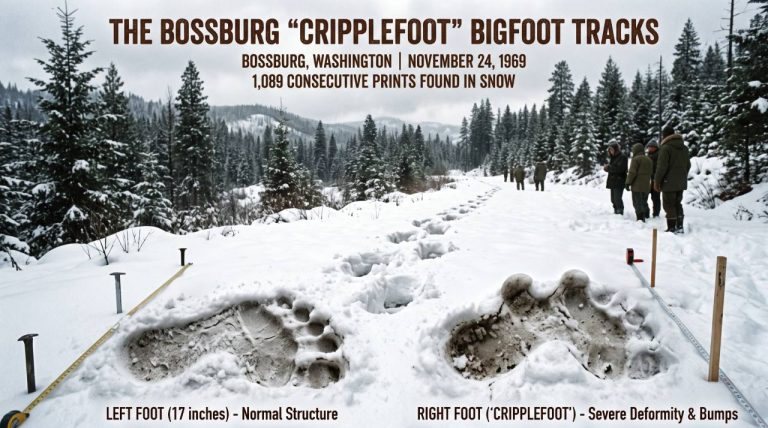
👣 Physical Evidence at Bluff Creek

While the Patterson–Gimlin film remains the centrepiece of the 1967 encounter, it was not the only evidence reportedly documented at Bluff Creek.
According to Roger Patterson, Bob Gimlin and subsequent investigators, the site also contained a series of large footprints extending across the sandbar and surrounding terrain.
Several of these impressions were measured, photographed and preserved as plaster casts.
The footprints displayed characteristics that have continued to generate debate, including an apparent mid-foot flexibility, a broad forefoot and, in some casts, indications of dermal ridge patterns similar to fingerprints.
Supporters argue that these anatomical features would have been extremely difficult to fabricate convincingly, particularly given the materials and knowledge available in the late 1960s.
Sceptics, however, have questioned whether such impressions could have been artificially created using carved wooden feet or other fabricated moulds.
Others argue that environmental factors, soil conditions and the casting process itself can introduce artefacts that resemble anatomical detail. As with the film, no single footprint or cast has been universally accepted as definitive proof of an unknown primate.
Perhaps the strongest aspect of the footprint evidence is that it exists independently of the film itself.
Multiple casts remain available for examination decades after the original encounter, allowing researchers to compare measurements, pressure distribution and anatomical characteristics using increasingly sophisticated techniques.
Although interpretation remains divided, the footprints continue to represent one of the most tangible pieces of physical evidence associated with the Patterson–Gimlin case.
🔬 AI Assessment of the Physical Evidence
From an evidence-based perspective, the footprint casts provide an important line of inquiry because they represent physical objects that can still be studied, unlike the fleeting visual evidence captured on film.
However, AI cannot determine whether a cast originated from an unknown species or a fabricated impression.
Without a verified chain of custody, direct observation of the original track formation or biological material such as DNA, the casts cannot independently confirm the existence of Bigfoot.
Nevertheless, when considered alongside the film, witness testimony and the reported trackway, the footprint evidence contributes additional data that researchers continue to analyse more than half a century after the event.
🦍 A Mystery That Refuses to Disappear
Nearly six decades after it was filmed, the Patterson–Gimlin encounter remains one of the most intensively examined pieces of evidence in cryptozoology.
Modern AI-assisted image analysis allows researchers to evaluate gait, anatomy and biomechanics with greater consistency than was possible in 1967, yet many of the same questions remain unanswered.
Neither the film nor the associated footprint evidence has conclusively proven the existence of an unknown North American primate, but neither has either line of evidence been definitively explained to the satisfaction of all researchers.
Whether interpreted as an extraordinary wildlife encounter or one of the most convincing hoaxes ever recorded, the Patterson–Gimlin film continues to occupy a unique place in the history of cryptozoological research.