Scotland’s Forgotten Lake Monster: Morag
Most people have heard of the legendary Loch Ness Monster, but few know that another Scottish loch is home to its own enduring mystery.
Hidden among the remote Highlands, Loch Morar has been linked to sightings of a mysterious creature known as Morag for more than a century.
While millions of visitors flock to Loch Ness each year in search of Scotland’s most famous monster, Loch Morar remains a far quieter and more secluded place.
Surrounded by rugged mountains, ancient forests, and deep, dark waters, the loch possesses all the ingredients that have fuelled mysterious tales for generations.
Here, far from the crowds and souvenir shops, reports of an unidentified creature have quietly accumulated through the decades.
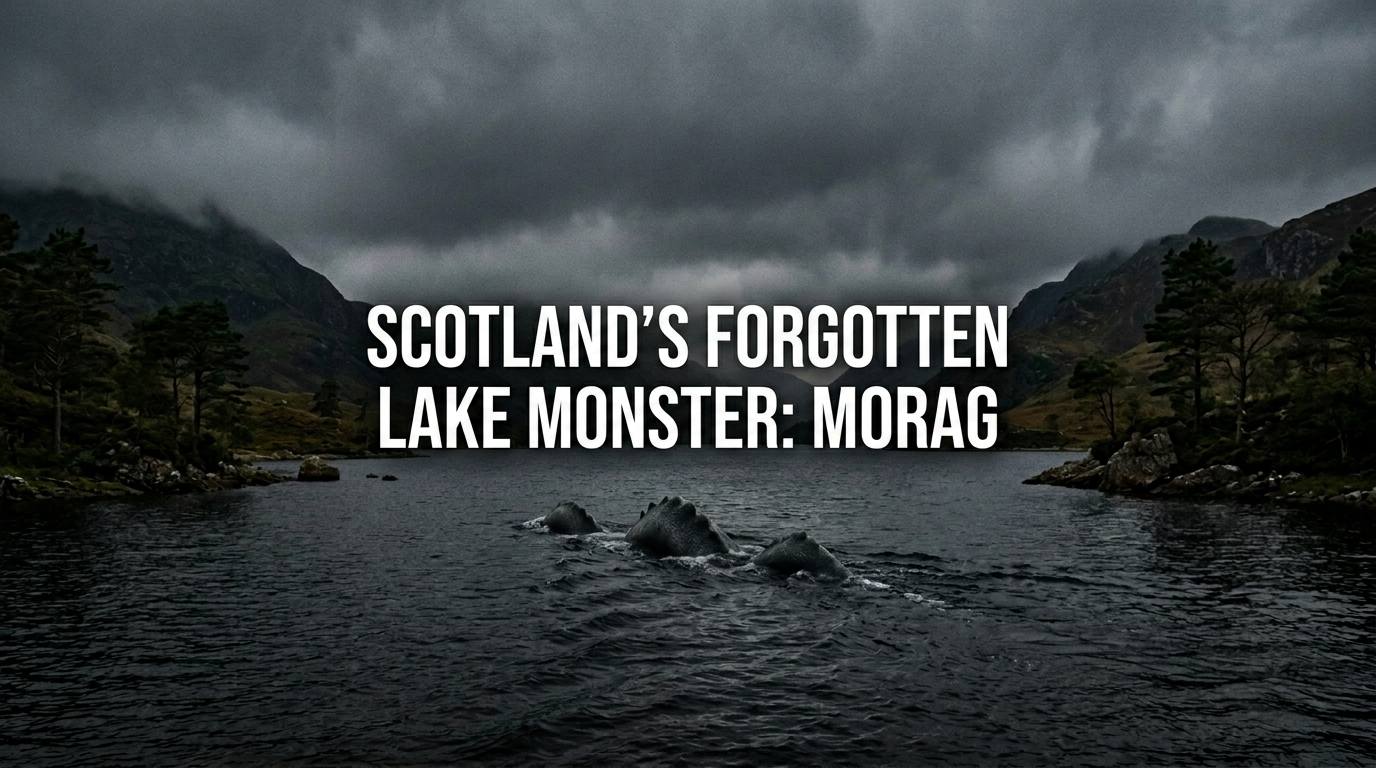
Known locally as Morag, the alleged lake monster has been described by witnesses as a large, dark creature moving through the water with humps, coils, or an unusually long body.
Although far less famous than Nessie, Morag has been the subject of numerous reported sightings dating back to the late nineteenth century, earning a place among Scotland’s most intriguing cryptid legends.
Unlike many famous monsters that have become cultural icons through films, tourism, and worldwide media attention, Morag has remained largely in the shadows.
The creature rarely features in documentaries, receives little international recognition, and is often overlooked even by those fascinated by unexplained mysteries. Yet for many enthusiasts, that relative obscurity only adds to its appeal.
So why has Scotland’s deepest freshwater loch produced its own monster legend?
Are the reported sightings simply the result of misidentification, folklore, and the eerie atmosphere of the Highlands, or could Loch Morar still conceal an undiscovered animal beneath its dark surface?
While no convincing scientific evidence has confirmed Morag’s existence, the reports continue to fuel one of Scotland’s most enduring and least explored mysteries.
In this article, we’ll explore the history of Morag, examine the most significant eyewitness accounts, compare the legend with the more famous Loch Ness Monster, consider scientific explanations, and discover why Scotland’s forgotten lake monster continues to capture the imagination of those drawn to the unknown.
Where is Loch Morar?
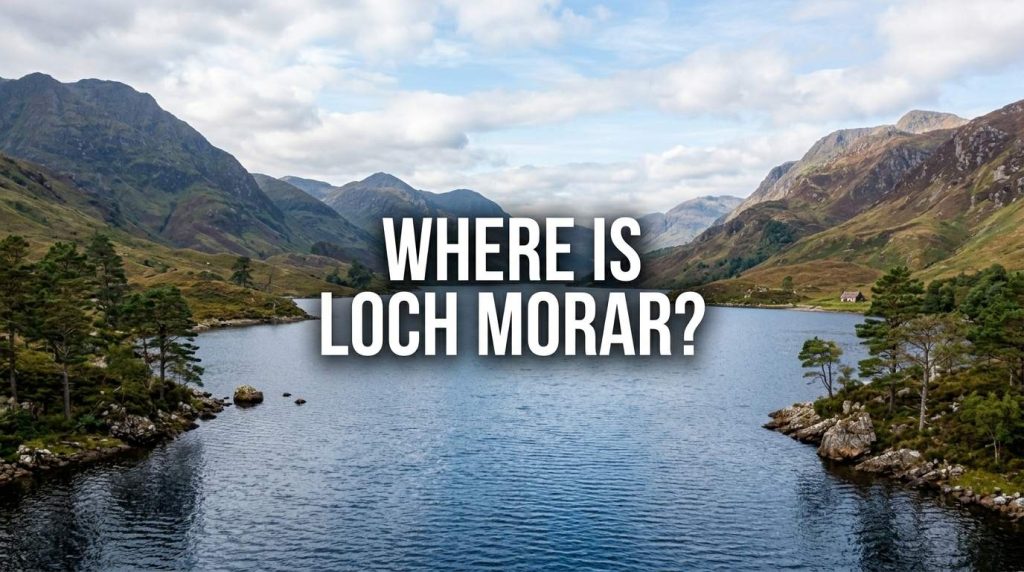
Loch Morar lies deep within the western Highlands of Scotland, far from the country’s major cities and modern development. It is a place defined by isolation, a long, dark body of water surrounded by steep mountains, dense woodland, and a landscape that feels largely untouched by time.
At first glance, it may seem like just another Highland loch. But Morar is not ordinary. It is the deepest freshwater body of water in the British Isles, plunging to depths of over 300 metres in places.
Beneath its surface, entire sections of the loch drop away into darkness where sunlight struggles to reach, creating an environment that remains largely unexplored even today.
The loch stretches for around 12 miles, yet much of its shoreline is inaccessible. There are few settlements nearby, and even fewer vantage points where the full scale of the water can be taken in.
On quiet days, the surface of the loch can appear almost unnaturally still, a vast sheet of dark glass reflecting the surrounding mountains. On stormy days, however, it transforms entirely, with wind-driven waves and shifting mists giving the impression that something far beneath the surface is stirring.
Unlike the heavily visited Loch Ness, Morar remains relatively remote and overlooked. There are no bustling tourist centres built around its shores, no constant flow of boats scanning its surface, and no modern infrastructure designed to observe what lies beneath.
Instead, it retains a quiet, almost abandoned atmosphere, the kind of place where it is easy to imagine something unseen slipping just out of view beneath the water.
The surrounding environment only adds to this sense of isolation. Forests press down toward the shoreline, hills rise sharply into mist-covered peaks, and weather conditions can change rapidly, often reducing visibility within minutes. In these conditions, even ordinary natural phenomena can take on a strange and unsettling quality.
It is within this landscape, deep water, limited visibility, and near-total isolation, that the legend of Morag takes root. Whether the reports stem from misidentifications, rare natural sightings, or something more elusive, Loch Morar provides the perfect setting for uncertainty to linger.
Because here, in one of Scotland’s most remote and least disturbed environments, the boundary between what is known and what is possible feels unusually thin.
Why Loch Morar Is Perfect for Monster Legends
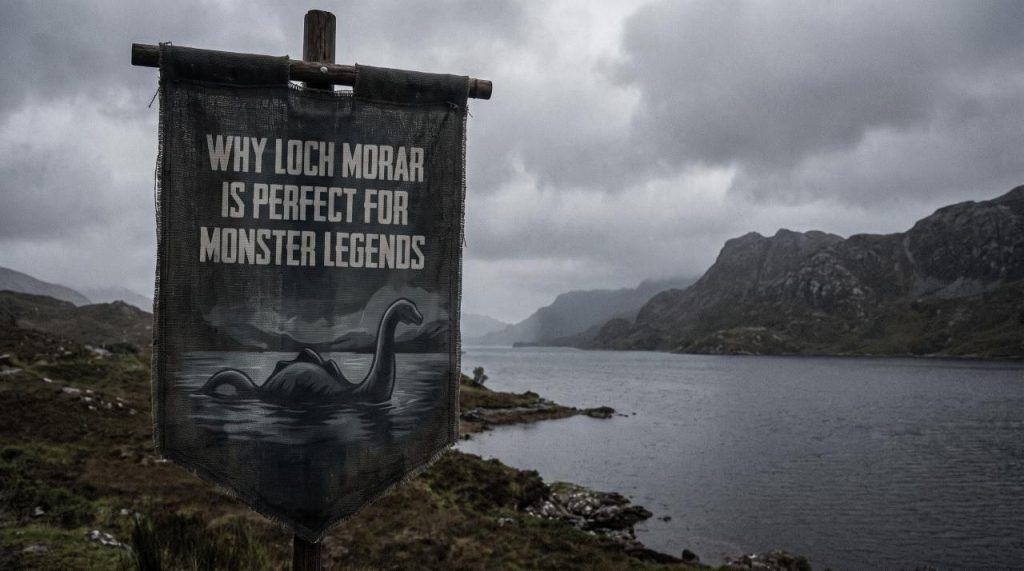
Loch Morar is not just a remote body of water, it is the kind of environment where uncertainty feels natural, and where stories have room to grow in the absence of answers.
Human beings have always created legends around places they cannot fully see, fully understand, or fully control. In that sense, Morar is almost engineered for mystery. It combines isolation, depth, and atmosphere in a way that makes even ordinary moments feel unsettling when viewed through the right lens.
One of the most important factors is its extreme depth. As the deepest freshwater loch in the British Isles, Morar contains vast underwater terrain that has never been fully explored in detail.
Steep underwater drops and dark, sediment-heavy waters reduce visibility to a minimum. To early witnesses, and even modern observers, this creates a simple but powerful problem: you can never truly see what lies beneath the surface.
Then there is the issue of light and perception. On calm days, the loch can appear deceptively still, reflecting the surrounding mountains like a mirror. But that stillness can also distort distance and shape. A ripple becomes a movement. A shadow becomes something solid. At the far end of the water, where haze and mist often gather, it becomes difficult for the human eye to reliably judge scale or direction.
The surrounding landscape plays its own role. Loch Morar is bordered by steep hills, dense woodland, and narrow stretches of shoreline that limit visibility from most angles. Unlike more accessible lakes, there are few clear, elevated viewpoints. Much of the loch is seen in fragments rather than as a complete whole, partial glimpses rather than full perspective.
Weather in the Highlands adds another layer of uncertainty. Mist can roll in quickly, cutting visibility in minutes. Wind can disturb the surface without warning. Light shifts constantly across the water, especially when clouds move over the surrounding mountains. In these conditions, even a brief sighting can become fragmented, incomplete, and difficult to interpret later.
Just as important is the loch’s remoteness. There is no constant human presence observing the water, no steady flow of boats or tourists scanning its surface. Sightings, when they occur, are often isolated events, brief moments experienced by a handful of people, with no immediate way to verify or disprove what was seen. In this kind of environment, uncertainty is not just possible; it is expected.
Over time, this combination of factors creates the perfect conditions for legend-building. Depth that hides, weather that distorts, terrain that restricts perspective, and isolation that limits confirmation, all of it allows small moments of confusion to persist, evolve, and accumulate into something larger.
Whether or not anything unknown actually exists within its waters, Loch Morar provides exactly the kind of environment where a story like Morag does not fade easily. Instead, it lingers, reinforced by every ripple, every shadow, and every uncertain glance across the dark surface of the loch.
The Legend Of Morag
Loch Morar has long been associated with stories of something large moving beneath its dark surface, but the creature now known as Morag did not emerge from a single clear origin point.
Instead, the legend appears to have formed gradually, built from scattered accounts, local storytelling, and repeated descriptions that slowly converged into something more defined.
The name Morag itself is often linked to Scottish naming traditions rather than any ancient classification.
Unlike older Highland folklore creatures with deep mythological roots, Morag feels comparatively modern, a name attached to a mystery rather than a figure preserved through centuries of written legend. This already sets it apart from many traditional Scottish beings, suggesting a story shaped more by eyewitness accounts than ancient mythology.
Early reports associated with Morag describe strange disturbances on the surface of the loch, unexplained wakes, sudden ripples moving against the wind, or brief sightings of something large breaking the water before disappearing beneath it again.
Over time, these reports began to share common features. Witnesses spoke of dark shapes, elongated forms, and movements that did not match known wildlife in the region.
Some descriptions suggested multiple humps or arches breaking the surface, similar in passing resemblance to the classic “serpent-like” lake monster archetype seen in other parts of the world.
Others described something more solid and animal-like, a creature that appeared to move with strength and weight rather than randomness or drift. The lack of consistency in detail did not weaken the legend; instead, it allowed it to expand, as different interpretations layered over the same unknown phenomenon.
Unlike heavily publicised cryptids such as Loch Ness Monster, Morag never became a global media sensation.
There were no major tourism campaigns built around it, no large-scale investigations that brought international attention, and no definitive photographs that transformed it into a cultural icon. Instead, the legend remained largely local, passed between anglers, residents, and occasional visitors who claimed to have seen something unusual in the water.
This quieter evolution is part of what makes Morag distinct. It is not a story shaped by repetition in popular media, but rather one sustained by intermittent, isolated reports that never fully disappeared. Each new account added another layer, reinforcing the idea that something unusual may occasionally be glimpsed within the loch.
Over time, Morag became less of a single defined creature and more of a shared label for the unknown. Any unexplained movement in the waters of Loch Morar could, in theory, be attributed to it. In this way, the legend grew not from certainty, but from ambiguity — a name given to moments that did not easily fit explanation.
And so Morag remains today: not as a clearly documented creature with a fixed appearance, but as an enduring presence within the folklore of the Highlands. A name attached to uncertainty. A story shaped as much by what was not seen as by what was.
The Most Notable Sightings
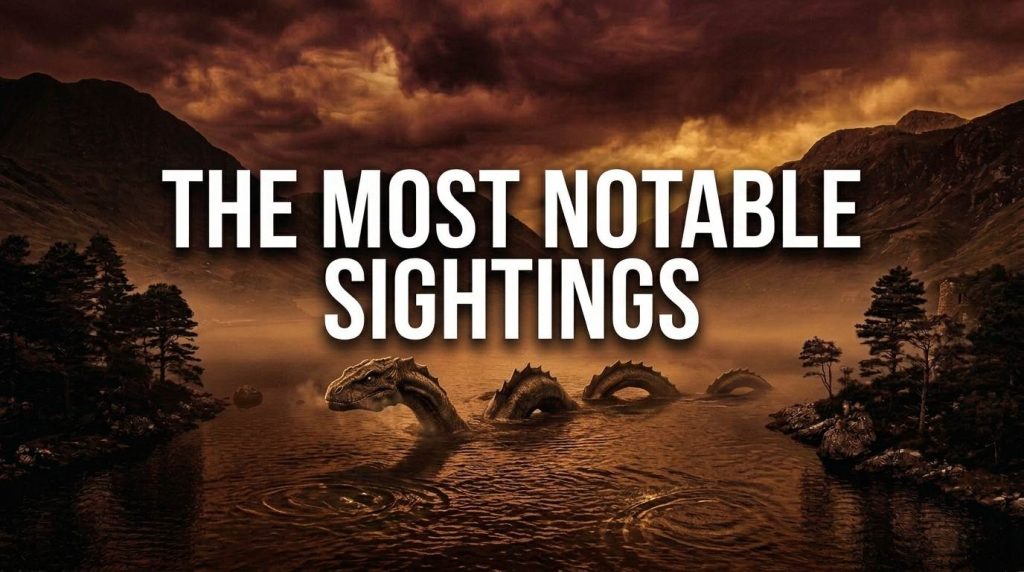
Unlike the Loch Ness Monster, which has a handful of globally famous and heavily debated photographs and media events, Loch Morar and its alleged inhabitant Morag do not have one defining “breakthrough” sighting.
Instead, the legend is built from a series of lesser-known but often repeated reports, accounts that never achieved international fame, but continue to be referenced within cryptid discussions and local folklore.
One of the most frequently cited periods of activity comes from the early 20th century, when anglers and residents reported large, unexplained disturbances across the surface of the loch.
These were not described as brief ripples or ordinary wind patterns, but as distinct movements of something substantial beneath the water, often producing a wake that seemed inconsistent with passing boats or natural currents.
In one commonly repeated account from this period, witnesses described a dark shape moving just below the surface at notable speed before suddenly vanishing into deeper water. The object was said to be too large to resemble fish and too controlled in its movement to be dismissed as drifting debris or vegetation.
Perhaps the most well-known Morag incident, however, comes from a later 1969 sighting involving two fishermen, often identified as Duncan McDonnel and William Simpson.
While out on Loch Morar in a speedboat, they reported encountering a large, dark, serpent-like creature surfacing directly behind them. According to their account, the animal closed the distance rapidly before striking or bumping the vessel.
In the confusion, one of the men allegedly attempted to fend it off with an oar, while the other fired a rifle shot toward the water.
The creature then reportedly submerged and disappeared without further trace. This dramatic “close encounter” version of events has since become one of the most widely retold Morag stories and has featured in later documentary retellings of the legend.
Later accounts, particularly from mid-to-late 20th century observers, began to add further variation in description. Some reported multiple humps breaking the surface in sequence, suggesting a long-bodied animal moving just beneath the waterline. Others described a low-profile, animal-like form briefly visible before slipping back under the loch’s dark surface.
A consistent theme runs through many of these sightings: the creature, or phenomenon being observed, rarely remains visible for more than a few seconds. Instead, witnesses typically report partial glimpses, a section of movement, a sudden disturbance in the water, or a brief silhouette cutting through the loch’s surface, followed by an immediate disappearance.
This fragmented and fleeting nature of the reports has made them difficult to verify. Unlike more heavily documented cryptid cases elsewhere, there are no widely accepted photographs, no confirmed physical remains, and no large-scale scientific investigation that produced conclusive evidence. As a result, Morag remains rooted in anecdotal testimony and local oral tradition rather than formal scientific record.
Still, what makes these accounts notable is their consistency in theme rather than detail. Across different decades and different observers, the same core ideas persist: something large moving beneath the surface, something powerful enough to disturb the loch significantly, and something that does not neatly match known aquatic species in the region.
Whether these encounters were misidentified wildlife, natural underwater phenomena, or something still unexplained, together they have helped establish Loch Morar as one of Scotland’s quieter but most persistent cryptid mysteries.
Scientific Explanations and Possible Theories
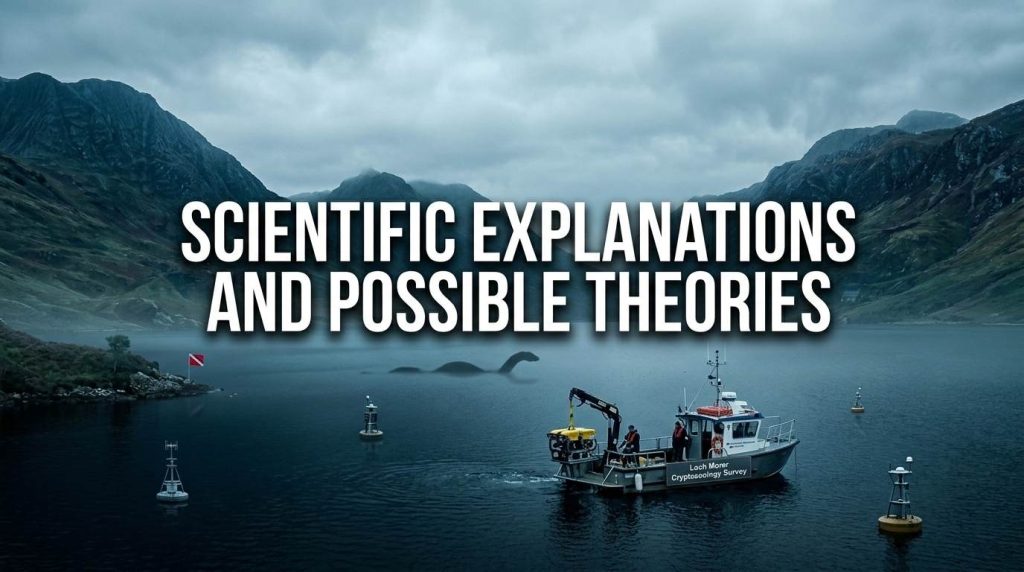
Loch Morar has never produced verified evidence of a large unknown animal, and despite more than a century of reported sightings, no physical remains, clear photographs, or conclusive sonar data have confirmed the existence of a creature such as Morag.
Because of this, most researchers and sceptics approach the phenomenon through natural explanations rather than cryptozoological ones.
One of the most common explanations is misidentification of known wildlife. The waters of Loch Morar support populations of fish, birds, and marine-adapted mammals such as seals in nearby coastal regions.
Large fish breaking the surface, diving birds, or groups of animals moving in sequence can sometimes create the illusion of a single, larger body moving beneath the water. From a distance, especially under poor visibility, these fragmented movements may appear connected.
Another major factor is wave behaviour and water dynamics. Deep lochs like Morar can produce unusual surface patterns caused by wind shear, underwater currents, or sudden changes in depth.
These effects can create long, rolling disturbances that resemble the movement of something travelling just below the surface. In certain lighting conditions, these waves can appear structured or intentional, even though they are entirely natural.
The loch’s extreme depth also introduces the possibility of optical distortion and scale misjudgement. With steep underwater drops and dark, peat-stained waters, visibility below the surface is extremely limited. Objects partially submerged can appear significantly larger or closer than they actually are, particularly when viewed from low angles along the shoreline.
There is also the psychological factor of expectation and suggestion. Once a location becomes associated with a monster legend, even ordinary natural events can be reinterpreted through that lens. A ripple becomes a movement. A shadow becomes a form. A moment of uncertainty becomes a potential sighting. This does not imply fabrication, but rather demonstrates how human perception adapts when confronted with ambiguous stimuli in unfamiliar environments.
Some researchers also point to the possibility of rare or uncommon animal behaviour. While there is no evidence of undiscovered large species in Loch Morar, known animals can behave unpredictably. Fish rising in groups, eels moving through shallow water, or seals surfacing nearby (in coastal-connected areas) can occasionally produce visual effects that do not immediately match expectations.
More speculative theories suggest that sightings may represent a combination of multiple factors occurring simultaneously, environmental conditions, wildlife activity, and perception errors aligning in a way that creates the impression of something larger and more coherent than what is actually present.
Despite these explanations, none can account for every reported detail with complete certainty. The key challenge is not that any single theory is implausible, but that most sightings are brief, incomplete, and observationally limited. Without clear visual records or physical evidence, each explanation remains possible, but not definitive.
This is what keeps the Morag mystery alive. While science provides multiple reasonable interpretations of what witnesses may have seen, it cannot reconstruct every moment exactly as it was experienced.
And in the absence of certainty, the waters of Loch Morar continue to hold their ambiguity, allowing both explanation and mystery to coexist in the same dark expanse.
Why Morag Was Overshadowed by Nessie
Loch Morar and its associated mystery, Morag, exist in the long shadow of Scotland’s most famous cryptid “Nessie” at Loch Ness.
While both lochs have produced similar types of reported sightings, large shapes beneath the water, unexplained disturbances, and brief glimpses of something unidentified, their cultural trajectories could not be more different.
One of the main reasons for this imbalance is scale of attention. Loch Ness became a global phenomenon early on, driven by media coverage, tourism, and a steady stream of public fascination that intensified throughout the 20th century.
Once the idea of “Nessie” entered popular culture, it rapidly evolved beyond local folklore into an international icon. Books, documentaries, photographs, and organised searches all reinforced its presence in the public imagination.
By contrast, Morag remained largely regional. Sightings associated with Loch Morar were reported more quietly, often through local accounts or niche cryptozoological references rather than mainstream media. Without sustained attention or high-profile investigation, the legend never developed the same cultural momentum.
Geography also played a role. Loch Ness is more accessible, better known, and far more integrated into Scotland’s tourism infrastructure. Visitors can easily travel to viewpoints, take boat tours, and engage directly with the legend. Loch Morar, on the other hand, is far more remote and less frequently visited. Its isolation, while contributing to its mystery, also limited exposure.
Another important factor is timing and narrative advantage. By the time Morag began to be discussed more widely, the “lake monster” concept had already been firmly established in global culture through Nessie. As a result, later sightings in other lochs were often interpreted as variations of an existing idea rather than independent mysteries with their own identity.
Media reinforcement further deepened this divide. Once Nessie became a recognisable figure, every new sighting, whether real, mistaken, or exaggerated, fed back into an already established narrative. Morag never benefited from that feedback loop. Without a defining photograph, major documentary feature, or widely publicised investigation, it remained a quieter parallel rather than a competing legend.
Yet this lack of attention may also be part of Morag’s appeal. While Nessie became a global symbol of mystery tourism and modern folklore branding, Morag has remained closer to its origins: local reports, isolated sightings, and a sense of ambiguity that has never been fully shaped by commercialisation or mass media.
In that sense, the comparison between the two lochs is not simply about which legend is more credible, but about how stories grow. One became a global icon. The other remained a regional mystery. And both, in their own way, continue to reflect the enduring human fascination with the unknown.
Final Thoughts On The Loch Morar Legend Of Morag
Loch Morar remains one of the most intriguing and least explored locations in Scottish folklore.
Unlike more famous mystery sites, it has never been fully absorbed into global popular culture, yet the stories associated with it have continued quietly for over a century.
The legend of Morag exists in that uncertain space between observation and interpretation, a collection of fragmented encounters, brief glimpses, and unexplained movements across dark water.
There is no single defining moment, no universally accepted photograph, and no confirmed physical evidence. Instead, there is a pattern of human experiences that never quite resolved into something explainable or dismissible.
This is what gives the Morag story its enduring strength. It does not rely on spectacle or widespread attention. It persists because of its ambiguity, because in a remote and deeply atmospheric environment, people occasionally report seeing something they cannot easily categorise.
From a scientific perspective, there are multiple possible explanations for these accounts: misidentified wildlife, shifting light conditions, wave patterns, or simple perceptual error in a landscape where distance and scale are often difficult to judge.
None of these explanations require the existence of an unknown creature, and none of them can be entirely ruled out for every individual sighting.
Yet folklore does not depend solely on certainty. It grows in places where certainty is difficult to achieve.
Whether Morag represents a misunderstood natural phenomenon or simply a story shaped by the unique conditions of the Highlands, the result is the same: Loch Morar has become a place where imagination and environment overlap. A landscape where silence, depth, and isolation allow the unknown to feel briefly possible.
In that sense, Morag is not just a creature said to inhabit the loch, it is part of the loch’s identity itself.
A reminder that even in a modern world mapped, measured, and surveyed in detail, there are still places where questions remain unanswered, and where the surface of the water can still hold a sense of mystery.
And perhaps that is why the story endures.
Not because it is proven.
But because it has never been fully resolved.