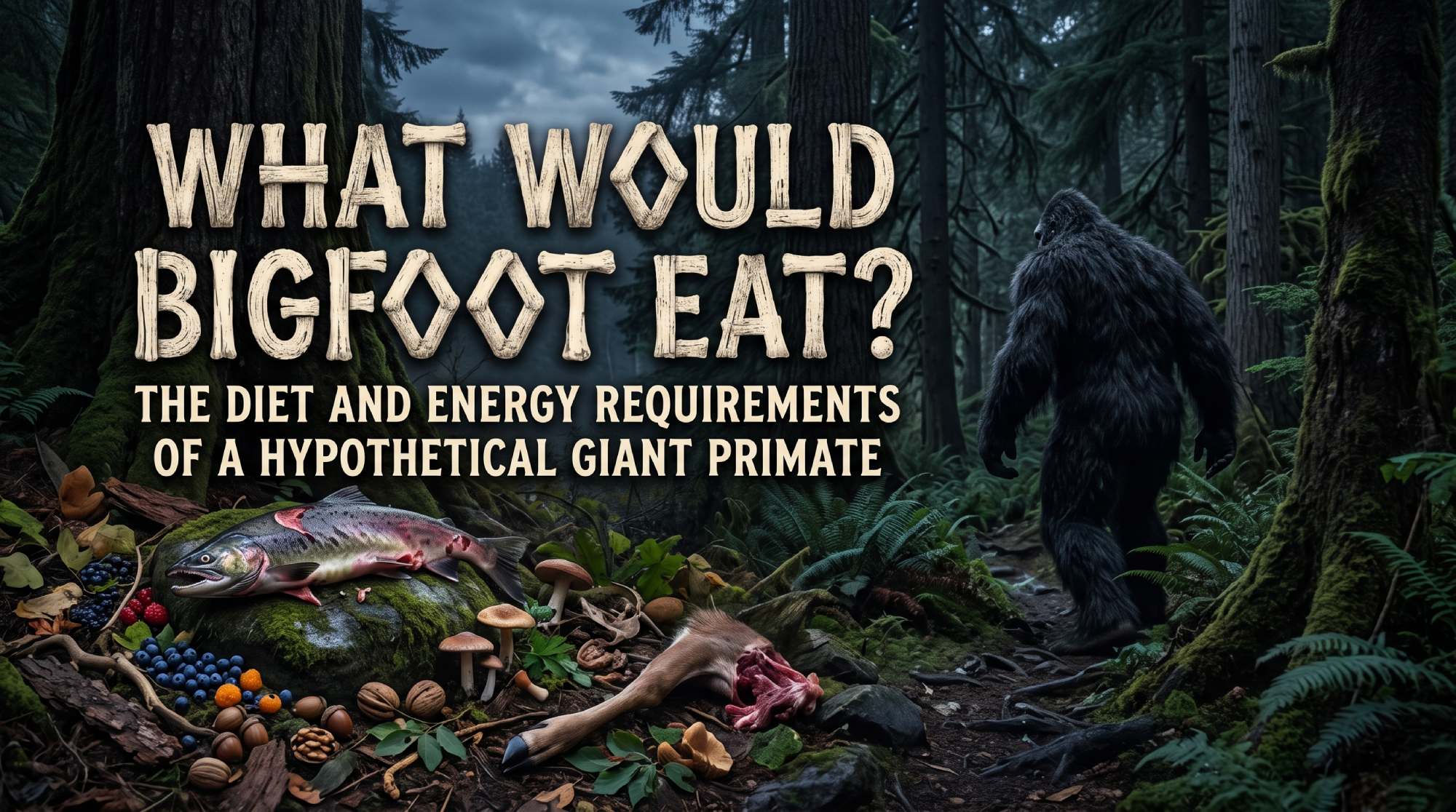
What Would Bigfoot Eat? The Diet and Energy Requirements of a Hypothetical Giant Primate
Deep in the forests of North America, the legendary Sasquatch is often imagined as a powerful, human-sized, or even much larger, ape-like creature moving silently through the wilderness.
But if such an animal really existed, there would be a much more fundamental question than where it hides:
What does it eat?
An animal weighing several hundred kilograms would have enormous energy requirements. It couldn’t simply survive on the occasional berry or handful of leaves.
Like every large mammal, it would need a reliable supply of calories, protein, fats, carbohydrates, vitamins, minerals and water, and enough food to sustain itself through changing seasons.
So what might be on the menu?
Fruit and berries? Nuts and seeds? Roots and vegetation? Insects and eggs? Fish and salmon? Carrion or even hunted prey?
In this article, we aren’t assuming that Bigfoot exists. Instead, we’re treating Sasquatch as a hypothetical giant primate and applying what we know about nutrition, metabolism, great ape diets and North American ecosystems to a simple question:
If an animal like Bigfoot really lived in these forests, what would it actually need to eat to survive?
🧬 2. Defining Our Hypothetical Sasquatch

Before we can calculate what Bigfoot might need to eat, we first need to establish what kind of animal we’re imagining.
There is no scientifically verified Sasquatch specimen from which body weight, body composition, metabolism or nutritional requirements can be measured.
Descriptions also vary considerably, with some accounts describing a creature broadly comparable to a very tall human, while others portray a much larger and more heavily built animal.
Rather than choosing one arbitrary weight and declaring it to be “the weight of Bigfoot,” we can do something much more useful.
We can model several hypothetical body sizes and see how their nutritional requirements would change.
⚖️ Four hypothetical adult body sizes
For our nutritional thought experiment, we’ll use four deliberately broad scenarios:
| Scenario | Body mass | Approx. equivalent |
|---|---|---|
| 🧍 Human-sized | 75 kg | ~12 stone / 165 lb |
| 🦍 Large Sasquatch | 150 kg | ~23.6 stone / 331 lb |
| 🦍 Very large Sasquatch | 250 kg | ~39.4 stone / 551 lb |
| 🐻 Extreme hypothetical | 350 kg | ~55.1 stone / 772 lb |
These figures are not estimates of the actual weight of Bigfoot. They are simply useful modelling points for exploring how increasing body size changes energy requirements.
The 75 kg scenario is particularly important because it prevents us from assuming that every possible Sasquatch would have to be a huge, 700–800 lb animal.
A hypothetical creature weighing around 75 kg could be broadly human-sized in body mass, even if it were considerably taller than an average human.
At the other end of our range, 350 kg represents an intentionally extreme scenario.
For comparison, the National Research Council’s review of nonhuman-primate nutrition included adult orangutans and gorillas averaging around 76.5 kg in one energy study.
Humans and other primates vary widely in size, but the 150–350 kg scenarios in our model would represent animals substantially larger than living great apes.
That difference matters enormously.
A 250–350 kg animal would not simply be a slightly larger version of a gorilla. Its nutritional requirements, movement costs, heat production and food requirements would all have to be considered at a much larger scale.
🔥 Body mass and metabolism
One of the most useful concepts in comparative physiology is metabolic scaling: larger animals generally require more energy, but their energy requirements do not increase in a perfectly linear relationship with body weight.
A classic approximation known as Kleiber’s law describes resting energy expenditure across mammals as scaling approximately with body mass raised to the 0.75 power.
More recent research has refined and debated the exact exponent, but the general principle remains useful: body size strongly influences metabolic requirements.
This is important for our thought experiment because it means we shouldn’t simply say:
“A 350 kg Bigfoot weighs five times as much as a 70 kg human, so it needs five times as many calories.”
Biology is more complicated than that.
The animal’s total energy expenditure would depend on much more than body mass alone.
🏃 What else determines energy requirements?
A hypothetical Sasquatch’s daily energy needs would be influenced by:
- Body mass and composition
- Physical activity and distance travelled
- Basal metabolic requirements
- Ambient temperature and thermoregulation
- Age and growth
- Sex
- Pregnancy and lactation
- Seasonal food availability
- The energy actually absorbed from its diet
The National Academies notes that maintenance energy requirements include the costs of basal metabolism, thermoregulation and physical activity, while reproductive status, age, growth and other biological factors can also alter energy requirements.
So there won’t be one magic number representing “the Bigfoot diet.”
Instead, we’ll be looking at ranges and scenarios.
🦍 Why real primates are useful—but only up to a point
Living great apes provide an important nutritional comparison.
Gorillas, for example, consume a remarkably diverse plant-based diet. Research on western lowland gorillas has documented more than 200 plant species and varieties and around 100 types of fruit among foods consumed.
Their diet is exceptionally high in fibre and relatively low in fat, with substantial energy potentially derived from fermentation of fibre in the large intestine.
That tells us something important:
A large primate does not necessarily need a meat-heavy diet to obtain energy.
But there is a major caveat.
Gorillas have evolved specialised digestive systems and feeding strategies suited to their particular foods and environment. We cannot simply assume that a hypothetical North American giant primate would possess the same digestive capabilities.
That leaves us with several possibilities.
Would Sasquatch resemble a gorilla and rely heavily on vegetation?
Could it behave more like an omnivorous chimpanzee or human?
Or might it occupy an ecological niche somewhere between the two?
🌲 The most flexible model: an opportunistic omnivore
For the purposes of our investigation, the most useful starting hypothesis may be an omnivorous and highly opportunistic giant primate.
That doesn’t mean Bigfoot would necessarily eat large amounts of meat.
It means that, if such an animal existed, it could potentially exploit whichever foods offered the greatest nutritional return at different times of year.
That might include:
🌿 Vegetation — leaves, shoots, roots and other plant material
🫐 Fruit and berries — seasonal sources of carbohydrates and micronutrients
🌰 Nuts and seeds — relatively energy-dense plant foods
🍄 Fungi — where nutritionally and ecologically available
🐜 Insects — concentrated sources of protein and fat
🥚 Eggs — seasonal, nutrient-dense foods
🐟 Fish — particularly during predictable spawning events
🦌 Animal matter — carrion or potentially hunted prey
There is a useful real-world comparison here.
American black bears are omnivorous and opportunistic, with their diets changing substantially according to season and food availability. Spring brings more grasses and herbaceous plants; summer provides berries and insects; and autumn can bring an abundance of energy-rich nuts and other hard mast.
A hypothetical Sasquatch would obviously not be a bear. But the example demonstrates an important ecological principle:
An adaptable large omnivore can change what it eats as the nutritional landscape changes.
And that may be far more important than assigning Bigfoot a single “diet.”
🧒 Females, juveniles and the changing nutritional equation
There is another important consideration.
A hypothetical Sasquatch population wouldn’t consist entirely of identical adult males.
There would potentially be:
- Adult males
- Adult females
- Juveniles
- Growing adolescents
- Pregnant females
- Lactating mothers
- Older individuals
Their nutritional requirements would not be identical.
A juvenile isn’t simply a miniature adult. Growing animals have to spend energy not only maintaining their existing tissues, but also building new bone, muscle and other tissues. Young primates can therefore have substantially different energy requirements relative to their body mass.
Pregnancy and lactation would introduce another major nutritional demand, particularly for females supporting rapidly growing offspring.
This is another reason why our four body masses are modelling scenarios rather than a proposed Sasquatch population structure.
We’re using adult body masses to establish the basic relationship between body size and energy requirements, while recognising that a real population would contain individuals with very different nutritional needs.
🔬 The question we’re really asking
With our hypothetical animal defined, we can now move from speculation into something more quantitative.
How much energy would a 75, 150, 250 or 350 kg giant primate actually require?
And once we have an estimated range, we can turn those numbers into something much easier to understand:
How much food would it actually have to consume?
That’s where the Bigfoot diet gets really interesting.
🔥 3. How Many Calories Would a Giant Primate Need?

Now we reach the question at the heart of the entire investigation:
If our hypothetical Sasquatch really existed, how much food energy would it need every day?
There is, of course, no measured “Bigfoot calorie requirement.” No verified specimen exists, and therefore there is no Sasquatch metabolism to measure.
But biology gives us a way to make an informed estimate.
Rather than inventing a single calorie figure, we can start with what is known about metabolic scaling in real mammals and primates and apply those relationships to our four hypothetical body sizes.
⚙️ Starting with basal metabolism
One established approach to estimating basal metabolic rate uses the relationship:
BMR ≈ 70 × body mass (kg)^0.75
This relationship, discussed in the National Research Council’s Nutrient Requirements of Nonhuman Primates, provides an approximation of the energy required to support basic physiological functions in a resting animal under controlled conditions.
The 0.75 exponent is important.
Larger animals generally require more energy, but their energy requirements don’t increase in a perfectly linear relationship with body weight. This concept is known as metabolic scaling, and the classic relationship is often associated with Kleiber’s law.
It is important to understand what basal metabolic rate actually means.
It isn’t the amount of food an animal needs to get through an ordinary day.
BMR represents the approximate energy cost of keeping the body functioning at rest, maintaining processes such as circulation, respiration, cellular activity and other essential physiological functions.
A wild animal still has to move, forage, digest food, regulate its body temperature and interact with its environment.
So BMR is our starting line, not the finish line.
🧮 Applying the equation to our hypothetical Sasquatch
Using the four body masses established in the previous section gives us approximately:
| Hypothetical adult | Body mass | Estimated BMR |
|---|---|---|
| 🧍 Human-sized | 75 kg | ~1,780 kcal/day |
| 🦍 Large Sasquatch | 150 kg | ~3,000 kcal/day |
| 🦍 Very large Sasquatch | 250 kg | ~4,400 kcal/day |
| 🐻 Extreme hypothetical | 350 kg | ~5,660 kcal/day |
These numbers are basal estimates, not recommended daily calorie intakes for Bigfoot.
And that distinction is crucial.
Our hypothetical 350 kg Sasquatch, for example, would have a calculated basal energy requirement of roughly 5,660 kcal per day before we’ve accounted for normal activity, foraging, thermoregulation or reproduction.
Even the 75 kg scenario produces a basal estimate of around 1,780 kcal/day.
The important observation isn’t that any of these numbers represents “the Bigfoot calorie requirement.”
It is that body size creates a very different energy budget.
🚶 But Bigfoot wouldn’t spend its life lying still
A wild Sasquatch would presumably have to travel through its territory, locate food, climb or dig where necessary, interact socially and potentially care for offspring.
Depending on its environment, it could also encounter steep terrain, cold temperatures, deep snow and other conditions that increase the energetic cost of living.
All of those activities require additional energy.
The National Research Council describes maintenance energy requirements as including the costs of basal metabolism, thermoregulation and physical activity, while factors such as age, body composition, sex, growth and reproductive status can further influence requirements.
This means that calculating a realistic daily food requirement requires us to move beyond BMR.
📈 From basal metabolism to daily energy expenditure
There is no scientifically justified multiplier that can tell us exactly how much energy a hypothetical Sasquatch would expend in the wild.
Real animals vary according to species, activity, environment and behaviour.
However, the National Research Council discusses maintenance energy requirements in relation to multiples of BMR, including approximately 2 × BMR as a useful modelling value under certain maintenance conditions, while recognising that actual requirements vary.
Measurements from real nonhuman primates likewise demonstrate substantial differences between species and circumstances.
So, purely as an illustrative modelling scenario, what would 2 × BMR look like?
| Hypothetical adult | Estimated BMR | Illustrative 2× BMR scenario |
|---|---|---|
| 🧍 75 kg | ~1,780 kcal | ~3,570 kcal/day |
| 🦍 150 kg | ~3,000 kcal | ~6,000 kcal/day |
| 🦍 250 kg | ~4,400 kcal | ~8,800 kcal/day |
| 🐻 350 kg | ~5,660 kcal | ~11,300 kcal/day |
These figures should not be interpreted as evidence that Bigfoot requires 3,500, 6,000, 8,800 or 11,300 calories every day.
They are a modelling exercise showing something much more useful:
A larger primate would have a much larger absolute energy budget.
And that energy has to come from somewhere.
🌲 The forest has to pay the energy bill
This is where nutrition meets ecology.
Calories don’t exist in an ecosystem as an abstract number.
They are packaged inside actual foods.
A hypothetical Sasquatch would therefore have to obtain enough usable energy from its environment to cover its daily expenditure.
And the nutritional value of those foods varies enormously.
A kilogram of leafy vegetation is not equivalent to a kilogram of nuts.
A handful of berries is not equivalent to a salmon.
A root is not equivalent to fatty animal tissue.
The energy density of the food therefore becomes just as important as the total amount of food available.
This creates a fascinating nutritional problem.
If a very large primate relied heavily on relatively low-energy foods, it could potentially need to consume enormous quantities simply to meet its energy requirements.
Conversely, foods such as nuts, seeds, fish and animal tissues can provide considerably more energy in a smaller amount of food.
That doesn’t mean Sasquatch would necessarily prefer animal foods.
It means that energy density could influence which foods become particularly valuable when they are available.
🥜 Seasonal energy jackpots
This is where the North American environment becomes especially interesting.
Different foods become available at different times of year.
Spring might provide:
🌱 New vegetation
🐜 Emerging insects
🥚 Eggs
🌿 Shoots and roots
Summer could bring:
🫐 Berries
🍓 Wild fruits
🐜 Insects
🐟 Fish
🌿 Abundant vegetation
Autumn could provide:
🌰 Nuts and seeds
🍎 Late fruits
🐟 Seasonal fish runs
🦌 Carrion and other animal foods
Winter could be considerably more challenging.
Fruit and tender vegetation become less abundant in many environments, while snow and cold can make both food acquisition and movement more energetically expensive.
A hypothetical large omnivore would therefore potentially benefit from exploiting seasonal pulses of highly energy-dense food when they became available.
This is one reason the idea of an opportunistic omnivore is interesting.
The animal wouldn’t necessarily need to eat the same foods throughout the year.
It could potentially adjust its diet according to what the ecosystem was providing.
🧠 But calories aren’t everything
Energy is only one part of an animal’s nutritional requirements.
A viable diet would also need to provide sufficient:
- Protein and essential amino acids
- Fat and essential fatty acids
- Carbohydrates and usable energy
- Vitamins
- Minerals
- Water
- Other essential micronutrients
And the animal would need to be capable of actually digesting and absorbing those nutrients.
This is particularly important when comparing Sasquatch with real great apes.
A gorilla can obtain substantial nutrition from fibrous vegetation partly because its digestive system is adapted to extracting nutrients from those foods.
We cannot simply assume that an unknown giant primate would possess identical digestive capabilities.
So even if a forest contained enough calories to theoretically support a Sasquatch, that wouldn’t automatically mean it contained an adequate nutritional diet.
🦍 Size isn’t the only variable
Our four adult scenarios also don’t represent every stage of life.
A juvenile would have different requirements from an adult.
Growing animals need energy not simply to maintain their existing tissues, but to build new bone, muscle and other tissues.
A pregnant female would have additional nutritional demands, while lactation can substantially increase energy requirements because the mother must produce milk for a rapidly growing offspring.
Activity level would matter too.
A sedentary animal and a highly mobile animal of identical body mass could have very different daily energy expenditures.
So our numbers should be regarded as biological scenarios rather than fixed calorie targets.
❄️ And then comes winter
Our calculations so far are deliberately simplified.
A Sasquatch living somewhere in the Pacific Northwest would not experience the same nutritional environment every day of the year.
Cold temperatures can increase the energy required for thermoregulation, while seasonal changes can dramatically alter the availability of fruit, vegetation, insects, fish and other foods.
The National Research Council specifically identifies ambient temperature as an influence on energy expenditure, with increased metabolic heat production required under sufficiently cold conditions.
This creates a potentially important seasonal challenge.
An animal might be able to obtain abundant calories during one part of the year and face a much more difficult nutritional landscape several months later.
That raises another fascinating possibility:
Would a hypothetical Sasquatch need to change its diet seasonally, build up body reserves, cache food, migrate, or simply become less active when food was scarce?
We can’t answer that for Sasquatch.
But those are the kinds of adaptations we would expect zoologists to investigate if a large, previously unknown primate were ever discovered.
🔬 What have we learned?
Our hypothetical Sasquatch doesn’t need one magical number of calories.
Instead, the biology suggests something more interesting.
The larger the animal, the greater the absolute amount of energy it must obtain from its environment.
Our modelling suggests that a hypothetical 75 kg animal could have a very different energy budget from a 150, 250 or 350 kg animal.
And once we move beyond resting metabolism, the real world becomes considerably more complicated.
Activity, temperature, terrain, growth, reproduction, digestion and seasonal food availability can all change the equation.
Most importantly, calories don’t arrive as numbers.
They arrive as food.
And that brings us to perhaps the most interesting part of the entire thought experiment:
What would all those calories actually look like on the forest floor?
If a hypothetical Sasquatch needed several thousand calories every day, how many berries, nuts, roots, insects, fish or animal foods would it actually have to consume?
That’s where the numbers start becoming tangible.
🌲 4. What Would Be on the Bigfoot Diet Menu? — The Pacific Northwest Food Web

If we temporarily treat Sasquatch as a hypothetical animal rather than an established species, the next question becomes surprisingly practical:
What could a large omnivorous primate actually eat in the Pacific Northwest?
The answer is: potentially quite a lot.
The Pacific Northwest contains a remarkably diverse mixture of forests, rivers, wetlands, mountains, coastal habitats and seasonal ecosystems. That means food availability would change dramatically throughout the year.
A hypothetical Sasquatch wouldn’t necessarily need to rely on one particular food.
Instead, if it behaved like an opportunistic omnivore, its diet could potentially shift according to whatever combination of energy, protein, fats and micronutrients the environment offered at the time.
And that’s important.
We’re not asking:
“What is Bigfoot’s favourite food?”
We’re asking:
“What foods could realistically contribute to the energy and nutritional requirements of a large hypothetical primate?”
🌿 Vegetation — the foundation of the food web
The most abundant potential food source would ultimately be plant material.
Leaves, shoots, stems, roots, tubers and other vegetation are widespread throughout the Pacific Northwest, although their nutritional value varies considerably.
For a hypothetical Sasquatch, plant foods could potentially provide:
- Carbohydrates
- Fibre
- Some protein
- Minerals
- Vitamins
- Water
But there’s a major nutritional problem.
Not all plant material is equally digestible.
A leaf isn’t simply a bag of calories waiting to be eaten. Much of its structural material consists of cellulose and other compounds that many animals cannot digest efficiently themselves.
This is where digestive physiology becomes critical.
A gorilla, for example, can exploit large quantities of fibrous vegetation because its digestive system and gut microbiome are adapted to extracting nutrients from those foods.
We therefore shouldn’t assume that a hypothetical Sasquatch could simply eat enormous quantities of leaves and obtain the same nutritional return.
That leaves more digestible and energy-rich plant foods particularly interesting.
🫐 Fruit and berries — seasonal carbohydrate packages
The Pacific Northwest offers a huge variety of wild fruits and berries.
Huckleberries, salmonberries, blackberries and other fruits can provide readily available carbohydrates, water and micronutrients when they’re in season.
For a large omnivore, however, fruit has an interesting limitation:
It can be energy-rich compared with leaves, but it is also highly seasonal.
A Sasquatch couldn’t necessarily rely on berries alone throughout the year.
Instead, fruit could represent a seasonal energy pulse, a period when large quantities of relatively easy-to-digest food become available.
This kind of seasonal opportunity is exactly the sort of resource an adaptable omnivore could exploit.
🌰 Nuts and Seeds — small packages of big energy
If we’re thinking about the problem from a nutrition perspective, nuts and seeds become particularly interesting.
They’re relatively energy-dense because they contain substantial amounts of fat, alongside protein and other nutrients.
That makes them very different from a large quantity of leafy vegetation.
A hypothetical large primate trying to meet thousands of calories per day would potentially benefit enormously from finding a productive nut or seed crop.
And it wouldn’t be alone.
Black bears are also generalist omnivores that rely heavily on plant foods such as berries and nuts, alongside insects, fish, mammals, birds and carrion. Washington Department of Fish & Wildlife estimates approximately 22,000 black bears across Washington.
That gives us an important real-world comparison that we’ll return to later.
🍄 Fungi — an intriguing but uncertain food source
Fungi could also potentially contribute to the diet.
The Pacific Northwest’s moist forests support an enormous diversity of fungi, but this is an area where we need to be particularly cautious.
“There are lots of mushrooms” does not automatically mean “there are lots of usable calories.”
Different fungi have very different nutritional properties, digestibility and toxicity.
So fungi are best regarded as a potential supplementary food source, rather than something we should assume forms a major component of Sasquatch nutrition.
🐜 Insects — tiny animals, concentrated nutrition
Insects are much more interesting nutritionally.
Depending on the species, insects can provide substantial amounts of:
- Protein
- Fat
- Micronutrients
And they’re potentially available in enormous numbers.
Ants, beetles, larvae, wasps and other insects could theoretically provide an opportunistic primate with animal-derived nutrients without requiring it to successfully hunt large prey.
This is particularly interesting because insect eating is already widespread among primates.
Chimpanzees, for example, consume insects such as termites, while many other primates exploit insects opportunistically.
For a hypothetical Sasquatch, insect feeding could therefore represent an energetically useful supplement to a predominantly plant-based diet.
🥚 Eggs — seasonal nutritional packages
Bird and other animal eggs would represent another potentially valuable resource.
An egg provides a combination of:
Protein + fat + vitamins + minerals.
But availability would be highly seasonal and geographically variable.
A hypothetical Sasquatch would also have to locate nests and obtain eggs without expending more energy finding them than it gained by eating them.
That brings us back to one of the central principles of this article:
Food isn’t valuable simply because it contains calories.
The animal also has to be able to find, obtain, digest and absorb those calories at a reasonable energetic cost.
🐟 Fish — a potentially enormous seasonal opportunity
Then we reach one of the Pacific Northwest’s most famous food resources:
Salmon.
Pacific salmon migrations can create enormous seasonal concentrations of biomass in rivers and streams.
For a large omnivore, that could represent an extraordinary nutritional opportunity.
Fish provide:
- High-quality protein
- Fat
- Essential fatty acids
- Micronutrients
- Considerable energy
And Sasquatch wouldn’t be the only animal interested.
Black bears are known to exploit fish and salmon runs in parts of the Pacific Northwest and adjacent regions. Historical Washington wildlife research has also documented black bear use of salmon and other anadromous fish resources.
This is exactly the kind of seasonal nutritional pulse that could become disproportionately important to a large omnivore.
But again, we’re not claiming Sasquatch would fish for salmon.
We’re asking:
If it existed, would this be the sort of resource a flexible omnivore could exploit?
Biologically, it certainly would be.
🦌 Animal matter — from scavenging to potential predation
The final category is animal tissue.
This is where our hypothetical Sasquatch becomes particularly interesting.
Animal matter could theoretically include:
- Carrion
- Small mammals
- Young ungulates
- Birds
- Eggs
- Fish
- Invertebrates
- Potentially larger prey
But there’s a major distinction between scavenging and actively hunting large animals.
Finding a carcass can provide a huge amount of energy without requiring the animal to kill its own prey.
Successfully hunting a large mammal is a completely different proposition.
A hypothetical Sasquatch would have to expend energy pursuing, subduing and processing the animal—and potentially risk serious injury.
So from an energetic perspective, scavenging could potentially be much cheaper than hunting.
That makes carrion an especially interesting possibility for an opportunistic omnivore.
🦌 And what about deer and elk?
The Pacific Northwest also contains abundant large herbivores.
Washington deer consume a wide variety of plants, particularly browse from trees and shrubs, but also fruit, nuts, acorns, fungi and other vegetation.
Elk similarly form a major component of the region’s large-herbivore communities.
These animals are important to our thought experiment for two reasons.
First, they represent potential animal food.
Second, they represent a completely different part of the same food web.
A hypothetical Sasquatch eating vegetation would be drawing energy directly from plants.
A Sasquatch consuming deer would instead be obtaining energy that had already been packaged into animal biomass.
That distinction becomes extremely important when we start considering ecological efficiency.
🌎 One ecosystem, many nutritional strategies
And this brings us to the central idea behind the Pacific Northwest food web.
There isn’t one giant food source waiting to feed Sasquatch.
There is a patchwork of resources that appear at different times and in different places.
| Potential food | Main nutritional contribution | Availability |
|---|---|---|
| 🌿 Vegetation | Fibre, carbohydrate, micronutrients | Broadly available, seasonal variation |
| 🫐 Berries & fruit | Carbohydrate, water, micronutrients | Strongly seasonal |
| 🌰 Nuts & seeds | Fat, energy, protein | Highly seasonal |
| 🍄 Fungi | Variable | Seasonal/local |
| 🐜 Insects | Protein, fat, micronutrients | Strongly seasonal |
| 🥚 Eggs | Protein, fat, micronutrients | Seasonal/local |
| 🐟 Fish | Protein, fat, energy | Highly seasonal in spawning systems |
| 🦌 Animal matter | Protein, fat, minerals | Opportunistic |
| 🦌 Deer/elk | Large potential energy source | Requires substantially greater acquisition effort |
This is beginning to look less like a single “Bigfoot diet” and more like a nutritional strategy.
🧠 The opportunist advantage
If our hypothetical Sasquatch were an adaptable omnivore, one of its greatest advantages could be its ability to switch between food sources.
A bad berry year wouldn’t necessarily mean starvation if insects were abundant.
A poor salmon run might be partially offset by nuts, vegetation or other foods.
An autumn nut crop could provide an enormous energy opportunity before winter.
A carcass could provide a concentrated burst of protein and fat.
This is one reason our original hypothesis of an opportunistic omnivore remains so interesting.
We’re not saying Sasquatch would eat all of these things.
We’re asking what a large, hypothetical primate would have access to if it occupied the Pacific Northwest.
And the answer is that the menu could potentially be remarkably diverse.
🔬 But there’s a catch…
There is a fundamental ecological problem hiding underneath all of this abundance.
Sasquatch wouldn’t have the forest to itself.
Every berry, nut, salmon, insect, carcass and edible plant is already part of an existing ecosystem.
Black bears are eating many of the same foods.
Deer are consuming vegetation, fruit, nuts and fungi.
Squirrels exploit nuts and seeds.
Raccoons exploit an enormous variety of foods.
Birds consume fruit, insects, eggs and other resources.
Fish, mammals and birds exploit salmon runs.
And predators such as cougars and coyotes depend on the same broader ecosystem of prey.
So the next question isn’t simply:
“Is there enough food in the Pacific Northwest?”
It’s much more interesting:
🐻 Who would Sasquatch actually be competing with for it?
That’s where we can start examining black bears, deer, elk, raccoons, coyotes, cougars, salmon predators and other wildlife, and, eventually, whether a hypothetical population of only a few hundred Sasquatch would represent a meaningful additional demand on an ecosystem that already supports tens of thousands of large mammals.
🐻 5. Who Would Sasquatch Compete With?

If a hypothetical Sasquatch lived in the Pacific Northwest, it wouldn’t be entering an empty ecosystem.
The forests, rivers and mountains already support a huge community of herbivores, omnivores, predators and scavengers, all competing, sometimes directly, sometimes indirectly, for the same resources.
But competition doesn’t mean every species is competing for exactly the same food.
A deer browsing on shrubs and a black bear eating berries are using the same ecosystem in very different ways.
A cougar and Sasquatch might both consume deer, but their overall diets and hunting strategies would be radically different.
For our hypothetical omnivorous Sasquatch, the degree of dietary overlap would probably fall into several broad categories.
🐻 Major dietary overlap
🐻 Black bears — probably the closest comparison
Black bears would arguably be the most obvious dietary competitor.
Washington’s black bears are generalist omnivores, with diets dominated by plant foods such as berries and nuts but supplemented by insects, mammals, fish, birds and carrion.
WDFW reports that more than two-thirds of the black bear diet in Washington consists of plants.
That creates substantial potential overlap with our hypothetical Sasquatch.
Both could theoretically exploit:
- 🫐 Berries
- 🌰 Nuts and other mast
- 🍄 Fungi
- 🐜 Insects
- 🐟 Fish
- 🥚 Eggs
- 🦌 Carrion
- 🐭 Small mammals
The overlap could become particularly important during seasonal food pulses, when large numbers of animals converge on particularly valuable resources.
But bears and Sasquatch would still be fundamentally different animals. A black bear has its own specialised adaptations, including powerful jaws, claws, an excellent sense of smell and the ability to exploit foods that a primate might not handle in exactly the same way.
So we’d be talking about resource overlap, not identical diets.
🦌 Deer — competition at the plant-food level
Deer are a fascinating comparison because they aren’t omnivores.
They’re herbivores and ruminants, and their main food is browse, the growing tips of trees and shrubs. They also consume grass, fruit, nuts, acorns, fungi and other plant material depending on season and availability.
A hypothetical Sasquatch eating vegetation would therefore be tapping into some of the same primary productivity that supports deer.
But the competition would be somewhat different from the bear comparison.
A deer is essentially competing with Sasquatch for plant biomass.
Sasquatch, if omnivorous, would have another option: it could switch to insects, fruit, fish or animal matter when particular vegetation became scarce.
That dietary flexibility could potentially reduce direct competition with specialist herbivores.
There is another important difference.
Deer possess a specialised ruminant digestive system that allows them to extract nutrients from fibrous plant material extremely effectively. A hypothetical primate could not simply be assumed to process vegetation in the same way.
So although both animals might eat plants, they wouldn’t necessarily obtain the same nutritional value from those plants.
🫎 Elk — another major consumer of plant energy
Elk occupy a similar but larger herbivorous niche.
Across suitable Pacific Northwest habitats, elk consume substantial quantities of vegetation, making them important consumers of the same plant productivity that could potentially support a large herbivorous or omnivorous primate.
For Sasquatch, elk could therefore represent two different ecological relationships.
If it ate vegetation, it would share part of the same plant-food base.
If it consumed animal matter, elk could theoretically become a source of carrion or, much more speculatively, prey.
Those are very different propositions, however.
Competing for plants is not the same thing as hunting elk.
And we shouldn’t automatically assume that a large primate would attempt to tackle large ungulates simply because it was physically capable of doing so.
🦝 Significant local and seasonal overlap
🦝 Raccoons
Raccoons are another interesting competitor because they’re highly adaptable omnivores.
They can exploit fruit, plant material, insects, eggs, small animals and other foods, meaning their dietary niche overlaps with several components of our hypothetical Sasquatch diet.
However, their much smaller body size means their absolute energy requirements would be vastly lower.
A raccoon and a Sasquatch could therefore eat some of the same foods without placing anything like the same demand on the resource.
🐟 Fish-eating wildlife
Fish creates another major area of potential overlap.
Salmon and other fish can provide an extremely valuable combination of protein, fat and micronutrients, particularly during seasonal runs.
A hypothetical Sasquatch exploiting these resources could potentially encounter competition from:
- 🐻 Black bears
- 🦅 Eagles
- 🦦 River otters
- Other fish-eating mammals and birds
But again, competition would be highly seasonal and geographically concentrated.
A salmon run isn’t spread evenly across an entire forest. It creates a temporary concentration of food in particular rivers and streams.
That means hundreds of animals might exploit the same resource for a relatively short period without necessarily competing throughout the rest of the year.
🐺 Coyotes
Coyotes are primarily carnivorous but highly opportunistic, and their diet can include mammals, birds, insects, fruit and carrion.
Their overlap with Sasquatch would therefore be greatest around animal foods and carrion, rather than vegetation.
A hypothetical Sasquatch wouldn’t be competing with a coyote for a berry patch in quite the same way it might compete with a bear.
But both could potentially exploit the same carcass.
🐆 Cougars
Cougars are a much more specialised comparison.
They’re predators rather than omnivores, so there would be relatively little overlap over plant foods, berries or nuts.
Their potential overlap would instead concern animal biomass.
If Sasquatch scavenged or hunted deer and other mammals, it would theoretically be accessing some of the same prey base used by cougars.
That’s a much narrower form of competition.
🐿️ More specialised competitors
Then there are the animals that overlap with particular pieces of the hypothetical diet:
🐿️ Squirrels and other rodents
These animals can be extremely important consumers of nuts, seeds, fungi and other plant foods.
A hypothetical Sasquatch exploiting an autumn mast crop would therefore be using a resource already heavily exploited by much smaller mammals.
But again, the enormous difference in body size means the absolute quantity consumed would be very different.
🐇 Rabbits and hares
These primarily herbivorous animals could overlap with Sasquatch over grasses, shoots and other vegetation.
However, their ecological niche is considerably narrower.
🐦 Omnivorous and insectivorous birds
Birds could overlap with Sasquatch over:
- Insects
- Fruit
- Seeds
- Eggs
- Small vertebrates
But their relatively tiny energy requirements make their contribution to overall resource competition comparatively small on an individual basis.
🌎 Competition doesn’t mean ecological impossibility
This is perhaps the most important point.
The presence of competitors doesn’t automatically mean there isn’t enough food for another species.
Ecosystems routinely support multiple species that consume some of the same resources.
The key questions are:
How much does each animal consume?
How much habitat does it occupy?
How much of its diet overlaps with other species?
Are the resources available year-round or seasonally?
And how large is the population?
That last question becomes particularly important for our Sasquatch thought experiment.
A hypothetical population of 500 large primates would be a very different ecological proposition from 20,000 additional large omnivores.
Washington already supports a substantial population of black bears, along with deer, elk and countless smaller consumers of the same plant and animal resources.
WDFW describes black bears as widespread generalist omnivores and deer as abundant herbivorous browsers exploiting a wide range of vegetation and seasonal foods.
So the interesting question isn’t simply:
“Would Sasquatch compete with other animals?”
It almost certainly would, if it existed.
The much more interesting question is:
“Would the amount of competition created by a hypothetical Sasquatch population be large enough to significantly alter the existing ecosystem?”
And that brings us to the next stage of our investigation.
🔢 500 Sasquatch vs. an entire ecosystem
If we assume, purely for modelling purposes, a population of 500 Sasquatch, we can finally start putting the previous sections together:
Body mass → daily calories → annual food requirement → population size → resource demand.
That allows us to ask whether a few hundred hypothetical giant primates would actually represent an enormous additional burden on the Pacific Northwest food web, or whether, spread across a sufficiently large landscape, their total resource demand might be surprisingly modest compared with the ecosystem’s existing consumers.
🔢 6. Could the Pacific Northwest Feed 500 Sasquatch?

So far, we’ve looked at Sasquatch one animal at a time.
We’ve estimated how much energy a hypothetical individual might require based on body mass, considered what foods could potentially provide that energy, and examined the other animals already exploiting those resources.
But ecosystems don’t support individual animals in isolation.
They support populations.
And that gives us a fascinating question:
If Sasquatch were a real species, could the Pacific Northwest support a population of 500 large individuals?
There is no evidence establishing a population of 500 Sasquatch, or any Sasquatch at all.
So 500 is simply a deliberately chosen modelling scenario.
It allows us to take everything we’ve calculated so far and ask what the nutritional consequences would look like at population scale.
🧮 Start with the individual
Our four hypothetical adult body sizes give us very different energy requirements.
Using our illustrative 2× BMR maintenance scenario:
| Hypothetical adult | Approx. daily energy |
|---|---|
| 🧍 75 kg | ~3,570 kcal/day |
| 🦍 150 kg | ~6,000 kcal/day |
| 🦍 250 kg | ~8,800 kcal/day |
| 🐻 350 kg | ~11,300 kcal/day |
Now imagine 500 individuals.
If every animal were 75 kg:
500 × 3,570 ≈ 1.79 million kcal/day
At 150 kg:
500 × 6,000 ≈ 3 million kcal/day
At 250 kg:
500 × 8,800 ≈ 4.4 million kcal/day
And at our extreme 350 kg scenario:
500 × 11,300 ≈ 5.65 million kcal/day
Those are enormous numbers.
But there’s an important trick hidden inside them.
🌲 Put them into perspective
Five million calories sounds enormous when viewed as a single number.
But we’re talking about an entire population spread across a huge landscape, consuming food every day.
And the Pacific Northwest isn’t a single forest containing one finite pile of food.
It’s an enormous mosaic of forests, rivers, mountains, wetlands, coastlines, valleys and other habitats, each producing biological energy at different times of year.
The relevant question therefore isn’t:
“Does the Pacific Northwest contain five million calories?”
Obviously it contains vastly more than that.
The question is:
What proportion of the ecosystem’s annual usable energy would 500 Sasquatch actually consume?
That’s a much more meaningful ecological question.
📅 From calories per day to calories per year
Let’s take the 250 kg scenario as an example.
Our illustrative maintenance estimate is approximately:
8,800 kcal/day
Over a year:
8,800 × 365 ≈ 3.2 million kcal per animal
For 500 animals:
≈ 1.6 billion kcal per year
That sounds enormous.
But now remember what we’re modelling.
This represents 500 very large animals, each consuming energy every day for an entire year.
And even this figure is based on our deliberately simplified 2× BMR scenario.
Real energy expenditure could be higher or lower depending on activity, climate, body composition, season, reproduction and behaviour.
So the calculation isn’t telling us:
“500 Sasquatch would consume exactly 1.6 billion calories.”
It’s giving us an order-of-magnitude estimate that allows us to explore the ecological problem.
🐻 Compare that with existing wildlife
This is where our earlier discussion of black bears becomes particularly useful.
Washington supports a substantial black bear population, with WDFW estimating approximately 22,000 black bears statewide.
Now imagine our hypothetical population of 500 Sasquatch alongside them.
That’s important because black bears aren’t tiny animals.
They’re large omnivores capable of consuming enormous quantities of food, and their diets overlap with many of the foods we’ve identified as potential Sasquatch resources:
🫐 berries
🌰 nuts
🐜 insects
🐟 fish
🥚 eggs
🦌 animal matter
🌿 vegetation
Yet the ecosystem supports them.
That doesn’t prove that Sasquatch could also exist.
But it does demonstrate something important:
The Pacific Northwest already supports large populations of substantial omnivorous mammals.
The existence of competitors therefore isn’t, by itself, evidence that another large omnivore would be ecologically impossible.
🧠 But 500 Sasquatch wouldn’t simply be “500 more bears”
This is where we need to be careful.
Sasquatch would presumably have a different digestive system, different body size distribution, different activity levels and potentially a different diet from black bears.
A 250 kg hypothetical primate shouldn’t simply be assumed to consume exactly what a black bear consumes.
It might rely more heavily on plant foods.
It might exploit different fruits or vegetation.
It might consume more insects.
It might exploit fish.
It might scavenge.
It might hunt.
Or it could potentially use a combination of all of these strategies.
That’s why dietary flexibility becomes so important.
The broader the range of foods an animal can exploit, the less dependent it becomes on any single resource.
🌰 The importance of seasonal food
The annual calculation also hides an important ecological reality:
Food isn’t evenly distributed throughout the year.
Imagine a hypothetical Sasquatch population experiencing:
🌱 Spring
New vegetation becomes available.
Insects emerge.
Bird eggs and other seasonal foods become available.
🫐 Summer
Fruit and berries become increasingly abundant.
Insects can become extremely productive.
Fish may provide concentrated food opportunities in particular waterways.
🌰 Autumn
This could be particularly important.
Nuts, seeds and other high-energy foods can provide concentrated sources of fat and calories.
For an animal facing winter, these seasonal resources could be extremely valuable.
❄️ Winter
The situation changes dramatically.
Many fruits disappear.
Vegetation becomes less nutritious or less accessible.
Snow can increase the energetic cost of movement.
Cold increases thermoregulatory demands.
The animal might therefore have to rely on stored body fat, cached resources, remaining vegetation, carrion or whatever other foods remain accessible.
This is one reason why annual food production is more informative than simply asking how many calories exist in the forest on a good summer day.
🐟 Food pulses could matter more than averages
Some of the most important resources in the Pacific Northwest are highly seasonal.
Salmon are an excellent example.
During a productive run, enormous quantities of aquatic biomass can temporarily become available to terrestrial wildlife.
Bears, eagles, otters, other mammals and birds can exploit these concentrated resources.
A hypothetical Sasquatch population could theoretically do the same.
But it wouldn’t need to live beside a salmon river all year.
It could exploit salmon when they were available and switch to other foods afterwards.
The same principle could apply to:
🌰 autumn mast crops
🫐 berry seasons
🐜 insect emergence
🍎 fruiting events
🦌 seasonal carrion availability
This is one reason an opportunistic omnivore may make more ecological sense than an animal dependent on a single food source.
🗺️ Distribution changes everything
There is another enormous variable:
Where are those 500 animals?
500 Sasquatch concentrated into one small valley would create an enormous local food demand.
500 Sasquatch distributed across a huge area would be a completely different situation.
Population density matters.
If the animals occupied large territories, individual groups could potentially exploit different seasonal resources without constantly competing with one another.
This is particularly important for a hypothetical large primate.
A 250 kg animal is unlikely to live like a colony of mice.
Its territory and movements would presumably reflect its enormous energetic requirements.
The spatial distribution of food would therefore become just as important as the total quantity of food.
⚖️ So could 500 actually be supported?
We cannot demonstrate that they could.
There is no known Sasquatch population from which we can measure territory size, food consumption, reproductive rate or mortality.
But we can say something more scientifically useful.
Our calculations don’t immediately reveal a simple nutritional impossibility.
The Pacific Northwest contains extremely productive ecosystems capable of supporting large populations of herbivores, omnivores, predators and scavengers.
The region already contains:
- 🐻 Large omnivores
- 🦌 Large herbivores
- 🐟 Massive seasonal fish biomass
- 🌰 Energy-rich mast crops
- 🫐 Seasonal fruit and berries
- 🐜 Enormous insect populations
- 🌿 Extensive plant productivity
- 🦌 Large mammalian prey and carrion
A hypothetical population of 500 Sasquatch would certainly consume resources and would certainly compete with some existing wildlife.
But competition isn’t the same as ecological impossibility.
🔬 The real question is footprint
And this may ultimately be more interesting than the calorie calculation itself.
If 500 large primates genuinely occupied the Pacific Northwest for generations, what would their presence do to the ecosystem?
Would we expect:
Lower berry availability?
Changes in salmon mortality?
Competition with bears?
Changes in deer populations?
Distinctive feeding sites?
Damaged vegetation?
Carcasses?
Tracks and trails?
Faecal material containing recognisable dietary remains?
DNA left behind in the environment?
Now we’re moving beyond the question of:
“Could Bigfoot physically get enough calories?”
and towards a much more scientifically interesting question:
“If a breeding population of several hundred giant primates existed, what ecological footprint should they leave behind?”
And that is where our nutritional thought experiment begins to intersect with ecology, population biology and evidence.
🔬 A crucial caveat
There is one thing we should not conclude from this exercise.
The fact that the Pacific Northwest contains enough biological productivity to theoretically support another large omnivore does not constitute evidence that Sasquatch exists.
We’re testing a hypothetical biological scenario.
If Sasquatch were real, it would have to obey the same fundamental rules as every other animal:
It would need food.
It would need energy.
It would need nutrients.
It would reproduce.
It would die.
And a population of 500 would have to leave some kind of ecological footprint.
That gives us our next question:
🌎 What Would 500 Sasquatch Actually Do to the Ecosystem?
Because perhaps the most interesting part of this entire investigation isn’t whether Bigfoot could find enough food.
It’s whether 500 of them could do so without leaving a much larger biological footprint than the evidence currently suggests.
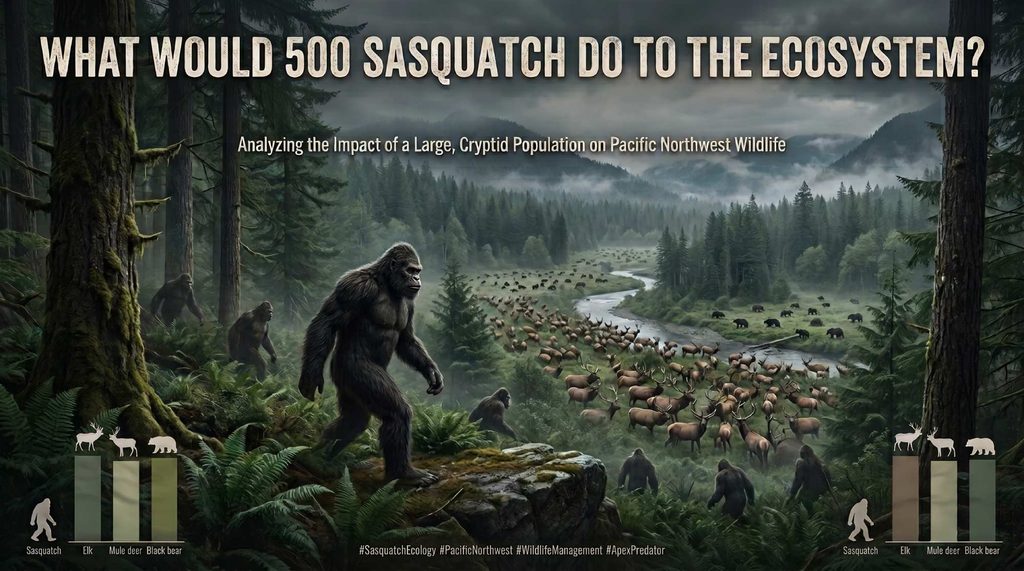
🌎 7. What Would 500 Sasquatch Do to the Ecosystem?
So far, our thought experiment has concentrated on one deceptively simple question:
Could a large hypothetical primate obtain enough food to survive in the Pacific Northwest?
Our calculations suggest that the answer isn’t obviously impossible from a nutritional perspective.
But there’s another side to the equation.
Animals don’t simply consume energy from ecosystems.
They become part of them.
They eat plants and animals, compete with other species, produce waste, reproduce, die and leave physical and biological traces behind.
So if we imagine a hypothetical population of 500 Sasquatch living across the Pacific Northwest for generations, we shouldn’t only ask whether they could find enough calories.
We should ask:
What ecological footprint would 500 large primates leave behind?
🌿 Every large animal leaves a footprint
A population of several hundred animals weighing anywhere from 75 to 350 kg would represent a substantial amount of living biomass.
They would have to:
- Eat
- Drink
- Travel
- Sleep
- Defecate
- Urinate
- Reproduce
- Raise young
- Avoid predators and hazards
- Interact with other animals
- Eventually die
Those activities would inevitably interact with their surroundings.
Some effects would be subtle.
Others could potentially be surprisingly large.
🌱 Vegetation
If Sasquatch consumed substantial quantities of vegetation, repeated feeding could affect local plant communities.
Browsing could remove:
- Leaves
- Shoots
- Bark
- Fruits
- Roots
- Young vegetation
A population of 500 animals would therefore potentially consume a considerable amount of plant material every year.
But the impact would depend heavily on how much of their diet was actually plant-based.
A gorilla-like, highly herbivorous Sasquatch could place considerable pressure on vegetation.
An opportunistic omnivore obtaining a large proportion of its energy from fruit, nuts, insects, fish and animal matter could have a very different footprint.
This is another reason why the animal’s digestive physiology matters so much.
🫐 Seasonal resources could be particularly vulnerable
A population wouldn’t necessarily consume food evenly throughout the landscape.
Animals tend to concentrate around particularly profitable resources.
If hundreds of Sasquatch were exploiting the same productive berry patch, nut-producing woodland or other seasonal food source, the effect could potentially become noticeable.
The important variable would be population density.
Five hundred animals spread across a huge area could have a relatively diffuse impact.
Five hundred animals concentrated around a handful of productive food patches could create much greater local pressure.
So the geographical distribution of the hypothetical population becomes critical.
🦌 Effects on other wildlife
The consequences wouldn’t stop with plants.
If Sasquatch consumed animal foods, there could potentially be effects further up the food web.
For example, if they regularly consumed:
- Small mammals
- Birds
- Eggs
- Fish
- Deer
- Elk
- Carrion
then they would become another consumer within an already complex ecosystem.
The magnitude of that effect would depend on how much animal matter they actually consumed.
A predominantly plant-and-insect-eating Sasquatch would have a very different ecological footprint from a population regularly killing large mammals.
This is where our earlier distinction between omnivory and carnivory becomes important.
Being an omnivore doesn’t mean an animal eats enormous quantities of meat.
It means it can potentially exploit both plant and animal foods.
🐻 Competition could create indirect effects
Our hypothetical Sasquatch population could also affect other species without directly consuming them.
Imagine Sasquatch and black bears exploiting the same autumn nut crop.
If Sasquatch consumed a significant proportion of that resource, bears could potentially encounter less food.
The same could apply to:
🫐 Berry crops
🐟 Fish
🥚 Eggs
🦌 Carrion
🐜 Insects
This is called resource competition.
But again, competition isn’t necessarily catastrophic.
Natural ecosystems contain enormous numbers of overlapping consumers.
The important question is whether the additional demand from Sasquatch would be large relative to the available resource.
🦌 What about deer and elk?
This becomes particularly interesting if we imagine Sasquatch consuming large mammals.
Suppose a hypothetical population regularly hunted deer.
Even 500 animals wouldn’t necessarily need to kill enormous numbers of deer if animal matter formed only a relatively small proportion of their diet.
But if they depended heavily on large prey, their ecological footprint could become much larger.
The difference between:
“occasionally scavenges a deer carcass”
and
“regularly hunts adult deer”
is enormous.
The first could represent an opportunistic source of concentrated nutrition.
The second would make Sasquatch a significant predator within the ecosystem.
And that distinction would have consequences.
💩 The less glamorous evidence: waste
One of the most overlooked consequences of a large animal population is also one of the simplest:
They produce waste.
A population of 500 large mammals would produce substantial quantities of:
- Faeces
- Urine
- Hair
- Shed skin
- Other biological material
Faeces in particular could potentially contain evidence of diet.
Depending on preservation and environmental conditions, researchers might potentially find:
- Plant fragments
- Seeds
- Hair
- Insect remains
- Fish scales
- Bone fragments
- Parasite material
- Microbial signatures
- Host DNA
Modern environmental DNA techniques also mean that biological material doesn’t necessarily have to come from a carcass to leave a detectable genetic signal.
A hypothetical breeding population repeatedly using the same landscape would therefore have many opportunities to leave biological traces.
🧬 DNA would be particularly interesting
This is where the hypothetical becomes scientifically fascinating.
Large mammals shed biological material constantly.
Hair, skin cells, saliva, urine and faeces can all potentially contribute DNA to the environment.
If 500 Sasquatch genuinely inhabited the Pacific Northwest for generations, we might therefore expect some environmental DNA to accumulate in places they regularly used.
That doesn’t necessarily mean finding Sasquatch DNA would be easy.
DNA degrades.
Environmental conditions vary.
Samples can be contaminated.
And the probability of detection depends on where and how samples are collected.
But a large, reproducing population should theoretically produce many opportunities for biological detection.
That creates a potential testable prediction.
👣 Trails and repeated movement
Then there is the physical footprint.
Large mammals moving repeatedly through an environment can create:
- Trails
- Flattened vegetation
- Damaged branches
- Digging sites
- Feeding areas
- Bedding locations
- Scratch marks
- Tree damage
- Disturbed soil
A single animal passing through a forest might leave little obvious evidence.
But hundreds of animals repeatedly using the same landscape over many generations could potentially produce much more persistent signs.
Again, the question becomes one of scale.
A 500-animal population would not necessarily leave obvious evidence everywhere.
But we would expect their preferred routes and feeding areas to experience repeated use.
🏕️ Could their footprint actually be surprisingly small?
Possibly.
This is where we need to avoid turning the argument into:
“If Bigfoot existed, we’d see everything everywhere.”
Wild animals can be remarkably difficult to detect.
Forests are enormous.
Vegetation regenerates.
Rain destroys tracks.
Scavengers consume carcasses.
DNA degrades.
Animals move.
Some signs may persist for hours while others disappear within days.
A low-density population could therefore leave a surprisingly diffuse footprint.
This is especially true if Sasquatch were:
- Highly mobile
- Nocturnal
- Avoidant of humans
- Widely dispersed
- Low in population density
- Opportunistic in feeding
So the existence of a relatively subtle footprint cannot automatically disprove the hypothetical animal.
⚖️ But scale still matters
There is an important biological principle here:
The larger the population, the more opportunities there are for detection.
One hypothetical Sasquatch passing through a forest is one thing.
Five hundred animals living, feeding and reproducing across the same broad region for decades is something else.
And a population that successfully reproduces must eventually produce:
Births → juveniles → adults → deaths → generations
Each generation creates more opportunities for:
- Tracks
- Hair
- Faeces
- DNA
- Feeding remains
- Injuries
- Carcasses
- Interactions with other wildlife
The longer the population persists, the more cumulative evidence there should theoretically be.
🧠 The ecological footprint becomes a prediction
This gives us something much more scientifically useful than simply saying:
“Bigfoot could survive in the forest.”
If we assume, purely hypothetically, that 500 Sasquatch exist, we can make predictions.
We would expect some combination of:
🌿 Ecological effects
- Consumption of vegetation
- Removal of seasonal fruits and nuts
- Consumption of insects
- Competition with omnivores
- Potential effects on prey populations
🦴 Physical evidence
- Tracks
- Trails
- Feeding remains
- Bedding sites
- Hair
- Damaged vegetation
💩 Biological evidence
- Faecal material
- Parasites
- Hair
- Environmental DNA
- Biological remains
🧬 Population evidence
- Juveniles
- Dead individuals
- Reproductive evidence
- Genetic material
Not every prediction would necessarily be detectable.
But collectively, a persistent population should interact with the environment in measurable ways.
🔬 And this brings us back to the central question
Our nutritional calculations have shown that we can’t simply dismiss the idea by saying:
“There isn’t enough food in the Pacific Northwest.”
The region is biologically productive and already supports substantial populations of large herbivores, omnivores and predators.
But the opposite conclusion would also be unjustified.
We cannot say:
“There is enough food, therefore Bigfoot exists.”
Those are completely different propositions.
The real scientific question is whether a hypothetical population could exist while remaining consistent with the physical, ecological and biological evidence we actually observe.
And that’s where our thought experiment becomes particularly useful.
Because if 500 giant primates were genuinely living somewhere in the Pacific Northwest, nutrition would only be the beginning of their ecological signature.
They would have to eat. They would have to move. They would have to reproduce. They would have to interact with other species.
And eventually, they would have to die.
The forest would have to remember them.
And that leads naturally into the next question:
🔎 What Evidence Should a Real Sasquatch Population Leave Behind?
That’s where we can take everything we’ve established about metabolism, diet and ecology and turn it into a set of testable predictions, and examine whether the evidence associated with Sasquatch sightings actually matches what we’d expect from a real large primate.
🔎 8. What Evidence Should a Real Sasquatch Population Leave Behind?

Our thought experiment has now taken us a long way from the familiar question of:
“What does Bigfoot eat?”
We’ve estimated hypothetical body masses.
We’ve modelled energy requirements.
We’ve considered possible foods.
We’ve examined competition with bears, deer, elk and other wildlife.
And we’ve considered what several hundred animals might consume over an entire year.
But there’s an important consequence of all of this.
Animals leave evidence of being animals.
A real Sasquatch population wouldn’t exist outside the ecosystem.
It would have to eat, move, reproduce, interact with other organisms and eventually die.
So if we temporarily assume that a breeding population of several hundred Sasquatch exists in the Pacific Northwest, what should we expect to find?
And perhaps more importantly:
Does the evidence that has actually been reported over the decades resemble what our biological model predicts?
👣 1. Tracks and trails
The most obvious prediction would be footprints.
And unlike some of the evidence we’ll discuss later, this is an area where there is already a substantial historical record of claimed Sasquatch evidence.
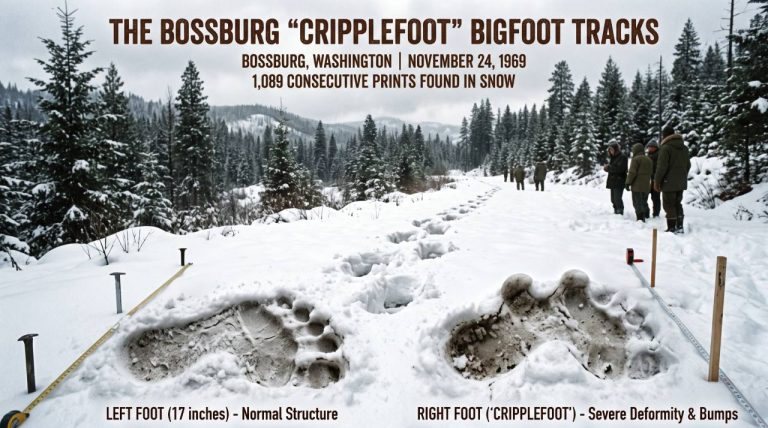
Footprints have been reported for decades across the Pacific Northwest and elsewhere in North America, including some famous cases that have attracted considerable attention from investigators, researchers and the wider public.
Some trackways are remarkably detailed and have been examined by experienced footprint analysts.
Others have been challenged as misidentifications, hoaxes or deliberate fabrications.
And some individual cases remain disputed rather than conclusively explained either way.
So the scientific position isn’t simply:
“There are no tracks.”
There clearly are claimed Sasquatch track records.
The much harder question is:
Which tracks, if any, represent an unknown biological animal?
That distinction matters enormously.
A large terrestrial primate weighing perhaps 75–350 kg would place substantial forces through its feet while walking. If hundreds of individuals repeatedly travelled through the same landscapes, we might expect some combination of:
- Footprints
- Trackways
- Repeated trails
- Disturbed soil
- Flattened vegetation
- Mud impressions
- Crossing points around streams
- Tracks around feeding locations
And a genuine population should produce variation.
Adults wouldn’t all have identical feet.
Males and females could differ.
Juveniles would produce smaller tracks.
Older individuals might have different gait patterns or foot morphology.
A real population should therefore theoretically produce a distribution of track sizes and characteristics, rather than one stereotypical giant footprint.
This is where the existing footprint record becomes particularly interesting.
The fact that alleged tracks have been reported for decades is certainly relevant to the Sasquatch question, but reported footprints alone do not establish the existence of a new primate species.
For that, we would want track evidence supported by independent biological evidence.
🧬 2. DNA and biological material
A living population would constantly shed biological material.
Hair.
Skin cells.
Saliva.
Urine.
Faeces.
Blood from injuries.
And eventually, carcasses.
Modern environmental DNA research has demonstrated that organisms can leave detectable genetic material in their surroundings without researchers ever seeing the animal itself.
For a hypothetical Sasquatch population, this creates a powerful prediction:
If large numbers of Sasquatch repeatedly occupy particular environments, some biological material should eventually enter those environments.
That doesn’t mean environmental DNA would be easy to recover.
Forest environments are difficult.
DNA degrades.
Water moves.
Samples can become contaminated.
And researchers need to know where to look.
But a population of hundreds would provide hundreds of individual animals repeatedly shedding biological material over generations.
That is very different from searching for one hypothetical animal passing through an area once.
💩 3. Faeces — the nutritional evidence
This is where our nutrition investigation becomes particularly relevant.
A real animal has to eliminate what it doesn’t digest.
Sasquatch scat, if found and properly authenticated, could potentially be enormously informative.
Researchers could potentially investigate:
- Plant fragments
- Seeds
- Hair
- Feathers
- Insect remains
- Fish scales
- Bone fragments
- Parasites
- Microbial communities
- Dietary DNA
- Host DNA
It could potentially answer one of the questions we’ve been modelling throughout this article:
What does Sasquatch actually eat?
And perhaps even more importantly, it could tell us whether the animal’s digestive physiology resembles that of known primates or something substantially different.
A confirmed scat sample containing identifiable biological material and previously unknown primate DNA would obviously be extraordinary evidence.
🦴 4. Carcasses and skeletal remains
This is perhaps one of the biggest predictions of all.
Animals die.
No population escapes mortality.
If 500 Sasquatch existed for generations, some individuals would eventually die from:
- Age
- Disease
- Injury
- Accidents
- Predation
- Starvation
- Environmental exposure
- Competition
- Reproductive complications
Not every carcass would be found.
Forests are extremely effective at destroying biological remains.
Scavengers consume soft tissue.
Insects accelerate decomposition.
Weather damages bones.
And a carcass could disappear remarkably quickly.
So we shouldn’t expect a convenient pile of skeletons waiting in the woods.
But over multiple generations, the population would theoretically produce many opportunities for skeletal material to enter the environment.
Even a fragment of bone containing recoverable DNA could potentially be transformative.
🦷 5. Feeding remains
Our nutritional model also makes another prediction.
A large omnivore eating animal foods should sometimes leave behind evidence of feeding.
That could include:
- Broken bones
- Fish remains
- Eggshells
- Partially consumed carcasses
- Damaged vegetation
- Dug-up roots
- Opened nests
- Insect colonies disturbed during feeding
The interpretation would be difficult because almost every one of these signs has known alternatives.
A broken bone isn’t automatically Sasquatch evidence.
A disturbed tree isn’t automatically Sasquatch evidence.
A pile of fish remains could have many explanations.
But a consistent combination of unusual feeding traces associated with DNA, tracks and other biological material would be far more interesting.
Science becomes much stronger when independent lines of evidence converge.
🌲 6. Repeated feeding sites and shelters
A population of large primates would also need places to rest and potentially raise young.
If Sasquatch constructed nests, shelters or bedding sites, repeated use could potentially leave physical evidence.
This would be particularly interesting if structures displayed:
- Consistent construction patterns
- Similar dimensions
- Repeated use
- Associated hair or biological material
- Signs of different individuals
- Evidence of juveniles
But again, caution is essential.
Branches naturally fall.
Storms break trees.
Deer, bears and other animals disturb vegetation.
Humans create structures.
An unusual arrangement of branches by itself is not enough.
The strength would come from a reproducible pattern combined with independent evidence.
🐻 7. Evidence of interaction with other wildlife
Our hypothetical Sasquatch wouldn’t exist alone.
We’ve already established that it could potentially share food resources with black bears, deer, elk, raccoons, coyotes and other wildlife.
That creates another prediction.
A real population should occasionally interact with those animals.
This could theoretically produce:
- Injuries
- Scars
- Carcass remains
- Disturbed feeding sites
- Competition around food
- Predator/prey interactions
But we’d need to be especially careful here.
Finding a bear with unexplained injuries wouldn’t demonstrate a Sasquatch attack.
The Pacific Northwest contains plenty of large animals capable of injuring one another.
Again, the evidence would need to be unusually specific and reproducible.
🧒 8. Juveniles should exist
This one sounds obvious, but it’s incredibly important.
If Sasquatch were a breeding population rather than a collection of isolated individuals, there should be:
Babies → juveniles → adolescents → adults.
That means we wouldn’t expect every reported Sasquatch to be a huge adult male.
Our hypothetical population should contain individuals of different:
- Ages
- Body sizes
- Sexes
- Physical conditions
A juvenile would potentially be considerably smaller than our largest hypothetical adults.
That also means a genuine population could potentially produce different-sized footprints, different dietary requirements and different patterns of movement.
From an ecological perspective, reproduction is one of the strongest indicators that we’re dealing with a genuine population rather than isolated anomalies.
🧬 9. Genetic evidence should eventually become possible
Perhaps the most powerful prediction is also the simplest.
A breeding population requires heredity.
If Sasquatch were a genuine primate population, it would possess a genome.
And members of that population would share genetic relationships.
With sufficient high-quality biological material, researchers should theoretically be able to determine whether the organism represents:
- A known primate
- An unusual human population
- A previously unknown primate lineage
- Contamination
- Or something else entirely
We wouldn’t need to identify every Sasquatch.
A single independently authenticated biological sample containing genuinely novel primate DNA could potentially change the entire discussion.
📊 What would the evidence look like collectively?
This is where we need to avoid a common mistake in cryptozoology.
The question isn’t:
“Can we explain this individual piece of evidence?”
Almost anything can potentially be explained in isolation.
The better question is:
“Do multiple independent observations converge on the same biological explanation?”
Imagine, purely hypothetically, that researchers discovered the following in the same region:
👣 Repeated tracks
↓
🧬 Novel primate DNA
↓
💩 Authenticated scat containing matching DNA
↓
🦴 Biological remains consistent with the same animal
↓
📹 Repeated observations of the same type of animal
↓
🧒 Evidence of juveniles and multiple individuals
That would be dramatically stronger than hundreds of unrelated eyewitness reports.
Why?
Because each piece of evidence would be testing a different prediction of the same biological hypothesis.
⚠️ What about the existing Sasquatch evidence?
This is where the article needs to remain especially fair.
Sasquatch reports include a huge variety of claimed evidence:
- 👣 Footprints and trackways
- 👁️ Eyewitness encounters
- 📷 Photographs
- 🎥 Video
- 🧬 Hair samples
- 🔊 Audio recordings
- 🌲 Alleged nests and structures
- 📰 Historical reports
- 🦴 Alleged biological remains
The footprint record is particularly notable because claims of Sasquatch tracks extend back decades and include a number of famous cases.
That history shouldn’t be ignored.
At the same time, a long history of reported tracks isn’t equivalent to a scientifically confirmed animal.
Individual track cases have varying levels of documentation and credibility, and some famous examples have been disputed or demonstrated to involve hoaxing.
The correct scientific position is therefore neither:
“All Sasquatch tracks are fake.”
nor:
“Sasquatch tracks prove Bigfoot exists.”
It is:
There is a substantial historical record of alleged Sasquatch footprints, but the overall track evidence has not established the existence of a previously unknown primate.
That distinction is important for the credibility of the entire article.
🔬 The standard is higher than “something unexplained”
This distinction is crucial.
An unexplained footprint is not automatically a Sasquatch footprint.
An unidentified hair is not automatically Sasquatch hair.
An unusual sound is not automatically a Sasquatch vocalisation.
An eyewitness seeing something they cannot identify is not automatically evidence of a new species.
The strongest evidence would be something that is:
Physical
Something tangible can be independently examined.
Reproducible
Other researchers can investigate it.
Independently verified
It doesn’t depend entirely on one person’s interpretation.
Biologically consistent
It fits what we know, or can reasonably predict, about a large primate.
Difficult to explain conventionally
Alternative explanations have been seriously investigated.
Supported by multiple lines of evidence
Different types of evidence point toward the same conclusion.
That is a much higher bar.
🧠 What our thought experiment has actually demonstrated
And this brings us back to the beginning of the article.
We started with a hypothetical question:
What would Bigfoot eat?
But nutrition has taken us somewhere much more interesting.
If Sasquatch were a real giant primate, it wouldn’t simply need calories.
It would need an entire ecological existence.
It would need:
Food → energy → nutrients → territory → reproduction → offspring → mortality → interactions → biological traces.
A population of hundreds couldn’t simply appear in the ecosystem without interacting with it.
And those interactions should, at least in principle, create evidence.
That doesn’t mean the absence of a definitive specimen proves Sasquatch doesn’t exist.
But it does mean that the larger and more persistent the hypothetical population becomes, the more scientifically interesting the missing biological evidence becomes.
🌎 From calories to evidence
Our thought experiment has therefore produced a series of predictions:
| If Sasquatch were a real population… | We might expect… |
|---|---|
| 🥗 It needs food | Feeding remains & resource use |
| 🚶 It moves | Tracks & trails |
| 💩 It digests food | Faeces & dietary remains |
| 🧬 It sheds cells | Environmental DNA |
| 🧒 It reproduces | Juveniles & multiple age groups |
| 🦴 It dies | Skeletal/carcass evidence |
| 🐻 It shares habitat | Ecological interactions |
| 🌲 It occupies territory | Repeated physical disturbance |
| 🧬 It is a species | A distinct genetic signature |
| 🌎 It persists for generations | A cumulative ecological footprint |
And that leaves us with perhaps the most important question of the entire investigation:
🧪 Does the Sasquatch Evidence Actually Match the Animal We Have Just Modelled?
We’ve established what a hypothetical giant primate would need.
We’ve established what it would potentially eat.
We’ve calculated the scale of its energy requirements.
We’ve considered what several hundred animals might do to the ecosystem.
And we’ve identified the biological evidence that should theoretically accompany a persistent population.
Now we can turn the lens around and examine the actual Sasquatch evidence, the famous footprints, hair samples, photographs, recordings, sightings and scientific investigations, and ask a much more difficult question:
How well does the evidence we have actually fit the animal biology we’ve just modelled?
That, I think, is a much stronger ending to the scientific side of the article than simply declaring Bigfoot possible or impossible. It lets the evidence speak for itself.
🔬 9. What Does the Existing Evidence Tell Us?

Our hypothetical model has given us a set of predictions.
If a large primate really inhabited the Pacific Northwest, we would expect it to require substantial quantities of food, interact with existing wildlife and leave biological traces behind.
And, importantly, there is already a long history of claimed Sasquatch evidence.
Footprints and trackways have been reported for decades, alongside eyewitness encounters, photographs, video, alleged hair samples, audio recordings and other physical evidence.
Some cases are genuinely intriguing.
Others have plausible conventional explanations, while some have been exposed as hoaxes.
The overall body of evidence remains inconclusive.
That distinction is important.
Our nutritional calculations don’t prove Sasquatch exists, but neither does the availability of conventional explanations for individual reports automatically explain every report ever made.
Instead, our model gives us a framework for asking better questions.
If the animal exists, its biology should ultimately be consistent with:
Its body size → its energy requirements → its diet → its digestive physiology → its habitat → its population size → its ecological footprint.
At present, we don’t have a verified specimen, genome or independently authenticated biological sample demonstrating the existence of such a primate.
So the scientific conclusion remains that Sasquatch has not been established as a real animal.
But that doesn’t make the ecological thought experiment pointless.
Quite the opposite.
It allows us to ask whether the hypothetical animal itself makes biological sense.
🧠 10. So, What Would Bigfoot Actually Eat?
After working through the numbers, one dietary model stands out as particularly plausible if Sasquatch were a real large primate:
🌲 An opportunistic omnivore.
Not necessarily a meat-eating monster.
Not necessarily a giant gorilla surviving entirely on leaves.
And certainly not an animal with one fixed menu.
Instead, a hypothetical Sasquatch would probably benefit from being able to exploit whatever nutritious foods were available.
Its diet could potentially include:
🌿 Vegetation
🫐 Fruits and berries
🌰 Nuts and seeds
🍄 Fungi
🐜 Insects
🥚 Eggs
🐟 Fish
🦌 Carrion
🐭 Small animals
🦌 Potentially larger animal matter
The proportions would be the real question.
A predominantly plant-based diet could work if the animal possessed the appropriate digestive adaptations.
A more flexible omnivorous diet could potentially reduce the dependence on extremely large quantities of low-energy vegetation.
And seasonal switching could allow the animal to take advantage of different nutritional opportunities throughout the year.
🔥 The calorie problem is real—but not necessarily impossible
Our hypothetical body sizes demonstrated something important.
A very large primate could have an enormous energy requirement.
At 250–350 kg, our illustrative maintenance scenarios reached roughly 8,800–11,300 kcal per day, before considering that actual expenditure could vary substantially with activity, climate, reproduction and other factors.
That’s a remarkable amount of food energy.
But the Pacific Northwest isn’t nutritionally empty.
It contains:
🌲 Vast forest ecosystems
🫐 Seasonal fruit and berries
🌰 Energy-rich nuts and seeds
🐜 Insects
🐟 Fish
🦌 Large herbivores
🐻 Existing omnivores
🌿 Enormous quantities of plant biomass
So the nutritional evidence doesn’t allow us to simply conclude:
“There isn’t enough food for Bigfoot.”
But it also doesn’t allow us to conclude:
“There is enough food, therefore Bigfoot exists.”
Those are completely different claims.
🌎 Could the Pacific Northwest Support 500 Sasquatch?
Our 500-animal scenario provides another useful perspective.
A population of 500 large primates would certainly consume substantial resources and compete with existing wildlife.
But the Pacific Northwest already supports large populations of substantial mammals, including thousands of black bears alongside deer, elk and countless smaller consumers.
Whether another large omnivore could be accommodated would depend on:
- Population density
- Territory size
- Body size
- Diet
- Seasonal food availability
- Reproductive rate
- Activity levels
- Competition
- Climate
- How efficiently the animal could exploit available foods
So 500 is not automatically ecologically impossible.
But neither can we demonstrate that 500 animals could actually be sustained.
It’s a modelling scenario, not a population estimate.
🧬 The biggest problem isn’t necessarily calories
And perhaps that’s the most interesting conclusion of the entire investigation.
The Pacific Northwest appears capable of producing enormous quantities of biological energy.
The harder question isn’t simply:
“Could a giant primate find enough food?”
It’s:
“Could a breeding population of giant primates obtain that food for generation after generation while leaving only the level of evidence we currently have?”
Because a real population would have to leave some kind of footprint.
Tracks.
Hair.
Faeces.
DNA.
Feeding remains.
Juveniles.
Carcasses.
Ecological interactions.
The longer the population existed, and the larger it became, the more opportunities there would be for such evidence to accumulate.
🦍 The Final Nutritional Verdict
So, what can we actually conclude from the exercise?
✅ Biologically plausible as a thought experiment
A large omnivorous primate exploiting a diverse Pacific Northwest food web is not inherently absurd from a nutritional perspective.
✅ An opportunistic diet makes ecological sense
Flexibility would be advantageous in a seasonal environment.
✅ High-energy foods would probably matter
Nuts, fruit, insects, fish and animal matter could provide valuable concentrated energy alongside plant foods.
⚠️ A highly herbivorous diet would require appropriate adaptations
We cannot simply assume Sasquatch could digest huge quantities of fibrous vegetation like a gorilla.
⚠️ Body size creates a substantial energy demand
The larger our hypothetical animal becomes, the greater the absolute amount of food energy it must obtain.
⚠️ 500 animals would have some ecological footprint
They would compete with existing wildlife and inevitably interact with their environment.
❌ None of this establishes that Sasquatch exists
Our calculations demonstrate what such an animal would need to survive, not that the animal actually exists.
And that’s ultimately the value of the exercise.
🌲 Conclusion — If Bigfoot Were Real, It Would Have to Eat
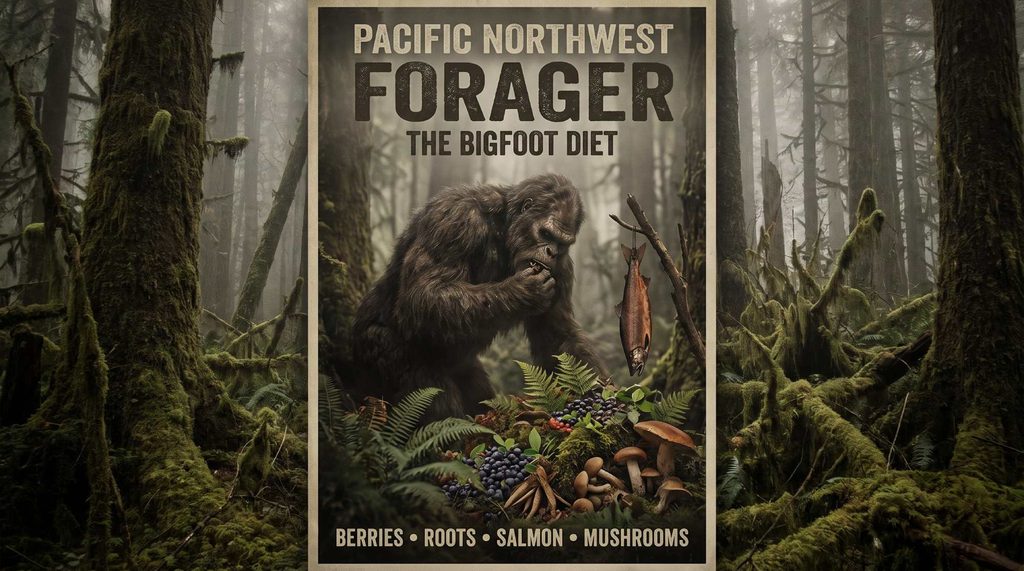
Bigfoot is often discussed as a creature of mystery.
But beneath the footprints, photographs and legends is a much simpler biological reality.
If Sasquatch exists, it has to eat.
It has to obtain enough energy to power a large body.
It has to obtain protein, fats, carbohydrates, vitamins, minerals and water.
It has to survive winter. It has to reproduce. It has to raise young. It has to compete with other animals.
And it has to leave an ecological footprint.
Our best hypothetical model therefore isn’t a monster that mysteriously appears from the forest and survives on an unspecified diet.
It is something much more ordinary, and much more biologically demanding:
A large primate attempting to make a living.
An opportunistic omnivore moving through a seasonal landscape.
Eating what is available.
Following energy-rich foods when they appear.
Exploiting fruit and nuts when they’re abundant.
Taking advantage of insects, fish and other animal foods when the opportunity arises.
And falling back on whatever resources its environment can provide when conditions become difficult.
Whether such an animal actually exists remains an entirely separate question.
The biology, however, gives us a fascinating way to ask what it would take for Bigfoot to survive.
And perhaps that’s the most interesting thing about the question:
🧬 Before we can ask whether Bigfoot is real, we can ask whether the animal described by the legend could actually live.
If it could, the forest would still have to pay the energy bill. 🌲🔥