The Minnesota Iceman: The Frozen Bigfoot That Shocked America
Imagine walking into a travelling carnival in the late 1960s.
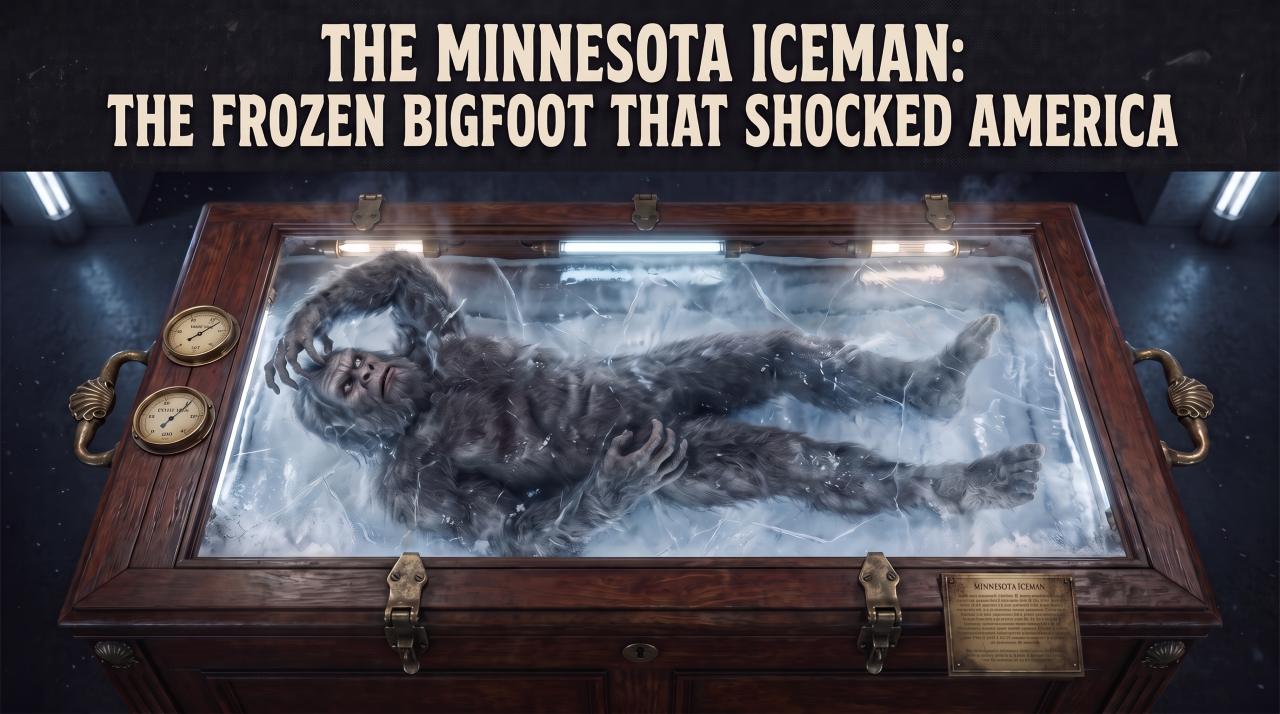
A small crowd gathers around a dimly lit refrigerated display. Hidden beneath a layer of cloudy ice lies the motionless body of a large, hairy creature unlike anything most people have ever seen.
Broad shoulders. Long arms. Human-like hands. A flattened face frozen forever behind frosted glass.
A hand-painted sign offers few answers.
Some whisper that it is an ape.
Others insist it is a missing link.
A few quietly wonder if they are staring at the frozen body of Bigfoot.
For many visitors, the Minnesota Iceman was little more than an unusual carnival attraction. For others, it became one of the most intriguing and controversial exhibits in the history of cryptozoology.
As word spread across the United States, curiosity soon extended beyond paying spectators. Journalists, scientists, and some of the world’s leading cryptozoologists began asking uncomfortable questions.
What exactly was preserved inside the ice?
Was it an elaborate sideshow creation designed to attract crowds?
Could it have been an undiscovered species of giant primate?
Or had Frank Hansen, the travelling showman behind the exhibit, unknowingly found himself at the centre of one of cryptozoology’s greatest mysteries?
The story only became stranger. A mysterious California millionaire was said to own the frozen creature, yet no convincing evidence of his identity has ever emerged.
Scientists were reportedly denied the opportunity to carry out a full examination. Conflicting explanations began to appear.
The exhibit disappeared from public view before eventually returning in a form that some researchers claimed looked noticeably different from the specimen they believed they had originally studied.
Supporters argued that the original body had been quietly replaced with a replica.
Sceptics believed the entire affair had always been nothing more than an extraordinarily convincing publicity stunt.
More than half a century later, the Minnesota Iceman continues to occupy a unique place in cryptid history.
Unlike many famous Bigfoot sightings, this was not simply an eyewitness account or a blurry photograph.
It was a physical exhibit that thousands of people claimed to have seen with their own eyes, an alleged frozen creature displayed before the public, examined by respected investigators, and surrounded by a trail of unanswered questions that persists to this day.
In this Cryptid Legends investigation, we’ll explore the remarkable history of the Minnesota Iceman, examine the evidence, separate documented facts from enduring legend, and discover why this frozen mystery remains one of the most debated chapters in the history of Bigfoot research.
The Frozen Mystery Appears
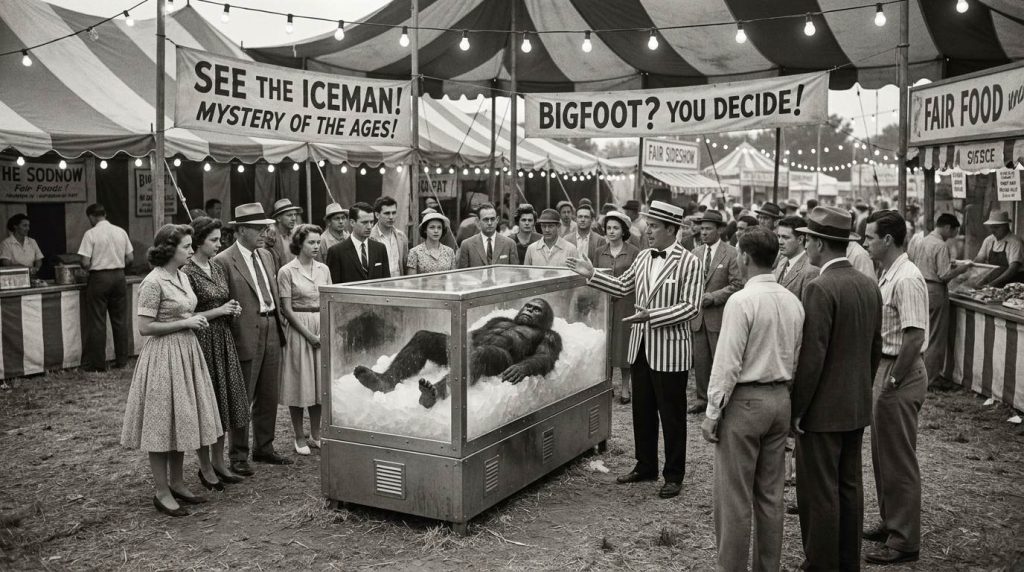
Long before internet debates, viral videos, and social media speculation, one of cryptozoology’s most unusual mysteries travelled quietly across the United States inside a refrigerated display case.
During the late 1960s, a travelling exhibition operated by Minnesota businessman and showman Frank Hansen began attracting curious visitors who claimed they had seen something unlike any ordinary carnival attraction.
Inside a large glass container, partially concealed beneath cloudy ice, lay the frozen body of what appeared to be a huge ape-like creature.
The exhibit quickly became known as The Minnesota Iceman.
Unlike traditional museum displays or circus attractions, Hansen presented the creature as something mysterious.
Visitors were encouraged to draw their own conclusions as they peered through the frosted glass at a figure that seemed remarkably human, yet distinctly unlike any known person.
A Creature Frozen in Ice
Those who viewed the Minnesota Iceman often described a remarkably lifelike figure.
Reports commonly mentioned:
🦍 A body covered in dark hair.
💪 Broad shoulders and a muscular chest.
✋ Human-like hands with long fingers.
🦶 Large feet that appeared proportionally longer than those of an average person.
👤 A flattened face with heavy brow ridges and a broad nose.
🩸 Apparent wounds or damage to one side of the head and face, leading some observers to speculate that the creature may have died violently.
Because the body remained enclosed within cloudy blocks of ice, fine details were difficult to examine.
The frozen surface distorted visibility, creating an eerie effect that left many visitors wondering whether they were looking at an elaborate sculpture or the preserved remains of an unknown creature.
Public Fascination
Word of the exhibit spread rapidly.
Thousands of paying visitors reportedly viewed the frozen figure as it travelled between fairs, exhibitions, and small venues across the United States. Newspapers began mentioning the mysterious attraction, and rumours quickly followed.
Some believed it was nothing more than clever showmanship designed to sell tickets.
Others wondered whether Hansen had somehow acquired the preserved body of an unknown primate.
The timing also played an important role.
Interest in Bigfoot was growing rapidly during the 1960s following the famous Bluff Creek footprint discoveries and increasing reports of large ape-like creatures across North America.
Although Hansen himself did not always describe the Minnesota Iceman as Bigfoot, many members of the public naturally began making the connection.
For believers, the exhibit appeared to offer something extraordinary, a chance to see, with their own eyes, what might be physical evidence of a creature that until then had largely existed through eyewitness accounts and folklore.
More Than a Carnival Attraction
At first glance, the Minnesota Iceman seemed destined to become just another curious sideshow exhibit.
Instead, it attracted the attention of individuals who approached the mystery from an entirely different perspective.
Among those who heard about Hansen’s frozen creature were respected cryptozoologists and naturalists who believed the exhibit deserved serious scientific investigation.
What began as a travelling attraction was about to become one of the most debated cases in the history of cryptozoology.
Scientists and Researchers Investigate
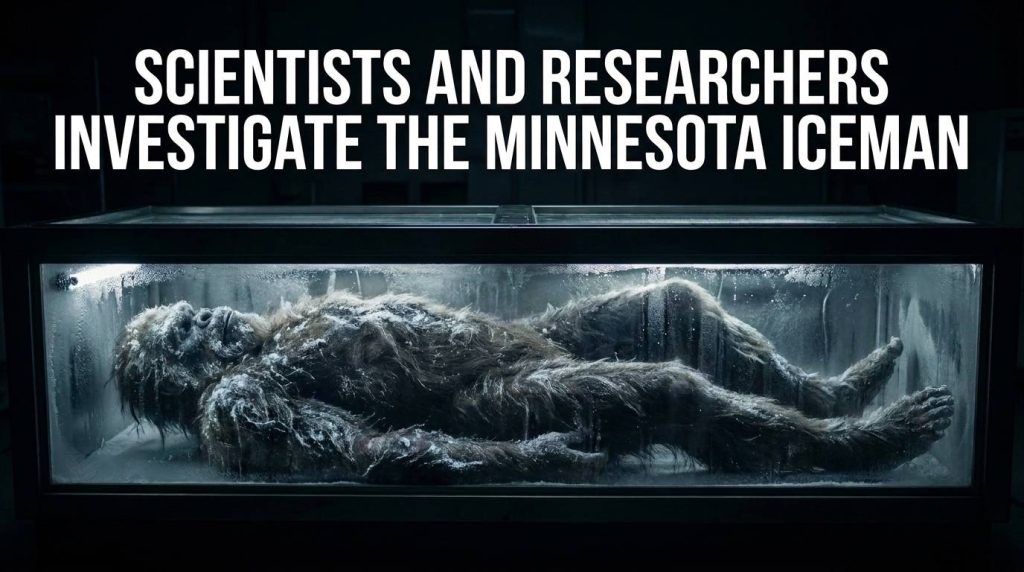
Although the Minnesota Iceman first appeared as a travelling exhibition, it quickly attracted attention from people who viewed it as more than a simple curiosity.
The late 1960s were a fascinating period for cryptozoology. Reports of unknown animals and mysterious creatures were receiving increased public attention, while researchers were beginning to investigate whether some legendary creatures might represent undiscovered species.
The Minnesota Iceman presented a unique opportunity.
Unlike many cryptid reports that relied only on eyewitness testimony, this appeared to be a physical object that could potentially be examined.
If genuine, the implications would have been extraordinary.
A previously unknown primate preserved in ice would represent one of the most significant zoological discoveries in modern history.
However, before any conclusions could be reached, researchers first needed access to the specimen.
Among those who became involved were three important figures who approached the mystery from different perspectives:
- Bernard Heuvelmans
- Ivan T. Sanderson
- John Napier
Bernard Heuvelmans: The Father of Cryptozoology Investigates
Belgian-French zoologist Bernard Heuvelmans was one of the most influential figures in early cryptozoology.
Known for his interest in animals that were reported by witnesses but not officially recognised by science, Heuvelmans approached the Minnesota Iceman as a potentially significant discovery rather than simply another sideshow attraction.
When he examined the frozen figure in 1968, he believed it displayed characteristics worthy of serious investigation.
Among the details that interested him were the overall body structure, apparent muscular development, the proportions of the arms, shoulders, and torso, the hands and fingers, and the visible injuries on the figure.
However, Heuvelmans’ examination was severely limited. The specimen remained encased within ice, preventing detailed analysis of its surface features, anatomy, and possible construction.
Despite these limitations, he considered the possibility that the figure represented something biologically significant rather than immediately dismissing it as an elaborate attraction.
For supporters of the Minnesota Iceman, Heuvelmans’ involvement remains one of the strongest arguments that the case deserved serious attention.
Ivan T. Sanderson: A Naturalist Searches for Answers
Another major figure connected with the investigation was Ivan T. Sanderson, a Scottish-American naturalist, writer, and researcher known for his work involving unusual animals and unexplained creatures.
Like Heuvelmans, Sanderson believed the Minnesota Iceman deserved closer examination.
Sanderson was experienced in studying unusual biological reports and approached the specimen with interest rather than immediate dismissal.
After viewing the figure, he reportedly found certain features intriguing, including its apparent anatomy and physical proportions.
However, like Heuvelmans, Sanderson faced the same fundamental problem:
The conditions surrounding the exhibit prevented a complete scientific examination.
The creature remained behind ice and under the control of those presenting it, meaning researchers could not conduct the type of investigation that would normally be required to confirm an extraordinary biological claim.
For Sanderson, the Minnesota Iceman represented a mystery that required more evidence.
For sceptics, the inability to properly examine the figure became one of the biggest weaknesses of the case.
John Napier: A Scientific Sceptical Perspective
While Heuvelmans and Sanderson approached the Minnesota Iceman as a possibility worth investigating, another respected researcher reached a very different conclusion.
John Napier, a British primatologist associated with the Smithsonian Institution, examined the available information surrounding the exhibit.
Napier approached the case from the perspective of mainstream biological science.
Rather than accepting the figure as evidence of an unknown primate, he concluded that the available evidence was more consistent with an artificial construction.
His assessment became one of the strongest arguments for sceptics of the Minnesota Iceman.
However, Napier’s conclusion also faced the same limitation experienced by other investigators:
The original specimen was never available for a complete forensic examination.
The debate therefore remained unresolved.
Supporters argued:
“The problem was that nobody was allowed to properly study the original.”
Sceptics argued:
“The lack of scientific verification was itself evidence against the claim.”
Three Researchers, Three Interpretations
The involvement of Heuvelmans, Sanderson, and Napier demonstrates why the Minnesota Iceman became such an enduring mystery.
The case was not simply divided between believers and sceptics.
It involved respected investigators looking at the same unusual exhibit and reaching different interpretations.
To some, the Minnesota Iceman represented a possible unknown creature hidden behind secrecy and circumstance.
To others, it represented an impressive piece of exhibition craftsmanship that became surrounded by mythology.
But regardless of interpretation, one fact remained:
The Minnesota Iceman had moved beyond the world of sideshow entertainment and had become one of the most debated physical mysteries in cryptozoological history.
The Mysterious California Millionaire

As interest in the Minnesota Iceman increased, so did the questions surrounding its ownership and mysterious origins.
Frank Hansen maintained that the frozen creature was not actually his property.
According to Hansen’s account, the exhibit belonged to an unnamed wealthy California businessman who had acquired the specimen and allowed him to display it. Hansen described himself as a caretaker or exhibitor rather than the true owner of the mysterious frozen body.
The identity of this supposed “eccentric California millionaire” became one of the most puzzling aspects of the entire case.
Despite years of discussion, the owner was never publicly identified, and no convincing documentation proving his existence ever emerged.
Adding further mystery was Hansen’s explanation of where the creature originally came from.
One of the earliest stories claimed that the body had been discovered near Siberia, with Hansen suggesting it had been recovered from the frozen waters of the region before eventually making its way into the hands of the mysterious California owner.
Some versions involved Russian seal hunters discovering the frozen remains, while other accounts later suggested different origins.
Over time, however, Hansen gave different explanations for the creature’s background, including alternative stories involving other locations and circumstances. These changing accounts would later become one of the major points of criticism from sceptics, who argued that the lack of a consistent origin story weakened the case.
For researchers hoping to conduct a detailed scientific examination, the mysterious ownership created a significant obstacle.
If the specimen was genuine, it represented something potentially extraordinary, perhaps one of the most important discoveries in natural history.
But without permission from the alleged owner, access remained limited.
The situation became even more complicated as scientists and researchers attempted to learn more about the frozen figure.
The mysterious owner reportedly did not want the specimen subjected to extensive examination, and Hansen eventually withdrew the exhibit from public view.
For supporters of the Minnesota Iceman’s authenticity, this raised an obvious question:
Why would someone hide a discovery that could potentially change science forever?
For sceptics, however, the situation created an equally important question:
Was the mysterious owner simply a way to prevent the exhibit from being independently examined?
The Original or the Replica? The Great Minnesota Iceman Debate
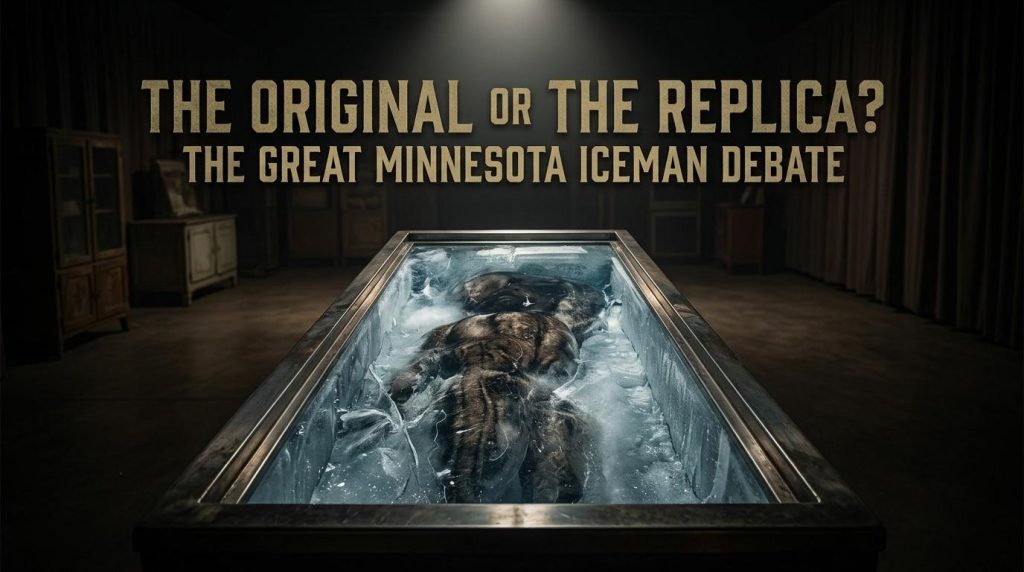
As the Minnesota Iceman mystery developed, one question began to dominate the discussion:
Had researchers examined the original specimen, or had it later been replaced by a replica?
This became one of the most important controversies surrounding the case.
When Bernard Heuvelmans and Ivan T. Sanderson examined the frozen figure in 1968, they believed they were looking at something unusual enough to deserve further scientific investigation.
However, their examination was limited by the fact that the creature remained enclosed within thick ice, preventing a complete analysis.
Not long afterwards, the original exhibit reportedly disappeared from public view.
When the Minnesota Iceman later returned, some observers claimed that the figure appeared different from the specimen they believed they had previously examined.
This led to one of the most enduring theories connected to the case:
Had the original Minnesota Iceman been quietly replaced?
The Replacement Theory
For supporters of the Minnesota Iceman’s authenticity, the possibility of a replacement offers an explanation for many of the unresolved questions surrounding the exhibit.
Their argument is that the specimen examined by researchers such as Heuvelmans and Sanderson may have been something genuinely unusual, while the later public display was a manufactured copy created to protect the original.
Supporters of this theory have pointed to perceived differences between earlier descriptions and later versions of the exhibit, including:
🧊 Changes in facial appearance.
🦍 Differences in body proportions.
💪 Alterations in the apparent muscle definition and realism of the figure.
👤 A less convincing overall appearance compared with the specimen described by early investigators.
If this interpretation were correct, the most important part of the Minnesota Iceman mystery may have disappeared before proper scientific examination could take place.
The Problem of the Ice
However, there is another important factor that must be considered.
The specimen examined by early researchers was not viewed as an uncovered body. It was seen through thick layers of ice, creating conditions that could significantly affect how the figure appeared.
The ice may have altered perceptions of:
🧊 Facial structure and apparent injuries.
🦍 Body proportions.
💪 Muscle definition.
👤 Hair, skin texture, and surface details.
When the exhibit was later displayed with less ice covering the figure, previously hidden details may have become visible, potentially creating the impression that viewers were looking at a different object.
This provides a possible explanation for some of the reported differences between the early specimen and later displays.
The Replica Explanation
Sceptics argue that an even simpler explanation exists.
They suggest that the Minnesota Iceman was always an artificial creation designed for exhibition purposes, and that the differences between descriptions, photographs, and memories can be explained through normal factors such as:
- different viewing conditions,
- ice obscuring important details,
- changes in lighting,
- limitations of photography from the era,
- and the natural way human memories of unusual events can change over time.
From this perspective, there was no need for a genuine specimen to have been removed because no genuine specimen existed.
The exhibit was instead a carefully constructed attraction designed to create mystery and public fascination.
A Mystery That Cannot Be Fully Resolved
The difficulty is that the original specimen was never subjected to the kind of detailed scientific examination that could have settled the debate.
There was no complete forensic analysis.
No verified chain of ownership was established.
No definitive documentation confirmed exactly what happened between the early exhibit and later versions.
As a result, the Minnesota Iceman became a mystery within a mystery.
The question was no longer only:
“What was the creature inside the ice?”
It became:
“Was anyone ever able to properly examine what was inside the ice at all?”
Decades later, the debate continues.
To believers, the changing appearance suggests that something important may have been hidden.
To sceptics, the same inconsistencies are evidence that the mystery was created rather than discovered.
And somewhere between those two interpretations remains one of cryptozoology’s most enduring questions, what exactly was the Minnesota Iceman?
Who Was Frank Hansen? The Showman Behind the Mystery
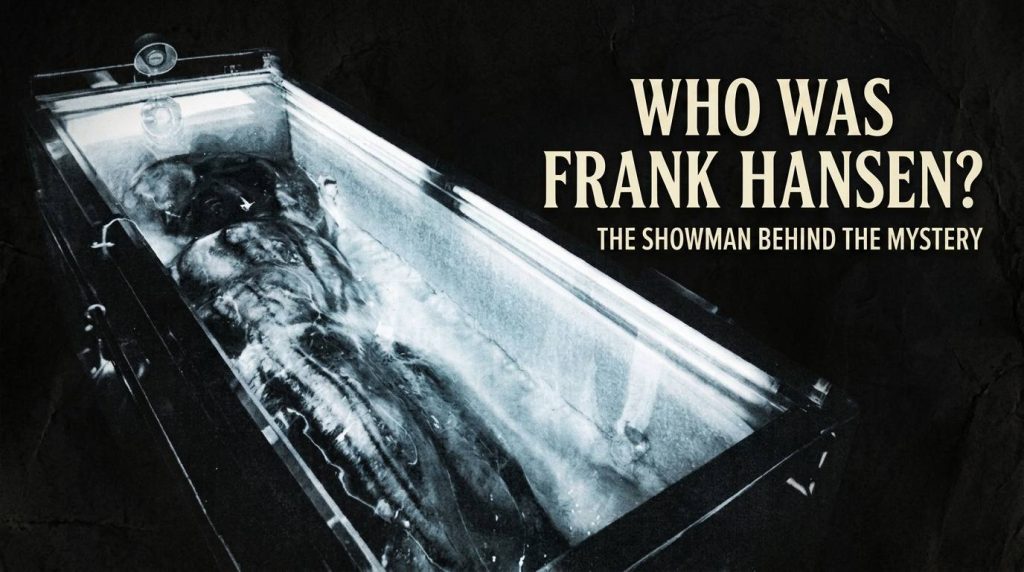
Every great mystery has a central figure, someone whose decisions, personality, and actions shape how the story is remembered.
For the Minnesota Iceman, that person was Frank Hansen.
Before his name became permanently linked with one of cryptozoology’s strangest controversies, Hansen was known as a Minnesota businessman and travelling showman who understood a timeless principle of public entertainment:
Mystery attracts attention.
During the mid-20th century, fairs, exhibitions, and travelling attractions were filled with unusual displays designed to capture public imagination.
From strange animals and unusual collections to sideshow curiosities, audiences were fascinated by things that existed somewhere between science, entertainment, and the unknown.
Hansen operated within this tradition. He understood that people were not only interested in what they could see, they were interested in the questions surrounding what they saw.
And the Minnesota Iceman provided perhaps the ultimate mystery. A frozen humanoid figure inside a display case was not simply an object. It was a story.
A Showman and His Extraordinary Attraction
When Hansen began exhibiting the frozen figure in the late 1960s, he presented it as something unusual and unexplained.
Unlike a traditional museum specimen with labels, measurements, and scientific documentation, the Minnesota Iceman existed in a much more mysterious space, leaving visitors to wonder whether they were looking at a remarkable piece of craftsmanship, an unknown animal, or something science had never encountered before.
That uncertainty became part of the attraction itself. For Hansen, the mystery surrounding the figure helped draw crowds; the more people debated what they were seeing, the more attention the exhibit received.
To supporters of the Iceman’s authenticity, this behaviour was understandable, someone possessing something genuinely extraordinary might naturally want to protect it, control access, or avoid unwanted attention.
To sceptics, however, the same behaviour appeared more consistent with a skilled showman protecting an elaborate attraction.
The Man Behind the Questions
One of the reasons Hansen remains such a fascinating figure is that so much of the Minnesota Iceman story revolves around unanswered questions about him.
Why did he claim he was only exhibiting the figure rather than owning it?
Who was the mysterious California businessman said to be connected to the specimen?
Where did the creature supposedly originate, and why was access to it so limited?
These questions became almost as famous as the exhibit itself.
Over time, different explanations emerged regarding the origins and ownership of the Iceman, including claims involving remote locations and unusual circumstances.
However, many details remained difficult to verify, allowing speculation to grow around a case where the unanswered questions became almost as important as the frozen figure itself.
The Showman or the Protector?
Frank Hansen’s role in the Minnesota Iceman mystery depends greatly on interpretation.
To some, he was a skilled promoter who understood how to create intrigue around an artificial exhibit, with secrecy, mystery, and limited access becoming part of an effective showman’s strategy.
To others, Hansen was a man caught between possessing something extraordinary and dealing with the consequences of public attention, with his secrecy reflecting the difficulty of controlling a discovery that could attract worldwide interest.
The truth may never be fully known.
What is certain is that Hansen played a crucial role in transforming the Minnesota Iceman from a strange travelling attraction into one of the most enduring mysteries in cryptozoological history.
The Legacy of Frank Hansen
Whether the Minnesota Iceman was an elaborate creation or something far stranger, Frank Hansen understood something fundamental about human curiosity: people are fascinated by the unknown.
The frozen figure captured attention because it appeared to offer something incredibly rare, a mystery that could be looked at, a legend placed behind glass, and a question that seemed almost within reach of an answer.
Perhaps that is why, decades later, the name Frank Hansen remains inseparable from the frozen figure that shocked America.
The Minnesota Iceman was never only about what was hidden inside the ice; it was also about the man who brought that mystery into the world.
The Airport Incident and the Mystery Deepens
As interest in the Minnesota Iceman continued, the mystery surrounding the exhibit became even more complicated.
One of the strangest episodes occurred when Frank Hansen attempted to transport the figure through Canada.
During the journey, customs officials reportedly became suspicious of the frozen object and wanted to examine it more closely.
Hansen maintained that the figure was merely a wax or artificial display piece, but according to later accounts, he resisted allowing authorities to inspect it fully.
The situation reportedly became serious enough that political involvement was required before the exhibit was allowed to continue its journey.
For many observers, this incident added another layer of intrigue.
If the Minnesota Iceman was simply a carnival prop, why was there such reluctance to allow examination or need for supposed political involvement?
Sceptics argued that secrecy was exactly what one would expect from a sideshow attraction designed to preserve mystery and avoid exposure.
Believers, however, viewed the incident differently.
To them, Hansen’s behaviour suggested that there may have been more to the story, perhaps questions about ownership, origins, or the true nature of the object hidden beneath the ice.
The Modern Minnesota Iceman: Replica, Museum History, and Legacy
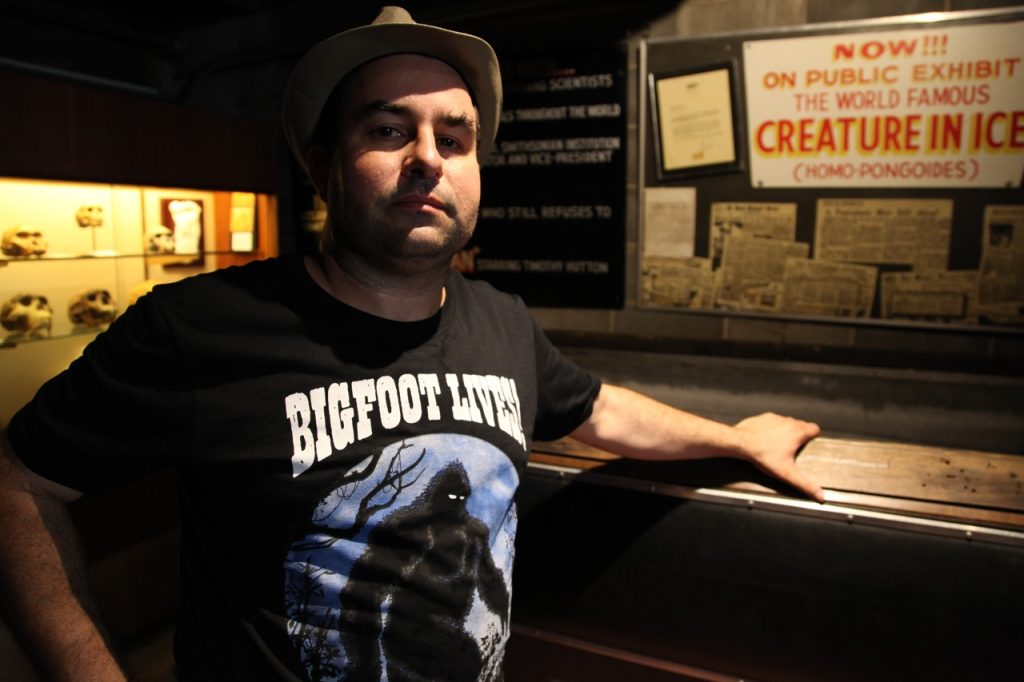
(photo credit: Steve Busti)
Although the original Minnesota Iceman appears to have disappeared from history, the legend itself has never truly faded.
For decades, enthusiasts wondered what had become of Frank Hansen’s famous frozen attraction.
Then, in 2013, the figure most widely believed to be Hansen’s later exhibition piece resurfaced when it was offered for sale on eBay.
It was purchased by Steve Busti, owner of the Museum of the Weird in Austin, Texas, where it remains on public display today.
Visitors to the Museum of the Weird can now stand face-to-face with the legendary Iceman for themselves.
However, the exhibit is generally regarded as the later Hansen display figure rather than the original specimen that attracted the attention of Bernard Heuvelmans and Ivan T. Sanderson during the late 1960s.
That distinction is important.
Today, the Minnesota Iceman is no longer displayed as scientific proof of an unknown species.
Instead, it has become a remarkable piece of cryptozoological history, a museum exhibit representing one of the most debated mysteries ever to blur the boundaries between science, folklore, entertainment, and belief.
Whether viewed as an elaborate sideshow creation or the surviving legacy of a much greater mystery, the Minnesota Iceman continues to attract curious visitors from around the world, proving that sometimes the story behind an exhibit can become just as fascinating as the exhibit itself.
Could the Minnesota Iceman Have Been Something Real?
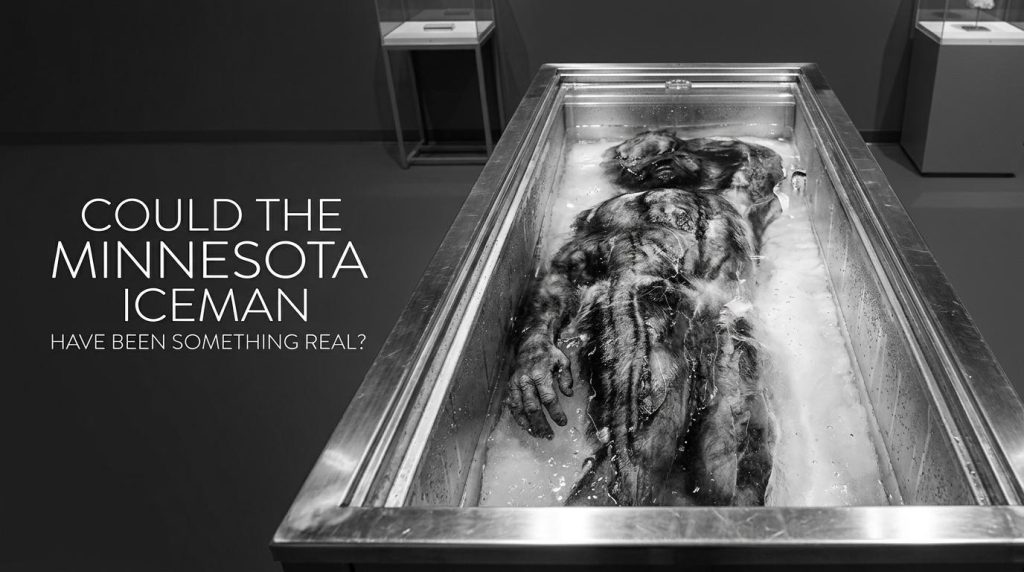
Assuming for a moment that the original specimen represented an undiscovered creature rather than an elaborate exhibition, several theories have been proposed over the decades.
None can be proven, and all remain speculative.
Nevertheless, they offer an intriguing glimpse into how researchers and enthusiasts attempted to explain one of cryptozoology’s greatest mysteries.
Unlike many cryptid reports that exist only through eyewitness testimony, the Minnesota Iceman appeared to offer something different, a physical object that could potentially reveal the existence of an unknown creature.
This led researchers to consider several possibilities, ranging from unknown human relatives to mysterious giant apes.
🧬 The Hominid and “Missing Link” Theory
When the Minnesota Iceman first appeared, Frank Hansen presented the figure as a genuine unknown creature rather than simply an unusual attraction.
The possibility that the body represented an undiscovered type of hominid quickly became one of the most discussed theories surrounding the case.
For some researchers, the figure appeared to possess characteristics that seemed neither fully human nor fully ape-like.
The questions became:
Could this have represented a surviving branch of human evolution?
Could an unknown relative of humanity have survived into modern times?
Or was the creature something even older?
Bernard Heuvelmans and the Neanderthal Theory
Among the researchers most interested in the specimen was Belgian-French zoologist Bernard Heuvelmans.
After examining the frozen figure, Heuvelmans considered the possibility that it represented an unknown human relative.
One of his more controversial ideas was that the creature could have been connected to surviving Neanderthals or another unknown hominid lineage.
He even proposed the name Homo pongoides for a hypothetical unknown human relative with characteristics between humans and apes.
Heuvelmans was particularly interested in features such as the apparent size of the hands and feet, the muscular body structure, and the overall anatomy of the figure.
To him, the Minnesota Iceman represented the possibility that a previously unknown branch of human evolution could have survived unnoticed.
However, without access to the original specimen for complete examination, the theory could never move beyond speculation.
🦍 Ivan T. Sanderson and the Gigantopithecus Connection
Another influential researcher, Ivan T. Sanderson, considered a different possibility.
Rather than viewing the creature as a surviving human relative, Sanderson suggested it might represent a surviving relative of Gigantopithecus, a giant prehistoric ape believed to have lived in Asia millions of years ago.
Gigantopithecus is often mentioned in cryptozoology because of its enormous size and the possibility, suggested by some enthusiasts, that isolated populations could have survived longer than currently accepted by mainstream science.
Sanderson’s theory reflected the broader cryptozoological question of the time:
Could ancient animals thought to be extinct have survived in remote areas?
Again, however, there was no verified evidence linking the Minnesota Iceman to Gigantopithecus.
The theory remained an intriguing possibility rather than a scientific conclusion.
🌏 The Siberia and Hong Kong Origin Story
Adding another layer of mystery, Frank Hansen offered changing explanations about where the creature supposedly came from.
One early claim suggested that the body had been discovered floating inside an iceberg off the coast of Siberia before eventually making its way to a cold storage facility in Hong Kong.
This story naturally fuelled speculation among researchers and enthusiasts.
If the claim had been true, the creature would not have been a North American Sasquatch-type animal, but potentially something connected with the unexplored regions of northern Asia.
Some cryptozoology researchers have noted that such an origin story would naturally bring comparisons with the Almas, the legendary wild hominid reported in parts of Mongolia and Central Asia.
Unlike the larger, more ape-like descriptions often associated with Bigfoot, Almas traditions frequently describe a creature that appears more human in appearance, with a powerful build, heavy body hair, and primitive features.
There is no evidence connecting the Minnesota Iceman to the Almas, and Hansen’s Siberian claims were never independently verified.
However, the possibility became another fascinating branch of speculation surrounding the mystery: if the creature was truly from Asia, could it have represented a surviving unknown hominid from a region where wildman legends have existed for centuries?
🪖 The Vietnam War and Rock Ape Theory
Another fascinating theory connects the Minnesota Iceman with reports of mysterious ape-like creatures encountered during the Vietnam War.
Known as Rock Apes, these creatures were reported by some soldiers serving in the jungles of Southeast Asia during the 1960s.
One version of the Minnesota Iceman story suggested that the creature may have been shot and killed during the conflict before being secretly transported out of the region.
Some enthusiasts have pointed to the apparent injury visible on the figure’s face and wondered whether it could have been connected to such an event.
However, there is no confirmed evidence that the Minnesota Iceman originated from Vietnam or that it was connected with Rock Ape reports.
The theory remains one of cryptozoology’s more speculative possibilities, based largely on timing, geography, the potential wound on the Minnesota Iceman exhibit, and similarities between the legends.
🧩 A Mystery With Many Possible Identities
The extraordinary range of theories surrounding the Minnesota Iceman reveals something important about the case.
Different researchers looked at the same mysterious figure and saw different possibilities:
🧬 A surviving human relative.
🦍 A descendant of an ancient giant ape.
🌏 A mysterious Asian hominid.
🪖 A wartime discovery from Southeast Asia.
🧊 Or simply an expertly created exhibition piece.
Each interpretation attempted to explain the same unanswered question:
What was hidden inside the ice?
But every theory ultimately faces the same problem.
The original specimen is unavailable.
Without DNA, anatomical examination, or verified documentation of its origin, the Minnesota Iceman remains a fascinating historical mystery rather than a confirmed discovery.
And perhaps that uncertainty is the very reason the legend has survived.